

The Journal of Practical Medicine ›› 2026, Vol. 42 ›› Issue (15): 2839-2846.doi: 10.3969/j.issn.1006-5725.2026.15.021
• Treatise:Mechanism and Practice • Previous Articles
Guoshan YAN1,Wenfu LAN2,Cuishan LIANG2,Wubin HUANG2( )
)
Received:2026-05-20
Revised:2026-06-15
Accepted:2026-06-17
Online:2026-08-10
Published:2026-08-13
Contact:
Wubin HUANG
E-mail:13534390002@163.com
CLC Number:
Guoshan YAN,Wenfu LAN,Cuishan LIANG,Wubin HUANG. A multimodal clinical, radiological, and electrophysiological model for risk stratification and diagnostic performance in neonatal acute bilirubin encephalopathy[J]. The Journal of Practical Medicine, 2026, 42(15): 2839-2846.
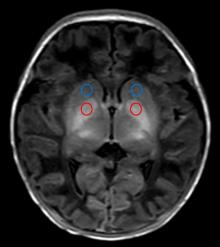
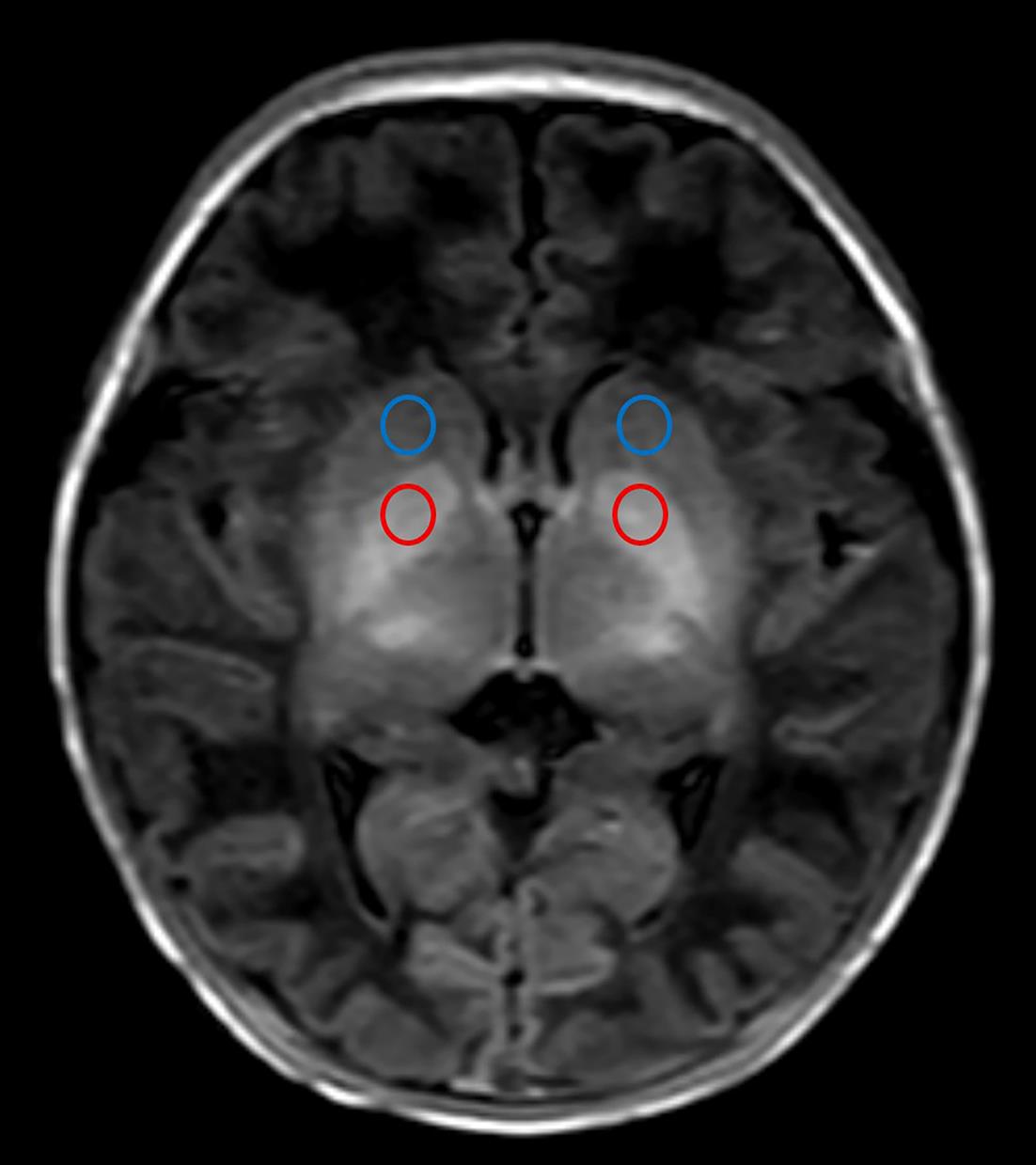
Fig.1
T1WI image of a 7-day-old female patient with ABE"
Tab.1
Baseline analysis of neonatal hyperbilirubinemiain the training set"
| 因素 | ABE (n = 40) | 非ABE (n = 153) | χ2/Z值 | P值 |
|---|---|---|---|---|
| 早产儿 | 3.037 | 0.081 | ||
| 是 | 9(22.5) | 18(11.8) | ||
| 否 | 31(77.5) | 135(88.2) | ||
| ABO溶血 | 4.372 | 0.038 | ||
| 是 | 8(20) | 12(7.8) | ||
| 否 | 32(80) | 141(92.2) | ||
| G-6-PD缺乏 | 16.505 | < 0.001 | ||
| 是 | 19(47.5) | 26(17.0) | ||
| 否 | 21(52.5) | 127(83.0) | ||
| 母亲糖尿病 | 2.923 | 0.087 | ||
| 是 | 1(2.5) | 21(13.7) | ||
| 否 | 39(97.5) | 132(86.3) | ||
| 颅内出血 | 1.998 | 0.158 | ||
| 是 | 3(7.5) | 25(16.3) | ||
| 否 | 37(92.5) | 128(83.7) | ||
| 新生儿感染 | 7.701 | 0.006 | ||
| 是 | 13(32.5) | 21(13.7) | ||
| 否 | 27(67.5) | 132(86.3) | ||
| 新生儿贫血 | 7.480 | 0.006 | ||
| 是 | 14(35.0) | 24(15.7) | ||
| 否 | 26(65.0) | 129(84.3) | ||
| 听觉异常 | 87.674 | < 0.001 | ||
| 是 | 28(70.0) | 8(5.2) | ||
| 否 | 12(30.0) | 145(94.8) | ||
| 脑电图异常 | 14.730 | < 0.001 | ||
| 是 | 27(67.5) | 52(34.0) | ||
| 否 | 13(32.5) | 101(66.0) | ||
| G/P | 1.665 (1.505,1.891) | 1.341 (1.252,1.439) | -7.586 | < 0.001 |
Tab.2
Univariate and multivariate binary logistic regression analysis of neonatal hyperbilirubinemia in the training cohort"
| 因素 | 单因素 | 多因素 | ||
|---|---|---|---|---|
| P值 | OR(95%CI) | P值 | OR(95%CI) | |
| ABO溶血 | 0.030 | 2.94(1.11 ~ 7.78) | 0.884 | 1.24(0.14 ~ 10.64) |
| G-6-PD缺乏 | < 0.001 | 4.42(2.09 ~ 9.36) | 0.002 | 11.99(2.44 ~ 58.95) |
| 新生儿感染 | 0.007 | 3.03(1.35 ~ 6.78) | 0.642 | 0.60(0.07 ~ 5.24) |
| 新生儿贫血 | 0.008 | 2.89(1.32 ~ 6.33) | 0.721 | 0.75(0.16 ~ 3.55) |
| 脑电图异常 | < 0.001 | 4.03(1.92 ~ 8.47) | 0.342 | 1.97(0.49 ~ 8.01) |
| 听觉异常 | < 0.001 | 42.29(15.84 ~ 112.89) | < 0.001 | 63.97(12.45 ~ 328.72) |
| G/P × 100(每0.01个单位) | < 0.001 | 1.10(1.07 ~ 1.13) | < 0.001 | 1.10(1.05 ~ 1.14) |
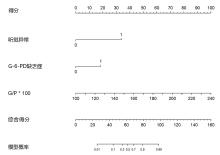
Fig.2
The combined model nomogram for diagnosing ABE"
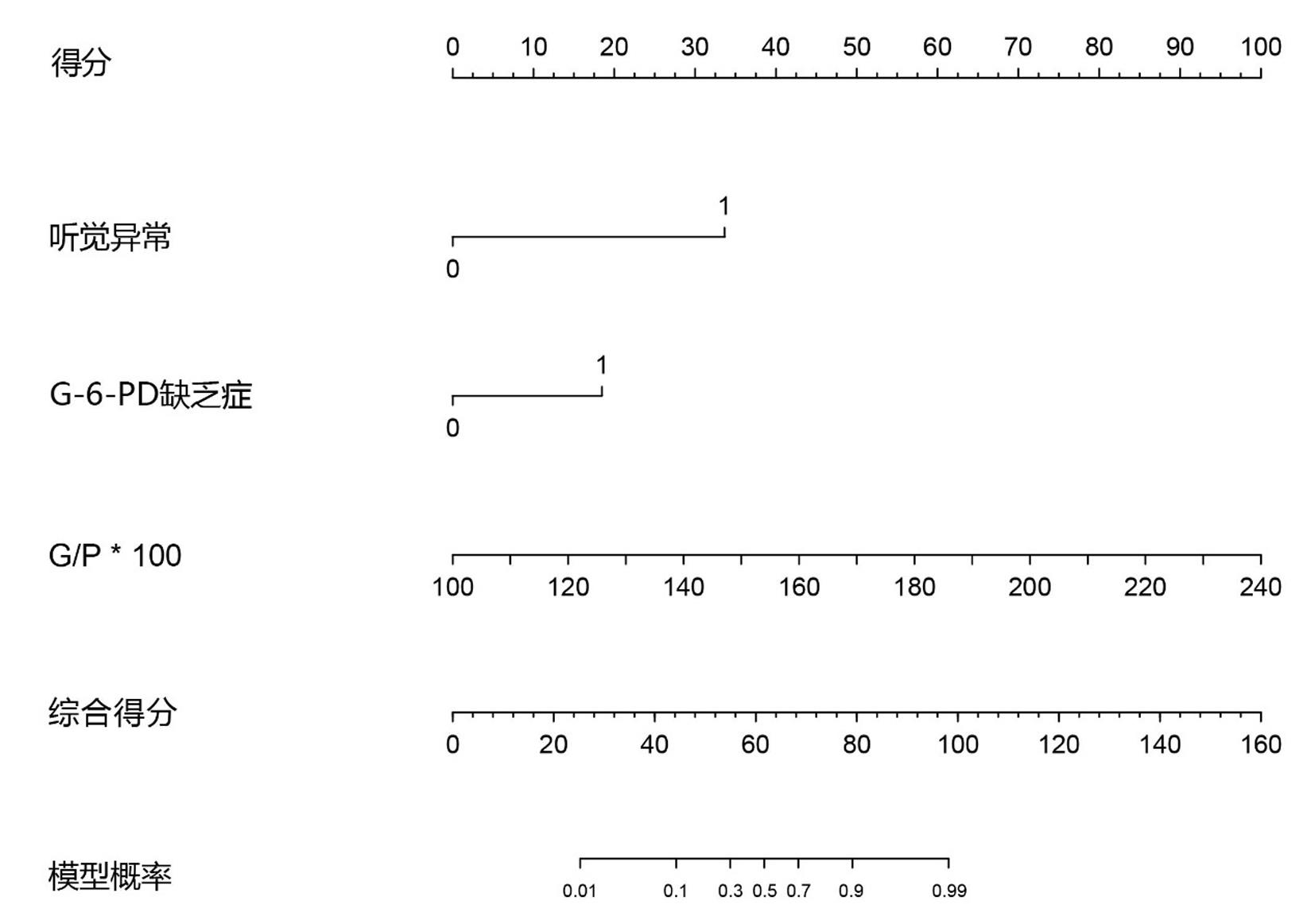
Tab.3
Diagnostic performance of independent factors and the combined model for ABE in the training and validation cohorts"
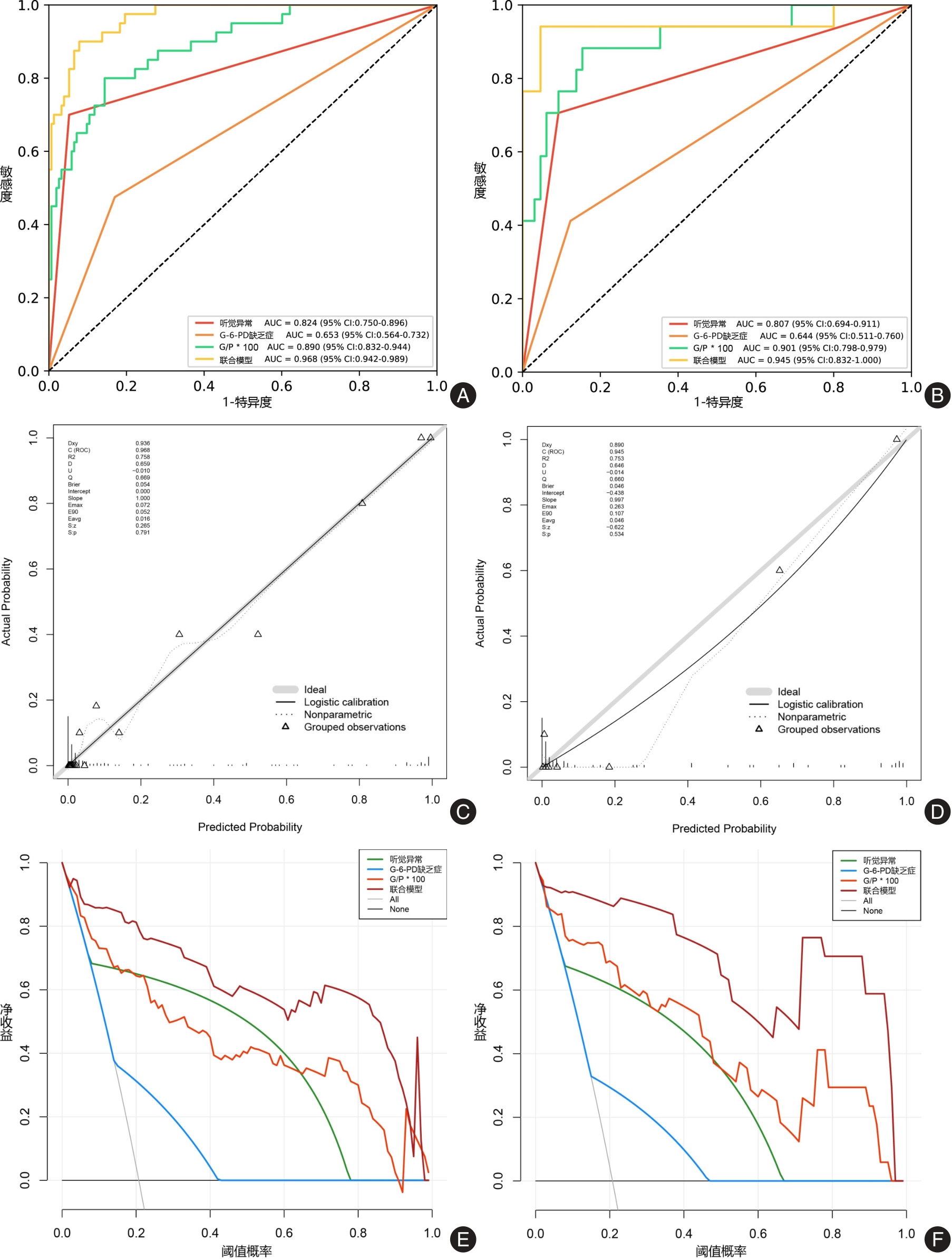
| 数据集 | 因素 | AUC(95%CI) | cut-off值 | P值 | 准确度 | 敏感度 | 特异度 |
|---|---|---|---|---|---|---|---|
| 训练集 | 听觉异常 | 0.824(0.750 ~ 0.896) | < 0.001 | 0.896 | 0.700 | 0.948 | |
| G-6-PD缺乏 | 0.653(0.564 ~ 0.732) | < 0.001 | 0.756 | 0.475 | 0.830 | ||
| G/P × 100 | 0.890(0.832 ~ 0.944) | 150.087 | 0.002 | 0.845 | 0.800 | 0.856 | |
| 联合模型 | 0.968(0.942 ~ 0.989) | 0.917 | 0.900 | 0.922 | |||
| 验证集 | 听觉异常 | 0.807(0.694 ~ 0.911) | 0.019 | 0.866 | 0.706 | 0.908 | |
| G-6-PD缺乏 | 0.644(0.511 ~ 0.760) | < 0.001 | 0.780 | 0.412 | 0.877 | ||
| G/P × 100 | 0.901(0.798 ~ 0.979) | 0.116 | 0.854 | 0.882 | 0.846 | ||
| 联合模型 | 0.945(0.832 ~ 1.000) | 0.915 | 0.941 | 0.908 |
Fig.3
Evaluation of the diagnostic performance and clinical practicability of the combined clinical-imaging model"
| [1] |
JIMENEZ-DIAZ G, AUNE A, ELIZARRARAS-RIVAS J, et al. Neonatal jaundice detection in low-resource Mexican settings: Possibilities and barriers for innovation with mobile health[J]. BMC Health Serv Res, 2024, 24(1): 1-12 doi: 10.1186/s12913-024-11141-6 .
doi: 10.1186/s12913-024-11141-6 |
| [2] |
SOTO CONTI C P. Bilirubin: The toxic mechanisms of an antioxidant molecule[J]. Arch Argent Pediatr, 2021, 119(1): e18-e25. doi: 10.5546/aap.2021.eng.e18 .
doi: 10.5546/aap.2021.eng.e18 |
| [3] |
CHAKRABORTY S, MUKHERJEE J, GHOSAL J. Neurological complications of neonatal hyperbilirubinemia in Eastern India[J]. Annal Med Sci Res, 2025, 4(3): 146-154. doi: 10.4103/amsr.amsr_74_25 .
doi: 10.4103/amsr.amsr_74_25 |
| [4] |
OYINWOLA O I, MUKHTAR-YOLA M, OLUSESI A D, et al. Automated ABR screening for hearing loss and its clinical determinants among newborns with hyperbilirubinemia in National Hospital, Abuja, Nigeria[J]. Niger J Clin Pract, 2023, 26(9): 1249-1256. doi: 10.4103/njcp.njcp_449_22 .
doi: 10.4103/njcp.njcp_449_22 |
| [5] |
杨冬, 崔湘君, 周彬, 等. 振幅整合脑电图联合血清神经丝蛋白H磷酸化亚型、S100β蛋白对新生儿黄疸脑损伤的早期预测价值[J]. 安徽医药, 2026, 30(3): 524-528. doi: 10.3969/j.issn.1009-6469.2026.03.018 .
doi: 10.3969/j.issn.1009-6469.2026.03.018 |
| [6] |
于金红, 苗延巍. 新生儿胆红素脑病早期诊断MRI研究[J]. 放射学实践, 2022, 37(6): 778-781. doi: 10.13609/j.cnki. 1000-0313.2022.06.019 .
doi: 10.13609/j.cnki. 1000-0313.2022.06.019 |
| [7] |
YI M, LOU J, CUI R, et al. Globus pallidus/putamen T(1)WI signal intensity ratio in grading and predicting prognosis of neonatal acute bilirubin encephalopathy[J]. Front Pediatr, 2023, 29:11:1-7. doi: 10.3389/fped.2023.1192126 .
doi: 10.3389/fped.2023.1192126 |
| [8] |
符小玲, 赵兴丹, 王亚洲, 等. 脐血胆红素水平结合高风险因素构建ABO新生儿溶血病发生高胆红素血症风险的预测模型与效能验证[J]. 实用医学杂志, 2023, 39(20): 2658-2663. doi: 10.3969/j.issn.1006-5725.2023.20.018 .
doi: 10.3969/j.issn.1006-5725.2023.20.018 |
| [9] |
中华医学会儿科学分会新生儿学组, 中华儿科杂志编辑委员会. 新生儿高胆红素血症诊治指南(2025)[J]. 中华儿科杂志, 2025, 63(4): 338-350. doi: 10.3760/cma.j.cn112140-20241231-00944 .
doi: 10.3760/cma.j.cn112140-20241231-00944 |
| [10] |
WU M, LIU Q, LAI C. Detecting acute bilirubin encephalopathy in neonates based on multimodal MRI images and non-image clinical data[J]. BMC Pediatr, 2025, 25(1): 1-8. doi: 10.1186/s12887-025-05411-3 .
doi: 10.1186/s12887-025-05411-3 |
| [11] |
DURRANI N U R, DINAN M H. Amplitude-Integrated Electroencephalography: A Primer for Neonatologists and Practitioners in the NICU[J]. Neoreviews, 2022, 23(2): e96-e107. doi: 10. 1542/neo.23-2-e96 .
doi: 10. 1542/neo.23-2-e96 |
| [12] |
LEE H Y, ITHNIN A, AZMA R Z, et al. Glucose-6-Phosphate Dehydrogenase Deficiency and Neonatal Hyperbilirubinemia: Insights on Pathophysiology, Diagnosis, and Gene Variants in Disease Heterogeneity[J]. Front Pediatr, 2022, 10:1-13. doi: 10.3389/fped.2022.875877 .
doi: 10.3389/fped.2022.875877 |
| [13] |
HANSEN T W R, WONG R J, STEVENSON D K. Molecular Physiology and Pathophysiology of Bilirubin Handling by the Blood, Liver, Intestine, and Brain in the Newborn[J]. Physiol Rev, 2020, 100(3): 1291-1346. doi: 10.1152/physrev.00004. 2019 .
doi: 10.1152/physrev.00004. 2019 |
| [14] |
KAPLAN M, KASSIRER Y, HAMMERMAN C. Controversies in our understanding of extreme hyperbilirubinemia in glucose-6-phosphate dehydrogenase-deficient neonates[J]. Pediatr Res, 2025, 97(5): 1507-1515. doi:10.1038/s41390-024-03611-8 .
doi: 10.1038/s41390-024-03611-8 |
| [15] |
XU J X, LIN F, WU Y H, et al. Etiology analysis for term newborns with severe hyperbilirubinemia in eastern Guangdong of China[J]. World J Clin Cases, 2023, 11(11): 2443-2451. doi: 10.12998/wjcc.v11.i11.2443 .
doi: 10.12998/wjcc.v11.i11.2443 |
| [16] |
HABIB S H, HABIB S S. Auditory brainstem response: An overview of neurophysiological implications and clinical applications- A Narrative Review[J]. J Pak Med Assoc, 2021, 71(9): 2230-2236. doi: 10.47391/JPMA.03-432 .
doi: 10.47391/JPMA.03-432 |
| [17] |
蒋秋亚, 谢秋盈, 黄宇, 等. 听性脑干反应与多频稳态反应联合评估婴儿轻度感音神经性听力损失的研究[J]. 实用医学杂志, 2024, 40(16): 2305-2310. doi: 10.3969/j.issn.1006-5725. 2024.16.017 .
doi: 10.3969/j.issn.1006-5725. 2024.16.017 |
| [18] |
TEIXEIRA M H, BORGES V M S, RIESGO R D S, et al. Hyperbilirubinemia impact on newborn hearing: A literature review[J]. Rev Assoc Med Bras (1992), 2020, 66(7): 1002-1008. doi: 10.1590/1806-9282.66.7.1002 .
doi: 10.1590/1806-9282.66.7.1002 |
| [19] |
OKUMURA A, MORIOKA I, ARAI H, et al. Second nationwide survey of bilirubin encephalopathy in preterm infants in Japan[J]. Brain Dev, 2024, 46(1): 2-9. doi: 10.1016/j.braindev. 2023.08.009 .
doi: 10.1016/j.braindev. 2023.08.009 |
| [20] |
ZIDAN L K, ROWISHA M A, NASSAR M A E, et al. Magnetic resonance spectroscopy and auditory brain-stem response audiometry as predictors of bilirubin-induced neurologic dysfunction in full-term jaundiced neonates[J]. Eur J Pediatr, 2024, 183(2): 727-738. doi: 10.1007/s00431-023-05246-z .
doi: 10.1007/s00431-023-05246-z |
| [21] |
HORI S, TAOKA T, OCHI T, et al. Structures Showing Negative Correlations of Signal Intensity with Postnatal Age on T(1)- weighted Imaging of the Brain of Newborns and Infants[J]. Magn Reson Med Sci, 2017, 16(4): 325-331. doi: 10.2463/mrms.mp. 2015-0168 .
doi: 10.2463/mrms.mp. 2015-0168 |
| [22] |
CAYABYAB R, RAMANATHAN R. High unbound bilirubin for age: A neurotoxin with major effects on the developing brain[J]. Pediatr Res, 2019, 85(2): 183-190. doi: 10.1038/s41390-018-0224-4 .
doi: 10.1038/s41390-018-0224-4 |
| [23] |
李文, 任转勤, 田宏哲. MR T1 mapping成像在诊断新生儿高胆红素血症脑损伤中的应用价值[J]. 实用放射学杂志, 2022, 38(5): 818-821. doi: 10.3969/j.issn.1002-1671.2022. 05.029 .
doi: 10.3969/j.issn.1002-1671.2022. 05.029 |
| [24] |
LIU H, ZHANG R, ZHANG M, et al. Diagnostics Value of Quantitative Magnetic Resonance Imaging (MRI) in Neonatal Acute Bilirubin Encephalopathy[J]. J Child Neurol, 2023, 38(3-4): 153-160. doi: 10.1177/08830738231168514 .
doi: 10.1177/08830738231168514 |
| [25] |
张钊, 马永倩, 张捷宇, 等. 头颅磁共振G/P值、GP/CSF值在新生儿急性胆红素脑病早期的预测价值[J]. 临床放射学杂志, 2022, 41(2): 325-329. doi: 10.13437/j.cnki.jcr.2022.02.006 .
doi: 10.13437/j.cnki.jcr.2022.02.006 |
| [26] |
徐衡, 姜新年, 李静, 等. 重度新生儿高胆红素血症并发急性胆红素脑病影响因素及MRI影像特征分析[J]. 临床放射学杂志, 2025, 44(9): 1744-1749. doi: 10.13437/j.cnki.jcr.2025. 09.016 .
doi: 10.13437/j.cnki.jcr.2025. 09.016 |
| [1] | Jing YIN,Pingyang ZHANG,Junli WANG,Weiwei YIN,Xiaoai CHU,Wenyan ZHAO. Developing an ovarian cancer diagnostic model from ultrasound radiomics, O‑RADS classification, and clinical factors [J]. The Journal of Practical Medicine, 2026, 42(7): 1192-1200. |
| [2] | Maoting TANG,Zhen WANG,Xiaoxia PING,Nan JIANG,Qian MENG. The predictive value of combined X-ray and MRI features for early non-traumatic osteonecrosis of the femoral head collapse [J]. The Journal of Practical Medicine, 2026, 42(5): 814-823. |
| [3] | Neng HU,Jianghua SHEN,Mei YAO,Xinqian ZHAO. The assessment value of nomogram prediction model based on lung ultrasound and clinical indicators for children with severe mycoplasma pneumoniae pneumoniae prognosis [J]. The Journal of Practical Medicine, 2026, 42(5): 869-877. |
| [4] | Shouquan CHENG,Naifeng LIU,Ruoshui LI. Analysis of risk factors for aortic valve calcification in patients with coronary artery calcification and construction of a predictive model [J]. The Journal of Practical Medicine, 2026, 42(4): 668-676. |
| [5] | Mengyuan WANG,Fanliang MENG. Analysis of risk factors for carbapenem-resistant Klebsiella pneumoniae infection and construction of a nomogram prediction model [J]. The Journal of Practical Medicine, 2026, 42(3): 477-485. |
| [6] | Yao ZHOU,Qianbin DAI,Wei LONG,Kaixiang HU,Rui WU,Biqi FU. Expression and significance of circular RNA hsa_circ_0001707 in ankylosing spondylitis [J]. The Journal of Practical Medicine, 2026, 42(2): 295-302. |
| [7] | Zhongqi ZHANG,Yajie ZHANG,Ziyi LIANG,Junjie XU,Yang LU,Zhuang SHA,Jun LIANG. Nomogram prediction model for early acute kidney injury in patients with traumatic brain injury based on a coagulation dysfunction score [J]. The Journal of Practical Medicine, 2026, 42(14): 2521-2532. |
| [8] | Junge LOU,Haihong SHI,Li GUO,Xueqi ZHAO,Yuanyuan YAN. Construction and validation of a nomogram model for predicting bone erosion risk based on ultrasound-detected tophi [J]. The Journal of Practical Medicine, 2026, 42(13): 2396-2403. |
| [9] | Zihao PAN,Jiatong LIN,Meiyu JIANG,Xiaoyan OU,Zejian LÜ. Function and clinical significance of circular RNA circGAS5 in plasma of patients with chemoresistant rectal cancer [J]. The Journal of Practical Medicine, 2026, 42(12): 2153-2160. |
| [10] | Shuxin LI,Rongli ZHANG,Xiongfeng QIU,Zhenyun HU,Weiming WU,Huilin JIANG,Min LI,Huai CHEN. Development and validation of a model based on AI and imaging features from non-contrast chest-abdomen CT for diagnosing aortic dissection [J]. The Journal of Practical Medicine, 2026, 42(11): 1906-1914. |
| [11] | Yaxin ZHANG,Peijia LIU,Peng TIAN,Zhibo ZHANG,Wenhai ZHANG,Tiansheng LIU. Risk factors analysis and construction of predictive nomogram for acute cerebral infarction in elderly patients with hip fracture [J]. The Journal of Practical Medicine, 2026, 42(11): 1959-1966. |
| [12] | Kui DONG,jie WU,Jing YAN,Haitao LIU,Jun WANG,Guan′en. QIAO. Study on risk factors of colorectal adenomatous polyps and construction and validation of prediction model [J]. The Journal of Practical Medicine, 2025, 41(6): 838-845. |
| [13] | Runfang WANG,Ya DUAN,Liyan DU,Xiaodan LIU,Wenning LIAN,Yan HUO,Dandan. YANG. Epidemiological status and risk factors associated with placental abruption among pregnant women in Hebei Province [J]. The Journal of Practical Medicine, 2025, 41(6): 904-910. |
| [14] | Dongli LIU,Zilin QUAN,Lingxiu ZHONG,Qiqi CHEN,Wenqiao CAI,Senpei ZHUANG,Ying WEI,Huiyi PAN,Yawen. LIN. Construction and validation of a predictive model for antibiotic-associated diarrhea after surgery in children with congenital heart disease [J]. The Journal of Practical Medicine, 2025, 41(5): 683-690. |
| [15] | Qiaoying MO,Fangyi ZHU,Cunkui ZHU,Shenglong. MA. Nomogram model of malnutrition risk in patients suffering from chronic heart failure grounded on GNRI score [J]. The Journal of Practical Medicine, 2025, 41(5): 691-698. |
| Viewed | ||||||
|
Full text |
|
|||||
|
Abstract |
|
|||||
