

The Journal of Practical Medicine ›› 2026, Vol. 42 ›› Issue (12): 2153-2160.doi: 10.3969/j.issn.1006-5725.2026.12.009
• Oncology: Diagnosis, Treatment and Prevention • Previous Articles
Zihao PAN,Jiatong LIN,Meiyu JIANG,Xiaoyan OU,Zejian LÜ( )
)
Received:2026-03-26
Online:2026-06-25
Published:2026-06-30
Contact:
Zejian Lü
E-mail:lvzejian@gdph.org.cn
Zihao PAN,Jiatong LIN,Meiyu JIANG,Xiaoyan OU,Zejian LÜ. Function and clinical significance of circular RNA circGAS5 in plasma of patients with chemoresistant rectal cancer[J]. The Journal of Practical Medicine, 2026, 42(12): 2153-2160.
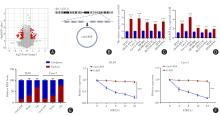
Fig.1
Identify circRNAs associated with chemotherapy resistance in rectal cancer"
Tab.1
Primer sequences for qPCR"
| 目的基因 | 前引物(F) | 后引物(R) |
|---|---|---|
| circGAS5 | AATGACCACAACAAGCAAGCA | ATTCTCATCCTTCCTTGGGGAC |
| GAPDH | TGCACCACCAACTGCTTAGC | GGCATGGACTGTGGTCATGAG |
Tab.2
Clinical characteristics of patients with OXA-sensitivity and OXA-resistance"
| 项目 | 化疗敏感组(n = 108) | 化疗耐药组(n = 44) | χ2/t值 | P值 |
|---|---|---|---|---|
| 性别/例 | 0.12 | 0.725 | ||
| 男 | 50 | 19 | ||
| 女 | 58 | 25 | ||
| 年龄/岁 | 61.50 ± 11.50 | 61.36 ± 10.53 | 0.07 | 0.946 |
| 距离肛门距离/cm | 8.14 ± 3.38 | 7.25 ± 2.72 | 1.55 | 0.122 |
| WBC/(× 109?L-1) | 6.87 ± 1.58 | 7.24 ± 1.43 | -1.33 | 0.183 |
| RBC/(× 1012?L-1) | 3.69 ± 1.05 | 3.83 ± 1.00 | -0.73 | 0.463 |
| CEA/(U/mL) | 3.40 ± 2.01 | 4.02 ± 1.92 | -1.73 | 0.085 |
| CA199/(μg/L) | 41.73 ± 10.64 | 41.83 ± 10.84 | -0.05 | 0.956 |
| T分期/例 | 8.75 | 0.003 | ||
| T3 | 70 | 17 | ||
| T4 | 38 | 27 | ||
| N分期/例 | 6.80 | 0.009 | ||
| N0 | 62 | 15 | ||
| N1—N2 | 46 | 29 | ||
| log2circGAS5/(copies/mL) | 7.06 ± 1.11 | 8.39 ± 0.84 | -7.17 | < 0.001 |
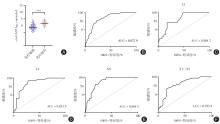
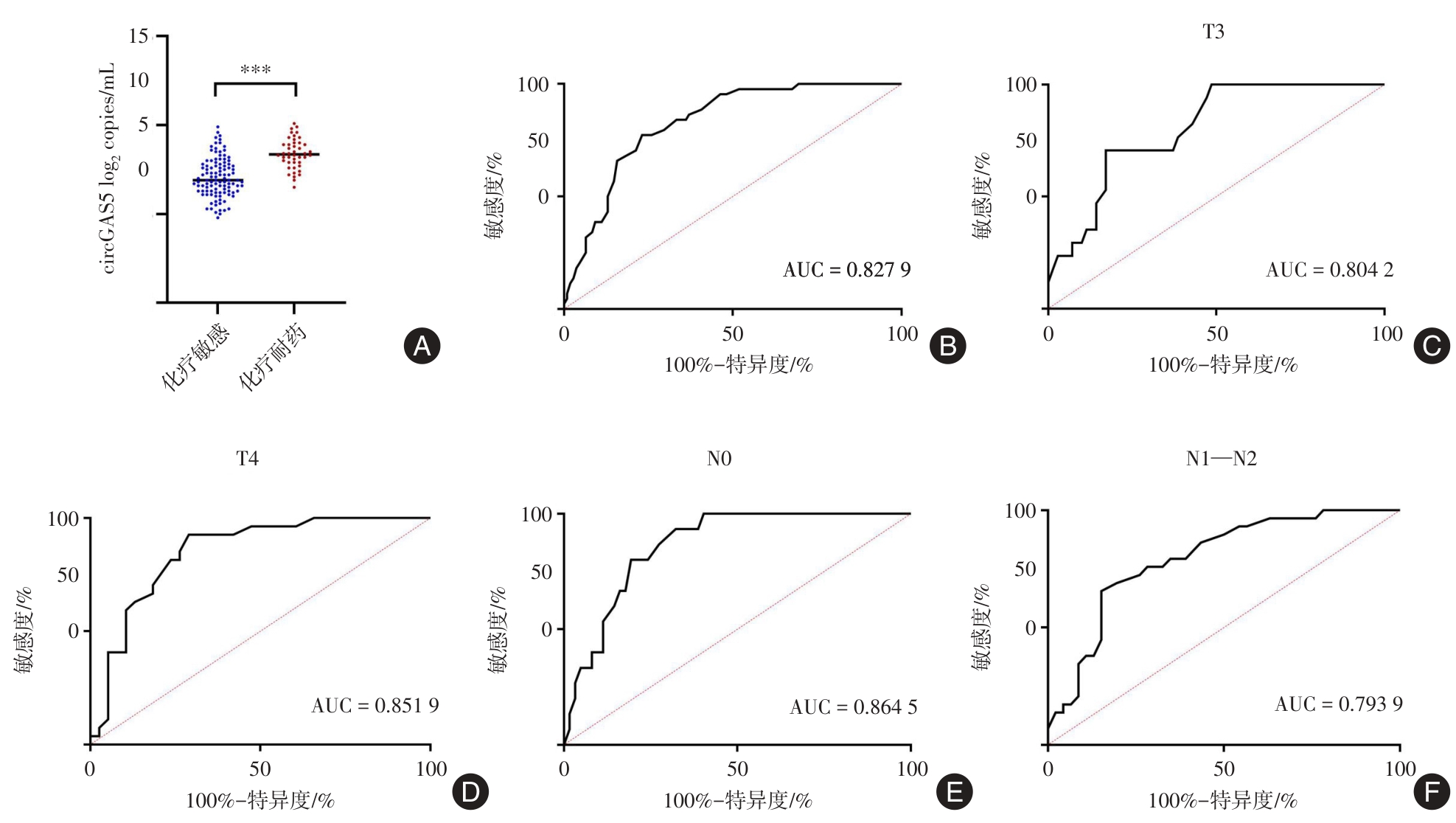
Fig.2
Diagnostic performance analysis of circGAS5 for chemotherapy resistance in rectal cancer"
Tab.3
Univariate and multivariate Cox-regression analysis"
| 项目 | 单因素分析 | 多因素分析 | ||||
|---|---|---|---|---|---|---|
| OR | 95%CI | P值 | OR | 95%CI | P值 | |
| 年龄 | 0.99 | 0.97 ~ 1.03 | 0.946 | |||
| 距离肛门距离 | 0.92 | 0.82 ~ 1.02 | 0.124 | |||
| 性别 | ||||||
| 女 | 1 | |||||
| 男 | 1.34 | 0.56 ~ 2.30 | 0.727 | |||
| T分期 | ||||||
| T3 | 1 | 1 | ||||
| T4 | 2.92 | 1.42 ~ 6.03 | 0.004 | 3.26 | 1.36 ~ 7.81 | 0.008 |
| N分期 | ||||||
| N0 | 1 | |||||
| N1—N2 | 2.61 | 1.25 ~ 5.41 | 0.010 | 2.29 | 0.95 ~ 5.53 | 0.065 |
| log2circGAS5 | 3.41 | 2.19 ~ 5.32 | < 0.001 | 3.41 | 2.15 ~ 5.42 | < 0.001 |
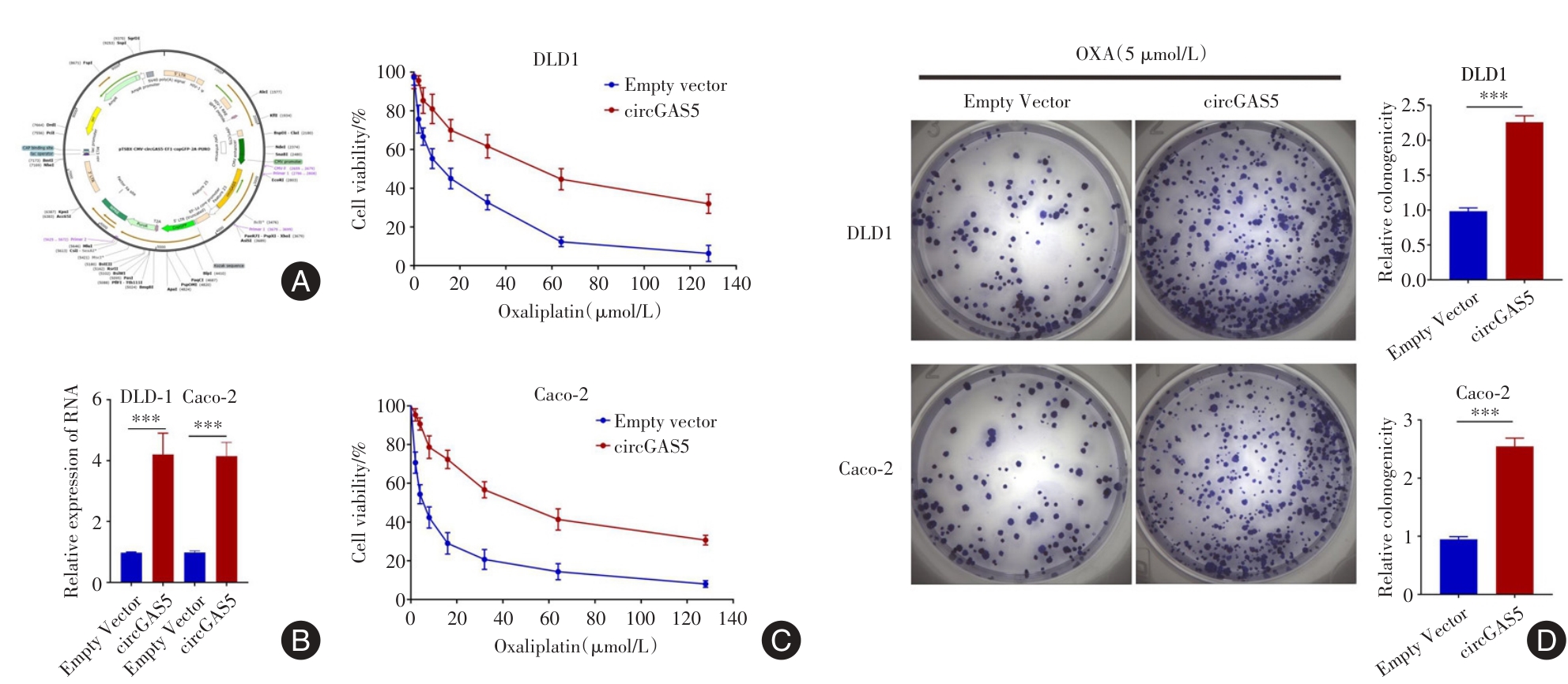
Fig.3
The effect of circGAS5 on the malignant phenotype of chemotherapy resistance in rectal cancer cells"
| [1] |
中华医学会外科学分会结直肠外科学组, 中国研究型医院学会结直肠肛门外科专业委员会, 中华医学会消化内镜学分会超级微创协作组中华医学会外科学分会结直肠外科学组, 等. 直肠癌新辅助治疗达临床完全缓解或近临床完全缓解后局部切除策略专家共识(2026版)[J]. 中华胃肠外科杂志, 2026, 29(3): 258-274. doi: 10.3760/cma.j.cn441530-20260113-00031 .
doi: 10.3760/cma.j.cn441530-20260113-00031 |
| [2] |
SIEGEL R L, WAGLE N S, CERCEK A, et al. Colorectal cancer statistics, 2023[J]. CA A Cancer J Clin, 2023, 73(3): 233-254. doi:10.3322/caac.21772 .
doi: 10.3322/caac.21772 |
| [3] |
结直肠早癌全程管理指南制定工作组,中华医学会外科学分会结直肠外科学组,广东省医院协会结直肠外科专委会. 早期结直肠癌全程管理指南(2025版)[J]. 中华胃肠外科杂志,2025,28(12):1351-1368. doi:10.3760/cma.j.cn441530-20251012-00378
doi: 10.3760/cma.j.cn441530-20251012-00378 |
| [4] |
中国医师协会结直肠肿瘤专委会机器人外科学组. 机器人结直肠癌手术专家共识(2025版)[J]. 中华胃肠外科杂志,2025,28(8):845-864. doi:10.3760/cma.j.cn441530-20250728-00285 .
doi: 10.3760/cma.j.cn441530-20250728-00285 |
| [5] |
XIE Y H, CHEN Y X, FANG J Y. Comprehensive review of targeted therapy for colorectal cancer[J]. Sig Transduct Target Ther, 2020, 5: 22. doi:10.1038/s41392-020-0116-z .
doi: 10.1038/s41392-020-0116-z |
| [6] |
YOSHINO T, ARNOLD D, TANIGUCHI H, et al. Pan-Asian adapted ESMO consensus guidelines for the management of patients with metastatic colorectal cancer: A JSMO–ESMO initiative endorsed by CSCO, KACO, MOS, SSO and TOS[J]. Ann Oncol, 2018, 29(1): 44-70. doi:10.1093/annonc/mdx738 .
doi: 10.1093/annonc/mdx738 |
| [7] |
HU F, SONG D, YAN Y, et al. IL-6 regulates autophagy and chemotherapy resistance by promoting BECN1 phosphorylation[J]. Nat Commun, 2021, 12: 3651. doi:10.1038/s41467-021-23923-1 .
doi: 10.1038/s41467-021-23923-1 |
| [8] |
ABDELMAKSOUD N M, ABULSOUD A I, DOGHISH A S, et al. From resistance to resilience: Uncovering chemotherapeutic resistance mechanisms; insights from established models[J]. Biochim Biophys Acta BBA Rev Cancer, 2023, 1878(6): 188993. doi:10.1016/j.bbcan.2023.188993 .
doi: 10.1016/j.bbcan.2023.188993 |
| [9] |
LIN C, MA M, ZHANG Y, et al. Correction to: The N6-methyladenosine modification of circALG1 promotes the metastasis of colorectal cancer mediated by the miR-342-5p/PGF signalling pathway[J]. Mol Cancer, 2022, 21(1): 101. doi:10.1186/s12943-022-01571-3 .
doi: 10.1186/s12943-022-01571-3 |
| [10] |
BILLER L H, SCHRAG D. Diagnosis and treatment of metastatic colorectal cancer: A review[J]. Jama, 2021, 325(7): 669. doi:10.1001/jama.2021.0106 .
doi: 10.1001/jama.2021.0106 |
| [11] |
KRISTENSEN L S, JAKOBSEN T, HAGER H, et al. The emerging roles of circRNAs in cancer and oncology[J]. Nat Rev Clin Oncol, 2022, 19(3): 188-206. doi:10.1038/s41571-021-00585-y .
doi: 10.1038/s41571-021-00585-y |
| [12] |
XIAO M S, AI Y, WILUSZ J E. Biogenesis and functions of circular RNAs come into focus[J]. Trends Cell Biol, 2020, 30(3): 226-240. doi:10.1016/j.tcb.2019.12.004 .
doi: 10.1016/j.tcb.2019.12.004 |
| [13] |
KRISTENSEN L S, ANDERSEN M S, STAGSTED L V W, et al. The biogenesis, biology and characterization of circular RNAs[J]. Nat Rev Genet, 2019, 20(11): 675-691. doi:10.1038/s41576-019-0158-7 .
doi: 10.1038/s41576-019-0158-7 |
| [14] |
LIN J, ZHONG W, LYU Z, et al. Circular RNA circTATDN3 promotes the Warburg effect and proliferation in colorectal cancer[J]. Cancer Lett, 2024, 589: 216825. doi:10.1016/j.canlet. 2024.216825 .
doi: 10.1016/j.canlet. 2024.216825 |
| [15] |
PAN Z, CAI J, LIN J, et al. A novel protein encoded by circFNDC3B inhibits tumor progression and EMT through regulating Snail in colon cancer[J]. Mol Cancer, 2020, 19(1): 71. doi:10.1186/s12943-020-01179-5 .
doi: 10.1186/s12943-020-01179-5 |
| [16] |
PAN Z, ZHENG J, ZHANG J, et al. A novel protein encoded by exosomal CircATG4B induces oxaliplatin resistance in colorectal cancer by promoting autophagy[J]. Adv Sci, 2022, 9(35): 2204513. doi:10.1002/advs.202204513 .
doi: 10.1002/advs.202204513 |
| [17] |
LIN J, LYU Z, FENG H, et al. CircPDIA3/miR-449a/XBP1 feedback loop curbs pyroptosis by inhibiting palmitoylation of the GSDME-C domain to induce chemoresistance of colorectal cancer[J]. Drug Resist Updat, 2024, 76: 101097. doi:10.1016/j.drup. 2024.101097 .
doi: 10.1016/j.drup. 2024.101097 |
| [18] |
LIU C X, CHEN L L. Circular RNAs: Characterization, cellular roles, and applications[J]. Cell, 2022, 185(13): 2390. doi:10.1016/j.cell.2022.06.001 .
doi: 10.1016/j.cell.2022.06.001 |
| [19] |
ZHOU W Y, CAI Z R, LIU J, et al. Circular RNA: Metabolism, functions and interactions with proteins[J]. Mol Cancer, 2020, 19(1): 172. doi:10.1186/s12943-020-01286-3 .
doi: 10.1186/s12943-020-01286-3 |
| [20] |
张顺皓,耿志欣,孙建,等. 环状RNA在结直肠癌中的研究进展[J]. 临床肿瘤学杂志,2024,29(6):605-611. doi:10.3969/j.issn.1009-0460.2024.06.018
doi: 10.3969/j.issn.1009-0460.2024.06.018 |
| [21] |
周瑶, 戴乾滨, 龙伟, 等. 强直性脊柱炎患者环状RNA hsa_circ_0001707的表达及意义[J]. 实用医学杂志, 2026, 42(2): 295-302. doi:10.3969/j.issn.1006-5725.2026.02.015 .
doi: 10.3969/j.issn.1006-5725.2026.02.015 |
| [22] |
刘杜平, 李国平, 王亮军. 甲胎蛋白、癌胚抗原联合细胞角蛋白19片段在结直肠癌患者中的表达及意义[J]. 医学信息, 2026, 39(4): 18-22. doi:10.3969/j.issn.1006-1959.2026.04.004 .
doi: 10.3969/j.issn.1006-1959.2026.04.004 |
| [23] |
文雅星, 郭忠聪. 结直肠癌化疗耐药的影响因素分析及其风险预测列线图模型构建[J]. 临床合理用药, 2025, 18(9): 27-30. doi:10.15887/j.cnki.13-1389/r.2025.09.007 .
doi: 10.15887/j.cnki.13-1389/r.2025.09.007 |
| [24] |
CERCEK A, DOS SANTOS FERNANDES G, ROXBURGH C S, et al. Mismatch repair-deficient rectal cancer and resistance to neoadjuvant chemotherapy[J]. Clin Cancer Res, 2020, 26(13): 3271-3279. doi:10.1158/1078-0432.ccr-19-3728 .
doi: 10.1158/1078-0432.ccr-19-3728 |
| [25] |
PRETTA A, ZIRANU P, GIAMPIERI R, et al. Mismatch Repair system protein deficiency as a resistance factor for locally advanced rectal adenocarcinoma patients receiving neoadjuvant chemo-radiotherapy[J]. Br J Cancer, 2023, 129(10): 1619-1624. doi:10.1038/s41416-023-02444-2 .
doi: 10.1038/s41416-023-02444-2 |
| [26] |
华梅, 翟晓璐, 唐翀, 等. 结直肠癌患者血清microRNA-497的表达及其诊断与预后价值[J]. 实用医学杂志, 2025, 41(22): 3579-3584. doi:10.3969/j.issn.1006-5725.2025.22.016 .
doi: 10.3969/j.issn.1006-5725.2025.22.016 |
| [1] | Yuan WANG,Zijie CHEN,Jieqing ZHONG,Yujie MO,Xiaoling QIN,Dongxu LIANG,Xiaojing GUO,Shiyi CHEN,Dan LUO. Untargeted metabolomics-based discovery of potential biomarkersfor active pulmonary tuberculosis [J]. The Journal of Practical Medicine, 2026, 42(7): 1149-1157. |
| [2] | Jing YIN,Pingyang ZHANG,Junli WANG,Weiwei YIN,Xiaoai CHU,Wenyan ZHAO. Developing an ovarian cancer diagnostic model from ultrasound radiomics, O‑RADS classification, and clinical factors [J]. The Journal of Practical Medicine, 2026, 42(7): 1192-1200. |
| [3] | Bin YU,Jian ZHOU,Tian TIAN,Fusheng WANG. The efficacy of bevacizumab combined with chemotherapy in the treatment of postoperative patients with oligometastatic colorectal cancer and its impact on mpfs median progression-free survival [J]. The Journal of Practical Medicine, 2026, 42(5): 750-758. |
| [4] | Yongping ZHENG,Cheng PENG,Ximei REN,Maofeng GONG,Yang LIU. Evaluation of the application value of intraoperative spraying dimethicone as needed combined with oral sulphate solution in colonoscopy [J]. The Journal of Practical Medicine, 2026, 42(4): 611-617. |
| [5] | Shu ZHOU,Shuhan YANG,Zengxia WANG,Xuening WANG,Ruihan FENG,Lili PENG,Meiling YANG. The clinical application value of SAVE, APACHEⅡ score combined with circulating biomarkers in predicting the 90 day survival prognosis of patients with AMICS treated with VA-ECMO [J]. The Journal of Practical Medicine, 2026, 42(4): 698-705. |
| [6] | Yu XIA,Min DONG,Jinkui WU,Mengbin LI. Research progress on the regulatory mechanism of MYH9 in intestinal epithelial cells and related diseases [J]. The Journal of Practical Medicine, 2026, 42(4): 706-713. |
| [7] | Wen LI,Haisheng HUANG,Bin HUANG,Li HAN. Expression correlation of PD⁃L1 and Her⁃2 in invasive urothelial carcinoma and their impact on prognosis [J]. The Journal of Practical Medicine, 2026, 42(2): 194-200. |
| [8] | Wei TAO,Shifeng LIANG,Zhinong SHI,Zhen LI,Lunshan WANG. Effects of acupuncture on immune homeostasis and functional recovery in ischemic stroke rehabilitation patients [J]. The Journal of Practical Medicine, 2026, 42(2): 255-265. |
| [9] | Yao ZHOU,Qianbin DAI,Wei LONG,Kaixiang HU,Rui WU,Biqi FU. Expression and significance of circular RNA hsa_circ_0001707 in ankylosing spondylitis [J]. The Journal of Practical Medicine, 2026, 42(2): 295-302. |
| [10] | Shuxin LI,Rongli ZHANG,Xiongfeng QIU,Zhenyun HU,Weiming WU,Huilin JIANG,Min LI,Huai CHEN. Development and validation of a model based on AI and imaging features from non-contrast chest-abdomen CT for diagnosing aortic dissection [J]. The Journal of Practical Medicine, 2026, 42(11): 1906-1914. |
| [11] | Pao YU,Feng ZHU,Zi WANG,Yin ZHANG,Zheng GE,Bi ZHOU. Exploration of the application value of urinary ACE2 and PAX2 in early kidney injury of congenital kidney and urinary tract malformations [J]. The Journal of Practical Medicine, 2026, 42(1): 139-145. |
| [12] | Guoxun HUANG,Dunlu YAO,Le YAO,Fei YI,Xingping JIANG. Comparison of tumor and functional outcome between preserving LCA and high ligation IMA in laparoscopic D3 resection of rectal cancer [J]. The Journal of Practical Medicine, 2026, 42(1): 64-71. |
| [13] | Lu ZHAO,Huiwen ZHI,Yafeng LI. The role of biomarkers in the diagnosis and prediction of disease progression of IgA nephropathy [J]. The Journal of Practical Medicine, 2025, 41(9): 1267-1272. |
| [14] | Na WU,Zetian ZHANG,Rui WANG. The expression and clinical significance of B7⁃H3, PRDX1, and TRX in the serum and tissues of patients with ulcerative colitis and its related colorectal cancer [J]. The Journal of Practical Medicine, 2025, 41(9): 1407-1412. |
| [15] | Likun WANG,Qi HAO,Weihan JIN,Shizheng DONG,Xueliang WU,Xiaofeng HU,Liang WU,Jing XUN,Hongqing MA. Application of multi⁃omics and artificial intelligence in the prediction and diagnosis of liver metastases in colorectal cancer [J]. The Journal of Practical Medicine, 2025, 41(7): 1070-1078. |
| Viewed | ||||||
|
Full text |
|
|||||
|
Abstract |
|
|||||
