

The Journal of Practical Medicine ›› 2026, Vol. 42 ›› Issue (15): 2832-2838.doi: 10.3969/j.issn.1006-5725.2026.15.020
• Treatise:Mechanism and Practice • Previous Articles
Sen LAN( ),Quanrui FENG,Yuanyuan ZHOU,Tingting YANG
Received:2026-04-22
Revised:2026-06-10
Accepted:2026-06-17
Online:2026-08-10
Published:2026-08-13
Contact:
Sen LAN
E-mail:287406095@qq.com
CLC Number:
Sen LAN,Quanrui FENG,Yuanyuan ZHOU,Tingting YANG. Clinical efficacy and prognosis of ventricular intracranial pressure monitoring-assisted stepwise decompression in treatment of severe craniocerebral injury complicated with cerebral hernia[J]. The Journal of Practical Medicine, 2026, 42(15): 2832-2838.
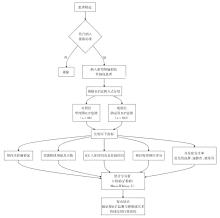
Fig.1
Flow chart of the research"
Tab.1
Comparison of ICP control between the two groups"
| 组别 | 例数 | 术后1 d | 术后3 d | 术后7 d |
|---|---|---|---|---|
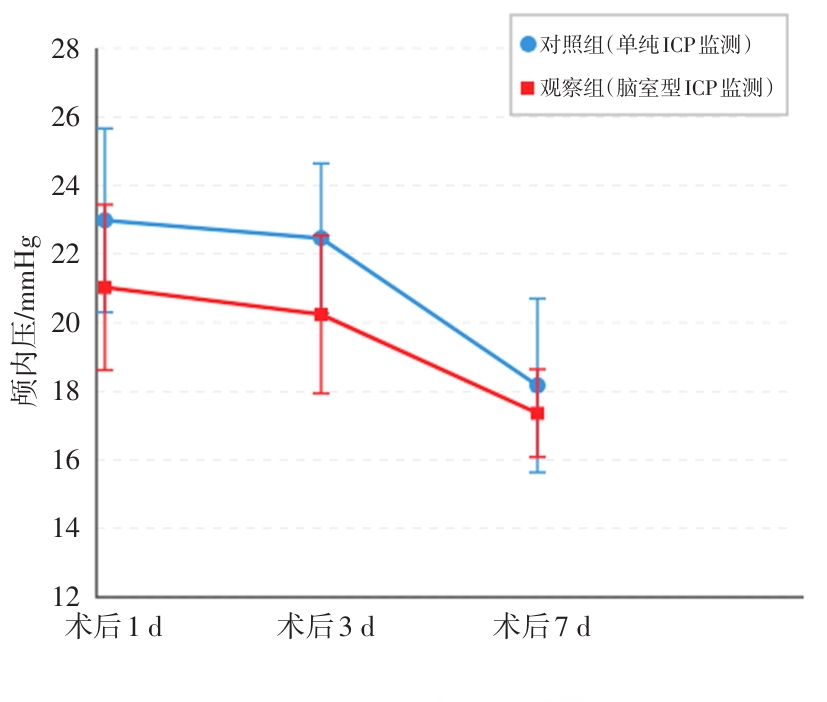
| 对照组 | 98 | 22.98 ± 2.68 | 22.46 ± 2.18 | 18.17 ± 2.53& |
| 观察组 | 102 | 21.03 ± 2.41 | 20.24 ± 2.30* | 17.36 ± 1.28*& |
| t值 | 5.415 | 7.000 | 2.873 | |
| P值 | < 0.001 | < 0.001 | 0.005 | |
| F时间/组间/交互值 | 37.08、7.36、1.00 | |||
| P值 | < 0.001、< 0.001、0.005 | |||
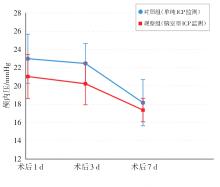
Fig.2
Line chart of ICP control in two groups"
Tab.2
Comparison of mannitol use between the two groups"
| 组别 | 例数 | 甘露醇使用量/g | 甘露醇使用时间/d |
|---|---|---|---|
| 对照组 | 98 | 1 594.76 ± 121.52 | 11.00(9.00,13.00) |
| 观察组 | 102 | 678.59 ± 77.81 | 7.00(4.00,9.00) |
| t/Z值 | 63.749 | -8.732 | |
| P值 | < 0.001 | < 0.001 |
Tab.3
Comparison of hospitalization parameters between the two groups"
| 组别 | 例数 | 术后入住ICU时间 | 总住院时间 |
|---|---|---|---|
| 对照组 | 98 | 18.77 ± 3.59 | 30.52 ± 4.02 |
| 观察组 | 102 | 12.65 ± 3.25 | 17.64 ± 3.79 |
| t/Z值 | 12.648 | 23.322 | |
| P值 | < 0.001 | < 0.001 |
Tab.4
Comparison of prognosis between the two groups"
| 组别 | 例数 | 1分 | 2分 | 3分 | 4分 | 5分 | 预后良好 |
|---|---|---|---|---|---|---|---|
| 对照组 | 98 | 18(18.37) | 22(22.45) | 30(30.61) | 17(17.35) | 11(11.22) | 11(11.22) |
| 观察组 | 102 | 12(11.76) | 14(13.73) | 18(17.65) | 34(33.33) | 24(23.53) | 24(23.53) |
| χ2 值 | 1.709 | 2.577 | 4.606 | 6.724 | 5.242 | 5.242 | |
| P值 | 0.191 | 0.108 | 0.032 | 0.010 | 0.022 | 0.022 |
Tab.5
Comparison of complications between the two groups"
| 组别 | 例数 | 迟发性血肿 | 颅内感染 | 急性恶性脑膨出 | 肾功能不全 | 总发生率 |
|---|---|---|---|---|---|---|
| 对照组 | 98 | 11(11.22) | 7(7.14) | 16(16.33) | 10(10.20) | 44(44.90) |
| 观察组 | 102 | 2(1.96) | 5(4.90) | 7(6.86) | 6(5.88) | 20(19.61) |
| χ2 值 | 7.057 | 0.445 | 4.398 | 1.268 | 14.694 | |
| P值 | 0.008 | 0.505 | 0.036 | 0.260 | < 0.001 |
| [1] |
顾卫国,孙明,姚成洲,等. S-100β蛋白与RPTPγ基因多态性在颅脑损伤预后中的交互作用[J]. 中华急诊医学杂志,2026,35(1):107-113.doi:10.3760/cma.j.cn114656-20250403-00250 .
doi: 10.3760/cma.j.cn114656-20250403-00250 |
| [2] |
IZZY S, CHEN P M, TAHIR Z, et al. Association of Traumatic Brain Injury With the Risk of Developing Chronic Cardiovascular, Endocrine, Neurological, and Psychiatric Disorders[J]. JAMA Netw Open, 2022,5(4):e229478.doi: 10.1001/jamanetworkopen.2022.9478 .
doi: 10.1001/jamanetworkopen.2022.9478 |
| [3] |
LARA-REYNA J, KARABACAK M, WEDDERBURN R, et al. Midbrain volume in brain herniation: A volumetric analysis in operative traumatic brain injury[J]. Surg Neurol Int, 2024,15:437.doi: 10.25259/SNI_389_2024 .
doi: 10.25259/SNI_389_2024 |
| [4] |
HUANG X, YU C, LIAO X, et al. The efficacy of controlled stepped intracranial decompression surgery in patients with craniocerebral injury[J]. Front Neurol, 2025,16:1574036.doi: 10.3389/fneur.2025.1574036 .
doi: 10.3389/fneur.2025.1574036 |
| [5] |
张尚明,胡晓芳,陈宏颉,等. 脑室型颅内压监测在颅脑外伤后脑疝患者梯度减压术中的应用价值分析[J]. 中华神经医学杂志,2021,20(5):488-494.doi:10.3760/cma.j.cn115354-20210112-00024 .
doi: 10.3760/cma.j.cn115354-20210112-00024 |
| [6] |
MARIN-CASTAÑEDA L A, GÓMEZ-VILLARROEL R A, PACHECO AISPURO G, et al. Comparative Efficacy and Safety of External Ventricular Drains and Intraparenchymal Pressure Monitors for Intracranial Pressure Monitoring in Traumatic Brain Injury: A Systematic Review and Meta-analysis[J]. Neurocrit Care, 2025,42(2):374-386.doi:10.1007/ s12028-024- 02136-6 .
doi: 10.1007/ s12028-024- 02136-6 |
| [7] |
WANG C, SUN J, LIU J. Clinical effect of external ventricular drainage under intracranial pressure monitoring in the treatment of aneurysmal subarachnoid hemorrhage patients and investigation of the mechanism of miR-146a-5p/STC1 axis in inhibiting early brain injury in aneurys[J]. Cell Mol Biol (Noisy-le-grand), 2024,70(5):295-302.doi:10.14715/cmb/2024.70.5.44 .
doi: 10.14715/cmb/2024.70.5.44 |
| [8] |
中国医师协会急诊医师分会,解放军急救医学专业委员会,北京急诊医学学会,等. 成人创伤性颅脑损伤院前与急诊诊治中国专家共识[J]. 中华急诊医学杂志,2025,34(5):626-635. doi:10.3760/cma.j.issn.1671-0282.2025.05.004 .
doi: 10.3760/cma.j.issn.1671-0282.2025.05.004 |
| [9] |
SCHUCHT J E, RAKHIT S, SMITH M C, et al. Beyond Glasgow Coma Scale: Prehospital prediction of traumatic brain injury[J]. Surgery, 2025,179:108893.doi: 10.1016/j.surg.2024.07.090 ,
doi: 10.1016/j.surg.2024.07.090 |
| [10] |
WEI A, PENG Q, ZHENG X, et al. Application of Glasgow Outcome Scale score combined with neutrophil-to-lymphocyte ratio in predicting prognosis of aneurysmal subarachnoid hemorrhage[J]. J Stroke Cerebrovasc Dis, 2025,34(11):108451.doi: 10.1016/j.jstrokecerebrovasdis.2025.108451 .
doi: 10.1016/j.jstrokecerebrovasdis.2025.108451 |
| [11] |
MA K, LIU Z, WANG W. Changes of serum NSE, lactate and CRP in patients with postoperative infection after acute craniocerebral injury and their predictive value for prognosis[J]. Biotechnol Genet Eng Rev, 2024,40(2):800-814.doi: 10.1080/02648725.2023.2191067 .
doi: 10.1080/02648725.2023.2191067 |
| [12] |
冷彪,洪德全,谈明,等. 重型颅脑损伤患者血清组织因子途径抑制物-1联合核因子-κB在预后预测中的价值[J]. 实用医学杂志,2025,41(16):2455-2460. doi:10.3969/j.issn.1006-5725.2025.16.003 .
doi: 10.3969/j.issn.1006-5725.2025.16.003 |
| [13] |
ZOERLE T, BEQIRI E, ÅKERLUND C A I, et al. Intracranial pressure monitoring in adult patients with traumatic brain injury: challenges and innovations[J]. Lancet Neurol, 2024,23(9):938-950.doi: 10.1016/S1474-4422(24) 00235-7 .
doi: 10.1016/S1474-4422(24) 00235-7 |
| [14] |
MARTÍNEZ-PALACIOS K, VÁSQUEZ-GARCÍA S, FARIYIKE O A, et al. Using Optic Nerve Sheath Diameter for Intracranial Pressure (ICP) Monitoring in Traumatic Brain Injury: A Scoping Review[J]. Neurocrit Care, 2024,40(3):1193-1212.doi: 10.1007/s12028-023-01884-1 .
doi: 10.1007/s12028-023-01884-1 |
| [15] |
KASTURIARACHI B M, MICHAELS M, SHARMA S. Intracranial Pressure[J]. Crit Care Clin, 2025,41(3):529-539.doi: 10.1016/j.ccc.2025.03.003 .
doi: 10.1016/j.ccc.2025.03.003 |
| [16] |
邓任强,郭智霖,梁定兴,等. 不同类型颅内压监测下梯度减压术在重型颅脑损伤并脑疝患者中的应用对比研究[J]. 临床神经外科杂志,2024,21(6):668-672.doi:10.3969/j.issn.1672-7770.2024.06.013 .
doi: 10.3969/j.issn.1672-7770.2024.06.013 |
| [17] |
VIARASILPA T. Managing Intracranial Pressure Crisis[J]. Curr Neurol Neurosci Rep, 2024,25(1):12.doi: 10.1007/s11910-024-01392-5 .
doi: 10.1007/s11910-024-01392-5 |
| [18] |
CHEN W, CHEN Q, WANG Y, et al. Impact of mannitol on mortality in patients with non-traumatic intracerebral haemorrhage and acute kidney injury: A retrospective study[J]. Sci Rep, 2025,15(1):26612.doi: 10.1038/s41598-025- 11175-8 .
doi: 10.1038/s41598-025- 11175-8 |
| [19] |
YANG X, LIU Z, CHEN X, et al. Renal impairment and prognosis in mannitol-treated intracerebral hemorrhage: A retrospective clinical analysis[J]. J Clin Neurosci, 2025,142:111695.doi: 10.1016/j.jocn.2025.111695 .
doi: 10.1016/j.jocn.2025.111695 |
| [20] |
SOEJIMA A, OGATA M, TAKAKI R, et al. Efficacy of hemodialysis and importance of tonicity monitoring in mannitol-induced acute kidney injury with hyponatremia[J]. CEN Case Rep, 2025,14(5):746-750.doi: 10.1007/s13730-025 -01017-x .
doi: 10.1007/s13730-025 -01017-x |
| [21] |
江基尧,冯军峰,杨小锋,等. 急性颅脑创伤颅内高压处理流程[J]. 中华神经外科杂志,2024,40(12):1192-1194. doi:10.3760/ cma.j.cn112050-20240923-00281 .
doi: 10.3760/ cma.j.cn112050-20240923-00281 |
| [22] |
THONGRONG C, TANGPHIKUNATAM W, KASEMSIRI P, et al. Comparison of utilizing a hypertonic saline solution and mannitol to improve brain relaxation during craniotomy in patients with brain tumours: A prospective randomized controlled trial[J]. Sci Rep, 2025,15(1):30912.doi: 10.1038/s41598-025-15002-y .
doi: 10.1038/s41598-025-15002-y |
| [23] |
申皓宇,黄子芮,梁文佳,等. 颅内压监测在颅脑创伤去骨瓣减压术中的作用[J]. 中华神经外科杂志,2024,40(6):581-585. doi:10.3760 /cma.j.cn 112050- 20231116-00172 .
doi: 10.3760 /cma.j.cn 112050- 20231116-00172 |
| [24] |
冯柏塨,申传安. 外周烧伤导致的大脑病理改变[J]. 中华烧伤与创面修复杂志,2025,41(9):886.doi:10.3760/cma.j.issn. 2097-1109.2025.09.105 .
doi: 10.3760/cma.j.issn. 2097-1109.2025.09.105 |
| [25] |
ÖHMAN J M, MARKLUND N, CEDERBERG D. Evaluation of a Novel Automated Cerebral Ventricular Drainage System for Intracranial Pressure Monitoring and Cerebrospinal Fluid Drainage in Neurocritical Care Patients: A Prospective, Randomized Clinical Study[J]. Neurocrit Care, 2026,23.doi:10.1007/s12028-026-02477-4 .
doi: 10.1007/s12028-026-02477-4 |
| [26] |
WU H, JIANG B, YAN X, et al. Effect of Decompressive Craniectomy with Stepwise Decompression of the Intracranial Compartment on Postoperative Neurologic Function, Hemodynamics, and Glasgow Outcome Scale Score of Patients with Severe Traumatic Brain Injury[J]. J Neurol Surg A Cent Eur Neurosurg, 2023,84(6):536-541.doi: 10.1055/s-0042-1757933 .
doi: 10.1055/s-0042-1757933 |
| [27] |
郦昱琨,尹文俊,安晓婕,等. 呋塞米与甘露醇联用致脑水肿患者急性肾损伤风险因素分析及预测[J]. 中国新药与临床杂志,2022,41(5): 286-290.doi:10.14109/j.cnki.xyylc.2022.05.07 .
doi: 10.14109/j.cnki.xyylc.2022.05.07 |
| Viewed | ||||||
|
Full text |
|
|||||
|
Abstract |
|
|||||
