

The Journal of Practical Medicine ›› 2026, Vol. 42 ›› Issue (7): 1183-1191.doi: 10.3969/j.issn.1006-5725.2026.07.010
• Oncology: Diagnosis, Treatment and Prevention • Previous Articles
Yahong NIE1,Meiyu ZHAO2,Chengyu SHI3,Shan LIU1( )
)
Received:2025-12-23
Revised:2026-01-08
Accepted:2026-01-09
Online:2026-04-10
Published:2026-04-13
Contact:
Shan LIU
E-mail:18561857560@163.com
CLC Number:
Yahong NIE,Meiyu ZHAO,Chengyu SHI,Shan LIU. The relationship between serum miR-145, miR-934, AFP, TK1 levels and clinicopathological characteristics and prognosis in patients with primary liver cancer[J]. The Journal of Practical Medicine, 2026, 42(7): 1183-1191.
Tab.1
Primer sequence"
| 基因名称 | 引物 | 碱基序列 |
|---|---|---|
| miR-145 | 5'-ACACTCCAGCTGGGGTCCAGTTTTCCCAGGA-3' | 31 |
| 5'-CTCAACTGGTGTCGTGGA-3' | 18 | |
| miR-934 | 5'-GCCTAGAAACATCCTGCCGG-3' | 20 |
| 5'-AGGCCATGTGTCGTGGTCG-3' | 19 | |
| U6 | 5'-ATTGCAACCATACACACAACATT-3' | 23 |
| 5'-GCAACGCTTCACGAATTTG-3' | 19 |
Tab.2
Clinical features"
| 临床特征 | 肝癌组(n = 202) | 肝硬化组(n = 205) | 对照组(n = 213) | χ2/F值 | P值 |
|---|---|---|---|---|---|
| 年龄/岁 | 55.08 ± 6.29 | 53.96 ± 6.35 | 53.78 ± 7.01 | 2.359 | 0.095 |
| 性别/[例(%)] | 0.386 | 0.824 | |||
| 男 | 105(51.98) | 111(54.15) | 117(54.93) | ||
| 女 | 97(48.02) | 94(45.85) | 96(45.07) | ||
| BMI/(kg/m2) | 23.07 ± 1.07 | 22.77 ± 1.35 | 22.89 ± 1.49 | 2.667 | 0.070 |
| 肿瘤最大径/[例(%)] | - | - | |||
| ≤ 5 cm | 85(42.08) | - | - | ||
| > 5 cm | 117(57.92) | - | - | ||
| TNM分期/[例(%)] | - | - | |||
| Ⅰ—Ⅱ级 | 174(86.14) | - | - | ||
| Ⅲ级 | 28(13.86) | - | - | ||
| 分化程度/[例(%)] | - | - | |||
| 低分化 | 53(26.24) | - | - | ||
| 中高分化 | 149(73.76) | - | - |
Tab.3
Comparison of serum miR-145, miR-934, AFP and TK1 levels among the liver cancer group, liver cirrhosis group and control group"
| 指标 | 肝癌组(n = 202) | 肝硬化组(n = 205) | 对照组(n = 213) | F值 | P值 |
|---|---|---|---|---|---|
| miR-145 | 0.73 ± 0.16 | 1.21±0.38* | 1.51 ± 0.42*# | 273.800 | < 0.001 |
| miR-934 | 3.01 ± 0.96 | 2.19±0.77* | 1.23 ± 0.36*# | 304.824 | < 0.001 |
| AFP/(ng/mL) | 297.28 ± 63.39 | 84.89 ± 20.54* | 35.86 ± 10.83*# | 2 661.415 | < 0.001 |
| TK1/(pmol/L) | 4.09 ± 1.06 | 2.57±0.72* | 1.77 ± 0.37*# | 490.105 | < 0.001 |
Tab.4
Comparison of serum miR-145, miR-934 levels in patients with primary liver cancer with different clinicopathological characteristics"
| 临床病理特征/指标 | 例数 | miR-145 | t值 | P值 | miR-934 | t值 | P值 |
|---|---|---|---|---|---|---|---|
| 肿瘤最大径 | 1.764 | 0.079 | 1.539 | 0.125 | |||
| ≤ 5 cm | 85 | 0.76 ± 0.25 | 2.93 ± 0.91 | ||||
| > 5 cm | 117 | 0.70 ± 0.23 | 3.14 ± 0.99 | ||||
| TNM分期 | 7.559 | 0.001 | 4.734 | 0.001 | |||
| Ⅰ—Ⅱ级 | 174 | 0.98 ± 0.23 | 2.68 ± 0.74 | ||||
| Ⅲ级 | 28 | 0.63 ± 0.21 | 3.41 ± 0.86 | ||||
| 分化程度 | 9.644 | 0.001 | 1.606 | 0.110 | |||
| 低分化 | 53 | 0.58 ± 0.18 | 3.12 ± 1.00 | ||||
| 中高分化 | 149 | 0.99 ± 0.29 | 2.88 ± 0.91 |
Tab.5
Comparison of serum AFP and TK1 levels in patients with primary liver cancer of different clinical pathological characteristics"
| 临床病理特征/指标 | 例数 | AFP/(ng/mL) | t值 | P值 | TK1/(pmol/L) | t值 | P值 |
|---|---|---|---|---|---|---|---|
| 肿瘤直径 | 0.186 | 0.852 | 0.588 | 0.543 | |||
| ≤ 5 cm | 85 | 296.68 ± 88.38 | 4.02 ± 1.27 | ||||
| > 5 cm | 117 | 299.06 ± 90.48 | 4.12 ± 1.31 | ||||
| TNM分期 | 1.859 | 0.001 | 6.822 | 0.001 | |||
| Ⅰ—Ⅱ级 | 174 | 288.49 ± 82.32 | 3.16 ± 1.05 | ||||
| Ⅲ级 | 28 | 319.86 ± 86.41 | 4.63 ± 1.11 | ||||
| 分化程度 | 4.536 | 0.001 | 3.684 | 0.001 | |||
| 低分化 | 53 | 325.33 ± 102.53 | 4.61 ± 1.32 | ||||
| 中高分化 | 149 | 262.58 ± 80.11 | 3.85 ± 1.20 |
Tab.6
Comparison of serum miR-145, miR-934, AFP and TK1 levels between the poor-outcome group and the good-outcome group"
| 指标 | 预后不良组(n = 56) | 预后良好组(n = 146) | t值 | P值 |
|---|---|---|---|---|
| miR-145 | 0.57 ± 0.18 | 0.77 ± 0.22 | 6.066 | < 0.001 |
| miR-934 | 3.43 ± 0.89 | 2.72 ± 0.89 | 5.075 | < 0.001 |
| AFP/(ng/mL) | 334.17 ± 79.56 | 268.73 ± 77.34 | 5.234 | < 0.001 |
| TK1/(pmol/L) | 4.28 ± 1.06 | 3.39 ± 1.09 | 5.341 | < 0.001 |
Tab.7
The predictive value of combined detection of serum miR-145, miR-934, AFP and TK1 levels for the poor prognosis of patients with primary liver cancer"
| 指标 | 敏感度/% | 特异度/% | AUC | 95%CI | 截断值 | P值 |
|---|---|---|---|---|---|---|
| miR-145 | 76.79 | 65.07 | 0.750a | 0.685 ~ 0.809 | ≤ 0.72 | < 0.001 |
| miR-934 | 76.79 | 63.01 | 0.745a | 0.679 ~ 0.804 | > 3.03 | < 0.001 |
| AFP | 75.00 | 60.96 | 0.715a | 0.647 ~ 0.776 | > 285.03 ng/mL | < 0.001 |
| TK1 | 60.70 | 74.00 | 0.708a | 0.640 ~ 0.770 | > 4.12 pmol/L | < 0.001 |
| 联合 | 83.93 | 86.99 | 0.897 | 0.846 ~ 0.935 | > 13.00 | < 0.001 |
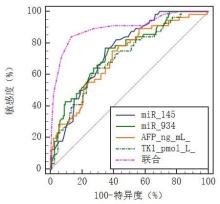
Fig.1
The ROC curve of the predictive value of combined detection of serum miR-145, miR-934, AFP and TK1 levels for poor prognosis in patients with primary liver cancer"
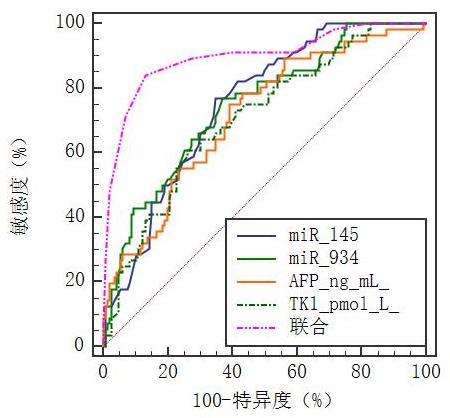
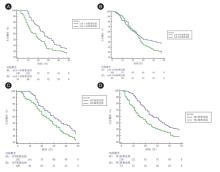
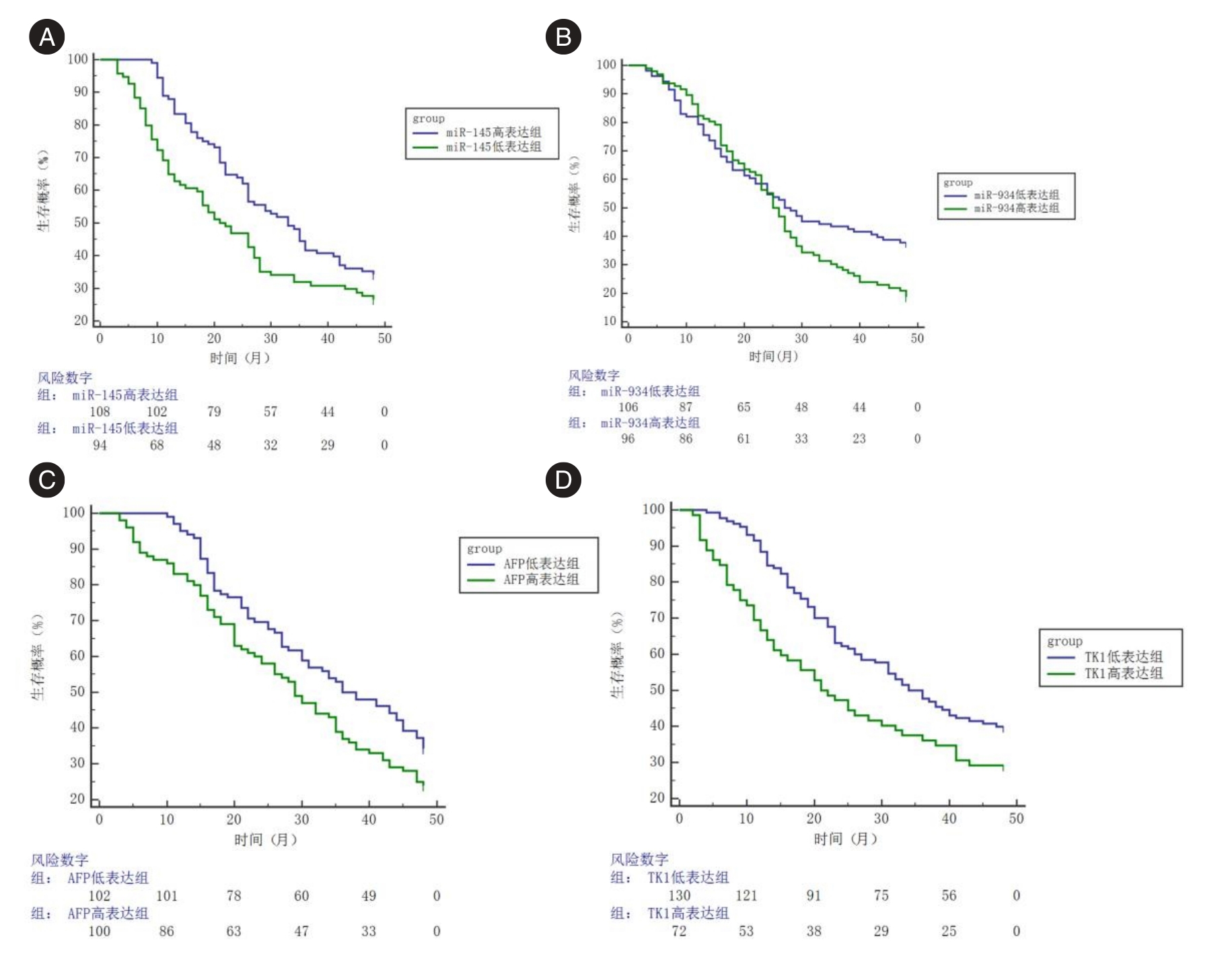
Fig.2
Survival curves of patients with different expression levels of miR-145, miR-934, AFP and TK1"
| [1] |
HONG Z. Research progress of Chinese medicine in the treatment of primary liver cancer[J]. JCTT, 2025, 3(2): 48-51. doi: 10.3736/jcim20050620 .
doi: 10.3736/jcim20050620 |
| [2] |
Li S J, SHEN H, ZHANG S C, et al. Research progress of acupuncture and moxibustion in treatment of primary liver cancer and its related complications[J]. Acupunct Res, 2025, 50(5): 605-612. doi: 10.13702/j.1000-0607.20240053 .
doi: 10.13702/j.1000-0607.20240053 |
| [3] |
ALMOHAMMADI N H. Liver cancer in Saudi Arabia: A registry-based nationwide descriptive epidemiological and survival analysis[J]. Cancer epidemiol, 2025, 94(18): 91-94. doi: 10.1016/j.canep.2024.102731 .
doi: 10.1016/j.canep.2024.102731 |
| [4] |
WASEEM H B, SHAKEEL M, HASSAN F U, et al. In silico Identification and Computational Screening of Potential AFP Inhibitors Against Liver Cancer[J]. Med Chem, 2025, 21(6): 10-12. doi: 10.2174/0115734064330103250106034126 .
doi: 10.2174/0115734064330103250106034126 |
| [5] |
HAYAT A. New Insights on the Roles of miR-21 in Cancer Development and Proliferation[J]. Proc Anticancer Res, 2024, 8(6): 53-66. doi:10.26689/par.v8i6.8160 .
doi: 10.26689/par.v8i6.8160 |
| [6] |
LAI Y, LIU J, HU X, et al. Modifications of The Human Liver Cancer Cells through microRNA-145-Mediated Targeting of CDCA3[J]. Cell Journal, 2023, 25(8): 48-51. doi: 10.22074/cellj.2023.1995666.1251 .
doi: 10.22074/cellj.2023.1995666.1251 |
| [7] |
李明, 王华, 张磊, 等. miR-4262、miR-934与原发性肝癌临床病理特征及其预后的关系[J]. 中华肝脏病杂志, 2023, 31(5): 389-395. doi: 10.14000/j.cnki.issn.1008-1704.2025.08.013 .
doi: 10.14000/j.cnki.issn.1008-1704.2025.08.013 |
| [8] |
张晓华, 李素娟, 侯得山, 等. 血清Smad4、TK1、VEGF对原发性肝癌诊断及预后评估的临床价值分析[J]. 中国肿瘤临床, 2024, 51(18): 945-950. doi: 10.3969/j.issn.1674-1129.2023.04.030 .
doi: 10.3969/j.issn.1674-1129.2023.04.030 |
| [9] |
国家卫生健康委员会医政医管局. 原发性肝癌诊疗规范(2019年版)[J]. 中华肝脏病杂志, 2020, 28(2): 112-128. doi: 10.3760/cma.j.issn.1673-9752.2020.01.001 .
doi: 10.3760/cma.j.issn.1673-9752.2020.01.001 |
| [10] |
中国抗癌协会肝癌专业委员会. 原发性肝癌规范化病理诊断指南(2015年版)[J]. 中华肝胆外科杂志, 2015, 21(3): 145-151. doi: 10.11855/j.issn.0577-7402.2015.11.03 .
doi: 10.11855/j.issn.0577-7402.2015.11.03 |
| [11] |
European Association for the Study of the Liver (EASL). EASL Clinical Practice Guidelines: Management of cirrhosis and its complications[J]. J Hepatol, 2018, 69(2): 406-460. doi: 10.1016/j.jhep.2018.03.024 .
doi: 10.1016/j.jhep.2018.03.024 |
| [12] |
American Joint Committee on Cancer. AJCC Cancer Staging Manual[M]. 8th ed. Cham: Springer Int Publ, 2017 doi: 10.1097/SLA.0000000000003071 .
doi: 10.1097/SLA.0000000000003071 |
| [13] |
ZHAO X, LIU J, CHEN M, et al. Selection and validation of reference genes for serum microRNA detection[J]. J Laborat Med, 2019, 42(3): 215-220. doi: 10.1016/j.plaphy.2011.10.010 .
doi: 10.1016/j.plaphy.2011.10.010 |
| [14] |
JIANG L, ZHAO N, XU J, et al. Incidence trends of primary liver cancer in different geographical regions of China from 1978 to 2012 and projections to 2032: An age‐period‐cohort analysis[J]. J Inter Cancer, 2024, 154(3): 465-476. doi: 10.1002/ijc.34724 .
doi: 10.1002/ijc.34724 |
| [15] |
XIANG Z, HUANG Y, MA J, et al. Temporal trends of incidence, mortality, and survival of liver cancer during 2011–2020 in Fujian Province, Southeast China[J]. Arch Public Health, 2024, 82(1): 1-10. doi: 10.1186/s13690-024-01462-7 .
doi: 10.1186/s13690-024-01462-7 |
| [16] |
GUANGCAI N, GANG C. Risk factors and prognosis of postoperative intraperitoneal seeding in primary liver cancer patients[J]. JPO, 2024, 39(1): 22-24. doi: 10.13267/j.cnki.syzlzz.2024.008 .
doi: 10.13267/j.cnki.syzlzz.2024.008 |
| [17] |
ZHU S, JIN Y, ZHOU M, et al. KK-LC-1, a biomarker for prognosis of immunotherapy for primary liver cancer[J]. BMC Cancer, 2024, 24(1): 36-38. doi: 10.1186/s12885-024-12586-y .
doi: 10.1186/s12885-024-12586-y |
| [18] |
沈未, 鲁迪, 徐骁. 肝癌肝移植适应证的科学演进[J]. 器官移植, 2025, 16(2): 202-207. DOI: 10.12464/j.issn.1674-7445.2025064 .
doi: 10.12464/j.issn.1674-7445.2025064 |
| [19] |
LIU Y, JIANG W, LI X, et al. The Diagnostic Performance of AFP, AFP-L3, DCP, CA199, and Their Combination for Primary Liver Cancer[J]. J Hepatocell Carcinoma, 2025, 12(1): 64-66. doi: 10.2147/JHC.S499966 .
doi: 10.2147/JHC.S499966 |
| [20] |
SHA M, ZHANG J, LIU J K, et al. Inhibiting Pyk2/Src expression by miR-23b-3p suppressed liver cancer stem cell function and hepatic carcinoma progression[J]. Cancer Cell Int, 2025, 25(1): 6-8. doi: 10.1186/s12935-025-03841-8 .
doi: 10.1186/s12935-025-03841-8 |
| [21] |
KORDKATOULI M, SATEEI A, JAFARI A, et al. Exploring the Role of MiR-373 in Colorectal Cancer Development and Progression[J]. Gene Cell Tissue, 2025, 12(2): 90-93. doi:10.5812/gct-159893 .
doi: 10.5812/gct-159893 |
| [22] |
CHU D X, JIN Y, WANG B R, et al. LncRNA HOTAIR Enhances Epithelial-to-mesenchymal Transition to Promote the Migration and Invasion of Liver Cancer by Regulating NUAK1 via Epigenetic Inhibition miR-145-5p Expression[J]. J Cancer, 2023, 14(12): 332-335. doi: 10.7150/jca.85335 .
doi: 10.7150/jca.85335 |
| [23] |
鲁建锋, 蔡莹, 徐佳灵, 等. miR-934、UbcH10、外周血T淋巴细胞亚群在原发性肝癌早期诊断及预后评估中的应用价值[J]. 中西医结合肝病杂志, 2023, 33(11): 976-980. doi: 10.3969/j.issn.1005-0264.2023.011.004 .
doi: 10.3969/j.issn.1005-0264.2023.011.004 |
| [24] |
韩廷超, 王忠, 申梦圆, 等. 载药微球对比碘化油肝动脉化疗栓塞联合局部热消融治疗巨块型肝癌的疗效分析[J]. 介入放射学杂志, 2024, 33(9): 989-994. doi: 10.3969/j.issn.1008-794X.2024.09.012 .
doi: 10.3969/j.issn.1008-794X.2024.09.012 |
| [25] |
燕彩霞, 王达, 魏传霞, 等. 酸味方对原发性肝癌经导管肝动脉化疗栓塞术后血清AFP,CEA,CA-125及CD_(4)^(+)/CD_(8)^(+)水平的影响[J]. 中华中医药学刊, 2024, 42(8): 98-102. doi: 10.13193/j.issn.1673-7717.2024.08.021 .
doi: 10.13193/j.issn.1673-7717.2024.08.021 |
| [26] |
TANG S, LIU H, CHEN P, et al. Analysis on the value of soluble intercellular adhesion molecule-1 (sICAM-1), alpha fetoprotein (AFP), and aspartate aminotransferase/platelet ratio index (APRI) in predicting the prognostic survival of patients with primary liver cancer after radiofrequency ablation[J]. Am J Transl Res, 2024, 15(1): 5004-5010. doi: 10.21037/apm-21-749 .
doi: 10.21037/apm-21-749 |
| [27] |
刘杰, 董浩. miR-4262,miR-934与原发性肝癌临床病理特征及其预后的关系[J]. 肝脏, 2025, 30(8): 1097-1100. doi: 10.3969/j.issn.1008-1704.2025.08.018 .
doi: 10.3969/j.issn.1008-1704.2025.08.018 |
| [28] |
鲁建锋, 蔡莹, 徐佳灵, 等. miR-934,UbcH10,外周血T淋巴细胞亚群在原发性肝癌早期诊断及预后评估中的应用价值[J]. 中西医结合肝病杂志, 2023, 33(11): 976-980. doi: 10.3969/j.issn.1005-0264.2023.011.004 .
doi: 10.3969/j.issn.1005-0264.2023.011.004 |
| [29] |
MARKERS D. The Value of MRI Combined with AFP, AFP-L3, GP73, and DCP in the Diagnosis of Early Primary Liver Cancer[J]. Dis Markers, 2023, 3(22): 620-623. doi: 10.1155/2023/9815623 .
doi: 10.1155/2023/9815623 |
| Viewed | ||||||
|
Full text |
|
|||||
|
Abstract |
|
|||||
