

The Journal of Practical Medicine ›› 2026, Vol. 42 ›› Issue (4): 691-697.doi: 10.3969/j.issn.1006-5725.2026.04.021
• Original Articles • Previous Articles
Jinsong LI,Senxin HUA,Ludan HUANG,Qing SU( )
)
Received:2025-09-04
Online:2026-02-25
Published:2026-02-25
Contact:
Qing SU
E-mail:sqgrace@sina.com
CLC Number:
Jinsong LI,Senxin HUA,Ludan HUANG,Qing SU. Changes in serum levels of NRG-1, CHIT1, Cx43, and MECP2 in patients with acute cerebral infarction and their relationship with severity and prognosis[J]. The Journal of Practical Medicine, 2026, 42(4): 691-697.
Tab.1
Comparison of the case and the control groups of basic data and serum levels of NRG-1, CHIT1, Cx43, and MECP2"
| 指标 | 病例组(n = 355) | 对照组(n = 355) | t/χ2 值 | P值 |
|---|---|---|---|---|
| BMI/(kg/m2) | 23.14 ± 1.35 | 23.08 ± 1.41 | 0.579 | 0.563 |
| 年龄/岁 | 63.49 ± 4.22 | 62.88 ± 5.14 | 1.728 | 0.084 |
| 性别/[例(%)] | 0.051 | 0.882 | ||
| 男 | 182(51.27) | 179(50.42) | ||
| 女 | 173(48.73) | 176(49.58) | ||
| 饮酒史/[例(%)] | 113(31.83) | 97(27.32) | 1.731 | 0.188 |
| 吸烟史/[例(%)] | 125(35.21) | 108(30.42) | 1.846 | 0.174 |
| NRG-1/(pg/mL) | 227.86 ± 37.53 | 291.33 ± 44.29 | 20.600 | < 0.001 |
| CHIT1/(μg/L) | 57.89 ± 6.89 | 24.63 ± 3.44 | 81.374 | < 0.001 |
| Cx43/(pg/mL) | 93.41 ± 16.54 | 46.88 ± 10.22 | 45.091 | < 0.001 |
| MECP2/(pg/mL) | 561.27 ± 88.65 | 406.72 ± 74.31 | 25.173 | < 0.001 |
Tab.2
Comparison of the patients with ACI with different severity of serum levels of NRG-1, CHIT1, Cx43, and MECP2"
| 指标 | 轻度组(n = 180) | 中度组(n = 126) | 重度组(n = 49) | F值 | P值 |
|---|---|---|---|---|---|
| NRG-1/(pg/mL) | 243.38 ± 32.49 | 224.56 ± 25.79* | 179.34 ± 22.57*# | 95.010 | < 0.001 |
| CHIT1/(μg/L) | 53.92 ± 4.13 | 57.21 ± 5.58* | 74.22 ± 8.83*# | 262.854 | < 0.001 |
| Cx43/(pg/mL) | 85.50 ± 13.41 | 95.22 ± 14.21* | 117.83 ± 22.47*# | 88.136 | < 0.001 |
| MECP2/(pg/mL) | 526.14 ± 57.22 | 552.67 ± 92.31* | 712.45 ± 109.43*# | 106.847 | < 0.001 |
Tab.3
Comparison of basic data and serum levels of NRG-1, CHIT1, Cx43, and MECP2 in patientswith ACI with different prognosis"
| 指标 | 预后不良组(n = 81) | 预后良好组(n = 274) | t/χ2 值 | P值 |
|---|---|---|---|---|
| BMI(x ± s)/(kg/m2) | 23.27 ± 1.42 | 23.10 ± 1.45 | 0.931 | 0.352 |
| 年龄(x ± s)/岁 | 64.11 ± 3.97 | 63.31 ± 4.16 | 1.536 | 0.125 |
| 性别 | 0.392 | 0.531 | ||
| 男 | 44(54.32) | 138(50.36) | ||
| 女 | 37(45.68) | 136(49.64) | ||
| 入院时NIHSS评分 | 8.221 | 0.004 | ||
| < 15分 | 62(76.54) | 244(89.05) | ||
| ≥ 15分 | 19(23.46) | 30(10.95) | ||
| 梗死位置 | 0.849 | 0.457 | ||
| 后循环 | 32(39.51) | 93(33.94) | ||
| 前循环 | 49(60.49) | 181(66.06) | ||
| 梗死面积 | 12.325 | <0.001 | ||
| 大面积梗死 | 40(49.38) | 78(28.47) | ||
| 小面积及腔隙性梗死 | 41(50.62) | 196(71.53) | ||
| 发病至溶栓时间 | 13.920 | < 0.001 | ||
| < 3 h | 53(65.43) | 231(84.31) | ||
| 3 ~ 4.5 h | 28(34.57) | 43(15.69) | ||
| 溶栓后出血 | 12(14.81) | 23(8.39) | 2.900 | 0.089 |
| 合并糖尿病 | 19(23.46) | 56(20.44) | 0.342 | 0.559 |
| 合并高脂血症 | 35(43.21) | 101(36.86) | 1.066 | 0.302 |
| 合并高血压 | 32(39.51) | 98(35.77) | 0.377 | 0.539 |
| 饮酒史 | 29(35.80) | 84(30.66) | 0.763 | 0.382 |
| 吸烟史 | 32(39.51) | 93(33.94) | 0.849 | 0.357 |
| NRG-1(x ± s)/(pg/mL) | 181.34 ± 40.57 | 241.61 ± 67.88 | 7.595 | < 0.001 |
| CHIT1(x ± s)/(μg/L) | 69.43 ± 13.15 | 54.48 ± 10.93 | 10.305 | < 0.001 |
| Cx43(x ± s)/(pg/mL) | 115.89 ± 31.25 | 86.76 ± 19.54 | 10.134 | < 0.001 |
| MECP2(x ± s)/(pg/mL) | 689.23 ± 133.55 | 523.44 ± 101.22 | 11.984 | < 0.001 |
Tab.4
Multivariate logistic regression analysis of poor prognosis in patients with ACI"
| 因素 | β | SE | Wald χ2 | P值 | OR | 95%CI |
|---|---|---|---|---|---|---|
| 入院时NIHSS评分≥ 15分 | 0.672 | 0.379 | 3.144 | 0.076 | 1.958 | 0.932 ~ 4.116 |
| 大面积梗死 | 0.544 | 0.297 | 3.355 | 0.067 | 1.723 | 0.963 ~ 3.084 |
| 发病至溶栓时间为3 ~ 4.5 h | 0.712 | 0.381 | 3.492 | 0.062 | 2.038 | 0.966 ~ 4.301 |
| NRG-1 | -0.594 | 0.188 | 9.983 | 0.002 | 0.552 | 0.382 ~ 0.798 |
| CHIT1 | 0.813 | 0.269 | 9.134 | 0.003 | 2.255 | 1.331 ~ 3.820 |
| Cx43 | 0.614 | 0.226 | 7.381 | 0.007 | 1.848 | 1.187 ~ 2.878 |
| MECP2 | 0.688 | 0.214 | 10.336 | 0.001 | 1.990 | 1.308 ~ 3.027 |
Tab.5
Predictive value of serum NRG-1, CHIT1, Cx43 and MECP2 for poor prognosis in patients with ACI"
| 指标 | 截断值 | AUC | 95%CI | P值 | 敏感度/% | 特异度/% |
|---|---|---|---|---|---|---|
| NRG-1 | 218.51 pg/mL | 0.796* | 0.750 ~ 0.836 | < 0.001 | 67.88 | 82.72 |
| CHIT1 | 59.17 μg/L | 0.801* | 0.756 ~ 0.841 | < 0.001 | 75.31 | 70.80 |
| Cx43 | 102.45 pg/mL | 0.791* | 0.745 ~ 0.832 | < 0.001 | 67.90 | 82.85 |
| MECP2 | 643.53 pg/mL | 0.805* | 0.760 ~ 0.845 | < 0.001 | 62.92 | 91.24 |
| 联合检测 | 0.931 | 0.899 ~ 0.955 | < 0.001 | 85.19 | 87.96 |
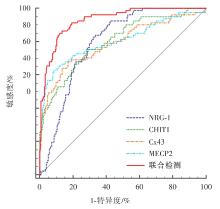
Fig.1
ROC curve of serum NRG-1, CHIT1, Cx43 and MECP2 in predicting poor prognosis of patients with ACI"
| [1] |
HUANG H, XIE W, HU F, et al. Acute bilateral multiple subcortical infarcts as manifestation in cerebral autosomal dominant arteriopathy with subcortical infarcts and leukoencephalopathy[J]. Neurol Sci, 2023, 44(12): 4391-4399. doi:10.1007/s10072-023-06949-9 .
doi: 10.1007/s10072-023-06949-9 |
| [2] |
沈丽萍,杨江胜,刘东柏,等. 高迁移率族蛋白B1水平与急性脑梗死病情严重程度及预后的关联研究[J]. 中华神经医学杂志,2019,18(11):1131-1135. doi:10.3760/cma.j.issn.1671-8925.2019.11.009 .
doi: 10.3760/cma.j.issn.1671-8925.2019.11.009 |
| [3] | 陈文浩. Htr2b通过Nrg-1/ErbB通路促进脊髓损伤中小胶质细胞M1极化及神经炎症[D]. 济南: 山东大学, 2024. |
| [4] | 袁诗韵. CHIT1通过调节小胶质细胞极性和功能影响阿尔茨海默病发生发展的机制研究[D]. 重庆: 重庆医科大学, 2022. |
| [5] |
CHEN W, WU Z, YIN M, et al. Blockage of p38mapk in astrocytes alleviates brain damage in a mouse model of embolic stroke through the cx43/aqp4 axis[J]. J Stroke Cerebrovasc Dis, 2024, 33(12): 108085. doi:10.1016/j.jstrokecerebrovasdis. 2024. 108085 .
doi: 10.1016/j.jstrokecerebrovasdis. 2024. 108085 |
| [6] |
LI H, SHANG J, ZHANG C, et al. Repetitive transcranial magnetic stimulation alleviates neurological deficits after cerebral ischemia through interaction between rack1 and bdnf exon iv by the phosphorylation-dependent factor mecp2[J]. Neurotherapeutics, 2020, 17(2): 651-663. doi:10.1007/s13311-019-00771-y .
doi: 10.1007/s13311-019-00771-y |
| [7] |
ZHU X, SUN X, CHAI Q, et al. Dysregulation of serum uca1 and its clinical significance in patients with acute cerebral infarction[J]. Ann Clin Lab Sci, 2023, 53(5): 719-725. doi:10.1159/000523902
doi: 10.1159/000523902 |
| [8] |
DU W, FAN L, DU J. Neuroinflammation-associated mir-106a-5p serves as a biomarker for the diagnosis and prognosis of acute cerebral infarction[J]. BMC Neurol, 2023, 23(1): 248. doi:10.1186/s12883-023-03241-3 .
doi: 10.1186/s12883-023-03241-3 |
| [9] |
中华医学会神经病学分会, 中华医学会神经病学分会脑血管病学组. 中国急性缺血性脑卒中诊治指南2018[J]. 中华神经科杂志, 2018, 51(9): 666-682. doi:10.3760/cma.j.issn.1006-7876.2018.09.004 .
doi: 10.3760/cma.j.issn.1006-7876.2018.09.004 |
| [10] |
张文, 吕槐琴, 黄巧云, 等. 基于宽体探测器CT灌注成像评估的侧支循环与急性脑梗死体积及预后的关系[J]. 中国医学影像学杂志, 2023, 31(7): 689-694, 700. doi:10.3969/j.issn. 1005-5185.2023.07.003 .
doi: 10.3969/j.issn. 1005-5185.2023.07.003 |
| [11] | 臧爽. 多维疲劳量表的汉化及在老年缺血性卒中患者中的初步应用研究[D]. 沈阳: 中国医科大学, 2023. |
| [12] |
WEI Y, ZHANG Q, NIU J, et al. Enlarged perivascular spaces predict malignant cerebral edema after acute large hemispheric infarction[J]. Cerebrovasc Dis Extra, 2024, 14(1): 30-38. doi:10.1159/000536592 .
doi: 10.1159/000536592 |
| [13] |
LIU L L, LIU P N, LI X A, et al. Ultra-early electroacupuncture rehabilitation for intravenous thrombolysis-induced cerebral infarction[J]. Eur Rev Med Pharmacol Sci, 2023, 27(21): 10419-10426. doi:10.26355/eurrev_202311_34316 .
doi: 10.26355/eurrev_202311_34316 |
| [14] |
LIN G, LIU F, XU H, et al. Development of a model to predict the risk of cerebral infarction in acute vestibular syndrome[J]. Heliyon, 2023, 9(4): 14852. doi:10.1016/j.heliyon.2023.e14852 .
doi: 10.1016/j.heliyon.2023.e14852 |
| [15] |
马铭, 王艳, 赵明月, 等. NRG-1/ErbB信号通路对周围神经肌肉系统的调控作用[J]. 中华神经医学杂志, 2025, 24(2): 207-212. doi:10.3760/cma.j.cn115354-20241015-00632 .
doi: 10.3760/cma.j.cn115354-20241015-00632 |
| [16] |
张成十, 王东霞, 姜紫誉, 等. 老年急性脑梗死患者脂蛋白-α、CHIT1、HMGB1、TLR4水平变化及意义[J]. 中国老年学杂志, 2025, 45(3): 536-539. doi:10.3969/j.issn.1005-9202. 2025. 03.007 .
doi: 10.3969/j.issn.1005-9202. 2025. 03.007 |
| [17] |
彭林辉, 李丹, 胡志强, 等. 连接蛋白43半通道介导NLRP3炎症小体激活在脑缺血中的作用[J]. 实用医学杂志, 2024, 40(10): 1450-1454. doi:10.3969/j.issn.1006-5725.2024.10.021 .
doi: 10.3969/j.issn.1006-5725.2024.10.021 |
| [18] | 黄冠又, 张欣, 苏恒, 等. MeCP2对胶质瘤U87细胞增殖和侵袭的影响[J]. 中国老年学杂志, 2025, 45(13): 3249-3252. |
| [19] |
GUO W P, WANG J, LI R X, et al. The neuroprotective effects of neuregulin-1 in neurological Diseases[J]. Neuroimmunomodulation, 2022, 29(3): 205-215. doi:10.1159/000525240 .
doi: 10.1159/000525240 |
| [20] |
BELIËN J, SWINNEN S, D'HONDT R, et al. Chit1 at diagnosis predicts faster disability progression and reflects early microglial activation in multiple sclerosis[J]. Nat Commun, 2024, 15(1): 5013. doi:10.1038/s41467-024-49312-y .
doi: 10.1038/s41467-024-49312-y |
| [21] |
WANG Y, LI W, JIE W, et al. Reactive astrocytic connexin43 hemichannels modulate hippocampal neuronal survival after traumatic brain injury in mice[J]. CNS Neurosci Ther, 2022, 28(2): 242-254. doi: 10.1111/cns.13765 .
doi: 10.1111/cns.13765 |
| [22] |
CHEN F, WANG L, WANG Y, et al. Inhibition of astrocyte hemichannels ameliorates neuroinflammation and neuronal damage in experimental ischemic stroke[J]. J Neuroinflammation, 2022, 19(1): 262. doi: 10.1186/s12974-022-02630-8 .
doi: 10.1186/s12974-022-02630-8 |
| [23] |
CHEN L, WANG F, ZHANG D. MeCP2 promotes neuronal apoptosis in a model of ischemic stroke by suppressing the Bcl-2 promoter[J]. Neurochem Res, 2022, 47(5): 1353-1363. doi: 10.1007/s11064-022-03535-x .
doi: 10.1007/s11064-022-03535-x |
| [24] |
XU J, LI H, WANG F, et al. MeCP2 mediates neuroinflammation in experimental ischemic stroke through upregulation of TLR4 expression[J]. J Neuroinflammation, 2023, 20(1): 115. doi: 10.1186/s12974-023-02803-z .
doi: 10.1186/s12974-023-02803-z |
| [25] |
LI X, XU C, SHANG C, et al. Machine learning predicts the risk of hemorrhagic transformation of acute cerebral infarction and in-hospital death[J]. Comput Methods Programs Biomed, 2023, 237(1): 107582. doi: 10.1016/j.cmpb.2023.107582 .
doi: 10.1016/j.cmpb.2023.107582 |
| [26] |
YANG C, HU R, XIONG S, et al. Development of machine learning-based models for predicting risk factors in acute cerebral infarction patients: A clinical retrospective study[J]. BMC Neurol, 2024, 24(1): 306-306. doi: 10.1186/s12883-024-03818-6 .
doi: 10.1186/s12883-024-03818-6 |
| Viewed | ||||||
|
Full text |
|
|||||
|
Abstract |
|
|||||
