

The Journal of Practical Medicine ›› 2026, Vol. 42 ›› Issue (8): 1428-1434.doi: 10.3969/j.issn.1006-5725.2026.08.017
• Treatise: Clinical Practice • Previous Articles
Li XIANG,Yijuan JIA,Ping WANG,Yanqin LOU,Donghua WANG( )
)
Received:2026-01-09
Online:2026-04-25
Published:2026-04-28
Contact:
Donghua WANG
E-mail:huahua434569@126.com
CLC Number:
Li XIANG,Yijuan JIA,Ping WANG,Yanqin LOU,Donghua WANG. The predictive value of sCD276,YKL-40,miR-152-5p and miR-193a-5p in the prognosis of patients with high-grade serous ovarian cancer[J]. The Journal of Practical Medicine, 2026, 42(8): 1428-1434.
Tab.1
Primer sequence"
| 引物 | 引物序列(5’→3’) |
|---|---|
| U6 | 正向引物:GCTTCGGCAGCACATATACTAAAAT |
| 反向引物:CGCTTCACGAATTTGCGTGTCAT | |
| miR-193a-5p | 正向引物:AACTGGCTTCAAGTCCCGCT |
| 反向引物:GTGCAGGGTCCGAGGT | |
| miR-152-5p | 正向引物:TCAGTGCATGACAGAACTTGG |
| 反向引物:AGTAGGCTGCTAGCGCTGC |
Tab.2
Comparison of clinical data and levels of serum sCD276, YKL-40, miR-152-5p and miR-193a-5p between poor prognosis group and good prognosis group"
| 指标 | 预后不良组(n = 71) | 预后良好组(n = 165) | t/χ2 值 | P值 |
|---|---|---|---|---|
| BMI( | 22.59 ± 1.22 | 22.67 ± 1.15 | 0.481 | 0.631 |
| 年龄( | 58.45 ± 6.22 | 58.85 ± 6.17 | 0.456 | 0.649 |
| 饮酒史 | 13(18.31) | 25(15.15) | 0.367 | 0.545 |
| 吸烟史 | 16(22.54) | 27(16.36) | 1.269 | 0.260 |
| 肿瘤分化程度 | 1.294 | 0.255 | ||
| 中高分化 | 33(46.48) | 90(54.55) | ||
| 低分化 | 38(53.52) | 75(45.45) | ||
| 临床分期 | 0.877 | 0.349 | ||
| Ⅲ期 | 31(43.66) | 83(50.30) | ||
| Ⅳ期 | 40(56.34) | 82(49.70) | ||
| 肿瘤最大径 | 1.164 | 0.281 | ||
| <5 cm | 32(45.07) | 87(52.73) | ||
| ≥5 cm | 39(54.93) | 78(47.27) | ||
| 新辅助化疗 | 48(67.61) | 125(75.76) | 1.686 | 0.194 |
| 腹水 | 45(63.38) | 63(38.18) | 12.699 | < 0.001 |
| 淋巴结转移 | 51(71.83) | 82(49.70) | 9.887 | 0.002 |
| 术后残余病灶 | 47(66.20) | 78(47.27) | 7.136 | 0.008 |
| BRCA状态 | 1.704 | 0.192 | ||
| 野生型 | 30(42.25) | 85(51.52) | ||
| 突变型 | 41(57.75) | 80(48.48) | ||
| 接受PARPi维持治疗 | 28(39.44) | 75(45.45) | 0.731 | 0.393 |
| sCD276( | 441.45 ± 65.42 | 383.26 ± 41.79 | 8.193 | < 0.001 |
| YKL-40( | 131.47 ± 25.84 | 106.78 ± 20.32 | 7.865 | < 0.001 |
| miR-152-5p( | 0.69 ± 0.22 | 0.97 ± 0.31 | 6.896 | < 0.001 |
| miR-193a-5p( | 0.41 ± 0.13 | 0.62 ± 0.20 | 8.134 | < 0.001 |
Tab.3
Independent variable assignment"
| 自变量 | 赋值 |
|---|---|
| 腹水 | 无=0,有=1 |
| 淋巴结转移 | 无=0,有=1 |
| 术后残余病灶 | 无=0,有=1 |
| sCD276 | 连续变量,原值输入 |
| YKL-40 | 连续变量,原值输入 |
| miR-152-5p | 连续变量,原值输入 |
| miR-193a-5p | 连续变量,原值输入 |
Tab.4
Multivariate logistic regression analysis of poor prognosis in patients with HGSOC"
| 因素 | β | SE | Wald χ2 | P值 | OR | 95%CI |
|---|---|---|---|---|---|---|
| 有腹水 | 0.686 | 0.241 | 8.102 | 0.004 | 1.986 | 1.238 ~ 3.185 |
| 有淋巴结转移 | 0.613 | 0.226 | 7.357 | 0.007 | 1.846 | 1.185 ~ 2.875 |
| 有术后残余病灶 | 0.709 | 0.301 | 5.548 | 0.018 | 2.032 | 1.126 ~ 3.665 |
| sCD276 | 0.544 | 0.196 | 7.703 | 0.006 | 1.723 | 1.173 ~ 2.530 |
| YKL-40 | 0.611 | 0.227 | 7.245 | 0.007 | 1.842 | 1.181 ~ 2.875 |
| miR-152-5p | -0.577 | 0.188 | 9.420 | 0.002 | 0.562 | 0.388 ~ 0.812 |
| miR-193a-5p | -0.713 | 0.244 | 8.539 | 0.003 | 0.490 | 0.304 ~ 0.791 |
Tab.5
The predictive value of levels of serum sCD276, YKL-40, miR-152-5p and miR-193a-5p in patients with HGSOC"
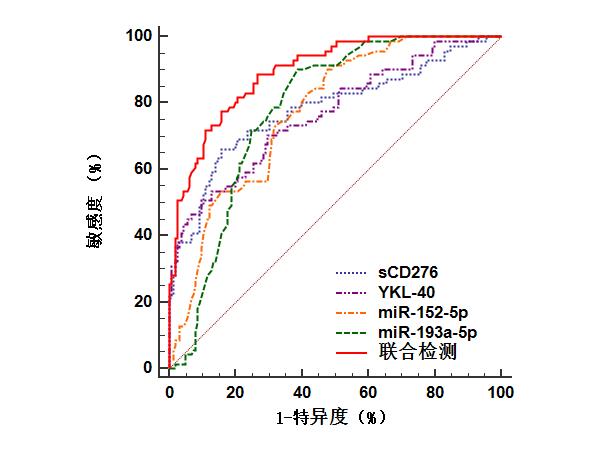
| 指标 | 截断值 | AUC | 95%CI | P值 | 敏感度/% | 特异度/% |
|---|---|---|---|---|---|---|
| sCD276 | 427.52 pg/mL | 0.781* | 0.723 ~ 0.832 | < 0.001 | 66.20 | 84.24 |
| YKL-40 | 118.26 ng/mL | 0.767* | 0.708 ~ 0.819 | < 0.001 | 61.97 | 72.12 |
| miR-152-5p | 0.89 | 0.773* | 0.714 ~ 0.825 | < 0.001 | 60.00 | 80.28 |
| miR-193a-5p | 0.56 | 0.782* | 0.723 ~ 0.883 | < 0.001 | 61.21 | 90.14 |
| 联合检测 | 0.895 | 0.849 ~ 0.931 | < 0.001 | 88.73 | 73.33 |
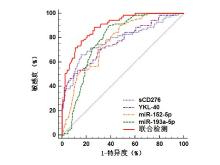
Fig.1
ROC curve of levels of serum sCD276, YKL-40, miR-152-5p and miR-193a-5p in predicting the prognosis of patients with HGSOC"
| [1] |
黄羽棠, 杜炜钦, 袁冬, 等. 连接桥粒斑珠蛋白促进高级别浆液性卵巢癌恶性进展的机制[J]. 实用医学杂志, 2025, 41(24): 3848-3859. doi: 10.3969/j.issn.1006-5725.2025.24.008 .
doi: 10.3969/j.issn.1006-5725.2025.24.008 |
| [2] |
卢立杰, 刘式浩, 刘月平, 等. 高级别浆液性卵巢癌患者新辅助化疗前后肿瘤浸润淋巴细胞差异与预后的关系[J]. 中国免疫学杂志, 2025, 41(10): 2341-2347, 2353. doi: 10.3969/j.issn.1000-484X.2025.10.007 .
doi: 10.3969/j.issn.1000-484X.2025.10.007 |
| [3] |
刘鑫,周安艳,胡蓉. 超声O-RADS 4亚分类联合CA125、HE4及RMI 4预测卵巢-附件肿块恶性风险[J]. 中国医学影像技术, 2024, 40(10): 1548-1551. doi: 10.13929/j.issn.1003-3289.2024.10.019 .
doi: 10.13929/j.issn.1003-3289.2024.10.019 |
| [4] |
田春迎,李铤,陈媛媛,等. 卵巢癌患者血清中ST2、CA125和HE4水平检测及其临床意义[J]. 吉林大学学报(医学版), 2025, 51(3): 778-784. doi: 10.13481/j.1671-587X.20250323 .
doi: 10.13481/j.1671-587X.20250323 |
| [5] |
EURICH K, DE LA CRUZ P, LAGUNA A, et al. Multiplex serum immune profiling reveals circulating lag-3 is associated with improved patient survival in high grade serous ovarian cancer[J]. Gynecol Oncol, 2023, 174(1): 200-207. doi: 10.1016/j.ygyno.2023.05.015 .
doi: 10.1016/j.ygyno.2023.05.015 |
| [6] |
FANG T, XIA Y, LI Y, et al. Parp inhibitors accumulate b7-h3 on fibroblasts via blocking autophagic flux to potentiate immune evasion in ovarian cancer[J]. Oncoimmunology, 2025, 14(1): 2516294-2516294. doi: 10.1080/2162402X.2025.2516294 .
doi: 10.1080/2162402X.2025.2516294 |
| [7] |
KJAERGAARD A D, VAAG A A, JENSEN V H, et al. Ykl-40 and risk of incident cancer in early type 2 diabetes: A danish cohort study[J]. Br J Cancer, 2025, 132(11): 1019-1026. doi: 10.1038/s41416-025-02996-5 .
doi: 10.1038/s41416-025-02996-5 |
| [8] |
CHEN S, HUANG Y, LIU R, et al. Exosomal mir-152-5p/arhgap6/rock axis regulates apoptosis and fibrosis in cardiomyocytes[J]. Exp Ther Med, 2023, 25(4): 165-165. doi: 10.3892/etm.2023.11864 .
doi: 10.3892/etm.2023.11864 |
| [9] |
LOPACINSKA-JØRGENSEN J, PETERSEN P H D, OLIVEIRA D V N P, et al. Strategies for data normalization and missing data imputation and consequences for potential diagnostic microrna biomarkers in epithelial ovarian cancer[J]. PLoS One, 2023, 18(5): 282576-282576. doi: 10.1371/journal.pone.0282576 .
doi: 10.1371/journal.pone.0282576 |
| [10] |
中国抗癌协会妇科肿瘤专业委员会. 卵巢恶性肿瘤诊断与治疗指南(第四版)[J]. 中国实用妇科与产科杂志, 2018, 34(7): 739-749. doi: 10.19538/J.FK2018070110 .
doi: 10.19538/J.FK2018070110 |
| [11] |
刘璐雯,邓思思,周晴晴,等. NLR、PLR与高级别浆液性卵巢癌分期、BRCA突变及淋巴结转移、HRD状态的关系[J]. 临床与实验病理学杂志, 2023, 39(3): 261-264, 270. doi: 10.13315/j.cnki.cjcep.2023.03.002 .
doi: 10.13315/j.cnki.cjcep.2023.03.002 |
| [12] |
朱连成,林蓓. 新辅助化疗对卵巢癌肿瘤细胞减灭术手术结局的影响[J]. 中国实用妇科与产科杂志, 2023, 39(7): 706-711. doi: 10.19538/j.fk2023070108 .
doi: 10.19538/j.fk2023070108 |
| [13] |
何乐伟,王充,杨诗敏,等. 血清CA125和HE4的动态变化在预测卵巢高级别浆液性腺癌无进展生存期方面的价值研究[J]. 南京医科大学学报(自然科学版), 2024, 44(9): 1207-1216. doi: 10.7655/NYDXBNSN230894 .
doi: 10.7655/NYDXBNSN230894 |
| [14] |
ZHENG X, WANG X, CHENG X, et al. Single-cell analyses implicate ascites in remodeling the ecosystems of primary and metastatic tumors in ovarian cancer[J]. Nat Cancer, 2023, 4(8): 1138-1156. doi: 10.1038/s43018-023-00599-8 .
doi: 10.1038/s43018-023-00599-8 |
| [15] |
李曼菱,章桃,杨桃,等. 术前超声联合临床特点构建的列线图对卵巢癌淋巴结转移的预测价值[J]. 中国妇产科临床杂志, 2025, 26(1): 65-67. doi: 10.13390/j.issn.1672-1861.2025.01.020 .
doi: 10.13390/j.issn.1672-1861.2025.01.020 |
| [16] |
ZHANG L L, WANG Y S, ZHENG A. Ovarian cancer presenting with isolated inguinal lymph node metastasis[J]. Asian J Surg, 2023, 46(11): 5147-5148. doi: 10.1016/j.asjsur.2023.06.112 .
doi: 10.1016/j.asjsur.2023.06.112 |
| [17] |
邢瑞生,刘华,高丽,等. 卵巢癌患者血清sCD276、HE4水平及与患者术后复发的相关性[J]. 昆明医科大学学报, 2025, 46(12): 84-91. doi: 10.12259/j.issn.2095-610X.S20251210 .
doi: 10.12259/j.issn.2095-610X.S20251210 |
| [18] |
MIYAMOTO T, MURAKAMI R, HAMANISHI J, et al. B7-h3 suppresses antitumor immunity via the ccl2-ccr2-m2 macrophage axis and contributes to ovarian cancer progression[J]. Cancer Immunol Res, 2022, 10(1): 56-69. doi: 10.1158/2326-6066 .
doi: 10.1158/2326-6066 |
| [19] |
MILLER C D, LOZADA J R, ZORKO N A, et al. Pan-cancer interrogation of b7-h3 (cd276) as an actionable therapeutic target across human malignancies[J]. Cancer Res Commun, 2024, 4(5): 1369-1379. doi: 10.1158/2767-9764 .
doi: 10.1158/2767-9764 |
| [20] |
BÖCKELMANN L C, FELIX T, CALABRÒ S, et al. Ykl-40 protein expression in human tumor samples and human tumor cell line xenografts: Implications for its use in tumor models[J]. Cell Oncol (Dordr), 2021, 44(5): 1183-1195. doi: 10.1007/s13402-021-00630-z .
doi: 10.1007/s13402-021-00630-z |
| [21] |
CHANG M C, CHIANG P F, KUO Y J, et al. Develop companion radiopharmaceutical ykl40 antibodies as potential theranostic agents for epithelial ovarian cancer[J]. Biomed Pharmacother, 2022, 155(1): 113668-113668. doi: 10.1016/j.biopha.2022.113668 .
doi: 10.1016/j.biopha.2022.113668 |
| [22] |
ZHAO X, ZHOU H B, LIU J, et al. Apigenin suppresses proliferation, invasion, and epithelial-mesenchymal transition of cervical carcinoma cells by regulation of mir-152/brd4 axis[J]. Kaohsiung J Med Sci, 2021, 37(7): 583-593. doi: 10.1002/kjm2.12370 .
doi: 10.1002/kjm2.12370 |
| [23] |
ZHANG S, LIU J, HE J, et al. Microrna-193a-5p exerts a tumor suppressive role in epithelial ovarian cancer by modulating rbbp6[J]. Mol Med Rep, 2021, 24(2): 582-582. doi: 10.3892/mmr.2021.12221 .
doi: 10.3892/mmr.2021.12221 |
| [24] |
MAO C, LI J, FENG L, et al. Beyond antibody fucosylation: α-(1,6)-fucosyltransferase (Fut8) as a potential new therapeutic target for cancer immunotherapy[J]. Antib Ther, 2023, 6(2): 87-96. doi: 10.1093/abt/tbad004 .
doi: 10.1093/abt/tbad004 |
| [25] |
YAMANAKA K, KOMA Y I, URAKAMI S, et al. Ykl40/integrin β4 axis induced by the interaction between cancer cells and tumor-associated macrophages is involved in the progression of high-grade serous ovarian carcinoma[J]. Int J Mol Sci, 2024, 25(19): 10598-10598. doi: 10.3390/ijms251910598 .
doi: 10.3390/ijms251910598 |
| [26] |
LYU M, LI X, SHEN Y, et al. Circatrnl1 and circznf608 inhibit ovarian cancer by sequestering mir-152-5p and encoding protein[J]. Front Genet, 2022, 13(1): 784089-78089. doi: 10.3389/fgene.2022.784089 .
doi: 10.3389/fgene.2022.784089 |
| [27] |
UKAI M, YOKOI A, YOSHIDA K, et al. Extracellular mirnas as predictive biomarkers for glypican-3-derived peptide vaccine therapy response in ovarian clear cell carcinoma[J]. Cancers (Basel), 2021, 13(3): 550-550. doi: 10.3390/cancers13030550 .
doi: 10.3390/cancers13030550 |
| Viewed | ||||||
|
Full text |
|
|||||
|
Abstract |
|
|||||
