

The Journal of Practical Medicine ›› 2026, Vol. 42 ›› Issue (7): 1201-1207.doi: 10.3969/j.issn.1006-5725.2026.07.012
• Oncology: Diagnosis, Treatment and Prevention • Previous Articles
Fengxue DAI1,Zhenfei WANG2( )
)
Received:2025-12-07
Revised:2026-01-21
Accepted:2026-01-23
Online:2026-04-10
Published:2026-04-13
Contact:
Zhenfei WANG
E-mail:ndwzf2013@126.com
CLC Number:
Fengxue DAI,Zhenfei WANG. Predictive analysis of serum COL10A1, miRNA-21 and miRNA-320c expression levels for peritoneal metastasis and prognosis of gastric cancer[J]. The Journal of Practical Medicine, 2026, 42(7): 1201-1207.
Tab.1
Comparison of clinical characteristics between peritoneal metastasis group and non-peritoneal metastasis group"
| 项目 | 转移组(n = 31) | 未转移组(n = 89) | χ2值 | P值 |
|---|---|---|---|---|
| 性别 | 0.657 | 0.417 | ||
| 女 | 11(35.48) | 39(43.82) | ||
| 男 | 20(64.52) | 50(56.18) | ||
| 年龄 | 1.828 | 0.176 | ||
| ≥ 60岁 | 23(74.19) | 54(60.67) | ||
| < 60岁 | 8(25.81) | 35(39.33) | ||
| TNM分期 | 17.750 | 0.000 | ||
| Ⅰ—Ⅱ期 | 7(22.58) | 59(66.29) | ||
| Ⅲ—Ⅳ期 | 24(77.42) | 30(33.71) | ||
| 分化程度 | 0.000 | 0.994 | ||
| 低分化 | 15(48.39) | 43(48.31) | ||
| 中高分化 | 16(51.61) | 46(51.69) | ||
| 肿瘤位置 | 0.160 | 0.923 | ||
| 贲门 | 7(22.58) | 18(20.22) | ||
| 胃体 | 15(48.39) | 42(47.19) | ||
| 远端 | 9(29.03) | 29(32.58) |
Tab.2
Comparison of serum COL10A1, miRNA-21, and miRNA-320c expression levels between peritoneal metastasis group and non-peritoneal metastasis group"
| 组别 | 例数 | COL10A1/(ng/mL) | miR-21 | miR-320c |
|---|---|---|---|---|
| 腹膜转移组 | 31 | 6.75 ± 0.95 | 2.32 ± 0.47 | 1.59 ± 0.34 |
| 无腹膜转移组 | 89 | 5.43 ± 0.74 | 0.59 ± 0.08 | 0.18 ± 0.02 |
| t值 | 7.925 | 33.605 | 39.239 | |
| P值 | < 0.001 | < 0.001 | < 0.001 |
Tab.3
Comparison of serum COL10A1, miRNA-21, and miRNA-320c expression levels in gastric cancer patients with different prognoses"
| 组别 | 例数 | COL10A1/(ng/mL) | miR-21 | miR-320c |
|---|---|---|---|---|
| 不良组 | 42 | 7.74 ± 0.59 | 2.87 ± 0.45 | 1.87 ± 0.29 |
| 良好组 | 78 | 5.15 ± 0.49 | 0.45 ± 0.04 | 0.15 ± 0.01 |
| t值 | 25.683 | 47.319 | 52.514 | |
| P值 | < 0.001 | < 0.001 | < 0.001 |
Tab.4
Univariate and multivariate cox regression analysis of factors affecting gastric cancer prognosis"
| 临床病理特征 | 单因素 | 多因素 | ||||
|---|---|---|---|---|---|---|
| HR | 95%CI | P值 | HR | 95%CI | P值 | |
| 性别 | 1.868 | 1.019 ~ 2.414 | 0.003 | 1.554 | 1.293 ~ 1.883 | 0.018 |
| 年龄 | 1.418 | 1.295 ~ 1.730 | 0.025 | 1.148 | 1.023 ~ 1.345 | 0.056 |
| TNM分期 | 1.987 | 1.065 ~ 2.364 | < 0.001 | 1.635 | 1.355 ~ 2.807 | 0.011 |
| 分化程度 | 1.418 | 1.295 ~ 1.730 | 0.025 | 1.148 | 1.023 ~ 1.345 | 0.056 |
| 肿瘤位置 | 1.019 | 0.682 ~ 1.523 | 0.926 | - | - | - |
| 腹膜转移 | 1.794 | 1.142 ~ 2.821 | 0.007 | 1.499 | 1.314 ~ 1.763 | 0.023 |
| 淋巴结转移 | 1.152 | 0.948 ~ 1.506 | 0.275 | - | - | - |
| COL10A1 | 1.868 | 1.019 ~ 2.414 | 0.003 | 1.554 | 1.293 ~ 1.883 | 0.018 |
| miR-21 | 2.297 | 1.166 ~ 3.420 | < 0.001 | 1.830 | 1.409 ~ 2.302 | 0.004 |
| miR-320c | 2.189 | 1.409 ~ 3.401 | < 0.001 | 1.801 | 1.254 ~ 2.633 | 0.005 |
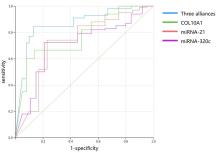
Fig.1
ROC curves for predicting gastric cancer prognosis by serum COL10A1, miRNA-21, and miRNA-320c"
Tab.5
Predictive efficacy of serum col10a1, mirna-21, and mirna-320c for gastric cancer prognosis"
| 指标 | AUC | 95%CI | Cut-off值 | 灵敏度/% | 特异度/% | 约登指数 |
|---|---|---|---|---|---|---|
| COL10A1 | 0.683 | 0.516 ~ 0.733 | 6.85 ng/mL | 68.75 | 73.25 | 0.142 |
| miR-21 | 0.748 | 0.657 ~ 0.814 | 2.14 | 74.14 | 75.68 | 0.150 |
| miR-320c | 0.701 | 0.651 ~ 0.759 | 1.56 | 72.35 | 73.44 | 0.146 |
| 联合检测 | 0.921abc | 0.811 ~ 0.947 | - | 89.45 | 92.34 | 0.182 |
| [1] |
YANG W J, ZHAO H P, YU Y, et al. Updates on global epidemiology, risk and prognostic factors of gastric cancer[J]. World J Gastroenterol, 2023, 29(16): 2452-2468. doi: 10.3748/wjg.v29.i16.2452 .
doi: 10.3748/wjg.v29.i16.2452 |
| [2] |
成晓芬, 闵淑慧, 郭芮绮, 等. 1990-2019年中国胃癌发病与死亡率年龄-时期-队列分析及2020-2030年变化趋势预测[J]. 中国肿瘤, 2023, 32(6): 454-461. doi: 10.11735/j.issn.1004-0242.2023.06.A008 .
doi: 10.11735/j.issn.1004-0242.2023.06.A008 |
| [3] |
HUANG X Z, PANG M J, LI J Y, et al. Single-cell sequencing of ascites fluid illustrates heterogeneity and therapy-induced evolution during gastric cancer peritoneal metastasis[J]. Nat Commun, 2023, 14(1): 822. doi: 10.1038/s41467-023-36310-9 .
doi: 10.1038/s41467-023-36310-9 |
| [4] |
LI Z, WANG J, WANG Z, et al. Towards an optimal model for gastric cancer peritoneal metastasis: Current challenges and future directions[J]. EBioMedicine, 2023, 92: 104601. doi: 10.1016/j.ebiom.2023.104601 .
doi: 10.1016/j.ebiom.2023.104601 |
| [5] |
NAGARAJAN A, VARADHAN V, MANIKANDAN M S, et al. Signature of collagen alpha-1(x) gene expression in human cancers and their therapeutic implications[J]. Pathol Res Pract, 2025, 266: 155811. doi: 10.1016/j.prp.2025.155811 .
doi: 10.1016/j.prp.2025.155811 |
| [6] |
SEO S B, HWANG J S, KIM E, et al. Isothermal amplification-mediated lateral flow biosensors for in vitro diagnosis of gastric cancer-related microRNAs[J]. Talanta, 2022, 246: 123502. doi: 10.1016/j.talanta.2022.123502 .
doi: 10.1016/j.talanta.2022.123502 |
| [7] |
FANG J, SUN Y, YU Y, et al. Plasma Small RNAs as Predictive and Monitoring Biomarkers for Combination Immunotherapy in Advanced Gastric Cancer[J]. Cancer Med, 2025, 14(21): e71339. doi: 10.1002/cam4.71339 .
doi: 10.1002/cam4.71339 |
| [8] |
MENG Z, ZHANG R, WU X, et al. LncRNA HAGLROS promotes breast cancer evolution through miR-135b-3p/COL10A1 axis and exosome-mediated macrophage M2 polarization[J]. Cell Death Dis, 2024, 15(8): 633. doi: 10.1038/s41419-024-07020-x .
doi: 10.1038/s41419-024-07020-x |
| [9] |
中华医学会肿瘤学分会, 中华医学会杂志社. 中华医学会胃癌临床诊疗指南(2021版)[J]. 中华医学杂志, 2022, 102(16): 1169-1189. doi: 10.3760/cma.j.cn112137-20220127-00197 .
doi: 10.3760/cma.j.cn112137-20220127-00197 |
| [10] |
中国抗癌协会胃癌专业委员会. 胃癌腹膜转移诊治中国专家共识(2023版)[J]. 中华胃肠外科杂志, 2023, 26(8): 717-728. doi: 10.3760/cma.j.cn441530-20230608-00196 .
doi: 10.3760/cma.j.cn441530-20230608-00196 |
| [11] |
MATSUOKA T, YASHIRO M. Bioinformatics Analysis and Validation of Potential Markers Associated with Prediction and Prognosis of Gastric Cancer[J]. Int J Mol Sci, 2024, 25(11): 5880. doi: 10.3390/ijms25115880 .
doi: 10.3390/ijms25115880 |
| [12] |
WANG X, BAI Y, ZHANG F, et al. Prognostic value of COL10A1 and its correlation with tumor-infiltrating immune cells in urothelial bladder cancer: A comprehensive study based on bioinformatics and clinical analysis validation[J]. Front Immunol, 2023, 14: 955949. doi: 10.3389/fimmu.2023.955949 .
doi: 10.3389/fimmu.2023.955949 |
| [13] |
NECULA L G, DRAGU D L, MATEI L, et al. COL10A1 Overexpression Promotes Gastric Cancer Aggressiveness Through EMT and Major Oncogenic Pathways[J]. Int J Mol Sci, 2025, 26(22): 11043. doi: 10.3390/ijms262211043 .
doi: 10.3390/ijms262211043 |
| [14] |
SHEN N, ZHU S, ZHANG Z, et al. High Expression of COL10A1 Is an Independent Predictive Poor Prognostic Biomarker and Associated with Immune Infiltration in Advanced Gastric Cancer Microenvironment[J]. J Oncol, 2022: 1463316. doi: 10.1155/2022/1463316 .
doi: 10.1155/2022/1463316 |
| [15] |
王佩显, 单彪, 张倩倩, 等. 血清COL10A1、TK1、MIP-3α水平与胃癌患者病理特征的关系及其对腹膜转移的诊断价值研究[J]. 检验医学与临床, 2024, 21(12): 1727-1730, 1738. doi: 10.3969/j.issn.1672-9455.2024.12.012 .
doi: 10.3969/j.issn.1672-9455.2024.12.012 |
| [16] |
FARASATI FAR B, VAKILI K, FATHI M, et al. The role of microRNA-21 (miR-21) in pathogenesis, diagnosis, and prognosis of gastrointestinal cancers: A review[J]. Life Sci, 2023, 316: 121340. doi: 10.1016/j.lfs.2022.121340 .
doi: 10.1016/j.lfs.2022.121340 |
| [17] |
王艳花, 聂亚楠, 齐俊娟, 等. miR-21靶向PTEN调控AKT/FoxO1信号通路对胃癌细胞凋亡的机制研究[J]. 河北医学, 2023, 29(12): 1985-1992. doi: 10.3969/j.issn.1006-6233.2023.12.010 .
doi: 10.3969/j.issn.1006-6233.2023.12.010 |
| [18] |
SILVIA LIMA R Q D, VASCONCELOS C F M, GOMES J P A, et al. miRNA-21, an oncomiR that regulates cell proliferation, migration, invasion and therapy response in lung cancer[J]. Pathol Res Pract, 2024, 263: 155601. doi: 10.1016/j.prp.2024.155601 .
doi: 10.1016/j.prp.2024.155601 |
| [19] |
HAN X, LV C. MiRNA-21 promotes the migration and proliferation of prostate cancer cells via activating the JAK/STAT pathway[J]. Discov Oncol, 2025, 16(1): 162. doi: 10.1007/s12672-025-01883-y .
doi: 10.1007/s12672-025-01883-y |
| [20] |
NØST T H, SKOGHOLT A H, URBAROVA I, et al. Increased levels of microRNA-320 in blood serum and plasma is associated with imminent and advanced lung cancer[J]. Mol Oncol, 2023, 17(2): 312-327. doi: 10.1002/1878-0261.13336 .
doi: 10.1002/1878-0261.13336 |
| [21] |
YANG C K, HSU H C, LIU Y H, et al. EV-miRome-wide profiling uncovers miR-320c for detecting metastatic colorectal cancer and monitoring the therapeutic response[J]. Cell Oncol (Dordr), 2022, 45(4): 621-638. doi: 10.1007/s13402-022-00688-3 .
doi: 10.1007/s13402-022-00688-3 |
| [22] |
李蓉, 缪忠惠, 唐嘉黛, 等. miR-320c靶向FADD基因抑制肺腺癌细胞凋亡促进癌细胞的迁移和侵袭[J]. 现代肿瘤医学, 2022, 30(9): 1531-1537. doi: 10.3969/j.issn.1672-4992.2022.09.001 .
doi: 10.3969/j.issn.1672-4992.2022.09.001 |
| [23] |
LIU Q, ZHAO H, GUO Y, et al. Bioinformatics-Based Analysis: Noncoding RNA-Mediated COL10A1 Is Associated with Poor Prognosis and Immune Cell Infiltration in Pancreatic Cancer[J]. J Healthc Eng, 2022: 7904982. doi: 10.1155/2022/7904982 .
doi: 10.1155/2022/7904982 |
| [24] |
WANG H F, WANG H H, YE X J, et al. Therapeutic effects and safety of apatinib mesylate on patients with gastric carcinoma peritoneal metastasis in SOX scheme[J]. Eur Rev Med Pharmacol Sci, 2023, 27(14): 6627-6638. doi: 10.26355/eurrev_202307_33133 .
doi: 10.26355/eurrev_202307_33133 |
| Viewed | ||||||
|
Full text |
|
|||||
|
Abstract |
|
|||||
