

The Journal of Practical Medicine ›› 2026, Vol. 42 ›› Issue (18): 3270-3277.doi: 10.3969/j.issn.1006-5725.2026.18.005
• Oncology: Diagnosis, Treatment and Prevention • Previous Articles
Min Hua1, Fan Ouyang1, Xueying Zhu1, Liling Zhao1, Rui Zhang2( )
Received:2026-06-04
Revised:2026-06-23
Accepted:2026-07-03
Online:2026-09-25
Published:2026-10-19
Contact:
Rui Zhang
About author:Hua Min performed the experiments, collected and analyzed the data, and wrote the article. Ouyang Fan and Zhu Xueying performed the experiments and collected the data. Zhao Liling revised the article and performed the statistical analysis. Zhang Rui designed the study, supervised the research, and reviewed the article. All authors read and approved the final manuscript as submitted.
CLC Number:
Min Hua, Fan Ouyang, Xueying Zhu, Liling Zhao, Rui Zhang. The predictive value and influencing factors of TGF-β1/Smads signaling pathway proteins in peripheral blood for infection after modified radical mastectomy for breast cancer[J]. The Journal of Practical Medicine, 2026, 42(18): 3270-3277.
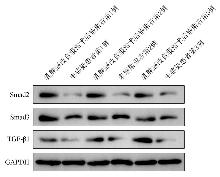
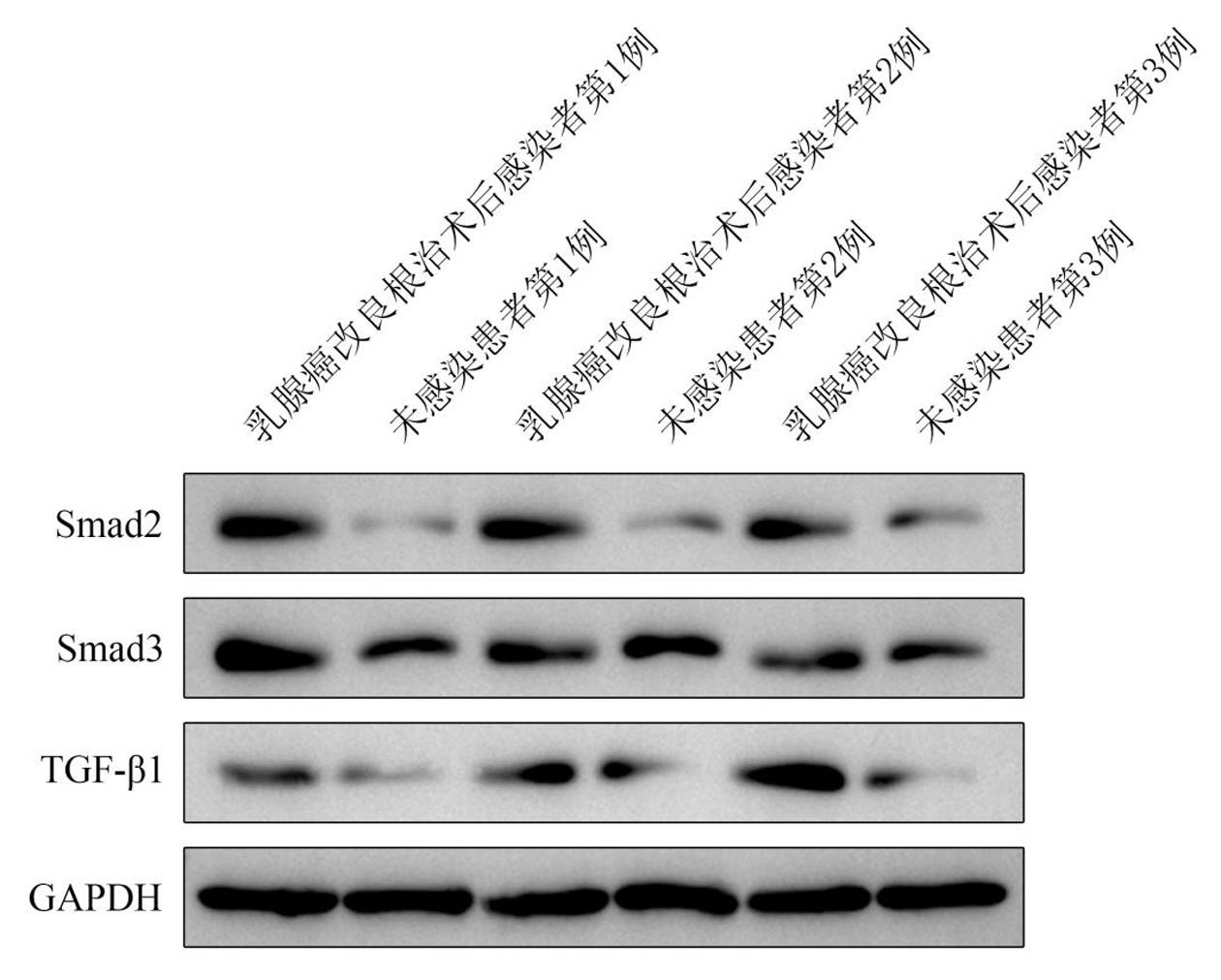
Fig.1
Protein expression of TGF-β1/Smad signaling pathway in peripheral blood mononuclear cells of patients with and without infection after modified radical mastectomy for breast cancer"
Tab.1
Comparison of general data and TGF-β1/Smad signaling pathway protein levels between the two groups"
| 因素 | 感染组(n = 62) | 非感染组(n = 357) | t/χ2/Z值 | P值 |
|---|---|---|---|---|
| 年龄/岁 | 56.48 ± 5.38 | 55.82 ± 5.19 | 0.919 | 0.358 |
| 体质量指数/(kg/m2) | 21.02 ± 0.84 | 20.88 ± 0.81 | 1.249 | 0.212 |
| 糖尿病/[例(%)] | ||||
| 有 | 9(14.52) | 21(5.88) | 4.696* | 0.030 |
| 无 | 53(85.48) | 336(94.12) | ||
| 高血压/[例(%)] | ||||
| 有 | 10(16.13) | 32(8.96) | 3.007 | 0.083 |
| 无 | 52(83.87) | 325(91.04) | ||
| 高脂血症/[例(%)] | ||||
| 有 | 8(12.90) | 25(7.00) | 2.535 | 0.111 |
| 无 | 54(87.10) | 332(93.00) | ||
| 美国麻醉医师协会分级/[例(%)] | ||||
| Ⅰ级 | 14(22.58) | 83(23.25) | 1.097 | 0.273 |
| Ⅱ级 | 39(62.90) | 183(51.26) | ||
| Ⅲ级及以上 | 9(14.52) | 91(25.49) | ||
| 手术时间/h | 1.93 ± 0.54 | 1.86 ± 0.49 | 1.022 | 0.307 |
| 术中失血量/mL | 368.74 ± 69.40 | 363.71 ± 66.88 | 0.544 | 0.587 |
| 脂肪液化/[例(%)] | ||||
| 有 | 4(6.45) | 12(3.36) | 0.661* | 0.416 |
| 无 | 58(93.55) | 345(96.64) | ||
| 预防性使用抗菌药物/[例(%)] | ||||
| 有 | 21(33.87) | 156(43.70) | 2.091 | 0.148 |
| 无 | 41(66.13) | 201(56.30) | ||
| 置管时间/d | 10.98 ± 3.26 | 8.91 ± 2.51 | 5.714 | < 0.001 |
| 术后引流量/mL | 775.48 ± 83.28 | 769.50 ± 80.77 | 0.536 | 0.592 |
| TGF-β1/Smad信号通路蛋白 | ||||
| TGF-β1 | 13.73 ± 4.21 | 9.05 ± 3.62 | 9.163 | < 0.001 |
| Smad2 | 30.84 ± 6.40 | 25.33 ± 5.51 | 7.089 | < 0.001 |
| Smad3 | 43.84 ± 7.88 | 35.37 ± 6.82 | 8.813 | < 0.001 |
Tab.2
Assignment"
| 变量 | 赋值 |
|---|---|
| 术后感染 | 是 = 1,否 = 0 |
| 糖尿病 | 有 = 1,无 = 0 |
| TGF-β1蛋白水平 | 原值输入 |
| Smad2蛋白水平 | 原值输入 |
| Smad3蛋白水平 | 原值输入 |
| 术后置管时间 | 原值输入 |
Tab.3
Influencing factors of infection after modified radical mastectomy"
| 影响因素 | β | SE | Wald χ2 | P值 | OR值 | 95%CI |
|---|---|---|---|---|---|---|
| 合并糖尿病 | 1.322 | 0.426 | 9.630 | 0.002 | 3.751 | 1.627 ~ 8.645 |
| 术后置管时间较长 | 0.218 | 0.102 | 4.568 | 0.033 | 1.244 | 1.018 ~ 1.519 |
| TGF-β1蛋白水平较高 | 0.352 | 0.113 | 9.704 | 0.002 | 1.422 | 1.139 ~ 1.774 |
| Smad2蛋白水平较高 | 0.344 | 0.125 | 7.574 | 0.006 | 1.411 | 1.104 ~ 1.802 |
| Smad3蛋白水平较高 | 0.371 | 0.137 | 7.333 | 0.007 | 1.449 | 1.108 ~ 1.896 |
Tab.4
Predictive value of TGF-β 1/SMADS signaling pathway protein in patients with infection after modified radical mastectomy"
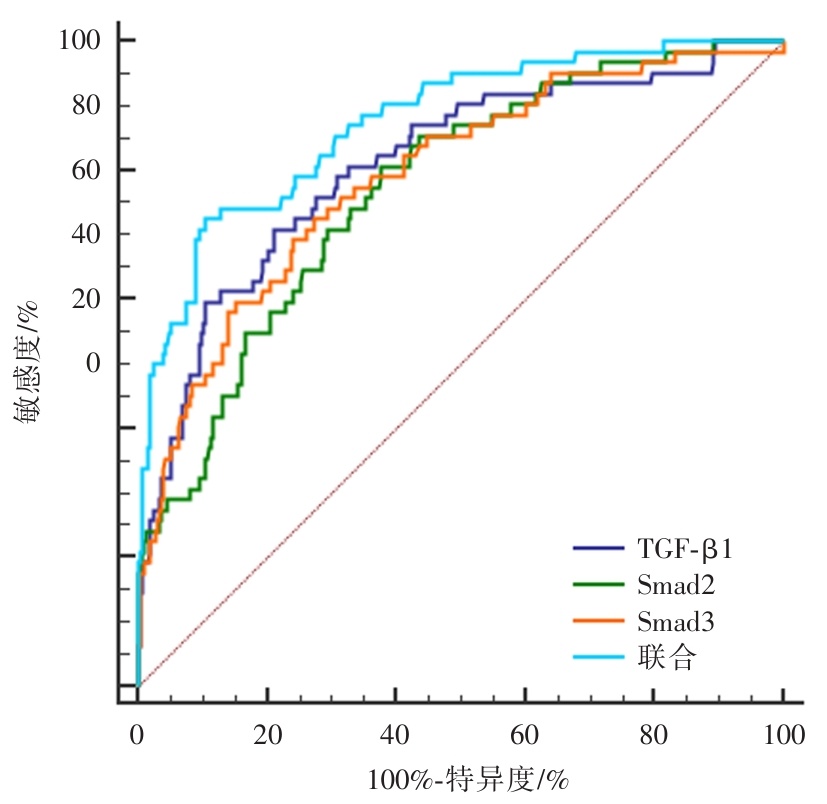
| 指标 | 截断值 | AUC | 95%CI | 敏感度/% | 特异度/% | 约登指数 | Z值 | P值 |
|---|---|---|---|---|---|---|---|---|
| TGF-β1 | 11.88 | 0.808 | 0.767 ~ 0.845 | 70.97 | 78.99 | 0.500 | 9.655 | < 0.001 |
| Smad2 | 26.44 | 0.772 | 0.728 ~ 0.811 | 80.65 | 62.18 | 0.428 | 8.701 | < 0.001 |
| Smad3 | 40.89 | 0.791 | 0.748 ~ 0.829 | 69.35 | 75.91 | 0.453 | 8.987 | < 0.001 |
| 联合 | - | 0.874 | 0.838 ~ 0.904 | 72.58 | 89.64 | 0.622 | 14.992 | < 0.001 |
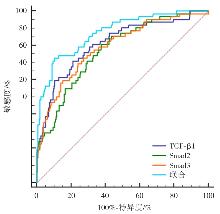
Fig.2
ROC curve of TGF-β1/SMADS signaling pathway protein in predicting infection of patients after modified radical mastectomy"
| [1] |
|
| [2] |
|
| [3] |
|
| [4] |
|
| [5] |
|
| [6] |
|
| [7] |
|
| [8] |
|
| [9] |
中国抗癌协会乳腺癌专业委员会, 中华医学会肿瘤学分会乳腺肿瘤学组, 邵志敏. 中国抗癌协会乳腺癌诊治指南与规范(2024年版)[J]. 中国癌症杂志, 2023, 33(12): 1092-1186. doi:10.19401/j.cnki.1007-3639.2023.12.004 .
|
| [10] |
姜纪华, 刘翠萍. 医院感染管理[M]. 北京: 北京大学医学出版社, 2010: 78-81.
|
| [11] |
孙正霞, 张林, 常家琦, 等. 胸横肌平面-胸神经阻滞辅助下羟考酮-丙泊酚少阿片全身麻醉在乳腺癌保乳手术中的有效性及安全性[J]. 实用医学杂志, 2026, 42(5): 734-741. doi:10.3969/j.issn.1006-5725.2026.05.002 .
|
| [12] |
|
| [13] |
|
| [14] |
钟燕澜, 张卿,彭云. 乳腺癌术后化疗病人感染风险预测模型的构建[J]. 护理研究, 2025,39(23):3934-3941. doi.10.12102/j.issn.1009⁃6493.2025,23,005.
|
| [15] |
|
| [16] |
|
| [17] |
钱芳, 孙永强, 张思涵, 等. 乳腺癌改良根治术后感染的病原学特征、影响因素及炎症因子分析[J]. 中国癌症杂志, 2025, 35(6): 563-569. doi:10.19401/j.cnki.1007-3639.2025.06.005 .
|
| [18] |
|
| [19] |
|
| [20] |
|
| [21] |
|
| [22] |
|
| [23] |
|
| [24] |
|
| [25] |
|
| [26] |
|
| Viewed | ||||||
|
Full text |
|
|||||
|
Abstract |
|
|||||
