

The Journal of Practical Medicine ›› 2026, Vol. 42 ›› Issue (13): 2419-2427.doi: 10.3969/j.issn.1006-5725.2026.13.018
• Treatise:Mechanism and Practice • Previous Articles
Jing YIN1,Qinghua WU1,Hongyan QIAO2( )
)
Received:2026-03-04
Online:2026-07-10
Published:2026-07-14
Contact:
Hongyan QIAO
E-mail:kevinqiao986@163.com
CLC Number:
Jing YIN,Qinghua WU,Hongyan QIAO. The value of ankle brachial index, vascular endothelial growth factor and infection indicators in predicting the prognosis of interventional therapy with arteriosclerosis obliterans complicated with ischemic gangrene infection[J]. The Journal of Practical Medicine, 2026, 42(13): 2419-2427.
Tab.1
Comparison of clinical data between restenosis group and patency group"
| 临床资料 | 再狭窄组(n = 102) | 通畅组(n = 202) | χ2/t值 | P值 |
|---|---|---|---|---|
| 性别/[例(%)] | 0.939 | 0.333 | ||
| 男 | 61(59.80) | 109(53.96) | ||
| 女 | 41(40.20) | 93(46.04) | ||
| 年龄/岁 | 61.25 ± 6.76 | 60.72 ± 6.72 | 0.734 | 0.519 |
| BMI/(kg/m2) | 21.36 ± 2.09 | 21.22 ± 2.14 | 0.543 | 0.588 |
| 合并症/[例(%)] | ||||
| 高血压 | 50(49.02) | 83(41.09) | 1.732 | 0.188 |
| 糖尿病 | 26(25.49) | 43(21.29) | 0.682 | 0.409 |
| 高血脂 | 68(66.67) | 122(60.40) | 1.137 | 0.286 |
| 冠心病 | 18(17.65) | 30(14.85) | 0.255 | 0.614 |
| 病变侧别/[例(%)] | 0.102 | 0.750 | ||
| 左下肢 | 56(54.90) | 107(52.97) | ||
| 右下肢 | 46(45.10) | 95(47.03) | ||
| 闭塞血管位置/[例(%)] | 0.159 | 0.690 | ||
| 髂-股动脉段 | 44(44.44) | 92(48.04) | ||
| 腘动脉及远端段 | 58(55.56) | 110(51.96) | ||
| 完全闭塞/[例(%)] | 56(54.90) | 62(30.69) | 16.726 | 0.001 |
| 血管病变长度/cm | 6.92 ± 1.43 | 5.59 ± 1.38 | 7.820 | 0.001 |
| TASC分型/[例(%)] | 6.356 | 0.012 | ||
| A型 | 44(43.14) | 118(58.42) | ||
| B型 | 58(56.86) | 84(41.58) | ||
| 介入方式/[例(%)] | 0.525 | 0.469 | ||
| 支架 | 60(58.82) | 110(54.46) | ||
| 球囊 | 42(41.18) | 92(45.54) | ||
| DBP/mmHg | 84.65 ± 7.24 | 83.00 ± 7.78 | 1.786 | 0.075 |
| SBP/mmHg | 132.32 ± 9.12 | 131.70 ± 11.32 | 0.302 | 0.629 |
| WBC/(×109/L) | 9.13 ± 2.09 | 8.70 ± 1.94 | 0.302 | 0.079 |
| LYM/(×109/L) | 1.67 ± 0.41 | 1.80 ± 0.32 | 2.889 | 0.004 |
| NEUT/(×109/L) | 5.13 ± 1.32 | 4.83 ± 1.11 | 2.059 | 0.040 |
| TC/(mmol/L) | 4.83 ± 0.86 | 4.75 ± 0.94 | 0.721 | 0.472 |
| TG/(mmol/L) | 1.20 ± 0.20 | 1.17 ± 0.18 | 1.638 | 0.302 |
| LDL-C/(mmol/L) | 3.73 ± 0.59 | 3.59 ± 0.60 | 1.935 | 0.054 |
| HDL-C/(mmol/L) | 1.15 ± 0.19 | 1.20 ± 0.22 | 1.956 | 0.051 |
| CRP/(mg/L) | 25.63 ± 4.69 | 23.69 ± 4.68 | 3.423 | 0.001 |
| PCT/(μg/L) | 0.82 ± 0.17 | 0.68 ± 0.15 | 7.220 | 0.001 |
Tab.2
Comparison of ABI, VEGF, NLR, SAA and sTREM-1 between restenosis group and patency group x ± s"
| 项目 | 再狭窄组(n = 102) | 通畅组 (n = 202) | t值 | P值 |
|---|---|---|---|---|
| ABI | 0.60 ± 0.13 | 0.78 ± 0.15 | 10.409 | 0.001 |
| VEGF/(ng/L) | 257.82 ± 21.10 | 231.73 ± 23.53 | 9.444 | 0.001 |
| NLR | 3.57 ± 0.58 | 2.89 ± 0.67 | 8.812 | 0.001 |
| SAA/(mg/L) | 11.83 ± 1.92 | 9.69 ± 2.05 | 8.816 | 0.001 |
| sTREM-1/(ng/L) | 59.76 ± 6.32 | 51.61 ± 7.90 | 9.062 | 0.001 |
Tab.3
Correlation analysis of ABI, VEGF, NLR, SAA and sTREM-1 levels with restenosis in ASO patients after interventional therapy"
| 项目 | 介入后再狭窄 | |
|---|---|---|
| r值 | P值 | |
| ABI | -0.533 | 0.001 |
| VEGF | 0.506 | 0.001 |
| NLR | 0.463 | 0.001 |
| SAA | 0.427 | 0.001 |
| sTREM-1 | 0.487 | 0.001 |
Tab.4
Analysis of influencing factors of EVT prognosis in patients with ASO complicated with ischemic gangrene infection"
| 变量 | β | SE | Waldχ2 | OR | P值 | 95%CI |
|---|---|---|---|---|---|---|
| 血管病变长度 | 0.631 | 0.207 | 9.254 | 1.880 | 0.002 | 1.252 ~ 2.823 |
| PCT | 4.164 | 1.871 | 4.954 | 1.187 | 0.026 | 1.045 ~ 2.507 |
| ABI | -6.626 | 2.176 | 9.272 | 0.002 | 0.003 | 0.001 ~ 0.094 |
| VEGF | 0.039 | 0.012 | 9.810 | 1.040 | 0.002 | 1.015 ~ 1.065 |
| NLR | 1.112 | 0.556 | 4.006 | 3.042 | 0.045 | 1.023 ~ 9.040 |
| SAA | 0.635 | 0.177 | 12.858 | 1.887 | 0.001 | 1.334 ~ 2.670 |
| sTREM-1 | 0.161 | 0.045 | 12.668 | 1.175 | 0.001 | 1.075 ~ 1.823 |
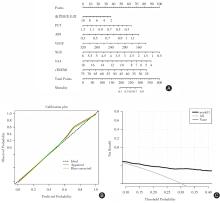
Fig.1
Model construction and validation of the adverse EVT prognosis risk in ASO patients with combined ischemic gangrene infection"
Tab.5
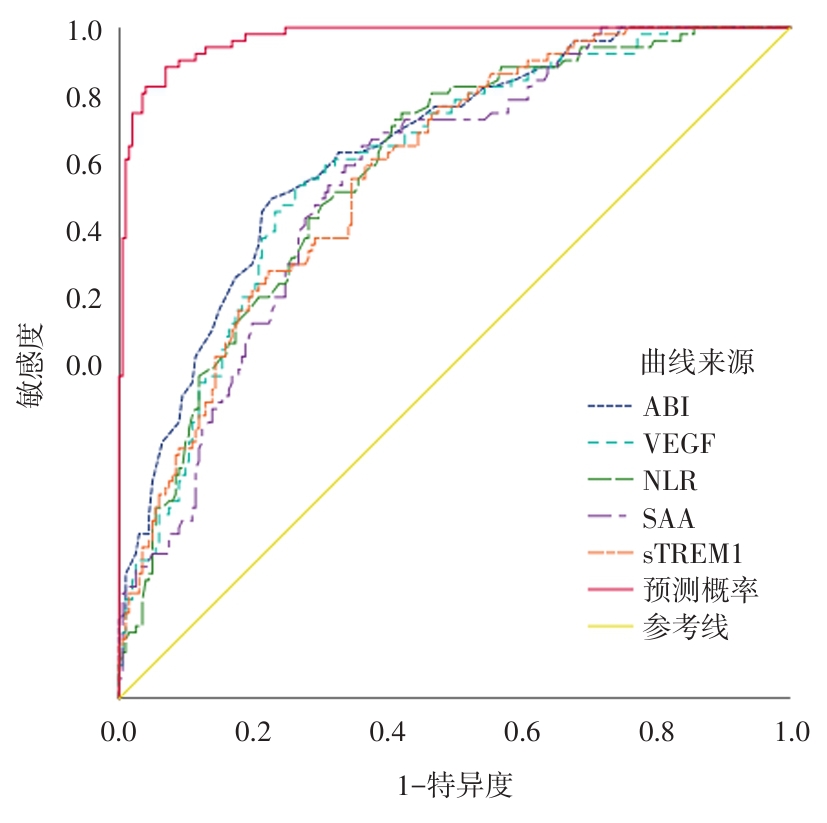
Predictive value of ABI, VEGF, NLR, SAA and sTREM-1 on the EVT prognosis in patients with ASO complicated with ischemic gangrene infection based on the ROC curve analysis"
| 指标 | AUC | Cut-off值 | 敏感度/% | 特异度/% | 约登指数 | 95%CI |
|---|---|---|---|---|---|---|
| ABI | 0.815 | 0.68 | 79.41 | 75.25 | 0.547 | 0.766 ~ 0.864 |
| VEGF | 0.794 | 246.95 ng/L | 81.37 | 71.78 | 0.532 | 0.742 ~ 0.845 |
| NLR | 0.785 | 3.10 | 82.35 | 70.79 | 0.531 | 0.733 ~ 0.837 |
| SAA | 0.773 | 10.05 mg/L | 80.39 | 71.29 | 0.517 | 0.720 ~ 0.826 |
| sTREM-1 | 0.784 | 54.61 ng/L | 83.33 | 69.31 | 0.526 | 0.733 ~ 0.835 |
| 联合检测 | 0.984 | 92.15 | 68.31 | 0.605 | 0.973 ~ 0.994 |
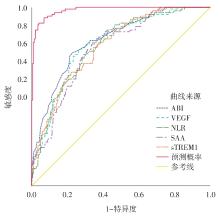
Fig.2
ROC curves of preoperative ABI, VEGF, NLR, SAA and sTREM-1 in predicting the EVT prognosis in patients with ASO complicated with ischemic gangrene infection"
| [1] |
ZHAO H, ZHUO T, HAO X, et al. Effect of diabetes on the prognosis, serum inflammatory factors, and quality of life of patients with lower extremity arteriosclerosis obliterans after vascular intervention: A retrospective comparative cohort study[J]. Ann Palliat Med, 2022, 11(8): 2720-2729. doi: 10.21037/apm-22-827 .
doi: 10.21037/apm-22-827 |
| [2] |
LI Y P, SU T, XUE X L, et al. Application of buried auricular point combined with Wenjing Sanhan prescription in arteriosclerosis obliterans patients with resting pain[J]. World J Clin Cases, 2024, 12(24): 5558-5567. doi: 10.12998/wjcc.v12.i24.5558 .
doi: 10.12998/wjcc.v12.i24.5558 |
| [3] |
SU Z, LI Y, WANG C, et al. Directional atherectomy combined with drug-coated balloon angioplasty for superficial femoral arteriosclerosis obliterans[J]. Annals, 2023, 105(7): 627-631. doi: 10.1308/rcsann.2022.0164 .
doi: 10.1308/rcsann.2022.0164 |
| [4] |
ZHANG C, CHEN S. Percutaneous transluminal angioplasty with stenting for the treatment of lower limb arteriosclerosis obliterans[J]. Wideochir Inne Tech Maloinwazyjne, 2024, 19(4): 465-469. doi: 10.20452/wiitm.2024.17915 .
doi: 10.20452/wiitm.2024.17915 |
| [5] |
DEL MAR VILA M, IGUAL L, REMESEIRO B, et al. Polyvascular subclinical atherosclerosis: Correlation between ankle brachial index and carotid atherosclerosis in a population-based sample[J]. Angiology, 2023, 74(5): 443-451. doi: 10.1177/00033197221110720 .
doi: 10.1177/00033197221110720 |
| [6] |
YAN F, DING H, SUN Z, et al. Glycoside combinations of Buyang Huanwu decoction ameliorate atherosclerosis via STAT3, HIF-1, and VEGF[J]. Naunyn Schmiedeberg′s Arch Pharmacol, 2023, 396(6): 1187-1203. doi: 10.1007/s00210-023-02389-6 .
doi: 10.1007/s00210-023-02389-6 |
| [7] |
TIAN S Y. Systemic immune-inflammation index predicts restenosis after interventions for lower extremity arteriosclerosis obliterans[J]. Heart Surg Forum, 2023, 26(3): E225-E233. doi: 10.1532/hsf.5303 .
doi: 10.1532/hsf.5303 |
| [8] |
中华医学会外科学分会血管外科学组. 下肢动脉硬化闭塞症诊治指南[J]. 中华普通外科学文献(电子版), 2016, 10(1): 1-18. doi: 10.3877/cma.j.issn.1674-0793.2016.01.001 .
doi: 10.3877/cma.j.issn.1674-0793.2016.01.001 |
| [9] |
NORGREN L, HIATT W R, DORMANDY J A, et al. Inter-society consensus for the management of peripheral arterial disease (TASC II)[J]. J Vasc Surg, 2007, 45(1): S5-S67. doi: 10.1016/j.jvs.2006.12.037 .
doi: 10.1016/j.jvs.2006.12.037 |
| [10] |
PARASKEVAS K I, POREDOS P, STANEK A, et al. Dyslipidemia and lower extremity arterial disease[J]. Int Angiol, 2024, 43(4): 450-457. doi: 10.23736/s0392-9590.24.05266-0 .
doi: 10.23736/s0392-9590.24.05266-0 |
| [11] |
TAKAHARA M, SOGA Y, IIDA O. Lower extremity arterial disease vs. coronary artery disease: Mortality differences after revascularization[J]. Eur Heart J, 2024, 45(18): 1634-1643. doi: 10.1093/eurheartj/ehae207 .
doi: 10.1093/eurheartj/ehae207 |
| [12] |
SECEMSKY E S, PARIKH S P, KOHI M, et al. Intravascular ultrasound guidance for lower extremity arterial and venous interventions[J]. EuroIntervention, 2022, 18(7): 598-608. doi: 10.4244/eij-d-21-00898 .
doi: 10.4244/eij-d-21-00898 |
| [13] |
CHEN J, TANG Y, SHEN Z, et al. Predicting and analyzing restenosis risk after endovascular treatment in lower extremity arterial disease: Development and assessment of a predictive nomogram[J]. J Endovasc Ther, 2024, 31(6): 1140-1149. doi: 10.1177/15266028231158294 .
doi: 10.1177/15266028231158294 |
| [14] |
LEE M, SMOLDEREN K G, IONESCU C, et al. Lower extremity symptoms and ankle-brachial index screening as predictors of cardiovascular outcomes in Black adults[J]. Vasc Med, 2023, 28(3): 197-204. doi: 10.1177/1358863X231151729 .
doi: 10.1177/1358863X231151729 |
| [15] |
张红松, 赵亚恒, 郑丽华, 等. 紫杉醇涂层球囊与普通球囊治疗腘动脉硬化闭塞症效果的倾向性评分匹配分析[J]. 中国普通外科杂志, 2022, 31(12): 1597-1604. doi: 10.7659/j.issn.1005-6947.2022.12.006 .
doi: 10.7659/j.issn.1005-6947.2022.12.006 |
| [16] |
何洋, 何欣燃, 黄超, 等. 置管溶栓结合多种腔内介入术在改善下肢动脉硬化闭塞症患者动脉硬化指标中的应用[J]. 实用医学杂志, 2025, 41(24): 3874-3882. doi: 10.3969/j.issn. 1006-5725.2025.24.011 .
doi: 10.3969/j.issn. 1006-5725.2025.24.011 |
| [17] |
LI X, ZHANG L, LI Q, et al. Construction of prediction models for novel subtypes in patients with arteriosclerosis obliterans undergoing endovascular therapy: An unsupervised machine learning study[J]. J Cardiothorac Surg, 2024, 19(1): 370. doi: 10.1186/s13019-024-02913-6 .
doi: 10.1186/s13019-024-02913-6 |
| [18] |
马松, 马海燕, 陈斌, 等. 踝肱指数联合Wagner分级预测糖尿病足预后应用价值的研究[J]. 中国糖尿病杂志, 2025, 33(8): 587-591. doi: 10.3969/j.issn.1006-6187.2025.08.006 .
doi: 10.3969/j.issn.1006-6187.2025.08.006 |
| [19] |
CHEN B, ZHANG Y, CHEN S, et al. The role of vascular endothelial growth factor in ischemic stroke[J]. Pharmazie, 2021, 76(4): 127. doi: 10.31083/ph.2021.1315 .
doi: 10.31083/ph.2021.1315 |
| [20] |
BALAKRISHNAN S, SENTHIL KUMAR B. Correlation of serum vascular endothelial growth factor and cardiovascular risk factors on collateral formation in patients with acute coronary artery syndrome[J]. Clin Anat, 2022, 35(5): 673-678. doi: 10.1002/ca.23890 .
doi: 10.1002/ca.23890 |
| [21] |
胡威龙, 王高尚, 张小兵, 等. 血清IL-8、VEGF水平与下肢动脉硬化闭塞症患者支架植入术后1年内支架内再狭窄的关系[J]. 中国普通外科杂志, 2024, 33(6): 943-951. doi: 10.7659/j.issn.1005-6947.2024.06.010 .
doi: 10.7659/j.issn.1005-6947.2024.06.010 |
| [22] |
LIU Y, CUI Y, ZHOU Z, et al. Relationship between angiotensin II, vascular endothelial growth factor, and arteriosclerosis obliterans[J]. Dis Markers, 2023, 2023(1): 1316821. doi: 10.1155/2023/1316821 .
doi: 10.1155/2023/1316821 |
| [23] |
ZHENG L, ZHAO B, ZHANG Z, et al. Berbamine promotes the repair of lower limb muscle damage in chronic limb-threatening ischemia by inhibiting local inflammation and NF-κB nuclear translocation[J]. Pharmaceuticals, 2024, 17(12): 1583. doi: 10.3390/ph17121583 .
doi: 10.3390/ph17121583 |
| [24] |
MARIACA K, SERÉS-NORIEGA T, VIÑALS C, et al. Neutrophil-to-lymphocyte ratio is independently associated with carotid atherosclerosis burden in individuals with type 1 diabetes[J]. Nutr Metab Cardiovasc Dis, 2024, 34(2): 395-403. doi: 10.1016/j.numecd.2023.09.017 .
doi: 10.1016/j.numecd.2023.09.017 |
| [25] |
王庆贺, 唐晨, 王宜梅, 等. 髂动脉钙化评分与下肢动脉硬化闭塞症患者药物涂层球囊联合支架植入术后下肢动脉再狭窄的相关性及其预测价值分析[J]. 中华医学杂志, 2024, 104(37): 3520-3527. doi: 10.3760/cma.j.cn112137-20240310-00539 .
doi: 10.3760/cma.j.cn112137-20240310-00539 |
| [26] |
丁洁, 李天润, 庄金满, 等. Rotarex机械血栓切除系统联合药物涂层球囊治疗股腘动脉支架内再狭窄[J]. 中国微创外科杂志, 2024, 24(3): 178-183. doi: 10.3969/j.issn.1009-6604.2024. 03.004 .
doi: 10.3969/j.issn.1009-6604.2024. 03.004 |
| [27] |
WANG X, WEN S, DU X, et al. SAA suppresses α-PD-1 induced anti-tumor immunity by driving TH2 polarization in lung adenocarcinoma[J]. Cell Death Dis, 2023, 14: 718. doi: 10.1038/s41419-023-06198-w .
doi: 10.1038/s41419-023-06198-w |
| [28] |
XU Y, XU Y, LI Y, et al. Analysis of the Relationship Between the Changes of Serum SAA, LP-PLA2, sCD40L and Carotid Atherosclerosis Plaque in Patients with Acute Cerebral Infarction[J]. Altern Ther Health Med, 2024, 30(9): 47-53. PMID: .
pmid: 38330557 |
| [29] |
邓默, 贾米山, 田彦卿, 等. sTREM-1、PCT与MRP8/14对重症肺结核患者急性呼吸窘迫综合征的时序预测价值[J]. 实用医学杂志, 2025, 41(22): 3552-3557. doi: 10.3969/j.issn.1006-5725.2025.22.012 .
doi: 10.3969/j.issn.1006-5725.2025.22.012 |
| [1] | Huiping ZHU,Jian JIANG,Chunfeng WU,Chen NI,Yang SUN,Yu SONG. The efficacy of sintilimab combined with concurrent chemoradiotherapy in the treatment of oligometastatic non-small cell lung cancer and its influence on the levels of serum VEGF, NF-κB and PD-L1 in patients [J]. The Journal of Practical Medicine, 2026, 42(2): 185-193. |
| [2] | Huixin ZHENG,Yanjun CHEN,Wenying HU,Yuxing HOU,Zhongjiang HUANG. Diagnostic and prognostic value of enhanced CT combined with SPARCL1, VEGF, and TK-1 in primary liver cancer [J]. The Journal of Practical Medicine, 2026, 42(12): 2170-2178. |
| [3] | Xuan SUN,Lu XU,Yan GAO,Yingying MA,Jidong ZHAO. The combined predictive value of sFlt-1, Lp-PLA2, MHR and ICAM-1 for the severity and prognosis of diabetic foot ulcers [J]. The Journal of Practical Medicine, 2026, 42(10): 1703-1711. |
| [4] | Mei CHEN,Zongzhi LI,Xuewei QIN,Limin WANG,LI ZHENG. Protective effect of LncRNA MEG3 on diabetic retinopathy in rats by regulating COX⁃2/PGE2/VEGF signaling pathway [J]. The Journal of Practical Medicine, 2025, 41(9): 1319-1326. |
| [5] | Rui ZHONG,Jianing WANG,Lei ZHANG,Lingyun GUO,Jianye YANG,Fei ZHENG,Yuwen YAN,Danli YU,Liguo. TAN. Experimental study on treatment of severe limb ischemia with Ad⁃hVEGF⁃hHGF gene [J]. The Journal of Practical Medicine, 2024, 40(5): 639-645. |
| [6] | Canwei CHEN,Zhuangwen LIAO,Ziwen FAN,Shuai HUANG,Yan HUANG,Binwei CHEN. LAMP3 inhibited the proliferation, metastatic and PC⁃3⁃induced vasculogenesis of HUVEC by regulating VEGF/AKT signaling [J]. The Journal of Practical Medicine, 2024, 40(2): 182-187. |
| [7] | Yancun ZHENG,Zhu DONG,Jinli LIN,Xiaowu WANG. The role of 3D printing technology in the preoperative interventional endovascular exclusion of Stanford B aortic dissection [J]. The Journal of Practical Medicine, 2024, 40(12): 1651-1658. |
| [8] | Yaoxin CHEN,Songbo LI,Guanjun FANG,Guobiao YE,Xianyin. LIU. Analysis of the relationship between FGF⁃1 and VEGF expression in the ligamentum flavum of patients with lumbar spinal stenosis and restenosis after decompression [J]. The Journal of Practical Medicine, 2023, 39(18): 2289-2293. |
| [9] | WU Yuliang, WU Chunling, WU Dan. . The correlation of endometriosis with serum levels of FLT1 and CTRP3 [J]. The Journal of Practical Medicine, 2023, 39(14): 1798-1803. |
| [10] |
HUANG Jianmin, YUN Yanfang, YANG Guixin, CHEN Haiyan, JIANG Yongming, HUANG Dongxu, LIU Jie, MO Xiaorong, LI Xuebin..
Effects of survivin inhibitor YM155 on microvessel density and angiogenesis⁃related gene expression in rats with cerebral infarction [J]. The Journal of Practical Medicine, 2022, 38(8): 946-951. |
| [11] |
LI Jihong, NIU Mengqi..
Predictive value of vascular endothelial growth factor level in patients with type 2 diabetes mellitus compli⁃ cated with retinal microangiopathy [J]. The Journal of Practical Medicine, 2022, 38(8): 1001-1005. |
| [12] |
XIA Xu, CUI Hongquan, HU Peisen, WANG Jiaotuo..
Role of rehmannia glutinosa polysaccharide in proliferation and apoptosis of prostate cancer PC ⁃ 3 cells and effect of rehmannia polysaccharide on VEGF/Akt signaling pathway [J]. The Journal of Practical Medicine, 2021, 37(17): 2194-2198. |
| [13] |
JIANG Yixiao, HUANG Bo, WANG Yuchuan, CHEN Xiahuan, LIU Meilin..
Clinical application of quantitative Allen′s test and simplified Allen′s test before the interventional therapy via radial artery [J]. The Journal of Practical Medicine, 2021, 37(15): 1944-1947. |
| [14] |
LIU Meilian, SU Faming, LI Xiaoling, PENG Xiaoxia, CHEN Xiaoming. .
R736.1 Research on the predictive value of VEGF and Ang⁃2 in thyroid papillary carcinoma and its concomitant cervical lymph node metastasis [J]. The Journal of Practical Medicine, 2021, 37(11): 1441-1444. |
| Viewed | ||||||
|
Full text |
|
|||||
|
Abstract |
|
|||||
