

The Journal of Practical Medicine ›› 2026, Vol. 42 ›› Issue (8): 1471-1478.doi: 10.3969/j.issn.1006-5725.2026.08.023
• Treatise: Clinical Practice • Previous Articles
Hongyu WU1,2,Yupeng WU1,Shaojuan HUANG1,3( ),Suzhen HUANG1,2,Yingjie HOU1,2,Yi YANG1,2,Zhirong ZHANG1,2,Qingxi LI1,4,Zhixin WU1,5
Received:2025-12-05
Online:2026-04-25
Published:2026-04-28
Contact:
Shaojuan HUANG
E-mail:flamewu@163.com
CLC Number:
Hongyu WU,Yupeng WU,Shaojuan HUANG,Suzhen HUANG,Yingjie HOU,Yi YANG,Zhirong ZHANG,Qingxi LI,Zhixin WU. Risk prediction of postoperative cerebral infarction in elderly patients with intertrochanteric femoral fracture: A comparative study of decision tree and logistic regression model[J]. The Journal of Practical Medicine, 2026, 42(8): 1471-1478.
Tab.1
Comparison of general data between patients with and without cerebral infarction"
| 因素 | 脑梗死组(n = 61) | 非脑梗死组(n = 154) | t/χ2值 | P值 |
|---|---|---|---|---|
| 性别 | 0.040 | 0.842 | ||
| 男 | 33 | 81 | ||
| 女 | 28 | 73 | ||
| 年龄(x ± s)/岁 | 72.43 ± 3.51 | 73.06 ± 3.54 | 1.179 | 0.240 |
| BMI ≤ 24 kg/m2 | 42 | 93 | 1.339 | 0.247 |
| 饮酒(是) | 26 | 51 | 1.718 | 0.190 |
| 吸烟(是) | 23 | 45 | 1.454 | 0.228 |
| 高血压(有) | 41 | 67 | 9.822 | 0.002 |
| 糖尿病(有) | 37 | 57 | 9.926 | 0.002 |
| 手术时间≥ 2 h | 40 | 65 | 9.547 | 0.002 |
| 术中输血(有) | 19 | 33 | 2.251 | 0.134 |
| 深静脉血栓(有) | 11 | 24 | 0.192 | 0.661 |
| 肺部感染(有) | 16 | 28 | 1.739 | 0.187 |
| 尿路感染(有) | 13 | 22 | 1.582 | 0.208 |
| 压疮(有) | 25 | 57 | 0.292 | 0.589 |
| 住院卧床时间(x ± s)/d | 9.57 ± 2.31 | 6.95 ± 1.47 | 9.946 | 0.000 |
| 人血白蛋白(x ± s)/(U/L) | 41.17 ± 3.69 | 40.92 ± 3.52 | 0.463 | 0.644 |
| 甘油三酯(x ± s)/(mmol/L) | 2.51 ± 0.49 | 2.48 ± 0.47 | 0.417 | 0.677 |
| 总胆固醇(x ± s)/(mmol/L) | 5.96 ± 1.32 | 5.83 ± 1.17 | 0.708 | 0.480 |
| Hcy(x ± s)/(μmol/L) | 22.65 ± 2.97 | 18.43 ± 2.79 | 9.816 | 0.000 |
| C反应蛋白(x ± s)/(mg/L) | 13.27 ± 3.49 | 12.65 ± 3.16 | 1.259 | 0.210 |
| 血肌酐(x ± s)/(μmol/L) | 330.14 ± 35.62 | 328.52 ± 32.75 | 0.319 | 0.750 |
| 甲状旁腺激素(x ± s)/(mIU/L) | 3.15 ± 0.57 | 3.06 ± 0.52 | 1.113 | 0.267 |
| D-D(x ± s)/(mg/L) | 2.08 ± 0.42 | 1.54 ± 0.37 | 9.277 | 0.000 |
| 优质护理(是) | 21 | 89 | 9.547 | 0.002 |
Tab.2
Independent variables assignment method"
| 变量 | 赋值 |
|---|---|
| IFF术后合并脑梗死 | 脑梗死组=“1”;非脑梗死组=“0” |
| 高血压 | 有=“1”;无=“0” |
| 糖尿病 | 有=“1”;无=“0” |
| 手术时间 | ≥ 2 = “1”;< 2 = “0” |
| 住院卧床时间 | 原值载入 |
| Hcy | 原值载入 |
| D-D | 原值载入 |
| 优质护理 | 有=“1”;无=“0” |
Tab.3
Regression analysis of factors affecting cerebral infarction"
| 自变量 | β | S.E. | Wald值 | P值 | OR | 95%CI | |
|---|---|---|---|---|---|---|---|
| 下限 | 上限 | ||||||
| 高血压 | 1.120 | 0.585 | 3.668 | 0.049 | 3.063 | 0.974 | 9.633 |
| 糖尿病 | 1.108 | 0.555 | 3.984 | 0.046 | 3.028 | 1.020 | 8.991 |
| 住院卧床时间 | 0.712 | 0.173 | 16.846 | < 0.001 | 2.038 | 1.451 | 2.863 |
| Hcy | 0.450 | 0.102 | 19.379 | < 0.001 | 1.569 | 1.284 | 1.917 |
| D-D | 3.091 | 0.798 | 15.003 | < 0.001 | 21.991 | 4.603 | 105.063 |
| 优质护理 | -1.616 | 0.586 | 7.599 | 0.006 | 0.199 | 0.063 | 0.627 |
| 常量 | -22.120 | 3.389 | 42.611 | < 0.001 | 0.000 | - | - |
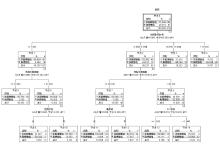
Fig.1
Decision tree model of cerebral infarction after surgery for IFF among elderly patients"
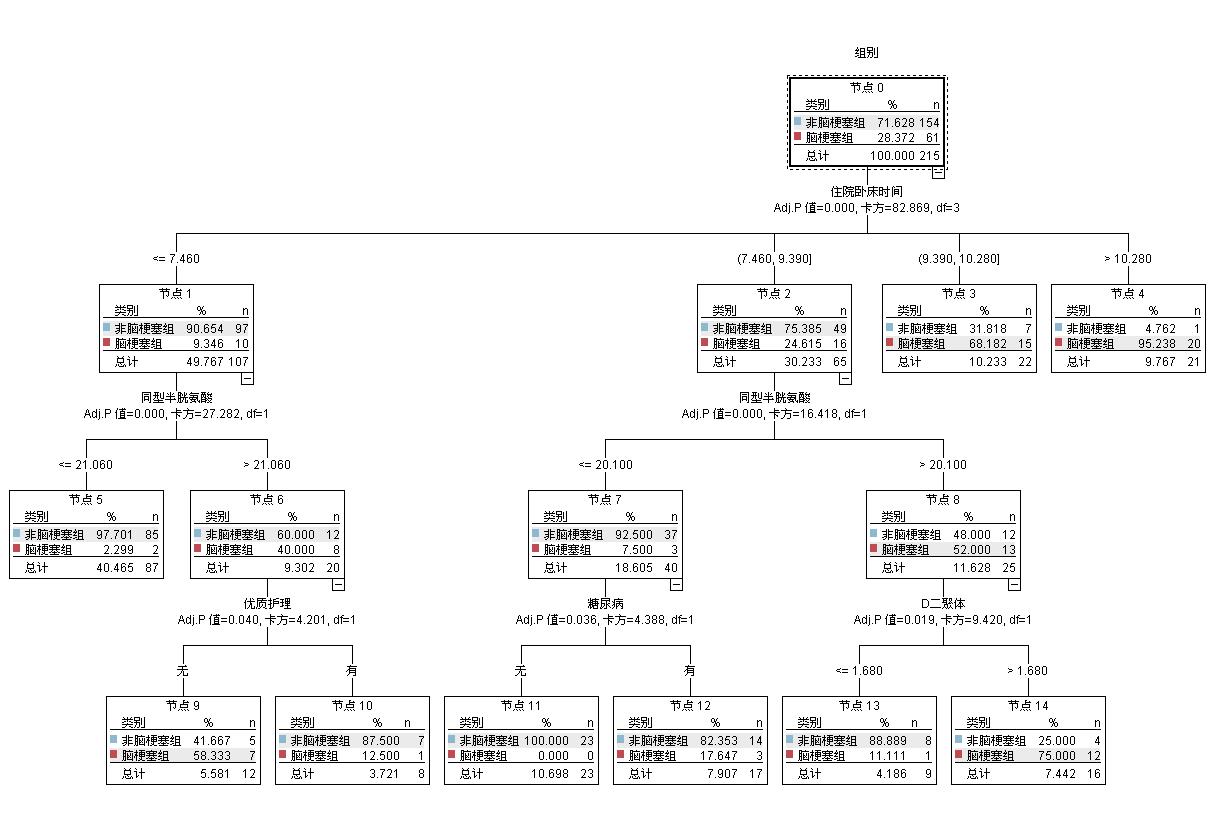
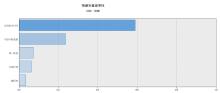
Fig.2
Ranking of predictive variables for postoperative cerebral infarction in elderly IFF patients"
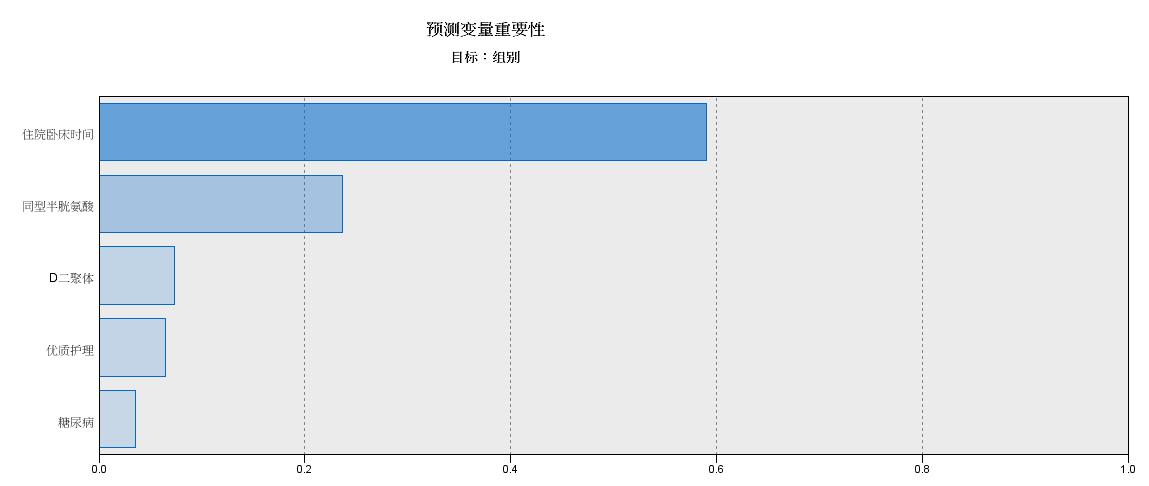
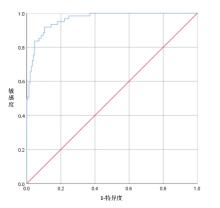
Fig.3
ROC curves of the decision tree model"
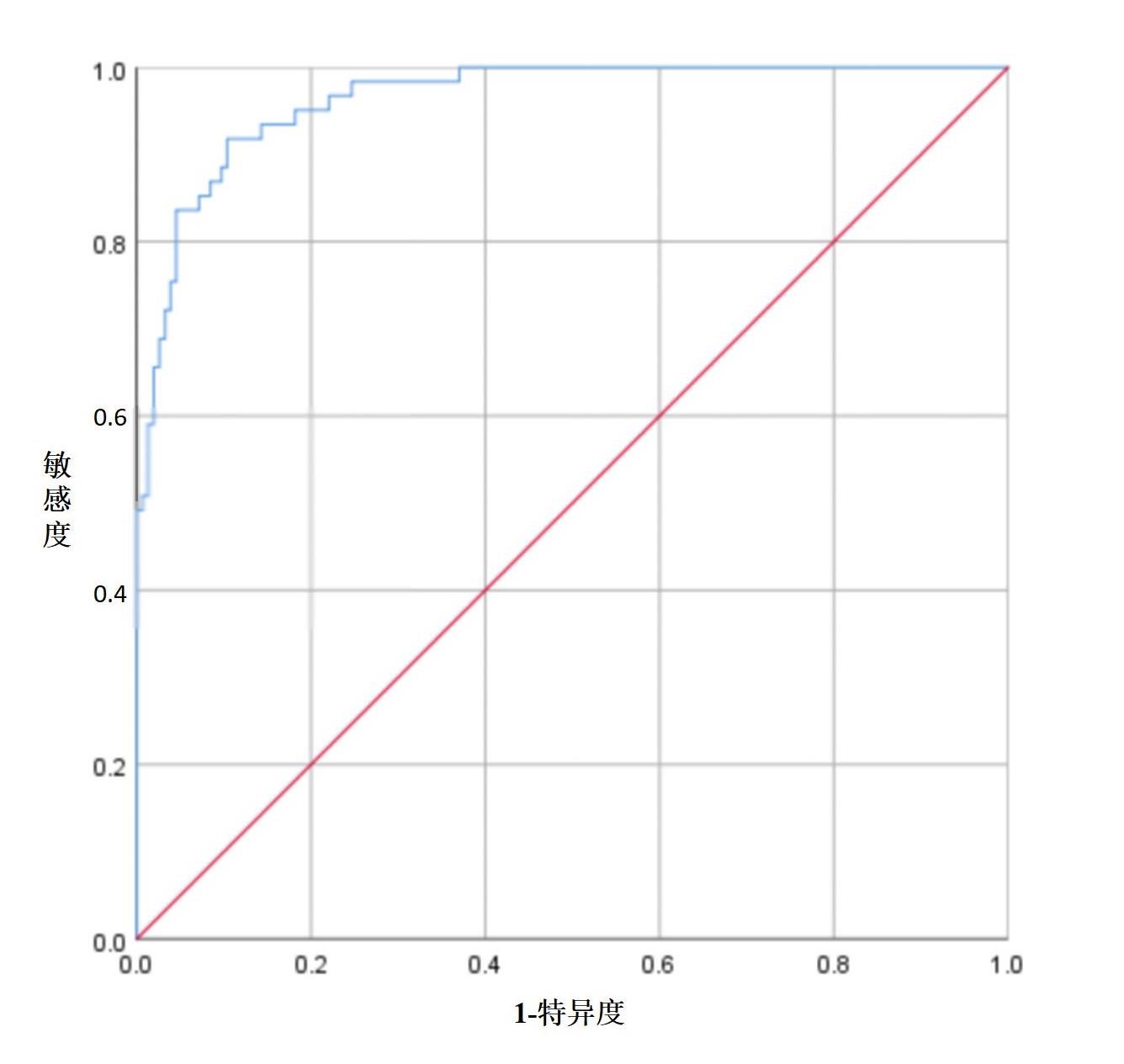
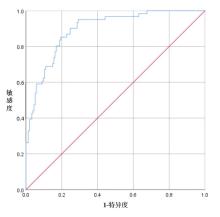
Fig.4
ROC curves of the logistic regression model"
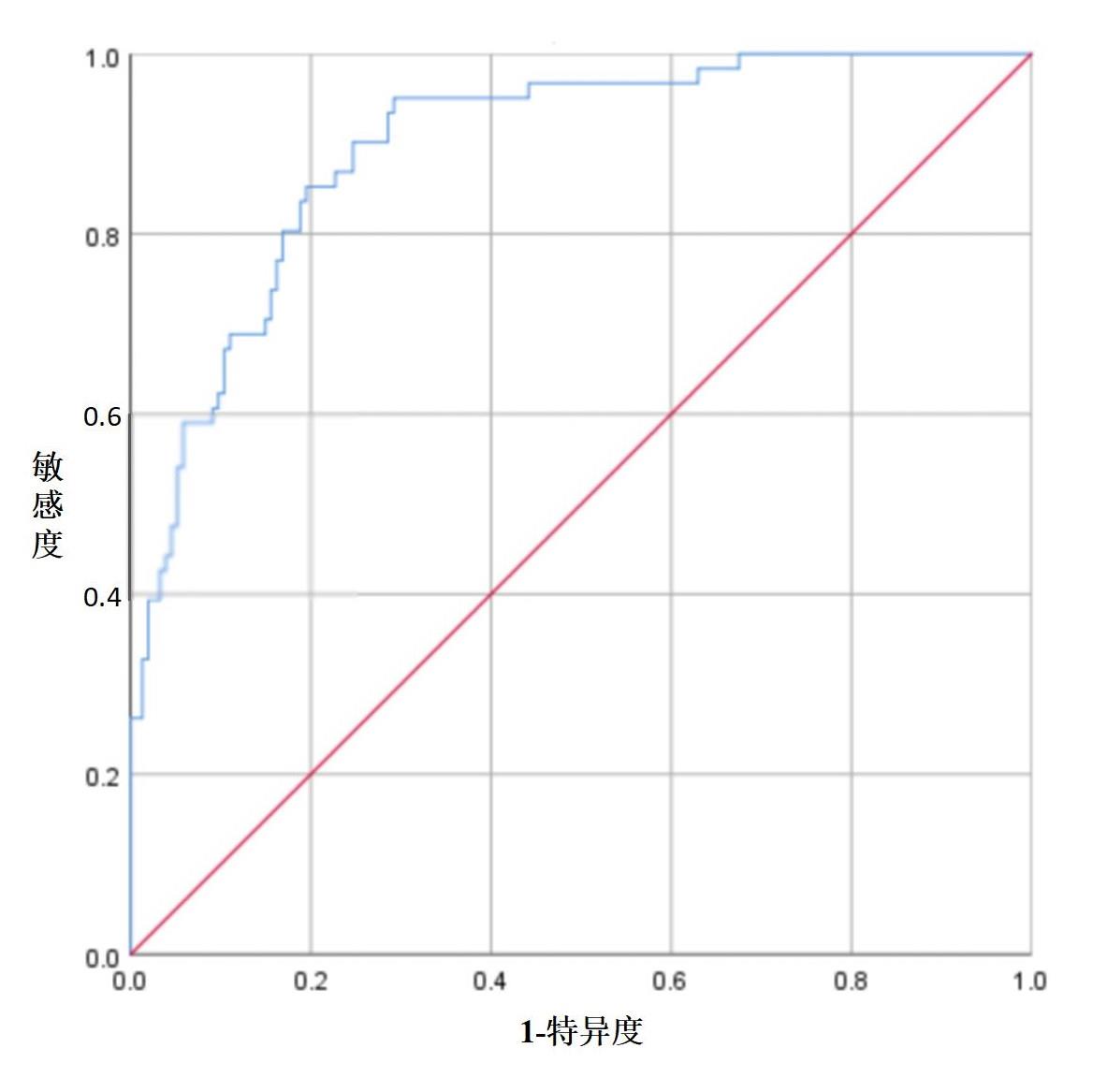
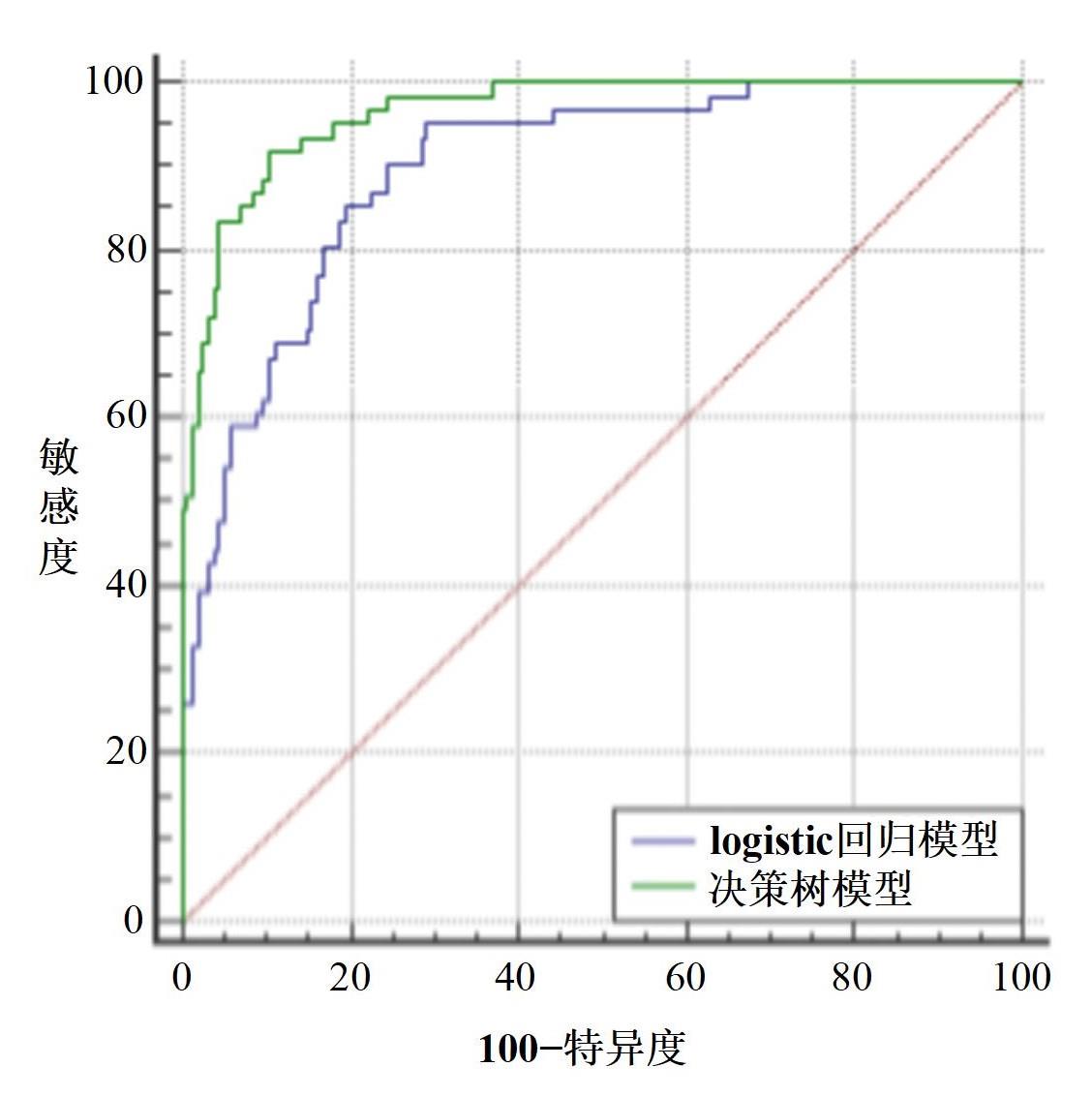
Fig.5
Comparison of ROC curves between decision tree model and logistic regression model"
Tab.4
Comparison of prediction performance between two models"
| 模型 | AUC | 标准误 | P值 | 95%CI |
|---|---|---|---|---|
| logistic回归 | 0.896 | 0.022 5 | < 0.05 | 0.847 ~ 0.933 |
| 决策树模型 | 0.964 | 0.011 2 | < 0.05 | 0.930 ~ 0.985 |
| [1] |
KIM K, WOO S, KIM S H, et al. The prediction model of non-suicidal self-injury in psychiatric patients using decision tree analysis[J]. Yonsei Med J, 2024, 65(3): 137-147. doi:10.3349/ymj.2023.0129 .
doi: 10.3349/ymj.2023.0129 |
| [2] |
POLAT G, BAYRAM S, GÖKÇEOĞLU Y S, et al. The effect of bone morphology on fracture type and treatment result in patients with intertrochanteric femur fracture aged over 65 year[J]. Ulus Travma Acil Cerrahi Derg, 2022, 28(12): 1731-1738. doi:10.14744/tjtes.2022.57400 .
doi: 10.14744/tjtes.2022.57400 |
| [3] |
MENG Y, LIU Y, FU M, et al. Clinical characteristics of elderly hip fracture patients with chronic cerebrovascular disease and construction of a clinical predictive model for perioperative pneumonia[J]. Orthop Traumatol Surg Res, 2024, 110(3): 103821. doi:10.1016/j.otsr.2024.103821 .
doi: 10.1016/j.otsr.2024.103821 |
| [4] |
COSTA A, PAIS M, LOUREIRO J, et al. Decision tree-based classification as a support to diagnosis in the Alzheimer's disease continuum using cerebrospinal fluid biomarkers: Insights from automated analysis[J]. Braz J Psychiatry, 2022, 44(4): 370-377. doi:10.47626/1516-4446-2021-2277 .
doi: 10.47626/1516-4446-2021-2277 |
| [5] |
TOYODA H, TERAI H, YAMADA K, et al. A decision tree analysis to predict clinical outcome of minimally invasive lumbar decompression surgery for lumbar spinal stenosis with and without coexisting spondylolisthesis and scoliosis[J]. Spine J, 2023, 23(7): 973-981. doi:10.1016/j.spinee.2023.01.023 .
doi: 10.1016/j.spinee.2023.01.023 |
| [6] |
PEDUZZI P, CONCATO J, KEMPER E, et al. A simulation study of the number of events per variable in logistic regression analysis[J]. J Clin Epidemiol, 1996, 49(12): 1373-1379. doi:10.1016/s0895-4356(96)00236-3 .
doi: 10.1016/s0895-4356(96)00236-3 |
| [7] |
LIU L, LI Z, ZHOU H, et al. Chinese Stroke Association guidelines for clinical management of ischaemic cerebrovascular diseases: Executive summary and 2023 update[J]. Stroke Vasc Neurol, 2023, 8(6): e3. doi:10.1136/svn-2023-002998 .
doi: 10.1136/svn-2023-002998 |
| [8] |
ZHANG T, ZHAO Y N, NIU Z X, et al. Analysis of risk factors for readmission in elderly patients with hip fractures undergoing hip hemiarthroplasty[J]. China J Orthop Traumatol, 2022, 35(5): 460-463. doi:10.12200/j.issn.1003-0034.2022.05.010 .
doi: 10.12200/j.issn.1003-0034.2022.05.010 |
| [9] |
YUAN J, ZHU G, ZHAO Y, et al. Effect of hip fracture on prognosis of acute cerebral infarction[J]. Clinics, 2021, 76: e3059. doi:10.6061/clinics/2021/e3059 .
doi: 10.6061/clinics/2021/e3059 |
| [10] |
ZHANG Y, FU M, GUO J, et al. Characteristics and perioperative complications of hip fracture in the elderly with acute ischemic stroke: A cross-sectional study[J]. BMC Musculoskelet Disord, 2022, 23(1): 642. doi:10.1186/s12891-022-05585-2 .
doi: 10.1186/s12891-022-05585-2 |
| [11] |
RAJEEV V, FANN D Y, DINH Q N, et al. Pathophysiology of blood brain barrier dysfunction during chronic cerebral hypoperfusion in vascular cognitive impairment[J]. Theranostics, 2022, 12(4): 1639-1658. doi:10.7150/thno.68304 .
doi: 10.7150/thno.68304 |
| [12] |
KHANDELWAL S, LANE N E. Osteoporosis: Review of etiology, mechanisms, and approach to management in the aging population[J]. Endocrinol Metab Clin North Am, 2023, 52(2): 259-275. doi:10.1016/j.ecl.2022.10.009 .
doi: 10.1016/j.ecl.2022.10.009 |
| [13] |
CZERWINSKI E, CARDONA J, PLEBANSKI R, et al. The efficacy and safety of abaloparatide-SC in men with osteoporosis: A randomized clinical trial[J]. J Bone Miner Res, 2022, 37(12): 2435-2442. doi:10.1002/jbmr.4719 .
doi: 10.1002/jbmr.4719 |
| [14] |
钟智荣, 俞志茹, 钟智华, 等. 股骨粗隆间骨折患者术后并发心脑血管疾病风险因素分析[J]. 当代护士(上旬刊), 2023, 30(1): 66-69. doi:10.19791/j.cnki.1006-6411.2023.01.018 .
doi: 10.19791/j.cnki.1006-6411.2023.01.018 |
| [15] |
应金萍, 蔡根莲, 项雪佳, 等. 维持性血液透析患者并发脑梗死的危险因素分析[J/OL]. 中华危重症医学杂志(电子版), 2021, 14(3): 206-212. doi:10.3877/cma.j.issn.1674-6880.2021.03.006 .
doi: 10.3877/cma.j.issn.1674-6880.2021.03.006 |
| [16] |
牛稳, 邱晓晖, 刘艺超. 颈动脉粥样硬化狭窄的血管周围脂肪密度与脑梗死之间的关系[J]. 实用医学杂志, 2023, 39(1): 103-108.doi:10.3969/j.issn.1006-5725.2023.01.018 .
doi: 10.3969/j.issn.1006-5725.2023.01.018 |
| [17] |
黄慧, 苏金虎, 吴冰. 不同降压水平对老年高血压患者复合心血管事件的影响[J]. 实用医学杂志, 2023, 39(17): 2225-2229. doi:10.3969/j.issn.1006-5725.2023.17.013 .
doi: 10.3969/j.issn.1006-5725.2023.17.013 |
| [18] |
JIA H, HUANG B, KANG L, et al. Preoperative and intraoperative risk factors of postoperative stroke in total aortic arch replacement and stent elephant trunk implantation[J]. EClinicalMedicine, 2022, 47: 101416. doi:10.1016/j.eclinm.2022.101416 .
doi: 10.1016/j.eclinm.2022.101416 |
| [19] |
孔静渊, 郭巧云. 急性脑梗塞发病的危险因素及急性脑梗塞与凝血酶激活纤溶抑制物的相关性分析[J]. 血栓与止血学, 2022, 28(2): 230-232. doi:10.3969/j.issn.1009-6213.2022.02.022 .
doi: 10.3969/j.issn.1009-6213.2022.02.022 |
| [20] |
LAURETTA M P, MELOTTI R M, SANGERMANO C, et al. Homocysteine plasmatic concentration in brain-injured neurocritical care patients: Systematic review of clinical evidence[J]. J Clin Med, 2022, 11(2): 394. doi:10.3390/jcm11020394 .
doi: 10.3390/jcm11020394 |
| [21] |
蒋兴亮, 刘素兰, 易婷婷. 高同型半胱氨酸血症患者氧化应激指标的研究[J]. 检验医学, 2014, 29(2): 125-129. doi:10.3969/j.issn.1673-8640.2014.02.009 .
doi: 10.3969/j.issn.1673-8640.2014.02.009 |
| [22] | 范文慧. 急性Stanford A型主动脉夹层术后并发脑梗死相关因素分析[D]. 石家庄: 河北医科大学, 2023. |
| [23] |
周有婷, 李志鹏, 王嘉鹏. 急性脑梗死患者血清CTRP-3、D-二聚体、sTREM2水平及相关临床特征与溶栓后出血性转化的关系[J]. 中国现代医学杂志, 2023, 33(24): 60-66. doi:10.3969/j.issn.1005-8982.2023.24.011 .
doi: 10.3969/j.issn.1005-8982.2023.24.011 |
| [24] |
KONISHI T, INOKUCHI H, SASABUCHI Y, et al. Association between care-need level after discharge and long-term outcomes in 7491 patients requiring rehabilitation for stroke[J]. JMA J, 2024, 7(1): 52-59. doi:10.31662/jmaj.2023-0094 .
doi: 10.31662/jmaj.2023-0094 |
| [25] |
李莹, 陈杰, 沙培, 等. 个性化康复训练结合循证护理在老年股骨粗隆间骨折患者术后康复中的应用[J]. 中西医结合护理(中英文), 2024, 10(2): 112-114. doi:10.11997/nitcwm.202402033 .
doi: 10.11997/nitcwm.202402033 |
| [26] | DU P, WU X, LIU X, et al. The application of decision tree model based on clinicopathological risk factors and pre-operative MRI radiomics for predicting short-term recurrence of glioblastoma after total resection: A retrospective cohort study[J]. Am J Cancer Res, 2023, 13(8): 3449-3462. |
| [27] |
TANAKA S, JUNG H, YAMASHINA S, et al. Clinical prediction rule for locomotive syndrome in older adults: A decision tree model[J]. J Orthop Sci, 2023, 28(4): 886-894. doi:10.1016/j.jos.2022.04.008 .
doi: 10.1016/j.jos.2022.04.008 |
| [28] |
HEINRICH M, WOIKE J K, SPIES C D, et al. Forecasting postoperative delirium in older adult patients with fast-and-frugal decision trees[J]. J Clin Med, 2022, 11(19): 5629. doi:10.3390/jcm11195629 .
doi: 10.3390/jcm11195629 |
| Viewed | ||||||
|
Full text |
|
|||||
|
Abstract |
|
|||||
