

The Journal of Practical Medicine ›› 2026, Vol. 42 ›› Issue (6): 1088-1096.doi: 10.3969/j.issn.1006-5725.2026.06.023
• Treatise: Clinical Practice • Previous Articles
Wei GONG1( ),Tianle GAO1,Jin WANG2
Received:2025-12-18
Revised:2026-01-21
Accepted:2026-01-23
Online:2026-03-25
Published:2026-03-26
Contact:
Wei GONG
E-mail:como0912@163.com
CLC Number:
Wei GONG,Tianle GAO,Jin WANG. Analysis of influencing factors for secondary fractures in adjacent vertebrae after percutaneous kyphoplasty in patients with osteoporotic vertebral compression fractures based on sagittal parameters of the spine-pelvis, fracture characteristics, and treatment-related clinical features[J]. The Journal of Practical Medicine, 2026, 42(6): 1088-1096.

Tab.1
Comparison of clinical data and spinal pelvic sagittal plane parameters between two groups"
| 因素 | 发生组(n = 54) | 未发生组(n = 186) | t/χ2 值 | P值 |
|---|---|---|---|---|
| 外伤史/[例(%)] | 14(25.93) | 40(21.51) | 0.469 | 0.493 |
| 高血压/[例(%)] | 17(31.48) | 43(23.12) | 1.561 | 0.211 |
| 糖尿病/[例(%)] | 29(53.70) | 45(24.19) | 17.089 | < 0.001 |
| 冠心病/[例(%)] | 11(20.37) | 33(17.74) | 0.193 | 0.660 |
| 术前骨密度/SD | 2.43 ± 0.21 | 2.41 ± 0.19 | 0.665 | 0.507 |
| 骨折至入院时间/[例(%)] | 0.461 | 0.497 | ||
| ≤ 24 h | 21(38.89) | 82(44.09) | ||
| > 24 h | 33(61.11) | 104(55.91) | ||
| 骨折压缩程度/[例(%)] | 4.102 | 0.043 | ||
| Ⅰ度 | 20(37.04) | 98(52.69) | ||
| Ⅱ度/Ⅲ度 | 34(62.96) | 88(47.31) | ||
| AO分型/[例(%)] | 1.891 | 0.059 | ||
| A1 | 46(85.19) | 134(72.04) | ||
| A2 | 1(1.85) | 12(6.45) | ||
| A3 | 4(7.41) | 21(11.29) | ||
| A4 | 3(5.56) | 19(10.22) | ||
| 初始骨折部位/[例(%)] | 11.789 | 0.001 | ||
| T10—L2 | 39(72.22) | 85(45.70) | ||
| 非T10—L2 | 15(27.78) | 101(54.30) | ||
| 骨水泥量/mL | 3.98 ± 1.02 | 3.87 ± 0.97 | 0.725 | 0.469 |
| 骨水泥椎间盘渗漏/[例(%)] | 22(40.74) | 25(13.44) | 19.805 | < 0.001 |
| 椎体高度恢复率/% | 8.54 ± 2.03 | 10.51 ± 3.28 | 4.183 | < 0.001 |
| 存在陈旧性骨折/[例(%)] | 11(20.37) | 26(13.98) | 1.311 | 0.252 |
| 前壁骨折/[例(%)] | 28(51.85) | 88(47.31) | 0.345 | 0.557 |
| 上终板塌陷/[例(%)] | 35(64.81) | 98(52.69) | 2.491 | 0.115 |
| 多节段骨折/[例(%)] | 24(44.44) | 36(19.35) | 14.050 | < 0.001 |
| 终板损伤/[例(%)] | 52(96.30) | 174(93.55) | 0.184* | 0.668 |
| 骨折线达终板/[例(%)] | 34(62.96) | 97(52.15) | 1.974 | 0.160 |
| 椎间盘损伤/[例(%)] | 18(33.33) | 26(13.98) | 10.471 | 0.001 |
| 手术方式/[例(%)] | 29(53.70) | 91(48.92) | 0.382 | 0.536 |
| 骨水泥分布形态/[例(%)] | 0.499 | 0.617 | ||
| Ⅰ型 | 36(66.67) | 126(67.74) | ||
| Ⅱ型 | 12(22.22) | 15(8.06) | ||
| Ⅲ型 | 2(3.70) | 7(3.76) | ||
| Ⅳ型 | 3(5.56) | 33(17.74) | ||
| Ⅴ型 | 1(1.85) | 5(2.69) | ||
| TK/° | 42.54 ± 12.54 | 35.43 ± 8.32 | 4.880 | < 0.001 |
| TLK/° | 11.43 ± 3.12 | 10.95 ± 2.08 | 1.320 | 0.188 |
| SVA/mm | 26.54 ± 6.32 | 13.65 ± 4.02 | 18.002 | < 0.001 |
| TPA/ mm | 34.54 ± 9.17 | 23.98 ± 6.27 | 9.731 | < 0.001 |
| PT/° | 21.54 ± 4.87 | 21.39 ± 4.61 | 0.208 | 0.836 |
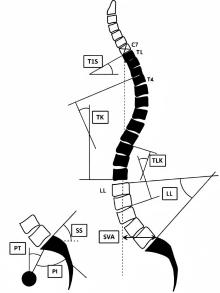
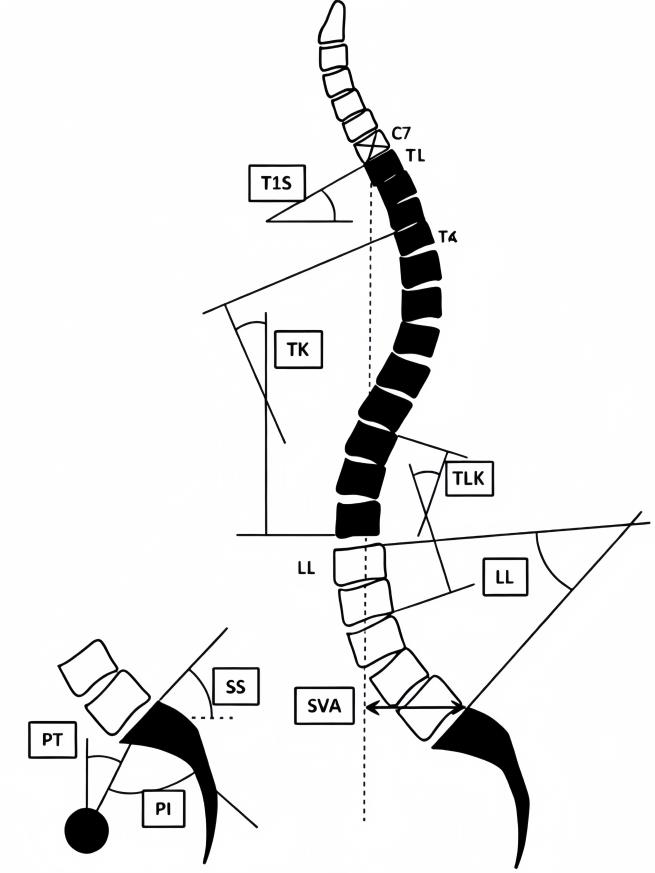
Fig.1
Schematic diagram of spinal pelvic sagittal imaging parameter measurement"
Tab.2
Assignment table of influencing factors"
| 因素 | 变量性质 | 赋值 |
|---|---|---|
| 术后AVCF发生情况 | Y | 0=无,1=有 |
| 糖尿病 | X1 | 0=无,1=有 |
| 骨折压缩程度 | X2 | 0=Ⅰ度,1=Ⅱ度/Ⅲ度 |
| 初始骨折部位 | X3 | 0=非T10—L2,1=T10—L2 |
| 骨水泥椎间盘渗漏 | X4 | 0=无,1=有 |
| 多节段骨折 | X5 | 0=否,1=是 |
| 椎间盘损伤 | X6 | 0=无,1=有 |
| 椎体高度恢复率 | X7 | 原值输入 |
| TK | X8 | 原值输入 |
| SVA | X9 | 原值输入 |
| TPA | X10 | 原值输入 |
Tab.3
Risk factors analysis of AVCF in OVCF patients after PKP surgery"
| 变量 | β | SE | Wald χ2 | P值 | OR | 95%CI |
|---|---|---|---|---|---|---|
| 有糖尿病 | 0.879 | 0.243 | 13.085 | < 0.001 | 2.408 | 1.496 ~ 3.878 |
| Ⅱ度/Ⅲ度骨折压缩 | 1.043 | 0.490 | 4.531 | 0.033 | 2.838 | 1.086 ~ 7.414 |
| 初始骨折部位为T10—L2 | 0.471 | 0.511 | 0.850 | 0.357 | 1.602 | 0.588 ~ 4.360 |
| 骨水泥椎间盘渗漏 | 0.436 | 0.101 | 18.635 | < 0.001 | 1.547 | 1.269 ~ 1.885 |
| 多节段骨折 | 0.768 | 0.203 | 14.313 | < 0.001 | 2.155 | 1.448 ~ 3.209 |
| 椎间盘损伤 | 1.113 | 0.497 | 5.015 | 0.025 | 3.043 | 1.149 ~ 8.062 |
| 椎体高度恢复率 | -1.114 | 0.213 | 27.353 | < 0.001 | 0.328 | 0.216 ~ 0.498 |
| TK | 0.733 | 0.117 | 39.250 | < 0.001 | 2.081 | 1.655 ~ 2.618 |
| SVA | 0.832 | 0.234 | 12.642 | < 0.001 | 2.298 | 1.453 ~ 3.635 |
| TPA | 0.492 | 0.118 | 17.385 | < 0.001 | 1.636 | 1.298 ~ 2.061 |
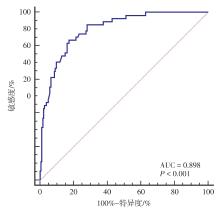
Fig.2
ROC curve of predicting AVCF after PKP in OVCF patients using logistic regression equation"
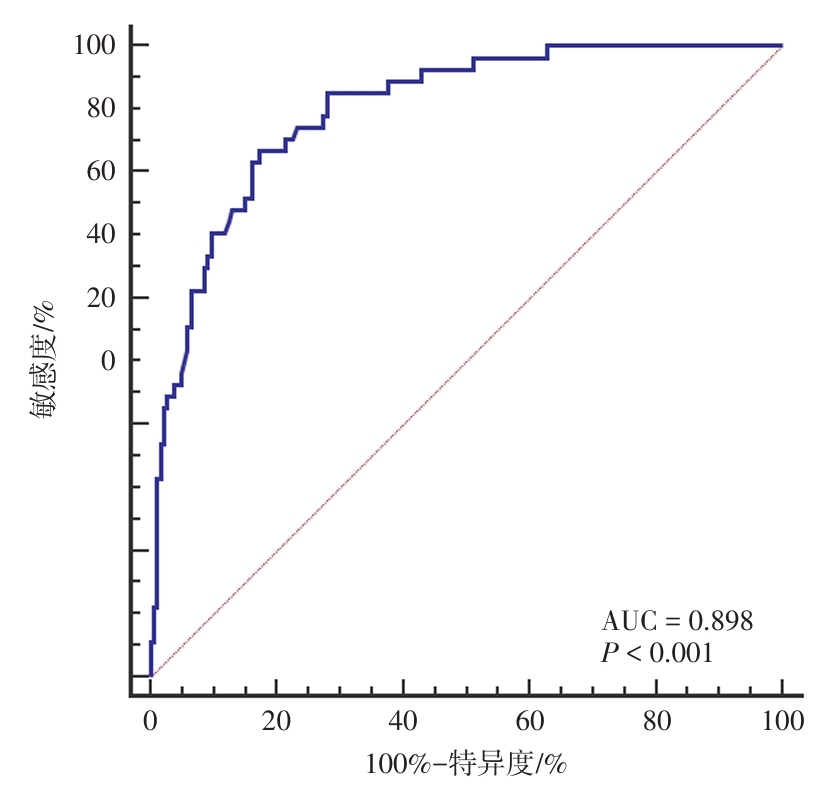
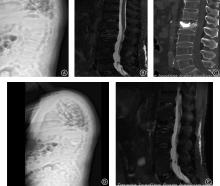
Fig.3
Typical case 1"
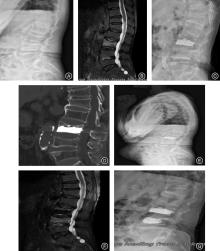
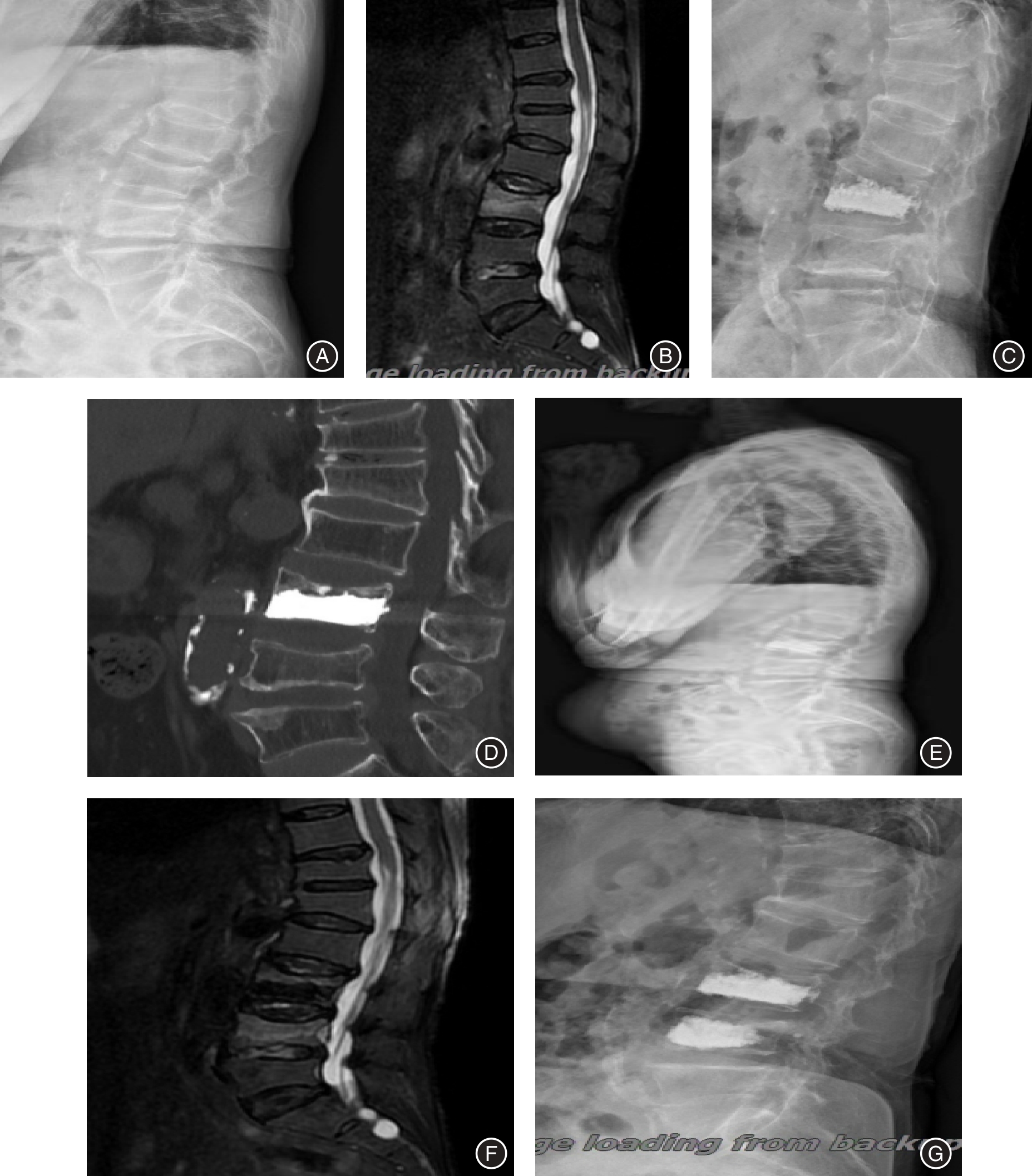
Fig.4
Typical case 2"
| [1] |
张宁宁, 徐玉生, 徐远志, 等. 侧开口套管椎体成形术治疗骨质疏松性椎体压缩骨折[J]. 实用医学杂志, 2021, 37(7): 889-893. doi:10.3969/j.issn.1006-5725.2021.07.012 .
doi: 10.3969/j.issn.1006-5725.2021.07.012 |
| [2] |
CHO C H, HWANG S W, MAZANEC D J, et al. Guideline summary review: An evidence-based clinical guideline for the diagnosis and treatment of adults with osteoporotic vertebral compression fractures[J]. Spine J, 2025, 25(8): 1670-1687. doi:10.1016/j.spinee.2025.01.016 .
doi: 10.1016/j.spinee.2025.01.016 |
| [3] |
QIAO Y, WANG X, LIU Y, et al. Clinical efficacy of modified percutaneous kyphoplasty (PKP) vs. conventional PKP for osteoporotic vertebral compression fractures: A single-center retrospective study[J]. Eur Rev Med Pharmacol Sci, 2023, 27(19): 9121-9131. doi:10.26355/eurrev_202310_33938 .
doi: 10.26355/eurrev_202310_33938 |
| [4] |
CAI D, ZHANG B, LI J, et al. Clinical effect of percutaneous kyphoplasty and percutaneous vertebroplasty in managing osteoporotic vertebral compression fractures: A single-center propensity score-matched study[J]. Ann Ital Chir, 2024, 95(5): 848-858. doi:10.62713/aic.3634 .
doi: 10.62713/aic.3634 |
| [5] |
XUE Y, ZHANG J, ZHANG Z, et al. Clinical outcomes with second injection after insufficient bone cement distribution in unilateral kyphoplasty for osteoporotic vertebral compressive fracture: A cohort retrospective study[J]. J Orthop Surg Res, 2023, 18(1): 530. doi:10.1186/s13018-023-03968-2 .
doi: 10.1186/s13018-023-03968-2 |
| [6] | 胥少汀, 葛宝丰, 徐印坎. 实用骨科学[M]. 4版. 北京: 人民军医出版社, 2012: 56-59. |
| [7] |
黄徐兵,焦伟,翟云雷, 等. 骨质疏松性椎体压缩骨折损伤程度对经皮椎体后凸成形术后骨水泥皮质渗漏影响的研究[J]. 中国修复重建外科杂志, 2023, 37(4): 452-456. doi:10.7507/1002-1892.202212066 .
doi: 10.7507/1002-1892.202212066 |
| [8] |
LAMBRECHTS M J, SCHROEDER G D, CONAWAY W, et al. Management of C0 sacral fractures based on the AO spine sacral injury classification: A narrative review[J]. Clin Spine Surg, 2023, 36(2): 43-53. doi:10.1097/BSD.0000000000001384 .
doi: 10.1097/BSD.0000000000001384 |
| [9] |
唐本强, 王彦辉, 许崧杰, 等. 骨质疏松性椎体压缩骨折经皮椎体强化术后椎体内骨水泥分布类型的研究进展[J]. 中华骨科杂志, 2022, 42(5): 320-330. doi:10.3760/cma.j.cn121113-20210129-00089 .
doi: 10.3760/cma.j.cn121113-20210129-00089 |
| [10] |
田烨, 袁秋文, 胡梁深. 骨质疏松椎体压缩性骨折患者术后再骨折的风险列阵图构建与验证[J]. 实用医学杂志, 2023, 39(18): 2294-2299. doi:10.3969/j.issn.1006-5725.2023.18.002 .
doi: 10.3969/j.issn.1006-5725.2023.18.002 |
| [11] |
ZHOU L, GU J, XU F, et al. Efficacy analysis of PKP and PMCP in treatment of osteoporotic vertebral compression fracture[J]. Niger J Clin Pract, 2025, 28(5): 641-647. doi:10.4103/njcp.njcp_22_24 .
doi: 10.4103/njcp.njcp_22_24 |
| [12] |
潘辉龙, 张国如, 谢行思, 等. 骨质疏松性椎体压缩骨折经皮椎体后凸成形术后脊柱-骨盆矢状面参数变化及其对邻近椎体继发骨折的影响[J]. 中国脊柱脊髓杂志, 2025, 35(8): 828-836. doi:10.3969/j.issn.1004-406X.2025.08.07 .
doi: 10.3969/j.issn.1004-406X.2025.08.07 |
| [13] |
TAKEMASA R, KONISHI H, MINAMIDE A, et al. Effectiveness and safety of vertebral body stenting for acute spinal compression fractures due to primary osteoporosis: A multicenter prospective clinical study[J]. Spine Surg Relat Res, 2024, 8(4): 415-426. doi:10.22603/ssrr.2023-0248 .
doi: 10.22603/ssrr.2023-0248 |
| [14] |
LI T, PANG S, ENGLAND R, et al. Clinical outcomes and safety comparison of vertebroplasty, balloon kyphoplasty, and vertebral implant for treatment of vertebral compression fractures[J]. AJNR Am J Neuroradiol, 2023, 44(11): 1345-1351. doi:10.3174/ajnr.A8031 .
doi: 10.3174/ajnr.A8031 |
| [15] |
LI C, LAI X M, LIU N, et al. Correlation analysis of the vertebral compression degree and CT HU value in elderly patients with osteoporotic thoracolumbar fractures[J]. J Orthop Surg Res, 2023, 18(1): 457. doi:10.1186/s13018-023-03941-z .
doi: 10.1186/s13018-023-03941-z |
| [16] |
邵梦琪, 高远, 邱晨, 等. 老年椎体骨折术后患者骨质疏松症知识掌握现状及影响因素分析[J]. 中华护理杂志, 2024, 59(24): 2995-3002. doi:10.3761/j.issn.0254-1769.2024.24.008 .
doi: 10.3761/j.issn.0254-1769.2024.24.008 |
| [17] |
XIE S, CUI L, WANG C, et al. Contact between leaked cement and adjacent vertebral endplate induces a greater risk of adjacent vertebral fracture with vertebral bone cement augmentation biomechanically[J]. Spine J, 2025, 25(2): 324-336. doi:10.1016/j.spinee.2024.09.021 .
doi: 10.1016/j.spinee.2024.09.021 |
| [18] |
SAEED M U, BIN W, SHENG J, et al. An automated multi-scale feature fusion network for spine fracture segmentation using computed tomography images[J]. J Imag Inform Med, 2024, 37(5): 2216-2226. doi:10.1007/s10278-024-01091-0 .
doi: 10.1007/s10278-024-01091-0 |
| [19] |
ZHANG Y, WANG W, BAI L, et al. A comparison of outcomes between the wiltse approach with pedicle screw fixation and the percutaneous pedicle screw fixation for multi-segmental thoracolumbar fractures[J]. Orthop Surg, 2023, 15(9): 2363-2372. doi:10.1111/os.13816 .
doi: 10.1111/os.13816 |
| [20] |
KUMAR A, KUMAR N, PATHAK Z, et al. Extra cellular matrix remodeling: An adjunctive target for spinal cord injury and intervertebral disc degeneration[J]. Neurospine, 2022, 19(3): 632-645. doi:10.14245/ns.2244366.183 .
doi: 10.14245/ns.2244366.183 |
| [21] |
童奕博, 李明辉. 骨质疏松性椎体骨折患者椎体成形后邻近椎体再发骨折的影响因素[J]. 中国组织工程研究, 2024, 28(8): 1241-1246. doi:10.12307/2023.958 .
doi: 10.12307/2023.958 |
| [22] |
ŁAZIŃSKI M, NIEMYJSKI W, NIEMYJSKI M, et al. Mobility of the lumbo-pelvic-hip complex (spinopelvic mobility) and sagittal spinal alignment-implications for surgeons performing hip arthroplasty[J]. Arch Orthop Trauma Surg, 2024, 144(5): 1945-1953. doi:10.1007/s00402-024-05241-5 .
doi: 10.1007/s00402-024-05241-5 |
| [23] |
BO J, ZHAO X, HUA Z, et al. Impact of sarcopenia and sagittal parameters on the residual back pain after percutaneous vertebroplasty in patients with osteoporotic vertebral compression fracture[J]. J Orthop Surg Res, 2022, 17(1): 111. doi:10.1186/s13018-022-03009-4 .
doi: 10.1186/s13018-022-03009-4 |
| [24] |
SURESH S J, MARGALIT A, SPONSELLER P D. Evaluating the sagittal spinal and pelvic parameters in Marfan syndrome patients affected by scoliosis[J]. Spine Deform, 2022, 10(4): 873-881. doi:10.1007/s43390-022-00484-x .
doi: 10.1007/s43390-022-00484-x |
| [25] |
LIU C, HU F, LI Z, et al. Anterior pelvic plane: A potentially useful pelvic anatomical reference plane in assessing the patients' ideal pelvic parameters without the influence of spinal sagittal deformity[J]. Global Spine J, 2022, 12(4): 567-572. doi:10.1177/2192568220958676 .
doi: 10.1177/2192568220958676 |
| [26] |
OHASHI M, HASEGAWA K, HATSUSHIKANO S, et al. Anatomical pelvic parameters using the anterior pelvic plane: Relationships with standing sagittal spinal alignment and estimated lumbar alignment in healthy volunteers[J]. Spine Surg Relat Res, 2024, 9(4): 469-476. doi:10.22603/ssrr.2024-0283 .
doi: 10.22603/ssrr.2024-0283 |
| Viewed | ||||||
|
Full text |
|
|||||
|
Abstract |
|
|||||
