

The Journal of Practical Medicine ›› 2026, Vol. 42 ›› Issue (12): 2194-2199.doi: 10.3969/j.issn.1006-5725.2026.12.014
• Chronic Disease Control • Previous Articles
Yanling LIU( ),Huimin ZHANG,Jingjing YUE,Xiaojing CHEN
Received:2026-03-12
Online:2026-06-25
Published:2026-06-30
Contact:
Yanling LIU
E-mail:355629717@qq.com
CLC Number:
Yanling LIU,Huimin ZHANG,Jingjing YUE,Xiaojing CHEN. Value of plasma C4d combined with complements C3 and C4 in the diagnosis and prognosis prediction of systemic lupus erythematosus combined with lupus nephritis[J]. The Journal of Practical Medicine, 2026, 42(12): 2194-2199.
Tab.1
Comparison of plasma C4d, complements C3 and C4 levels between SLE-LN group and simple SLE group"
| 组别 | C4d/(mg/L) | 补体C3/(g/L) | 补体C4/(g/L) |
|---|---|---|---|
| SLE-LN组(n = 38) | 0.43 ± 0.16 | 0.68 ± 0.17 | 0.14 ± 0.03 |
| 单纯SLE组(n = 60) | 0.31 ± 0.12 | 0.92 ± 0.23 | 0.17 ± 0.05 |
| t值 | 4.231 | 5.541 | 3.334 |
| P值 | < 0.001 | < 0.001 | 0.001 |
Tab.2
Comparison of C4d, complement C3 and C4 levels in SLE-LN patients with different pathological types"
| 病理类型 | C4d/(mg/L) | 补体C3/(g/L) | 补体C4/(g/L) |
|---|---|---|---|
| Ⅱ型(n = 4) | 0.36 ± 0.13 | 0.79 ± 0.19 | 0.16 ± 0.04 |
| Ⅲ型(n = 8) | 0.40 ± 0.14 | 0.71 ± 0.18 | 0.15 ± 0.04 |
| Ⅳ型(n = 16) | 0.51 ± 0.17 | 0.59 ± 0.14 | 0.12 ± 0.03 |
| Ⅴ型(n = 7) | 0.38 ± 0.15 | 0.77 ± 0.20 | 0.16 ± 0.05 |
| Ⅵ型(n = 3) | 0.34 ± 0.11 | 0.72 ± 0.16 | 0.15 ± 0.04 |
| F值 | 4.171 | 3.822 | 3.563 |
| P值 | < 0.001 | < 0.001 | 0.001 |
Tab.3
Comparison of 24h urine protein and renal function between SLE-LN group and simple SLE group"
| 组别 | 24 h尿蛋白/g | Scr/(μmol/L) | BUN/(mmol/L) | UA/(μmol/L) | eGFR/[mL/(min·1.73m2)] |
|---|---|---|---|---|---|
| SLE-LN组(n = 38) | 1.82 ± 0.72 | 163.27 ± 34.51 | 9.82 ± 2.63 | 392.52 ± 44.63 | 69.87 ± 12.72 |
| 单纯SLE组(n = 60) | 0.35 ± 0.12 | 82.48 ± 16.89 | 7.67 ± 2.24 | 278.19 ± 31.08 | 82.39 ± 10.95 |
| t值 | 15.532 | 15.472 | 4.325 | 14.946 | 5.177 |
| P值 | < 0.001 | < 0.001 | < 0.001 | < 0.001 | < 0.001 |
Tab.4
Correlation analysis between plasma C4d, complement C3, C4 and 24h urine protein, renal function"
| 指标 | 24 h尿蛋白 | Scr | BUN | UA | eGFR |
|---|---|---|---|---|---|
| C4d | |||||
| r值 | 0.802 | 0.728 | 0.709 | 0.698 | -0.792 |
| P值 | < 0.001 | < 0.001 | < 0.001 | < 0.001 | < 0.001 |
| C3 | |||||
| r值 | -0.716 | -0.716 | -0.652 | -0.669 | 0.727 |
| P值 | < 0.001 | < 0.001 | < 0.001 | < 0.001 | < 0.001 |
| C4 | |||||
| r值 | -0.699 | -0.694 | -0.633 | -0.628 | 0.674 |
| P值 | < 0.001 | < 0.001 | < 0.001 | < 0.001 | < 0.001 |
Tab.5
Comparison of plasma C4d, complements C3 and C4 levels between poor prognosis group and good prognosis group x ± s"
| 组别 | C4d/(mg/L) | 补体C3/(g/L) | 补体C4/(g/L) |
|---|---|---|---|
| 预后不良组(n = 29) | 0.48 ± 0.19 | 0.64 ± 0.15 | 0.13 ± 0.03 |
| 预后良好组(n = 66) | 0.29 ± 0.11 | 0.96 ± 0.24 | 0.18 ± 0.06 |
| t值 | 6.135 | 6.623 | 4.251 |
| P值 | < 0.001 | < 0.001 | < 0.001 |
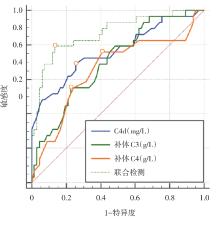
Fig.1
Predictive value of plasma C4d, complements C3 and C4 for prognosis of SLE patients"
Tab.6
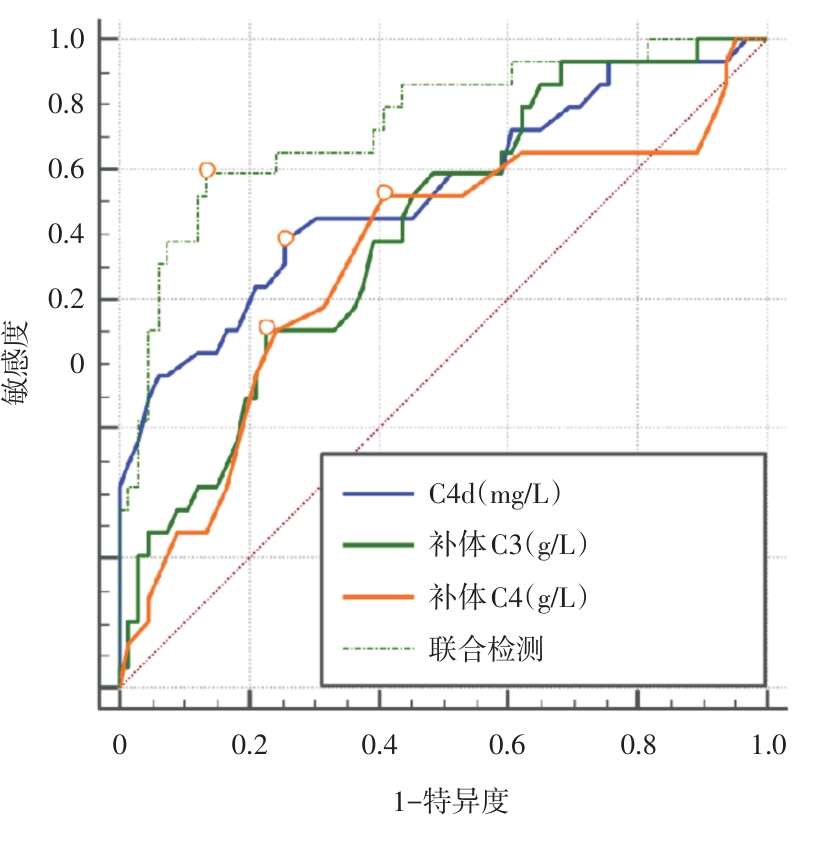
Predictive value of plasma C4d, complements C3 and C4 for prognosis of SLE patients"
| 指标 | AUC | 95%CI | 截断值 | 敏感度/% | 特异度/% | P值 |
|---|---|---|---|---|---|---|
| C4d | 0.763 | 0.665 ~ 0.844 | 0.37 mg/L | 68.97 | 74.24 | < 0.001 |
| 补体C3 | 0.671 | 0.567 ~ 0.764 | 0.70 g/L | 51.72 | 77.27 | 0.004 |
| 补体C4 | 0.659 | 0.555 ~ 0.753 | 0.15 g/L | 75.86 | 59.09 | 0.015 |
| 联合检测 | 0.868 | 0.783 ~ 0.929 | - | 79.31 | 86.36 | < 0.001 |
| [1] |
ELIA A, ZUCCHI D, SILVAGNI E, et al. Systemic lupus erythematosus: One year in review 2025[J]. Clin Exp Rheumatol, 2025,43(3):397-406. doi: 10.55563/clinexprheumatol/m0pi1k .
doi: 10.55563/clinexprheumatol/m0pi1k |
| [2] |
MORAND E F, FERNANDEZ-RUIZ R, BLAZER A, et al. Advances in the management of systemic lupus erythematosus[J]. BMJ, 2023,383(1):e073980. doi: 10.1136/bmj-2022-073980 .
doi: 10.1136/bmj-2022-073980 |
| [3] |
DAI X, FAN Y, ZHAO X. Systemic lupus erythematosus: Updated insights on the pathogenesis, diagnosis, prevention and therapeutics[J]. Signal Transduct Target Ther, 2025,10(1):102. doi: 10.1038/s41392-025-02168-0 .
doi: 10.1038/s41392-025-02168-0 |
| [4] |
WANG W, HE S, ZHANG W, et al. BCMA-CD19 compound CAR T cells for systemic lupus erythematosus: A phase 1 open-label clinical trial[J]. Ann Rheum Dis, 2024,83(10):1304-1314. doi: 10.1136/ard-2024-225785 .
doi: 10.1136/ard-2024-225785 |
| [5] |
田新平,李梦涛,曾小峰. 我国系统性红斑狼疮的诊治现状与未来发展方向:来自中国系统性红斑狼疮发展报告2020年年度报告[J]. 中华内科杂志,2022,61(6):611-616. doi:10.3760/cma.j.cn112138-20220324-00206 .
doi: 10.3760/cma.j.cn112138-20220324-00206 |
| [6] |
CHANG K, NA W, LIU C, et al. Peripheral CD4+CD8+ double positive T cells: A potential marker to evaluate renal impairment susceptibility during systemic lupus erythematosus[J]. J Biomed Res, 2022,37(1):59-68. doi: 10.7555/JBR.36.20220094 . Online ahead of print.
doi: 10.7555/JBR.36.20220094 |
| [7] |
WANG S S Y, TANG H, LOE M W C, et al. Complements and Their Role in Systemic Disorders[J]. Cureus, 2024,16(1):e52991. doi: 10.7759/cureus.52991. eCollection 2024 Jan .
doi: 10.7759/cureus.52991. eCollection 2024 Jan |
| [8] |
SHATRI H, PURNAMANDALA, HIDAYAT R, et al. The correlation of anxiety and depression with C3 and C4 Levels and systemic lupus erythematosus activity[J]. BMC Psychiatry, 2023, 23(1):785. doi: 10.1186/s12888-023-05285-8 .
doi: 10.1186/s12888-023-05285-8 |
| [9] |
傅嘉莹,田耘,李江徽,等.补体C4d与IgA肾病研究进展[J].中华实用诊断与治疗杂志, 2025, 39(2):189-192. doi:10.13507/j.issn.1674-3474.2025.02.017 .
doi: 10.13507/j.issn.1674-3474.2025.02.017 |
| [10] |
QIN S, WANG X, WANG J, et al. Complement C4d as a biomarker for systemic lupus erythematosus and lupus nephritis[J]. Lupus, 2024,33(2):111-120. doi: 10.1177/09612033231226351 .
doi: 10.1177/09612033231226351 |
| [11] |
ZAGOREC N, HORVATIĆ I, KASUMOVIĆ D, et al. C4d Is an Independent Predictor of the Kidney Failure in Primary IgA Nephropathy[J]. J Clin Med, 2024, 13(17):5338. doi: 10.3390/jcm13175338 .
doi: 10.3390/jcm13175338 |
| [12] |
国家皮肤与免疫疾病临床医学研究中心,中国系统性红斑狼疮研究协作组,中华医学会风湿病学分会. 中国系统性红斑狼疮诊疗指南(2025版)[J]. 中华医学杂志,2025,105(23):1879-1906. doi:10.12290/xhyxzz.2025-0726 .
doi: 10.12290/xhyxzz.2025-0726 |
| [13] |
中华医学会儿科学分会肾脏学组. 狼疮性肾炎诊治循证指南(2016)[J]. 中华儿科杂志,2018,56(2):88-94. doi:10.3760/cma.j.issn.0578-1310.2018.02.003 .
doi: 10.3760/cma.j.issn.0578-1310.2018.02.003 |
| [14] |
MA J, ZHANG L, YAN M, et al. Value of SLE-DAS in assessing disease activity in patients with systemic lupus erythematosus: A single-centre retrospective study[J]. Lupus Sci Med, 2024,11(1):e001196. doi: 10.1136/lupus-2024-001196 .
doi: 10.1136/lupus-2024-001196 |
| [15] |
YOO E J, OH K H, PIAO H, et al. Macrophage transcription factor TonEBP promotes systemic lupus erythematosus and kidney injury via damage-induced signaling pathways[J]. Kidney Int, 2023, 104(1):163-180. doi: 10.1016/j.kint.2023.03.030 .
doi: 10.1016/j.kint.2023.03.030 |
| [16] |
SAMMARITANO L R, ASKANASE A, BERMAS B L, et al. 2024 American College of Rheumatology (ACR) Guideline for the Screening, Treatment, and Management of Lupus Nephritis[J]. Arthritis Rheumatol, 2025,77(9):1115-1135. doi: 10.1002/ art.43212 .
doi: 10.1002/ art.43212 |
| [17] |
王乾宇,陈美彤,郭兆安. NLRP3炎性小体在狼疮性肾炎发病机制中的作用及其研究进展[J]. 细胞与分子免疫学杂志,2025,41(10):929-936. doi:10.13423/j.cnki.cjcmi.009996 .
doi: 10.13423/j.cnki.cjcmi.009996 |
| [18] |
TSAI C Y, WU T H, OU S M, et al. The Pathogenesis, Potential Biomarkers and Novel Therapeutic Strategies for Tubulointerstitial Nephritis in Systemic Lupus Erythematosus-A Narrative Review[J]. Int J Mol Sci, 2025,26(22):10903. doi: 10.3390/ijms262210903 .
doi: 10.3390/ijms262210903 |
| [19] |
王佳丽,崔安凤,韩伟霞,等. 狼疮性肾炎中相关尿液生物标志物的研究进展[J]. 中国免疫学杂志, 2024, 40(10):2189-2193. doi:10.3969/j.issn.1000-484X.2024.10.029 .
doi: 10.3969/j.issn.1000-484X.2024.10.029 |
| [20] |
钱香,杨平. 活动期系统性红斑狼疮患者血清补体C3,C4,C1q水平变化及其诊断和鉴别诊断效能[J]. 山东医药, 2024, 64(36):36-39. doi:10.3969/j.issn.1002-266X.2024.36.007 .
doi: 10.3969/j.issn.1002-266X.2024.36.007 |
| [21] |
ZICKERT A, GRÖNWALL C, JUTO A, et al. Plasma C4d levels correlate with treatment response and renal activity in proliferative lupus nephritis[J]. Rheumatology (Oxford), 2025, 64(8):4825-4833. doi: 10.1093/rheumatology/keaf160 .
doi: 10.1093/rheumatology/keaf160 |
| [22] |
SAADATI N, MIRI M. Evaluation of serum C4d levels in patients with systemic lupus erythematosus and its relation to lupus nephritis[J]. Caspian J Intern Med, 2023,14(2):231-236. doi: 10.22088/cjim.14.2.231 .
doi: 10.22088/cjim.14.2.231 |
| [23] |
蒋道芳,马晓燕,王奕,等. 特发性膜性肾病患者血清补体C3水平与血压及估算肾小球滤过率的相关性分析[J]. 中华肾脏病杂志, 2024, 40(6):475-480. doi:10.3760/cma.j.cn441217-20231207-01213 .
doi: 10.3760/cma.j.cn441217-20231207-01213 |
| [24] |
JIANG X, LAN L, ZHOU Q, et al. Characteristics and renal survival of patients with lupus nephritis with glomerular immunoglobulin G4 deposition: A single-centre retrospective analysis[J]. Lupus Sci Med, 2022,9(1):e000690. doi: 10.1136/lupus-2022-000690 .
doi: 10.1136/lupus-2022-000690 |
| [25] |
TEYMUR A, TANG C, NAZIR F, et al. Urinary V-Set Ig Domain-Containing Protein 4 and Immune Complexes for Tracking Lupus Nephritis and Renal Pathology[J]. ACR Open Rheumatol, 2025, 7(5):e70044. doi: 10.1002/acr2.70044 .
doi: 10.1002/acr2.70044 |
| [26] |
WANG S, WU M, CHIRIBOGA L, et al. Membrane attack complex (MAC) deposition in renal tubules is associated with interstitial fibrosis and tubular atrophy: A pilot study[J]. Lupus Sci Med, 2022,9(1):e000576. doi: 10.1136/lupus-2021-000576 .
doi: 10.1136/lupus-2021-000576 |
| Viewed | ||||||
|
Full text |
|
|||||
|
Abstract |
|
|||||
