

The Journal of Practical Medicine ›› 2026, Vol. 42 ›› Issue (12): 2185-2193.doi: 10.3969/j.issn.1006-5725.2026.12.013
• Chronic Disease Control • Previous Articles
Bo WU1,2,3,Qiang WANG1,2,3( )
)
Received:2026-03-10
Online:2026-06-25
Published:2026-06-30
Contact:
Qiang WANG
E-mail:wqiang_1981@126.com
CLC Number:
Bo WU,Qiang WANG. Integrating multidimensional autoantibody profiles to develop and validate organ-specific risk models in systemic lupus erythematosus[J]. The Journal of Practical Medicine, 2026, 42(12): 2185-2193.
Tab.1
Baseline data for model validation"
| 变量 | 开发队列 (n = 170) | 验证队列 (n = 60) | P值 |
|---|---|---|---|
| 年龄(x ± s)/岁 | 47.71 ± 15.62 | 46.5 ± 14.8 | 0.59 |
| 女性 | 157(92.4) | 55(91.7) | 1.00 |
| 疾病持续时间[M(P25,P75)]/月 | 12(6,36) | 11(6,30) | - |
| SLEDAI(x ± s)/分 | 7.2 ± 4.1 | 7.0 ± 4.3 | 0.75 |
| 低补体C3 | 88(51.8) | 31(51.7) | 0.99 |
| 肾脏受累 | 54(31.8) | 19(31.7) | 0.99 |
| 肺受累 | 20(11.8) | 8(13.3) | 0.75 |
| 浆膜受累 | 30(17.6) | 9(15.0) | 0.64 |
| 血液学受累 | 40(23.5) | 16(26.7) | 0.63 |
| 皮肤受累 | 92(54.1) | 30(50.0) | 0.58 |
Tab.2
Results of logistic regression analysis of organ/system involvement"
| 器官或系统 | 因素 | β | 标准误SE | P值 | OR | OR(95%CI) | |
|---|---|---|---|---|---|---|---|
| 下限 | 上限 | ||||||
| 浆膜系统 | P0(+) | 1.440 | 0.583 | 0.013 | 4.330 | 1.348 | 13.215 |
| NUC(+) | 1.459 | 0.619 | 0.018 | 4.303 | 1.279 | 14.482 | |
| 肾脏 | Ro52(+) | 1.005 | 0.441 | 0.022 | 2.733 | 1.152 | 6.481 |
| 肺 | ln(年龄) | 0.058 | 0.014 | < 0.001 | 1.059 | 1.031 | 1.089 |
| 皮肤 | ln(年龄) | -0.035 | 0.013 | 0.009 | 0.966 | 0.941 | 0.991 |
| ln(病程) | 0.072 | 0.029 | 0.014 | 1.075 | 1.015 | 1.139 | |
| dsDNA(+) | 1.150 | 0.440 | 0.009 | 3.159 | 1.333 | 7.486 | |
| 血液系统 | nRNP/Sm(+) | 0.854 | 0.402 | 0.031 | 2.350 | 1.070 | 5.170 |
| 关节 | NUC(+) | 1.705 | 0.566 | 0.003 | 5.500 | 1.185 | 16.665 |
| AMA-M2 | -1.392 | 0.700 | 0.047 | 0.248 | 0.063 | 0.979 | |
| 肝功能 | HIS(+) | 0.742 | 0.510 | 0.146 | 2.100 | 0.770 | 7.710 |
| dsDNA(+) | 0.223 | 0.340 | 0.512 | 1.250 | 0.640 | 2.430 | |
| ln(年龄) | -0.051 | 0.150 | 0.732 | 0.950 | 0.710 | 1.270 | |
| ln(病程) | 0.095 | 0.090 | 0.290 | 1.100 | 0.920 | 1.310 | |
Tab.3
Performance indicators of prediction models for organ involvement in the development cohort"
| 预测模型 | AUC(95%CI) | 敏感度/% | 特异度/% | 阳性预测值/% | 阴性预测值/% |
|---|---|---|---|---|---|
| 浆膜系统受累 | 0.78(0.70 ~ 0.85) | 80 | 68 | 34 | 95 |
| 肾脏受累 | 0.65(0.56 ~ 0.73) | 65 | 60 | 60 | 65 |
| 肺受累 | 0.60(0.51 ~ 0.68) | 60 | 55 | 55 | 60 |
| 皮肤受累 | 0.72(0.64 ~ 0.80) | 75 | 62 | 60 | 77 |
| 血液系统受累 | 0.61(0.52 ~ 0.70) | 60 | 58 | 50 | 68 |
| 关节受累 | 0.80(0.72 ~ 0.88) | 85 | 70 | 45 | 95 |
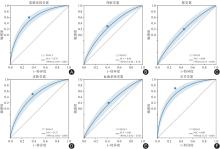
Fig.1
ROC curves of the 6 models"
Tab.4
Results of ROC analysis for the involvement risk prediction model"
| 数据集/模型 | AUC(95%CI) | 灵敏度/% | 特异度/% | Youden指数 |
|---|---|---|---|---|
| 全样本模型 | 0.88(0.81 ~ 0.94) | 85 | 80 | 0.65 |
| 10折交叉验证平均 | 0.86(0.78 ~ 0.93) | 82 | 78 | 0.60 |
Tab.5
Hosmer-Lemeshow test and brier score of prediction models for each organ/system"
| 预测模型(器官/系统) | Hosmer-Lemeshow χ2 | df | P值 | Brier分数 |
|---|---|---|---|---|
| 浆膜系统受累 | 6.20 | 8 | 0.62 | 0.15 |
| 肾脏受累 | 9.10 | 8 | 0.33 | 0.20 |
| 肺受累 | 7.50 | 8 | 0.48 | 0.22 |
| 皮肤受累 | 5.80 | 8 | 0.67 | 0.14 |
| 血液系统受累 | 8.00 | 8 | 0.43 | 0.18 |
| 关节受累 | 4.90 | 8 | 0.77 | 0.12 |
| 任一器官/系统受累(总体模型) | 7.12 | 8 | 0.52 | 0.12 |
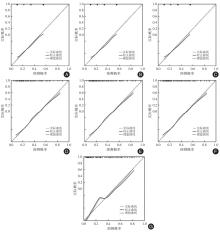
Fig.2
Calibration curves of risk prediction models for involvement of different organs or systems"
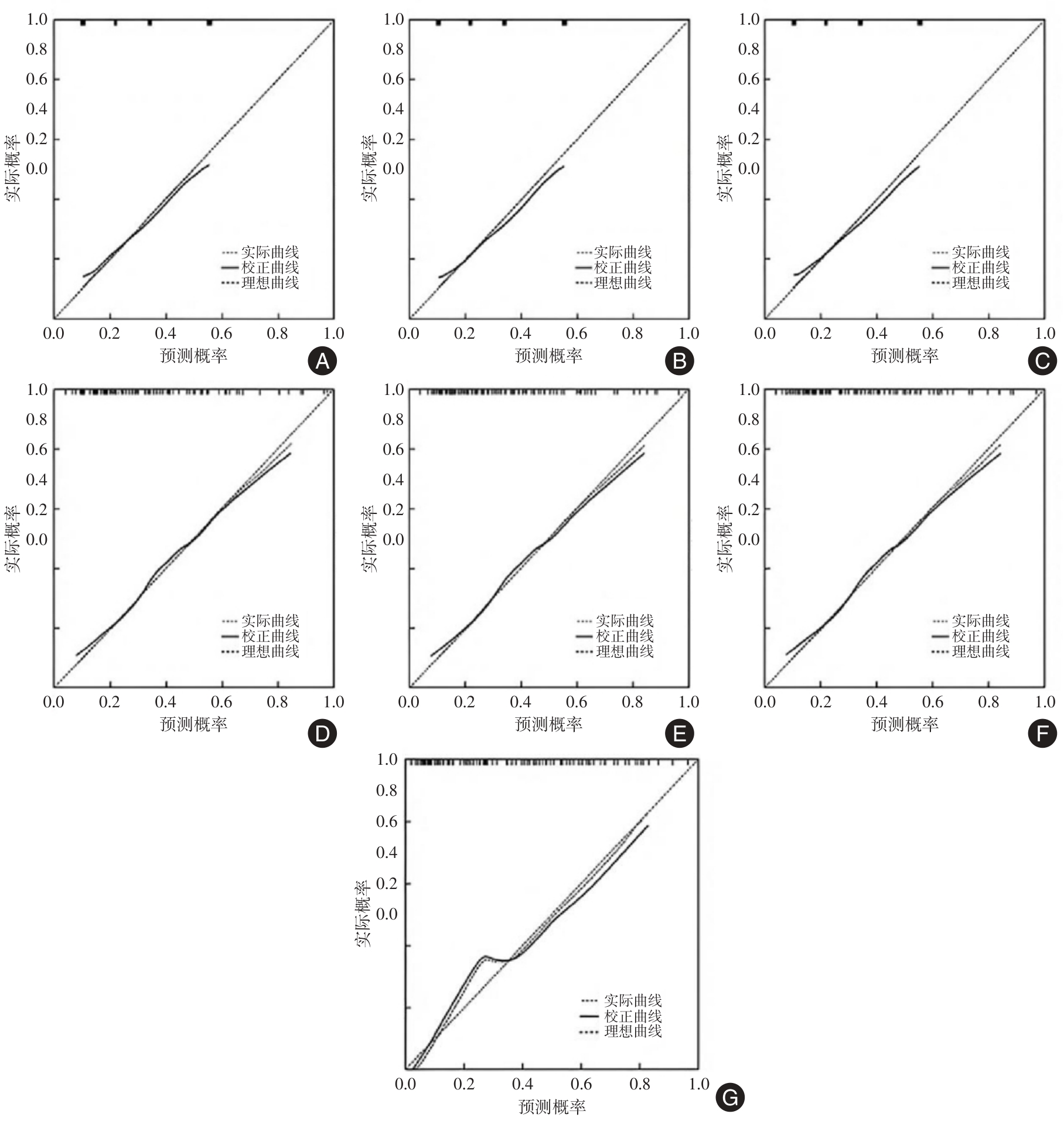
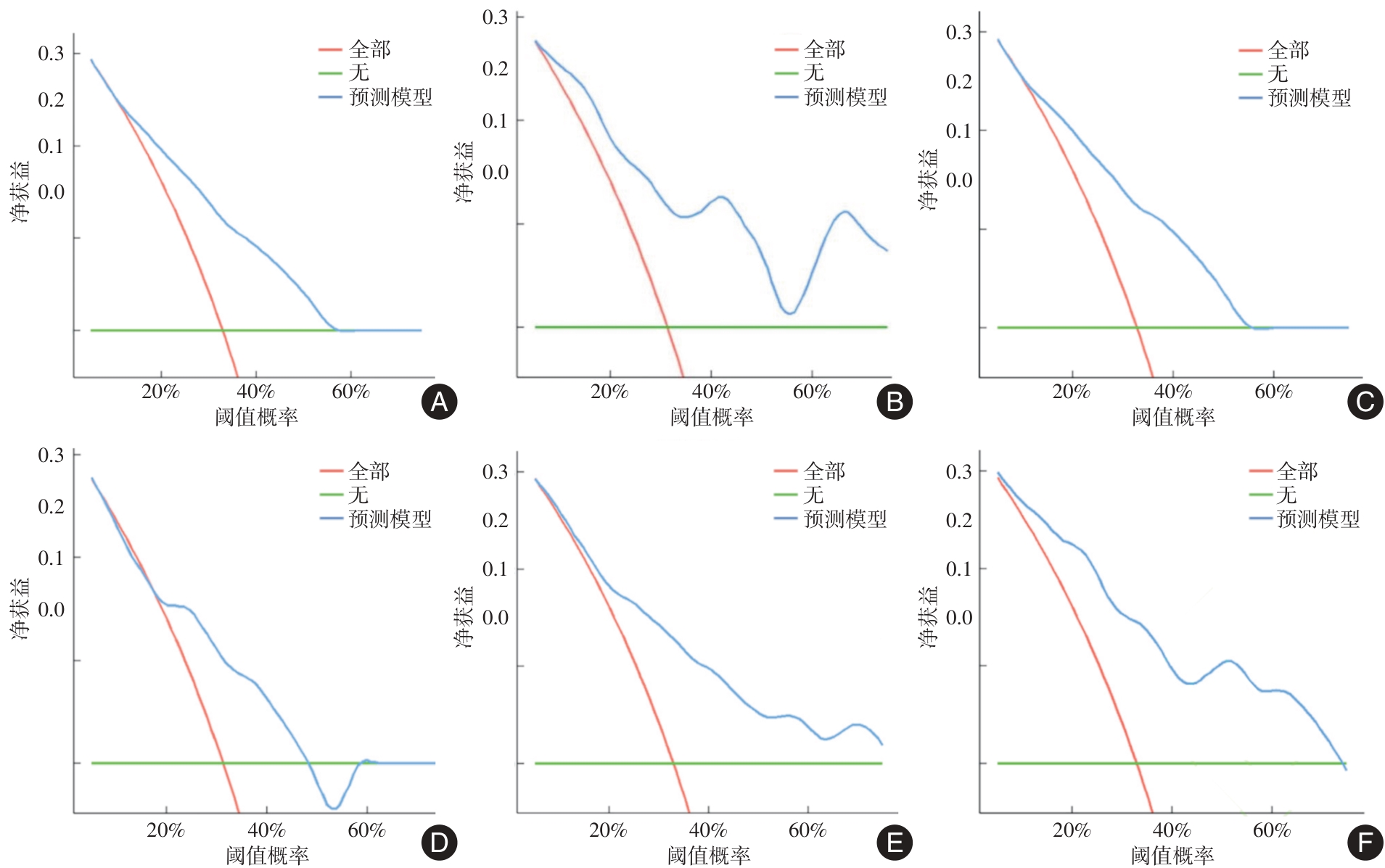
Fig.3
Decision curve analysis of risk prediction models for involvement of different organs or systems"
| [1] |
马茜,周少岚,陈会鹃, 等. 系统性红斑狼疮患者外周血单个核细胞miR-4524a-3p的表达及临床意义[J]. 实用医学杂志, 2024, 40(17): 2412-2417. doi: 10.3969/j.issn.1006-5725.2024. 17.010 .
doi: 10.3969/j.issn.1006-5725.2024. 17.010 |
| [2] |
李昊,曾珊,邱茜, 等. BET蛋白抑制剂JQ-1对系统性红斑狼疮患者外周血B细胞分化的调控作用 [J]. 实用医学杂志, 2022, 38(8): 953-957. doi: 10.3969/j.issn.1006-5725.2022. 08.008 .
doi: 10.3969/j.issn.1006-5725.2022. 08.008 |
| [3] |
FAVA A, PETRI M. Systemic lupus erythematosus: Diagnosis and clinical management[J]. J Autoimmun, 2019, 96: 1-13. doi: 10.3760/cma.j.cn112150-20241210-00991 .
doi: 10.3760/cma.j.cn112150-20241210-00991 |
| [4] |
COZZANI E, DROSERA M, GASPARINI G, et al. Serology of Lupus Erythematosus: Correlation between Immunopathological Features and Clinical Aspects[J]. Autoimmune Dis, 2014, 2014: 1-13. doi: 10.1155/2014/321359 .
doi: 10.1155/2014/321359 |
| [5] |
ROJO R, CALVO ALÉN J, PRADA Á, et al. Recommendations for the use of anti-dsDNA autoantibodies in the diagnosis and follow-up of systemic lupus erythematosus-A proposal from an expert panel[J]. Autoimmun Rev, 2023, 22(12): 103479. doi: 10.1016/j.autrev.2023.103479 .
doi: 10.1016/j.autrev.2023.103479 |
| [6] |
LUO Q, XIAO Q, ZHANG L, et al. Circulating TIGIT(±)PD1(+)TPH, TIGIT (±) PD1(+)TFH cells are elevatedand their predicting role in systemic lupus erythematosus[J]. Heliyon, 2024, 10(6): e27687. doi: 10.1016/j.heliyon.2024.e27687 .
doi: 10.1016/j.heliyon.2024.e27687 |
| [7] |
YANG W,NG P, ZHAO M, et al. Population differences in SLE susceptibility genes: STAT4 and BLK, but not PXK, are associated with systemic lupus erythematosus in Hong Kong Chinese[J]. Genes Immun, 2009, 10(3): 219-226. doi: 10.1038/gene. 2009.1 .
doi: 10.1038/gene. 2009.1 |
| [8] |
程方月,储依然,徐胜前. 抗双链DNA抗体定量、抗核抗体及抗中性粒细胞胞浆抗体联合检测在系统性红斑狼疮诊断及病情评估中的应用分析[J]. 实用医学杂志, 2026,42(9): 1626-1634. doi:10.3969/j.issn.1006-5725.2024.09.018
doi: 10.3969/j.issn.1006-5725.2024.09.018 |
| [9] |
WICHAINUN R, KASITANON N, WANGKAEW S, et al. Sensitivity and specificity of ANA and anti-dsDNA in the diagnosis of systemic lupus erythematosus: A comparison using control sera obtained from healthy individuals and patients with multiple medical problems[J]. Asian Pac J Allergy Immunol, 2013, 31(4): 292-298. doi: 10.12932/AP0272.31.4.2013 .
doi: 10.12932/AP0272.31.4.2013 |
| [10] |
MOLANO-GONZÁLEZ N, ROJAS M, MONSALVE D M, et al. Cluster analysis of autoimmune rheumatic diseases based on autoantibodies. New insights for polyautoimmunity[J]. J Autoimmun, 2019, 98: 24-32. doi: 10.1016/j.jaut.2018.11.002 .
doi: 10.1016/j.jaut.2018.11.002 |
| [11] |
FRANCESCHINI F, CAVAZZANA I. Anti-Ro/SSA and La/SSB antibodies [review][J]. Autoimmunity, 2005, 38(1): 55-63.doi: 10.1080/08916930400022954 .
doi: 10.1080/08916930400022954 |
| [12] |
宋萧怡,许程洁,张航烽, 等. 抗中性粒细胞胞浆抗体与系统性红斑狼疮患者疾病活动度的相关性[J]. 实用医学杂志, 2024, 40(5): 658-663. doi: 10.3969/j.issn.1006-5725.2024. 05.012 .
doi: 10.3969/j.issn.1006-5725.2024. 05.012 |
| [13] |
GODA T, KAMEL R, RIYADH A, et al. Study of Anti-nucleosome Antibodies as A Predictor of Early Renal Affection in Systemic Lupus Erythematosus Patients[J]. Egypt J Hosp Med, 2022, 89: 6928-6936. doi:10.21608/ejhm.2022.271913 .
doi: 10.21608/ejhm.2022.271913 |
| [14] | SZEWCZYK A, KOŁACIŃSKA-STRASZ Z, GLIŃSKI W. Diagnostic value of anti-nucleosome antibodies in systemic lupus erythematosus and other connective tissue diseases[J]. Przegl Dermatol, 2009, 96: 309-317. |
| [15] |
LIN W, YIN H, JIA C, et al. POS0594 DOUBLE POSITIVITY FOR ANTI-Ro52/TRIM21 AND ANTI-Ro60/SSA ANTIBODIES IS LINKED TO GREATER ORGAN INVOLVEMENT AND DISEASE PROGRESSION IN SYSTEMIC SCLEROSIS: INSIGHTS FROM THE RENJI SCLERODERMA LONGITUDINAL COHORT[J]. Ann Rheum Dis, 2025, 84: 792.doi: 10.1016/j.ard.2025.05.974 .
doi: 10.1016/j.ard.2025.05.974 |
| [16] |
AURORA M, JESÚS G, LUIS C M, et al. Common and Specific Associations of Anti-SSA/Ro60 and Anti-Ro52/TRIM21 Antibodies in Systemic Lupus Erythematosus[J]. Sci World J, 2013, 2013: 832789.doi: 10.1155/2013/832789 .
doi: 10.1155/2013/832789 |
| [17] |
PARODI A, DROSERA M, BARBIERI L, et al. Counterimmunoelectrophoresis, ELISA and immunoblotting detection of anti-Ro/SSA antibodies in subacute cutaneous lupus erythematosus. A comparative study[J]. Br J Dermatol, 2010, 138(1): 114-117.doi: 10.1046/j.1365-2133.1998.02035.x .
doi: 10.1046/j.1365-2133.1998.02035.x |
| [18] |
NI J D, YAO X, PAN H F, et al. Clinical and serological correlates of anti-Sm autoantibodies in Chinese patients with systemic lupus erythematosus: 1,584 cases[J]. Rheumatol Int, 2009, 29(11): 1323-1326. doi: 10.1007/s00296-009-0855-1 .
doi: 10.1007/s00296-009-0855-1 |
| [19] |
DRAGOUTSOS G, TSIGGALOU C, OIKONOMOU E, et al. Association of Anti-Ro/SSA and Anti-La/SSB Autoantibodies With Pregnancy Outcome in the General Population[J]. Mater Sociomed, 2024, 36(1): 47. doi: 10.5455/msm.2024.36.47-53 .
doi: 10.5455/msm.2024.36.47-53 |
| [20] |
MOLANO-GONZÁLEZ N, ROJAS M, MONSALVE D M, et al. Cluster analysis of autoimmune rheumatic diseases based on autoantibodies. New insights for polyautoimmunity[J]. J Autoimmun, 2019, 98: 24-32.doi: 10.1016/j.jaut.2018.11.002 .
doi: 10.1016/j.jaut.2018.11.002 |
| [21] |
LIN C Y, KO C H, HSU C Y, et al. Epidemiology and mortality of connective tissue disease-associated pulmonary arterial hypertension: A national cohort study in taiwan[J]. Semin Arthritis Rheum, 2020, 50(5): 957-962. doi: 10.1016/j.semarthrit. 2020.06.005 .
doi: 10.1016/j.semarthrit. 2020.06.005 |
| [22] |
ELBAGIR S, MOHAMMED N A,OKE V, et al. Anti-histone and anti-nucleosome rather than anti-dsDNA antibodies associate with IFN-induced biomarkers in Sudanese and Swedish SLE patients[J]. Rheumatology (Oxford), 2025, 64(3): 1170-1178. doi: 10.1093/rheumatology/keae134 .
doi: 10.1093/rheumatology/keae134 |
| [1] | Fangyue CHENG,Yiran CHU,Shengqian XU. Application of combined detection of anti-dsDNA antibody quantification, ANA, and ANCA in the diagnosis and severity evaluation of systemic lupus erythematosus [J]. The Journal of Practical Medicine, 2026, 42(9): 1626-1634. |
| [2] | Hongyu WU,Yupeng WU,Shaojuan HUANG,Suzhen HUANG,Yingjie HOU,Yi YANG,Zhirong ZHANG,Qingxi LI,Zhixin WU. Risk prediction of postoperative cerebral infarction in elderly patients with intertrochanteric femoral fracture: A comparative study of decision tree and logistic regression model [J]. The Journal of Practical Medicine, 2026, 42(8): 1471-1478. |
| [3] | Yiming HOU,Huafang WEI,Jiayang TANG,Ziyang WANG,Ying CHEN,Ling YUE. Study on the relationship between serum Metrnl levels and pregnancy outcomes in patients with hypertriglyceridemia in late pregnancy [J]. The Journal of Practical Medicine, 2026, 42(5): 785-791. |
| [4] | Jianbin LI,Rui. WU. Correlation study on pericyte depletion, eye⁃signs in blood stasis syndrome, and blood⁃brain barrier dysfunction in neuropsychiatric systemic lupus erythematosus [J]. The Journal of Practical Medicine, 2025, 41(6): 790-799. |
| [5] | Wei LIU,Jun HOU,Longquan TANG,Peng ZHOU,Yan ZHONG,Qinyan LUO,Xiaoyu KUANG,Hua LIU,Ziqing XIONG,Wei XIONG,Chenggao WU,Aiping. LE. Analysis of influencing factors of blood transfusion in children with traumatic brain injury and construction of prediction model: A multi⁃center retrospective study [J]. The Journal of Practical Medicine, 2025, 41(4): 553-560. |
| [6] | Dawei WANG,Zheng ZHENG,Yuxiang SHENG,Zhiran LI,Shaohua HUANGFU,Bin. JIANG. Risk factors for multidrug⁃resistant bacterial infections in perianal abscesses and the construction of a nomogram prediction model [J]. The Journal of Practical Medicine, 2025, 41(24): 3897-3903. |
| [7] | Luxing LU,Jing XIE,Yi XIANG,Yuhua ZHENG,Tinchun WU,Dawei LV,Tao. XU. The relationship between hemorheology and carotid atherosclerosis [J]. The Journal of Practical Medicine, 2025, 41(19): 3041-3045. |
| [8] | Shuting ZHENG,Xixi LIU,Shiyang CHEN,Peiqian LAI,Chunhong GUO,Shaohua. CHEN. Latent profiles analysis and influencing factors of Health⁃Promoting Lifestyle in patients with conservative treatment of Lumbar Disc Herniation [J]. The Journal of Practical Medicine, 2025, 41(19): 3052-3059. |
| [9] | Yunfang ZHANG,Zheng LI,Xiaogai NIE,Yun GUAN,Qi CHEN,Yong YUAN. D⁃dimer/Alb ratio, IL⁃6 and FDP jointly predict poor outcomes post type A dissection [J]. The Journal of Practical Medicine, 2025, 41(17): 2755-2760. |
| [10] | Hong ZHANG,Rong ZHANG,Pengcheng YANG,Liyan LUO,Wenlong ZHANG,Yurong CHENG,Wenlin LIU,Wenbin. DONG. Construction of risk prediction model for preterm infant respiratory distress syndrome in Dali Prefecture [J]. The Journal of Practical Medicine, 2025, 41(15): 2342-2348. |
| [11] | Yuhai QIAO,Chunhua DU,Xinhong ZHAO,Xiaodong MENG,Jianfei. ZHANG. Construction and validation of a risk prediction model for clinical characteristics of patients with chronic non⁃bacterial prostatitis [J]. The Journal of Practical Medicine, 2025, 41(14): 2224-2230. |
| [12] | Huangjunqing LIAO,Jiadong CAO,Zhichao WANG,Qiuhong ZHANG,Jianfu ZHOU,Songtao XIANG. Establishment and validation of a predictive model for the stone⁃free rateafter flexible ureteroscopy for lower pole calculi [J]. The Journal of Practical Medicine, 2025, 41(13): 1979-1986. |
| [13] | Xianqun TAN,Fenglin ZHANG,Guangyan ZOU,Xidong CHEN. Establishment of a risk prediction model for neurogenic bladder dysfunction after spinal cord injury [J]. The Journal of Practical Medicine, 2025, 41(13): 2058-2064. |
| [14] | Shouping LIU,Yinlin TANG,Yanfang CHENG,Qian ZHOU. Analysis of coagulation and fibrinolysis biomarkers for prognostic assessment and clinical efficacy evaluation in patients with intracerebral hemorrhage [J]. The Journal of Practical Medicine, 2025, 41(12): 1846-1852. |
| [15] | Xiaoyi SONG,Chengjie XU,Hangfeng ZHANG,Jiajia. WANG. Association of anti⁃neutrophil cytoplasmic antibodies with the disease activity in patients with systemic lupus erythematosus [J]. The Journal of Practical Medicine, 2024, 40(5): 658-663. |
| Viewed | ||||||
|
Full text |
|
|||||
|
Abstract |
|
|||||
