

The Journal of Practical Medicine ›› 2026, Vol. 42 ›› Issue (9): 1626-1634.doi: 10.3969/j.issn.1006-5725.2026.09.018
• Chronic Disease Control • Previous Articles
Fangyue CHENG,Yiran CHU,Shengqian XU( )
)
Received:2025-12-10
Online:2026-05-10
Published:2026-04-29
Contact:
Shengqian XU
E-mail:yfy119243@fy.ahmu.edu.cn
CLC Number:
Fangyue CHENG,Yiran CHU,Shengqian XU. Application of combined detection of anti-dsDNA antibody quantification, ANA, and ANCA in the diagnosis and severity evaluation of systemic lupus erythematosus[J]. The Journal of Practical Medicine, 2026, 42(9): 1626-1634.
Tab.1
Comparison of clinical data between the SLE group and the non-SLE group"
| 项目 | SLE组(n = 154) | 非SLE组(n = 100) | χ2/t/Z值 | P值 |
|---|---|---|---|---|
| 性别/[例(%)] | 4.182 | 0.041 | ||
| 男 | 19(12.34) | 22(22.00) | ||
| 女 | 135(87.66) | 78(78.00) | ||
| 年龄/岁 | 42.45 ± 12.78 | 59.01 ± 12.86 | 10.065 | < 0.001 |
| 家族史/[例(%)] | 12(7.79) | 6(6.00) | 0.296 | 0.587 |
| 病程/年 | 5.69 ± 0.59 | 4.82 ± 0.49 | 12.253 | < 0.001 |
| 临床表现/[例(%)] | ||||
| 红斑 | 36(23.38) | 20(20.00) | 0.402 | 0.526 |
| 光过敏 | 19(12.34) | 7(7.00) | 1.880 | 0.170 |
| 肾损害 | 53(34.42) | 21(21.00) | 5.285 | 0.022 |
| 关节炎 | 39(25.32) | 20(20.00) | 0.964 | 0.326 |
| 浆膜炎 | 25(16.23) | 12(12.00) | 0.873 | 0.350 |
| 血液学病变 | 26(16.88) | 12(12.00) | 1.136 | 0.286 |
| 口腔溃疡 | 34(22.08) | 17(17.00) | 0.974 | 0.324 |
| SLEDAI评分/分 | 11.80 ± 5.86 | 7.78 ± 0.79 | 6.815 | < 0.001 |
| 实验室指标 | ||||
| Cr/(μmol/L) | 56.87 ± 5.81 | 55.89 ± 5.97 | 1.299 | 0.195 |
| WBC/(×109/L) | 5.67 ± 1.14 | 5.48 ± 1.26 | 1.245 | 0.214 |
| RBC/(×1012/L) | 3.58 ± 0.38 | 3.49 ± 0.37 | 1.863 | 0.064 |
| ESR/(mm/h) | 23.55 ± 5.07 | 19.45 ± 2.14 | 7.652 | < 0.001 |
| Hb/(g/L) | 104.98 ± 12.77 | 116.73 ± 12.57 | 7.209 | < 0.001 |
| PLT/(×109/L) | 164.05 ± 16.91 | 162.78 ± 17.74 | 0.574 | 0.567 |
| LY/(×109/L) | 1.11 ± 0.22 | 1.43 ± 0.18 | 12.142 | < 0.001 |
| ALB/(g/L) | 34.95 ± 3.67 | 35.24 ± 3.53 | 0.625 | 0.533 |
| 免疫指标 | ||||
| IgA/(g/L) | 2.92 ± 0.28 | 2.64 ± 0.37 | 6.847 | < 0.001 |
| IgM/(g/L) | 1.53 ± 0.15 | 1.09 ± 0.18 | 21.090 | < 0.001 |
| IgG/(g/L) | 16.37 ± 1.68 | 15.07 ± 2.10 | 5.453 | < 0.001 |
| 补体C3[M(P25,P75)]/(g/L) | 0.15(0.11,0.78) | 0.62(0.23,0.84) | 12.146 | < 0.001 |
| 补体C4[M(P25,P75)]/(g/L) | 0.26(0.28,0.98) | 0.87(0.37,1.02) | 8.722 | 0.003 |
Tab.2
Expression of anti-dsDNA, ANA, and ANCA"
| 项目 | SLE组(n = 154) | 非SLE组(n = 100) | 对照组(n = 50) | F/χ2值 | P值 |
|---|---|---|---|---|---|
| Anti-dsDNA/(U/mL) | 15.67 ± 1.68*# | 4.12 ± 0.45* | 3.98 ± 0.43 | 3 336.795 | < 0.001 |
| ANA/(U/mL) | 326.87 ± 33.75*# | 63.42 ± 6.51* | 6.73 ± 0.69 | 5 197.877 | < 0.001 |
| Anti-dsDNA阳性 | 86(55.84) | 37(37.00) | 0(0) | 8.620 | 0.003 |
| ANA阳性 | 154(100.00) | 0(0) | 0(0) | - | - |
| ANCA阳性 | 34(22.08) | 12(12.00) | 0(0) | 4.152 | 0.042 |
Tab.3
Comparison of clinical data between active and inactive SLE"
| 项目 | 活动期(n = 115) | 非活动期(n = 39) | χ2/t/Z值 | P值 |
|---|---|---|---|---|
| 性别 | 0.209 | 0.647 | ||
| 男 | 15(13.04) | 4(10.26) | ||
| 女 | 100(86.96) | 35(89.74) | ||
| 年龄( | 42.53 ± 12.77 | 42.21 ± 12.96 | 0.135 | 0.893 |
| 家族史 | 10(8.70) | 2(5.13) | 0.516 | 0.473 |
| 病程( | 5.68 ± 0.59 | 5.73 ± 0.58 | 0.459 | 0.647 |
| 临床表现 | ||||
| 红斑 | 27(23.48) | 9(23.08) | 0.003 | 0.959 |
| 光过敏 | 15(13.04) | 4(10.26) | 0.209 | 0.647 |
| 肾损害 | 45(39.13) | 8(20.51) | 4.472 | 0.034 |
| 关节炎 | 29(25.22) | 10(25.64) | 0.003 | 0.958 |
| 浆膜炎 | 20(17.39) | 5(12.82) | 0.447 | 0.504 |
| 血液学病变 | 18(15.65) | 8(20.51) | 0.490 | 0.484 |
| 口腔溃疡 | 25(21.74) | 9(23.08) | 0.030 | 0.862 |
| SLEDAI评分( | 15.11 ± 1.56 | 2.05 ± 0.28 | 51.891 | < 0.001 |
| 实验室指标 | ||||
| Cr( | 56.79 ± 5.84 | 57.12 ± 5.79 | 0.306 | 0.760 |
| WBC( | 5.12 ± 0.56 | 7.31 ± 0.78 | 18.991 | < 0.001 |
| RBC( | 3.56 ± 0.38 | 3.64 ± 0.37 | 1.144 | 0.255 |
| ESR( | 26.18 ± 2.46 | 15.79 ± 1.64 | 24.562 | < 0.001 |
| Hb( | 102.37 ± 11.45 | 112.68 ± 13.47 | 4.642 | < 0.001 |
| PLT( | 164.32 ± 16.88 | 163.27 ± 17.19 | 0.334 | 0.739 |
| LY( | 1.02 ± 0.15 | 1.38 ± 0.16 | 12.734 | < 0.001 |
| ALB( | 34.67 ± 3.65 | 35.78 ± 3.65 | 1.641 | 0.103 |
| 免疫指标 | ||||
| IgA( | 2.79 ± 0.28 | 2.21 ± 0.25 | 11.473 | < 0.001 |
| IgM( | 1.13 ± 0.18 | 0.96 ± 0.11 | 5.550 | < 0.001 |
| IgG( | 15.89 ± 1.64 | 12.67 ± 1.35 | 11.050 | < 0.001 |
| 补体C3[M(P25,P75)]/(g/L) | 0.08(0.06,0.17) | 0.48(0.37,0.73) | 4.352 | < 0.001 |
| 补体C4[M(P25,P75)]/(g/L) | 0.15(0.11,0.22) | 0.82(0.5,0.96) | 16.214 | < 0.001 |
| Anti-dsDNA阳性 | 72(62.61) | 14(35.90) | 5.643 | 0.018 |
| ANA阳性 | 115(100.00) | 39(100.00) | 0.000 | 1.000 |
| ANCA阳性 | 32(27.82) | 2(5.13) | 8.722 | 0.003 |
Tab.4
Correlation analysis results"
| 指标 | 肾损害 | SLEDAI评分 | ||
|---|---|---|---|---|
| r值 | P值 | r值 | P值 | |
| Anti-dsDNA阳性率 | 0.436 | < 0.001 | 0.297 | 0.015 |
| ANA阳性率 | 0.425 | < 0.001 | 0.311 | 0.013 |
| ANCA阳性率 | 0.327 | 0.005 | 0.425 | < 0.001 |
Tab.5
Factors influencing active SLE"
| 因素 | β | SE | Waldχ2 | P值 | OR | 95%CI |
|---|---|---|---|---|---|---|
| 肾损害 | 0.248 | 0.168 | 2.179 | 0.141 | 1.281 | 0.922 ~ 1.781 |
| SLEDAI评分 | 0.372 | 0.181 | 4.224 | 0.040 | 1.451 | 1.017 ~ 2.068 |
| 血清补体C3 | -0.288 | 0.154 | 3.497 | 0.062 | 0.750 | 0.554 ~ 1.014 |
| Anti-dsDNA阳性 | 0.487 | 0.205 | 5.644 | 0.018 | 1.627 | 1.089 ~ 2.432 |
| ANCA阳性 | 0.387 | 0.154 | 6.315 | 0.012 | 1.473 | 1.089 ~ 1.991 |
| 常量 | -10.175 | 2.673 | 14.490 | < 0.001 | - | 0.000 ~ 0.007 |
Tab.6
Value in predicting active SLE"
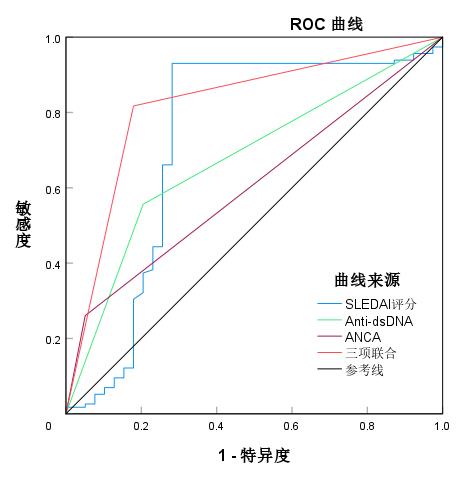
| 诊断方法 | 敏感度/% | 特异度/% | AUC | 95%CI |
|---|---|---|---|---|
| SLEDAI评分 | 78.23 | 67.96 | 0.727 | 0.612 ~ 0.843 |
| Anti-dsDNA阳性 | 55.65 | 79.49 | 0.528 | 0.421 ~ 0.634 |
| ANCA阳性 | 26.09 | 94.87 | 0.605 | 0.510 ~ 0.700 |
| 联合 | 81.74 | 82.05 | 0.819 | 0.738 ~ 0.900 |
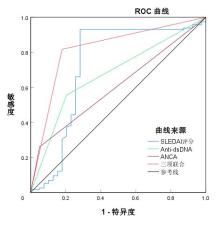
Fig.1
ROC curve of SLEDAI score, anti-dsDNA, ANCA, and their combination predicting active SLE"
| [1] |
PAGKOPOULOU E, LOUTRADIS C, PAPAIOANNOU M, et al. Autoantibodies in systemic lupus erythematosus:Diagnostic and pathogenic insights[J]. J Clin Med, 2025, 14(16): 5714. doi: 10.3390/jcm14165714 .
doi: 10.3390/jcm14165714 |
| [2] |
KUMAR A, VASDEV V, SANKAR J, et al. A retrospective study of clinical characteristics and serological profile of male systemic lupus erythematosus patients in India[J]. J Assoc Physicians India, 2025, 73(4): 42-47. doi: 10.59556/japi.73.0893 .
doi: 10.59556/japi.73.0893 |
| [3] |
GRANEL J, FERNANDES H, RICHER O, et al. Systemic lupus international collaborating clinics-2012 and European league against rheumatism/American college of rheumatology-2019 classification criteria for systemic lupus erythematosus associated with childhood-onset auto-immune cytopenia[J]. Lupus, 2024, 33(14): 1605-1610. doi: 10.1177/09612033241296471 .
doi: 10.1177/09612033241296471 |
| [4] |
ELBAGIR S, MOHAMMED N A, OKE V, et al. Anti-histone and anti-nucleosome rather than anti-dsDNA antibodies associate with IFN-induced biomarkers in Sudanese and Swedish SLE patients[J]. Rheumatology (Oxford), 2025, 64(3): 1170-1178. doi: 10.1093/rheumatology/keae134 .
doi: 10.1093/rheumatology/keae134 |
| [5] |
THAPA P, YADAV I, VINAGOLU-BAUR J. A Tale of overlapping autoimmune serologies:Diagnosing hydralazine-induced antineutrophilic cytoplasmic antibody(ANCA)-associated vasculitis (AAV) related with isolated pulmonary involvement[J]. Cureus, 2025, 17(8): e89547. doi: 10.7759/cureus.89547 .
doi: 10.7759/cureus.89547 |
| [6] |
CAMARD M, URBAIN F, NOEL N. Cognitive impairment in systemic autoimmune and inflammatory diseases: A narrative review focused on ANCA-associated vasculitis, sarcoidosis, Sjogren's syndrome, systemic sclerosis, and Behcet's disease[J]. Autoimmun Rev, 2025, 24(11): 103899. doi: 10.1016/j.autrev.2025.103899 .
doi: 10.1016/j.autrev.2025.103899 |
| [7] |
高云洁, 王慧静, 蔡方豪, 等. 2019年欧洲抗风湿病联盟/美国风湿病学会系统性红斑狼疮分类标准的临床应用分析[J]. 中华肾脏病杂志, 2021, 37(10): 789-794. doi: 10.3760/cma.j.cn441217-20200907-00117 .
doi: 10.3760/cma.j.cn441217-20200907-00117 |
| [8] |
EBRAHIMI CHAHAROM F, EBRAHIMI A A, FEGHHI KOOCHEBAGH F, et al. Association of IL-17 serum levels with clinical findings and systemic lupus erythematosus disease activity index[J]. Immunol Med, 2023, 46(4): 175-181. doi: 10.1080/25785826.2023.2202050 .
doi: 10.1080/25785826.2023.2202050 |
| [9] |
LUO X, QUAN L, LIN Q, et al. Integrating clinical data and genetic susceptibility to elucidate the relationship between systemic lupus erythematosus and human cytomegalovirus infection[J]. Virol J, 2024, 21(1): 311. doi: 10.1186/s12985-024-02578-6 .
doi: 10.1186/s12985-024-02578-6 |
| [10] |
DJURAN I, LJUBICIC B, LAZAREVIC A, et al. Anti-PL-12 and interstitial lung disease as the first signs of antisynthetase syndrome in patients with previously diagnosed systemic lupus erythematosus[J]. Cureus, 2025, 17(9): e93472. doi: 10.7759/cureus.93472 .
doi: 10.7759/cureus.93472 |
| [11] |
MATSUMOTO K, SUZUKI K, YASUOKA H, et al. Longitudinal monitoring of circulating immune cell phenotypes in anti-neutrophil cytoplasmic antibody-associated vasculitis[J]. Autoimmun Rev, 2023, 22(3): 103271. doi: 10.1016/j.autrev.2023.103271 .
doi: 10.1016/j.autrev.2023.103271 |
| [12] |
ARAUJO F A G D R, LIMA I V S, SANTIAGO M B. Clinical characteristics of antinuc lear antibody-negative systemic lupus erythematosus: A systematic review[J]. J Clin Rheumatol, 2025, 31(7): 275-278. doi: 10.1097/RHU.0000000000002258 .
doi: 10.1097/RHU.0000000000002258 |
| [13] |
BELLO A R, CARNEVALE A C G, TRALHÃO A, et al. Cardiogenic shock and crescentic pauci-immune glomerulonephritis associated with systemic lupus erythematosus and ANCA-vasculitis overlap:a case report[J]. BMC Nephrol, 2025, 26(1): 634. doi: 10.1186/s12882-025-04567-5 .
doi: 10.1186/s12882-025-04567-5 |
| [14] |
赵盈, 程冰, 刘跃平, 等. 系统性红斑狼疮合并感染患者淋巴细胞亚群及细胞因子的变化[J]. 免疫学杂志, 2023, 39(6): 512-520. doi: 10.13431/j.cnki.immunol.j.20230067 .
doi: 10.13431/j.cnki.immunol.j.20230067 |
| [15] |
GULEVA D, MITEVA L, RAYKOVA V, et al. Immunological correlation in different cutaneous clinical types of lupus erythematosus in the bulgarian population[J]. Acta Dermatovenerol Croat, 2024, 32(4): 199-204. PMID: .
pmid: 40657653 |
| [16] |
BIANCHI M, KOZYREV S V, NOTARNICOLA A, et al. Unraveling the genetics of shared clinical and serological manifestations in patients with systemic inflammatory autoimmune diseases[J]. Arthritis Rheumatol, 2025, 77(2): 212-225. doi: 10.1002/art.42988 .
doi: 10.1002/art.42988 |
| [17] |
ABOZAID H S M, HEFNY H M, ABUALFADL E M, et al. Negative ANA-IIF in SLE patients: What is beyond?[J]. Clin Rheumatol, 2023, 42(7): 1819-1826. doi: 10.1007/s10067-023-06577-w .
doi: 10.1007/s10067-023-06577-w |
| [18] |
宋萧怡, 许程洁, 张航烽, 等. 抗中性粒细胞胞浆抗体与系统性红斑狼疮患者疾病活动度的相关性[J]. 实用医学杂志, 2024, 40(5): 658-663. doi: 10.3969/j.issn.1006-5725.2024.05.012 .
doi: 10.3969/j.issn.1006-5725.2024.05.012 |
| [19] |
张力奋, 夏成云, 蒋健, 等. 系统性红斑狼疮患者外周血辅助性T淋巴细胞17、核因子κB水平与肾损伤发生的关系[J]. 山东医药, 2024, 64(26): 76-79. doi: 10.3969/j.issn.1002-266X.2024.26.017 .
doi: 10.3969/j.issn.1002-266X.2024.26.017 |
| [20] |
王红彦, 李鑫铭, 房柯池, 等. 系统性红斑狼疮疾病活动度相关特征分析及评估模型的构建[J]. 北京大学学报(医学版), 2024, 56(6): 1017-1022. doi: 10.19723/j.issn.1671-167X.2024.06.011 .
doi: 10.19723/j.issn.1671-167X.2024.06.011 |
| [21] |
GONZÁLEZ-INOSTROZ D, SANDOVAL-GARCÍA F, CORONA-MERAZ F I, et al. The Association of anti-sm with osteopontin related to cognitive impairment in a pristane-induced lupus BALB/c mice model[J]. Int J Mol Sci, 2024, 25(23): 13080. doi: 10.3390/ijms252313080 .
doi: 10.3390/ijms252313080 |
| [22] |
PÉREZ-ISIDRO A, XIPELL M, LLOBELL A, et al. Anti-dsDNA B-Cell ELISpot as a monitoring and flare prediction tool in SLE Patients[J]. J Clin Med, 2023, 12(4): 1295. doi: 10.3390/jcm12041295 .
doi: 10.3390/jcm12041295 |
| [23] |
WANG Y, YU X, XIE X, et al. Clinical features and outcomes of patients with antineutrophil cytoplasmic antibody-positive systemic lupus erythematosus[J]. Ren Fail, 2023, 45(1): 2235431. doi: 10.1080/0886022X.2023.2235431 .
doi: 10.1080/0886022X.2023.2235431 |
| [24] |
MORÁN ÁLVAREZ P, BRACAGLIA C, NICOLAI R, et al. Different patterns of longitudinal changes in antinuclear antibodies titers in children with systemic lupus erythematosus and Sjogren's syndrome[J]. Lupus, 2024, 33(14): 1594-1604. doi: 10.1177/09612033241298729 .
doi: 10.1177/09612033241298729 |
| [25] |
BALMANT B D, FONSECA D C, PRUDÊNCIO A P A, et al. Megamonas funiformis, plasma zonulin, and sodium intake affect C3 complement levels in inactive systemic lupus erythematosus[J]. Nutrients, 2023, 15(8): 1999. doi: 10.3390/nu15081999 .
doi: 10.3390/nu15081999 |
| [26] |
杨婧偊, 陈留宝, 王康太, 等. 基于实验室指标的系统性红斑狼疮鉴别诊断列线图的构建及评估[J]. 上海交通大学学报(医学版), 2024, 44(2): 204-211. doi: 10.3969/j.issn.1674-8115.2024.02.006 .
doi: 10.3969/j.issn.1674-8115.2024.02.006 |
| Viewed | ||||||
|
Full text |
|
|||||
|
Abstract |
|
|||||
