

The Journal of Practical Medicine ›› 2026, Vol. 42 ›› Issue (12): 2098-2104.doi: 10.3969/j.issn.1006-5725.2026.12.002
• Perioperative Management and Critical Care Support • Previous Articles
Yan WU,Yihong XIAO,Xuefeng FENG,Tao ZENG( )
)
Received:2026-03-13
Online:2026-06-25
Published:2026-06-30
Contact:
Tao ZENG
E-mail:zeng_tao518@163.com
CLC Number:
Yan WU,Yihong XIAO,Xuefeng FENG,Tao ZENG. Development and validation of a prediction model for risk of enteral nutrition intolerance in patients with severe neurological impairment[J]. The Journal of Practical Medicine, 2026, 42(12): 2098-2104.

Tab.1
Patient demographics and baseline characteristics"
| 指标 | 非FI组(n = 81) | FI组(n = 167) | P值 | Z/χ2值 |
|---|---|---|---|---|
| 性别 | 1.000 | < 0.001 | ||
| 男 | 57(70.4) | 116(69.5) | ||
| 女 | 24(29.6) | 51(30.5) | ||
| 年龄[M(P25,P75)]/岁 | 53.00(40.00,65.00) | 55.00(42.50,64.00) | 0.630 | 6 508.000 |
| BMI[M(P25,P75)]/(kg/m2) | 23.30(20.70,24.60) | 23.40(20.80,25.60) | 0.397 | 6 314.500 |
| 病史 | ||||
| 高血压 | 30(37.0) | 70(41.9) | 0.551 | 0.356 |
| 糖尿病 | 12(14.8) | 28(16.8) | 0.835 | 0.043 |
| GCS评分 | 0.262 | 1.260 | ||
| ≥ 8分 | 8(10.3) | 27(16.7) | ||
| < 8分 | 70(89.7) | 135(83.3) | ||
| NRS2002[M(P25,P75)]/分 | 4.00(3.00,4.00) | 4.00(3.00,4.00) | 0.627 | 6 993.500 |
| 机械通气 | 61(75.3) | 154(92.2) | 0.001 | 12.100 |
| 目标温度管理 | 12(14.8) | 90(53.9) | < 0.001 | 27.300 |
| 药物使用 | ||||
| 镇静药物 | 78(96.3) | 166(99.4) | 0.200 | 21.400 |
| 阿片镇痛药物 | 68(84.0) | 164(98.2) | < 0.001 | 16.100 |
| 血管活性药 | 51(63.0) | 125(74.9) | 0.074 | 3.200 |
| 利尿剂 | 60(74.1) | 152(91.0) | 0.001 | 11.300 |
| 钾制剂 | 74(91.4) | 162(97.0) | 0.103 | 2.700 |
| 抗生素种类 | 0.088 | 2.400 | ||
| 1种 | 49(60.5) | 78(46.7) | ||
| ≥ 2种 | 32(39.5) | 89(53.3) | ||
| 营养液类型 | 1.000 | < 0.001 | ||
| 整蛋白 | 79(97.5) | 162(97.0) | ||
| 短肽 | 2(2.5) | 5(3.0) | ||
| 发热(体温≥ 38.5 ℃) | 37(45.7) | 71(42.5) | 0.738 | 0.112 |
| 腹内压[M(P25,P75)]/mmHg | 7.40(6.10,8.30) | 7.40(6.15,8.40) | 0.756 | 6 599.000 |
| 血糖(Glu)[M(P25,P75)]/(mmol/L) | 7.40(6.10,8.70) | 7.62(6.10,9.85) | 0.342 | 6 260.500 |
| 白蛋白[M(P25,P75)]/(g/L) | 37.30(35.30,42.30) | 39.50(34.85,42.60) | 0.422 | 6 338.500 |
| 血钾[M(P25,P75)]/(mmol/L) | 3.91(3.65,4.19) | 3.89(3.56,4.22) | 0.594 | 7 046.500 |
Tab.2
Logistic regression analysis of FI occurrence in neurocritical patients undergoing EN"
| 变量 | β | SE | Wald | 单因素分析 | 多因素分析 | ||
|---|---|---|---|---|---|---|---|
| P值 | OR(95%CI) | P值 | OR(95%CI) | ||||
| 性别 | 0.043 | 0.296 | 0.146 | 0.884 | 1.044(0.585 ~ 1.864) | - | - |
| 年龄 | 0.005 | 0.009 | 0.599 | 0.550 | 1.005(0.988 ~ 1.023) | - | - |
| BMI | 0.012 | 0.035 | 0.343 | 0.732 | 1.012(0.946 ~ 1.083) | - | - |
| 高血压 | 0.204 | 0.279 | 0.734 | 0.463 | 1.227(0.711 ~ 2.117) | - | - |
| 糖尿病 | 0.147 | 0.375 | 0.392 | 0.695 | 1.158(0.555 ~ 2.416) | - | - |
| ICU住院时长 | 0.181 | 0.042 | 4.298 | < 0.001 | 1.199(1.104 ~ 1.302) | 0.003 6 | 1.136(1.043 ~ 1.238) |
| GCS评分 | -0.560 | 0.429 | -1.306 | 0.192 | 0.571(0.247 ~ 1.324) | - | - |
| 机械通气 | 1.357 | 0.387 | 3.506 | 0.001 | 3.884(1.819 ~ 8.294) | 0.021 2 | 2.831(1.168 ~ 6.858) |
| 机械通气持续时间 | 0.012 | 0.021 | 0.588 | 0.556 | 1.012(0.972 ~ 1.055) | - | - |
| 低温治疗 | 2.271 | 0.488 | 4.651 | < 0.001 | 9.686(3.720 ~ 25.219) | - | - |
| 低温治疗持续时间 | 0.217 | 0.204 | 1.065 | 0.287 | 1.243(0.833 ~ 1.855) | - | - |
| 冰毯机 | 1.857 | 0.349 | 5.320 | < 0.001 | 6.405(3.231 ~ 12.696) | - | - |
| 冰毯机持续时间 | 0.019 | 0.080 | 0.242 | 0.809 | 1.020(0.871 ~ 1.193) | - | - |
| 目标温度管理 | 1.905 | 0.349 | 5.456 | < 0.001 | 6.721(3.390 ~ 13.324) | 0.000 7 | 3.595(1.709 ~ 7.565) |
| 使用≤ 2种镇静药物 | 0.942 | 0.419 | 2.248 | 0.025 | 2.564(1.128 ~ 5.827) | - | - |
| 联用> 2种镇静药物 | 1.797 | 0.421 | 4.270 | < 0.001 | 6.031(2.643 ~ 13.76) | 0.030 4 | 2.786(1.102 ~ 7.045) |
| 阿片类药物 | 2.347 | 0.657 | 3.574 | 0.000 | 10.451(2.886 ~ 37.846) | - | - |
| 使用阿片类药物> 24 h | 0.212 | 0.048 | 4.429 | < 0.001 | 1.236(1.126 ~ 1.358) | - | - |
| 血管活性药物 | 0.560 | 0.291 | 1.924 | 0.054 | 1.751(0.990 ~ 3.098) | - | - |
| 利尿剂 | 1.266 | 0.371 | 3.414 | 0.001 | 3.547(1.714 ~ 7.337) | 0.003 5 | 3.692(1.535 ~ 8.876) |
| 钾制剂 | 1.120 | 0.602 | 1.860 | 0.063 | 3.065(0.942 ~ 9.976) | - | - |
| 使用1种抗生素使用 | 1.182 | 0.660 | 1.789 | 0.074 | 3.260(0.893 ~ 11.895) | - | - |
| 联用≥ 2种抗生素 | 0.480 | 0.282 | 1.705 | 0.088 | 1.616(0.931 ~ 2.806) | - | - |
| 喂养途径 | 0.772 | 0.384 | 2.009 | 0.045 | 2.163(1.019 ~ 4.593) | - | - |
| 营养液类型 | 0.198 | 0.848 | 0.234 | 0.815 | 1.219(0.231 ~ 6.423) | - | - |
| NRS2002 | -0.095 | 0.201 | -0.473 | 0.636 | 0.909(0.614 ~ 1.347) | - | - |
| 发热 | 0.128 | 0.273 | 0.471 | 0.638 | 1.137(0.666 ~ 1.94) | - | - |
| 腹内压 | 0.122 | 0.071 | 1.713 | 0.087 | 1.130(0.983 ~ 1.299) | - | - |
| 血糖 | 0.037 | 0.040 | 0.935 | 0.350 | 1.038(0.960 ~ 1.122) | - | - |
| 白蛋白 | 0.018 | 0.020 | 0.881 | 0.378 | 1.018(0.978 ~ 1.06) | - | - |
| 血钾 | -0.178 | 0.271 | -0.658 | 0.511 | 0.837(0.492 ~ 1.424) | - | - |
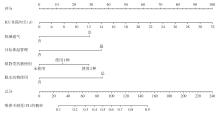
Fig.1
Nomogram for predicting the risk of FI in neurocritical patients undergoing EN"
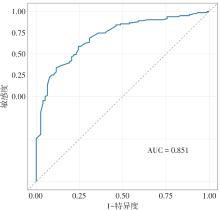
Fig.2
ROC curve of the ENFI risk prediction model in neurocritical patients"
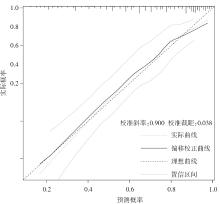
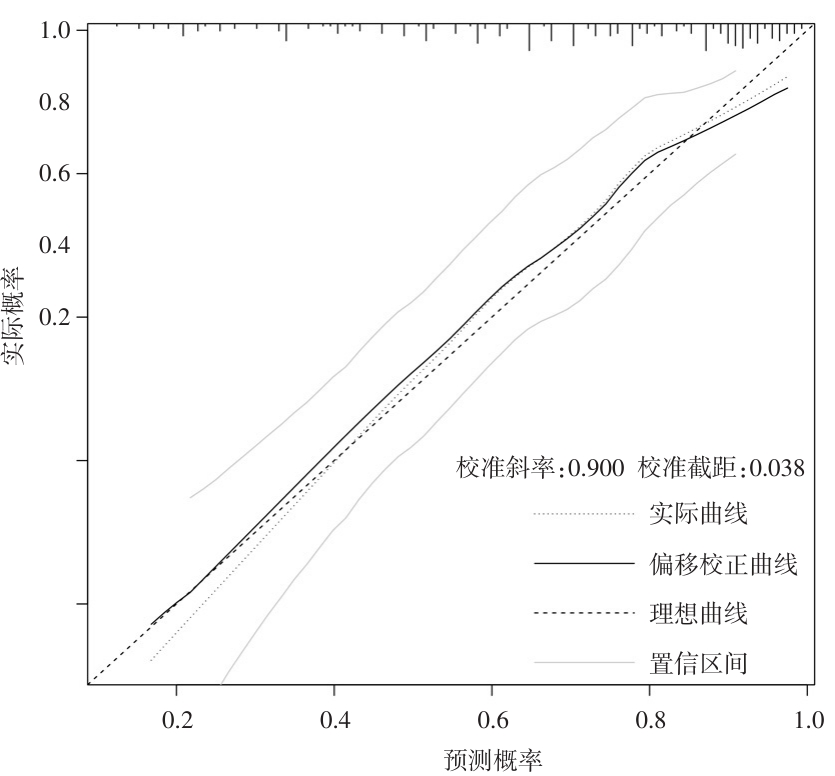
Fig.3
Calibration curve of the ENFI risk prediction model in neurocritical patients"
| [1] |
SINGER P, BLASER A R, BERGER M M, et al. ESPEN practical and partially revised guideline: Clinical nutrition in the intensive care unit[J]. Clin Nutr, 2023, 42(9): 1671-1689. doi:10.1016/j.clnu.2023.07.011 .
doi: 10.1016/j.clnu.2023.07.011 |
| [2] |
KAGAN I, HELLERMAN-ITZHAKI M, BENDAVID I, et al. Controlled enteral nutrition in critical care patients-A randomized clinical trial of a novel management system[J]. Clin Nutr, 2023, 42(9): 1602-1609. doi:10.1016/j.clnu.2023.06.018 .
doi: 10.1016/j.clnu.2023.06.018 |
| [3] |
中华医学会神经外科分会,中国神经外科重症管理协作组. 中国神经外科重症营养治疗专家共识(2022版)[J]. 中华医学杂志, 2022,102(29):2236-2255. doi:10.3760/cma.j.cn112137-20220621-01362 .
doi: 10.3760/cma.j.cn112137-20220621-01362 |
| [4] |
SINGER P, ROBINSON E, RAPHAELI O. The future of artificial intelligence in clinical nutrition[J]. Curr Opin Clin Nutr Metab Care, 2024, 27(2): 200-206. doi:10.1097/mco.0000000000000977 .
doi: 10.1097/mco.0000000000000977 |
| [5] |
卜黎静, 程飞儿, 张爱琴, 等. 危重症患者肠内营养喂养不耐受风险预测模型的构建及验证[J]. 中华护理杂志, 2024, 59(15): 1877-1883. doi:10.3761/j.issn.0254-1769.2024.15.012 .
doi: 10.3761/j.issn.0254-1769.2024.15.012 |
| [6] |
杨金, 黄敬英, 许苗苗, 等. 危重症患者肠内喂养不耐受风险预测模型的系统评价[J]. 中华急危重症护理杂志, 2024, 5(8): 747-755. doi:10.3761/j.issn.2096-7446.2024.08.015 .
doi: 10.3761/j.issn.2096-7446.2024.08.015 |
| [7] |
包益萍, 张玲, 俞臻梁. 成人ICU患者肠内营养喂养不耐受风险预测模型的研究进展[J]. 中华急危重症护理杂志, 2023, 4(6): 562-568. doi:10.3761/j.issn.2096-7446.2023.06.016 .
doi: 10.3761/j.issn.2096-7446.2023.06.016 |
| [8] |
苏小平, 徐静娟, 赵亚东, 等. 危重患者早期肠内营养喂养不耐受风险预测模型的构建[J]. 护理学报, 2022, 29(17): 47-51. doi:10.16460/j.issn1008-9969.2022.17.047 .
doi: 10.16460/j.issn1008-9969.2022.17.047 |
| [9] |
李炜, 杨富, 王晓平, 等. 神经重症患者肠内营养喂养不耐受风险预警模型的构建[J]. 中国神经免疫学和神经病学杂志, 2022, 29(5): 398-403. doi:10.3969/j.issn.1006-2963.2022.05.010 .
doi: 10.3969/j.issn.1006-2963.2022.05.010 |
| [10] |
潘宜波, 王琳, 陈霞, 等. 神经外科重症患者肠内营养喂养不耐受动态列线图预测模型的构建与应用[J]. 护士进修杂志, 2023, 38(21): 1921-1926. doi:10.16821/j.cnki.hsjx.2023.21.001 .
doi: 10.16821/j.cnki.hsjx.2023.21.001 |
| [11] |
YUAN R, LIU L, MI J, et al. Development and validation of a risk prediction model for feeding intolerance in neurocritical patients with enteral nutrition[J]. Front Nutr, 2024, 11: 1481279. doi:10.3389/fnut.2024.1481279 .
doi: 10.3389/fnut.2024.1481279 |
| [12] |
RILEY R D, ENSOR J, SNELL K I E, et al. Calculating the sample size required for developing a clinical prediction model[J]. BMJ, 2020, 368: m441. doi:10.1136/bmj.m441 .
doi: 10.1136/bmj.m441 |
| [13] |
REINTAM BLASER A, MALBRAIN M L N G, STARKOPF J, et al. Gastrointestinal function in intensive care patients: Terminology, definitions and management. Recommendations of the ESICM Working Group on Abdominal Problems[J]. Intensive Care Med, 2012, 38(3): 384-394. doi:10.1007/s00134-011-2459-y .
doi: 10.1007/s00134-011-2459-y |
| [14] |
KIRKPATRICK A W, ROBERTS D J, DE WAELE J, et al. Intra-abdominal hypertension and the abdominal compartment syndrome: Updated consensus definitions and clinical practice guidelines from the World Society of the Abdominal Compartment Syndrome[J]. Intensive Care Med, 2013, 39(7): 1190-1206. doi:10.1007/s00134-013-2906-z .
doi: 10.1007/s00134-013-2906-z |
| [15] |
王晓瑾, 黄春荣, 赵慧慧, 等. 重症患者经膀胱腹内压监测管理的证据总结[J]. 中华护理杂志, 2022, 57(15): 1886-1892. doi:10.3761/j.issn.0254-1769.2022.15.014 .
doi: 10.3761/j.issn.0254-1769.2022.15.014 |
| [16] | 杨标, 潘夕光, 陈龙, 等. 神经重症病人肠内营养不耐受风险预测模型构建及验证[J]. 蚌埠医科大学学报, 2025, 50(9): 1329-1334. |
| [17] |
中国医师协会神经外科分会神经重症专家委员会,北京医学会神经外科分会神经外科危重症学组,中国神经外科重症管理协作组,神经重症目标温度管理中国专家共识(2022版) [J]. 中华神经医学杂志, 2022, 21(7): 649-656. doi:10.3760/cma.j.cn115354-20220515-00336 .
doi: 10.3760/cma.j.cn115354-20220515-00336 |
| [18] |
李旻露, 樊朝凤, 段丽娟, 等. 集束化护理对出血性脑卒中患者肠内营养不耐受干预的效果研究[J]. 中国护理管理, 2023, 23(12): 1774-1779. doi:10.3969/j.issn.1672-1756.2023. 12.003 .
doi: 10.3969/j.issn.1672-1756.2023. 12.003 |
| [19] |
丁佳莉, 刘晓光, 史甜, 等. 基于机器学习算法的重症脑出血患者肠内营养喂养不耐受风险预测模型构建[J]. 实用临床医药杂志, 2024, 28(12): 1-6. doi:10.7619/jcmp.20240467 .
doi: 10.7619/jcmp.20240467 |
| [20] |
刘桂英, 张艳艳, 郭红, 等. 脑卒中患者早期肠内营养喂养不耐受风险预测模型的构建及验证[J]. 护士进修杂志, 2022, 37(2): 97-101. doi:10.16821/j.cnki.hsjx.2022.02.001 .
doi: 10.16821/j.cnki.hsjx.2022.02.001 |
| [21] |
陈小颉, 段霞, 郑微艳, 等. 肠内营养病人喂养不耐受风险预测模型的系统评价[J]. 肠外与肠内营养, 2024, 31(2): 107-113. doi:10.16151/j.1007-810x.2024.02.007 .
doi: 10.16151/j.1007-810x.2024.02.007 |
| [22] |
杨羚, 张莉, 彭虎, 等. 脓毒症患者肠内喂养不耐受风险预测模型构建[J]. 中华全科医学, 2024, 22(3): 384-388. doi:10. 16766/j.cnki.issn.1674-4152.003408 .
doi: 10. 16766/j.cnki.issn.1674-4152.003408 |
| [23] |
米元元,程海洋,向成林,等.2020—2025年中国急危重症领域营养指南及共识的质量评价及内容分析[J].护士进修杂志,2025,40(24):2639-2649.doi:10.16821/j.cnki.hsjx.2025.24.010 .
doi: 10.16821/j.cnki.hsjx.2025.24.010 |
| [24] |
郭双辉, 张玉梅. 肠道菌群影响缺血性脑卒中预后的免疫机制研究进展[J]. 实用医学杂志, 2021, 37(18): 2428-2431. doi:10.3969/j.issn.1006-5725.2021.18.024 .
doi: 10.3969/j.issn.1006-5725.2021.18.024 |
| [25] |
许乐乐, 陈彦君, 陆件, 等. 基于肠道生物标志物评价肠内营养补充益生菌治疗重症胰腺炎的获益与限制[J]. 实用医学杂志, 2024, 40(24): 3458-3467. doi:10.3969/j.issn.1006-5725. 2024.24.005 .
doi: 10.3969/j.issn.1006-5725. 2024.24.005 |
| Viewed | ||||||
|
Full text |
|
|||||
|
Abstract |
|
|||||
