

The Journal of Practical Medicine ›› 2026, Vol. 42 ›› Issue (7): 1225-1234.doi: 10.3969/j.issn.1006-5725.2026.07.015
• Chronic Disease Control • Previous Articles
Zefeng YUAN,Qiang CHEN,Ming LUO,Bo WANG,Bin KONG( )
)
Received:2025-12-10
Revised:2026-01-11
Accepted:2026-01-19
Online:2026-04-10
Published:2026-04-13
Contact:
Bin KONG
E-mail:kongtian75@hebmu.edu.cn
CLC Number:
Zefeng YUAN,Qiang CHEN,Ming LUO,Bo WANG,Bin KONG. Construction of a nomogram prediction model for the efficacy of biofeedback therapy in patients with spastic pelvic floor syndrome[J]. The Journal of Practical Medicine, 2026, 42(7): 1225-1234.

Tab.1
Improvement in therapeutic efficacy before and after BFT treatment"
| 项目 | 治疗前(n = 175) | 治疗后(n = 175) | t值 | P值 |
|---|---|---|---|---|
| 肛管静息压/mmHg | 84.61 ± 19.87 | 65.81 ± 10.98 | 15.897 | 0.003 |
| 肛管长度/cm | 4.76 ± 0.80 | 3.79 ± 0.47 | 19.088 | < 0.001 |
| 缩榨压增量/mmHg | 100.67 ± 35.42 | 68.72 ± 17.78 | 17.283 | < 0.001 |
| 直肠推压/mmHg | 62.26 ± 23.22 | 73.47 ± 16.27 | -9.810 | < 0.001 |
| 肛管松弛率/% | -0.33 ± 10.62 | 16.75 ± 5.52 | -26.355 | < 0.001 |
| 初始感觉阈值/mmHg | 72.98 ± 19.83 | 57.71 ± 13.95 | 14.665 | < 0.001 |
| 初始便意阈值/mmHg | 108.90 ± 29.00 | 94.12 ± 20.57 | 12.905 | < 0.001 |
| 最大耐受阈值/mmHg | 164.77 ± 32.75 | 158.85 ± 23.87 | 4.453 | < 0.001 |
| ODS评分/分 | 23.15 ± 2.33 | 10.81 ± 2.27 | 62.346 | < 0.001 |
| 排便时间/分 | 2.87 ± 0.71 | 1.55 ± 0.60 | 25.74 | < 0.001 |
| 便意次数/分 | 2.58 ± 0.83 | 1.34 ± 0.63 | 23.344 | < 0.001 |
| 手助排便/分 | 3.35 ± 0.63 | 1.63 ± 0.77 | 29.989 | < 0.001 |
| 使用泻药/分 | 3.41 ± 0.62 | 1.30 ± 0.75 | 35.253 | < 0.001 |
| 使用灌肠/分 | 2.22 ± 0.89 | 1.05 ± 0.64 | 18.050 | < 0.001 |
| 排便不尽感/分 | 3.45 ± 0.67 | 1.42 ± 0.73 | 30.689 | < 0.001 |
| 排便费力/分 | 3.60 ± 0.49 | 1.65 ± 0.63 | 38.368 | < 0.001 |
| 粪便性状/分 | 1.66 ± 0.93 | 0.87 ± 0.62 | 12.299 | < 0.001 |
| PAC-QOL总分/分 | 60.86 ± 4.66 | 22.10 ± 3.94 | 102.196 | < 0.001 |
| 躯体不适 | 10.21 ± 2.02 | 3.65 ± 1.30 | 53.540 | < 0.001 |
| 心理不适 | 13.71 ± 2.48 | 4.65 ± 1.41 | 57.427 | < 0.001 |
| 担心与焦虑 | 24.03 ± 2.93 | 9.57 ± 2.76 | 59.428 | < 0.001 |
| 满意度 | 12.91 ± 1.68 | 4.23 ± 1.40 | 59.738 | < 0.001 |
Tab.2
Clinical features of SPFS"
| 项目 | TIE(n = 66) | TE(n = 109) | χ2/t/Z值 | P值 |
|---|---|---|---|---|
| 性别/[例(%)] | 0.644 | 0.422 | ||
| 男 | 27(45.1) | 38(34.9) | ||
| 女 | 39(54.9) | 71(65.1) | ||
| 年龄/岁 | 57.12 ± 14.06 | 56.15 ± 14.15 | 0.443 | 0.659 |
| 病程/年 | 12.38 ± 10.04 | 11.34 ± 7.30 | 0.732 | 0.466 |
| BMI/(kg/m2) | 22.12 ± 2.39 | 22.57 ± 2.15 | -1.295 | 0.197 |
| 高血压/[例(%)] | 30(45.5) | 50(45.9) | 0.003 | 0.957 |
| 糖尿病/[例(%)] | 21(31.8) | 38(34.9) | 0.170 | 0.680 |
| 腹部手术史/[例(%)] | 16(24.2) | 31(26.3) | 0.092 | 0.762 |
| 肛门手术史/[例(%)] | 17(25.8) | 27(25.0) | 0.012 | 0.911 |
| 肛管静息压/mmHg | 69.17 ± 12.63 | 63.78 ± 9.33 | 3.004 | < 0.001 |
| 肛管长度/cm | 3.92 ± 0.48 | 3.71 ± 0.45 | 2.933 | 0.004 |
| 缩榨压增量/mmHg | 69.18 ± 16.41 | 68.44 ± 18.63 | 0.267 | 0.790 |
| 直肠推压/mmHg | 71.32 ± 14.11 | 74.78 ± 17.38 | -1.439 | 0.152 |
| 肛管松弛率/% | 15.56 ± 5.77 | 17.47 ± 5.26 | -2.242 | 0.026 |
| 初始感觉阈值/mmHg | 61.26 ± 13.13 | 55.57 ± 14.05 | 2.660 | 0.009 |
| 初始便意阈值/mmHg | 96.33 ± 20.50 | 92.78 ± 20.59 | 1.108 | 0.269 |
| 最大耐受阈值/mmHg | 160.36 ± 21.59 | 157.94 ± 25.21 | 0.651 | 0.516 |
| ODS总评分 | 12.91 ± 1.39 | 9.54 ± 1.68 | 14.340 | < 0.001 |
| 排便时间 | 1.71 ± 0.55 | 1.46 ± 0.62 | 2.826 | 0.005 |
| 便意次数 | 1.41 ± 0.58 | 1.29 ± 0.66 | 1.176 | 0.241 |
| 手助排便 | 2.12 ± 0.60 | 1.33 ± 0.71 | 7.923 | < 0.001 |
| 使用泻药 | 1.80 ± 0.66 | 1.00 ± 0.62 | 8.069 | < 0.001 |
| 使用灌肠 | 1.35 ± 0.62 | 0.86 ± 0.59 | 5.210 | < 0.001 |
| 排便不尽感 | 1.89 ± 0.64 | 1.13 ± 0.63 | 7.802 | < 0.001 |
| 排便费力 | 1.73 ± 0.60 | 1.61 ± 0.65 | 1.235 | 0.218 |
| 粪便性状 | 0.89 ± 0.61 | 0.86 ± 0.63 | 0.325 | 0.746 |
| PAC-QOL总评分 | 23.38 ± 3.53 | 21.32 ± 3.99 | 3.452 | 0.001 |
| 躯体不适 | 3.86 ± 1.31 | 3.52 ± 1.27 | 1.696 | 0.092 |
| 心理不适 | 4.71 ± 1.38 | 4.61 ± 1.43 | 0.442 | 0.659 |
| 担心与焦虑 | 9.77 ± 2.55 | 9.44 ± 2.89 | 0.770 | 0.442 |
| 满意度 | 5.03 ± 1.52 | 3.74 ± 1.07 | 6.042 | < 0.001 |
Tab.3
Univariate logistic regression analysis of the efficacy of BFT"
| 变量 | β | SE | Waldχ2 | OR | 95%CI | P值 |
|---|---|---|---|---|---|---|
| 肛门静息压 | -0.05 | 0.02 | 5.95 | 0.95 | 0.92 ~ 0.99 | 0.015 |
| 肛管长度 | -1.38 | 0.45 | 9.55 | 0.25 | 0.10 ~ 0.58 | 0.002 |
| 肛管松弛率 | 0.09 | 0.04 | 6.59 | 1.10 | 1.02 ~ 1.18 | 0.010 |
| ODS总评分 | -1.39 | 0.27 | 27.53 | 0.25 | 0.14 ~ 0.39 | < 0.001 |
| 排便时间 | -0.77 | 0.33 | 5.36 | 0.46 | 0.23 ~ 0.87 | 0.021 |
| 手助排便 | -1.59 | 0.37 | 18.56 | 0.20 | 0.09 ~ 0.40 | < 0.001 |
| 使用泻药 | -1.92 | 0.38 | 25.67 | 0.15 | 0.07 ~ 0.29 | < 0.001 |
| 使用灌肠 | -1.17 | 0.35 | 10.95 | 0.31 | 0.15 ~ 0.60 | 0.001 |
| 排便不尽感 | -1.89 | 0.38 | 24.96 | 0.15 | 0.07 ~ 0.30 | < 0.001 |
| 满意度 | -0.7 | 0.17 | 17.07 | 0.50 | 0.35 ~ 0.68 | < 0.001 |
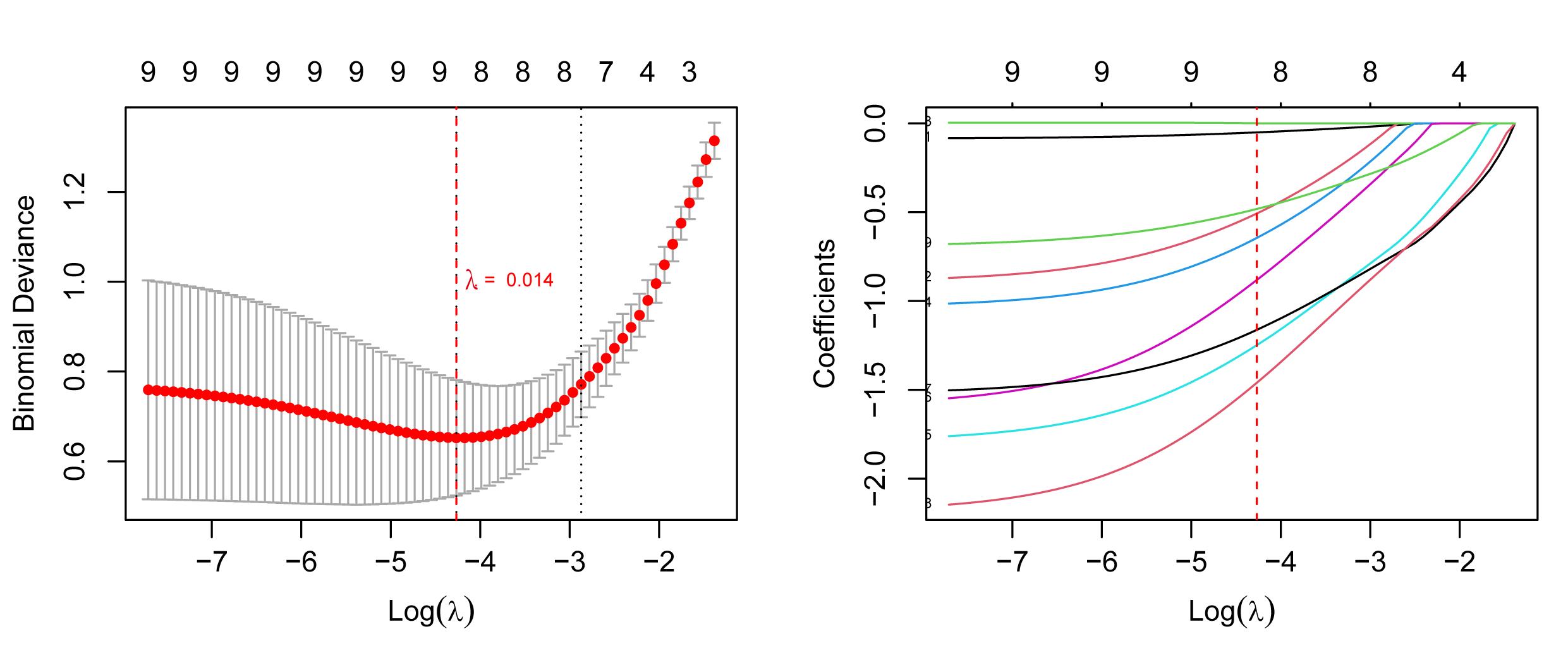
Fig.1
Lasso regression variable selection"
Tab.4
Multivariate logistic regression analysis of the efficacy of BFT"
| 变量 | β | SE | Wald χ2 | OR | 95% CI | P值 |
|---|---|---|---|---|---|---|
| 肛门静息压 | -0.09 | 0.04 | 5.18 | 0.92 | 0.85 ~ 0.98 | 0.024 |
| 肛管长度 | -0.89 | 0.70 | 1.63 | 0.41 | 0.10 ~ 1.55 | 0.201 |
| 肛管松弛率 | 0.01 | 0.07 | 0.01 | 1.00 | 0.88 ~ 1.15 | 0.955 |
| 排便时间 | -1.03 | 0.63 | 2.72 | 0.36 | 0.09 ~ 1.15 | 0.099 |
| 手助排便 | -1.79 | 0.65 | 7.57 | 0.17 | 0.04 ~ 0.52 | 0.006 |
| 排便不尽感 | -2.19 | 0.72 | 9.23 | 0.11 | 0.02 ~ 0.39 | 0.002 |
| 使用泻药 | -1.52 | 0.61 | 6.23 | 0.22 | -0.06 ~ 0.67 | 0.013 |
| 使用灌肠 | -1.59 | 2.35 | 4.12 | 0.20 | 0.04 ~ 0.80 | 0.042 |
| 满意度 | -0.69 | 0.63 | 4.74 | 0.50 | 0.25 ~ 0.88 | 0.029 |
Fig.2
Nomogram for predicting the efficacy of BFT"
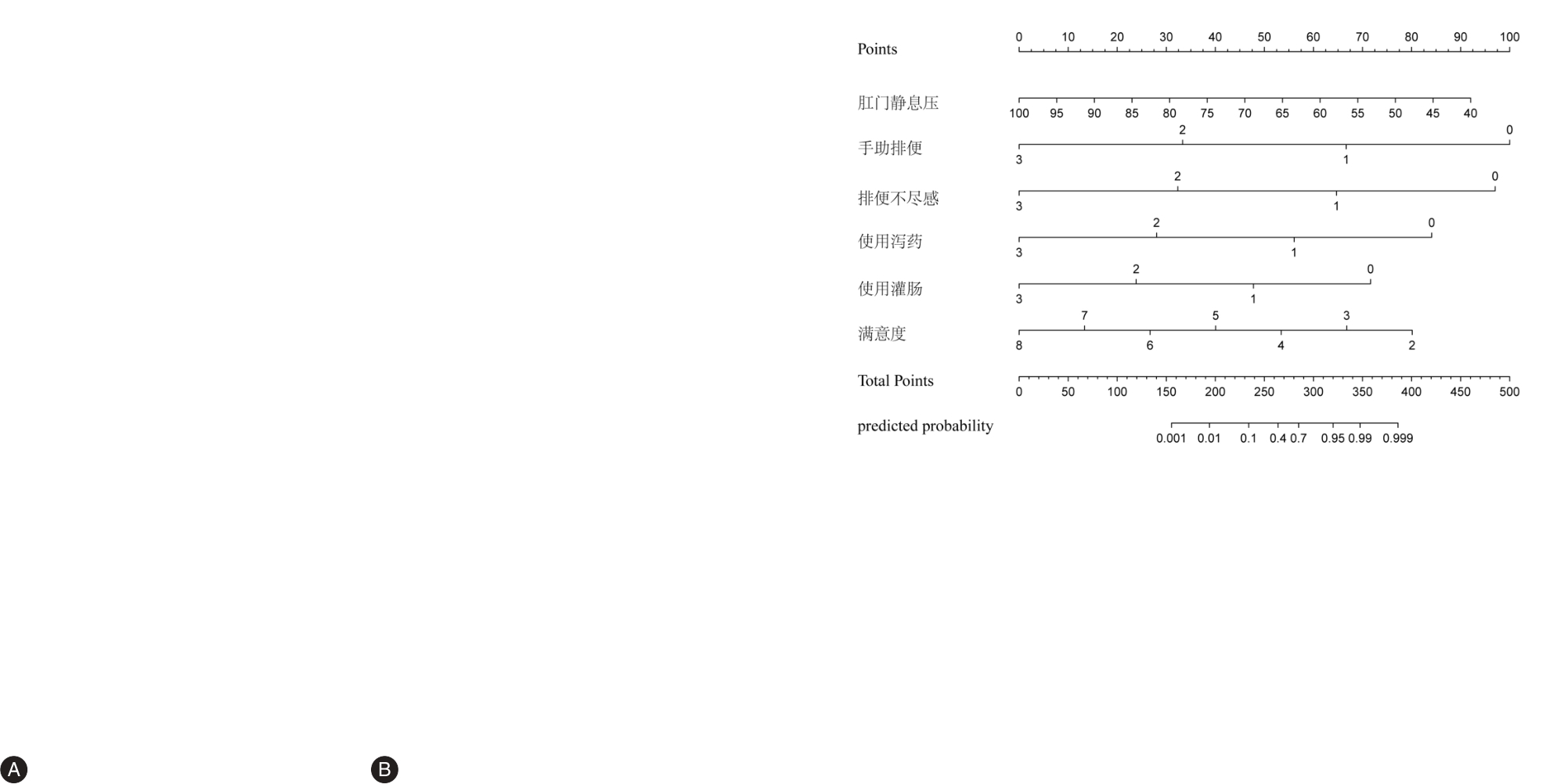
Fig.3
Performance validation of the BFT efficacy prediction model"
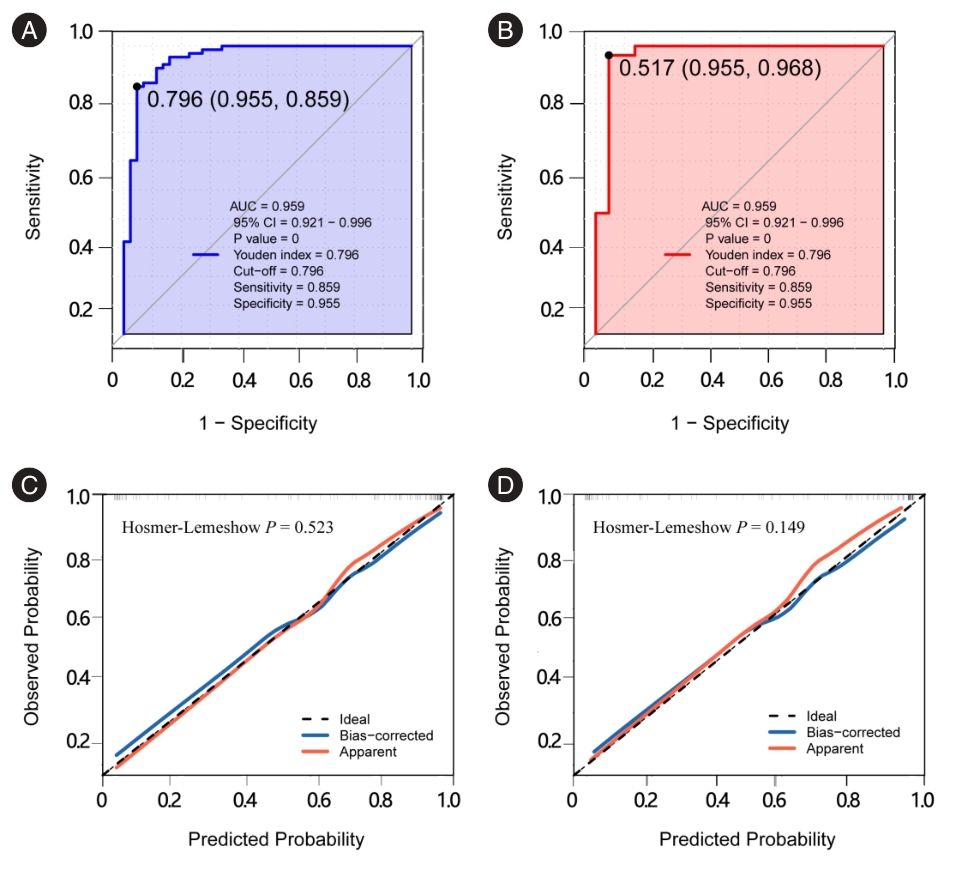
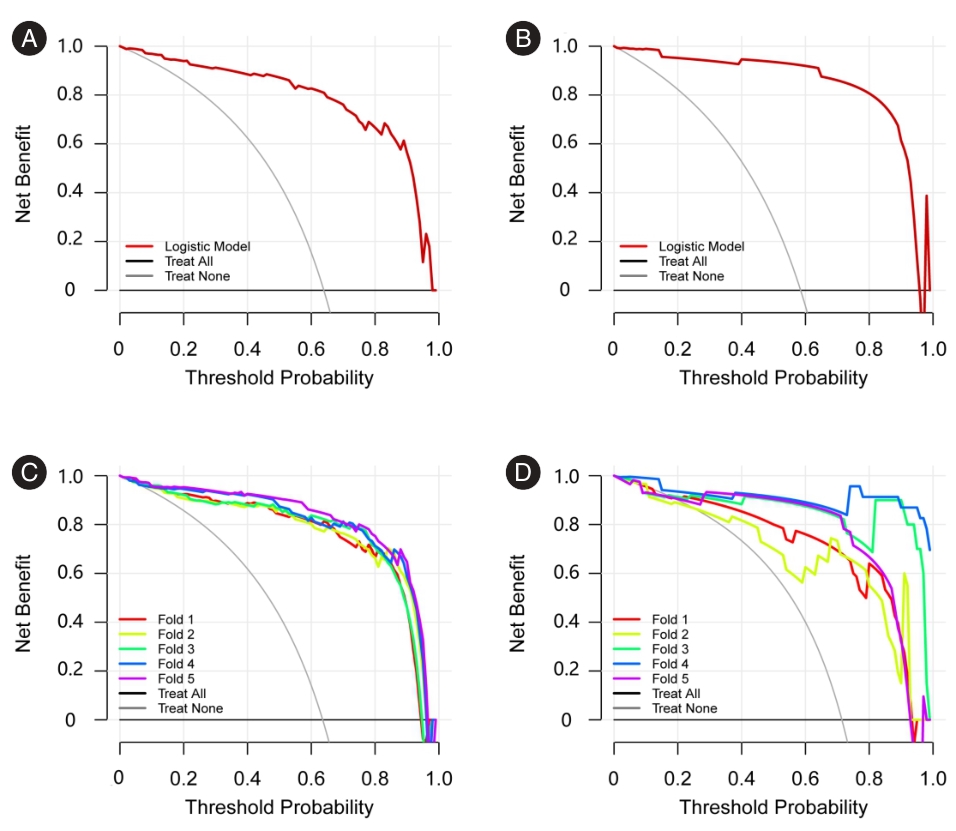
Fig.4
Clinical utility assessment of the BFT efficacy prediction model"
| [1] |
SRINIVASAN S G, MUTHYALA A, SHARMA M, et al. Abdomino-anal Dyscoordination in Defecatory Disorders[J]. Clin Gastroenterol Hepatol, 2022, 20: 2091-2101. e2095. doi: 10.1016/j.cgh.2021.11.040 .
doi: 10.1016/j.cgh.2021.11.040 |
| [2] |
SUN F F, CHEN Y Q, JIANG Z L, et al. Botulinum toxin type A injection combined with biofeedback in the treatment of spastic pelvic floor syndrome[J]. World J Clin Cases, 2024, 12: 4905-4912. doi: 10.12998/wjcc.v12.i22.4905 .
doi: 10.12998/wjcc.v12.i22.4905 |
| [3] |
HEINRICH H. Deconstructing Obstructive Defecation Syndrome with Adaptive Biofeedback[J]. Dig Dis Sci, 2022, 67: 1095-1096. doi: 10.1007/s10620-021-07097-w .
doi: 10.1007/s10620-021-07097-w |
| [4] |
WEGH C A M, BAALEMAN D F, TABBERS M M, et al. Nonpharmacologic Treatment for Children with Functional Constipation: A Systematic Review and Meta-analysis[J]. J Pediatr, 2022, 240: 136-149.e5. doi: 10.1016/j.jpeds.2021.09.010 .
doi: 10.1016/j.jpeds.2021.09.010 |
| [5] |
中国慢性便秘专家共识意见( 2019,广州)[J]. 中华消化杂志, 2019, (9): 577-598. doi: 10.3760/cma.j.issn.0254-1432.2019.09.001 .
doi: 10.3760/cma.j.issn.0254-1432.2019.09.001 |
| [6] |
ALAVI K, THORSEN A J, FANG S H, et al. The American Society of Colon and Rectal Surgeons Clinical Practice Guidelines for the Evaluation and Management of Chronic Constipation [J]. Dis Colon Rectum, 2024, 67: 1244-1257. doi:10.1097/dcr.0000000000003430 .
doi: 10.1097/dcr.0000000000003430 |
| [7] |
HOJO M, SHIBUYA T, NAGAHARA A. Management of Chronic Constipation: A Comprehensive Review[J]. Intern Med, 2025, 64(1): 7-15. doi: 10.2169/internalmedicine.2867-23 .
doi: 10.2169/internalmedicine.2867-23 |
| [8] |
PATCHARATRAKUL T, VALESTIN J, SCHMELTZ A, et al. Factors Associated With Response to Biofeedback Therapy for Dyssynergic Defecation[J]. Clin Gastroenterol Hepatol, 2018, 16: 715-721. doi: 10.1016/j.cgh.2017.10.027 .
doi: 10.1016/j.cgh.2017.10.027 |
| [9] |
AZIZ I, WHITEHEAD W E, PALSSON O S, et al. An approach to the diagnosis and management of Rome IV functional disorders of chronic constipation[J]. Expert Rev Gastroenterol Hepatol, 2020, 14: 39-46. doi: 10.1080/17474124.2020.1708718 .
doi: 10.1080/17474124.2020.1708718 |
| [10] |
KILGORE A, KHLEVNER J. Functional Constipation: Pathophysiology, evaluation, and management[J]. Aliment Pharmacol Ther, 2024, 60 : S20-S29. doi: 10.1111/apt.17852 .
doi: 10.1111/apt.17852 |
| [11] |
任晓阳, 殷燕, 闫小妮, 等. 不同检测方法对基于罗马Ⅳ标准的排便障碍型便秘的诊断价值 [J]. 西安交通大学学报(医学版), 2022, 43(6): 867-871. doi: 10.7652/jdyxb202206012 .
doi: 10.7652/jdyxb202206012 |
| [12] |
BUNNI J, LAUGHARNE M J. Pathophysiological basis, clinical assessment, investigation and management of patients with obstruction defecation syndrome[J]. Langenbecks Arch Surg, 2023, 408: 75. doi: 10.1007/s00423-023-02755-1 .
doi: 10.1007/s00423-023-02755-1 |
| [13] |
SADEGHI A, AKBARPOUR E, MAJIDIRAD F, et al. Dyssynergic Defecation: A Comprehensive Review on Diagnosis and Management[J]. Turk J Gastroenterol, 2023, 34: 182-195. doi: 10.5152/tjg.2023.22148 .
doi: 10.5152/tjg.2023.22148 |
| [14] |
TALEBI A, ALIMADADI E, AKBARI A, et al. Improvement of Patient Satisfaction and Anorectal Manometry Parameters After Biofeedback Therapy in Patients with Different Types of Dyssynergic Defecation[J]. Appl Psychophysiol Biofeedback, 2020, 45: 267-274. doi: 10.1007/s10484-020-09476-x .
doi: 10.1007/s10484-020-09476-x |
| [15] |
柴秀红, 杜丽萍, 张华. 生物反馈治疗加护理干预对出口梗阻型便秘的疗效观察[J]. 中国肛肠病杂志, 2019, 39(1): 63-65. doi: 10.3969/j.issn.1000-1174.2019.01.030 .
doi: 10.3969/j.issn.1000-1174.2019.01.030 |
| [16] |
CADEDDU F, SALIS F, DE LUCA E, et al. Efficacy of biofeedback plus transanal stimulation in the management of pelvic floor dyssynergia: A randomized trial[J]. Tech Coloproctol, 2015, 19: 333-338. doi:10.1007/s10151-015-1292-7 .
doi: 10.1007/s10151-015-1292-7 |
| [17] |
金绍兰, 贺潇月. 盆底磁刺激联合生物反馈治疗盆底失弛缓型便秘30例疗效观察[J]. 中国肛肠病杂志, 2021, 41(09): 51-53. doi: 10.3969/j.issn.1000-1174.2021.09.024 .
doi: 10.3969/j.issn.1000-1174.2021.09.024 |
| [18] |
RAO S S, SEATON K, MILLER M, et al. Randomized controlled trial of biofeedback, sham feedback, and standard therapy for dyssynergic defecation[J]. Clin Gastroenterol Hepatol, 2007, 5: 331-338. doi: 10.1016/j.cgh.2006.12.023 .
doi: 10.1016/j.cgh.2006.12.023 |
| [19] |
罗育连, 罗宏标, 唐清珠, 等. 电针联合生物反馈治疗盆底失弛缓型便秘患者疗效及对肛管直肠动力学的影响[J]. 现代中西医结合杂志, 2021, 30(28): 3113-3117+3150. doi: 10.3969/j.issn.1008-8849.2021.28.007 .
doi: 10.3969/j.issn.1008-8849.2021.28.007 |
| [20] |
BENNY S, MATHEWS N V, THOMAS A, et al. Abbreviated anorectal biofeedback therapy is beneficial in symptomatic improvement of functional defecatory disorder[J]. Indian J Gastroenterol, 2025, 44(4): 562. doi: 10.1007/s12664-025-01752-0 .
doi: 10.1007/s12664-025-01752-0 |
| [21] |
HONGYU Z, NANA L, MINGWEI H, et al. Effect of Biofeedback Combined with Psychotherapy on Functional Constipation Complicated with Anxiety and Depression[J]. Appl Psychophysiol Biofeedback, 2025, 50(1): 65-69. doi: 10.1007/s10484-024-09670-1 .
doi: 10.1007/s10484-024-09670-1 |
| [22] |
袁泽峰, 田高源, 黄志伟, 等. 生物反馈联合磁电刺激对盆底痉挛综合征患者排粪梗阻的改善作用[J]. 实用医学杂志, 2025, 41(15): 2372-2380. doi: 10.3969/j.issn.1006-5725.2025.15.012 .
doi: 10.3969/j.issn.1006-5725.2025.15.012 |
| [23] |
MARRA A A, SIMONELLI I, PARELLO A, et al. Analysis of factors that indicated surgery in 400 patients submitted to a complete diagnostic workup for obstructed defecation syndrome and rectal prolapse using a supervised machine learning algorithm[J]. Tech Coloproctol, 2024, 28(1): 73. doi: 10.1007/s10151-024-02951-1 .
doi: 10.1007/s10151-024-02951-1 |
| [24] |
BHARUCHA A E, LACY B E. Mechanisms, Evaluation, and Management of Chronic Constipation[J]. Gastroenterology, 2020, 158(5): 1232-1249. e1233. doi: 10.1053/j.gastro.2019.12.034 .
doi: 10.1053/j.gastro.2019.12.034 |
| [25] |
BHARUCHA A E, KNOWLES C H, MALCOLM A. An Evidence-Based Practical Review on Common Benign Anorectal Disorders: Hemorrhoids, Anal Fissure, Dyssynergic Defecation, and Fecal Incontinence[J]. Gastroenterology, 2026, 170(1): 50-69. doi: 10.1053/j.gastro.2025.07.031 .
doi: 10.1053/j.gastro.2025.07.031 |
| [26] |
MURAD-REGADAS S M, REGADAS F S, BEZERRA C C, et al. Use of Biofeedback Combined With Diet for Treatment of Obstructed Defecation Associated With Paradoxical Puborectalis Contraction (Anismus): Predictive Factors and Short-term Outcome[J]. Dis Colon Rectum, 2016, 59(2): 115-121. doi: 10.1097/dcr.0000000000000519 .
doi: 10.1097/dcr.0000000000000519 |
| [27] |
ISLAM M T, SHEIKH S H, REZA E, et al. Evaluation of Short Term Outcome of Stapled Transanal Rectal Resection (STARR) for ODS (Obstructed Defecation Syndrome) by Comparing Pre and Post-operative ODS Score[J]. Mymensingh Med J, 2022, 31(2): 355-359. PMID: .
pmid: 35383750 |
| [28] |
MAKSOUD W M ABD EL, ABBAS K S, BAWAHAB M A, et al. Prevalence of Obstructed Defecation among Patients Who Underwent Hemorrhoidectomy and Correlation between Preoperative Constipation Score and Postoperative Patients' Satisfaction: A Prospective Study in Two Centers[J]. Healthcare (Basel), 2023, 11(5): 759. doi: 10.3390/healthcare11050759 .
doi: 10.3390/healthcare11050759 |
| [29] |
BARBERIO B, JUDGE C, SAVARINO E V, et al. Global prevalence of functional constipation according to the Rome criteria: A systematic review and meta-analysis[J]. Lancet Gastroenterol Hepatol, 2021, 6(8): 638-648. doi: 10.1016/s2468-1253(21)00111-4 .
doi: 10.1016/s2468-1253(21)00111-4 |
| [30] |
ÖZIN Y, ÖZTÜRK Ö, TENLIK I, et al. Efficacy of combination of biofeedback therapy and pelvic floor muscle training in dyssynergic defecation[J]. Acta Gastroenterol Belg, 2021, 84: 577-583. doi: 10.51821/84.4.008 .
doi: 10.51821/84.4.008 |
| [31] |
LAMBIASE C, Bellini M, Whitehead W E, et al. Biofeedback efficacy for outlet dysfunction constipation: Clinical outcomes and predictors of response by a limited approach[J].Neurogastroenterol Motil, 2025, 37(1):e14948. doi: 10.1111/nmo.14948 .
doi: 10.1111/nmo.14948 |
| [32] |
PANNEMANS J, MASUY I, TACK J. Functional Constipation: Individualising Assessment and Treatment[J]. Drugs, 2020, 80(10): 947-963. doi: 10.1007/s40265-020-01305-z .
doi: 10.1007/s40265-020-01305-z |
| [33] |
SERRA J, POHL D, AZPIROZ F, et al. European society of neurogastroenterology and motility guidelines on functional constipation in adults[J]. Neurogastroenterol Motil, 2020, 32(2): e13762. doi: 10.1111/nmo.13762 .
doi: 10.1111/nmo.13762 |
| [34] |
CHEN Z, PENG Y, SHI Q, et al. Prevalence and Risk Factors of Functional Constipation According to the Rome Criteria in China: A Systematic Review and Meta-Analysis[J]. Front Med (Lausanne), 2022, 9: 815156. doi: 10.3389/fmed.2022.815156 .
doi: 10.3389/fmed.2022.815156 |
| [35] |
CAMILLERI M. Gastrointestinal motility disorders in neurologic disease[J]. J Clin Invest, 2021, 131(4): e143771. doi: 10.1172/jci143771 .
doi: 10.1172/jci143771 |
| [36] |
VRIESMAN M H, KOPPEN I J N, CAMILLERI M, et al. Management of functional constipation in children and adults[J]. Nat Rev Gastroenterol Hepatol, 2020, 17(1): 21-39. doi: 10.1038/s41575-019-0222-y .
doi: 10.1038/s41575-019-0222-y |
| [37] |
RAO S S, PATCHARATRAKUL T. Diagnosis and Treatment of Dyssynergic Defecation[J]. J Neurogastroenterol Motil, 2016, 22: 423-435. doi: 10.5056/jnm16060 .
doi: 10.5056/jnm16060 |
| [38] |
VELDMAN F, HAWINKELS K, KESZTHELYI D. Efficacy of vagus nerve stimulation in gastrointestinal disorders: A systematic review[J]. Gastroenterol Rep (Oxf), 2025, 13: goaf009. doi: 10.1093/gastro/goaf009 .
doi: 10.1093/gastro/goaf009 |
| [39] |
VERMA A, MISRA A, GHOSHAL U C. Effect of biofeedback therapy on anorectal physiological parameters among patients with fecal evacuation disorder[J]. Indian J Gastroenterol, 2017, 36(2): 99-104. doi: 10.1007/s12664-017-0731-y .
doi: 10.1007/s12664-017-0731-y |
| [40] |
GADEL HAK N, EL-HEMALY M, HAMDY E, et al. Pelvic floor dyssynergia: Efficacy of biofeedback training[J]. Arab J Gastroenterol, 2011, 12(1): 15-19. doi: 10.1016/j.ajg.2011.01.001 .
doi: 10.1016/j.ajg.2011.01.001 |
| [41] |
GULCIN N, ANADOLULU A I, CAGLAR M, et al. Evaluation of conventional anorectal manometry and biofeedback therapy in adolescents with functional constipation[J]. North Clin Istanb, 2024, 11(5): 466-470. doi: 10.14744/nci.2023.85126 .
doi: 10.14744/nci.2023.85126 |
| [42] |
袁泽峰, 程敏静, 陈强, 等. 生物反馈疗法在盆底失弛缓型便秘中的研究进展[J]. 实用医学杂志, 2024, 40(24): 3568-3574. doi: 10.3969/j.issn.1006-5725.2024.24.021 .
doi: 10.3969/j.issn.1006-5725.2024.24.021 |
| [43] |
SHIN J K, CHEON J H, KIM E S, et al. Predictive capability of anorectal physiologic tests for unfavorable outcomes following biofeedback therapy in dyssynergic defecation[J]. J Korean Med Sci, 2010, 25(7): 1060-1065. doi: 10.3346/jkms.2010.25.7.1060 .
doi: 10.3346/jkms.2010.25.7.1060 |
| Viewed | ||||||
|
Full text |
|
|||||
|
Abstract |
|
|||||
