

The Journal of Practical Medicine ›› 2026, Vol. 42 ›› Issue (12): 2091-2097.doi: 10.3969/j.issn.1006-5725.2026.12.001
• Perioperative Management and Critical Care Support •
Wenqing ZHAO,Liuyuan LI,Chongjian ZHANG,Hailong QIU,Xiaofeng LI( )
)
Received:2026-03-13
Online:2026-06-25
Published:2026-06-30
Contact:
Xiaofeng LI
E-mail:lixiaofeng@gdph.org.cn
CLC Number:
Wenqing ZHAO,Liuyuan LI,Chongjian ZHANG,Hailong QIU,Xiaofeng LI. Prognostic value of the Model for End-Stage Liver Disease Excluding International Normalized Ratio(MELD-XI) score for long-term all-cause mortality in elderly patients following cardiac valve surgery[J]. The Journal of Practical Medicine, 2026, 42(12): 2091-2097.

Tab.1
Baseline characteristics of the study population"
| 项目 | 低值组(n = 192) | 高值组(n = 71) | χ2/t/Z值 | P值 |
|---|---|---|---|---|
| 例数 | 192 | 71 | ||
| 年龄(x ± s)/岁 | 68.15 ± 3.28 | 69.39 ± 3.55 | 8.527 | 0.008 |
| 身高(x ± s)/cm | 159.16 ± 9.77 | 164.95 ± 7.37 | 24.430 | < 0.001 |
| 体质量(x ± s)/kg | 57.26 ± 10.81 | 60.06 ± 9.54 | 3.699 | 0.056 |
| 性别 | 30.724 | < 0.001 | ||
| 女 | 89(46.35) | 60(84.51) | ||
| 男 | 103(53.65) | 11(15.49) | ||
| 高血压 | 51(26.56) | 14(19.72) | 1.305 | 0.253 |
| 糖尿病 | 17(8.85) | 3(4.23) | 1.581 | 0.209 |
| 心房颤动 | 49(25.52) | 24(33.80) | 1.773 | 0.183 |
| 术前血红蛋白量(x ± s)/(g/L) | 126.31 ± 16.99 | 129.25 ± 21.25 | 1.998 | 0.247 |
| 术前血小板计数[M(P25,P75)]/(× 109/L) | 172.50(147.75,212.00) | 158.00(132.00,175.50) | 11.149 | 0.003 |
| 术前血清葡萄糖[M(P25,P75)]/(mmol/L) | 5.00(4.66,5.82) | 4.95(4.46,5.68) | 0.886 | 0.928 |
| 术前血浆纤维蛋白原含量[M(P25,P75)]/(g/L) | 3.63(3.10,4.30) | 3.30(2.96,4.22) | 2.039 | 0.908 |
| 术前血清低密度脂蛋白胆固醇[M(P25,P75)]/(mmol/L) | 2.86(2.24,3.39) | 2.64(2.09,3.22) | 2.497 | 0.115 |
| 术前总胆红素[M(P25,P75)]/(μmol/L) | 16.25(13.00,20.02) | 26.40(19.10,34.85) | 58.487 | < 0.001 |
| 术前血肌酐[M(P25,P75)]/(μmol/L) | 76.00(64.00,88.00) | 114.00(94.85,142.50) | 111.278 | < 0.001 |
| MELD-XI评分[M(P25,P75)]/分 | 7.46(5.19,9.34) | 14.46(12.83,16.00) | 154.910 | < 0.001 |
| 左心室射血分数[M(P25,P75)]/% | 64.00(58.00,68.00) | 62.00(54.00,68.00) | 2.165 | 0.112 |
| 再次手术 | 5(2.60) | 3(4.23) | 0.462 | 0.497 |
| 急诊手术 | 3(1.56) | 0(0.00) | 1.122 | 0.289 |
| 二尖瓣手术 | 145(75.52) | 61(85.92) | 3.299 | 0.069 |
| 三尖瓣手术 | 101(52.60) | 46(64.79) | 3.121 | 0.077 |
| 主动脉瓣手术 | 104(54.17) | 34(47.89) | 0.820 | 0.365 |
| 冠状动脉旁路移植 | 30(15.62) | 11(15.49) | 0.001 | 0.979 |
| 体外循环时间[M(P25,P75)]/min | 126.00(100.75,160.00) | 140.00(106.00,179.50) | 4.050 | 0.001 |
| 主动脉阻断时间[M(P25,P75)]/min | 86.00(65.00,113.00) | 93.00(71.00,123.50) | 1.418 | 0.117 |
| 随访时间[M(P25,P75)]/年 | 7.90(7.60,8.30) | 7.70(4.45,8.15) | 6.995 | 0.001 |
| 随访死亡 | 34(17.71) | 26(36.62) | 10.527 | 0.001 |
Tab.2
Univariate Cox regression analysis for follow-up mortality"
| 项目 | HR(95%CI) | P值 |
|---|---|---|
| 年龄/岁 | 1.06(0.99 ~ 1.13) | 0.110 1 |
| 身高/cm | 1.00(0.97 ~ 1.02) | 0.735 5 |
| 体质量/kg | 0.99(0.97 ~ 1.02) | 0.476 7 |
| 男性 | 0.87(0.52 ~ 1.46) | 0.600 4 |
| 高血压 | 1.01(0.56 ~ 1.81) | 0.974 2 |
| 糖尿病 | 0.87(0.32 ~ 2.41) | 0.792 3 |
| 心房颤动 | 0.94(0.53 ~ 1.67) | 0.841 5 |
| 术前血红蛋白量/(g/L) | 0.98(0.97 ~ 0.99) | 0.000 9 |
| 术前血小板计数/(× 109/L) | 1.00(1.00 ~ 1.01) | 0.382 6 |
| 术前血清葡萄糖/(mmol/L) | 1.05(0.92 ~ 1.19) | 0.478 0 |
| 术前血浆纤维蛋白原含量/(g/L) | 0.97(0.88 ~ 1.08) | 0.622 8 |
| 术前血清低密度脂蛋白胆固醇/(mmol/L) | 0.72(0.53 ~ 0.98) | 0.034 1 |
| 术前总胆红素/(μmol/L) | 1.03(1.01 ~ 1.05) | 0.014 0 |
| 术前血肌酐/(μmol/L) | 1.01(1.00 ~ 1.01) | < 0.000 1 |
| MELD-XI评分 | 1.11(1.05 ~ 1.17) | 0.000 2 |
| 左心室射血分数/% | 0.97(0.95 ~ 0.99) | 0.007 3 |
| 再次手术 | 2.72(0.99 ~ 7.52) | 0.053 2 |
| 急诊手术 | 0.00(0.00 ~ Inf) | 0.996 2 |
| 二尖瓣手术 | 1.12(0.59 ~ 2.11) | 0.728 2 |
| 三尖瓣手术 | 1.57(0.92 ~ 2.67) | 0.096 3 |
| 主动脉瓣手术 | 1.70(1.01 ~ 2.87) | 0.047 8 |
| 冠状动脉旁路移植 | 1.10(0.56 ~ 2.17) | 0.787 2 |
| 体外循环时间/min | 1.01(1.00 ~ 1.01) | 0.000 1 |
| 主动脉阻断时间/min | 1.01(1.00 ~ 1.02) | 0.005 2 |
Tab.3
Multivariate Cox regression analysis"
| 变量 | 单因素未调整模型 | 多因素调整模型1 | 多因素调整模型2 | |||
|---|---|---|---|---|---|---|
| HR(95%CI) | P值 | HR(95%CI) | P值 | HR(95%CI) | P值 | |
| MELD-XI | 1.11(1.05 ~ 1.17) | 0.000 2 | 1.12(1.05 ~ 1.18) | 0.000 2 | 1.09(1.03 ~ 1.16) | 0.002 4 |
| MELD-XI 切点二分组 | ||||||
| ≤ 11.82 | 1 | 1 | 1 | |||
| > 11.82 | 2.38(1.43 ~ 3.96) | 0.000 9 | 2.62(1.46 ~ 4.69) | 0.001 2 | 2.36(1.29 ~ 4.35) | 0.005 6 |
| MELD-XI 三等分组 | ||||||
| 低值组 | 1 | 1 | 1 | |||
| 中值组 | 1.24(0.62 ~ 2.46) | 0.542 5 | 1.27(0.63 ~ 2.56) | 0.497 0 | 1.52(0.72 ~ 3.21) | 0.273 5 |
| 高值组 | 1.97(1.05 ~ 3.70) | 0.035 9 | 2.13(1.05 ~ 4.29) | 0.035 3 | 2.34(1.10 ~ 4.96) | 0.027 5 |
| 趋势性检验 | 0.030 9 | 0.031 9 | 0.025 9 | |||
Tab.4
Subgroup analysis"
| 项目 | 例数 | OR(95%CI) | P值 | 交互检验P值 |
|---|---|---|---|---|
| 年龄 | 0.642 2 | |||
| ≤ 65岁 | 49 | 1.15(0.99 ~ 1.34) | 0.076 5 | |
| > 65岁 | 214 | 1.10(1.04 ~ 1.17) | 0.001 2 | |
| 男性 | ||||
| 否 | 149 | 1.12(1.05 ~ 1.21) | 0.001 4 | 0.800 9 |
| 是 | 114 | 1.10(1.01 ~ 1.21) | 0.030 7 | |
| 高血压 | 0.318 4 | |||
| 否 | 198 | 1.09(1.03 ~ 1.16) | 0.005 5 | |
| 是 | 65 | 1.17(1.04 ~ 1.31) | 0.007 5 | |
| 心房颤动 | 0.884 6 | |||
| 否 | 190 | 1.11(1.04 ~ 1.18) | 0.000 7 | |
| 是 | 73 | 1.09(0.97 ~ 1.23) | 0.130 8 | |
| 二尖瓣手术 | 0.092 9 | |||
| 否 | 57 | 1.02(0.89 ~ 1.15) | 0.808 4 | |
| 是 | 206 | 1.13(1.07 ~ 1.21) | < 0.000 1 | |
| 三尖瓣手术 | 0.085 2 | |||
| 否 | 116 | 1.03(0.93 ~ 1.14) | 0.546 7 | |
| 是 | 147 | 1.13(1.06 ~ 1.21) | 0.000 2 | |
| 主动脉瓣手术 | 0.423 4 | |||
| 否 | 125 | 1.15(1.04 ~ 1.26) | 0.005 8 | |
| 是 | 138 | 1.09(1.02 ~ 1.16) | 0.009 6 |
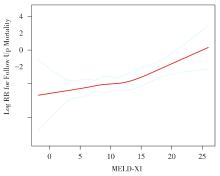
Fig.1
Restricted cubic spline for MELD-XI score and follow-up mortality risk"
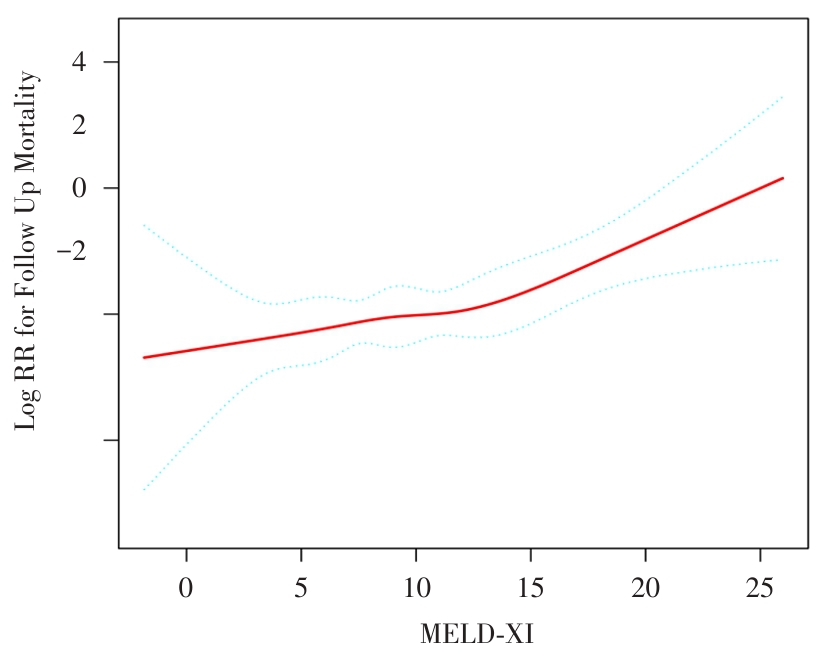
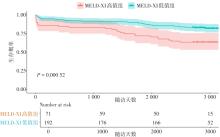
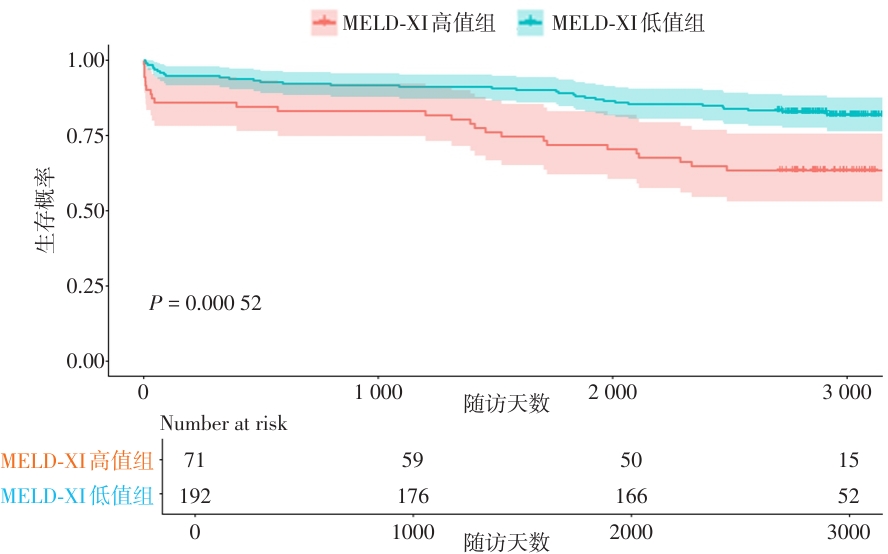
Fig.2
Comparison of survival curves between the high and low MELD-XI score groups"
| [1] |
QI X, XU H, LIU Q, et al. Prospective cohort study of characteristics and sex differences in elderly patients with degenerative valvular disease[J]. BMJ Open, 2022, 12(8): e060882. doi:10.1136/bmjopen-2022-060882 .
doi: 10.1136/bmjopen-2022-060882 |
| [2] |
卜林, 胡书群, 晁亚丽, 等. 压力控制容量保证通气模式对心脏瓣膜手术患者呼吸力学、心肌损伤及术后肺部并发症的影响[J]. 实用医学杂志, 2026, 42(3): 531-540. doi: 10.3969/j.issn.1006-5725.2026.03.023 .
doi: 10.3969/j.issn.1006-5725.2026.03.023 |
| [3] |
孟金枝. 快速康复外科-集束干预策略对心脏瓣膜置换术患者心理应激、恢复进程及肺部并发症的影响[J]. 吉林医学, 2026, 47(1): 97-100. doi:10.3969/j.issn.1004-0412.2026.01. 028 .
doi: 10.3969/j.issn.1004-0412.2026.01. 028 |
| [4] |
林佳漫, 叶咏欣, 李尚航, 等. 瑞马唑仑快通道麻醉在改善心脏瓣膜手术患者术后恢复的作用[J]. 实用医学杂志, 2024, 40(14): 1988-1994. doi:10.3969/j.issn.1006-5725.2024.14.015 .
doi: 10.3969/j.issn.1006-5725.2024.14.015 |
| [5] |
张媚娜, 郝春艳, 车星星. 老年退行性心脏瓣膜病诊治研究进展[J]. 中国循证心血管医学杂志, 2025, 17(12): 1527-1530. doi:10.3969/j.issn.1674-4055.2025.12.021 .
doi: 10.3969/j.issn.1674-4055.2025.12.021 |
| [6] |
PAGNESI M, RICCARDI M, COTTER G, et al. Special topics: Heart failure–related cardiogenic shock, valvular heart disease and end-stage renal disease. Part 4 of the International Expert Opinion Series on Acute Heart Failure Management[J]. Heart Fail Rev, 2025, 30(6): 1559-1589. doi:10.1007/s10741-025-10568-1 .
doi: 10.1007/s10741-025-10568-1 |
| [7] |
LV J, ZHANG B, YE Y, et al. Assessment of cardio-renal-hepatic function in patients with valvular heart disease: A multi-biomarker approach—the cardio-renal-hepatic score[J]. BMC Med, 2023, 21(1): 257. doi:10.1186/s12916-023-02971-y .
doi: 10.1186/s12916-023-02971-y |
| [8] |
MAI J, WANG Y, LI X, et al. The association between the MELD-XI score and 30-day mortality in ICU patients with sepsis: A retrospective cohort study[J]. Sci Rep, 2025, 15: 35121. doi:10.1038/s41598-025-19074-8 .
doi: 10.1038/s41598-025-19074-8 |
| [9] |
CHEN D, LU M, FU Z, et al. The association between the MELD-XI score and heart failure in patients with acute myocardial infarction after coronary artery stenting-a retrospective study[J]. J Thorac Dis, 2023, 15(5): 2721-2728. doi:10.21037/jtd-23-562 .
doi: 10.21037/jtd-23-562 |
| [10] |
RIZZO V, SALMASI M Y, SABETAI M, et al. Infective endocarditis: Do we have an effective risk score model? A systematic review[J]. Front Cardiovasc Med, 2023, 10: 1093363. doi:10.3389/fcvm.2023.1093363 .
doi: 10.3389/fcvm.2023.1093363 |
| [11] |
RICHTER M, MOSCHOVAS A, BARGENDA S, et al. Off-pump reduces risk of coronary bypass grafting in patients with high MELD-XI score[J]. Thorac Cardiovasc Surg, 2025, 73(3): 191-198. doi:10.1055/s-0044-1786039 .
doi: 10.1055/s-0044-1786039 |
| [12] |
HEUMAN D M, MIHAS A A, HABIB A, et al. MELD-XI: A rational approach to "sickest first" liver transplantation in cirrhotic patients requiring anticoagulant therapy[J]. Liver Transpl, 2007, 13(1): 30-37. doi:10.1002/lt.20906 .
doi: 10.1002/lt.20906 |
| [13] |
BRUNO R R, WERNLY B, et al. Early evaluation of organ failure using MELD-XI in critically ill elderly COVID-19 patients[J]. Clin Hemorheol Microcirc, 2021, 79(1): 109-120. doi:10.3233/ch-219202 .
doi: 10.3233/ch-219202 |
| [14] |
STEIGER K G, HARMON D M, KILLIAN J M, et al. Valvular heart disease and its association with death in advanced heart failure[J]. J Am Heart Assoc, 2025, 14(21): e042875. doi:10.1161/jaha.125.042875 .
doi: 10.1161/jaha.125.042875 |
| [15] |
MIZOBUCHI S, SAITO Y, FUJITO H, et al. Prognostic importance of improving hepatorenal function during hospitalization in acute decompensated heart failure[J]. ESC Heart Fail, 2022, 9(5): 3113-3123. doi:10.1002/ehf2.14046 .
doi: 10.1002/ehf2.14046 |
| [16] |
PANWAR R, MCNICHOLAS B, TEIXEIRA J P, et al. Renal perfusion pressure: Role and implications in critical illness[J]. Ann Intensive Care, 2025, 15(1): 115. doi:10.1186/s13613-025-01535-y .
doi: 10.1186/s13613-025-01535-y |
| [17] |
BANNON L, MERDLER I, BAR N, et al. The cardio-hepatic relation in STEMI[J]. J Pers Med, 2021, 11(12): 1241. doi:10.3390/jpm11121241 .
doi: 10.3390/jpm11121241 |
| [18] |
NODA T, KAMIYA K, HAMAZAKI N, et al. Effect of change in hepato-renal function and cardiac rehabilitation on mortality in patients with heart failure[J]. J Cardiol, 2024, 84(6): 355-361. doi:10.1016/j.jjcc.2024.06.006 .
doi: 10.1016/j.jjcc.2024.06.006 |
| [19] |
LEE C J M, KOSYAKOVSKY L B, KHAN M S, et al. Cardiovascular, kidney, liver, and metabolic interactions in heart failure: Breaking down silos[J]. Circ Res, 2025, 136(11): 1170-1207. doi:10.1161/circresaha.125.325602 .
doi: 10.1161/circresaha.125.325602 |
| [20] |
LONG T, YU Y, CHENG S, et al. Prognostic value of the modified Model for End-Stage Liver Disease score in patients treated with cardiac resynchronization therapy[J]. Heart Rhythm O2, 2025, 6(3): 339-349. doi:10.1016/j.hroo.2024.12.014 .
doi: 10.1016/j.hroo.2024.12.014 |
| [21] |
PFANNMUELLER B, BUDDE L M, ETZ C D, et al. Postoperative outcome after reoperative isolated tricuspid valve surgery—is there a predictor for survival?[J]. Eur J Cardio Thorac Surg, 2021, 60(4): 867-871. doi:10.1093/ejcts/ezab134 .
doi: 10.1093/ejcts/ezab134 |
| [22] |
POH C L, D’UDEKEM Y. Life after surviving fontan surgery: A meta-analysis of the incidence and predictors of late death[J]. Heart Lung Circ, 2018, 27(5): 552-559. doi:10.1016/j.hlc. 2017.11.007 .
doi: 10.1016/j.hlc. 2017.11.007 |
| [23] |
LIN Z, LIU X, XIAO L, et al. The MELD-XI score predicts 3-year mortality in patients with chronic heart failure[J]. Front Cardiovasc Med, 2022, 9: 985503. doi:10.3389/fcvm.2022.985503 .
doi: 10.3389/fcvm.2022.985503 |
| Viewed | ||||||
|
Full text |
|
|||||
|
Abstract |
|
|||||
