

The Journal of Practical Medicine ›› 2026, Vol. 42 ›› Issue (15): 2743-2751.doi: 10.3969/j.issn.1006-5725.2026.15.010
• Oncology: Diagnosis, Treatment and Prevention • Previous Articles
Qiong PENG,Wenyu MU,Shuying CHEN,Tian ZENG( )
)
Received:2026-04-08
Revised:2026-06-12
Accepted:2026-06-16
Online:2026-08-10
Published:2026-08-13
Contact:
Tian ZENG
E-mail:492945138@qq.com
CLC Number:
Qiong PENG,Wenyu MU,Shuying CHEN,Tian ZENG. Association of KIF11, FOXP3, and LAG-3 expression with prognosis in endometrial cancer: A retrospective cohort study based on a combined immune score[J]. The Journal of Practical Medicine, 2026, 42(15): 2743-2751.
Tab.1
Clinical-pathological data of 120 patients with endometrial carcinoma"
| 临床病理参数 | 分类 | 例数 | 构成比/% |
|---|---|---|---|
| 年龄 | < 60岁 | 78 | 65.00 |
| ≥ 60岁 | 42 | 35.00 | |
| 绝经状态 | 未绝经 | 48 | 40.00 |
| 已绝经 | 72 | 60.00 | |
| BMI | < 24 kg/m2 | 55 | 45.83 |
| ≥ 24k g/m2 | 65 | 54.17 | |
| FIGO分期 | Ⅰ期 | 58 | 48.33 |
| Ⅱ期 | 32 | 26.67 | |
| Ⅲ期 | 22 | 18.33 | |
| Ⅳ期 | 8 | 6.67 | |
| 病理分级 | G1 | 52 | 43.33 |
| G2 | 42 | 35.00 | |
| G3 | 26 | 21.67 | |
| 组织学类型 | 子宫内膜样癌 | 108 | 90.00 |
| 非子宫内膜样癌 | 12 | 10.00 | |
| 肌层浸润深度 | <1/2 | 72 | 60.00 |
| ≥1/2 | 48 | 40.00 | |
| 脉管癌栓 | 阴性 | 82 | 68.33 |
| 阳性 | 38 | 31.67 | |
| 淋巴结转移 | 阴性 | 90 | 75.00 |
| 阳性 | 30 | 25.00 | |
| 腹水细胞学 | 阴性 | 104 | 86.67 |
| 阳性 | 16 | 13.33 |
Tab.2
H-score scores and high expression levels of KIF11, FOXP3, and LAG-3 in 120 cases of endometrial cancer tissues"
| 指标 | 最小值 | 最大值 | 中位数 | 均数 ± 标准差 | 高表达例数 | 高表达率/% |
|---|---|---|---|---|---|---|
| KIF11 | 45 | 285 | 168 | 169.34 ± 52.18 | 63 | 52.50 |
| FOXP3 | 10 | 210 | 95 | 94.76 ± 41.23 | 49 | 40.83 |
| LAG-3 | 15 | 230 | 108 | 109.22 ± 46.75 | 54 | 45.00 |
Tab.3
Diagnostic efficacy analysis of KIF11, FOXP3, LAG-3 and their combined predictors for lymph node metastasis"
| 指标 | 截断值 | 敏感度/% | 特异度/% | AUC(95% CI) | 约登指数 | P值 |
|---|---|---|---|---|---|---|
| FOXP3 | 107.96分 | 86.67 | 70.00 | 0.853(0.777 ~ 0.911) | 0.5667 | < 0.000 1 |
| KIF11 | 197.99分 | 63.33 | 86.67 | 0.819(0.738 ~ 0.883) | 0.5000 | < 0.000 1 |
| LAG-3 | 102.34分 | 86.67 | 51.11 | 0.720(0.631 ~ 0.798) | 0.3778 | 0.000 2 |
| 联合诊断 | - | 76.67 | 98.89 | 0.920(0.856 ~ 0.961) | 0.7556 | < 0.000 1 |
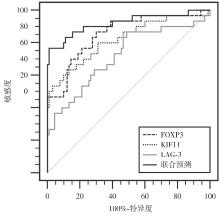
Fig.1
ROC curves of KIF11, FOXP3, LAG-3 andtheir combined prediction for lymph nodemetastasis diagnosis"
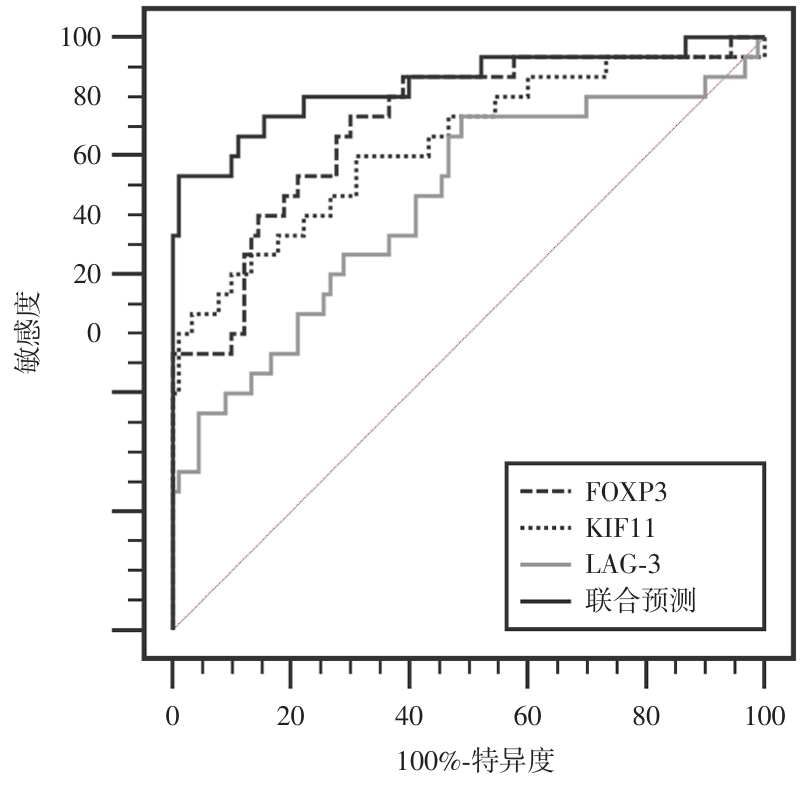
Tab.4
The relationship between the expression of KIF11, FOXP3, and LAG-3 and clinical-pathological parameters"
| 临床病理参数 | 例数 | KIF11高表达 | χ2值 | P值 | FOXP3高表达 | χ2值 | P值 | LAG-3高表达 | χ2值 | P值 |
|---|---|---|---|---|---|---|---|---|---|---|
| 年龄 | 0.133 | 0.716 | 0.003 | 0.953 | 0.001 | 0.969 | ||||
| < 60岁 | 78 | 40(51.28) | 32(41.03) | 35(44.87) | ||||||
| ≥ 60岁 | 42 | 23(54.76) | 17(40.48) | 19(45.24) | ||||||
| 绝经状态 | 0.089 | 0.765 | 0.023 | 0.879 | 0.022 | 0.881 | ||||
| 未绝经 | 48 | 26(54.17) | 20(41.67) | 22(45.83) | ||||||
| 已绝经 | 72 | 37(51.39) | 29(40.28) | 32(44.44) | ||||||
| BMI | 0.103 | 0.748 | 0.041 | 0.840 | 0.008 | 0.927 | ||||
| < 24 kg/m2 | 55 | 28(50.91) | 23(41.82) | 25(45.45) | ||||||
| ≥ 24 kg/m2 | 65 | 35(53.85) | 26(40.00) | 29(44.62) | ||||||
| FIGO分期 | 12.130 | < 0.001 | 1.391 | 0.238 | 2.200 | 0.138 | ||||
| Ⅰ—Ⅱ期 | 90 | 39(43.33) | 34(37.78) | 37(41.11) | ||||||
| Ⅲ—Ⅳ期 | 30 | 24(80.00) | 15(50.00) | 17(56.67) | ||||||
| 病理分级 | 2.210 | 0.137 | 8.281 | 0.004 | ||||||
| G1—G2 | 94 | 46(48.94) | 32(34.04) | 36(38.30) | 7.874 | 0.005 | ||||
| G3 | 26 | 17(65.38) | 17(65.38) | 18(69.23) | ||||||
| 组织学类型 | 1.073 | 0.300 | 0.464 | 0.496 | 0.958 | 0.328 | ||||
| 内膜样癌 | 108 | 55(50.93) | 43(39.81) | 47(43.52) | ||||||
| 非内膜样癌 | 12 | 8(66.67) | 6(50.00) | 7(58.33) | ||||||
| 肌层浸润 | 10.783 | 0.001 | 0.828 | 0.363 | 0.808 | 0.369 | ||||
| < 1/2 | 72 | 29(40.28) | 27(37.50) | 30(41.67) | ||||||
| ≥ 1/2 | 48 | 34(70.83) | 22(45.83) | 24(50.00) | ||||||
| 脉管癌栓 | 12.648 | < 0.001 | 0.983 | 0.321 | 0.562 | 0.454 | ||||
| 阴性 | 82 | 34(41.46) | 31(37.80) | 35(42.68) | ||||||
| 阳性 | 38 | 29(76.32) | 18(47.37) | 19(50.00) | ||||||
| 淋巴结转移 | 3.219 | 0.073 | 8.382 | 0.004 | 7.587 | 0.006 | ||||
| 阴性 | 90 | 43(47.78) | 30(33.33) | 34(37.78) | ||||||
| 阳性 | 30 | 20(66.67) | 19(63.33) | 20(66.67) | ||||||
| 腹水细胞学 | 0.870 | 0.351 | 0.642 | 0.423 | 0.944 | 0.331 | ||||
| 阴性 | 104 | 53(50.96) | 41(39.42) | 45(43.27) | ||||||
| 阳性 | 16 | 10(62.50) | 8(50.00) | 9(56.25) |
Tab.5
The relationship between the expression of KIF11, FOXP3, and LAG-3 and survival rates in patients with endometrial cancer"
| 指标 | 分组 | 例数 | 3年OS/% | Log?rank χ2 | P值 | 3年DFS/% | Log?rank χ2 | P值 |
|---|---|---|---|---|---|---|---|---|
| KIF11 | 高表达 | 63 | 68.25 | 8.64 | 0.003 | 60.32 | 9.87 | 0.002 |
| 低表达 | 57 | 85.96 | 82.46 | |||||
| FOXP3 | 高表达 | 49 | 67.35 | 5.23 | 0.022 | 59.18 | 6.18 | 0.013 |
| 低表达 | 71 | 83.10 | 78.87 | |||||
| LAG-3 | 高表达 | 54 | 64.81 | 7.45 | 0.006 | 57.41 | 8.92 | 0.003 |
| 低表达 | 66 | 84.85 | 80.30 |
Tab.6
Univariate and multivariate Cox regression analyses of single factors affecting overall survival in 120 patients with endometrial carcinoma"
| 变量 | 单因素分析 | 多因素分析 | ||
|---|---|---|---|---|
| HR(95% CI) | P值 | HR(95% CI) | P值 | |
| 年龄(≥ 60岁 vs. < 60岁) | 1.28(0.81 ~ 2.02) | 0.294 | - | - |
| 绝经状态(已绝经 vs. 未绝经) | 1.35(0.86 ~ 2.12) | 0.196 | - | - |
| BMI(≥ 24 kg/m2 vs. < 24 kg/m2) | 1.19(0.76 ~ 1.86) | 0.447 | - | - |
| FIGO分期(Ⅲ—Ⅳ期 vs. Ⅰ—Ⅱ期) | 3.24(1.98 ~ 5.30) | < 0.001 | 2.54(1.48 ~ 4.36) | 0.001 |
| 病理分级(G3 vs. G1—G2) | 1.56(0.98 ~ 2.48) | 0.062 | - | - |
| 组织学类型(非内膜样癌 vs. 内膜样癌) | 1.42(0.86 ~ 2.35) | 0.173 | - | - |
| 肌层浸润深度(≥ 1/2 vs. < 1/2) | 2.56(1.58 ~ 4.15) | < 0.001 | 1.58(0.94 ~ 2.66) | 0.085 |
| 脉管癌栓(阳性 vs. 阴性) | 2.87(1.76 ~ 4.68) | < 0.001 | 1.62(0.95 ~ 2.76) | 0.076 |
| 淋巴结转移(阳性 vs. 阴性) | 3.12(1.92 ~ 5.07) | < 0.001 | 1.54(0.89 ~ 2.66) | 0.123 |
| 腹水细胞学(阳性 vs. 阴性) | 1.48(0.92 ~ 2.38) | 0.106 | - | - |
| KIF11表达(高表达 vs. 低表达) | 2.68(1.64 ~ 4.38) | < 0.001 | 2.18(1.32 ~ 3.60) | 0.002 |
| 联合免疫评分(连续,0 ~ 2分) | 2.34(1.58 ~ 3.47) | < 0.001 | 1.98(1.34 ~ 2.93) | 0.001 |
| FOXP3表达(高表达 vs. 低表达) | 2.13(1.32 ~ 3.44) | 0.002 | - | - |
| LAG-3表达(高表达 vs. 低表达) | 2.45(1.51 ~ 3.98) | < 0.001 | - | - |
| [1] |
CORR B R, ERICKSON B K, BARBER E L, et al. Advances in the management of endometrial cancer[J]. BMJ, 2025, 388: e080978. doi:10.1136/bmj-2024-080978 .
doi: 10.1136/bmj-2024-080978 |
| [2] | BRYCE C, GAZDA R, FUERST H. Endometrial Cancer: Rapid Evidence Review[J]. Am Fam Physician, 2025,111(6):526-531. |
| [3] |
SILVA J P N, SILVA P M A, BOUSBAA H. Kinesin spindle protein (KIF11) in mitosis and cancer[J]. Int J Mol Sci, 2025, 26(18): 8975. doi:10.3390/ijms26188975 .
doi: 10.3390/ijms26188975 |
| [4] |
GAO W, LU J, YANG Z, et al. Mitotic functions and characters of KIF11 in cancers[J]. Biomolecules, 2024, 14(4): 386. doi:10.3390/biom14040386 .
doi: 10.3390/biom14040386 |
| [5] |
MORTEZAEE K. FOXP3 (in)stability and cancer immunotherapy[J]. Cytokine, 2024, 178: 156589. doi:10.1016/j.cyto.2024. 156589 .
doi: 10.1016/j.cyto.2024. 156589 |
| [6] |
CAI L, LI Y, TAN J, et al. Targeting LAG-3, TIM-3, and TIGIT for cancer immunotherapy[J]. J Hematol Oncol, 2023, 16(1): 101. doi:10.1186/s13045-023-01499-1 .
doi: 10.1186/s13045-023-01499-1 |
| [7] |
BREDEL D, TIHIC E, MOURAUD S, et al. Immune checkpoints are predominantly co-expressed by clonally expanded CD4+FoxP3+ intratumoral T-cells in primary human cancers[J]. J Exp Clin Cancer Res, 2023, 42(1): 333. doi:10.1186/s13046-023-02897-6 .
doi: 10.1186/s13046-023-02897-6 |
| [8] |
LI Y, JU M, MIAO Y, et al. Advancement of anti-LAG-3 in cancer therapy[J]. FASEB J, 2023, 37(11): e23236. doi:10.1096/fj.202301018R .
doi: 10.1096/fj.202301018R |
| [9] |
GUO X, ZHOU L, WU Y, et al. KIF11 as a potential pan-cancer immunological biomarker encompassing the disease staging, prognoses, tumor microenvironment, and therapeutic responses[J]. Oxid Med Cell Longev, 2022, 2022: 2764940. doi:10.1155/2022/2764940 .
doi: 10.1155/2022/2764940 |
| [10] |
KOH W J, ABU-RUSTUM N R, BEAN S, et al. Uterine neoplasms, version 1.2018, NCCN clinical practice guidelines in oncology[J]. J Natl Compr Canc Netw, 2018, 16(2): 170-199. doi:10.6004/jnccn.2018.0006 .
doi: 10.6004/jnccn.2018.0006 |
| [11] |
AVILÉS-SALAS A, MUÑIZ-HERNÁNDEZ S, MALDONADO-MARTÍNEZ H A, et al. Reproducibility of the EGFR immunohistochemistry scores for tumor samples from patients with advanced non-small cell lung cancer[J]. Oncol Lett, 2017, 13(2): 912-920. doi:10.3892/ol.2016.5512 .
doi: 10.3892/ol.2016.5512 |
| [12] |
WANG B, BAO L, LI X, et al. Identification and validation of the important role of KIF11 in the development and progression of endometrial cancer[J]. J Transl Med, 2025, 23(1): 48. doi:10.1186/s12967-025-06081-6 .
doi: 10.1186/s12967-025-06081-6 |
| [13] |
SUN R F, HE N, ZHANG G Y, et al. Combined Inhibition of KIF11 and KIF15 as an Effective Therapeutic Strategy for Gastric Cancer[J]. Curr Cancer Drug Targets, 2023, 23(4):293-306.doi: 10.2174/1568009622666220616122846 .
doi: 10.2174/1568009622666220616122846 |
| [14] |
FU L, ZHAO L, LIAO C, et al. Knockdown of KAT5/KIF11 induces autophagy and promotes apoptosis in anaplastic thyroid cancer cells[J]. Exp Ther Med, 2023, 25(6): 247. doi:10.3892/etm.2023.11946 .
doi: 10.3892/etm.2023.11946 |
| [15] |
ANTOSIK P, DURŚLEWICZ J, SMOLIŃSKA-ŚWITAŁA M, et al. KIF11 and KIF14 are a novel potential prognostic biomarker in patients with endometrioid carcinoma[J]. Cancers (Basel), 2025, 17(5): 804. doi:10.3390/cancers17050804 .
doi: 10.3390/cancers17050804 |
| [16] |
ZHOU Y, CHEN X, LI B, et al. KIF11 is a potential prognostic biomarker and therapeutic target for adrenocortical carcinoma[J]. Transl Androl Urol, 2023, 12(4): 594-611. doi:10.21037/tau-22-706 .
doi: 10.21037/tau-22-706 |
| [17] |
WANG F, FU X, CHANG M, et al. The interaction of calcium-sensing receptor with KIF11 enhances cisplatin resistance in lung adenocarcinoma via BRCA1/cyclin B1 pathway[J]. Int J Biol Sci, 2024, 20(10): 3892-3910. doi:10.7150/ijbs.92046 .
doi: 10.7150/ijbs.92046 |
| [18] |
LEE S B, NOH Y S, MOON J W, et al. Gene expression network analysis identified CDK1 and KIF11 as possible key molecules in the development of colorectal cancer from normal tissues[J]. Genomics Inform, 2025,23(1):15.doi: 10.1186/s44342-025-00046-3 .
doi: 10.1186/s44342-025-00046-3 |
| [19] |
WANG Y, ZHANG Z, HUANG L, et al. Update on the phenotypic and genotypic spectrum of KIF11-related retinopathy[J]. Genes (Basel), 2022,13(4):713.doi: 10.3390/genes13040713 .
doi: 10.3390/genes13040713 |
| [20] |
CHENG Y L, BANU M A, ZHAO W, et al. Multiplexed single-cell lineage tracing of mitotic kinesin inhibitor resistance in glioblastoma[J]. Cell Rep, 2024, 43(5): 114139. doi:10.1016/j.celrep.2024.114139 .
doi: 10.1016/j.celrep.2024.114139 |
| [21] |
ICHIYAMA K, LONG J, KOBAYASHI Y, et al. Transcription factor Ikzf1 associates with Foxp3 to repress gene expression in Treg cells and limit autoimmunity and anti-tumor immunity[J]. Immunity, 2024, 57(9): 2043-2060.e10. doi:10.1016/j.immuni.2024.07.010 .
doi: 10.1016/j.immuni.2024.07.010 |
| [22] |
RAUGH A, ALLARD D, BETTINI M. Nature vs. nurture: FOXP3, genetics, and tissue environment shape Treg function[J]. Front Immunol, 2022, 13: 911151. doi:10.3389/fimmu. 2022.911151 .
doi: 10.3389/fimmu. 2022.911151 |
| [23] |
ROLIG A S, PENG X, STURGILL E R, et al. The response to anti-PD-1 and anti-LAG-3 checkpoint blockade is associated with regulatory T cell reprogramming[J]. Sci Transl Med, 2025, 17(793): eadk3702. doi:10.1126/scitranslmed.adk3702 .
doi: 10.1126/scitranslmed.adk3702 |
| [24] |
KIM D, KIM G, YU R, et al. Inhibitory co-receptor Lag3 supports Foxp3+ regulatory T cell function by restraining Myc-dependent metabolic programming[J]. Immunity, 2024, 57(11): 2634-2650.e5. doi:10.1016/j.immuni.2024.08.008 .
doi: 10.1016/j.immuni.2024.08.008 |
| [25] |
ZAHRAEIFARD S, XIAO Z, SO J Y, et al. Loss of tumor suppressors promotes inflammatory tumor microenvironment and enhances LAG3+T cell mediated immune suppression[J]. Nat Commun, 2024, 15: 5873. doi:10.1038/s41467-024-50262-8 .
doi: 10.1038/s41467-024-50262-8 |
| [26] |
周慧男, 钦可为, 周丽君. 免疫检查点LAG-3及其靶向药物研究现状和临床应用进展[J]. 实用医学杂志, 2024, 40(11): 1607-1612. doi:10.3969/j.issn.1006-5725.2024.11.024 .
doi: 10.3969/j.issn.1006-5725.2024.11.024 |
| Viewed | ||||||
|
Full text |
|
|||||
|
Abstract |
|
|||||
