

The Journal of Practical Medicine ›› 2026, Vol. 42 ›› Issue (14): 2570-2576.doi: 10.3969/j.issn.1006-5725.2026.14.010
• Oncology: Diagnosis, Treatment and Prevention • Previous Articles
Jiao JIANG1,Jiayi JIANG1,Bingxin WU1,Quanhua LIU2,3( )
)
Received:2026-03-10
Online:2026-07-25
Published:2026-08-05
Contact:
Quanhua LIU
E-mail:13576238120@163.com
CLC Number:
Jiao JIANG,Jiayi JIANG,Bingxin WU,Quanhua LIU. Effects of quadratus lumborum nerve block combined with oxycodone on perioperative stress response, serum substance P and prostaglandin E2 in patients undergoing laparoscopic transabdominal radical resection of rectal cancer[J]. The Journal of Practical Medicine, 2026, 42(14): 2570-2576.
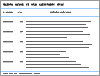
Tab.1
Comparison on basic data between the two groups"
| 组别 | 年龄(x ± s)/岁 | 性别 | 体质量指数 (x ± s)/(kg/m2) | ASA分级 | TNM分期 | ||||
|---|---|---|---|---|---|---|---|---|---|
| Ⅱ级 | Ⅲ级 | Ⅰ期 | Ⅱ期 | Ⅲ期 | |||||
| 男 | 女 | ||||||||
| 研究组(n = 73) | 61.15 ± 5.84 | 42(57.53) | 31(42.47) | 22.24 ± 2.16 | 38(52.05) | 35(47.95) | 23(31.51) | 32(43.84) | 18(24.66) |
| 对照组(n = 77) | 62.08 ± 6.11 | 46(59.74) | 1(40.26) | 22.09 ± 2.37 | 41(53.25) | 36(46.75) | 26(33.77) | 37(48.05) | 14(18.18) |
| t/χ2值 | 0.952 | 0.075 | 0.405 | 0.021 | 0.940 | ||||
| P值 | 0.343 | 0.784 | 0.687 | 0.884 | 0.625 | ||||
Tab.2
Comparison of perioperative MAP and HR between the two groups"
| 指标 | 组别 | T0 | T1 | T2 | T3 | T4 |
|---|---|---|---|---|---|---|
| MAP/mmHg | 研究组(n = 73) | 87.84 ± 8.13 | 93.07 ± 8.04*& | 92.37 ± 7.47* | 88.98 ± 7.84 | 89.34 ± 7.33 |
| 对照组(n = 77) | 88.37 ± 7.39 | 99.48 ± 9.08* | 96.82 ± 8.36* | 89.35 ± 7.49 | 90.57 ± 8.31 | |
| F/P交互值 | 4.292/0.002 | |||||
| F/P时间值 | 30.511/< 0.001 | |||||
| F/P组间值 | 19.926/< 0.001 | |||||
| HR/(次/min) | 研究组(n = 73) | 74.67 ± 6.03 | 78.12 ± 5.89* | 79.01 ± 6.04* | 75.24 ± 5.73 | 75.13 ± 6.11 |
| 对照组(n = 77) | 75.81 ± 4.04 | 81.33 ± 5.34*& | 83.15 ± 5.68*& | 78.61 ± 6.15& | 76.23 ± 5.74 | |
| F/P交互值 | 2.009/0.091 | |||||
| F/P时间值 | 30.689/< 0.001 | |||||
| F/P组间值 | 34.330/< 0.001 | |||||
Tab.3
Comparison of perioperative indexes between the two groups"
| 组别 | 手术时间/h | 手术中出血量/mL | 首次下床活动时间/h | 首次排气时间/h | 术后48 h镇痛泵按压次数/次 |
|---|---|---|---|---|---|
| 研究组(n = 73) | 2.49 ± 0.37 | 107.42 ± 12.33 | 25.79 ± 3.64 | 21.46 ± 3.82 | 6.33 ± 1.54 |
| 对照组(n = 77) | 2.53 ± 0.34 | 109.67 ± 10.28 | 28.51 ± 4.05 | 25.09 ± 4.30 | 7.88 ± 1.17 |
| t值 | 1.035 | 1.216 | 4.318 | 5.454 | 6.963 |
| P值 | 0.302 | 0.226 | < 0.001 | < 0.001 | < 0.001 |
Tab.4
Comparison of stress indexes between the two groups"
| 组别 | Cor/(nmol/mL) | NE/(pg/mL) | CRP/(ng/mL) | TNF-α/(pg/mL) | ||||
|---|---|---|---|---|---|---|---|---|
| 术前 | 术后1 d | 术前 | 术后1 d | 术前 | 术后1 d | 术前 | 术后1 d | |
| 研究组(n = 73) | 196.36 ± 20.36 | 244.72 ± 22.62* | 284.53 ± 31.55 | 376.89 ± 42.14* | 7.89 ± 1.62 | 28.41 ± 4.55* | 14.73 ± 2.46 | 39.42 ± 4.33* |
| 对照组(n = 77) | 194.72 ± 21.29 | 276.87 ± 23.29* | 280.71 ± 32.42 | 416.31 ± 38.33* | 7.57 ± 1.87 | 33.64 ± 4.18* | 14.58 ± 2.61 | 47.72 ± 4.19* |
| t值 | 0.482 | 8.569 | 0.731 | 5.999 | 1.118 | 7.336 | 0.362 | 1.931 |
| P值 | 0.631 | < 0.001 | 0.466 | < 0.001 | 0.266 | < 0.001 | 0.718 | < 0.001 |
Tab.5
Comparison of serum SP and PGE2 levels between the two groups"
| 组别 | SP/(μg/mL) | PGE2/(pg/mL) | ||
|---|---|---|---|---|
| 术前 | 术后1 d | 术前 | 术后1 d | |
| 研究组(n = 73) | 2.39 ± 0.41 | 3.69 ± 0.53* | 105.39 ± 12.62 | 121.71 ± 14.23* |
| 对照组(n = 77) | 2.42 ± 0.50 | 4.16 ± 0.44* | 102.48 ± 14.71 | 138.28 ± 13.66* |
| t值 | 0.401 | 5.922 | 1.297 | 7.276 |
| P值 | 0.689 | < 0.001 | 0.197 | <0 .001 |
| [1] |
LUO J, HE M W, LUO T, et al. Identification of multiple risk factors for colorectal cancer relapse after laparoscopic radical resection[J]. World J Gastrointest Surg, 2023, 15(10):2211-2221. doi: 10.4240/wjgs.v15.i10.2211 .
doi: 10.4240/wjgs.v15.i10.2211 |
| [2] |
朱晓明,张卫,直肠癌保肛手术——从极限走向极致 [J].中华胃肠外科杂志,2026,29(1) : 30-37. doi: 10.3760/cma.j.cn441530-20251120-00443 .
doi: 10.3760/cma.j.cn441530-20251120-00443 |
| [3] |
LI J, FAN W, PENG J, et al. Effect of general anesthesia combined with epidural block on hemorheology in elderly patients with laparoscopic radical resection of colorectal cancer: A randomized controlled trial[J]. Clin Hemorheol Microcirc, 2025, 90(1):39-44. doi: 10.1177/13860291251335469 .
doi: 10.1177/13860291251335469 |
| [4] |
SINGH N P, MAKKAR J K, CHAWLA J K, et al. Prophylactic dexamethasone for rebound pain after peripheral nerve block in adult surgical patients: Systematic review, meta-analysis, and trial sequential analysis of randomised controlled trials[J]. Br J Anaesth, 2024, 132(5):1112-1121. doi: 10.1016/j.bja.2023. 09.022 .
doi: 10.1016/j.bja.2023. 09.022 |
| [5] |
LEDFORD C K, GIUSTI N E, UBL D S, et al. Regional nerve blocks for primary total knee arthroplasty in chronic opioid patients[J]. J Knee Surg, 2026, 39(1):57-62. doi: 10.1055/a-2672-2907 .
doi: 10.1055/a-2672-2907 |
| [6] |
周维, 王凯, 舒爱华, 等. 无阿片类药物麻醉联合腰方肌阻滞在腹腔镜结直肠癌根治术中的应用效果[J]. 临床麻醉学杂志, 2024, 40(9): 938-943. doi:10.12089/jca.2024.09.008 .
doi: 10.12089/jca.2024.09.008 |
| [7] |
YANG G W, CHENG H, SONG X Y, et al. Effect of Oxycodone-based multimodal analgesia on visceral pain after major laparoscopic gastrointestinal surgery: A randomised, double-blind, controlled trial[J]. Drug Des Devel Ther, 2024, 18:1799-1810. doi: 10.2147/DDDT.S464518 .
doi: 10.2147/DDDT.S464518 |
| [8] |
蒋露香, 张建友, 张转, 等. 不同时机应用羟考酮对胸科手术肋间神经阻滞消退后反跳痛防治效果的临床研究[J]. 中国临床药理学与治疗学, 2025, 30(10): 1312-1318. doi:10.12092/j.issn.1009-2501.2025.10.003 .
doi: 10.12092/j.issn.1009-2501.2025.10.003 |
| [9] |
HUMES C, SIC A, KNEZEVIC N N. Substance P's impact on chronic pain and psychiatric conditions-a narrative review[J]. Int J Mol Sci, 2024, 25(11):5905. doi: 10.3390/ijms25115905 .
doi: 10.3390/ijms25115905 |
| [10] |
KANTARCI H, ELVIRA P D, THOTTUMKARA A P, et al. Schwann cell-secreted PGE2 promotes sensory neuron excitability during development[J]. Cell, 2024, 187(17):4690-4712.e30. doi: 10.1016/j.cell.2024.07.033 .
doi: 10.1016/j.cell.2024.07.033 |
| [11] |
LIAO X, LUO Z, HUANG F, et al. Trigeminal nerve root compression induced neuroinflammatory response promotes mechanical allodynia through the CGRP/SP-Piezo2 axis via Ca2+ signaling[J]. Cell Mol Biol Lett, 2025, 31(1):3-31. doi: 10.1186/s11658-025-00831-6 .
doi: 10.1186/s11658-025-00831-6 |
| [12] |
杨彤, 何媛媛, 黄梦楠, 等. 交泰丸和5-羟色胺再摄取抑制剂治疗对抑郁症患者短链脂肪酸、神经炎症标志物及神经营养因子调节作用的临床研究[J]. 中草药, 2026, 57(2): 574-582. doi:10.7501/j.issn.0253-2670.2026.02.017 .
doi: 10.7501/j.issn.0253-2670.2026.02.017 |
| [13] |
陈孝平, 汪建平, 赵继宗. 外科学[M]. 9版. 北京: 人民卫生出版社, 2018: 390-394. doi:10.3877/cma.j.issn.1674-3946.2018.05.001
doi: 10.3877/cma.j.issn.1674-3946.2018.05.001 |
| [14] |
LONG X, YIN Y, GUO W, et al. Ultrasound-guided quadratus lumborum block: A powerful way for reducing postoperative pain[J]. Ann Med Surg (Lond), 2023, 85(10):4947-4953. doi: 10.1097/MS9.0000000000001209 .
doi: 10.1097/MS9.0000000000001209 |
| [15] |
MAHMOUD FAKHRY D, ELMOUTAZ MAHMOUD H, YEHIA KASSIM D, et al. Erector spinae plane block versus quadratus lumborum block for postoperative analgesia after laparoscopic resection of colorectal cancer: A prospective randomized study[J]. Anesthesiol Res Pract, 2024, 2024:6200915. doi: 10.1155/2024/6200915 .
doi: 10.1155/2024/6200915 |
| [16] |
林晓东, 郭雨, 李文玲, 等. 羟考酮与右美托咪定复合腰方肌阻滞在腹腔镜直肠癌根治术中的应用[J]. 中国微创外科杂志, 2023, 23(11): 830-834. doi:10.3969/j.issn.1009-6604.2023. 11.006 .
doi: 10.3969/j.issn.1009-6604.2023. 11.006 |
| [17] |
DONG P, QU X, YANG Y, et al. Effect of oxycodone versus fentanyl for patient-controlled intravenous analgesia after laparoscopic hysteromyomectomy: A single-blind, randomized controlled trial[J]. Sci Rep, 2024, 14(1):20478-20485. doi: 10.1038/s41598-024-71708-5 .
doi: 10.1038/s41598-024-71708-5 |
| [18] |
CHEN L, LU D, ZHANG Y, et al. Optimal propofol dose with oxycodone for visceral pain relief in anxious patients undergoing abortion: A clinical trial report[J]. Drug Des Devel Ther, 2025, 19:11307-11316. doi: 10.2147/DDDT.S563921 .
doi: 10.2147/DDDT.S563921 |
| [19] |
宋枫, 高峰, 徐明, 等. NOSES联合ERAS与常规腹腔镜手术治疗直肠癌的临床疗效对比[J]. 解放军医学杂志, 2024, 49(1):31-36. doi:10.11855/j.issn.0577-7402.2526.2023.0719 .
doi: 10.11855/j.issn.0577-7402.2526.2023.0719 |
| [20] |
LAN J, DENG Z, WANG Q, et al. Neuropeptide substance P attenuates colitis by suppressing inflammation and ferroptosis via the cGAS-STING signaling pathway[J]. Int J Biol Sci, 2024, 20(7):2507-2531. doi: 10.7150/ijbs.94548 .
doi: 10.7150/ijbs.94548 |
| [21] |
SUN B F, ZHANG F, CHEN Q P, et al. Improvement of inflammatory response and gastrointestinal function in perioperative of cholelithiasis by Modified Xiao-Cheng-Qi decoction[J]. World J Clin Cases, 2023, 11(4):830-843. doi: 10.12998/wjcc.v11.i4.830 .
doi: 10.12998/wjcc.v11.i4.830 |
| [22] |
AN N, DONG W, PANG G, et al. TPVB and general anesthesia affects postoperative functional recovery in elderly patients with thoracoscopic pulmonary resections based on ERAS pathway[J]. Transl Neurosci, 2023, 14(1):20220305. doi: 10.1515/tnsci-2022-0305 .
doi: 10.1515/tnsci-2022-0305 |
| [23] |
段玉, 殷国江, 周谦, 等. 弓状韧带上腰方肌阻滞与肋缘下腹横肌平面阻滞对腹腔镜结直肠癌根治患者术后炎症反应的影响[J]. 实用医学杂志, 2025, 41(19): 2972-2978. doi:10.3969/j.issn.1006-5725.2025.19.003 .
doi: 10.3969/j.issn.1006-5725.2025.19.003 |
| [24] |
胡婷婷, 张菁. 腰方肌阻滞复合依托咪酯麻醉对老年结直肠癌手术患者苏醒质量和肠道屏障功能的影响[J]. 实用医学杂志, 2025, 41(19):2979-2984. doi:10.3969/j.issn.1006-5725. 2025.19.004 .
doi: 10.3969/j.issn.1006-5725. 2025.19.004 |
| [25] |
LIN C, XU Z, LIANG X, et al. A randomized controlled trial to compare the effect of oxycodone and sufentanil on postoperative analgesia and immune function for laparoscopic resection of colorectal cancer[J]. BMC Anesthesiol, 2025, 25(1):58-65. doi: 10.1186/s12871-025-02922-5 .
doi: 10.1186/s12871-025-02922-5 |
| [26] |
ZHU M, QI Y, HE H, et al. Effect of quadratus lumborum block on postoperative cognitive function in elderly patients undergoing laparoscopic radical gastrectomy: A randomized controlled trial[J]. BMC Geriatr, 2021, 21(1):238-246. doi: 10.1186/s12877-021-02179-w .
doi: 10.1186/s12877-021-02179-w |
| [27] |
VAN DAM C J, KRAMERS C, SCHELLEKENS A, et al. Cannabis combined with oxycodone for pain relief in fibromyalgia pain: A randomized clinical self-titration trial with focus on adverse events[J]. Front Pain Res (Lausanne), 2024, 5:1497111-1497120. doi: 10.3389/fpain.2024.1497111 .
doi: 10.3389/fpain.2024.1497111 |
| Viewed | ||||||
|
Full text |
|
|||||
|
Abstract |
|
|||||
