

The Journal of Practical Medicine ›› 2025, Vol. 41 ›› Issue (23): 3723-3729.doi: 10.3969/j.issn.1006-5725.2025.23.014
• Clinical Research • Previous Articles
Yi WEI1,Chunhui RAO1,Huize LIU1,Wen. CHEN2
Received:2025-09-04
Online:2025-12-10
Published:2025-12-18
CLC Number:
Yi WEI,Chunhui RAO,Huize LIU,Wen. CHEN. Predictive value of multimodal nomogram on the risk of metastasis and recurrence in patients with stage Ⅱ colorectal cancer without adjuvant treatment[J]. The Journal of Practical Medicine, 2025, 41(23): 3723-3729.

Tab.1
Comparative analysis of two sets of general data"
| 临床特征 | 非转移复发组(n = 320) | 转移复发组(n = 104) | χ2/t值 | P值 |
|---|---|---|---|---|
| 年龄( | 68.30 ± 9.60 | 67.52 ± 10.20 | 0.72 | > 0.05 |
| 肿瘤部位 | 2.15 | > 0.05 | ||
| 左半结肠 | 139 | 41 | ||
| 右半结肠 | 100 | 35 | ||
| 直肠 | 81 | 28 | ||
| 性别 | 0.56 | 0.454 | ||
| 女 | 127 | 44 | ||
| 男 | 193 | 60 | ||
| T分期 | 15.60 | < 0.001 | ||
| pT3 | 300 | 74 | ||
| pT4 | 20 | 30 | ||
| 分化程度 | 4.55 | 0.033 | ||
| 高 | 168 | 39 | ||
| 中低分化 | 152 | 65 | ||
| 脉管癌栓 | 28.21 | < 0.001 | ||
| 阳性 | 64 | 42 | ||
| 阴性 | 256 | 62 | ||
| 神经侵犯 | 87.34 | < 0.001 | ||
| 阳性 | 48 | 72 | ||
| 阴性 | 272 | 32 | ||
| 术前NLR( | 2.81 ± 0.60 | 4.12 ± 0.84 | 9.67 | < 0.001 |
| 术前LMR( | 4.33 ± 1.65 | 4.13 ± 1.43 | 1.18 | 0.240 |
| 术前CEA | 45.62 | < 0.001 | ||
| > 5 μg/L | 104 | 66 | ||
| ≤ 5 μg/L | 216 | 38 | ||
| MRI纹理熵值( | 6.54 ± 0.69 | 7.13 ± 0.90 | 6.88 | < 0.001 |
| 边缘浸润征象 | 53.51 | < 0.001 | ||
| 模糊 | 60 | 58 | ||
| 清晰 | 260 | 46 | ||
| KRAS突变状态 | 15.52 | < 0.001 | ||
| 是 | 136 | 63 | ||
| 否 | 184 | 41 |
Tab.2
Analysis of risk factors for metastasis and recurrence in stage Ⅱ crc patients without adjuvant therapy"
| 变量 | β值 | SE值 | Waldχ2值 | P值 | OR(95%CI) |
|---|---|---|---|---|---|
| T分期(pT4) | 0.35 | 0.31 | 1.27 | 0.260 | 1.42(0.77 ~ 2.62) |
| 术前CEA(> 5) | 0.92 | 0.30 | 9.38 | 0.002 | 2.50(1.34 ~ 4.64) |
| 分化程度(中低分化) | 0.59 | 0.25 | 5.64 | 0.018 | 1.80(1.10 ~ 2.95) |
| 有脉管癌栓 | 0.64 | 0.22 | 8.45 | 0.004 | 1.90(1.23 ~ 2.93) |
| 有神经侵犯 | 0.96 | 0.33 | 8.48 | 0.004 | 2.61(1.37 ~ 4.97) |
| 术前NLR | 0.41 | 0.18 | 5.18 | 0.023 | 1.50(1.06 ~ 2.14) |
| 边缘浸润征象(模糊) | 0.40 | 0.28 | 2.04 | 0.153 | 1.49(0.86 ~ 2.58) |
| MRI纹理熵值 | 0.18 | 0.08 | 5.06 | 0.025 | 1.20(1.02 ~ 1.40) |
| 有KRAS基因突变 | 0.47 | 0.20 | 5.52 | 0.019 | 1.60(1.08 ~ 2.37) |
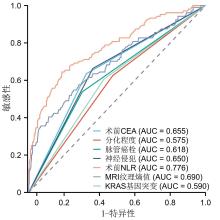
Fig.1
ROC curve of risk factors predicting metastasis and recurrence of stage Ⅱ CRC without adjuvant therapy"
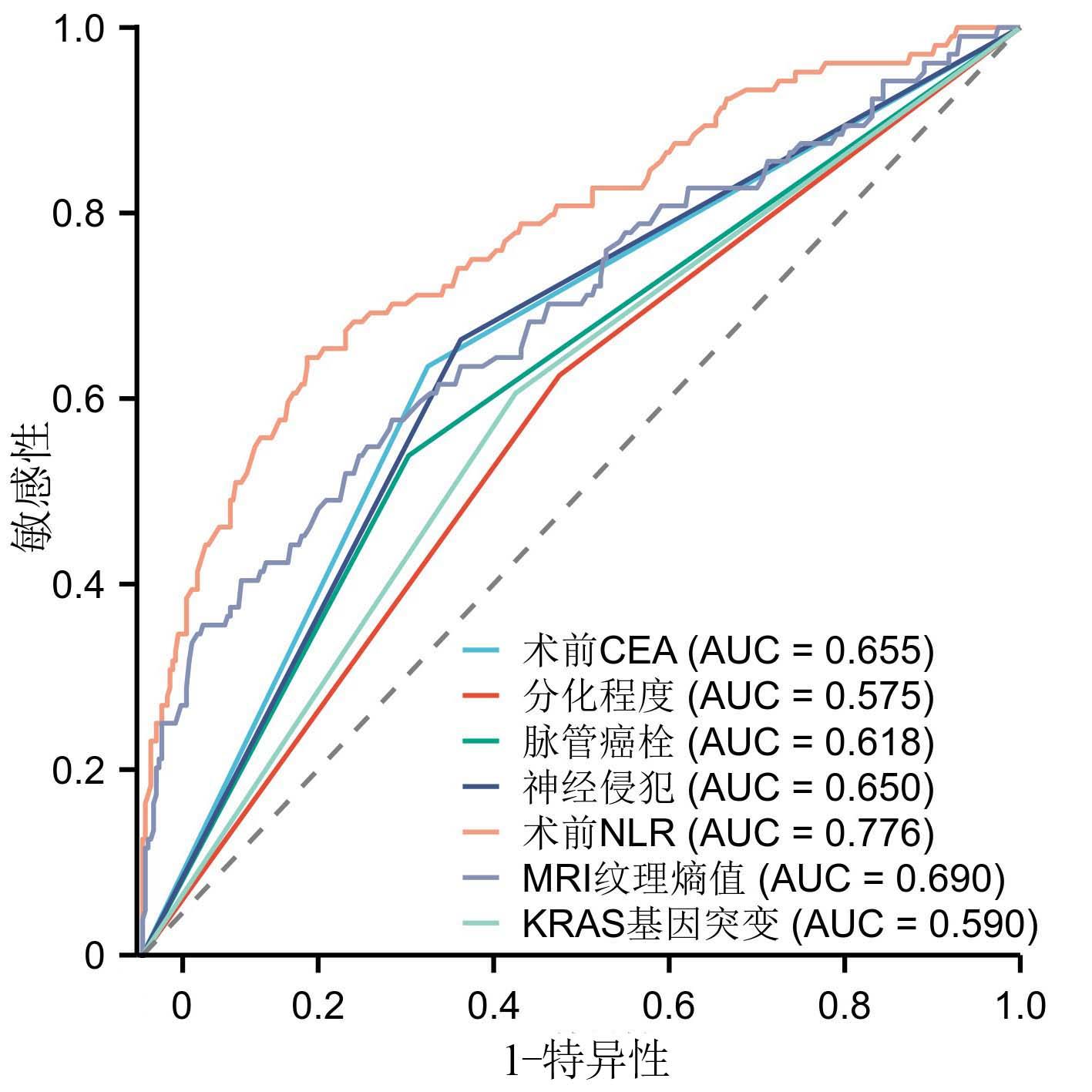
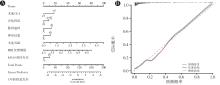
Fig.2
Nomogram and calibration curve for metastasis and recurrence of stage Ⅱ CRC without adjuvant therapy"
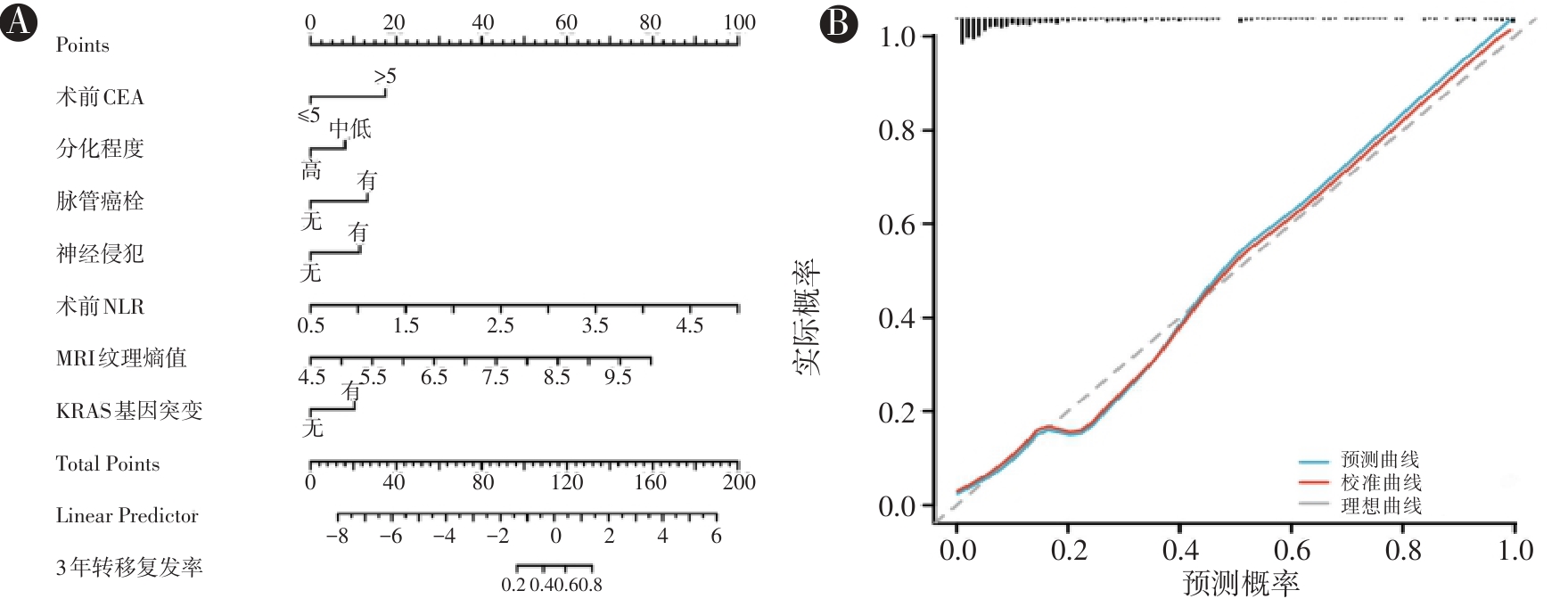
Fig.3
Nomogram-predicted ROC curve (A) and DCA curve (B) for metastasis and recurrence of stage Ⅱ CRC without adjuvant therapy"
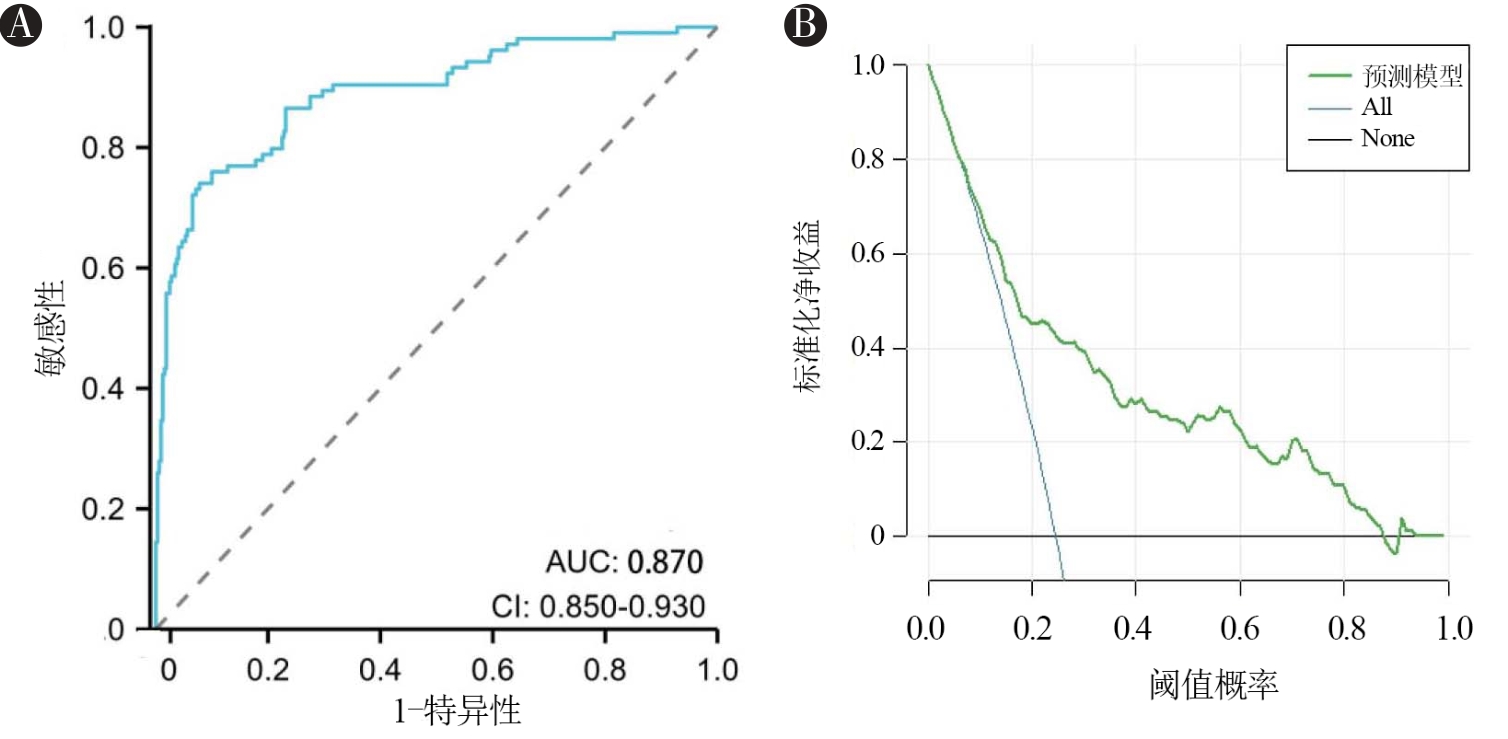
Fig.4
Corrected ROC curve"
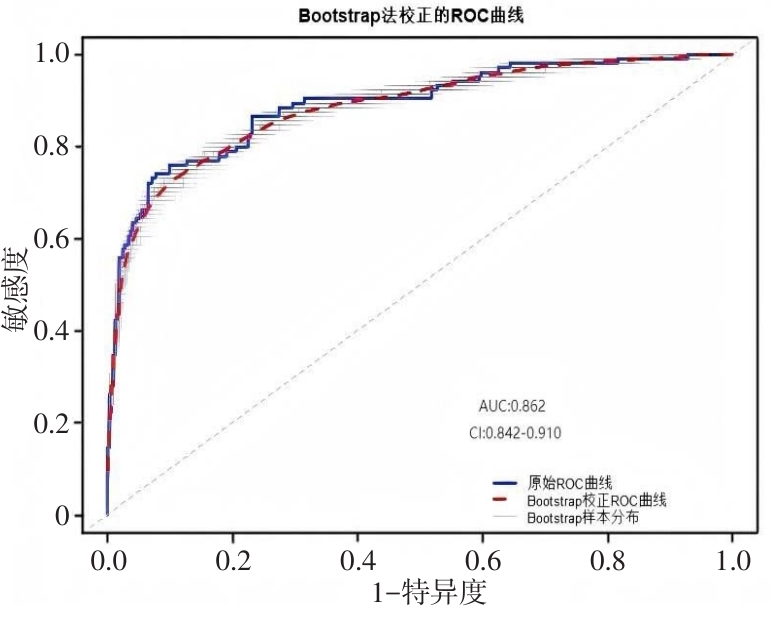
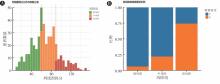
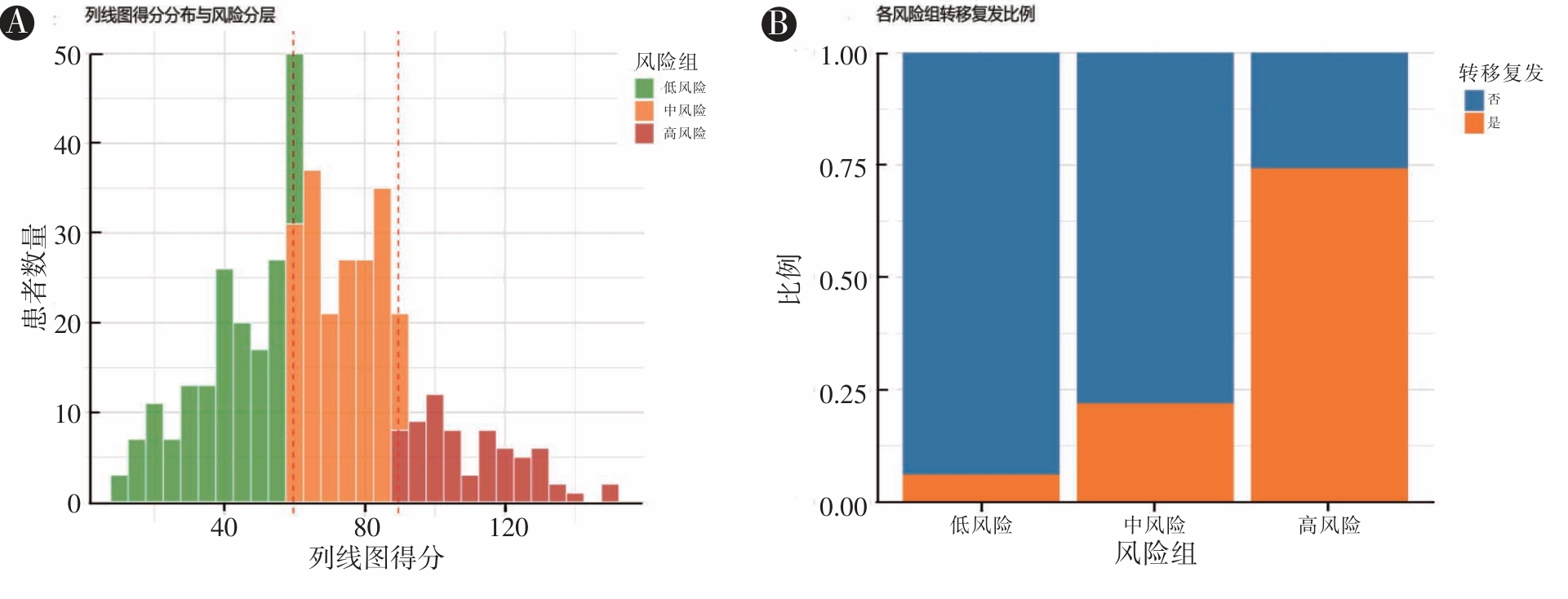
Fig.5
Distribution of risk groups and recurrence and metastasis rates"
| [1] |
SIMILLIS C, SINGH H, AFXENTIOU T, et al. Postoperative chemotherapy improves survival in patients with resected high‐risk Stage II colorectal cancer: Results of a systematic review and meta‐analysis[J]. Colorectal Dis, 2020, 22(10): 1231-1244. doi:10.1111/codi.14994
doi: 10.1111/codi.14994 |
| [2] | GOH V, MALLETT S, JUSTO R M, et al. Evaluation of prognostic models to improve prediction of metastasis in patients following potentially curative treatment for primary colorectal cancer: The PROSPECT trial[J]. Health Technol Assess, 2025, 29(8): 1-91. |
| [3] | 中国疾病预防控制中心慢性非传染性疾病预防控制中心肿瘤防控专家组, 吴静, 王宝华, 等. 中国社区居民结直肠癌筛查专家共识[J]. 环境卫生学杂志, 2024, 14(4): 273-285. |
| [4] | 上海市抗癌协会大肠癌专业委员会. 结直肠癌早筛、早诊、早治上海方案(2023年版)[J]. 中国癌症杂志, 2024, 34(1): 13-66. |
| [5] | 中华医学会外科学分会结直肠外科学组, 中国医师协会结直肠肿瘤专业委员会, 中国医师协会肛肠医师分会, 等. 结直肠(癌)手术永久性肠造口专家共识(2025版)[J]. 中华胃肠外科杂志, 2025, 28(6): 587-598. |
| [6] | BENSON A B, VENOOK A P, ADAM M, et al. Colon cancer, version 3.2024, NCCN clinical practice guidelines in oncology[J]. J Natl Compr Canc Netw, 2024, 22(2 D): e240029. |
| [7] |
WANG K, MA L, CHEN L, et al. The clinical value of a nomogram constructed from CEA, CA199, PT, FIB, tumor differentiation and TNM stage in colorectal cancer[J]. Cancer Biomark, 2023, 38(4): 537-549. doi:10.3233/cbm-230116
doi: 10.3233/cbm-230116 |
| [8] |
QUAH H M, CHOU J F, GONEN M, et al. Identification of patients with high-risk stage II colon cancer for adjuvant therapy[J]. Dis Colon Rectum, 2008, 51(5): 503-507. doi:10.1007/s10350-008-9246-z
doi: 10.1007/s10350-008-9246-z |
| [9] |
CAI M, HE H, Hong S, et al. Synergistic diagnostic value of circulating tumor cells and tumor markers CEA/CA19-9 in colorectal cancer[J]. Scand J Gastroenterol, 2023, 58(1): 54-60. doi:10.1080/00365521.2022.2106152
doi: 10.1080/00365521.2022.2106152 |
| [10] |
CHOI M S, HUH J W, SHIN J K, et al.Prognostic Factors and Treatment of Recurrence after Local Excision of Rectal Cancer[J]. Yonsei Med J, 2021, 62(12): 1107-1116. doi:10.3349/ymj.2021.62.12.1107
doi: 10.3349/ymj.2021.62.12.1107 |
| [11] |
WANG L, HIRANO Y, ISHII T, et al. Left colon as a novel high-risk factor for postoperative recurrence of stage II colon cancer[J]. World J Surg Oncol, 2020, 18(1): 54. doi:10.1186/s12957-020-01818-7
doi: 10.1186/s12957-020-01818-7 |
| [12] |
BAI F, LIU X, ZHANG X, et al. p18INK4C and BRCA1 inhibit follicular cell proliferation and dedifferentiation in thyroid cancer[J]. Cell Cycle, 2023, 22(13): 1637-1653. doi:10.1080/15384101.2023.2225938
doi: 10.1080/15384101.2023.2225938 |
| [13] |
WANG Q, ZHU X F, SHI M.Clinical and pathological features of advanced rectal cancer with submesenteric root lymph node metastasis: Meta-analysis[J]. World J Gastrointest Oncol, 2024, 16(7): 3299-3307. doi:10.4251/wjgo.v16.i7.3299
doi: 10.4251/wjgo.v16.i7.3299 |
| [14] |
BAI Z, WANG J, WANG T, et al. Clinicopathologic parameters associated with postoperative complications and risk factors for tumor recurrence and mortality after tumor resection of patients with colorectal cancer[J]. Clin Transl Oncol, 2018, 20(2): 176-192. doi:10.1007/s12094-017-1708-0
doi: 10.1007/s12094-017-1708-0 |
| [15] | 郑江江, 余晶晶, 谢晶晶, 等. 结直肠癌患者三级淋巴结构成熟的临床意义[J]. 浙江大学学报(医学版), 2024, 53(6): 765-771. |
| [16] |
TSAI Y, KE T, HUANG C, et al. Prognostic relevance of immunosuppressive CD155/TIGIT signaling in locally advanced rectal cancer patients with neoadjuvant chemoradiotherapy[J]. Anticancer Res, 2025, 45(1): 323-333. doi:10.21873/anticanres.17420
doi: 10.21873/anticanres.17420 |
| [17] |
LIU Q, MA Z, CAO Q, et al. Perineural invasion-associated biomarkers for tumor development[J]. Biomed Pharmacother, 2022, 155(3): 113691-113709. doi:10.1016/j.biopha.2022.113691
doi: 10.1016/j.biopha.2022.113691 |
| [18] |
SUI Q, ZHANG X, CHEN C, et al. Inflammation promotes resistance to immune checkpoint inhibitors in high microsatellite instability colorectal cancer[J]. Nat Commun, 2022, 13(1): 7316-7327. doi:10.1038/s41467-022-35096-6
doi: 10.1038/s41467-022-35096-6 |
| [19] | 李丽丽, 刘洋, 孙涛. 恶性肿瘤患者血小板计数、纤维蛋白原及中性粒细胞/淋巴细胞比值与肿瘤分期的关系[J]. 癌症进展, 2025, 23(15): 1791-1816. |
| [20] |
NG F, GANESHAN B, KOZARSKI R, et al. Assessment of primary colorectal cancer heterogeneity by using whole-tumor texture analysis: Contrast-enhanced CT texture as a biomarker of 5-year survival[J]. Radiology, 2013, 266(1): 177-184. doi:10.1148/radiol.12120254
doi: 10.1148/radiol.12120254 |
| [21] | 何遐遐, 陈超, 杨晓萍, 等. 多参数MRI纹理分析预测小病灶乳腺癌腋窝淋巴结转移[J]. 中国现代医生, 2024, 62(23): 21-25. |
| [22] | 赵勇强, 王媛媛, 刘春鹏, 等. 结直肠癌微卫星不稳定状态与KRAS、NRAS、BRAF基因突变和临床病理特征及预后的关系[J]. 国际检验医学杂志, 2024, 45(8): 969-975. |
| [23] |
YAEGER R, CHATILA W K, LIPSYC M D, et al. Clinical sequencing defines the genomic landscape of metastatic colorectal cancer[J]. Cancer cell, 2018, 33(1): 125-136. doi:10.1016/j.ccell.2017.12.004
doi: 10.1016/j.ccell.2017.12.004 |
| [24] | KUMAR S, SINGH S K, SRIVASTAVA P, et al. Interplay between MAP kinases and tumor microenvironment: Opportunity for immunotherapy in pancreatic cancer[J]. Adv Cancer Res, 2023, 159(4): 113-143. |
| Viewed | ||||||
|
Full text |
|
|||||
|
Abstract |
|
|||||
