

The Journal of Practical Medicine ›› 2026, Vol. 42 ›› Issue (5): 734-741.doi: 10.3969/j.issn.1006-5725.2026.05.002
• Oncology: Diagnosis, Treatment and Prevention • Previous Articles
Zhengxia SUN1,Lin ZHANG2,Jiaqi CHANG2,Hui XIE3,Hui LIU2,Qingming BIAN1,2( )
)
Received:2025-12-11
Online:2026-03-10
Published:2026-03-09
Contact:
Qingming BIAN
E-mail:bqm2518@njmu.edu.cn
CLC Number:
Zhengxia SUN,Lin ZHANG,Jiaqi CHANG,Hui XIE,Hui LIU,Qingming BIAN. Efficacy and safety of transversus thoracic muscle plane-pectoral nerve block combined with oxycodone-propofol opioid-sparing general anesthesia in breast-conserving surgery[J]. The Journal of Practical Medicine, 2026, 42(5): 734-741.
Tab.1
Comparison of demographic characteristics and perioperative data"
| 指标 | GA组(n = 30) | TO组(n = 30) | t/χ2值 | P值 |
|---|---|---|---|---|
| 年龄/岁 | 44.4 ± 9.5 | 46.2 ± 8.0 | -0.792 | 0.431 |
| 身高/cm | 160.5 ± 5.4 | 158.9 ± 5.1 | 1.157 | 0.252 |
| 体质量/kg | 56.4 ± 6.2 | 58.0 ± 8.0 | -0.628 | 0.533 |
| ASA分级/[例(%)] | 0.317 | 0.573 | ||
| Ⅰ级 | 8(26.7) | 10(33.3) | ||
| Ⅱ级 | 22(73.3) | 20(66.7) | ||
| 手术时间/min | 73.1 ± 12.9 | 78.2 ± 13.0 | -1.532 | 0.131 |
| 丙泊酚消耗量/mg | 361.2 ± 51.9 | 374.3 ± 50.9 | -0.992 | 0.325 |
| 麻醉苏醒时间/min | 13.4 ± 2.7 | 12.5 ± 3.3 | 1.195 | 0.237 |
| 拔管时间/min | 16.8 ± 3.0 | 15.6 ± 3.2 | 1.425 | 0.160 |
Tab.2
Comparison of MAP, HR, IoC1 and IoC2 values at different time points"
| 组别 | 例数 | MAP(x ± s)/mmHg | HR(x ± s)/(次/min) | ||||||||
|---|---|---|---|---|---|---|---|---|---|---|---|
| T0 | T1 | T2 | T3 | T4 | T0 | T1 | T2 | T3 | T4 | ||
| GA组 | 30 | 95.4 ± 7.1 | 74.9 ± 3.7* | 89.1 ± 5.4* | 91.0 ± 5.6* | 82.1 ± 6.2* | 79.1 ± 7.5 | 65.6 ± 5.7* | 77.0 ± 7.6 | 79.7 ± 7.3 | 67.5 ± 6.9* |
| TO组 | 30 | 94.0 ± 6.7 | 72.9 ± 4.8* | 84.6 ± 6.5?# | 86.7 ± 5.2?# | 79.7 ± 6.0* | 81.1 ± 8.1 | 63.9 ± 7.3* | 69.3 ± 6.3?# | 71.0 ± 8.3?# | 70.6 ± 6.3* |
| t值 | 0.753 | 1.788 | 2.934 | 3.087 | 1.570 | -0.990 | 1.050 | 4.293 | 5.254 | -1.803 | |
| P值 | 0.454 | 0.079 | 0.005 | 0.003 | 0.122 | 0.326 | 0.298 | < 0.001 | < 0.001 | 0.077 | |
Tab.3
Comparison of NRS scores at different time points"
| 组别 | 例数 | 安静状态 | 运动状态 | ||||||
|---|---|---|---|---|---|---|---|---|---|
| 术后2 h | 术后6 h | 术后24 h | 术后48 h | 术后2 h | 术后6 h | 术后24 h | 术后48 h | ||
| GA组 | 30 | 2.2 ± 0.6 | 2.6 ± 0.7 | 2.3 ± 0.5 | 1.8 ± 0.6 | 2.9 ± 0.7 | 3.2 ± 1.0 | 2.7 ± 0.8 | 2.3 ± 0.5 |
| TO组 | 30 | 1.9 ± 0.5 | 2.2 ± 0.7 | 2.0 ± 0.6 | 1.6 ± 0.5 | 2.3 ± 0.7 | 2.4 ± 0.6 | 2.4 ± 0.5 | 2.1 ± 0.6 |
| t值 | 2.453 | 2.991 | 1.677 | 1.564 | 2.946 | 3.286 | 1.940 | 0.916 | |
| P值 | 0.017 | 0.004 | 0.099 | 0.123 | 0.005 | 0.002 | 0.058 | 0.364 | |
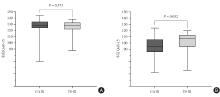
Fig.1
Comparison of QoR-15 scale scores at preoperative and postoperative 24 hours"
Tab.4
Comparison of the incidence of perioperative adverse events"
| 组别 | 例数 | 术后躁动 | 恶心呕吐 | 皮肤瘙痒 | 术中低血压 | 诱导期咳嗽 |
|---|---|---|---|---|---|---|
| GA组 | 30 | 1(3.3) | 6(20.0) | 3(10.0) | 3(10.0) | 6(20.0) |
| TO组 | 30 | 0(0.0) | 2(6.7) | 0(0.0) | 5(16.7) | 0(0.0) |
| χ2值 | 0.647 | 1.404 | 0.144 | 4.630 | ||
| P值 | > 0.999 | 0.421 | 0.236 | 0.704 | 0.031 |
| [1] |
DE LA CRUZ KU G, KARAMCHANDANI M, CHAMBERGO-MICHILOT D, et al. Does Breast-Conserving Surgery with Radiotherapy have a Better Survival than Mastectomy?A Meta-Analysis of More than 1,500,000 Patients[J]. Ann Surg Oncol, 2022, 29(10): 6163-6188. doi: 10.1245/s10434-022-12133-8 .
doi: 10.1245/s10434-022-12133-8 |
| [2] |
CHEN C Y, CHEN Y. Better survival was found in patients treated with breast-conserving surgery compared with mastectomy in malignant phyllodes tumor of the breast[J]. Updates Surg, 2024, 76(1): 265-270. doi: 10.1007/s13304-023-01547-y .
doi: 10.1007/s13304-023-01547-y |
| [3] |
LUO Y, CHEN X, LV R, et al. Breast-conserving surgery versus modified radical mastectomy in T1-2N3M0 stage breast cancer: A propensity score matching analysis[J]. Breast Cancer, 2024, 31(5): 979-987. doi: 10.1007/s12282-024-01611-4 .
doi: 10.1007/s12282-024-01611-4 |
| [4] |
LIAO Y H, LAI J N, HSU R J, et al. Breast‑conserving surgery with whole breast radiation therapy has a subsequent lower mood disorder incidence rate than total mastectomy in early‑stage breast cancer patients: A nationwide population‑based longitudinal study[J]. Breast Cancer Res Treat, 2022, 193(3): 659-667. doi: 10.1007/s10549-022-06579-3 .
doi: 10.1007/s10549-022-06579-3 |
| [5] |
王玉东, 刘育贤, 卞清明, 等. 羟考酮联合丙泊酚用于乳腺癌保乳手术静脉全麻的临床效果评估[J]. 南京医科大学学报(自然科学版), 2023, 43(12): 1724-1728. doi: 10.7655/NYDXBNS20231217 .
doi: 10.7655/NYDXBNS20231217 |
| [6] |
LI J, LYU Q, SU W, et al. A randomised trial: Effects of different anesthesia methods on early perioperative pain sensitivity and cellular immune function in patients undergoing radical mastectomy[J]. Gland Surg, 2021, 10(7): 2246-2254. doi:10.21037/gs-21-343 .
doi: 10.21037/gs-21-343 |
| [7] |
孙正秀, 汪媛媛, 林永傲, 等. 经皮耳迷走神经刺激对胸腔镜肺切除术患者术后早期恢复质量的影响[J]. 实用医学杂志, 2025, 41(17): 2670-2675. doi: 10.3969/j.issn.1006-5725. 2025.17.009 .
doi: 10.3969/j.issn.1006-5725. 2025.17.009 |
| [8] |
吴春培, 孙正霞, 刘辉, 等. 全身麻醉下胸横肌平面-胸神经阻滞在乳腺癌手术患者中的价值[J]. 南京医科大学学报(自然科学版), 2024, 44(5): 666-671. doi: 10.7655/NYDXBNSN231194 .
doi: 10.7655/NYDXBNSN231194 |
| [9] |
BRAY F, LAVERSANNE M, SUNG H, et al. Global cancer statistics 2022: GLOBOCAN estimates of incidence and mortality worldwide for 36 cancers in 185 countries [J]. CA Cancer J Clin, 2024, 74(3): 229-263. doi: 10.3322/caac.21834 .
doi: 10.3322/caac.21834 |
| [10] |
URMAN R D, KHANNA A K, BERGESE S D, et al. Postoperative opioid administration characteristics associated with opioid-induced respiratory depression: Results from the PRODIGY trial[J]. J Clin Anesth, 2021, 70: 110167. doi: 10.1016/j.jclinane. 2021.110167 .
doi: 10.1016/j.jclinane. 2021.110167 |
| [11] |
ORR J E, HILL D, OWENS R L. Opioids and Respiratory Related Consequences[J]. Sleep Med Clin, 2025, 20(4): 499-507. doi: 10.1016/j.jsmc.2025.07.010 .
doi: 10.1016/j.jsmc.2025.07.010 |
| [12] |
中国抗癌协会肿瘤整形外科专业委员会, 中国抗癌协会肿瘤麻醉与镇痛专业委员会. 乳房再造加速康复外科中国专家共识(2022版)[J]. 中国肿瘤临床, 2023, 50(8): 379-384. doi: 10.12354/j.issn.1000-8179.2023.20221437 .
doi: 10.12354/j.issn.1000-8179.2023.20221437 |
| [13] |
LOMBANA N F, MEHTA I M, ZHENG C, et al. Updates on Enhanced Recovery after Surgery protocols for plastic surgery of the breast and future directions[J]. Proc (Bayl Univ Med Cent), 2023, 36(4): 501-509. doi: 10.1080/08998280.2023.2210036 .
doi: 10.1080/08998280.2023.2210036 |
| [14] |
中华医学会麻醉学分会疼痛学组. 羟考酮注射液临床应用专家共识(2025版)[J]. 中华医学杂志,2025,105(44): 4024-4040. doi: 10.3760/cma.j.cn112137-20250903-02286 .
doi: 10.3760/cma.j.cn112137-20250903-02286 |
| [15] |
DIANA K, TEH M S, ISLAM T, et al. Benefits of PECS Block as Part of the Enhanced Recovery After Surgery (ERAS) Protocol for Breast Cancer Surgery in an Asian Institution: A Retrospective Cohort Study[J]. World J Surg, 2023, 47(3): 564-572. doi: 10.1007/s00268-022-06881-7 .
doi: 10.1007/s00268-022-06881-7 |
| [16] |
DOST B, BUGADA D, KARAPINAR Y E, et al. Paravertebral block is not superior to the interpectoral and pectoserratus plane block for patients undergoing breast surgery: An updated meta-analysis of randomised controlled trials with meta-regression and trial sequential analysis[J]. Eur J Anaesthesiol, 2025, 42(7): 637-648. doi: 10.1097/EJA.0000000000002148 .
doi: 10.1097/EJA.0000000000002148 |
| [17] |
ELJUGA D, MUŽAR R M, JURIŠIĆ I, et al. Regional anesthesia without opioid administration in mastectomy surgeries followed by breast reconstruction with implants: A randomized controlled study[J]. Croat Med J, 2025, 66(3): 213-219. doi: 10.3325/cmj.2025.66.213 .
doi: 10.3325/cmj.2025.66.213 |
| [18] |
BLANCO R, FAJARDO M, PARRAS MALDONADO T. Ultrasound description of Pecs Ⅱ (modified Pecs Ⅰ): A novel approach to breast surgery[J]. Rev Esp Anestesiol Reanim, 2012, 59(9): 470-475. doi: 10.1016/j.redar.2012.07.003 .
doi: 10.1016/j.redar.2012.07.003 |
| [19] |
CONTI D, VALORIANI J, BALLO P, et al. The clinical impact of pectoral nerve block in an 'enhanced recovery after surgery' program in breast surgery[J]. Pain Manag, 2023, 13(10): 585-592. doi: 10.2217/pmt-2023-0063 .
doi: 10.2217/pmt-2023-0063 |
| [20] |
ZHANG X, JIA Y, CHOU C, et al. Comparative evaluation of PECS Ⅱ versus RISS block for postoperative analgesia in breast cancer surgery: A randomized controlled trial[J]. Am J Transl Res, 2025, 17(5): 3971-3981. doi: 10.62347/CEED1530 .
doi: 10.62347/CEED1530 |
| [21] |
ZHAO Y, JIN W, PAN P, et al. Ultrasound-guided transversus thoracic muscle plane-pectoral nerve block for postoperative analgesia after modifed radical mastectomy: A comparison with the thoracic paravertebral nerve block[J]. Perioper Med (Lond), 2022, 11(1): 1-11. doi: 10.1186/s13741-022-00270-3 .
doi: 10.1186/s13741-022-00270-3 |
| [22] |
YANG G W, CHENG H, SONG X Y, et al. Effect of Oxycodone-Based Multimodal Analgesia on Visceral Pain After Major Laparoscopic Gastrointestinal Surgery: A Randomised, Double-Blind, Controlled Trial[J]. Drug Des Devel Ther, 2024, 18: 1799-1810. doi: 10.2147/DDDT.S464518 .
doi: 10.2147/DDDT.S464518 |
| [23] |
HUANG Y, QIN F, LIAN Z, et al. Effect of multimodal preventive analgesia based on serratus anterior plane block and oxycodone on postoperative analgesia in elderly patients undergoing thoracoscopic lobectomy: A randomized controlled trial[J]. Sci Rep, 2025, 15(1): 24459. doi: 10.1038/s41598-025-10117-8 .
doi: 10.1038/s41598-025-10117-8 |
| [24] |
汤黎黎, 孙月, 刘学胜, 等. 不同性别对日间关节镜手术患者瑞马唑仑使用剂量及术后恢复质量的影响[J]. 实用医学杂志, 2024, 40(8): 1063-1068. doi: 10.3969/j.issn.1006-5725. 2024.08.007 .
doi: 10.3969/j.issn.1006-5725. 2024.08.007 |
| [25] |
DE VLIEGER J C N, LUITING W H, LOCKYER J, et al. Validation of the Dutch translation of the quality of recovery-15 scale[J]. BMC Anesthesiol, 2022, 22(1): 243. doi: 10.1186/s12871-022-01784-5 .
doi: 10.1186/s12871-022-01784-5 |
| [26] |
BERGESTUEN L, MOGER T, OTERHALS K, et al. Translation and validation of the Norwegian version of the postoperative quality of recovery score QoR-15[J]. Acta Anaesthesiol Scand, 2024, 68(1): 43-50. doi: 10.1111/aas.14322 .
doi: 10.1111/aas.14322 |
| [27] |
LEE J H, KI M, CHOI S, et al. Validity and reliability of the Korean version of the Quality of Recovery-15 questionnaire[J]. Korean J Anesthesiol, 2021, 74(2): 142-149. doi: 10.4097/kja. 20435 .
doi: 10.4097/kja. 20435 |
| [28] |
NAKATANI S, IDA M, TANAKA Y, et al. Translation and validation of the Japanese Version of the Quality of Recovery-15 Questionnaire[J]. J Anesth, 2021, 35(3): 426-433. doi: 10.1007/s00540-021-02921-z .
doi: 10.1007/s00540-021-02921-z |
| [29] |
LE BESCOND V, PETIT-PHAN J, CAMPFORT M, et al. Validation of the postoperative Quality of Recovery-15 questionnaire after emergency surgery and association with quality of life at three months[J]. Can J Anaesth, 2024, 71(5): 590-599. doi: 10.1007/s12630-024-02722-4 .
doi: 10.1007/s12630-024-02722-4 |
| [30] |
DEMUMIEUX F, LUDES P O, DIEMUNSCH P, et al. Validation of the translated Quality of Recovery-15 questionnaire in a French-speaking population[J]. Br J Anaesth, 2020, 124(6): 761-767. doi: 10.1016/j.bja.2020.03.011 .
doi: 10.1016/j.bja.2020.03.011 |
| [31] |
KARA U, ŞIMŞEK F, KAMBUROĞLU H, et al. Linguistic validation of a widely used recovery score: Quality of recovery-15 (QoR-15)[J]. Turk J Med Sci, 2022, 52(2): 427-435. doi: 10.55730/1300-0144.5330 .
doi: 10.55730/1300-0144.5330 |
| [32] |
MYLES P S, SHULMAN M A, REILLY J, et al. Measurement of quality of recovery after surgery using the 15-item quality of recovery scale: A systematic review and meta-analysis[J]. Br J Anaesth, 2022, 12(6): 1029-1039. doi: 10.1016/j.bja. 2022. 03.009 .
doi: 10.1016/j.bja. 2022. 03.009 |
| [33] |
卞清明, 徐巧芳, 许仄平, 等. 不同剂量羟考酮预防全麻诱导时芬太尼诱发咳嗽的效果[J]. 中华麻醉学杂志, 2018, 38(7): 800-802. doi:10.3760/oma.j.issn.0254-1416.2018.07.008 .
doi: 10.3760/oma.j.issn.0254-1416.2018.07.008 |
| [1] | Huan LIN,Hongsheng LI,Mei HUANG,Guochun ZHANG,Neng WANG,Guanqun HUANG,Juan XU,Qingfeng ZOU,Xingyuan SHI,Wenguang HE,Feng LI,Yanqing CAI,xiaoping HUANG,Qiongdiao HUANG,Zejuan YANG,Runmei LUO,Jiewen ZHANG,Yi TANG,Chaoliang XU,Hongfei GAO,Weicai CHEN,Hao HU,Yongsheng YAO,Chu HUANG,Jiewen HUANG,Yichao HUANG,Yeyan LEI,Ming LUO,Zhe WU,Nangui YUAN,Yongting LIN. Consensus on integrative medicine cooling therapy management during the peri-chemotherapy period for breast cancer [J]. The Journal of Practical Medicine, 2026, 42(5): 723-733. |
| [2] | Mengrong HU,Ruwen HUANG,Rui LI,Xiaofen LIN,Qing WAN. Effects of fospropofol disodium and propofol on hemodynamic responses during anesthesia induction in painless endobronchial ultrasound-guided transbronchial needle aspiration [J]. The Journal of Practical Medicine, 2026, 42(3): 525-530. |
| [3] | Xinyang XIONG,Xiangwen LU,Na ZHANG,Qingping LI,Baihong XIONG,Shuting HU,Dunyi QI. Efficacy of oselidine for patient-controlled intravenous analgesia after total knee arthroplasty in elderly patients : A randomized controlled trial [J]. The Journal of Practical Medicine, 2026, 42(2): 303-310. |
| [4] | Maijuan DONG,Yufeng WANG,Wei YUAN,Jiale NIU,Yaomin ZHU. Observation on the anesthetic effects of remimazolam combined with propofol in transvaginal ultrasound-guided oocyte retrieval [J]. The Journal of Practical Medicine, 2026, 42(1): 126-131. |
| [5] | Sheng NONG,Zhanxiong LI,Qi ZHANG,Zhendong LU,Minping HONG,Wubiao CHEN,Zilin LIU. Predictive performance of an interpretable BPNN model for axillary lymph node burden in breast cancer patients with 1 ~ 2 sentinel lymph node positive [J]. The Journal of Practical Medicine, 2026, 42(1): 45-55. |
| [6] | Xinghua BIAN,Peng XU,Junfei SHI,Zhenhua MA. The predictive value of serum matrix metalloproteinase-2, myeloperoxidase, axonal guidance factor 3E for the prognosis of patients undergoing intracranial aneurysm clipping surgery under general anesthesia [J]. The Journal of Practical Medicine, 2026, 42(1): 56-63. |
| [7] | Fen SONG,Xiaojie LIU,Yue. LIU. Effects of noise isolation using noise-cancelling headphones during esophageal or gastric endoscopic submucosal dissection for postoperative recovery quality [J]. The Journal of Practical Medicine, 2025, 41(5): 704-710. |
| [8] | Lina MIAO,Gongyao LIU,Haitao HOU,Xing. LIU. The impact of perioperative sleep disorders in patients undergoing laparoscopic gynecological surgery under general anesthesia on anesthesia recovery and postoperative pain [J]. The Journal of Practical Medicine, 2025, 41(24): 3833-3841. |
| [9] | Xi CHEN,Beibei YU,Yuge LIU,Wei ZHAO,Ming. YAN. Comparison of the effects of remimazolam and propofol anesthesia on postoperative delirium in elderly patients with lung cancer undergoing thoracoscopic surgery [J]. The Journal of Practical Medicine, 2025, 41(19): 3089-3095. |
| [10] | Yingchao WU,Liushan CHEN,Yuqi LIANG,Jieting CHEN,Junfeng HUANG,Qian ZUO,Qianjun CHEN. Development of an organoid⁃based pan⁃TKI precision screening platform to enhance therapeutic efficacy of ET+CDK4/6 inhibitors in HR+/HER2⁃low breast cancer [J]. The Journal of Practical Medicine, 2025, 41(18): 2786-2795. |
| [11] | Xinran ZHANG,Yan SHEN,Jiaojiao HU,Qingqing CHEN,Yangjie XIAO,Feng LU,Shasha YUAN,Xiaohong FU. Study on the applied value of combined clinical and ultrasound multiparameter constructed nomogram for predicting HER⁃2⁃positive breast cancer [J]. The Journal of Practical Medicine, 2025, 41(18): 2812-2819. |
| [12] | Jingshuo LI,Shoushi LIU,Hongwei. GUO. Advances in the mechanism and therapeutic potential of Erianin⁃induced apoptosis in breast cancer cells [J]. The Journal of Practical Medicine, 2025, 41(14): 2132-2137. |
| [13] | Hai QIU,Yifei GUI,Yuan. LIU. Predictors of sentinel lymph node metastasis in clinical T1⁃2 N0 breast cancer patients with preoperatively normal axillary ultrasound [J]. The Journal of Practical Medicine, 2025, 41(14): 2143-2151. |
| [14] | Yuling DUAN,Xuezhi ZHOU,Yongyi LI,Lixia MA,Desheng YANG,Jiao CHENG,Yan WU,Tao LIU,Guoyuan JIANG,Mei. WANG. Clinical value analysis of different MRI measurement methods in evaluating the efficacy of neoadjuvant therapy for breast cancer [J]. The Journal of Practical Medicine, 2025, 41(14): 2152-2159. |
| [15] | Lu JIANG,Weipeng LYU,Sijing CHEN,Yanhua FANG,Shanshan LIANG. Inhibitory effect of disitamab vedotin on breast cancer cells with different HER⁃2 expression levels in tumor organoid culture system [J]. The Journal of Practical Medicine, 2025, 41(12): 1808-1815. |
| Viewed | ||||||
|
Full text |
|
|||||
|
Abstract |
|
|||||
