

The Journal of Practical Medicine ›› 2026, Vol. 42 ›› Issue (4): 706-713.doi: 10.3969/j.issn.1006-5725.2026.04.023
• Reviews • Previous Articles
Yu XIA1,2,Min DONG3,Jinkui WU2,Mengbin LI2( )
)
Received:2025-09-17
Online:2026-02-25
Published:2026-02-25
Contact:
Mengbin LI
E-mail:limbin@fmmu.edu.cn
CLC Number:
Yu XIA,Min DONG,Jinkui WU,Mengbin LI. Research progress on the regulatory mechanism of MYH9 in intestinal epithelial cells and related diseases[J]. The Journal of Practical Medicine, 2026, 42(4): 706-713.
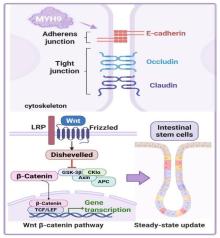
Fig.1
The core mechanisms of MYH9 in intestinal epithelial homeostasis"
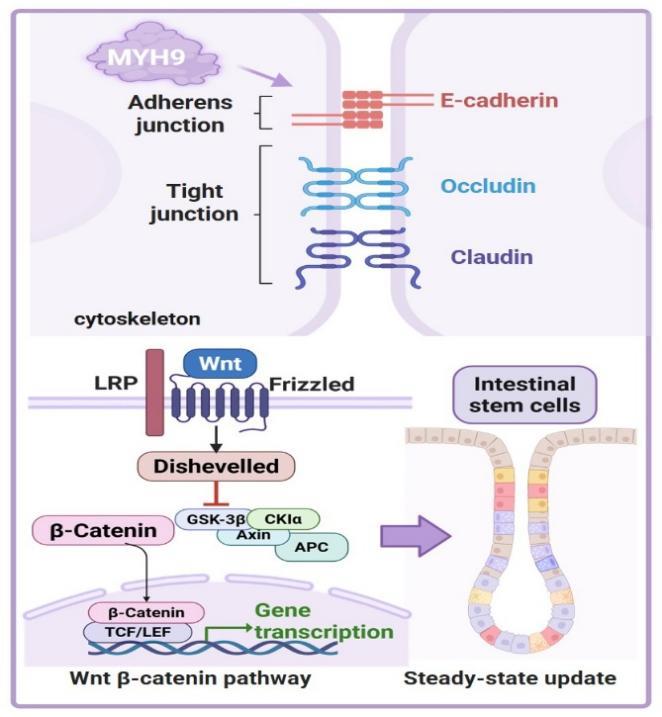
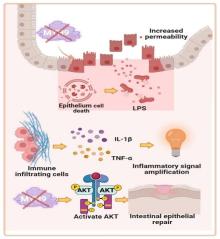
Fig.2
The core mechanisms of MYH9 inflammatory bowel disease"
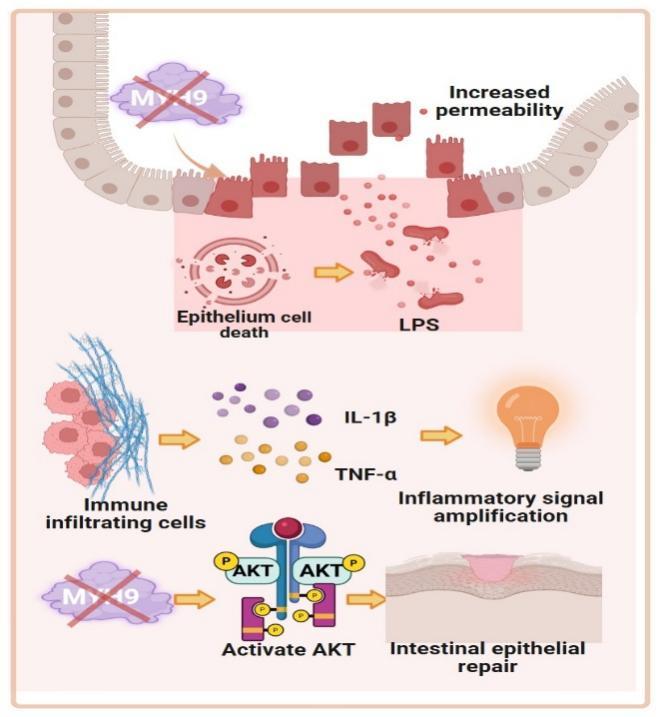
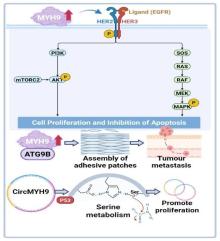
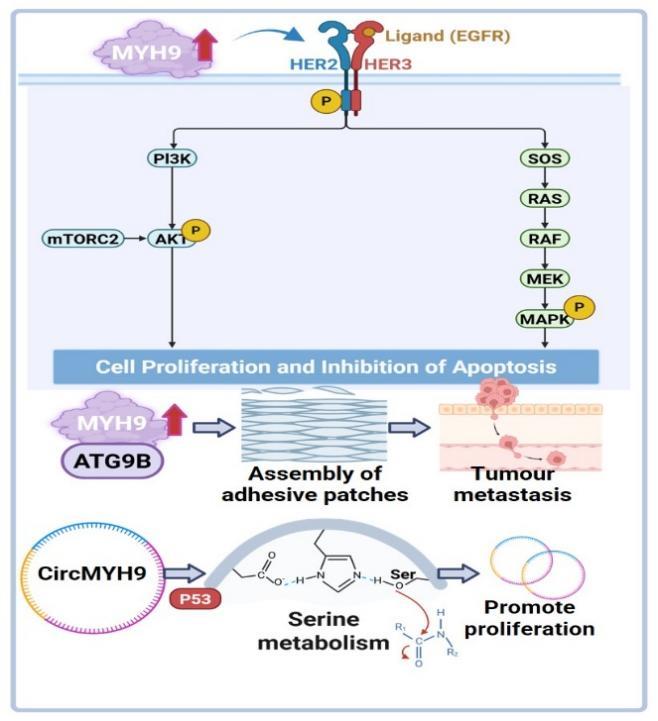
Fig.3
The core mechanisms of MYH9 in colorectal cancer"
| [1] |
LI Y, PAN Y, YANG X, et al. Unveiling the enigmatic role of MYH9 in tumor biology: a comprehensive review [J]. Cell Commun Signal, 2024, 22(1): 417. doi: 10.1186/s12964-024-01781-w .
doi: 10.1186/s12964-024-01781-w |
| [2] |
SIMONIN P, GUERRERO G L, BARDIN S, et al. The GTPase RAB6 is required for stem cell maintenance and cell migration in the gut epithelium [J]. Development, 2024, 151(21):dev203038. doi: 10.1242/dev.203038 .
doi: 10.1242/dev.203038 |
| [3] |
ZENG X F, WANG Y W, OU Y, et al. Role of myosin heavy chain 9 in gastrointestinal tumorigenesis: A comprehensive review [J]. World J Gastrointest Oncol, 2025, 17(6): 106617. doi: 10.4251/wjgo.v17.i6.106617 .
doi: 10.4251/wjgo.v17.i6.106617 |
| [4] |
PECCI A, MA X, SAVOIA A, et al. MYH9: Structure, functions and role of non-muscle myosin IIA in human disease [J]. Gene, 2018, 664: 152-167. doi: 10.1016/j.gene.2018.04.048 .
doi: 10.1016/j.gene.2018.04.048 |
| [5] |
SABBIR M G, DILLON R, MOWAT M R. Dlc1 interaction with non-muscle myosin heavy chain II-A (Myh9) and Rac1 activation [J]. Biol Open, 2016, 5(4): 452-460. doi: 10.1242/bio.015859 .
doi: 10.1242/bio.015859 |
| [6] |
CAO M, WANG Y, XIAO Y, et al. Activation of the clock gene TIMELESS by H3k27 acetylation promotes colorectal cancer tumorigenesis by binding to Myosin-9 [J]. J Exp Clin Cancer Res, 2021, 40(1): 162. doi: 10.1186/s13046-021-01936-4 .
doi: 10.1186/s13046-021-01936-4 |
| [7] |
YANG J S, CAO J M, SUN R, et al. SMYD4 promotes MYH9 ubiquitination through lysine monomethylation modification to inhibit breast cancer progression [J]. Breast Cancer Res, 2025, 27(1): 20. doi: 10.1186/s13058-025-01973-3 .
doi: 10.1186/s13058-025-01973-3 |
| [8] |
HU S, REN S, CAI Y, et al. Glycoprotein PTGDS promotes tumorigenesis of diffuse large B-cell lymphoma by MYH9-mediated regulation of Wnt-β-catenin-STAT3 signaling [J]. Cell Death Differ, 2022, 29(3): 642-656. doi: 10.1038/s41418-021-00880-2 .
doi: 10.1038/s41418-021-00880-2 |
| [9] |
LEE S, CHOI E, CHAE S, et al. Identification of MYH9 as a key regulator for synoviocyte migration and invasion through secretome profiling [J]. Ann Rheum Dis, 2023, 82(8): 1035-1048. doi: 10.1136/ard-2022-223625 .
doi: 10.1136/ard-2022-223625 |
| [10] |
BONDZIE P A, CHEN H A, CAO M Z, et al. Non-muscle myosin-IIA is critical for podocyte f-actin organization, contractility, and attenuation of cell motility [J]. Cytoskeleton, 2016, 73(8): 377-395. doi: 10.1002/cm.21313 .
doi: 10.1002/cm.21313 |
| [11] |
CHEN Z, LIU C, ZHENG W, et al. MYH9 promotes malignant progression of glioma cells through regulating β-catenin stability via epithelial-mesenchymal transition signaling pathway [J]. Sci Rep, 2025, 15(1): 4618. doi: 10.1038/s41598-025-87151-z .
doi: 10.1038/s41598-025-87151-z |
| [12] |
YANG B, LIU H, BI Y, et al. MYH9 promotes cell metastasis via inducing Angiogenesis and Epithelial Mesenchymal Transition in Esophageal Squamous Cell Carcinoma [J]. Int J Med Sci, 2020, 17(13): 2013-2023. doi: 10.7150/ijms.46234 .
doi: 10.7150/ijms.46234 |
| [13] |
YOU G R, CHANG J T, LI Y L, et al. MYH9 Facilitates Cell Invasion and Radioresistance in Head and Neck Cancer via Modulation of Cellular ROS Levels by Activating the MAPK-Nrf2-GCLC Pathway [J]. Cells, 2022, 11(18):2855. doi: 10.3390/cells11182855 .
doi: 10.3390/cells11182855 |
| [14] |
PERRIN L, MATIC VIGNJEVIC D. The emerging roles of the cytoskeleton in intestinal epithelium homeostasis [J]. Semin Cell Dev Biol, 2023, 150-151: 23-27. doi: 10.1016/j.semcdb. 2023. 03.008 .
doi: 10.1016/j.semcdb. 2023. 03.008 |
| [15] |
KANG J S, LEE S J, LEE J H, et al. Angiotensin II-mediated MYH9 downregulation causes structural and functional podocyte injury in diabetic kidney disease [J]. Sci Rep, 2019, 9(1): 7679. doi: 10.1038/s41598-019-44194-3 .
doi: 10.1038/s41598-019-44194-3 |
| [16] |
SUN H, ZHAO A, LI M, et al. Interaction of calcium binding protein S100A16 with myosin-9 promotes cytoskeleton reorganization in renal tubulointerstitial fibrosis [J]. Cell Death Dis, 2020, 11(2): 146. doi: 10.1038/s41419-020-2337-z .
doi: 10.1038/s41419-020-2337-z |
| [17] |
SUNG D C, AHMAD M, LERMA CERVANTES C B, et al. Mutations in non-muscle myosin 2A disrupt the actomyosin cytoskeleton in Sertoli cells and cause male infertility [J]. Dev Biol, 2021, 470: 49-61. doi: 10.1016/j.ydbio.2020.11.003 .
doi: 10.1016/j.ydbio.2020.11.003 |
| [18] |
LIU Y, ZHANG T, ZHANG H, et al. Cell Softness Prevents Cytolytic T-cell Killing of Tumor-Repopulating Cells [J]. Cancer Res, 2021, 81(2): 476-488. doi: 10.1158/0008-5472.Can-20-2569 .
doi: 10.1158/0008-5472.Can-20-2569 |
| [19] |
窦鑫,贺昌辉,梅笑,等. 基于“短链脂肪酸-肠屏障”途径探讨中药在腹泻型肠易激综合征中的干预研究进展 [J]. 实用医学杂志, 2024, 40(15): 2177-2182. doi: 10.3969/j.issn.1006-5725. 2024.15.023 .
doi: 10.3969/j.issn.1006-5725. 2024.15.023 |
| [20] |
NAYDENOV N G, FEYGIN A, WANG D, et al. Nonmuscle Myosin IIA Regulates Intestinal Epithelial Barrier in vivo and Plays a Protective Role During Experimental Colitis [J]. Sci Rep, 2016, 6: 24161. doi: 10.1038/srep24161 .
doi: 10.1038/srep24161 |
| [21] |
NAAMA M, TELPAZ S, AWAD A, et al. Autophagy controls mucus secretion from intestinal goblet cells by alleviating ER stress [J]. Cell Host Microbe, 2023, 31(3): 433-446.e434. doi: 10.1016/j.chom.2023.01.006 .
doi: 10.1016/j.chom.2023.01.006 |
| [22] |
WANG S, LI S, LI Y, et al. Non-muscle myosin heavy chain 9 maintains intestinal homeostasis by preventing epithelium necroptosis and colitis adenoma formation [J]. Stem Cell Reports, 2021, 16(5): 1290-1301. doi: 10.1016/j.stemcr.2021.03.027 .
doi: 10.1016/j.stemcr.2021.03.027 |
| [23] |
REN X, LIU Q, ZHOU P, et al. DHX9 maintains epithelial homeostasis by restraining R-loop-mediated genomic instability in intestinal stem cells [J]. Nat Commun, 2024, 15(1): 3080. doi: 10.1038/s41467-024-47235-2
doi: 10.1038/s41467-024-47235-2 |
| [24] |
WU H, MU C, XU L, et al. Host-microbiota interaction in intestinal stem cell homeostasis [J]. Gut Microbes, 2024, 16(1): 2353399. doi: 10.1080/19490976.2024.2353399 .
doi: 10.1080/19490976.2024.2353399 |
| [25] |
ZHAO B, QI Z, LI Y, et al. The non-muscle-myosin-II heavy chain Myh9 mediates colitis-induced epithelium injury by restricting Lgr5+ stem cells [J]. Nat Commun, 2015, 6: 7166. doi: 10.1038/ncomms8166 .
doi: 10.1038/ncomms8166 |
| [26] |
WU J, XU X, DUAN J, et al. EFHD2 suppresses intestinal inflammation by blocking intestinal epithelial cell TNFR1 internalization and cell death [J]. Nat Commun, 2024, 15(1): 1282. doi: 10.1038/s41467-024-45539-x .
doi: 10.1038/s41467-024-45539-x |
| [27] |
AL-ALIEM A E E ABD, BADR E A E, EL-SHAYEB E I, et al. Association of the myosin heavy chain 9 gene single nucleotide polymorphism with inflammatory bowel disease [J]. Biochem Biophys Rep, 2021, 28: 101113. doi: 10.1016/j.bbrep. 2021. 101113 .
doi: 10.1016/j.bbrep. 2021. 101113 |
| [28] |
GE X, XUE G, DING Y, et al. The Loss of YTHDC1 in Gut Macrophages Exacerbates Inflammatory Bowel Disease [J]. Adv Sci (Weinh), 2023, 10(14): e2205620. doi: 10.1002/advs. 202205620 .
doi: 10.1002/advs. 202205620 |
| [29] |
FENG L, WENG J, YAO C, et al. Extracellular Vesicles Derived from SIPA1(high) Breast Cancer Cells Enhance Macrophage Infiltration and Cancer Metastasis through Myosin-9 [J]. Biology (Basel), 2022, 11(4):543. doi: 10.3390/biology11040543 .
doi: 10.3390/biology11040543 |
| [30] |
SINGH S K, SINHA S, PADHAN J, et al. MYH9 suppresses melanoma tumorigenesis, metastasis and regulates tumor microenvironment [J]. Med Oncol, 2020, 37(10): 88. doi: 10.1007/s12032-020-01413-6 .
doi: 10.1007/s12032-020-01413-6 |
| [31] |
王伟, 王敏, 成敏敏, 等. 红花多糖对结直肠癌小鼠肿瘤生长及磷脂酰肌醇3-激酶/蛋白激酶B/雷帕霉素靶蛋白信号通路的影响 [J]. 实用医学杂志, 2025, 41(5): 670-675. doi: 10.3969/j.issn.1006-5725.2025.05.008 .
doi: 10.3969/j.issn.1006-5725.2025.05.008 |
| [32] |
WANG B, QI X, LIU J, et al. MYH9 Promotes Growth and Metastasis via Activation of MAPK/AKT Signaling in Colorectal Cancer [J]. J Cancer, 2019, 10(4): 874-884. doi: 10.7150/jca. 27635 .
doi: 10.7150/jca. 27635 |
| [33] |
WANG Z, ZHU Z, LI C, et al. NMIIA promotes tumorigenesis and prevents chemosensitivity in colorectal cancer by activating AMPK/mTOR pathway [J]. Exp Cell Res, 2021, 398(1): 112387. doi: 10.1016/j.yexcr.2020.112387 .
doi: 10.1016/j.yexcr.2020.112387 |
| [34] |
LIU X, LIU Y, LIU Z, et al. CircMYH9 drives colorectal cancer growth by regulating serine metabolism and redox homeostasis in a p53-dependent manner [J]. Mol Cancer, 2021, 20(1): 114. doi: 10.1186/s12943-021-01412-9 .
doi: 10.1186/s12943-021-01412-9 |
| [35] |
ZHONG Y, LONG T, GU C S, et al. MYH9-dependent polarization of ATG9B promotes colorectal cancer metastasis by accelerating focal adhesion assembly [J]. Cell Death Differ, 2021, 28(12): 3251-3269. doi: 10.1038/s41418-021-00813-z .
doi: 10.1038/s41418-021-00813-z |
| [36] |
SCHRAMEK D, SENDOEL A, SEGAL J P, et al. Direct in vivo RNAi screen unveils myosin IIa as a tumor suppressor of squamous cell carcinomas [J]. Science, 2014, 343(6168): 309-313. doi: 10.1126/science.1248627 .
doi: 10.1126/science.1248627 |
| [37] |
DERYCKE L, STOVE C, VERCOUTTER-EDOUART A S, et al. The role of non-muscle myosin IIA in aggregation and invasion of human MCF-7 breast cancer cells [J]. Int J Dev Biol, 2011, 55(7-9): 835-840. doi: 10.1387/ijdb.113336ld .
doi: 10.1387/ijdb.113336ld |
| [38] |
XU Z, XIAO L, WANG S, et al. Alteration of gastric microbiota and transcriptome in a rat with gastric intestinal metaplasia induced by deoxycholic acid [J]. Front Microbiol, 2023, 14: 1160821. doi: 10.3389/fmicb.2023.1160821 .
doi: 10.3389/fmicb.2023.1160821 |
| [39] |
WEI H, LI W, ZENG L, et al. OLFM4 promotes the progression of intestinal metaplasia through activation of the MYH9/GSK3β/β-catenin pathway [J]. Mol Cancer, 2024, 23(1): 124. doi: 10.1186/s12943-024-02016-9 .
doi: 10.1186/s12943-024-02016-9 |
| Viewed | ||||||
|
Full text |
|
|||||
|
Abstract |
|
|||||
