

实用医学杂志 ›› 2026, Vol. 42 ›› Issue (14): 2521-2532.doi: 10.3969/j.issn.1006-5725.2026.14.005
• 心脑血管疾病专栏 • 上一篇
张忠琦,张雅婕,梁子怡,徐俊杰,路洋,沙壮,梁君( )
)
收稿日期:2026-04-19
出版日期:2026-07-25
发布日期:2026-08-05
通讯作者:
梁君
E-mail:lj1971@126.com
基金资助:
Zhongqi ZHANG,Yajie ZHANG,Ziyi LIANG,Junjie XU,Yang LU,Zhuang SHA,Jun LIANG()
Received:2026-04-19
Online:2026-07-25
Published:2026-08-05
Contact:
Jun LIANG
E-mail:lj1971@126.com
摘要:
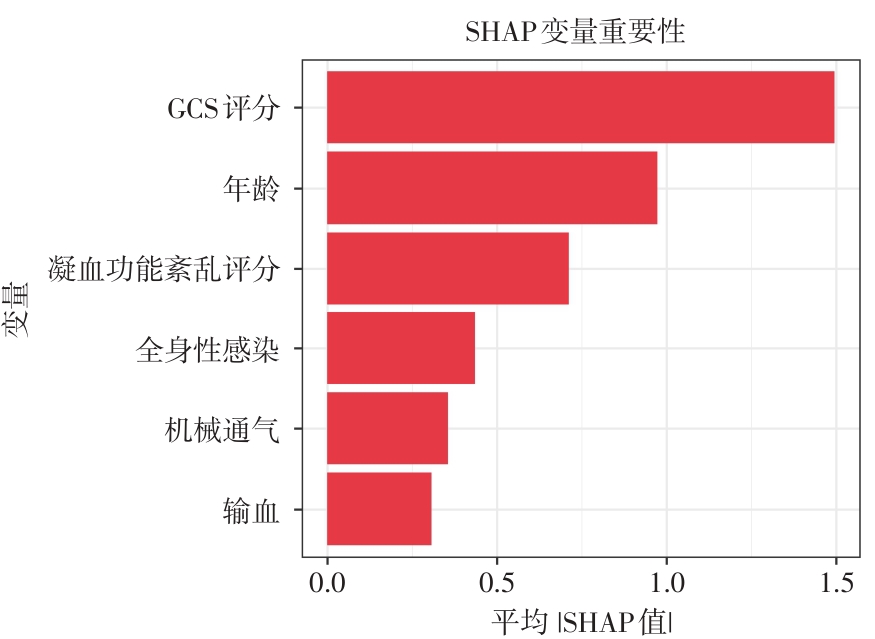
目的 探讨创伤性脑损伤(TBI)患者发生早期急性肾损伤(AKI)的独立相关因素,构建并验证列线图预测模型,并与随机森林及XGBoost模型进行判别效能比较。 方法 回顾性收集2023年1月至2025年12月徐州医科大学附属医院收治的TBI患者临床资料。依据入院后48 h内是否发生AKI分为AKI组和非AKI组。采用单因素及多因素logistic回归分析筛选早期AKI的独立相关因素,基于多因素模型构建列线图预测模型。进一步构建随机森林和XGBoost模型,通过5折交叉验证比较3种模型的判别效能。 结果 共纳入368例TBI患者,其中AKI组54例(14.7%),非AKI组314例(85.3%)。多因素logistic回归分析显示,年龄、输血、机械通气、全身性感染及凝血功能紊乱评分是TBI患者早期AKI的独立相关因素,而格拉斯哥昏迷评分(GCS)为保护因素(P < 0.05)。基于上述变量构建的列线图校准曲线平均绝对误差为0.034,校准度良好;决策曲线分析显示模型在较低至中等阈值概率范围内具有潜在的临床获益。5折交叉验证结果显示,logistic模型、随机森林模型、XGBoost模型曲线下面积(AUC)分别为0.862、0.870、0.852。DeLong检验显示3种模型间AUC差异均无统计学意义。SHAP分析揭示各变量在机器学习模型中的相对贡献及重要性排序。 结论 基于年龄、GCS评分、输血、机械通气、全身性感染及凝血功能紊乱评分构建的logistic列线图模型,具有良好的区分度、校准度及潜在临床参考价值,可为神经外科临床TBI患者早期AKI风险识别与个体化管理提供参考。鉴于本研究为单中心回顾性内部验证,模型仍需多中心、前瞻性队列进一步验证。
中图分类号:
张忠琦,张雅婕,梁子怡,徐俊杰,路洋,沙壮,梁君. 基于凝血功能紊乱评分的创伤性脑损伤患者早期急性肾损伤风险列线图预测模型[J]. 实用医学杂志, 2026, 42(14): 2521-2532.
Zhongqi ZHANG,Yajie ZHANG,Ziyi LIANG,Junjie XU,Yang LU,Zhuang SHA,Jun LIANG. Nomogram prediction model for early acute kidney injury in patients with traumatic brain injury based on a coagulation dysfunction score[J]. The Journal of Practical Medicine, 2026, 42(14): 2521-2532.
表1
两组患者基线资料比较 (例(%))"
| 变量 | 总计(n = 368) | 非AKI组(n = 314) | AKI组(n = 54) | Z/χ2/t值 | P值 |
|---|---|---|---|---|---|
| 年龄[M(P25,P75)]/岁 | 55.00(35.00,70.00) | 54.00(32.00,70.00) | 62.00(53.00,70.75) | -2.626 | 0.009 |
| 性别(男) | 255(69.3) | 219(69.7) | 36(66.7) | 0.205 | 0.651 |
| 高血压(否) | 219(59.5) | 184(58.6) | 35(64.8) | 0.739 | 0.390 |
| 糖尿病(否) | 270(73.4) | 231(73.6) | 39(72.2) | 0.043 | 0.836 |
| 平均动脉压(x ± s)/mmHg | 92.15 ± 16.47 | 91.78 ± 16.16 | 94.28 ± 18.16 | -0.946 | 0.347 |
| GCS评分[M(P25,P75)] | 11.00(8.00,14.00) | 12.00(8.00,15.00) | 8.00(6.00,10.00) | 6.012 | < 0.001 |
| 颅骨骨折(否) | 295(80.2) | 255(81.2) | 40(74.1) | 1.476 | 0.224 |
| 硬膜外出血(否) | 262(71.2) | 227(72.3) | 35(64.8) | 1.256 | 0.262 |
| 硬膜下出血(否) | 256(69.6) | 220(70.1) | 36(66.7) | 0.251 | 0.616 |
| 蛛网膜下腔出血(否) | 280(76.1) | 237(75.5) | 43(79.6) | 0.437 | 0.509 |
| 脑室内出血(否) | 354(96.2) | 302(96.2) | 52(96.3) | -* | 1.000 |
| 中线偏移> 5 mm(否) | 305(82.9) | 267(85.0) | 38(70.4) | 6.980 | 0.008 |
| 脑挫伤部位 | -* | 0.040 | |||
| 无 | 112(30.4) | 93(29.6) | 19(35.2) | ||
| 额叶 | 97(26.4) | 91(29.0) | 6(11.1) | ||
| 颞叶 | 118(32.1) | 98(31.2) | 20(37.0) | ||
| 顶叶 | 11(3.0) | 9(2.9) | 2(3.7) | ||
| 枕叶 | 21(5.7) | 17(5.4) | 4(7.4) | ||
| 其他 | 9(2.4) | 6(1.9) | 3(5.6) |
表2
两组实验检查结果比较 (例(%))"
| 变量 | 总计(n = 368) | 非AKI组(n = 314) | AKI组(n = 54) | Z/χ2/t值 | P值 |
|---|---|---|---|---|---|
| 肌红蛋白(x ± s)/(ng/mL) | 56.75 ± 17.26 | 56.21 ± 17.30 | 59.91 ± 16.81 | -1.489 | 0.141 |
| 肾小球滤过率(x ± s)/(mL/min) | 94.97 ± 17.81 | 95.49 ± 18.20 | 91.94 ± 15.12 | 1.542 | 0.127 |
| 天门冬氨酸氨基转移酶[M(P25,P75)]/(U/L) | 35.50(24.00,45.25) | 36.00(25.25,46.00) | 34.50(21.00,44.00) | 1.182 | 0.237 |
| 丙氨酸氨基转移酶[M(P25,P75)]/(U/L) | 42.00(27.00,59.00) | 42.00(26.25,59.00) | 42.50(27.00,53.00) | 0.328 | 0.743 |
| 白蛋白[M(P25,P75)]/(g/L) | 44.20(41.30,46.30) | 44.20(41.15,46.20) | 44.25(41.73,47.25) | -0.863 | 0.388 |
| 肌酐[M(P25,P75)]/(μmol/L) | 80.00(65.00,95.00) | 80.50(65.00,95.00) | 78.50(65.00,96.50) | -0.151 | 0.880 |
| C反应蛋白[M(P25,P75)]/(mg/L) | 5.00(2.68,9.25) | 4.90(2.60,9.57) | 5.30(2.87,7.55) | 0.263 | 0.792 |
| 降钙素原[M(P25,P75)]/(ng/mL) | 0.05(0.03,0.08) | 0.05(0.03,0.08) | 0.05(0.03,0.08) | 0.056 | 0.955 |
| 白细胞[M(P25,P75)]/(× 109·L-1) | 10.40(7.68,13.62) | 10.45(7.73,13.67) | 10.00(7.30,13.15) | 0.097 | 0.923 |
| 红细胞[M(P25,P75)]/(× 1012·L-1) | 3.95(3.46,4.33) | 3.94(3.46,4.33) | 4.02(3.44,4.31) | -0.175 | 0.861 |
| 红细胞比容[M(P25,P75)]/% | 35.40(31.67,39.30) | 35.40(31.70,39.27) | 35.35(30.97,39.42) | 0.486 | 0.627 |
| 血红蛋白[M(P25,P75)]/(g/L) | 119.00(102.75,132.25) | 119.00(102.25,133.00) | 117.00(103.75,129.00) | 0.737 | 0.461 |
| 尿素氮[M(P25,P75)]/(mmol/L) | 4.64(3.21,6.43) | 4.64(3.21,6.34) | 5.00(3.57,6.43) | -0.931 | 0.352 |
| 钾[M(P25,P75)]/(mmol/L) | 4.00(3.70,4.30) | 4.00(3.70,4.30) | 4.10(3.52,4.50) | -0.457 | 0.648 |
| 钠[M(P25,P75)]/(mmol/L) | 139.00(137.00,142.00) | 139.00(137.00,142.00) | 139.00(136.25,141.00) | 0.742 | 0.458 |
| 氯[M(P25,P75)]/(mmol/L) | 104.00(101.00,107.00) | 104.00(101.00,108.00) | 103.00(100.25,106.00) | 1.295 | 0.195 |
| 钙[M(P25,P75)]/(mmol/L) | 2.12(2.00,2.23) | 2.12(2.02,2.23) | 2.11(1.98,2.23) | 0.731 | 0.465 |
| 镁[M(P25,P75)]/(mmol/L) | 0.78(0.66,0.86) | 0.78(0.70,0.86) | 0.74(0.66,0.82) | 0.892 | 0.373 |
| 碳酸氢根[M(P25,P75)]/(mmol/L) | 23.00(20.00,25.00) | 23.00(21.00,25.00) | 23.00(20.00,25.00) | -0.106 | 0.916 |
| 阴离子间隙[M(P25,P75)]/(mmol/L) | 12.00(10.00,15.00) | 12.00(10.00,15.00) | 12.00(10.00,16.75) | -0.669 | 0.504 |
| 葡萄糖[M(P25,P75)]/(mmol/L) | 6.40(5.40,7.60) | 6.40(5.40,7.40) | 6.70(5.70,7.90) | -1.127 | 0.260 |
| PT[M(P25,P75)]/s | 12.80(11.90,14.00) | 12.70(11.90,13.88) | 13.40(12.12,15.28) | -2.296 | 0.022 |
| %FO[M(P25,P75)]/% | 2.64(1.73,4.15) | 2.68(1.71,4.24) | 2.54(1.92,3.80) | 0.253 | 0.800 |
| 甘露醇(否) | 25(6.8) | 22(7.0) | 3(5.6) | -* | 1.000 |
| 输血(否) | 328(89.1) | 289(92.0) | 39(72.2) | 18.675 | < 0.001 |
| 血管活性药物(否) | 335(91.0) | 289(92.0) | 46(85.2) | -* | 0.120 |
| 机械通气(否) | 281(76.4) | 252(80.3) | 29(53.7) | 17.993 | < 0.001 |
| 利尿剂(否) | 349(94.8) | 299(95.2) | 50(92.6) | -* | 0.500 |
| 神经外科手术干预(否) | 260(70.7) | 230(73.2) | 30(55.6) | 6.956 | 0.008 |
| 全身性感染(否) | 303(82.3) | 267(85.0) | 36(66.7) | 10.686 | 0.001 |
| 癫痫(否) | 349(94.8) | 297(94.6) | 52(96.3) | -* | 1.000 |
| 中枢性高热(否) | 345(93.8) | 295(93.9) | 50(92.6) | -* | 0.759 |
表3
两组PLT、INR评分等比较 (例(%))"
| 变量 | 总计(n = 368) | 非AKI组(n = 314) | AKI组(n = 54) | Z/χ2值 | P值 |
|---|---|---|---|---|---|
| PLT[M(P25,P75)]/(× 109·L-1) | 204.00(162.75,260.25) | 206.00(167.00,262.00) | 191.50(132.75,247.75) | 1.869 | 0.062 |
| INR[M(P25,P75)] | 1.15(1.10,1.30) | 1.10(1.10,1.20) | 1.20(1.10,1.30) | -3.249 | 0.001 |
| APTT[M(P25,P75)]/s | 27.80(25.60,30.50) | 27.80(25.60,30.50) | 27.95(25.73,32.18) | -0.792 | 0.428 |
| PLT评分 | -* | 0.003 | |||
| 0 | 286(77.7) | 253(80.6) | 33(61.1) | ||
| 1 | 59(16.0) | 46(14.6) | 13(24.1) | ||
| 2 | 23(6.2) | 15(4.8) | 8(14.8) | ||
| INR评分 | -* | < 0.001 | |||
| 0 | 269(73.1) | 240(76.4) | 29(53.7) | ||
| 1 | 74(20.1) | 58(18.5) | 16(29.6) | ||
| 2 | 25(6.8) | 16(5.1) | 9(16.7) | ||
| APTT评分 | -* | 0.105 | |||
| 0 | 349(94.8) | 300(95.5) | 49(90.7) | ||
| 1 | 8(2.2) | 7(2.2) | 1(1.9) | ||
| 2 | 11(3.0) | 7(2.2) | 4(7.4) | ||
| 凝血功能紊乱评分 | 212(57.6) | 193(61.5) | 19(35.2) | -* | < 0.001 |
| 0 | |||||
| 1 | 91(24.7) | 77(24.5) | 14(25.9) | ||
| 2 | 40(10.9) | 28(8.9) | 12(22.2) | ||
| 3 | 15(4.1) | 11(3.5) | 4(7.4) | ||
| 4 | 7(1.9) | 4(1.3) | 3(5.6) | ||
| 5 | 3(0.8) | 1(0.3) | 2(3.7) | ||
| 凝血功能紊乱 | 13.030 | < 0.001 | |||
| 0 | 212(57.6) | 193(61.5) | 19(35.2) | ||
| 1 | 156(42.4) | 121(38.5) | 35(64.8) | ||
| 凝血功能紊乱分级 | -* | < 0.001 | |||
| 0 | 212(57.6) | 193(61.5) | 19(35.2) | ||
| 1 | 131(35.6) | 105(33.4) | 26(48.1) | ||
| 2 | 25(6.8) | 16(5.1) | 9(16.7) |
表4
TBI患者早期AKI影响因素的单因素及多因素logistic回归分析"
| 变量 | 单因素分析 OR(95%CI) | P值 | 多因素分析* OR(95%CI) | P值 | 多因素分析& OR(95%CI) | P值 |
|---|---|---|---|---|---|---|
| 年龄/岁 | 1.023(1.007 ~ 1.039) | 0.005 | 1.023(1.005 ~ 1.044) | 0.013 | 1.023(1.005 ~ 1.042) | 0.016 |
| GCS评分 | 0.777(0.709 ~ 0.846) | < 0.001 | 0.801(0.721 ~ 0.885) | < 0.001 | 0.808(0.729 ~ 0.891) | < 0.001 |
| 输血 | 4.446(2.127 ~ 9.098) | < 0.001 | 3.676(1.565 ~ 8.603) | 0.003 | 3.817(1.642 ~ 8.831) | 0.002 |
| 机械通气 | 3.504(1.911 ~ 6.410) | < 0.001 | 2.373(1.144 ~ 4.900) | 0.019 | 2.262(1.097 ~ 4.633) | 0.026 |
| 全身性感染 | 2.840(1.469 ~ 5.371) | 0.002 | 2.680(1.216 ~ 5.845) | 0.013 | 2.674(1.223 ~ 5.760) | 0.012 |
| 凝血功能紊乱评分 | 1.741(1.369 ~ 2.227) | < 0.001 | 1.852(1.392 ~ 2.503) | < 0.001 | - | - |
| 凝血功能紊乱分级 | 2.424(1.570 ~ 3.770) | < 0.001 | - | - | 2.482(1.497 ~ 4.194) | < 0.001 |
| PT/s | 1.134(1.005 ~ 1.273) | 0.035 | - | - | - | - |
| INR | 5.676(1.493 ~ 21.154) | 0.009 | - | - | - | - |
| 凝血功能紊乱 | 2.938(1.625 ~ 5.460) | < 0.001 | - | - | - | - |
| PLT评分 | 2.057(1.338 ~ 3.126) | < 0.001 | - | - | - | - |
| INR评分 | 2.188(1.442 ~ 3.304) | < 0.001 | - | - | - | - |
| 中线偏移> 5 mm | 2.391(1.211 ~ 4.578) | 0.009 | 1.615(0.701 ~ 3.629) | 0.251 | 1.693(0.739 ~ 3.784) | 0.204 |
| 神经外科手术干预 | 2.190(1.204 ~ 3.955) | 0.010 | 1.208(0.579 ~ 2.481) | 0.609 | 1.144(0.549 ~ 2.339) | 0.715 |
表5
不同GCS分层中TBI患者早期AKI的单因素及多因素logistic回归分析"
| 变量 | 轻中型TBI | 重型TBI | ||||||
|---|---|---|---|---|---|---|---|---|
| 单因素分析OR(95%CI) | P值 | 多因素分析 OR(95%CI) | P值 | 单因素分析OR(95%CI) | P值 | 多因素分析OR(95%CI) | P值 | |
| 年龄/岁 | 1.026(1.002 ~ 1.050) | 0.037 | 1.045(1.012 ~ 1.079) | 0.007 | 1.028(1.006 ~ 1.051) | 0.014 | 1.026(1.001 ~ 1.052) | 0.041 |
| GCS评分 | 0.612(0.489 ~ 0.765) | < 0.001 | 0.544(0.411 ~ 0.721) | < 0.001 | - | - | - | - |
| 凝血功能紊乱评分 | 1.814(1.275 ~ 2.581) | < 0.001 | 1.765(1.114 ~ 2.796) | 0.016 | 1.567(1.108 ~ 2.217) | 0.011 | 1.645(1.096 ~ 2.469) | 0.016 |
| 凝血功能紊乱分级 | 3.188(1.665 ~ 6.105) | < 0.001 | - | - | - | - | - | - |
| 机械通气 | 3.784(1.563 ~ 9.162) | 0.003 | 3.472(1.170 ~ 10.302) | 0.025 | - | - | - | - |
| PLT评分 | 2.243(1.250 ~ 4.026) | 0.007 | - | - | - | - | - | - |
| 镁/(mmol/L) | 0.010(0.001 ~ 0.309) | 0.009 | 0.068(0.001 ~ 3.217) | 0.172 | - | - | - | - |
| INR评分 | 2.252(1.228 ~ 4.132) | 0.009 | - | - | 1.814(1.010 ~ 3.260) | 0.046 | - | - |
| 中线偏移> 5 mm | 3.426(1.295 ~ 9.065) | 0.013 | 3.055(0.902 ~ 10.352) | 0.073 | - | - | - | - |
| 神经外科手术干预 | 2.753(1.152 ~ 6.580) | 0.022 | 0.819(0.275 ~ 2.439) | 0.719 | - | - | - | - |
| 输血 | - | - | - | - | 4.111(1.520 ~ 11.116) | 0.005 | 5.897(1.841 ~ 18.892) | 0.003 |
| 全身性感染 | - | - | - | - | 3.487(1.361 ~ 8.936) | 0.009 | 3.910(1.351 ~ 11.316) | 0.012 |
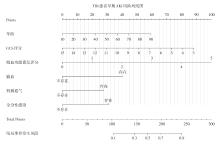
图1
TBI患者早期AKI风险列线图"
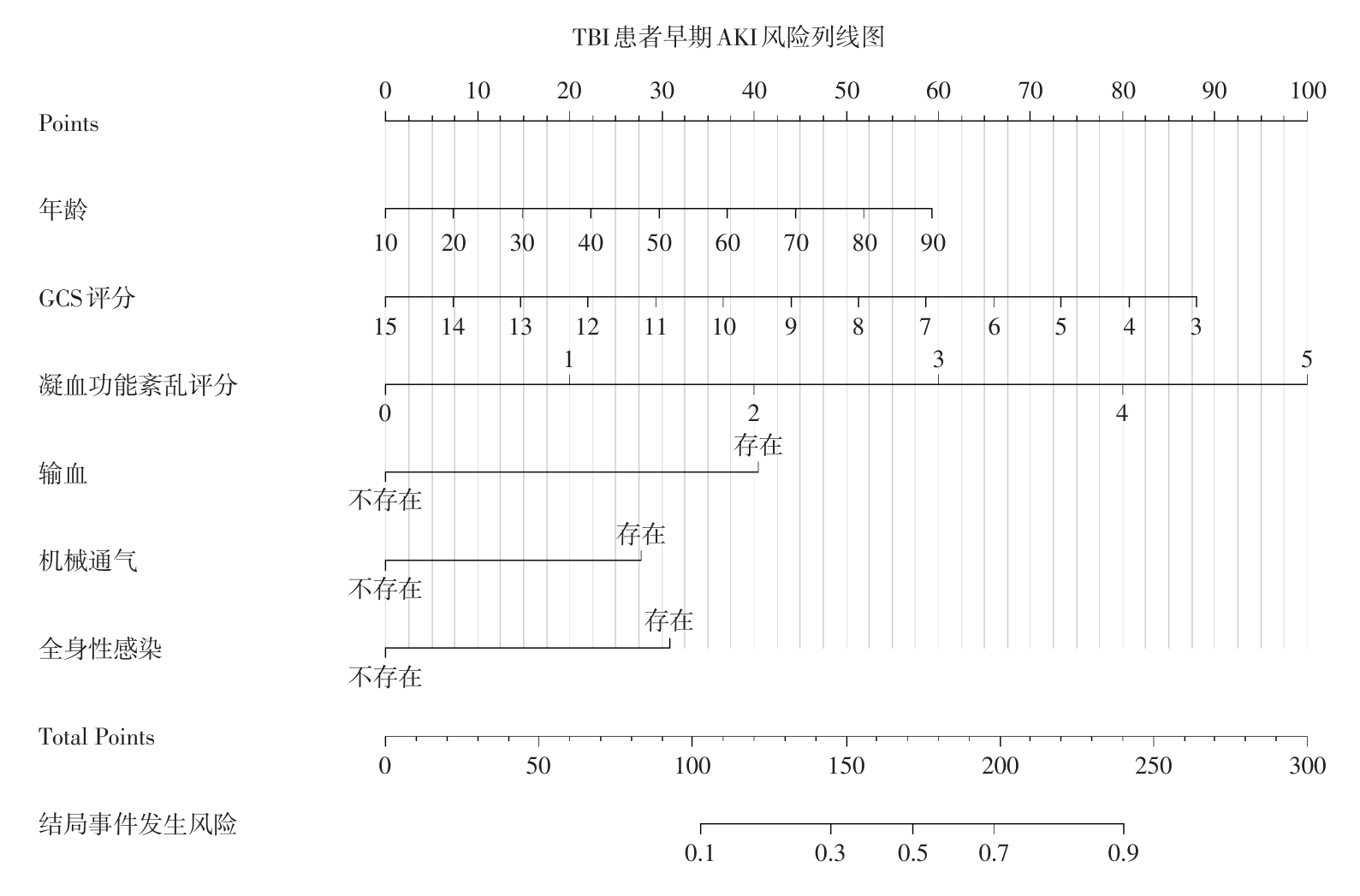
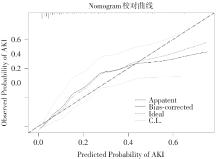
图2
列线图模型校准曲线"
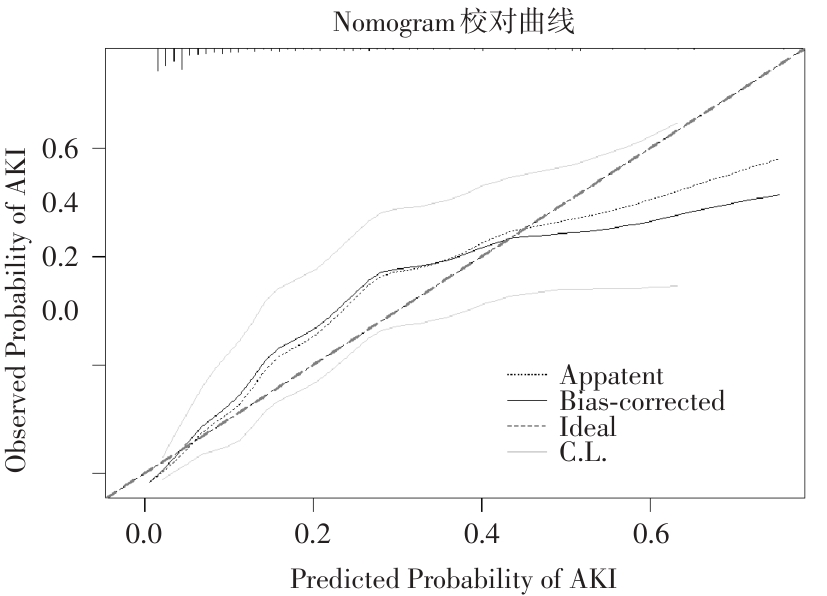
图3
列线图模型决策曲线"
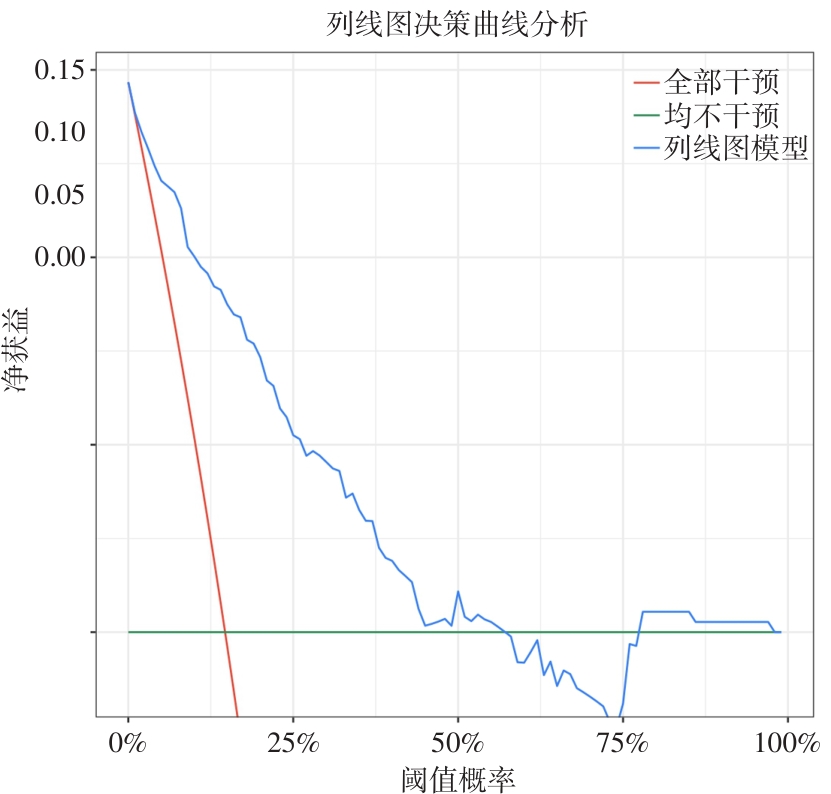
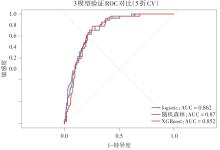
图4
3种模型5折交叉验证ROC曲线比较"
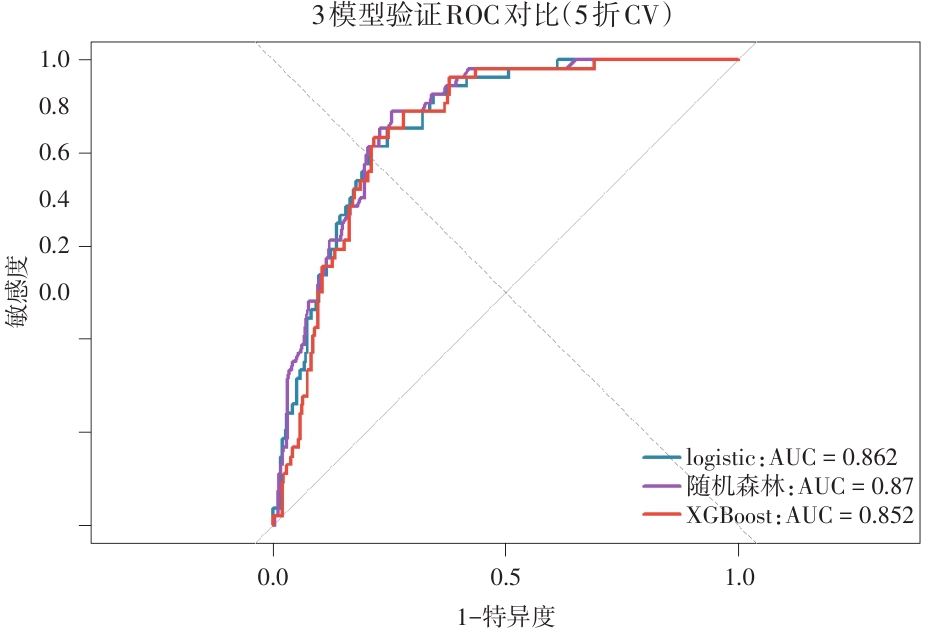
图5
XGBoost模型SHAP特征重要性分析"
| [1] |
杨阳, 田小溪, 史正华, 等. 成人创伤性颅脑损伤院前与急诊诊治中国专家共识[J]. 解放军医学杂志, 2025, 50(2): 123-133. doi:10.11855/j.issn.0577-7402.0144.2025.0211 .
doi: 10.11855/j.issn.0577-7402.0144.2025.0211 |
| [2] |
KRISHNAMOORTHY V, KOMISAROW J M, LASKOWITZ D T, et al. Multiorgan dysfunction after severe traumatic brain injury: Epidemiology, mechanisms, and clinical management[J]. Chest, 2021, 160(3): 956-964. doi:10.1016/j.chest.2021. 01.016 .
doi: 10.1016/j.chest.2021. 01.016 |
| [3] |
HUSAIN-SYED F, TAKEUCHI T, NEYRA J A, et al. Acute kidney injury in neurocritical care[J]. Crit Care, 2023, 27(1): 341. doi:10.1186/s13054-023-04632-1 .
doi: 10.1186/s13054-023-04632-1 |
| [4] |
ZHANG Y, DIAO H, DING J, et al. Risk factors associated with acute kidney injury in patients with traumatic brain injury: A systematic review and meta-analysis[J]. J Crit Care, 2025, 89: 155126. doi:10.1016/j.jcrc.2025.155126 .
doi: 10.1016/j.jcrc.2025.155126 |
| [5] |
洪雅盼, 阮潇潇. 创伤性脑损伤患者高氯血症与急性肾损伤的关系研究[J]. 中国现代医生, 2023, 61(2): 89-93. doi:10.3969/j.issn.1673-9701.2023.02.020 .
doi: 10.3969/j.issn.1673-9701.2023.02.020 |
| [6] |
BAREA-MENDOZA J A, CHICO-FERNÁNDEZ M, QUINTANA-DÍAZ M, et al. Traumatic brain injury and acute kidney injury—Outcomes and associated risk factors[J]. J Clin Med, 2022, 11(23): 7216. doi:10.3390/jcm11237216 .
doi: 10.3390/jcm11237216 |
| [7] |
SOLLA D J F, DE AMORIM R L O, KOLIAS A G, et al. Incremental prognostic value of coagulopathy in addition to the crash score in traumatic brain injury patients[J]. Neurocritical Care, 2021, 34(1): 130-138. doi:10.1007/s12028-020-00991-7 .
doi: 10.1007/s12028-020-00991-7 |
| [8] |
CHEN Y, TIAN J, CHI B, et al. Factors associated with the development of coagulopathy after open traumatic brain injury[J]. J Clin Med, 2022, 11(1): 185. doi:10.3390/jcm11010185 .
doi: 10.3390/jcm11010185 |
| [9] |
KIM I Y, KIM S, YE B M, et al. Effect of fluid overload on survival in patients with sepsis-induced acute kidney injury receiving continuous renal replacement therapy[J]. Sci Rep, 2023, 13: 2796. doi:10.1038/s41598-023-29926-w .
doi: 10.1038/s41598-023-29926-w |
| [10] |
HESS F, BAKI E, MCGINNIS J, et al. Differentiating central fever from infectious fever in intracerebral haemorrhage[J]. Stroke Vasc Neurol, 2025: svn-2025-004441. doi:10.1136/svn-2025-004441 .
doi: 10.1136/svn-2025-004441 |
| [11] |
GOGGINS E, INOUE H, OKUSA M D. Neuroimmune control of inflammation in acute kidney injury and multiorgan dysfunction[J]. J Am Soc Nephrol, 2025, 36(12): 2473-2484. doi:10.1681/ASN.0000000813 .
doi: 10.1681/ASN.0000000813 |
| [12] |
DE VLIEGER G, MEYFROIDT G. Kidney dysfunction after traumatic brain injury: Pathophysiology and general management[J]. Neurocritical Care, 2023, 38(2): 504-516. doi:10.1007/s12028-022-01630-z .
doi: 10.1007/s12028-022-01630-z |
| [13] |
崔玉健, 李宇珂, 朱赛楠, 等. 重症患者非心脏大手术后早期外周灌注与急性肾损伤的关系[J]. 实用医学杂志, 2025, 41(2): 195-201. doi:10.3969/j.issn.1006-5725.2025.02.006 .
doi: 10.3969/j.issn.1006-5725.2025.02.006 |
| [14] |
FADEN A I, BARRETT J P, STOICA B A, et al. Bidirectional brain-systemic interactions and outcomes after TBI[J]. Trends Neurosci, 2021, 44(5): 406-418. doi:10.1016/j.tins.2020. 12.004 .
doi: 10.1016/j.tins.2020. 12.004 |
| [15] |
中国老年学和老年医学学会老年慢性肾脏病综合管理指南制定专家组. 老年慢性肾脏病综合管理指南(2025年版)[J]. 中华肾脏病杂志, 2025, 41(3): 220-240. doi:10.3760/cma.j.cn441217-20240910-00920 .
doi: 10.3760/cma.j.cn441217-20240910-00920 |
| [16] |
JO M J, LEE J K, KIM J E, et al. Molecular mechanisms associated with aging kidneys and future perspectives[J]. Int J Mol Sci, 2023, 24(23): 16912. doi:10.3390/ijms242316912 .
doi: 10.3390/ijms242316912 |
| [17] |
STILLE K, KRIBBEN A, HERGET-ROSENTHAL S. Incidence, severity, risk factors and outcomes of acute kidney injury in older adults: Systematic review and meta-analysis[J]. J Nephrol, 2022, 35(9): 2237-2250. doi:10.1007/s40620-022-01381-2 .
doi: 10.1007/s40620-022-01381-2 |
| [18] |
DE ROSA S, BATTAGLINI D, ROBBA C. Kidney dysfunction after acute brain injury[J]. Nephrol Dial Transplant, 2024, 39(2): 170-173. doi: 10.1093/ndt/gfad192 .
doi: 10.1093/ndt/gfad192 |
| [19] |
PAVLOVIC D, PEKIC S, STOJANOVIC M, et al. Traumatic brain injury: Neuropathological, neurocognitive and neurobehavioral sequelae[J]. Pituitary, 2019, 22(3): 270-282. doi:10.1007/s11102-019-00957-9 .
doi: 10.1007/s11102-019-00957-9 |
| [20] |
HUANG J, SONG C, GU G, et al. Predictive value of triglyceride glucose index in acute kidney injury in patients with severe traumatic brain injury[J]. Sci Rep, 2024, 14: 24522. doi:10.1038/s41598-024-75887-z .
doi: 10.1038/s41598-024-75887-z |
| [21] |
YANG B, LI T, XUE C, et al. Explainable machine learning model for predicting traumatic brain injury-induced coagulopathy in elderly patients: A multicenter cohort study[J]. Neurosurg Rev, 2026, 49(1): 179. doi:10.1007/s10143-025-04070-3 .
doi: 10.1007/s10143-025-04070-3 |
| [22] |
HOU H, QU Z, LIU R, et al. Traumatic brain injury: Advances in coagulopathy (Review)[J]. Biomed Rep, 2024, 21(5): 156. doi:10.3892/br.2024.1844 .
doi: 10.3892/br.2024.1844 |
| [23] |
CAPPONI A, ROSTAGNO C. Trauma-induced coagulopathy: A review of specific molecular mechanisms[J]. Diagnostics, 2025, 15(11): 1435. doi:10.3390/diagnostics15111435 .
doi: 10.3390/diagnostics15111435 |
| [24] |
DOBSON G P, MORRIS J L, LETSON H L. Traumatic brain injury: Symptoms to systems in the 21st century[J]. Brain Res, 2024, 1845: 149271. doi:10.1016/j.brainres.2024.149271 .
doi: 10.1016/j.brainres.2024.149271 |
| [25] |
冷彪, 洪德全, 谈明, 等. 重型颅脑损伤患者血清组织因子途径抑制物-1联合核因子-κB在预后预测中的价值[J]. 实用医学杂志, 2025, 41(16): 2455-2460. doi:10.3969/j.issn.1006-5725.2025.16.003 .
doi: 10.3969/j.issn.1006-5725.2025.16.003 |
| [26] |
MOHAMMADZADEH I, NIROOMAND B, TAJERIAN A, et al. Coagulopathy at admission in traumatic brain injury and its association with hematoma progression: A systematic review and meta-analysis of 2411 patients[J]. Clin Neurol Neurosurg, 2025, 249: 108699. doi:10.1016/j.clineuro.2024.108699 .
doi: 10.1016/j.clineuro.2024.108699 |
| [27] |
IBA T, HELMS J, MAIER C L, et al. The role of thromboinflammation in acute kidney injury among patients with septic coagulopathy[J]. J Thromb Haemost, 2024, 22(6): 1530-1540. doi:10.1016/j.jtha.2024.02.006 .
doi: 10.1016/j.jtha.2024.02.006 |
| [28] |
ZHENG P, ZHANG N, REN D, et al. Integrated single-cell multiomics reveals novel immune candidate markers for post-traumatic coagulopathy[J]. Front Immunol, 2023, 13: 1095657. doi:10.3389/fimmu.2022.1095657 .
doi: 10.3389/fimmu.2022.1095657 |
| [29] |
BOYKO Y, RASMUSSEN S B, BARTOSZKO J, et al. Blood transfusion and acute kidney injury after cardiac surgery: A retrospective observational study[J]. Can J Anesth, 2025, 72(10): 1534-1543. doi:10.1007/s12630-025-03036-9 .
doi: 10.1007/s12630-025-03036-9 |
| [30] |
DE LA VEGA-MÉNDEZ F M, ESTRADA M I, ZUNO-REYES E E, et al. Blood transfusion reactions and risk of acute kidney injury and major adverse kidney events[J]. J Nephrol, 2024, 37(4): 951-960. doi:10.1007/s40620-023-01859-7 .
doi: 10.1007/s40620-023-01859-7 |
| [31] |
D'ALESSANDRO A, HOD E A. Red blood cell storage: From genome to exposome towards personalized transfusion medicine[J]. Transfus Med Rev, 2023, 37(4): 150750. doi:10.1016/j.tmrv. 2023.150750 .
doi: 10.1016/j.tmrv. 2023.150750 |
| [32] |
BARSHTEIN G, PAJIC-LIJAKOVIC I, GURAL A. Deformability of stored red blood cells[J]. Front Physiol, 2021, 12: 722896. doi:10.3389/fphys.2021.722896 .
doi: 10.3389/fphys.2021.722896 |
| [33] |
KUMAR A, EPLER K, DEWOLF S, et al. Bidirectional pressure: A mini review of ventilator-lung-kidney interactions[J]. Front Physiol, 2024, 15: 1428177. doi:10.3389/fphys.2024. 1428177 .
doi: 10.3389/fphys.2024. 1428177 |
| [34] |
PERSCHINKA F, MAYERHÖFER T, ENGELBRECHT T, et al. Impact of mechanical ventilation on severe acute kidney injury in critically ill patients with and without COVID-19–a multicentre propensity matched analysis[J]. Ann Intensive Care, 2025, 15(1): 17. doi:10.1186/s13613-025-01424-4 .
doi: 10.1186/s13613-025-01424-4 |
| [35] |
PAIS T, JORGE S, LOPES J A. Acute kidney injury in sepsis[J]. Int J Mol Sci, 2024, 25(11): 5924. doi:10.3390/ijms25115924 .
doi: 10.3390/ijms25115924 |
| [36] |
LEGRAND M, BAGSHAW S M, BHATRAJU P K, et al. Sepsis-associated acute kidney injury: Recent advances in enrichment strategies, sub-phenotyping and clinical trials[J]. Crit Care, 2024, 28(1): 92. doi:10.1186/s13054-024-04877-4 .
doi: 10.1186/s13054-024-04877-4 |
| [37] |
CHOI H W, YOON C H, RYU J A. Acute kidney injury following mannitol infusion in neurosurgical patients[J]. J Neurointensive Care, 2022, 5(1): 9-14. doi:10.32587/jnic.2021.00423 .
doi: 10.32587/jnic.2021.00423 |
| [38] |
YANG X, LIU Z, CHEN X, et al. Renal impairment and prognosis in mannitol-treated intracerebral hemorrhage: A retrospective clinical analysis[J]. J Clin Neurosci, 2025, 142: 111695. doi:10.1016/j.jocn.2025.111695 .
doi: 10.1016/j.jocn.2025.111695 |
| [39] |
GUPTA S, MA H M S B, et al. Effect of mannitol on cisplatin-associated acute kidney injury: A target trial emulation[J]. Nephrol Dial Transplant, 2025, 40(2): 405-408. doi:10.1093/ndt/gfae233 .
doi: 10.1093/ndt/gfae233 |
| [40] |
PURNOMO A, PERMANA K, DARYANTO B. Acute kidney injury following mannitol administration in traumatic brain injury: A meta-analysis[J]. Acta Inform Med, 2021, 29(4): 270. doi:10.5455/aim.2021.29.270-274 .
doi: 10.5455/aim.2021.29.270-274 |
| [41] |
JOANNIDIS M, MEERSCH-DINI M, FORNI L G. Acute kidney injury[J]. Intensive Care Med, 2023, 49(6): 665-668. doi:10.1007/s00134-023-07061-4 .
doi: 10.1007/s00134-023-07061-4 |
| [42] |
FENG Y, WANG A Y, JUN M, et al. Characterization of risk prediction models for acute kidney injury: A systematic review and meta-analysis[J]. JAMA Netw Open, 2023, 6(5): e2313359. doi:10.1001/jamanetworkopen.2023.13359 .
doi: 10.1001/jamanetworkopen.2023.13359 |
| [43] |
GOSSELIN A R, AHMAD S, HANNA J S, et al. Characterizing the impact of traumatic brain injury phenotype on coagulation dynamics in severely injured patients[J]. Thromb Res, 2026, 258: 109583. doi:10.1016/j.thromres.2026.109583 .
doi: 10.1016/j.thromres.2026.109583 |
| [44] |
ZENG J, TONG W, ZHENG P. Decreased risk of acute kidney injury with intracranial pressure monitoring in patients with moderate or severe brain injury: Clinical article[J]. J Neurosurg, 2013, 119(5): 1228-1232. doi:10.3171/2013.7.jns122131 .
doi: 10.3171/2013.7.jns122131 |
| [1] | 仇晓蕊,张译丹,杨国锋. 多模态人工智能在阿尔茨海默病早期诊断中的应用:现状、挑战与临床转化路径[J]. 实用医学杂志, 2026, 42(9): 1579-1585. |
| [2] | 校雨蒙,郑琳璐,郝晓静,程亚颖. 乳房早发育女童中枢型性早熟的列线图预测模型构建[J]. 实用医学杂志, 2026, 42(8): 1435-1443. |
| [3] | 周游,陈纪飞,何希,刘爱梅,杨小兵,黄一芳. 运用机器学习构建肺癌与肺结核鉴别诊断模型[J]. 实用医学杂志, 2026, 42(7): 1158-1164. |
| [4] | 蒋艳,王国徽,宋沧桑,张函舒,李兴德. 成人肝移植术后他克莫司个体化治疗的研究进展[J]. 实用医学杂志, 2026, 42(7): 1294-1300. |
| [5] | 唐茂廷,王振,平小夏,姜楠,孟倩. 联合X线及MRI特征对早期非创伤性股骨头坏死塌陷的预测价值[J]. 实用医学杂志, 2026, 42(5): 814-823. |
| [6] | 胡能,申江华,姚美,赵欣黔. 肺超声及临床指标的列线图模型对儿童重症支原体肺炎预后的评估[J]. 实用医学杂志, 2026, 42(5): 869-877. |
| [7] | 金丽娜,黄恬,张月丹. 血液净化联合亚胺培南西司他丁钠对脓毒症休克合并急性肾损伤患者的疗效[J]. 实用医学杂志, 2026, 42(4): 633-638. |
| [8] | 程守全,刘乃丰,李若水. 冠状动脉钙化患者主动脉瓣钙化危险因素分析及预测模型构建[J]. 实用医学杂志, 2026, 42(4): 668-676. |
| [9] | 王梦苑,孟凡亮. 碳青霉烯类耐药肺炎克雷伯菌感染的危险因素分析及列线图预测模型的构建[J]. 实用医学杂志, 2026, 42(3): 477-485. |
| [10] | 刘咏思,邓颖敏,玛尔苏,李蕊菁,施雯,陈楚云. 基于炎症指数SII和SIRI构建2型糖尿病肾脏疾病风险预测模型[J]. 实用医学杂志, 2026, 42(2): 266-275. |
| [11] | 娄君鸽,史海宏,郭丽,赵雪琪,闫媛媛. 基于超声检出痛风石的骨侵蚀风险预测列线图模型的构建与验证[J]. 实用医学杂志, 2026, 42(13): 2396-2403. |
| [12] | 张亚鑫,刘培佳,田鹏,张志波,张文海,刘天盛. 老年髋部骨折患者急性脑梗死的危险因素分析及预测模型构建[J]. 实用医学杂志, 2026, 42(11): 1959-1966. |
| [13] | 李竹,聂诗琪,谭江陆,李小悦,唐立丽,寇稚. N6-甲基腺嘌呤甲基化修饰下调Klotho介导脓毒症急性肾损伤肾小管上皮细胞衰老的机制[J]. 实用医学杂志, 2026, 42(11): 2037-2048. |
| [14] | 于跑,朱峰,王子,张印,葛争,周碧. 尿ACE2和PAX2在先天性肾脏及尿路畸形早期肾损伤辅助诊断中的应用[J]. 实用医学杂志, 2026, 42(1): 139-145. |
| [15] | 郭蕊,刘涛,苏玺. 基于心电图参数、犬尿氨酸代谢物建立精神分裂症共患心血管疾病的列线图模型[J]. 实用医学杂志, 2025, 41(8): 1205-1211. |
| 阅读次数 | ||||||
|
全文 |
|
|||||
|
摘要 |
|
|||||
