

The Journal of Practical Medicine ›› 2026, Vol. 42 ›› Issue (14): 2603-2612.doi: 10.3969/j.issn.1006-5725.2026.14.013
• Treatise:Mechanism and Practice • Previous Articles
Yongbo AN1,Ziqiang LU2,Zhiqian ZHANG1,Qian CHEN1,Song LIN1,Lei LI1( )
)
Received:2026-04-23
Online:2026-07-25
Published:2026-08-05
Contact:
Lei LI
E-mail:lileizgl@163.com
CLC Number:
Yongbo AN,Ziqiang LU,Zhiqian ZHANG,Qian CHEN,Song LIN,Lei LI. Predictive value of cervical sagittal parameters and prevertebral soft tissue swelling for dysphagia after anterior cervical spine surgery[J]. The Journal of Practical Medicine, 2026, 42(14): 2603-2612.
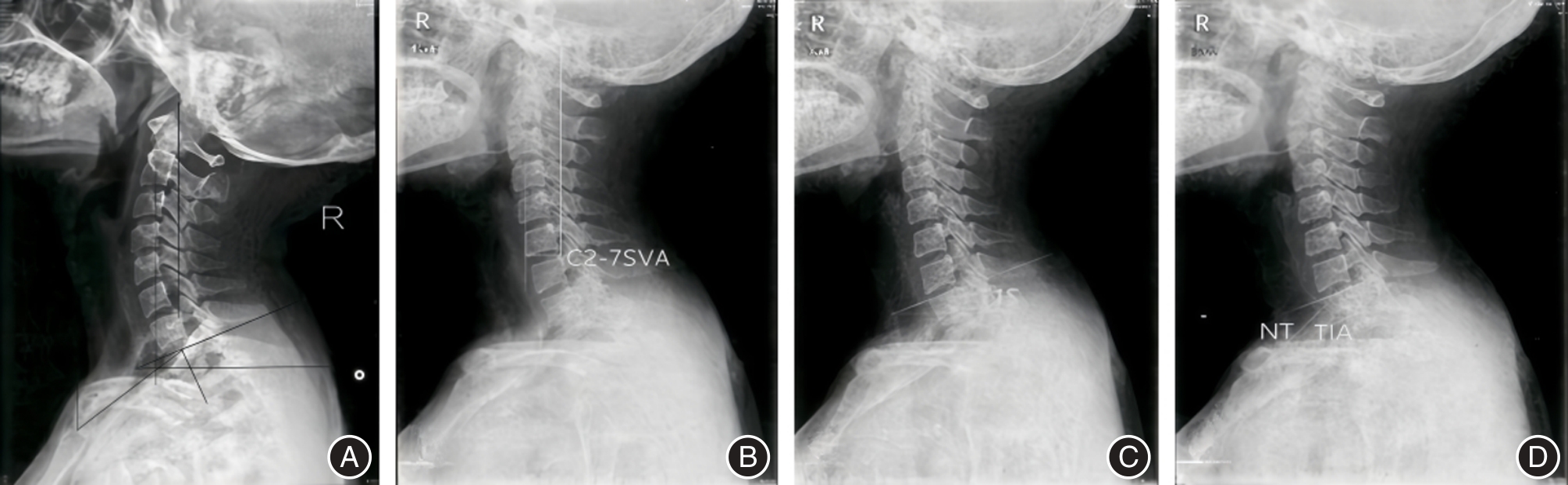
Fig.1
Sagittal measurement method for cervical vertebrae"

Tab.1
Comparison of general data between the two groups"
| 项目 | 发生组(n = 127) | 未发生组(n = 135) | Z/χ2/t值 | P值 |
|---|---|---|---|---|
| 年龄(x ± s)/岁 | 50.32 ± 7.28 | 48.39 ± 7.28 | 2.144 | 0.033 |
| 性别 | 4.782 | 0.029 | ||
| 男 | 61(48.03) | 83(61.48) | ||
| 女 | 66(51.97) | 52(38.52) | ||
| 体质量指数(x ± s)/(kg/m2) | 21.47 ± 4.21 | 20.98 ± 4.06 | 0.959 | 0.338 |
| 文化程度 | 0.073 | 0.964 | ||
| 初中及以下 | 35(27.56) | 36(26.67) | ||
| 高中或中专 | 59(46.46) | 62(45.93) | ||
| 大专及以上 | 33(25.98) | 37(27.40) | ||
| 吸烟史 | 61(48.03) | 50(37.04) | 3.239 | 0.072 |
| 饮酒史 | 91(71.65) | 94(69.63) | 0.129 | 0.719 |
| 高血压史 | 27(21.26) | 25(18.52) | 0.309 | 0.578 |
| 糖尿病史 | 25(19.69) | 21(15.56) | 0.771 | 0.380 |
| 高脂血症 | 21(16.54) | 18(13.33) | 0.530 | 0.467 |
| 心血管疾病 | 14(11.02) | 9(6.67) | 1.551 | 0.213 |
| 病程 | 5.302 | 0.021 | ||
| ≤ 12个月 | 63(49.61) | 86(63.70) | ||
| > 12个月 | 64(50.39) | 49(36.30) | ||
| 手术时间 | 4.239 | 0.039 | ||
| < 2 h | 78(61.42) | 99(73.33) | ||
| ≥ 2 h | 49(38.58) | 36(26.67) | ||
| 手术入路方向 | 0.110 | 0.740 | ||
| 左侧 | 27(21.26) | 31(22.96) | ||
| 右侧 | 100(78.74) | 104(77.04) | ||
| 术中出血量 | 0.068 | 0.794 | ||
| < 150 mL | 46(36.22) | 51(37.78) | ||
| ≥ 150 mL | 81(63.78) | 84(62.22) | ||
| 手术方式 | 1.847 | 0.174 | ||
| 颈椎前路椎间盘切除融合术 | 100(78.74) | 115(85.19) | ||
| 颈椎前路椎体次全切除融合术 | 27(21.26) | 20(14.81) | ||
| 内固定器材质 | 0.168 | 0.682 | ||
| 钢板 + 植骨 | 57(44.88) | 64(47.41) | ||
| 钢板 + 融合器 | 70(55.12) | 71(52.59) | ||
| 手术部位 | 1.193 | 0.755 | ||
| C4-5 | 60(47.24) | 67(49.63) | ||
| C5-6 | 35(27.56) | 36(26.67) | ||
| C6-7 | 17(13.39) | 21(15.56) | ||
| C3-4 | 15(11.81) | 11(8.15) | ||
| 手术节段数 | 0.737 | 0.391 | ||
| 单节段 | 89(70.08) | 101(74.81) | ||
| 多节段 | 38(29.92) | 34(25.19) | ||
| 颈椎病类型 | 0.067 | 0.796 | ||
| 神经根型 | 61(48.03) | 67(49.63) | ||
| 脊髓型 | 66(51.97) | 68(50.37) |
Tab.2
Comparison of laboratory and imaging parameters between the two groups"
| 项目 | 发生组(n = 127) | 未发生组(n = 135) | Z/χ2/t值 | P值 |
|---|---|---|---|---|
| RBC/(× 1012·L -1) | 4.52 ± 0.58 | 4.61 ± 0.62 | 1.212 | 0.227 |
| Hb/(g/L) | 132.56 ± 15.32 | 135.28 ± 14.87 | 1.458 | 0.146 |
| WBC/(× 109·L -1) | 7.85 ± 2.13 | 7.52 ± 1.98 | 1.300 | 0.195 |
| NLR[M(Q1,Q3)] | 2.28(1.79,2.89) | 2.05(1.58,2.62) | 2.081 | 0.038 |
| PLT/(× 109·L -1) | 235.68 ± 52.36 | 241.35 ± 48.72 | 0.908 | 0.365 |
| ALT/(U/L) | 35.26 ± 10.15 | 34.18 ± 11.12 | 0.819 | 0.413 |
| AST/(U/L) | 32.58 ± 10.36 | 31.85 ± 10.21 | 0.574 | 0.566 |
| ALB/(g/L) | 38.65 ± 4.23 | 39.52 ± 3.87 | 1.738 | 0.083 |
| PT/s | 12.56 ± 1.32 | 12.42 ± 1.25 | 0.882 | 0.379 |
| TBIL/(μmol/L) | 15.23 ± 4.68 | 14.85 ± 4.21 | 0.692 | 0.490 |
| TIS/° | 23.50 ± 4.44 | 25.79 ± 3.97 | 4.408 | <0.001 |
| C2-7 SVA/cm | 1.95 ± 0.43 | 1.70 ± 0.34 | 5.168 | <0.001 |
| TIA/° | 71.19 ± 11.60 | 75.75 ± 12.59 | 3.046 | 0.003 |
| NT/° | 44.81 ± 8.74 | 47.60 ± 7.71 | 2.746 | 0.006 |
| 椎前软组织肿胀程度/mm | 10.12 ± 2.78 | 8.45 ± 2.20 | 5.394 | <0.001 |
Tab.3
Assignment"
| 因素 | 赋值 |
|---|---|
| 因变量 | |
| 是否发生吞咽困难 | 否 = 0,是 = 1 |
| 自变量 | |
| 年龄 | 实际值 |
| 性别 | 男 = 0,女 = 1 |
| 病程 | ≤ 12月 = 0,> 12月 = 1 |
| 手术时间 | < 2 h = 0,≥ 2 h = 1 |
| NLR | 实际值 |
| TIS | 实际值 |
| C2-7 SVA | 实际值 |
| TIA | 实际值 |
| NT | 实际值 |
| 椎前软组织肿胀程度 | 实际值 |
Tab.4
Univariate logistic regression analysis of factors influencing dysphagia after ACSS"
| 因素 | β | SE | Wald χ2 | P值 | OR | 95%CI |
|---|---|---|---|---|---|---|
| 年龄 | 0.037 | 0.017 | 4.480 | 0.034 | 1.037 | 1.003 ~ 1.073 |
| 性别 | 0.546 | 0.251 | 4.752 | 0.029 | 1.727 | 1.057 ~ 2.823 |
| 病程 | 0.578 | 0.252 | 5.263 | 0.022 | 1.783 | 1.088 ~ 2.922 |
| 手术时间 | 0.547 | 0.267 | 4.203 | 0.040 | 1.728 | 1.024 ~ 2.914 |
| NLR | 0.336 | 0.163 | 4.230 | 0.040 | 1.399 | 1.016 ~ 1.927 |
| TIS | -0.130 | 0.031 | 17.114 | < 0.001 | 0.878 | 0.826 ~ 0.934 |
| C2-7 SVA | 1.676 | 0.355 | 22.308 | < 0.001 | 5.342 | 2.665 ~ 10.708 |
| TIA | -0.031 | 0.011 | 8.727 | 0.003 | 0.969 | 0.949 ~ 0.990 |
| NT | -0.042 | 0.016 | 7.175 | 0.007 | 0.959 | 0.931 ~ 0.989 |
| 椎前软组织肿胀程度 | 0.269 | 0.055 | 23.881 | <0.001 | 1.309 | 1.175 ~ 1.458 |
Tab.5
Factors affecting postoperative dysphagia after ACSS"
| 因素 | β | SE | Wald χ2 | P值 | OR | 95%CI |
|---|---|---|---|---|---|---|
| 年龄 | 0.039 | 0.021 | 3.546 | 0.060 | 1.040 | 0.998 ~ 1.083 |
| 手术时间 | 0.220 | 0.540 | 0.167 | 0.683 | 1.247 | 0.433 ~ 3.591 |
| NLR | 0.276 | 0.193 | 2.045 | 0.153 | 1.317 | 0.903 ~ 1.922 |
| TIS | -0.158 | 0.038 | 16.877 | < 0.001 | 0.854 | 0.792 ~ 0.921 |
| C2-7 SVA | 1.329 | 0.415 | 10.269 | 0.001 | 3.778 | 1.676 ~ 8.518 |
| TIA | -0.045 | 0.013 | 11.665 | < 0.001 | 0.956 | 0.932 ~ 0.981 |
| NT | -0.038 | 0.019 | 3.971 | 0.046 | 0.963 | 0.928 ~ 0.999 |
| 椎前软组织肿胀程度 | 0.246 | 0.062 | 15.924 | <0.001 | 1.279 | 1.134 ~ 1.444 |
Tab.6
The value of cervical sagittal parameters and prevertebral soft tissue swelling degree in predicting postoperativedysphagia after ACSS"
| 指标 | AUC | 标准误 | 95%CI | P值 | Cut-off | 约登指数 | 敏感度/% | 特异度/% |
|---|---|---|---|---|---|---|---|---|
| TIS | 0.654* | 0.034 | 0.593 ~ 0.711 | < 0.001 | 23.89° | 0.264 | 57.48 | 68.89 |
| C2-7 SVA | 0.679* | 0.033 | 0.619 ~ 0.735 | < 0.001 | 2.07 cm | 0.292 | 43.31 | 85.93 |
| TIA | 0.604* | 0.035 | 0.542 ~ 0.664 | 0.003 | 80.75° | 0.187 | 78.74 | 40.00 |
| NT | 0.590* | 0.035 | 0.527 ~ 0.650 | 0.011 | 40.29° | 0.198 | 33.86 | 85.93 |
| 椎前软组织肿胀程度 | 0.689* | 0.033 | 0.629 ~ 0.744 | < 0.001 | 9.54 mm | 0.293 | 56.69 | 72.59 |
| 联合 | 0.852 | 0.024 | 0.803 ~ 0.893 | < 0.001 | - | 0.594 | 77.17 | 82.22 |
Fig.2
ROC curves of cervical sagittal parameters and degree of prevertebral soft tissue swelling for predicting dysphagia after ACSS"
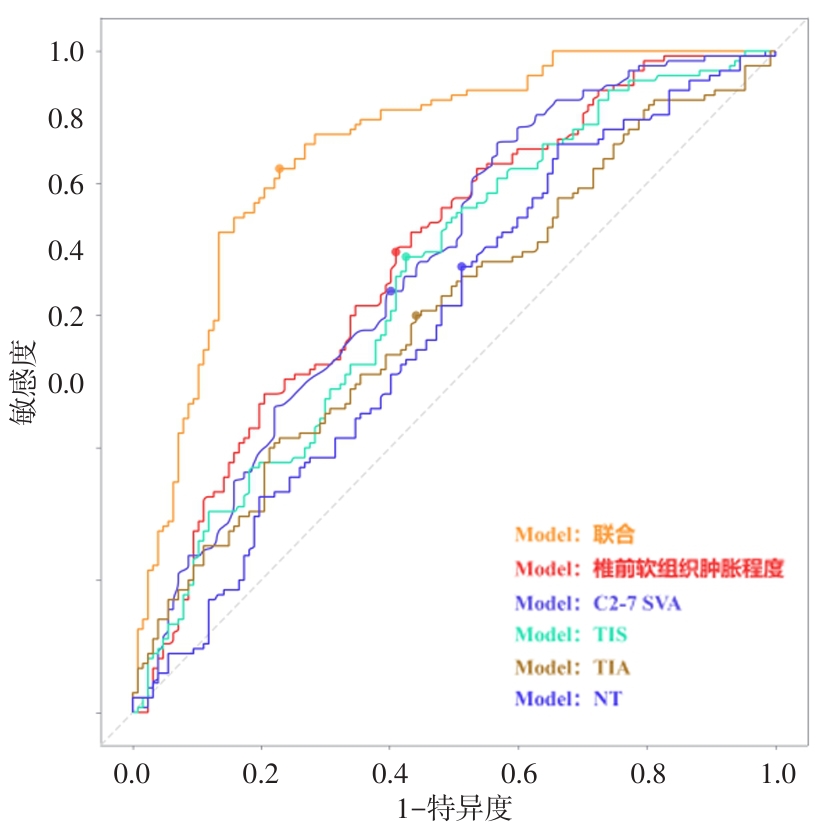
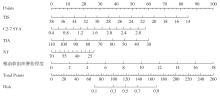
Fig.3
Nomogram model"
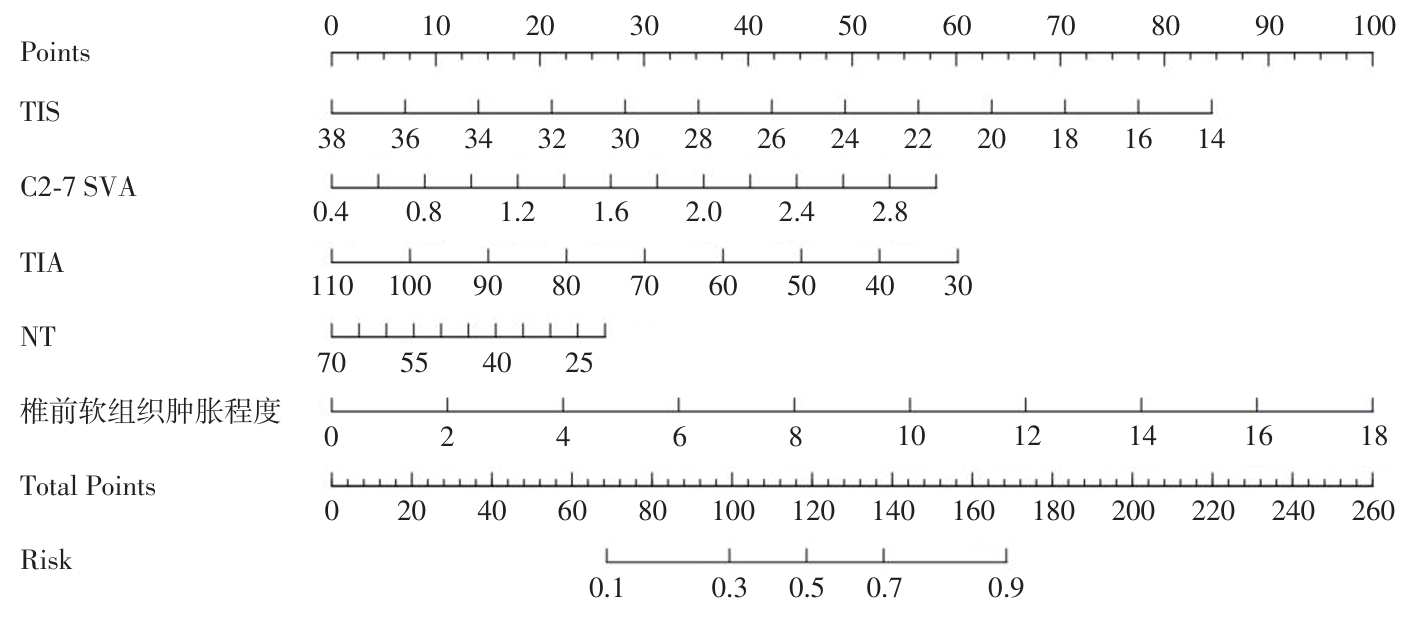
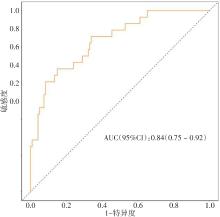
Fig.4
ROC curve of the training set"
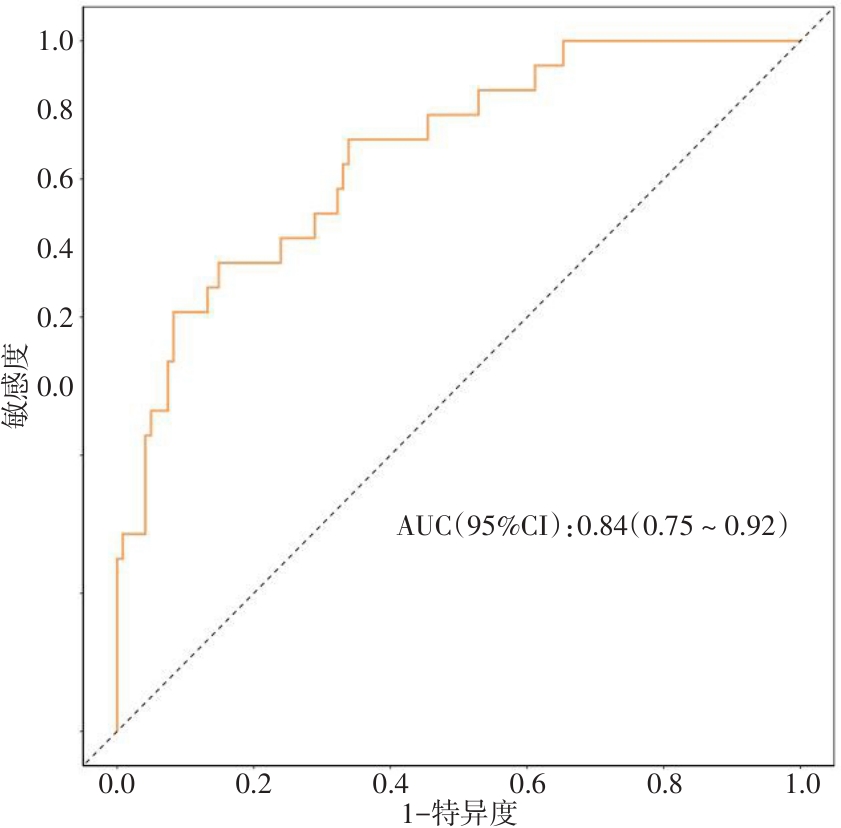
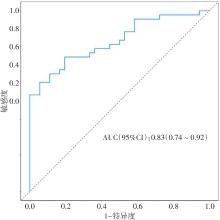
Fig.5
ROC curve of the validation set"
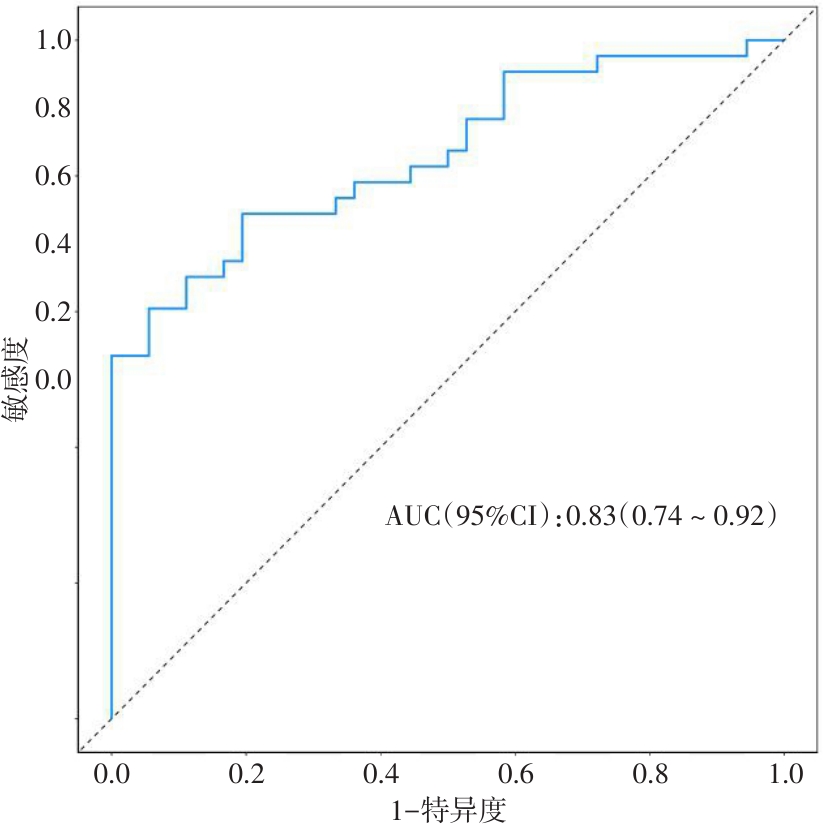
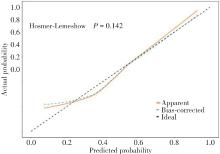
Fig.6
Calibration curve of the training set"
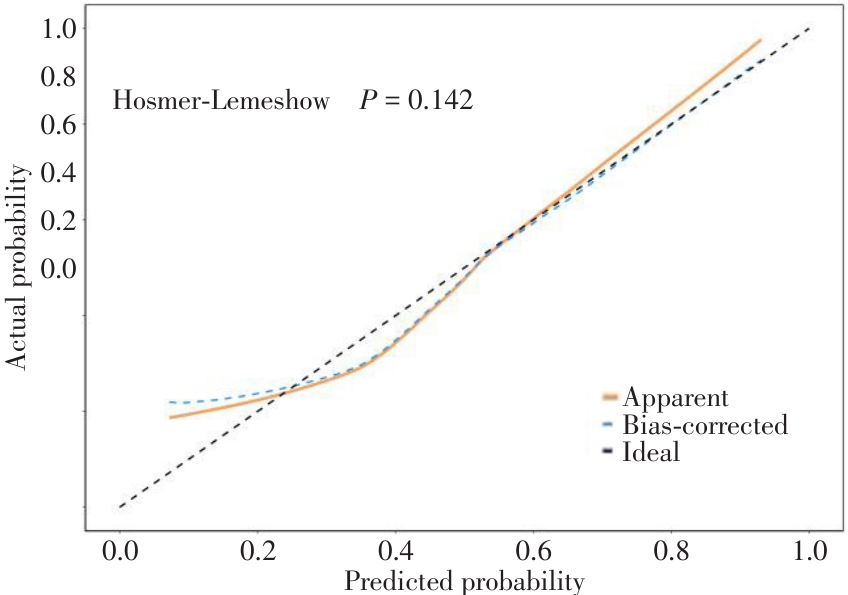
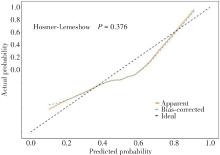
Fig.7
Calibration curve of the validation set"
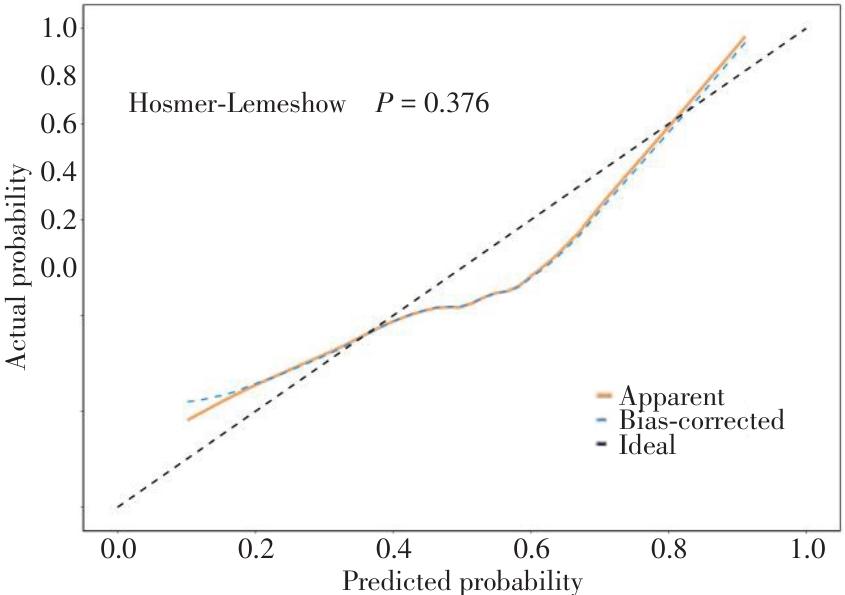
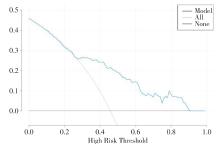
Fig.8
Decision curve of the training set"
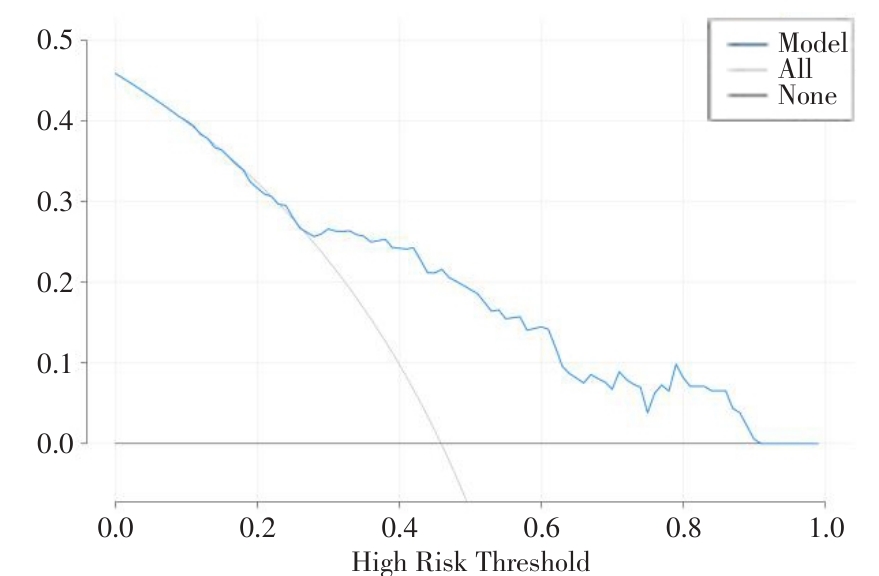
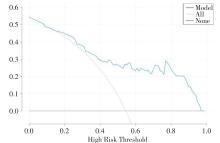
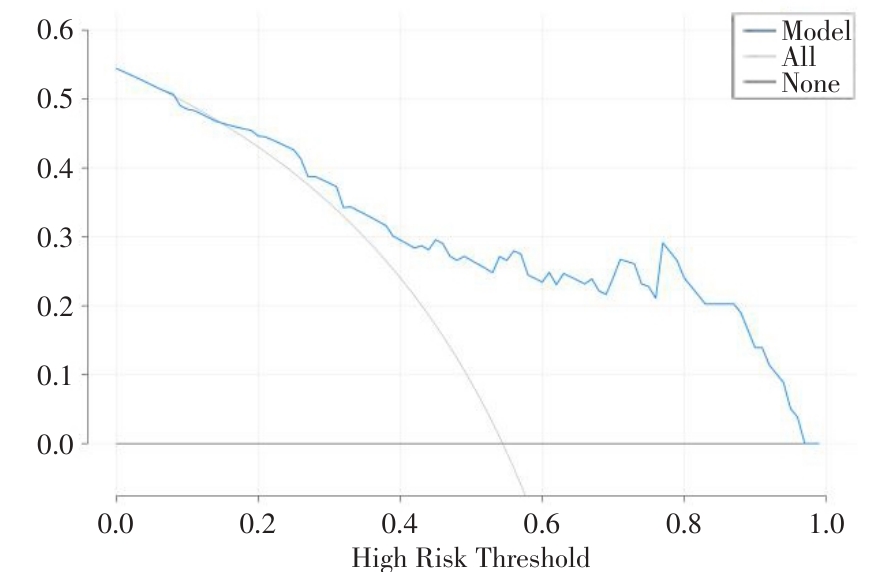
Fig.9
Decision curve of the validation set"
| [1] |
王益,徐彬,陈杨达豪,等. 微创内镜辅助下颈椎前路减压融合术治疗神经根型颈椎病的疗效[J]. 实用医学杂志, 2024, 40(20): 2880-2887. doi: 10.3969/j.issn.1006-5725.2024.20.011 .
doi: 10.3969/j.issn.1006-5725.2024.20.011 |
| [2] |
赵文生,李孝林,彭昌华,等. 颈椎前路术后吞咽困难危险因素的meta分析[J]. 海南医学院学报, 2024, 30(11): 850-860. doi: 10.13210/j.cnki.jhmu.20230815.001 .
doi: 10.13210/j.cnki.jhmu.20230815.001 |
| [3] |
陈波,黄天宇,杨林,等. 颈椎前路术后吞咽困难危险因素的Meta分析[J]. 中国脊柱脊髓杂志, 2023, 33(11): 1011-1022. doi: 10.3969/j.issn.1004-406X.2023.11.07 .
doi: 10.3969/j.issn.1004-406X.2023.11.07 |
| [4] |
晏蓉,王慧文,李雪丹,等. 颈椎前路术后患者吞咽困难管理的证据总结[J]. 护理学报, 2022, 29(4): 40-45. doi: 10.16460/j.issn1008-9969.2022.04.040 .
doi: 10.16460/j.issn1008-9969.2022.04.040 |
| [5] |
倪励斌,陆逊,夏威夷,等. 枕颈融合术后吞咽困难评估及预测方法的研究进展[J]. 中华骨科杂志, 2024, 44(1): 53-57. doi: 10.3760/cma.j.cn121113- 20230917- 00177 .
doi: 10.3760/cma.j.cn121113- 20230917- 00177 |
| [6] |
沈健,杜怡斌. 双节段ACDF术后邻近节段退变与颈椎矢状位参数的相关性研究[J]. 颈腰痛杂志, 2024, 45(2): 370-374. doi: 10.3969/j.issn.1005-7234. 2024.02. 037 .
doi: 10.3969/j.issn.1005-7234. 2024.02. 037 |
| [7] |
GHAZI SHERBAF F, SAIR H I, SHAKOOR D, et al. DECT in Detection of Vertebral Fracture-associated Bone Marrow Edema: A Systematic Review and Meta-Analysis with Emphasis on Technical and Imaging Interpretation Parameters[J]. Radiology, 2021, 300(1):110-119. doi: 10.1148/radiol.2021203624 .
doi: 10.1148/radiol.2021203624 |
| [8] | 唐冰之,胡剑锋,李晓辉. 实用骨科学[M]. 长春: 吉林科学技术出版社, 2019. |
| [9] |
古远莉,麦卓恒,王海铃,等. 颈椎旋提手法对颈型颈椎病患者疼痛、颈椎矢状位参数的改善作用观察[J]. 广州中医药大学学报, 2024, 41(8): 2062-2068. doi: 10.13359/j.cnki.gzxbtcm. 2024.08.018 .
doi: 10.13359/j.cnki.gzxbtcm. 2024.08.018 |
| [10] |
DAI L Y. Significance of prevertebral soft tissue measurement in cervical spine injuries[J]. Eur J Radiol, 2004, 51(1): 73-76. doi: 10.1016/s0720-048x(03)00142-6 .
doi: 10.1016/s0720-048x(03)00142-6 |
| [11] |
任耀民,区国集. 颈椎前路手术术后吞咽困难的影响因素与预防[J]. 临床骨科杂志, 2025, 28(1): 141-145. doi: 10.3969/j.issn.1008-0287. 2025.01. 044 .
doi: 10.3969/j.issn.1008-0287. 2025.01. 044 |
| [12] |
田雪丰,吕俊桥,尉哲铭,等. 颈前路手术治疗颈椎病的有限元研究进展[J]. 医用生物力学, 2024, 39(4): 768-774. doi: 10.16156/j.1004-7220.2024.04.029 .
doi: 10.16156/j.1004-7220.2024.04.029 |
| [13] |
殷若恒,刘加伟,蒋伟宇,等. 前路减压融合术治疗颈椎后纵韧带骨化症的研究进展[J]. 中国脊柱脊髓杂志, 2024, 34(1): 77-82. doi:10.3969/j.issn.1004-406X.2024. 01.11 .
doi: 10.3969/j.issn.1004-406X.2024. 01.11 |
| [14] |
NACHALON Y. Anterior cervical spine surgery and dysphagia[J]. Curr Opin Otolaryngol Head Neck Surg, 2022, 30(6): 417-421. doi: 10.1097/MOO. 0000000000000845 .
doi: 10.1097/MOO. 0000000000000845 |
| [15] |
ALENTADO V J, BISSON E F, POTTS E A. Dysphagia after cervical spine surgery: A review of risk factors and preventative measures[J]. J Neurosurg Spine, 2022, 38(3): 382-388. doi: 10.3171/2022.11.SPINE221247 .
doi: 10.3171/2022.11.SPINE221247 |
| [16] |
于杰,陶晓晖. 颈椎曲度变化与颈椎前路或后路术后吞咽困难的关系[J]. 山东医药, 2021, 61(25): 23-26. doi: 10.3969/j.issn.1002-266X.2021.25.006 .
doi: 10.3969/j.issn.1002-266X.2021.25.006 |
| [17] |
ZHU C, WANG L N, CHEN T Y, et al. Sequential sagittal alignment changes in the cervical spine after occipitocervical fusion[J]. World J Clin Cases, 2022, 10(4): 1172-1181. doi: 10.12998/wjcc.v10.i4.1172 .
doi: 10.12998/wjcc.v10.i4.1172 |
| [18] |
XIE R, LIU J, WANG M, et al. Realistic long-term dysphagia rates after anterior cervical discectomy with fusion: Is there a correlation with postoperative sagittal alignment and lordosis at a minimum 2-year follow-up [J]. J Neurosurg Spine, 2022, 37(5): 767-775. doi: 10.3171/2022.4.SPINE211086 .
doi: 10.3171/2022.4.SPINE211086 |
| [19] |
史淑芳,郭明霞,王晶晶,等. 颈椎前路手术患者吞咽困难风险预测模型的构建及验证[J]. 护理学杂志, 2025, 40(23): 25-29. doi: 10.3870/j.issn.1001-4152.2025. 23.025 .
doi: 10.3870/j.issn.1001-4152.2025. 23.025 |
| [20] |
ADAM B E, KıLıÇ O, BOZCAN S, et al. Pharyngeal perforations after anterior cervical spinal procedures: A systematic review[J]. Heliyon, 2024, 11(1):e41466. doi: 10.1016/j.heliyon.2024. e41466 .
doi: 10.1016/j.heliyon.2024. e41466 |
| [21] |
USHIRO K, WATANABE Y, KISHIMOTO Y, et al. Complications including dysphagia following transoral non-robotic surgery for pharyngeal and laryngeal squamous cell carcinoma: A retrospective multicenter study[J]. Auris Nasus Larynx, 2024, 51(3): 575-582. doi: 10.1016/j.anl.2024.03.005 .
doi: 10.1016/j.anl.2024.03.005 |
| [22] |
陈斌,吴涛,王刚,等. 单节段颈椎病ACDF结合内固定术后吞咽困难的相关因素分析[J]. 中国骨与关节损伤杂志, 2022, 37(1): 39-41. doi: 10.7531/j.issn.1672-9935.2022.01.011 .
doi: 10.7531/j.issn.1672-9935.2022.01.011 |
| [23] |
TATTER C, EL-HAJJ V G, FLETCHER-SANDERSJÖÖ A, et al. Radiographic measurements for the prediction of dysphagia after occipitocervical fusion: A systematic review[J]. Acta Neurochir, 2023, 165(5): 1161-1170. doi: 10.1007/s00701- 023-05509-6 .
doi: 10.1007/s00701- 023-05509-6 |
| [24] |
黄懿,秦志勇,马迅,等. 颈椎前路融合术后吞咽困难危险因素的研究进展[J]. 中华老年多器官疾病杂志, 2021, 20(7): 556-560. doi: 10.11915/j.issn.1671-5403. 2021.07.116 .
doi: 10.11915/j.issn.1671-5403. 2021.07.116 |
| [25] |
BAKER J F. Analysis of sagittal thoracic inlet measures in relation to anterior access to the cervicothoracic junction[J]. Global Spine J, 2023, 13(3): 705-712. doi: 10.1177/21925682211005730 .
doi: 10.1177/21925682211005730 |
| Viewed | ||||||
|
Full text |
|
|||||
|
Abstract |
|
|||||
