

The Journal of Practical Medicine ›› 2026, Vol. 42 ›› Issue (6): 1057-1062.doi: 10.3969/j.issn.1006-5725.2026.06.019
• Treatise: Clinical Practice • Previous Articles
Lili LI( ),Na′na PAN,Jing XU
Received:2025-10-16
Revised:2025-11-13
Accepted:2025-11-16
Online:2026-03-25
Published:2026-03-26
Contact:
Lili LI
E-mail:lilili771101@163.com
CLC Number:
Lili LI,Na′na PAN,Jing XU. Risk assessment of intracranial hemorrhage in preterm infants younger than 32 weeks based on early postnatal coagulation parameters and platelet counts[J]. The Journal of Practical Medicine, 2026, 42(6): 1057-1062.

Tab.1
Clinical data of the occurrence group and the non-occurrence group"
| 临床资料 | 发生组(n = 42) | 非发生组(n = 59) | t/ | P值 |
|---|---|---|---|---|
| 性别 | ||||
| 男 | 25(59.52) | 32(54.24) | 0.279 | 0.597 |
| 女 | 17(40.48) | 27(45.76) | ||
| 出生体质量(x ± s)/kg | 1.01 ± 0.23 | 1.64 ± 0.35 | 10.196 | < 0.001 |
| 胎龄(x ± s)/周 | 26.54 ± 0.38 | 29.41 ± 0.72 | 23.578 | < 0.001 |
| 产妇妊娠期合并症 | ||||
| 糖尿病 | 6(14.29) | 11(18.64) | 0.333 | 0.564 |
| 高血压 | 18(42.86) | 25(42.37) | 0.002 | 0.961 |
| 胎盘早剥 | 4(9.52) | 9(15.25) | 0.718 | 0.397 |
| 胎膜早破 | 18(42.86) | 24(40.68) | 0.048 | 0.827 |
| 生产方式 | ||||
| 顺产 | 27(64.29) | 35(59.32) | 0.255 | 0.614 |
| 剖宫产 | 15(35.71) | 24(40.68) |
Tab.2
Comparison of coagulation function and platelet count between the occurrence group and the non-occurrence group"
| 组别 | 例数 | FIB/(g/L) | PT/s | D-D/(mg/L) | APTT/s | 血小板计数(×109·L-1) |
|---|---|---|---|---|---|---|
| 非发生组 | 59 | 2.13 ± 0.34 | 14.02 ± 2.56 | 0.72 ± 0.14 | 68.74 ± 4.65 | 231.05 ± 23.46 |
| 发生组 | 42 | 2.52 ± 0.41 | 16.78 ± 3.45 | 0.98 ± 0.24 | 79.18 ± 5.83 | 175.16 ± 19.27 |
| t值 | 5.213 | 4.617 | 6.851 | 9.999 | 12.686 | |
| P值 | < 0.001 | < 0.001 | < 0.001 | < 0.001 | < 0.001 |
Tab.3
Influencing factors of intracranial hemorrhage in preterm infants younger than 32 weeks"
| 因素 | β | SE | Wald | P值 | OR | 95%CI |
|---|---|---|---|---|---|---|
| FIB | 1.452 | 0.361 | 16.178 | < 0.001 | 4.272 | 2.154 ~ 8.472 |
| D-D | 1.283 | 0.419 | 9.376 | 0.002 | 3.607 | 1.819 ~ 7.155 |
| APTT | 1.117 | 0.508 | 4.835 | 0.025 | 3.056 | 1.541 ~ 6.060 |
| 血小板计数 | -1.265 | 0.372 | 11.564 | < 0.001 | 0.282 | 0.142 ~ 0.560 |
| 胎龄 | -0.210 | 0.180 | 1.361 | 0.244 | 0.811 | 0.569 ~ 1.154 |
Tab.4
Predictive value of FIB, D-D, APTT, platelet count and the combination of the four for intracranialhemorrhage in preterm infants under 32 weeks"
| 指标 | 最佳截断点 | 灵敏度/% | 95%CI | 特异度/% | 95%CI | P值 | AUC值 | 95%CI | PPV/% | NPV/% |
|---|---|---|---|---|---|---|---|---|---|---|
| FIB | 2.61 g/L | 78.57 | 0.673 ~ 0.864 | 84.75 | 0.721 ~ 0.938 | < 0.001 | 0.799 | 0.696 ~ 0.878 | 65.80 | 83.10 |
| D-D | 1.03 mg/L | 83.33 | 0.713 ~ 0.921 | 72.88 | 0.624 ~ 0.807 | < 0.001 | 0.803 | 0.702 ~ 0.882 | 64.70 | 84.50 |
| APTT | 81.45 s | 85.71 | 0.733 ~ 0.947 | 83.05 | 0.711 ~ 0.920 | < 0.001 | 0.845 | 0.748 ~ 0.912 | 70.80 | 87.30 |
| 血小板计数 | 165.43 × 10⁹·L-1 | 90.48 | 0.774 ~ 0.953 | 72.88 | 0.624 ~ 0.807 | < 0.001 | 0.796 | 0.694 ~ 0.873 | 64.30 | 83.60 |
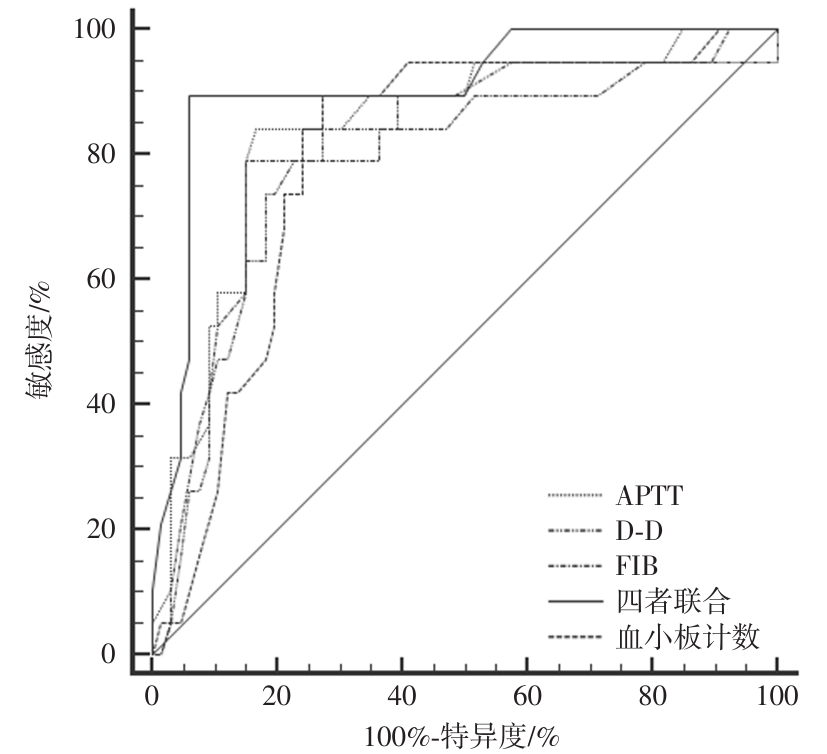
| 四者联合 | - | 90.48 | 0.774 ~ 0.953 | 93.22 | 0.798 ~ 0.986 | < 0.001 | 0.911 | 0.826 ~ 0.964 | 84.32 | 90.51 |
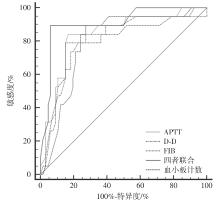
Fig.1
ROC curves of FIB, D-D, APTT, platelet count and the combination of the four for predicting intracranial hemorrhage in preterm infants younger than 32 weeks"
| [1] |
MA R, LUO Y, WANG J, et al. Ten-year time trends in preterm birth during a sociodemographic transition period: A retrospective cohort study in Shenzhen, China[J]. BMJ Open, 2020, 10(10): e037266. doi:10.1136/bmjopen-2020-037266 .
doi: 10.1136/bmjopen-2020-037266 |
| [2] |
OTLUOGLU G D, ISIK S, PAKER B, et al. Intraventricular hemorrhage and related Hydrocephalus Patients demographics in a university hospital NICU: Single-center data[J]. Turk Neurosurg, 2024, 34(2): 283-288. doi:10.5137/1019-5149.JTN. 43279-22.1 .
doi: 10.5137/1019-5149.JTN. 43279-22.1 |
| [3] |
李展莉, 薛茹, 王玮, 等. 不足32周早产儿颅内出血的临床分析[J]. 中国妇幼健康研究, 2022, 33(4): 82-86. doi:10.3969/j.issn.1673-5293.2022.04.015 .
doi: 10.3969/j.issn.1673-5293.2022.04.015 |
| [4] |
POMAR-FORERO D, AHMAD B, BARLOW B, et al. Headache management in the neuroscience intensive care unit[J]. Curr Pain Headache Rep, 2024, 28(12): 1273-1287. doi:10.1007/s11916-023-01181-8 .
doi: 10.1007/s11916-023-01181-8 |
| [5] |
FANG Y, LIU Y, CHEN L, et al. Cerebrospinal fluid markers of neuroinflammation and coagulation in severe cerebral edema and chronic Hydrocephalus after subarachnoid hemorrhage: A prospective study[J]. J Neuroinflammation, 2024, 21(1): 237. doi:10.1186/s12974-024-03236-y .
doi: 10.1186/s12974-024-03236-y |
| [6] |
WOLDEAMANUEL G G, TLAYE K G, WU L, et al. Platelet count in preeclampsia: A systematic review and meta-analysis[J]. Am J Obstet Gynecol MFM, 2023, 5(7): 100979. doi:10.1016/j.ajogmf.2023.100979 .
doi: 10.1016/j.ajogmf.2023.100979 |
| [7] |
DUNN L K, VENNER E, NGUYEN M, et al. ABO-identical versus incompatible platelet transfusion in patients with intracranial hemorrhage[J]. PLoS One, 2024, 19(11): e0312602. doi:10.1371/journal.pone.0312602 .
doi: 10.1371/journal.pone.0312602 |
| [8] |
张彩宁, 吴萍, 闫学爽, 等. 不同胎龄早产儿凝血功能与颅内出血发生风险的关系[J]. 中国妇幼健康研究, 2024, 35(10): 27-32. doi:10.3969/j.issn.1673-5293.2024.10.05 .
doi: 10.3969/j.issn.1673-5293.2024.10.05 |
| [9] |
王淳, 吕鑫, 史歆然. 颅脑超声在新生儿颅内出血诊断中的应用价值[J]. 影像科学与光化学, 2022, 40(3): 570-573. doi:10.7517/issn.1674-0475.211113 .
doi: 10.7517/issn.1674-0475.211113 |
| [10] |
PARK E K, KIM J Y, KIM D S, et al. Temporary surgical management of intraventricular hemorrhage in premature infants[J]. J Korean Neurosurg Soc, 2023, 66(3): 274-280. doi:10.3340/jkns.2022.0265 .
doi: 10.3340/jkns.2022.0265 |
| [11] |
YOU S K. Neuroimaging of germinal matrix and intraventricular hemorrhage in premature infants[J]. J Korean Neurosurg Soc, 2023, 66(3): 239-246. doi:10.3340/jkns.2022.0277 .
doi: 10.3340/jkns.2022.0277 |
| [12] |
CIMATTI A G, MARTINI S, GALLETTI S, et al. Cerebral oxygenation and autoregulation in very preterm infants developing IVH during the transitional period: A pilot study[J]. Front Pediatr, 2020, 8: 381. doi:10.3389/fped.2020.00381 .
doi: 10.3389/fped.2020.00381 |
| [13] |
CHEN J, ZENG Z, FANG Z, et al. Risk factors for thrombolysis-related intracranial hemorrhage: A systematic review and meta-analysis[J]. Thromb J, 2023, 21(1): 27. doi:10.1186/s12959-023-00467-6 .
doi: 10.1186/s12959-023-00467-6 |
| [14] |
PARODI A, GOVAERT P, HORSCH S, et al. Cranial ultrasound findings in preterm germinal matrix haemorrhage, sequelae and outcome[J]. Pediatr Res, 2020, 87(): 13-24. doi:10.1038/s41390-020-0780-2 .
doi: 10.1038/s41390-020-0780-2 |
| [15] |
WOLBERG A S. Fibrinogen and fibrin: Synthesis, structure, and function in health and disease[J]. J Thromb Haemost, 2023, 21(11): 3005-3015. doi:10.1016/j.jtha.2023.08.014 .
doi: 10.1016/j.jtha.2023.08.014 |
| [16] |
李天苏, 葛中玲, 黄蔓玲, 等. 凝血六项指标在早产儿颅内出血中的水平及预测预后不良的价值[J]. 西部医学, 2024, 36(5): 702-706. doi:10.3969/j.issn.1672-3511.2024.05.014 .
doi: 10.3969/j.issn.1672-3511.2024.05.014 |
| [17] |
张红玲, 许佑冬, 刘正东. 急性脑出血患者ICU期间下肢深静脉血栓发生的危险因素分析[J]. 中华神经医学杂志, 2020, 19(5): 488-492. doi:10.3760/cma.j.cn115354-20190926-00557 .
doi: 10.3760/cma.j.cn115354-20190926-00557 |
| [18] |
钟俊炎, 李俊祥, 黄美, 等. 基于全血细胞计数构建儿童呼吸道人腺病毒感染临床分类模型[J]. 中山大学学报(医学科学版), 2025, 46(5): 889-898. doi:10.13471/j.cnki.j.sun.yat-sen.univ(med.sci).2025.0519 .
doi: 10.13471/j.cnki.j.sun.yat-sen.univ(med.sci).2025.0519 |
| [19] |
PARIKH N S, ZHANG C, BRUCE S S, et al. Association between elevated fibrosis-4 index of liver fibrosis and risk of hemorrhagic stroke[J]. Eur Stroke J, 2025, 10(1): 289-297. doi:10.1177/23969873241259561 .
doi: 10.1177/23969873241259561 |
| [20] |
DOREY T, KONG D, LOBO W, et al. Plasma fibrinogen change as a predictor of major bleeding during catheter-directed thrombolysis[J]. Ann Vasc Surg, 2024, 99: 262-271. doi:10.1016/j.avsg.2023.08.020 .
doi: 10.1016/j.avsg.2023.08.020 |
| [21] |
肖娜娜, 闫学爽, 张彩宁, 等. 不同胎龄早产儿凝血功能比较及颅内出血影响因素分析[J]. 中南医学科学杂志, 2024, 52(3): 446-448. doi:10.15972/j.cnki.43-1509/r.2024.03.033 .
doi: 10.15972/j.cnki.43-1509/r.2024.03.033 |
| [22] | 于倩. 血压变异性联合凝血功能检测在早产儿颅内出血早期预测和预后评估中的价值[D]. 大连: 大连医科大学, 2023. |
| [23] |
DELANEY J, DE CARVALHO NUNES G, SIMONEAU J, et al. Thrombocytopenia and neonatal outcomes among extremely premature infants exposed to maternal hypertension[J]. Pediatr Blood Cancer, 2023, 70(2): e30131. doi:10.1002/pbc.30131 .
doi: 10.1002/pbc.30131 |
| [24] |
SARPER N, ÇAM İ, AYLAN GELEN S, et al. Splenic artery embolization in a patient with intracranial hemorrhage due to refractory persistent immune thrombocytopenia[J]. J Pediatr Hematol Oncol, 2023, 45(8): e988-e992. doi:10.1097/MPH. 0000000000002718 .
doi: 10.1097/MPH. 0000000000002718 |
| Viewed | ||||||
|
Full text |
|
|||||
|
Abstract |
|
|||||
