

The Journal of Practical Medicine ›› 2026, Vol. 42 ›› Issue (8): 1456-1462.doi: 10.3969/j.issn.1006-5725.2026.08.021
• Treatise: Clinical Practice • Previous Articles Next Articles
Suhua XU1,Wei HE2,Lina GUO1,Shuxian LIN1,Yingxi HE1,Xinzhu XU1,Wen SHENG1,Senling QIU3,4( )
)
Received:2025-12-30
Online:2026-04-25
Published:2026-04-28
Contact:
Senling QIU
E-mail:157038752@qq.com
CLC Number:
Suhua XU,Wei HE,Lina GUO,Shuxian LIN,Yingxi HE,Xinzhu XU,Wen SHENG,Senling QIU. Predictive value of the geriatric nutritional risk index for infection risk and implications for stratified management in patients with erythroderma[J]. The Journal of Practical Medicine, 2026, 42(8): 1456-1462.

Tab.1
Baseline characteristics of erythroderma patients grouped by GNRI"
| 变量 | 无营养风险(n = 78) | 轻度营养风险(n = 39) | 中重度营养风险(n = 66) | F/χ2 值 | P值 |
|---|---|---|---|---|---|
| 年龄( | 73.90 ± 8.23 | 73.21 ± 7.97 | 74.74 ± 8.89 | 0.432 | 0.650 |
| 性别 | 0.689 | 0.708 | |||
| 男 | 60(76.92) | 32(82.05) | 54(81.82) | ||
| 女 | 18(23.08) | 7(17.95) | 12(18.18) | ||
| 身高( | 163.41 ± 7.89 | 162.77 ± 6.87 | 163.02 ± 7.62 | 0.105 | 0.900 |
| 体质量( | 65.35 ± 9.18 | 60.97 ± 9.25 | 54.80 ± 7.81 | 26.164 | < 0.001 |
| BMI( | 24.45 ± 2.77 | 22.99 ± 3.11 | 20.58 ± 2.32 | 36.952 | < 0.001 |
| 吸烟史 | 32(41.03) | 19(48.72) | 30(45.45) | 0.683 | 0.711 |
| 饮酒史 | 12(15.38) | 6(15.38) | 8(12.12) | 0.369 | 0.832 |
| 过敏史 | 22(28.21) | 8(20.51) | 12(18.18) | 2.198 | 0.333 |
| 疾病史 | |||||
| 糖尿病 | 14(17.95) | 6(15.38) | 14(21.21) | 0.586 | 0.746 |
| 高血压 | 39(50.00) | 13(33.33) | 24(36.36) | 4.109 | 0.128 |
| 肾功能异常 | 6(7.69) | 2(5.13) | 5(7.58) | 0.275 | 0.936 |
| 冠心病 | 11(14.10) | 1(2.56) | 9(13.64) | 4.189 | 0.113 |
| 高脂血症 | 8(10.26) | 1(2.56) | 4(6.06) | 2.171 | 0.367 |
| 病因分类 | 8.904 | 0.534 | |||
| 湿疹 | 20(25.64) | 13(33.33) | 12(18.18) | ||
| 银屑病 | 17(21.79) | 12(30.77) | 13(19.70) | ||
| 特应性皮炎 | 8(10.26) | 3(7.69) | 9(13.64) | ||
| 慢性光化性皮炎 | 5(6.41) | 2(5.13) | 7(10.61) | ||
| 药物 | 1(1.28) | 1(2.56) | 3(4.55) | ||
| 肿瘤或其他原因 | 27(34.62) | 8(20.51) | 22(33.33) |
Tab.2
Prognostic outcome of erythroderma patients grouped by GNRI"
| 变量 | 无营养风险(n = 78) | 轻度营养风险(n = 39) | 中重度营养风险(n = 66) | F/χ2 值 | P值 |
|---|---|---|---|---|---|
| 感染 | 8(10.26) | 8(20.51) | 18(27.27) | 6.965 | 0.031 |
| 肺部感染 | 2(2.56) | 2(5.13) | 7(10.61) | 3.885 | 0.120 |
| 皮肤感染 | 6(7.69) | 5(12.82) | 8(12.12) | 1.221 | 0.576 |
| 泌尿系感染 | 2(2.56) | 2(5.13) | 5(7.58) | 1.974 | 0.407 |
| 贫血 | 5(6.41) | 4(10.26) | 8(12.12) | 1.542 | 0.484 |
| 心功能不全 | 3(3.85) | 4(10.26) | 8(12.12) | 3.748 | 0.157 |
| 心律失常 | 10(12.82) | 5(12.82) | 4(6.06) | 2.194 | 0.343 |
| 住院时间[M(P25,P75)]/d | 9.00(7.00,11.00) | 8.00(7.00,11.50) | 9.50(8.00,13.00) | 2.794 | 0.064 |
Tab.3
Analysis of the correlation between different degrees of nutritional risk and the prognosis of erythroderma"
| 变量 | 模型1 | 模型2 | 模型3 | |||
|---|---|---|---|---|---|---|
| OR/β(95%CI) | P值 | OR/β(95%CI) | P值 | OR/β(95%CI) | P值 | |
| 感染 | ||||||
| 无营养风险 | 1.00(Ref.) | - | 1.00(Ref.) | - | 1.00(Ref.) | - |
| 轻度营养风险 | 2.26(0.78 ~ 6.57) | 0.135 | 2.89(0.93 ~ 8.96) | 0.066 | 3.01(0.96 ~ 9.42) | 0.059 |
| 中重度营养风险 | 3.28(1.32 ~ 8.15) | 0.011 | 4.76(1.53 ~ 14.85) | 0.007 | 4.81(1.54 ~ 15.99) | 0.007 |
| 肺部感染 | ||||||
| 无营养风险 | 1.00(Ref.) | - | 1.00(Ref.) | - | 1.00(Ref.) | |
| 轻度营养风险 | 2.05(0.28 ~ 15.16) | 0.480 | 3.00(0.36 ~ 25.01) | 0.309 | 2.94(0.35 ~ 24.67) | 0.321 |
| 中重度营养风险 | 4.51(0.90 ~ 22.51) | 0.066 | 7.92(1.01 ~ 62.14) | 0.049 | 8.00(1.01 ~ 63.28) | 0.049 |
| 皮肤感染 | ||||||
| 无营养风险 | 1.00(Ref.) | - | 1.00(Ref.) | - | 1.00(Ref.) | |
| 轻度营养风险 | 1.76(0.50 ~ 6.19) | 0.375 | 1.95(0.54 ~ 7.08) | 0.307 | 2.04(0.55 ~ 7.53) | 0.285 |
| 中重度营养风险 | 1.66(0.54 ~ 5.04) | 0.375 | 2.18(0.58 ~ 8.22) | 0.251 | 2.22(0.59 ~ 8.39) | 0.241 |
| 泌尿系感染 | ||||||
| 无营养风险 | 1.00(Ref.) | - | 1.00(Ref.) | - | 1.00(Ref.) | |
| 轻度营养风险 | 2.05(0.28 ~ 15.16) | 0.480 | 4.17(0.40 ~ 43.22) | 0.232 | 4.43(0.42 ~ 47.01) | 0.217 |
| 中重度营养风险 | 3.11(0.58 ~ 16.61) | 0.183 | 5.73(0.49 ~ 67.60) | 0.166 | 5.61(0.48 ~ 65.45) | 0.169 |
| 贫血 | ||||||
| 无营养风险 | 1.00(Ref.) | - | 1.00(Ref.) | - | 1.00(Ref.) | |
| 轻度营养风险 | 1.67(0.42 ~ 6.60) | 0.466 | 1.96(0.48 ~ 8.03) | 0.349 | 1.97(0.47 ~ 8.18) | 0.353 |
| 中重度营养风险 | 2.01(0.63 ~ 6.48) | 0.241 | 3.32(0.80 ~ 13.76) | 0.098 | 3.33(0.80 ~ 13.79) | 0.098 |
| 心功能不全 | ||||||
| 无营养风险 | 1.00(Ref.) | - | 1.00(Ref.) | - | 1.00(Ref.) | |
| 轻度营养风险 | 2.86(0.61 ~ 13.46) | 0.184 | 3.09(0.63 ~ 15.14) | 0.164 | 3.93(0.76 ~ 20.30) | 0.102 |
| 中重度营养风险 | 3.45(0.88 ~ 13.58) | 0.077 | 4.01(0.81 ~ 19.93) | 0.090 | 4.50(0.90 ~ 22.50) | 0.067 |
| 心律失常 | ||||||
| 无营养风险 | 1.00(Ref.) | - | 1.00(Ref.) | - | 1.00(Ref.) | |
| 轻度营养风险 | 1.00(0.32 ~ 3.16) | 1.000 | 1.17(0.35 ~ 3.91) | 0.804 | 1.55(0.43 ~ 5.56) | 0.501 |
| 中重度营养风险 | 0.44(0.13 ~ 1.47) | 0.182 | 0.58(0.14 ~ 2.40) | 0.455 | 0.66(0.16 ~ 2.77) | 0.573 |
| 住院时间 | ||||||
| 无营养风险 | 1.00(Ref.) | - | 1.00(Ref.) | - | 1.00(Ref.) | |
| 轻度营养风险 | 0.03(-1.54 ~ 1.59)* | 0.974 | 0.36(-1.21 ~ 1.93)* | 0.655 | 0.38(-1.22 ~ 1.98)* | 0.642 |
| 中重度营养风险 | 1.49(0.16 ~ 2.83)* | 0.030 | 2.52(0.96 ~ 4.09)* | 0.002 | 2.53(0.96 ~ 4.10)* | 0.002 |
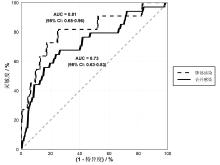
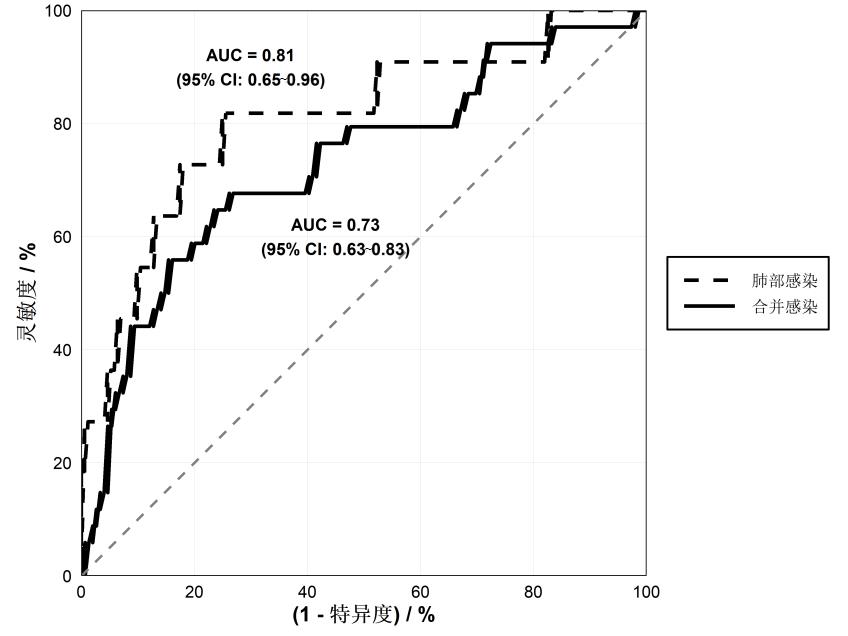
Fig.1
ROC curve of GNRI for predicting complicated infections and pulmonary infection in patients with erythroderma"
| [1] |
PANG Y, NGUYEN W Q, GUERRERO L I, et al. Deciphering the Etiologies of Adult Erythroderma: An Updated Guide to Presentations, Diagnostic Tools, Pathophysiologies, and Treatments[J]. Am J Clin Dermatol, 2024, 25(6): 927-950. doi:10.1007/s40257-024-00886-9 .
doi: 10.1007/s40257-024-00886-9 |
| [2] |
TSO S, SATCHWELL F, MOIZ H, et al. Erythroderma (exfoliative dermatitis). Part 1: Underlying causes, clinical presentation and pathogenesis[J]. Clin Exp Dermatol, 2021, 46(6): 1001-1010. doi:10.1111/ced.14625 .
doi: 10.1111/ced.14625 |
| [3] |
胡龄予. 红皮病105例临床分析[D]. 昆明: 昆明医科大学, 2023. doi:10.27202/d.cnki.gkmyc.2023.000703 .
doi: 10.27202/d.cnki.gkmyc.2023.000703 |
| [4] |
李园园, 施东雯, 孙淑娟, 等. 165例红皮病临床分析[J]. 皮肤性病诊疗学杂志, 2020, 27(3): 160-163,167. doi:10.3969/j.issn.1674-8468.2020.03.005 .
doi: 10.3969/j.issn.1674-8468.2020.03.005 |
| [5] |
MOHD NOOR N, HUSSEIN S H. Transepidermal water loss in erythrodermic patients of various aetiologies[J]. Skin Res Technol, 2013, 19(3): 320-323. doi:10.1111/srt.12048 .
doi: 10.1111/srt.12048 |
| [6] | CALLEN J P, JORIZZO J L, ZONE J J, et al. Dermatological Signs of Systemic Disease [M]. 5th ed. Edinburgh: Elsevier, 2016. |
| [7] |
TSO S, MOIZ H, SATCHWELL F, et al. Erythroderma (exfoliative dermatitis). Part 2: Energy homeostasis and dietetic management strategies[J]. Clin Exp Dermatol, 2021, 46(6): 1011-1015. doi:10.1111/ced.14667 .
doi: 10.1111/ced.14667 |
| [8] |
李天颖, 常艳, 史燕如, 等. 某医院脑卒中住院患者营养风险、营养不良状况调查[J]. 中国初级卫生保健, 2024, 38(9): 108-110. doi:10.3969/j.issn.1001-568X.2024.09.0030 .
doi: 10.3969/j.issn.1001-568X.2024.09.0030 |
| [9] |
韩孝红, 焦聪聪, 程立雪, 等. 住院患者营养风险筛查及影响因素分析[J]. 中国医药科学, 2024, 14(16): 110-113,159. doi:10.20116/j.issn2095-0616.2024.16.27 .
doi: 10.20116/j.issn2095-0616.2024.16.27 |
| [10] |
陈云峰, 魏颖俊, 潘雅萍, 等. 老年肺康复住院患者营养状况调查及其影响因素分析[J]. 中国老年保健医学, 2024, 22(4): 92-98. doi:10.3969/j.issn.1672-2671.2024.04.020 .
doi: 10.3969/j.issn.1672-2671.2024.04.020 |
| [11] |
BOUILLANNE O, MORINEAU G, DUPONT C, et al. Geriatric Nutritional Risk Index: A new index for evaluating at-risk elderly medical patients[J]. Am J Clin Nutr, 2005, 82(4): 777-783. doi:10.1093/ajcn/82.4.777 .
doi: 10.1093/ajcn/82.4.777 |
| [12] |
代美, 李昌秀, 周静, 等. 老年营养风险指数临床应用的研究进展[J]. 护理研究, 2024, 38(9): 1622-1626. doi:10.12102/j.issn.1009-6493.2024.09.020 .
doi: 10.12102/j.issn.1009-6493.2024.09.020 |
| [13] |
黄媛媛, 李昭, 宋丽丽, 等. 营养状态对急性心肌梗死合并心力衰竭患者预后的影响[J]. 心肺血管病杂志, 2023, 42(12): 1206-1211, 1225. doi:10.3969/j.issn.1007-5062.2023.12.003 .
doi: 10.3969/j.issn.1007-5062.2023.12.003 |
| [14] |
李冠成. 老年营养风险指数(GNRI)与老年胆总管结石患者术后并发症的相关性分析[D]. 赣州: 赣南医科大学, 2024. doi:10.27959/d.cnki.ggnyx.2024.000112 .
doi: 10.27959/d.cnki.ggnyx.2024.000112 |
| [15] |
莫乔莹, 朱芳一, 祝存奎, 等. 基于GNRI评分构建慢性心力衰竭患者营养不良风险的列线图模型[J]. 实用医学杂志, 2025, 41(5): 691-698. doi:10.3969/j.issn.1006-5725.2025.05.011 .
doi: 10.3969/j.issn.1006-5725.2025.05.011 |
| [16] |
张尧, 杨艳玲. 蛋白质营养不良致红皮病1例报告[J]. 北京医学, 2018, 40(7): 720-721. doi:10.15932/j.0253-9713.2018.07.035 .
doi: 10.15932/j.0253-9713.2018.07.035 |
| [17] |
PULIDO-PÉREZ A, BERGÓN-SENDíN M, SUÁREZ-FERNÁNDEZ R, et al. Skin and sepsis: Contribution of dermatology to a rapid diagnosis[J]. Infection, 2021, 49(4): 617-629. doi:10.1007/s15010-021-01608-7 .
doi: 10.1007/s15010-021-01608-7 |
| [18] |
KLINIEC K, SNOPKOWSKA A, ŁYKO M, et al. Erythroderma: A Retrospective Study of 212 Patients Hospitalized in a Tertiary Center in Lower Silesia, Poland[J]. J Clin Med, 2024, 13(3): doi:10.3390/jcm13030645. doi:10.3390/jcm13030645
doi: 10.3390/jcm13030645 |
| [19] |
VALLERAND I A, LEWINSON R T, FARRIS M S, et al. Efficacy and adverse events of oral isotretinoin for acne: A systematic review[J]. British Journal of Dermatology, 2018, 178(1): 76-85. doi:10.1111/bjd.15668 .
doi: 10.1111/bjd.15668 |
| [20] |
魏孟, 戴晓婧, 唐崎, 等. 胃肠息肉切除患者住院时间及焦虑情绪的影响因素分析[J]. 联勤军事医学, 2024, 38(10): 866-870, 887. doi:10.13730/j.issn.2097-2148.2024.10.009 .
doi: 10.13730/j.issn.2097-2148.2024.10.009 |
| [21] |
WIEDERMANN C J. Hypoalbuminemia as Surrogate and Culprit of Infections[J]. Int J Mol Sci, 2021, 22(9): 4496. doi:10.3390/ijms22094496 .
doi: 10.3390/ijms22094496 |
| [22] |
DICKSON R P, SINGER B H, NEWSTEAD M. W, et al. Enrichment of the lung microbiome with gut bacteria in sepsis and the acute respiratory distress syndrome[J]. Nat Microbiol, 2016, 1(10): 16113. doi:10.1038/nmicrobiol.2016.113 .
doi: 10.1038/nmicrobiol.2016.113 |
| [23] |
张玲玲, 曹劝劝, 高文君, 等. 老年营养风险指数对COPD急性加重期患者30d再入院的预测价值[J]. 护理学杂志, 2024, 39(15): 92-96. doi:10.3870/j.issn.1001-4152.2024.15.092 .
doi: 10.3870/j.issn.1001-4152.2024.15.092 |
| [24] |
麦梓玲. 冠心病患者营养不良与长期预后的相关性分析[D]. 广州: 华南理工大学, 2022. doi:10.27151/d.cnki.ghnlu.2022.000364 .
doi: 10.27151/d.cnki.ghnlu.2022.000364 |
| [25] |
张晓楠, 熊雅俊, 许爱国. 基于老年营养风险指数构建老年非小细胞肺癌患者的预后模型[J]. 中国肺癌杂志, 2023, 26(7): 497-506. doi:10.3779/j.issn.1009-3419.2023.106.14 .
doi: 10.3779/j.issn.1009-3419.2023.106.14 |
| Viewed | ||||||
|
Full text |
|
|||||
|
Abstract |
|
|||||
