

The Journal of Practical Medicine ›› 2026, Vol. 42 ›› Issue (13): 2291-2299.doi: 10.3969/j.issn.1006-5725.2026.13.004
• Feature Reports:Cardiovascular diseases • Previous Articles
Min YANG,Hongbo QIAN,Dafa ZHANG,Yingjing GUI( )
)
Received:2026-03-23
Online:2026-07-10
Published:2026-07-14
Contact:
Yingjing GUI
E-mail:guiyingjing123@126.com
CLC Number:
Min YANG,Hongbo QIAN,Dafa ZHANG,Yingjing GUI. Preoperative left ventricular end-systolic dimension predicts postoperative ejection fraction recovery trajectory and clinical outcomes in mitral regurgitation[J]. The Journal of Practical Medicine, 2026, 42(13): 2291-2299.
Tab.1
Comparison of baseline characteristics among different LVESD groups"
| 变量 | Q1组(n = 39) | Q2组(n = 39) | Q3组(n = 39) | Q4组(n = 40) | H/F/χ2值 | P值 |
|---|---|---|---|---|---|---|
| 年龄/岁 | 58.24 ± 9.37 | 59.83 ± 10.12 | 61.95 ± 10.28 | 63.08 ± 9.97 | 2.109 | 0.101 |
| 性别/例 | 0.365 | 0.947 | ||||
| 男 | 22 | 25 | 24 | 23 | ||
| 女 | 17 | 14 | 15 | 17 | ||
| MR类型/[例(%)] | 11.872 | 0.008 | ||||
| 退行性 | 31(79.49) | 27(69.23) | 22(56.41) | 18(45.00) | ||
| 功能性 | 8(20.51) | 12(30.77) | 17(43.59) | 22(55.00) | ||
| MR程度/[例(%)] | 0.926 | 0.819 | ||||
| 中度 | 14(35.90) | 12(30.77) | 11(28.21) | 11(27.50) | ||
| 重度 | 25(64.10) | 27(69.23) | 28(71.79) | 29(72.50) | ||
| AF/[例(%)] | 7(17.95) | 11(28.21) | 15(38.46) | 20(50.00) | 10.483 | 0.015 |
| CAD/[例(%)] | 5(12.82) | 7(17.95) | 9(23.08) | 12(30.00) | 3.782 | 0.286 |
| 高血压/[例(%)] | 14(35.90) | 17(43.59) | 19(48.72) | 22(55.00) | 3.241 | 0.356 |
| 手术方式/[例(%)] | 4.925 | 0.177 | ||||
| 置换 | 10(25.64) | 13(33.33) | 16(41.03) | 19(47.50) | ||
| 修复 | 29(74.36) | 26(66.67) | 23(58.97) | 21(52.50) | ||
| CPB时间/min | 101.85 ± 28.47 | 107.63 ± 29.88 | 114.21 ± 31.05 | 119.38 ± 32.76 | 2.876 | 0.038 |
| NT-proBNP[M(P25, P75)]/(pg/mL) | 682.24 (408.50,1 047.33) | 823.71 (518.66,1 348.92) | 1 125.48 (715.33,1 772.61) | 1 562.37 (975.42,2 475.18) | 41.356 | 0.001 |
| LVESD/mm | 30.12 ± 2.08 | 34.48 ± 1.12 | 38.41 ± 1.18 | 45.18 ± 4.07 | 315.627 | 0.001 |
| LVEDD/mm | 54.79 ± 4.88 | 58.87 ± 5.21 | 61.76 ± 5.43 | 64.23 ± 6.09 | 22.415 | 0.001 |
| LVEF/% | 63.75 ± 6.22 | 59.81 ± 6.79 | 56.08 ± 7.09 | 50.15 ± 8.31 | 37.224 | 0.001 |
| LAVI/(mL/m2) | 42.08 ± 11.17 | 47.62 ± 12.08 | 51.87 ± 13.48 | 55.25 ± 14.19 | 8.764 | 0.001 |
| PASP/mmHg | 34.25 ± 8.07 | 38.08 ± 9.23 | 41.96 ± 10.12 | 46.07 ± 11.28 | 11.328 | 0.001 |
Tab.2
Comparison of postoperative LVEF at different time windows among LVESD quartile groups"
| 时间窗/组内变化 | Q1组(n = 39) | Q2组(n = 39) | Q3组(n = 39) | Q4组(n = 40) | F值 | P值 |
|---|---|---|---|---|---|---|
| 出院前LVEF/% | 64.58 ± 6.12 | 60.47 ± 6.68 | 56.82 ± 7.03 | 51.14 ± 8.12 | 39.724 | 0.001 |
| 术后3个月LVEF/% | 66.36 ± 5.81 | 62.31 ± 6.32 | 58.85 ± 6.76 | 53.62 ± 7.94 | 41.893 | 0.001 |
| 术后6个月LVEF/% | 67.09 ± 5.57 | 63.24 ± 6.10 | 59.83 ± 6.49 | 54.75 ± 7.64 | 46.577 | 0.001 |
| 术后3个月-出院前差值(95%CI) | 1.78(1.02 ~ 2.54) | 1.84(1.05 ~ 2.63) | 2.03(1.16 ~ 2.90) | 2.48(1.50 ~ 3.46) | ||
| 校正后P值 | 0.001 | 0.001 | 0.001 | 0.001 | ||
| 术后6个月-出院前差值(95%CI) | 2.51(1.61 ~ 3.41) | 2.77(1.81 ~ 3.73) | 3.01(1.88 ~ 4.14) | 3.61(2.24 ~ 4.98) | ||
| 校正后P值 | 0.001 | 0.001 | 0.001 | 0.001 | ||
| 组内时间效应F值 | 18.236 | 21.417 | 24.908 | 27.635 | ||
| 组内时间效应P值 | 0.001 | 0.001 | 0.001 | 0.001 |
Tab.3
Marginal means of LVEF in each group at different time windows and the difference between Q4 and Q1"
| 时间窗 | 模型1 | ||||||
|---|---|---|---|---|---|---|---|
| Q1组边际均值/% | Q2组边际均值/% | Q3组边际均值/% | Q4组边际均值/% | Q4-Q1差值 | 95%CI | P值 | |
| 出院前 | 64.52 ± 0.624 | 60.47 ± 0.648 | 56.95 ± 0.673 | 51.42 ± 0.718 | -13.10 | -15.31 ~ -10.89 | 0.001 |
| 术后3个月 | 66.28 ± 0.698 | 62.24 ± 0.726 | 59.11 ± 0.763 | 53.99 ± 0.817 | -12.29 | -14.68 ~ -9.90 | 0.001 |
| 术后6个月 | 67.01 ± 0.758 | 63.11 ± 0.791 | 60.04 ± 0.838 | 54.98 ± 0.901 | -12.03 | -14.66 ~ -9.40 | 0.001 |
| 时间窗 | 模型2 | ||||||
| Q1组边际均值/% | Q2组边际均值/% | Q3组边际均值/% | Q4组边际均值/% | Q4-Q1差值 | 95%CI | P值 | |
| 出院前 | 64.43 ± 0.619 | 60.38 ± 0.642 | 56.89 ± 0.668 | 51.33 ± 0.709 | -13.10 | -15.27 ~ -10.93 | 0.001 |
| 术后3个月 | 66.19 ± 0.691 | 62.15 ± 0.719 | 59.05 ± 0.755 | 53.91 ± 0.808 | -12.28 | -14.61 ~ -9.95 | 0.001 |
| 术后6个月 | 66.92 ± 0.749 | 63.02 ± 0.782 | 59.98 ± 0.830 | 54.89 ± 0.889 | -12.03 | -14.59 ~ -9.47 | 0.001 |
Tab.4
Incidence of follow-up adverse events among different LVESD quartile groups"
| 结局 | Q1组(n = 39) | Q2组(n = 39) | Q3组(n = 39) | Q4组(n = 40) | χ2值 | P值 |
|---|---|---|---|---|---|---|
| 复合终点 | 2(5.13) | 4(10.26) | 7(17.95) | 12(30.00) | 10.268 | 0.016 |
| 心衰再住院 | 2(5.13) | 4(10.26) | 6(15.38) | 10(25.00) | 7.085 | 0.069 |
| 全因死亡 | 1(2.56) | 0(0.00) | 1(2.56) | 2(5.00) | 1.990 | 0.574 |
Tab.5
Cox regression analysis of LVESD quartiles and the risk of composite endpoint"
| 分层 | 未校正HR(95%CI) | P值 | 模型1 HR(95%CI) | P值 | 模型2 HR(95%CI) | P值 |
|---|---|---|---|---|---|---|
| Q1 | 1.000(参考) | 1.000(参考) | 1.000(参考) | |||
| Q2 | 1.812(0.612 ~ 5.368) | 0.280 | 1.402(0.520 ~ 3.780) | 0.504 | 1.385(0.509 ~ 3.768) | 0.524 |
| Q3 | 2.845(0.905 ~ 8.945) | 0.074 | 1.956(0.825 ~ 4.639) | 0.128 | 1.902(0.795 ~ 4.552) | 0.148 |
| Q4 | 4.826(1.521 ~ 15.308) | 0.008 | 2.512(1.182 ~ 5.339) | 0.017 | 2.388(1.112 ~ 5.127) | 0.026 |
| 趋势P值 | 0.006 | 0.012 | 0.018 |
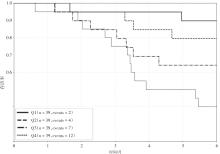
Fig.1
Cumulative incidence curve of follow-up composite endpoint among patients in different LVESD groups"
Tab.6
Comparison of perioperative interventions and postoperative remedial treatments among different LVESD groups"
| 指标 | Q1组(n = 39) | Q2组(n = 39) | Q3组(n = 39) | Q4组(n = 40) | χ2/F值 | P值 |
|---|---|---|---|---|---|---|
| 二尖瓣修复 | 29(74.36) | 26(66.67) | 23(58.97) | 21(52.50) | 4.925 | 0.177 |
| 二尖瓣置换 | 10(25.64) | 13(33.33) | 16(41.03) | 19(47.50) | 4.925 | 0.177 |
| 同期三尖瓣成形 | 9(23.08) | 11(28.21) | 13(33.33) | 16(40.00) | 2.799 | 0.424 |
| 术后残余反流 ≤ 轻度 | 38(97.44) | 37(94.87) | 37(94.87) | 37(92.50) | 1.164 | 0.762 |
| 正性肌力药支持 | 6(15.38) | 8(20.51) | 10(25.64) | 13(32.50) | 3.709 | 0.295 |
| 机械通气时间 24 h | 3(7.69) | 4(10.26) | 5(12.82) | 7(17.50) | 1.890 | 0.596 |
| 术后ICU停留时间(x ± s)/d | 2.15 ± 0.84 | 2.31 ± 0.92 | 2.48 ± 1.05 | 2.66 ± 1.18 | 1.769 | 0.156 |
| 出院时利尿剂 | 15(38.46) | 18(46.15) | 22(56.41) | 27(67.50) | 7.548 | 0.056 |
| 出院时ACEI/ARB/ARNI | 12(30.77) | 15(38.46) | 18(46.15) | 22(55.00) | 4.803 | 0.187 |
| 出院时β受体阻滞剂 | 10(25.64) | 12(30.77) | 15(38.46) | 18(45.00) | 3.733 | 0.292 |
| 出院时醛固酮受体拮抗剂 | 8(20.51) | 10(25.64) | 13(33.33) | 17(42.50) | 4.844 | 0.184 |
| 房颤患者抗凝或节律/室率控制 | 7/7(100.00) | 11/11(100.00) | 14/15(93.33) | 19/20(95.00) | 1.105 | 0.776 |
| [1] |
FIGLIOLI G, STICCHI A, CHRISTODOULOU M N, et al. Global Prevalence of Mitral Regurgitation: A Systematic Review and Meta-Analysis of Population-Based Studies[J]. J Clin Med, 2025, 14(8):2749. doi: 10.3390/jcm14082749 .
doi: 10.3390/jcm14082749 |
| [2] |
PRAZ F, VAHANIAN A, MESTRES C A, et al. 2025 ESC/EACTS Guidelines for the management of valvular heart disease[J]. Eur Heart J, 2025, 46(44):4635-4736. doi: 10.1093/eurheartj/ehaf194 .
doi: 10.1093/eurheartj/ehaf194 |
| [3] |
CRAVEN T P, CHEW P G, DOBSON L E, et al. Cardiac reverse remodeling in primary mitral regurgitation: mitral valve replacement vs. mitral valve repair[J]. J Cardiovasc Magn Reson, 2023, 25(1):43. doi: 10.1186/s12968-023-00946-9 .
doi: 10.1186/s12968-023-00946-9 |
| [4] |
李妍,金子燃,孙皓天,等. 自动心肌运动定量技术评价2型糖尿病合并肾功能不全患者左心室收缩功能[J]. 实用医学杂志,2025,41(3):414-421. doi:10.3969/j.issn.1006-5725.2025. 03.017 .
doi: 10.3969/j.issn.1006-5725.2025. 03.017 |
| [5] |
PETOLAT E, THERON A, RESSEGUIER N, et al. Prognostic value of forward flow indices in primary mitral regurgitation due to mitral valve prolapse[J]. Front Cardiovasc Med, 2023, 10:1076708. doi: 10.3389/fcvm.2023.1076708 .
doi: 10.3389/fcvm.2023.1076708 |
| [6] |
TRIBOUILLOY C, RUSINARU D, GRIGIONI F, et al. Indexing left ventricular end-systolic dimension to body size: Association with mortality in patients with degenerative mitral regurgitation[J]. Eur J Heart Fail, 2024, 26(12):2563-2569. doi: 10.1002/ejhf.3393 .
doi: 10.1002/ejhf.3393 |
| [7] |
YILMAZ F K, CAKAL B, YILMAZ F, et al. Relationship between fragmented QRS complex and early left ventricular dysfunction after mitral valve repair[J]. J Electrocardiol, 2024, 84:65-69. doi: 10.1016/j.jelectrocard.2024.02.011 .
doi: 10.1016/j.jelectrocard.2024.02.011 |
| [8] |
NATALINO L A, MARSAM R K, DINARTI L K, et al. The Role of Global Longitudinal Strain in Predicting Left Ventricular Reverse Remodeling After Mitral Valve Replacement Surgery in Patients With Primary Mitral Regurgitation[J]. Echocardiography, 2024, 41(11):e15950. doi: 10.1111/echo.15950 .
doi: 10.1111/echo.15950 |
| [9] |
PYPE L L, BERTRAND P B, DEBONNAIRE P, et al. Mitral Valve Surgery for Mitral Regurgitation Results in Reduced Left Ventricular Ejection Fraction in Barlow's Disease as Compared with Fibro-Elastic Deficiency[J]. J Cardiovasc Dev Dis, 2024, 11(3):71. doi: 10.3390/jcdd11030071 .
doi: 10.3390/jcdd11030071 |
| [10] |
MARCHETTI D, DI GIOVANNI F, NOVEMBRE M L, et al. Contemporary Echocardiographic Evaluation of Mitral Regurgitation and Guidance for Percutaneous Mitral Valve Repair[J]. J Clin Med, 2023, 12(22):7121. doi: 10.3390/jcm12227121 .
doi: 10.3390/jcm12227121 |
| [11] |
马春梅,吴志康,陈可,等. 肺动脉与主动脉直径比对急性失代偿性心力衰竭患者预后的影响[J]. 实用医学杂志,2025,41(7):960-967. doi:10.3969/j.issn.1006-5725.2025.07.005 .
doi: 10.3969/j.issn.1006-5725.2025.07.005 |
| [12] |
MUNERETTO C, D'ALONZO M, BAUDO M, et al. Outcomes of patients with mitral annular disjunction undergoing mitral valve repair[J]. Eur J Cardiothorac Surg, 2025, 67(2):ezaf029. doi: 10.1093/ejcts/ezaf029 .
doi: 10.1093/ejcts/ezaf029 |
| [13] |
LABABIDI H, EL-TALLAWI K C, KITKUNGVAN D, et al. The prognostic importance of left ventricular diastolic function in primary mitral regurgitation and its relation to structural changes by CMR[J]. Sci Rep, 2025, 15(1):35079. doi: 10.1038/s41598-025-18965-0 .
doi: 10.1038/s41598-025-18965-0 |
| [14] |
SPAMPINATO R A, MARIN-CUARTAS M, VAN KAMPEN A, et al. Left ventricular fibrosis and CMR tissue characterization of papillary muscles in mitral valve prolapse patients[J]. Int J Cardiovasc Imaging, 2024, 40(2):213-224. doi: 10.1007/s10554-023-02985-w .
doi: 10.1007/s10554-023-02985-w |
| [15] |
PAMIDIGHANTAM P, CHEN C, SHRESTHA N, et al. Long-term outcomes of semirigid ring and band annuloplasty in functional mitral regurgitation patients without advanced left ventricular dilation[J]. J Thorac Cardiovasc Surg, 2025, S0022-5223(25)00543-4. doi: 10.1016/j.jtcvs.2025.06.023 .
doi: 10.1016/j.jtcvs.2025.06.023 |
| [16] |
ZILBERSZAC R, GLEISS A, MASSETTI M, et al. Left atrial size predicts outcome in severe but asymptomatic mitral regurgitation[J]. Sci Rep, 2023, 13(1):3892. doi: 10.1038/s41598-023-31163-0 .
doi: 10.1038/s41598-023-31163-0 |
| [17] |
ALTES A, GAROT J, HABIB G, et al. Quantification of primary mitral regurgitation by cardiovascular magnetic resonance: An echocardiographic and cardiac magnetic resonance imaging study[J]. Front Cardiovasc Med, 2023, 10:1107724. doi: 10.3389/fcvm.2023.1107724 .
doi: 10.3389/fcvm.2023.1107724 |
| [18] |
ZHENG J, HUANG S W, AHMED M I, et al. Imminent risk of LVEF decline in asymptomatic patients with primary mitral regurgitation[J]. Front Cardiovasc Med, 2024, 11:1410859. doi: 10.3389/fcvm.2024.1410859 .
doi: 10.3389/fcvm.2024.1410859 |
| [19] |
GARG P, PAVON A G, PENICKA M, et al. Cardiovascular magnetic resonance imaging in mitral valve disease[J]. Eur Heart J, 2025, 46(7):606-619. doi: 10.1093/eurheartj/ehae801 .
doi: 10.1093/eurheartj/ehae801 |
| [20] |
PAGNESI M, RICCARDI M, MAISANO F, et al. Epidemiology, pathophysiology, diagnosis and management of atrial functional mitral regurgitation: An expert opinion paper[J]. ESC Heart Fail, 2025, 12(6):3788-3805. doi: 10.1002/ehf2.15405 .
doi: 10.1002/ehf2.15405 |
| [21] |
ALHAKAK A, BUTT J H, HAVERS-BORGERSEN E, et al. Mitral valve replacement or repair and long-term risk of infective endocarditis: A Danish nationwide study[J]. Eur Heart J, 2025, 46(36):3569-3579. doi: 10.1093/eurheartj/ehaf342 .
doi: 10.1093/eurheartj/ehaf342 |
| [22] |
FAZA N N, DELGADO V, BERREBI A, et al. Multimodality imaging in mitral regurgitation: Current applications and future directions[J]. Eur Heart J Cardiovasc Imaging, 2024, 25(12):1549-1563. doi: 10.1093/ehjci/jeae195 .
doi: 10.1093/ehjci/jeae195 |
| [23] |
AURIGEMMA G P, GRAYBURN P A, ZOGHBI W A. Quantitation of Primary Mitral Regurgitation: A Fresh Take on an Old Challenge[J]. J Am Soc Echocardiogr, 2025, 38(8):682-684. doi: 10.1016/j.echo.2025.04.009 .
doi: 10.1016/j.echo.2025.04.009 |
| [24] |
MCDONAGH T A, METRA M, ADAMO M, et al. 2023 Focused Update of the 2021 ESC Guidelines for the diagnosis and treatment of acute and chronic heart failure[J]. Eur Heart J, 2023, 44(37):3627-3639. doi: 10.1093/eurheartj/ehad195 .
doi: 10.1093/eurheartj/ehad195 |
| [25] |
VOORS A A, GARDNER R S, GHIORGHIADE M, et al. Novel Recommendations for the Treatment of Patients With Heart Failure: 2023 Focused Update of the 2021 ESC Heart Failure Guidelines[J]. J Card Fail, 2023, 29(12):1619-1621. doi: 10.1016/j.cardfail.2023.08.017 .
doi: 10.1016/j.cardfail.2023.08.017 |
| Viewed | ||||||
|
Full text |
|
|||||
|
Abstract |
|
|||||
