

The Journal of Practical Medicine ›› 2026, Vol. 42 ›› Issue (12): 2136-2143.doi: 10.3969/j.issn.1006-5725.2026.12.007
• Oncology: Diagnosis, Treatment and Prevention • Previous Articles
Ting ZHU1,Xiaowen ZONG2,Yaping SUN3,Zhaohui LUAN1( )
)
Received:2026-03-20
Online:2026-06-25
Published:2026-06-30
Contact:
Zhaohui LUAN
E-mail:luanzhaohui@126.com
CLC Number:
Ting ZHU,Xiaowen ZONG,Yaping SUN,Zhaohui LUAN. Value of combined detection of serum PAX8, ENO1, HE4 and NRP-2 in prognosis evaluation of endometrial cancer[J]. The Journal of Practical Medicine, 2026, 42(12): 2136-2143.
Tab.1
Comparison of clinical data of three groups"
| 指标 | 子宫内膜癌组(n = 165) | 良性子宫内膜疾病组(n = 165) | 健康对照组(n = 165) | F值 | P值 |
|---|---|---|---|---|---|
| 年龄/岁 | 55.63 ± 6.15 | 54.93 ± 6.02 | 54.77 ± 6.59 | 0.881 | 0.415 |
| BMI/(kg/m2) | 24.96 ± 1.22 | 25.13 ± 1.35 | 25.11 ± 1.42 | 0.802 | 0.449 |
Tab.2
Comparison of serum PAX8, ENO1, HE4 and NRP-2 levels among three groups"
| 指标 | 子宫内膜癌组(n = 165) | 良性子宫内膜疾病组(n = 165) | 健康对照组(n = 165) | F值 | P值 |
|---|---|---|---|---|---|
| PAX8/(ng/mL) | 58.14 ± 8.43 | 50.91 ± 7.46? | 41.32 ± 6.13?# | 214.495 | < 0.001 |
| ENO1/(pg/mL) | 742.32 ± 88.46 | 472.49 ± 68.83? | 306.59 ± 41.09?# | 1 679.924 | < 0.001 |
| HE4/(pmol/L) | 154.18 ± 15.24 | 139.11 ± 12.95? | 116.92 ± 7.05?# | 386.722 | < 0.001 |
| NRP-2/(μg/L) | 17.12 ± 2.24 | 12.62 ± 1.32? | 4.78 ± 0.23?# | 4 649.318 | < 0.001 |
Tab.3
Serum PAX8, ENO1, HE4 and NRP-2 levels in patients with endometrial cancer with different pathological features x ± s"
| 指标 | FIGO分期 | t值 | P值 | 分化程度 | t值 | P值 | ||
|---|---|---|---|---|---|---|---|---|
| Ⅰ—Ⅱ期 | Ⅲ—Ⅳ期 | 低分化 | 中高分化 | |||||
| 例数 | 108 | 57 | - | - | 29 | 136 | - | - |
| PAX8/(ng/mL) | 55.89 ± 7.90 | 62.41 ± 9.43 | 4.709 | < 0.001 | 64.66 ± 9.51 | 56.75 ± 8.20 | 4.582 | < 0.001 |
| ENO1/(pg/mL) | 725.41 ± 87.47 | 774.36 ± 90.33 | 3.380 | 0.001 | 771.91 ± 98.40 | 736.01 ± 86.34 | 1.983 | 0.049 |
| HE4/(pmol/L) | 146.38 ± 14.39 | 168.96 ± 16.85 | 9.026 | < 0.001 | 163.98 ± 16.79 | 152.09 ± 14.91 | 3.812 | < 0.001 |
| NRP-2/(μg/L) | 16.24 ± 1.96 | 18.79 ± 2.77 | 6.858 | < 0.001 | 18.15 ± 2.71 | 16.90 ± 2.14 | 2.718 | 0.007 |
| 指标 | 肌层浸润 | t值 | P值 | 淋巴结转移 | t值 | P值 | ||
| < 1/2 | ≥ 1/2 | 有 | 无 | |||||
| 例数 | 115 | 50 | - | - | 31 | 134 | - | - |
| PAX8/(ng/mL) | 54.75 ± 7.98 | 65.94 ± 9.46 | 7.815 | < 0.001 | 64.24 ± 9.16 | 56.73 ± 8.26 | 4.468 | < 0.001 |
| ENO1/(pg/mL) | 726.22 ± 86.88 | 779.35 ± 92.09 | 3.545 | 0.001 | 775.91 ± 91.01 | 734.55 ± 87.87 | 2.346 | 0.020 |
| HE4/(pmol/L) | 147.16 ± 14.87 | 170.32 ± 16.09 | 8.967 | < 0.001 | 164.64 ± 16.84 | 151.76 ± 14.87 | 4.237 | < 0.001 |
| NRP-2/(μg/L) | 16.30 ± 2.11 | 19.00 ± 2.54 | 7.090 | < 0.001 | 18.42 ± 2.58 | 16.82 ± 1.16 | 5.267 | < 0.001 |
Tab.4
Relationship between serum PAX8, ENO1, HE4, NRP-2 levels and severity of endometrial cancer"
| 指标 | FIGO分期 | 分化程度 | 肌层浸润 | 淋巴结转移 | ||||
|---|---|---|---|---|---|---|---|---|
| r值 | P值 | r值 | P值 | r值 | P值 | r值 | P值 | |
| PAX8 | 0.695 | < 0.001 | -0.758 | < 0.001 | 0.673 | < 0.001 | 0.861 | < 0.001 |
| ENO1 | 0.836 | < 0.001 | -0.741 | < 0.001 | 0.833 | < 0.001 | 0.699 | < 0.001 |
| HE4 | 0.718 | < 0.001 | -0.689 | < 0.001 | 0.799 | < 0.001 | 0.763 | < 0.001 |
| NRP-2 | 0.739 | < 0.001 | -0.806 | < 0.001 | 0.824 | < 0.001 | 0.779 | < 0.001 |
Tab.5
Serum levels of PAX8, ENO1, HE4 and NRP-2 in patients with endometrial cancer with different prognosis"
| 指标 | 预后不良组(n = 35) | 预后良好组(n = 130) | t值 | P值 |
|---|---|---|---|---|
| PAX8/(ng/mL) | 63.75 ± 9.31 | 56.36 ± 8.19 | 4.600 | < 0.001 |
| ENO1/(pg/mL) | 778.83 ± 89.35 | 732.49 ± 88.22 | 2.751 | 0.007 |
| HE4/(pmol/L) | 178.99 ± 16.35 | 147.50 ± 14.94 | 10.847 | < 0.001 |
| NRP-2/ (μg/L) | 18.94 ± 2.42 | 16.63 ± 2.19 | 5.416 | < 0.001 |
Tab.6
Predictive value of serum PAX8, ENO1, HE4 and NRP-2 levels for prognosis of patients with endometrial cancer"
| 指标 | 截断值 | AUC | 敏感度/% | 特异度/% | P值 | 95%CI |
|---|---|---|---|---|---|---|
| PAX8 | 61.21 ng/mL | 0.791 | 71.43 | 76.15 | < 0.001 | 0.721 ~ 0.851 |
| ENO1 | 748.42 pg/mL | 0.729 | 74.29 | 66.15 | < 0.001 | 0.654 ~ 0.795 |
| HE4 | 155.27 pmol/L | 0.788 | 77.14 | 68.46 | < 0.001 | 0.717 ~ 0.848 |
| NRP-2 | 17.92 ng/L | 0.759 | 71.43 | 74.62 | < 0.001 | 0.687 ~ 0.822 |
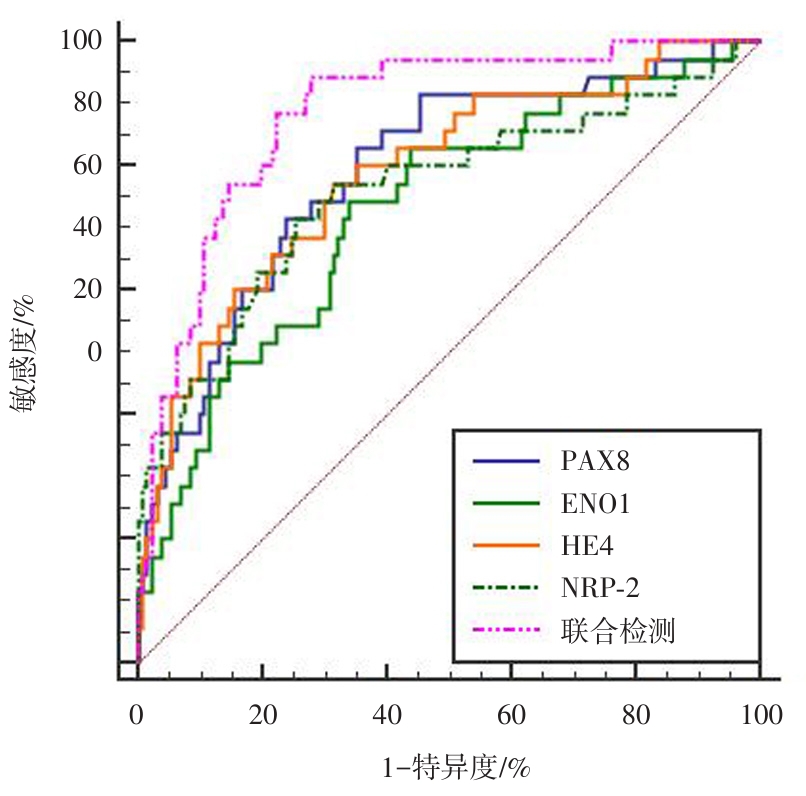
| 联合检查 | - | 0.885 | 94.29 | 71.31 | < 0.001 | 0.826 ~ 0.929 |
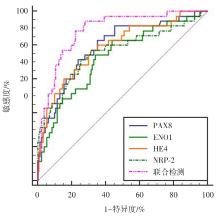
Fig.1
The predictive value of serum PAX8, ENO1, HE4 and NRP-2 levels for the prognosis of patients with endometrial cancer"
| [1] |
FERNANDEZ-GONZALEZ S, ZOCCOLI S G, SÁNCHEZ-PRIETO M, et al. Robotic versus laparoscopic and open surgery in obese endometrial cancer patients: A systematic review and meta-analysis[J]. J Robot Surg, 2025, 20(1): 129-129. doi:10.1007/s11701-025-03070-1 .
doi: 10.1007/s11701-025-03070-1 |
| [2] |
徐西凤, 王侠, 吴健亮, 等. 网膜素-1、分泌型磷蛋白1、错配修复系统蛋白表达状态与子宫内膜癌患者临床病理特征及预后的关系[J]. 实用医学杂志, 2025, 41(16): 2521-2527. doi:10.3969/j.issn.1006-5725.2025.16.012 .
doi: 10.3969/j.issn.1006-5725.2025.16.012 |
| [3] |
TAO W, PAN J, ZHANG W, et al. E2F8 Transcriptionally Activates DTL to Promote Endometrial Cancer Progression Via the MAPK Pathway[J]. Reprod Sci, 2025, 11(29): 33-38. doi:10.1007/s43032-025-02040-0 .
doi: 10.1007/s43032-025-02040-0 |
| [4] |
LIU W, REN J, LI Z, et al. Continuous-time random walk diffusion MRI facilitates assessment of Ki-67 expression in endometrial cancer: A comparative study with diffusion kurtosis imaging[J]. BMC Cancer, 2025, 25(1): 1890-1890. doi:10.1186/s12885-025-15271-w .
doi: 10.1186/s12885-025-15271-w |
| [5] |
ZHAN Q Q, LIU QY, YANG X, et al. Effects of silencing neuropilin-2 on proliferation, migration, and invasion of colorectal cancer HT-29[J]. Bioengineered, 2022, 13(4): 11042-11049. doi:10.1080/21655979.2022.2068363 .
doi: 10.1080/21655979.2022.2068363 |
| [6] |
LUNGULESCU C, GHIMPAU V, GHEONEA D I, et al. The Role of Neuropilin-2 in the Epithelial to Mesenchymal Transition of Colorectal Cancer: A Systematic Review[J]. Biomedicines, 2022, 10(1): 172-172. doi:10.3390/biomedicines10010172 .
doi: 10.3390/biomedicines10010172 |
| [7] |
LI Y, WANG H, CHEN L, et al. ENO1-mediated deoxycytidine synthesis and gemcitabine resistance by stabilizing RRM2 in pancreatic cancer[J]. Cell Death Dis, 2025, 17(1): 139-139. doi:10.1038/s41419-025-08061-6 .
doi: 10.1038/s41419-025-08061-6 |
| [8] |
中国抗癌协会妇科肿瘤专业委员会. 子宫内膜癌诊断与治疗指南(第四版)[J]. 中国实用妇科与产科杂志, 2018, 34(8): 880-886. doi:10.19538/j.fk2018080114 .
doi: 10.19538/j.fk2018080114 |
| [9] | 张惜明. 实用妇产科学[M]. 北京: 人民卫生出版社, 2011: 2031-2044. |
| [10] |
KIM M, LAI Y, LEE Y, et al. Validation of 2023 FIGO Stage IA1-IIIC2 Endometrial Carcinoma: A Retrospective Analysis of Two Tertiary Centers in South Korea and Taiwan[J]. Cancer Res Treat, 2025,57(4):1187-1197.doi:10.4143/crt.2024.1190 .
doi: 10.4143/crt.2024.1190 |
| [11] |
KAUPPINEN A K, OLKINUORA A P, MECKLIN J, et al. Molecular analysis of the evolutionary history of endometrial and ovarian carcinoma in Lynch syndrome[J]. Int J Cancer, 2025, 157(11): 2294-2308.doi:10.1002/ijc.70074 .
doi: 10.1002/ijc.70074 |
| [12] |
GAO H, XIAO M, FENG Y, et al. Serum biomarkers and clinicopathologic postoperative prognostic factors for in endometrial cancer patients[J]. Am J Transl Res, 2025, 17(7): 5063-5071. doi:10.62347/VRHT7250 .
doi: 10.62347/VRHT7250 |
| [13] |
LUO M, YU X, CHEN Z, et al. Mixed glandular neuroendocrine carcinoma of the endometrium with hypercalcemic crisis[J]. Am J Med Sci, 2025, 369(2): 281-285.doi:10.1016/j.amjms. 2024.08.010 .
doi: 10.1016/j.amjms. 2024.08.010 |
| [14] |
LIU F, LI C, DI M, et al. HNF1B polymorphisms and endometrial cancer risk: Validation of identified loci and evaluation of novel variants[J]. Expert Rev Mol Diagn, 2024, 11(4): 1-8. doi:10.1080/14737159.2024.2436397 .
doi: 10.1080/14737159.2024.2436397 |
| [15] |
NEILSON A, JAMIESON A, CHIU D, et al. Serum CA125 levels in the context of ProMisE molecular classification provides pre-operative prognostic information that can direct endometrial cancer management[J]. Gynecol Oncol, 2025, 5(193): 1-11. doi:10.1016/j.ygyno.2024.12.010 .
doi: 10.1016/j.ygyno.2024.12.010 |
| [16] |
KOLEVA V, SHEFKET S, STOENCHEVA S. Clinical significance of human epididymis protein 4 (HE4), cancer antigen 125 (CA125), the risk of ovarian malignancy algorithm (ROMA), and Copenhagen index (CPH-I) for the diagnosis of endometrial carcinoma[J]. Folia Med (Plovdiv), 2025, 67(1): 52-56. doi:10.3897/folmed.67.e143849 .
doi: 10.3897/folmed.67.e143849 |
| [17] |
SILPAIBULPANICH N, WIBULPOLPRASERT P, SRI-UTEN⁃CHAI B, et al. The diagnostic performance of CA 125, CT scan and combination of CA 125 with CT scan in extra-uterine extension, including intra-abdominal lymph node metastasis in apparently early-staged endometrial cancer patients[J]. J Minim Invasive Gynecol, 2026, 6(8): 1553-4650. doi:10.1016/j.jmig. 2026.01.004 .
doi: 10.1016/j.jmig. 2026.01.004 |
| [18] |
MAURYA V, SINGH S, SINGH S, et al. Tumor biomarkers HE4 and CA125 alongside enhanced computed tomography imaging in assessing lymph node metastasis in endometrial cancer[J]. Bioinformation, 2024, 20(11): 1453-1460. doi:10.6026/9732063002001453 .
doi: 10.6026/9732063002001453 |
| [19] |
SANTOS-PEREIRA J M, CARNERO A, MUÑOZ-GALVÁN S. Integrative multi-omic analysis reveals a PAX8-driven gene network linking tumor stemness to therapy response in ovarian cancer[J]. NAR Genom Bioinform, 2025, 7(3): 113-113. doi:10.1093/ nargab/lqaf113 .
doi: 10.1093/ nargab/lqaf113 |
| [20] |
TAHIR M, XING D, DING Q, et al. Identifying mesonephric-like adenocarcinoma of the endometrium by combining SOX17 and PAX8 immunohistochemistry[J]. Histopathology, 2025, 86(2): 268-277. doi:10.1111/his.15312 .
doi: 10.1111/his.15312 |
| [21] |
YING Q, XU H, WU X, et al. Clinical significance of lncRNA PAX8-AS1 and miR-96-5p in non-small cell lung cancer[J]. J Cardiothorac Surg, 2025, 20(1): 299-299. doi:10.1186/s13019-025-03542-3 .
doi: 10.1186/s13019-025-03542-3 |
| [22] |
WANG P, LI C, XU Y, et al. CEACAM6 regulates glycolytic metabolism in bladder cancer cell by controlling ENO1 stability[J]. Eur J Med Res, 2025, 30(1): 1233-1233. doi:10.1186/s40001-025-03659-0 .
doi: 10.1186/s40001-025-03659-0 |
| [23] |
WANG Z, WU P, ZHANG C, et al. Pachymic acid suppresses proliferation and invasion in colon cancer by inhibiting glycolysis via PPARγ/ENO1 pathway[J]. Chem Biol Interact, 2026, 25(424): 111881-111881. doi:10.1016/j.cbi.2025.111881 .
doi: 10.1016/j.cbi.2025.111881 |
| [24] |
LIU W, ZHOU L, LE Y, et al. UCHL3 depletion inhibits gastric cancer progression and enhances palbociclib sensitivity by regulating the AKT/CCND1 signaling axis via ENO1 ubiquitination[J]. Cell Death Dis, 2025, 16(1): 850-850. doi:10.1038/s41419-025-08153-3 .
doi: 10.1038/s41419-025-08153-3 |
| [25] |
MORELL A, STOKLOSA A, BLACKMAN A, et al. The utility of the novel biomarker HE4 for monitoring epithelial ovarian cancer during PARP inhibitor treatment[J]. Int J Gynecol Cancer, 2025, 9(27): 102682-102682. doi:10.1016/j.ijgc.2025.102682 .
doi: 10.1016/j.ijgc.2025.102682 |
| [26] |
MULLEN S A, DAS D, ZIAMIAVAGHI N, et al. Association of plasma NRP2 and VEGF-C levels with prostate cancer disease severity[J]. Prostate, 2024, 84(3): 277-284.doi:10.1002/pros.24648 .
doi: 10.1002/pros.24648 |
| Viewed | ||||||
|
Full text |
|
|||||
|
Abstract |
|
|||||
