

The Journal of Practical Medicine ›› 2026, Vol. 42 ›› Issue (12): 2238-2245.doi: 10.3969/j.issn.1006-5725.2026.12.020
• Chronic Disease Control • Previous Articles
Yihao CHEN1,Zonghua XIONG2,Yanpeng FANG3,Yang LIU3,Tao XU2( )
)
Received:2026-03-09
Online:2026-06-25
Published:2026-06-30
Contact:
Tao XU
E-mail:tcmking@sina.com
CLC Number:
Yihao CHEN,Zonghua XIONG,Yanpeng FANG,Yang LIU,Tao XU. The prognostic value of regadenoson stress echocardiography in patients with chronic coronary syndromes after percutaneous coronary intervention[J]. The Journal of Practical Medicine, 2026, 42(12): 2238-2245.
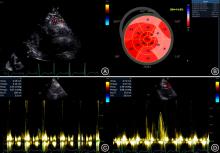
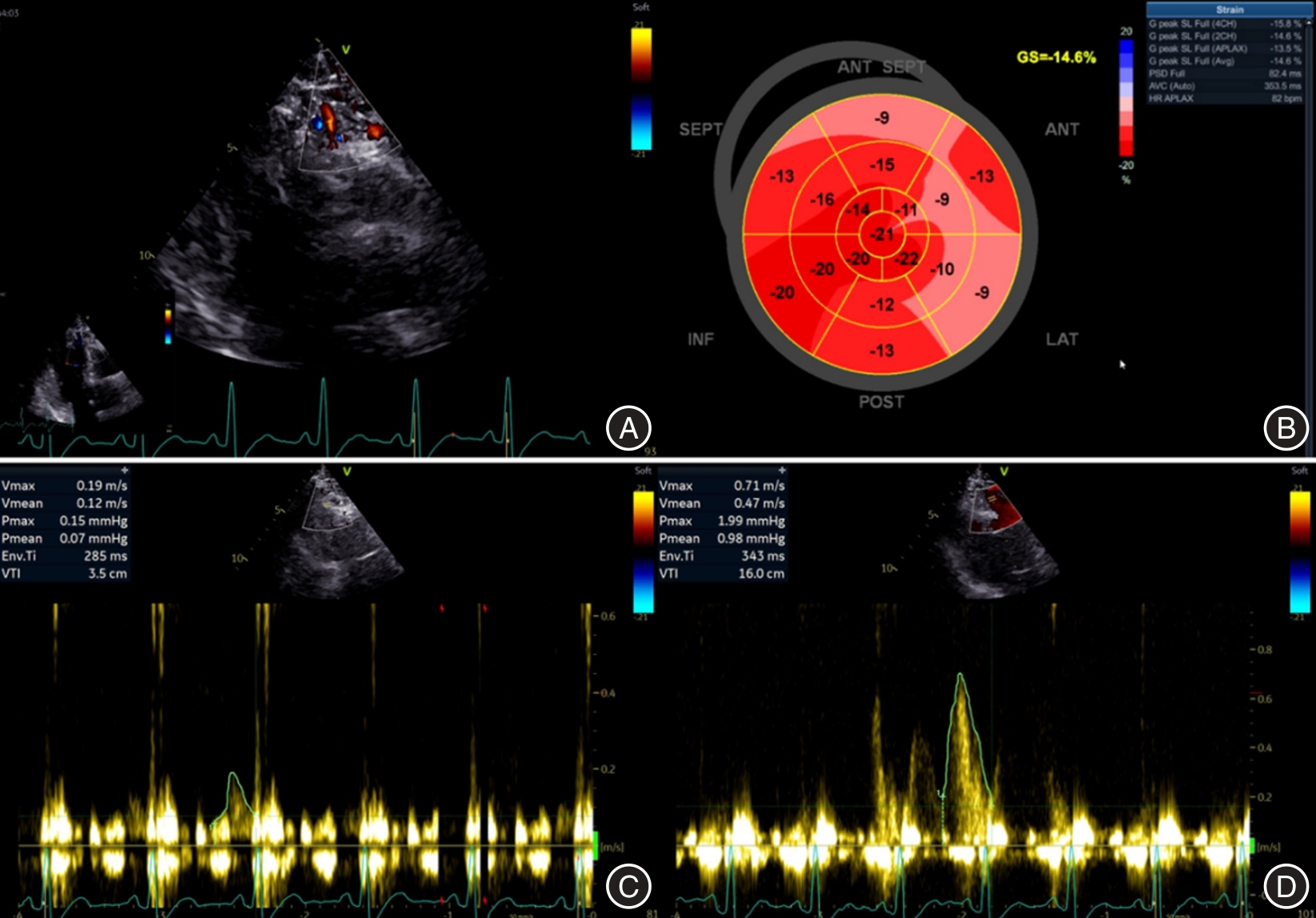
Fig.1
Schematic diagram of regadenoson stress echocardiography measurement"

Tab.1
Comparison of clinical data between the good prognosis group and the poor prognosis group"
| 临床资料 | 预后良好组(n = 71) | 预后不良组(n = 42) | t/Z/χ2 值 | P值 |
|---|---|---|---|---|
| 年龄( | 67.25 ± 10.54 | 71.05 ± 6.24 | 2.403 | 0.018 |
| 男性/例(%) | 41(57.74) | 26(61.90) | 0.189 | 0.664 |
| BMI( | 23.53 ± 2.84 | 24.48 ± 2.78 | 1.726 | 0.087 |
| 吸烟史/[例(%)] | 30(42.25) | 23(54.76) | 1.658 | 0.198 |
| 高血压病史/[例(%)] | 45(63.38) | 31(73.81) | 1.303 | 0.254 |
| 糖尿病病史/[例(%)] | 32(45.07) | 16(38.10) | 0.525 | 0.469 |
| 高脂血症病史/[例(%)] | 22(30.99) | 17(40.48) | 0.947 | 0.331 |
| 肾功能不全病史/[例(%)] | 16(22.54) | 11(26.19) | 0.194 | 0.660 |
| 多支病变血管/[例(%)] | 33(46.48) | 29(69.05) | 5.428 | 0.031 |
| CFVR( | 2.67 ± 0.50 | 2.06 ± 0.40 | -6.835 | < 0.001 |
| GLS(取绝对值)( | 18.71 ± 3.02 | 14.86 ± 3.82 | -5.927 | < 0.001 |
| LVEF[M(P25,P75)]/% | 60.00(56.00,63.00) | 57.00(55.00,61.25) | -1.708 | 0.088 |
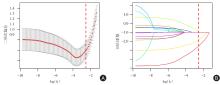
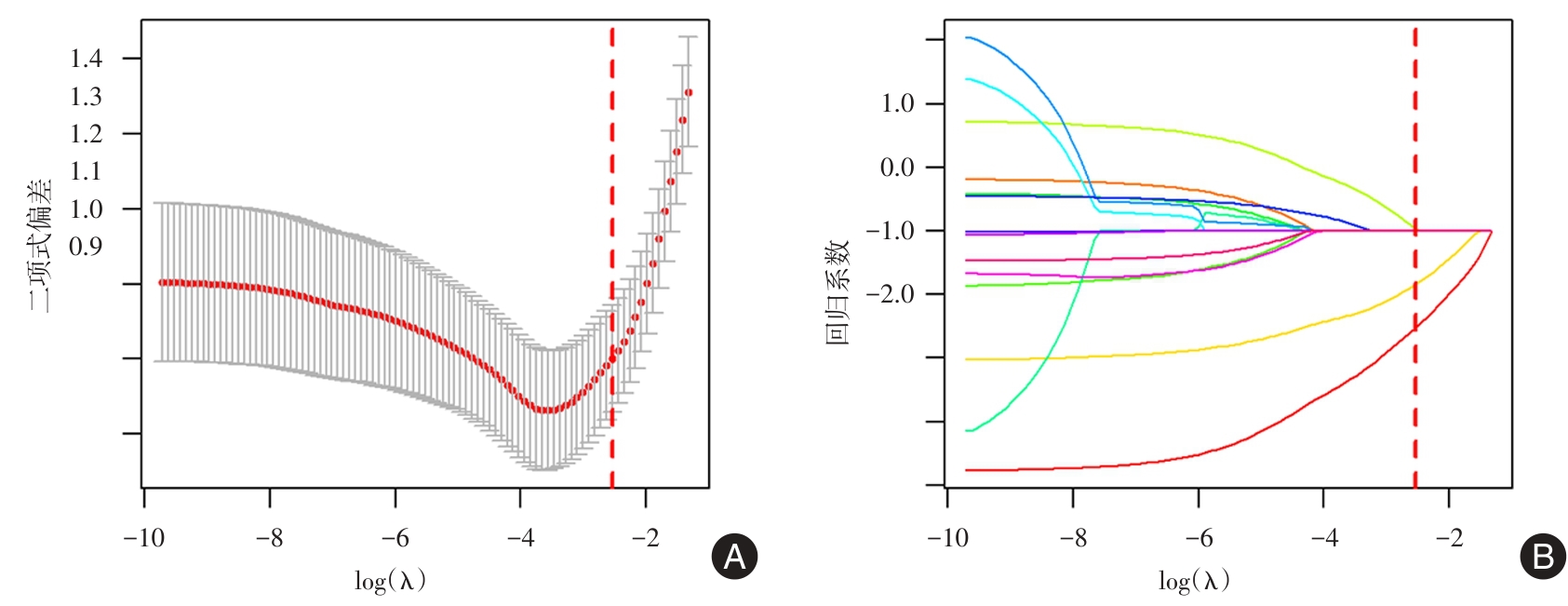
Fig.2
Variable selection by LASSO regression"
Tab.2
Logistic regression analysis of factors affecting the prognosis of CCS patients after PCI"
| 变量 | β | SE | Wald χ2 | P值 | OR值 | 95%CI |
|---|---|---|---|---|---|---|
| CFVR | -2.931 | 0.793 | 13.648 | < 0.001 | 0.053 | 0.011 ~ 0.253 |
| GLS | -0.237 | 0.091 | 6.815 | 0.009 | 0.789 | 0.661 ~ 0.943 |
| 年龄 | 0.068 | 0.032 | 4.630 | 0.031 | 1.071 | 1.006 ~ 1.139 |
| 常量 | 5.515 | 2.721 | 4.106 | 0.043 | - | - |
Tab.3
ROC analysis of CFVR, GLS, Age and their combined use in predicting poor prognosis in CCS patients after PCI"
| 项目 | 最佳截断值 | AUC(95%CI) | 约登指数 | 灵敏度/% | 特异度/% | P值 |
|---|---|---|---|---|---|---|
| CFVR | 2.22 | 0.835(0.759 ~ 0.910) | 0.521 | 83.1 | 69.0 | < 0.001 |
| GLS | 16.25 | 0.802(0.714 ~ 0.890) | 0.565 | 80.3 | 76.2 | < 0.001 |
| 年龄 | 64.50 | 0.607(0.504 ~ 0.709) | 0.304 | 88.1 | 42.3 | 0.058 |
| 联合 | - | 0.875(0.813 ~ 0.936) | 0.571 | 88.1 | 69.0 | < 0.001 |
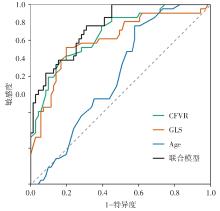
Fig.3
ROC curve of CFVR, GLS, Age and their combined use in predicting poor prognosis in CCS patients after PCI"
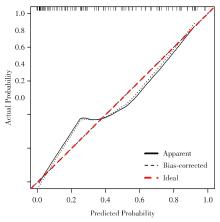
Fig.4
Calibration curve of the poor prognosis prediction model for CCS patients after PCI"
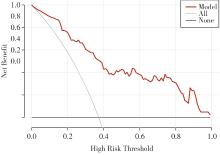
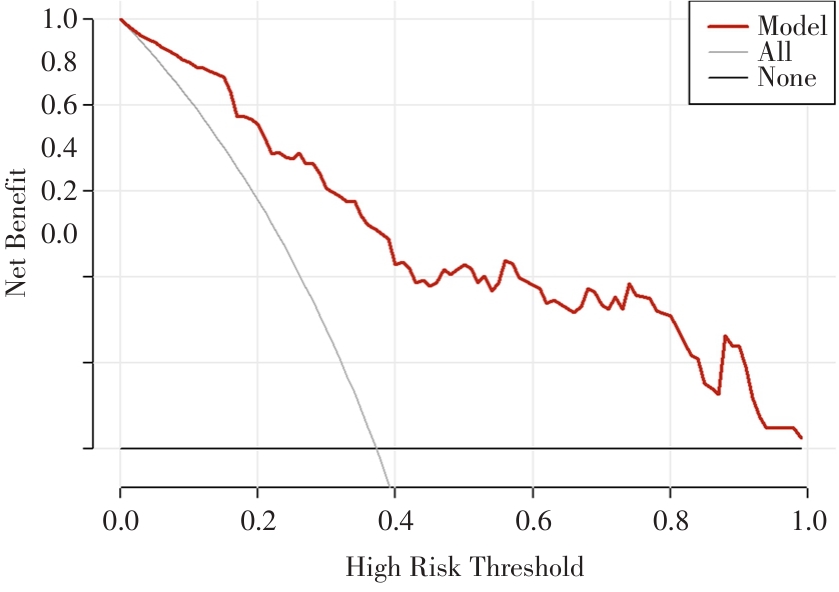
Fig.5
Decision curve analysis of the poor prognosis prediction model for CCS patients after PCI"
Tab.4
Group comparison of CFVR and GLS after ANCOVA adjustment for age"
| 指标 | 预后良好组(n = 71) | 预后不良组(n = 42) | F值 | P值 |
|---|---|---|---|---|
| CFVR | 2.68 ± 0.06 | 2.05 ± 0.07 | 45.88 | < 0.001 |
| GLS(取绝对值)/% | 18.71 ± 0.40 | 14.85 ± 0.52 | 33.55 | < 0.001 |
| [1] |
VRINTS C, ANDREOTTI F, KOSKINAS K C, et al. 2024 ESC Guidelines for the management of chronic coronary syndromes[J]. Eur Heart J, 2024,45(36): 3415-3537. doi: 10.1093/eurheartj/ehae177 .
doi: 10.1093/eurheartj/ehae177 |
| [2] |
中华医学会心血管病学分会, 中华心血管病杂志编辑委员会. 中国慢性冠脉综合征患者诊断及管理指南[J]. 中华心血管病杂志, 2024,52(6): 589-614. doi: 10.3760/cma.j.cn112148-20240325-00168 .
doi: 10.3760/cma.j.cn112148-20240325-00168 |
| [3] |
VIRANI S S, NEWBY L K, ARNOLD S V, et al. 2023 AHA/ACC/ACCP/ASPC/NLA/PCNA Guideline for the Management of Patients With Chronic Coronary Disease: A Report of the American Heart Association/American College of Cardiology Joint Committee on Clinical Practice Guidelines[J]. Circulation, 2023,148(9): e9-e119. doi: 10.1161/CIR.0000000000001168 .
doi: 10.1161/CIR.0000000000001168 |
| [4] |
BOUTALEB A M, GHAFARI C, UNGUREANU C, et al. Fractional flow reserve and non-hyperemic indices: Essential tools for percutaneous coronary interventions[J]. World J Clin Cases, 2023,11(10): 2123-2139. doi: 10.12998/wjcc.v11.i10.2123 .
doi: 10.12998/wjcc.v11.i10.2123 |
| [5] |
中国超声心动图学会, 中华医学会超声医学分会浅表组织和血管学组, 中国医药教育学会超声医学专业委员会. 慢性冠状动脉综合征负荷超声心动图检查临床实践指南(2023版)[J]. 中华超声影像学杂志, 2023,32(11): 921-945. doi:10. 3760/cma.j.cn131148-20230511-00267 .
doi: 10. 3760/cma.j.cn131148-20230511-00267 |
| [6] |
ANTONIOU N, ILIOPOULOU S, RAPTIS D G, et al. Global Longitudinal Strain in Stress Echocardiography: A Review of Its Diagnostic and Prognostic Role in Noninvasive Cardiac Assessment[J]. Diagnostics (Basel), 2025,15(16):2076. doi: 10.3390/diagnostics15162076 .
doi: 10.3390/diagnostics15162076 |
| [7] |
KWOK C S, NARAIN A, PACHA H M, et al. Readmissions to Hospital After Percutaneous Coronary Intervention: A Systematic Review and Meta-Analysis of Factors Associated with Readmissions[J]. Cardiovasc Revasc Med, 2020,21(3): 375-391. doi: 10.1016/j.carrev.2019.05.016 .
doi: 10.1016/j.carrev.2019.05.016 |
| [8] |
MAO Y, FAN H, HE W, et al. Risk Prediction Models for Hospital Readmission After Percutaneous Coronary Intervention: A Systematic Review and Meta-Analysis[J]. Rev Cardiovasc Med, 2025,26(9): 39409. doi: 10.31083/RCM39409 .
doi: 10.31083/RCM39409 |
| [9] |
YANG S, HWANG D, ZHANG J, et al. Clinical and Vessel Characteristics Associated With Hard Outcomes After PCI and Their Combined Prognostic Implications[J]. J Am Heart Assoc, 2023,12(17): e30572. doi: 10.1161/JAHA.123.030572 .
doi: 10.1161/JAHA.123.030572 |
| [10] |
LU Y, WANG Y, ZHOU B. Predicting long-term prognosis after percutaneous coronary intervention in patients with acute coronary syndromes: A prospective nested case-control analysis for county-level health services[J]. Front Cardiovasc Med, 2023,10: 1297527. doi: 10.3389/fcvm.2023.1297527 .
doi: 10.3389/fcvm.2023.1297527 |
| [11] |
WU C, GAO X, LI L, et al. Role of ST-Segment Resolution Alone and in Combination With TIMI Flow After Primary Percutaneous Coronary Intervention for ST-Segment-Elevation Myocardial Infarction[J]. J Am Heart Assoc, 2023,12(14): e29670. doi: 10.1161/JAHA.123.029670 .
doi: 10.1161/JAHA.123.029670 |
| [12] |
GALLONE G, KANG J, BRUNO F, et al. Impact of Left Ventricular Ejection Fraction on Procedural and Long-Term Outcomes of Bifurcation Percutaneous Coronary Intervention[J]. Am J Cardiol, 2022,172: 18-25. doi: 10.1016/j.amjcard.2022. 02.015 .
doi: 10.1016/j.amjcard.2022. 02.015 |
| [13] |
SANE P S, MANOJ V, DEMEL R, et al. Prognostic significance of Troponin I in patients undergoing primary percutaneous coronary intervention[J]. Indian Heart J, 2021,73(6): 737-739. doi: 10.1016/j.ihj.2021.09.004 .
doi: 10.1016/j.ihj.2021.09.004 |
| [14] |
ELKHOLY K O, HEGAZY O, OKUNADE A, et al. Regadenoson Stress Testing: A Comprehensive Review With a Focused Update[J]. Cureus, 2021,13(1): e12940. doi: 10.7759/cureus. 12940 .
doi: 10.7759/cureus. 12940 |
| [15] |
YAMAGUCHI M, HOSHINO M, SUGIYAMA T, et al. Preprocedural transthoracic Doppler echocardiography to identify stenosis associated with increased coronary flow after revascularisation[J]. Sci Rep, 2022,12(1): 1667. doi: 10.1038/s41598-022-05683-0 .
doi: 10.1038/s41598-022-05683-0 |
| [16] |
KHORSANDI M, BLUMENTHAL R S, BLAHA M J, et al. The ABCs of the 2023 AHA/ACC/ACCP/ASPC/NLA/PCNA guideline for the management of patients with chronic coronary disease[J]. Clin Cardiol, 2024,47(5): e24284. doi: 10.1002/clc.24284 .
doi: 10.1002/clc.24284 |
| [17] |
ZHAO R, ZHANG J, XIE Y, et al. Reserve of global constructive work for early diagnosis of myocardial ischemia and risk stratification in chronic coronary syndrome[J]. Front Cardiovasc Med, 2025,12: 1598453. doi: 10.3389/fcvm.2025.1598453 .
doi: 10.3389/fcvm.2025.1598453 |
| [18] |
SCARICA V, RINALDI R, ANIMATI F M, et al. Coronary microvascular dysfunction: Pathophysiology, diagnosis, and therapeutic strategies across cardiovascular diseases[J]. EXCLI J, 2025,24: 454-478. doi: 10.17179/excli2025-8285 .
doi: 10.17179/excli2025-8285 |
| [19] |
ČANKOVIĆ M, MILOVANČEV A, TADIĆ S, et al. Relationship Between Noninvasive Doppler-Derived Coronary Flow Reserve Measured by Transthoracic Echocardiography and Angiography Thermodilution-Measured Coronary Flow Reserve and the Index of Microcirculatory Resistance in Patients with Non-Obstructive Coronary Arteries[J]. Biomedicines, 2025,13(2):466. doi: 10.3390/biomedicines13020466 .
doi: 10.3390/biomedicines13020466 |
| [20] |
CIVIERI G, MONTISCI R, KERKHOF P L M, et al. Coronary Flow Velocity Reserve by Echocardiography: Beyond Atherosclerotic Disease[J]. Diagnostics (Basel), 2023,13(2):193. doi: 10.3390/diagnostics13020193 .
doi: 10.3390/diagnostics13020193 |
| [21] |
CIAMPI Q, ZAGATINA A, CORTIGIANI L, et al. Functional, Anatomical, and Prognostic Correlates of Coronary Flow Velocity Reserve During Stress Echocardiography[J]. J Am Coll Cardiol, 2019,74(18): 2278-2291. doi: 10.1016/j.jacc.2019.08.1046 .
doi: 10.1016/j.jacc.2019.08.1046 |
| [22] |
JENSEN S M, PRESCOTT E I B, ABDULLA J. The prognostic value of coronary flow reserve in patients with non-obstructive coronary artery disease and microvascular dysfunction: A systematic review and meta-analysis with focus on imaging modality and sex difference[J]. Int J Cardiovasc Imaging, 2023,39(12): 2545-2556. doi: 10.1007/s10554-023-02948-1 .
doi: 10.1007/s10554-023-02948-1 |
| [23] |
CORTIGIANI L, GAIBAZZI N, CIAMPI Q, et al. High Resting Coronary Flow Velocity by Echocardiography Is Associated With Worse Survival in Patients With Chronic Coronary Syndromes[J]. J Am Heart Assoc, 2024,13(4): e31270. doi: 10.1161/JAHA.123.031270 .
doi: 10.1161/JAHA.123.031270 |
| [24] |
CORTIGIANI L, GAIBAZZI N, CIAMPI Q, et al. Reduction of Coronary Flow Velocity Reserve as the Main Driver of Prognostically Beneficial Coronary Revascularization[J]. J Am Soc Echocardiogr, 2025,38(1): 24-32. doi: 10.1016/j.echo.2024.09.011 .
doi: 10.1016/j.echo.2024.09.011 |
| [25] |
VOIGT J, PEDRIZZETTI G, LYSYANSKY P, et al. Definitions for a common standard for 2D speckle tracking echocardiography: Consensus document of the EACVI/ASE/Industry Task Force to standardize deformation imaging[J]. Eur Heart J Cardiovasc Imaging, 2015,16(1): 1-11. doi: 10.1093/ehjci/jeu184 .
doi: 10.1093/ehjci/jeu184 |
| [26] |
叶白冰, 李秀娟, 陈赛君. 三维斑点追踪成像技术联合左室压力-应变环对冠心病早期患者左心室收缩功能减退的评估价值[J]. 实用医学杂志, 2025,41(1): 108-113. doi: 10.3969/j.issn.1006-5725.2025.01.018 .
doi: 10.3969/j.issn.1006-5725.2025.01.018 |
| [27] |
LENELL J, LINDAHL B, ERLINGE D, et al. Global longitudinal strain in long-term risk prediction after acute coronary syndrome: An investigation of added prognostic value to ejection fraction[J]. Clin Res Cardiol, 2025,114(6): 709-718. doi: 10.1007/s00392-024-02439-w .
doi: 10.1007/s00392-024-02439-w |
| [28] |
JANWETCHASIL P, YINDEENGAM A, KRITTAYAPHONG R. Prognostic value of global longitudinal strain in patients with preserved left ventricular systolic function: A cardiac magnetic resonance real-world study[J]. J Cardiovasc Magn Reson, 2024,26(2): 101057. doi: 10.1016/j.jocmr.2024.101057 .
doi: 10.1016/j.jocmr.2024.101057 |
| [29] |
KUNA C, BRADARIC C, KOCH T, et al. Age-related ten-year outcomes after percutaneous coronary intervention of in-stent restenosis[J]. Int J Cardiol, 2025, 428: 133109. doi: 10.1016/j.ijcard.2025.133109 .
doi: 10.1016/j.ijcard.2025.133109 |
| Viewed | ||||||
|
Full text |
|
|||||
|
Abstract |
|
|||||
