

The Journal of Practical Medicine ›› 2026, Vol. 42 ›› Issue (6): 1078-1087.doi: 10.3969/j.issn.1006-5725.2026.06.022
• Treatise: Clinical Practice • Previous Articles
Qian TANG,Zeyan LIU,Jinglin CHENG( )
)
Received:2025-11-28
Revised:2026-01-14
Accepted:2026-01-16
Online:2026-03-25
Published:2026-03-26
Contact:
Jinglin CHENG
E-mail:chjl2018@126.com
CLC Number:
Qian TANG,Zeyan LIU,Jinglin CHENG. The relationship of serum IMA, sST2, ApoB/ApoA1 with poor ST segment regression on electrocardiogram after PCI in STEMI patients[J]. The Journal of Practical Medicine, 2026, 42(6): 1078-1087.

Tab.1
Comparison of clinical data between the poor"
| 变量 | 回落不良组(n = 31) | 回落良好组(n = 71) | χ2 /t值 | P值 |
|---|---|---|---|---|
| 男性 | 20(64.52) | 42(59.15) | 0.260 | 0.610 |
| 年龄分层 | 0.749 | 0.387 | ||
| < 60岁 | 7(22.58) | 22(30.99) | ||
| ≥ 60岁 | 24(77.42) | 49(69.01) | ||
| 发病至入院时间 | 9.269 | 0.002 | ||
| ≤ 6 h | 14(45.16) | 54(76.06) | ||
| > 6 h | 17(54.84) | 17(23.94) | ||
| BMI(x ± s)/(kg/m2) | 23.26 ± 2.63 | 23.48 ± 1.93 | 0.472 | 0.638 |
| 吸烟 | 19(61.29) | 39(54.93) | 0.356 | 0.551 |
| 饮酒 | 13(41.94) | 26(36.62) | 0.258 | 0.611 |
| 糖尿病 | 9(29.03) | 16(22.54) | 0.492 | 0.483 |
| 高血压 | 15(48.39) | 36(50.70) | 0.046 | 0.830 |
| 高脂血症 | 10(32.26) | 19(26.76) | 0.321 | 0.571 |
| 冠脉左前降支梗死 | 23(74.19) | 34(47.89) | 6.057 | 0.014 |
| 梗死部位 | 1.665 | 0.435 | ||
| 前壁 | 20(64.52) | 36(50.70) | ||
| 下壁 | 7(22.58) | 22(30.99) | ||
| 其他 | 4(12.90) | 13(18.31) | ||
| 病变血管支数 | 1.707 | 0.191 | ||
| 单支 | 14(45.16) | 42(59.15) | ||
| 双支及以上 | 17(54.84) | 29(40.85) | ||
| 支架直径(x ± s)/mm | 3.31 ± 0.42 | 3.17 ± 0.35 | 1.746 | 0.084 |
| 置入支架数目(x ± s)/枚 | 1.48 ± 0.36 | 1.44 ± 0.30 | 0.582 | 0.561 |
| Killip分级 | 4.716 | 0.030 | ||
| < Ⅱ级 | 12(38.71) | 44(61.97) | ||
| ≥ Ⅱ级 | 19(61.29) | 27(38.03) | ||
| TIMI血流Ⅲ级 | 19(61.29) | 60(84.51) | 6.660 | 0.010 |
Tab.2
Comparison of serum IMA, sST2, and ApoB/ApoA1 levels between the poor recovery group and the good recovery group"
| 组别 | IMA(IU/mL) | t值 | P值 | sST2(pg/mL) | t值 | P值 | ApoB/ApoA1 | t值 | P值 | |||
|---|---|---|---|---|---|---|---|---|---|---|---|---|
| 术前 | 术后24 h | 术前 | 术后24 h | 术前 | 术后24 h | |||||||
| 回落不良组(n = 31) | 186.78 ± 30.61 | 130.79 ± 15.54 | 13.510 | < 0.001 | 110.78 ± 30.52 | 86.25 ± 15.79 | 8.759 | < 0.001 | 1.75 ± 0.34 | 1.42 ± 0.41 | 4.900 | < 0.001 |
| 回落良好组(n = 71) | 145.75 ± 40.96 | 86.52 ± 20.89 | 16.138 | < 0.001 | 82.14 ± 15.71 | 50.63 ± 12.75 | 18.658 | < 0.001 | 1.32 ± 0.27 | 0.81 ± 0.22 | 17.540 | < 0.001 |
| t值 | 5.001 | 10.578 | 6.256 | 12.049 | 6.823 | 9.759 | ||||||
| P值 | < 0.001 | < 0.001 | < 0.001 | < 0.001 | < 0.001 | < 0.001 | ||||||
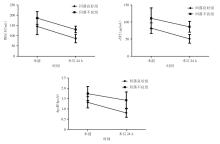
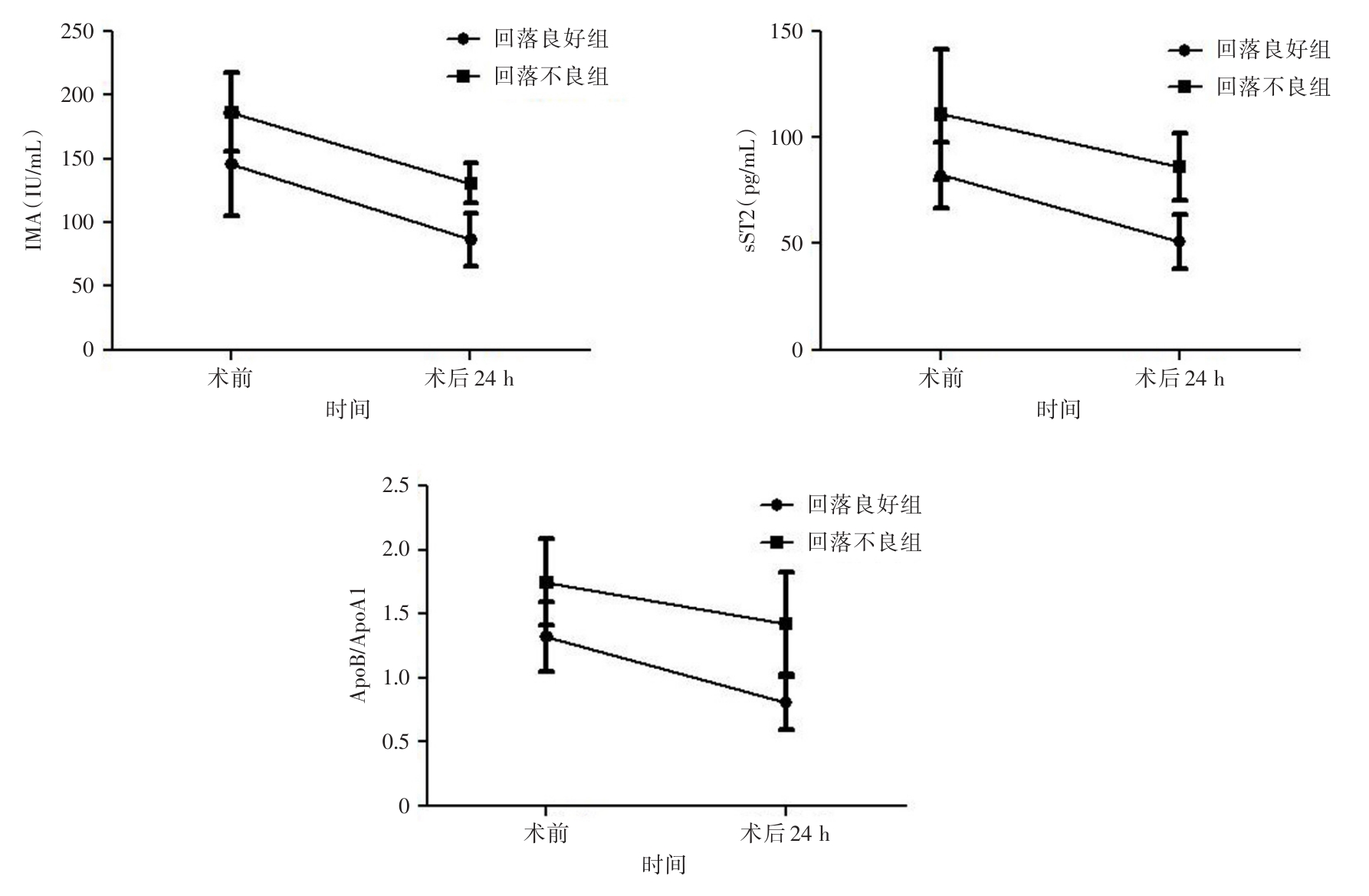
Fig.1
Line graphs of serum IMA, sST2, and ApoB/ApoA1 levels before surgery and 24 hours after surgery in the poor recovery group and the good recovery group"
Tab.3
ROC analysis of preoperative serum IMA, sST2, ApoB/ApoA1 and their combined use in predicting poor ST segment regression after PCI in STEMI patients"
| 项目 | AUC | 截断值 | Youden index | SE | 95%CI | P值 | 敏感度/% | 特异度/% |
|---|---|---|---|---|---|---|---|---|
| IMA/(IU/mL) | 0.818 | 160.57 | 0.539 | 0.046 | 0.730 ~ 0.888 | < 0.001 | 80.65 | 73.24 |
| sST2/(pg/mL) | 0.778 | 101.85 | 0.603 | 0.061 | 0.685 ~ 0.855 | < 0.001 | 64.52 | 95.77 |
| ApoB/ApoA1 | 0.866 | 1.63 | 0.611 | 0.040 | 0.784 ~ 0.925 | < 0.001 | 70.97 | 90.14 |
| 联合 | 0.931 | - | 0.760 | 0.035 | 0.864 ~ 0.972 | < 0.001 | 77.42 | 98.59 |
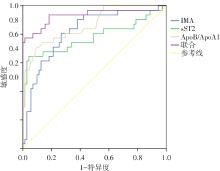
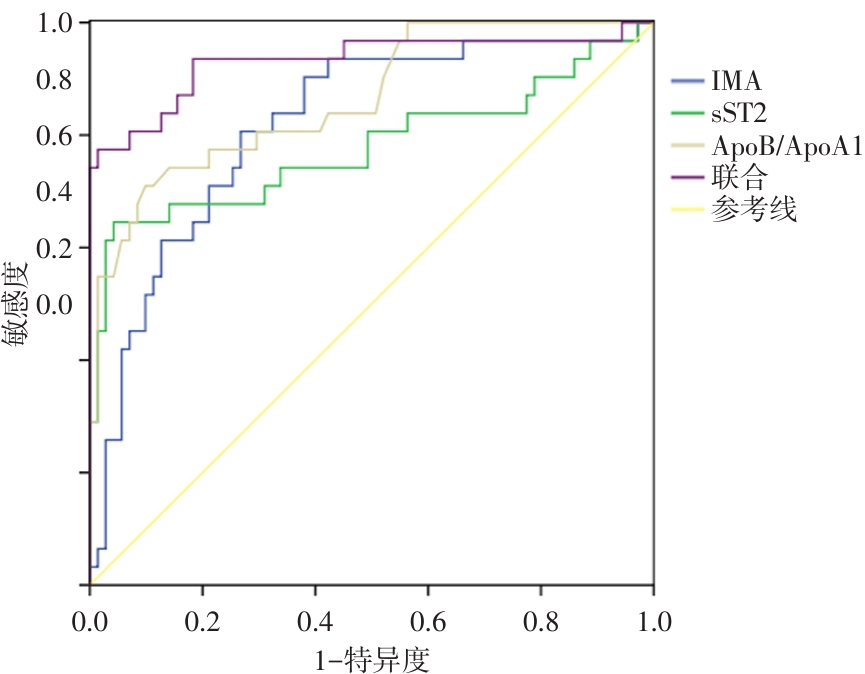
Fig.2
ROC analysis of serum IMA, sST2, ApoB/ApoA1and their combined prediction for poor ST segmentregression in STEMI patients after PCI"
Tab.4
Logistic regression analysis assignment table"
| 自变量 | 赋值 |
|---|---|
| 发病至入院时间 | ≤ 6 h = 0,> 6 h = 1 |
| 冠脉左前降支梗死 | 否 = 0,是 = 1 |
| Killip分级 | < Ⅱ级 = 0,≥ Ⅱ级 = 1 |
| TIMI血流Ⅲ级 | 否 = 0,是 = 1 |
| 术前IMA | ≤ 160.57 IU/mL = 0,> 160.57 IU/mL = 1 |
| 术前sST2 | ≤ 101.85 pg/mL = 0,> 101.85 pg/mL = 1 |
| 术前ApoB/ApoA1 | ≤ 1.63 = 0,> 1.63 = 1 |
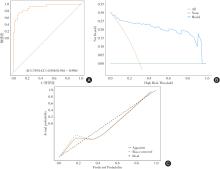
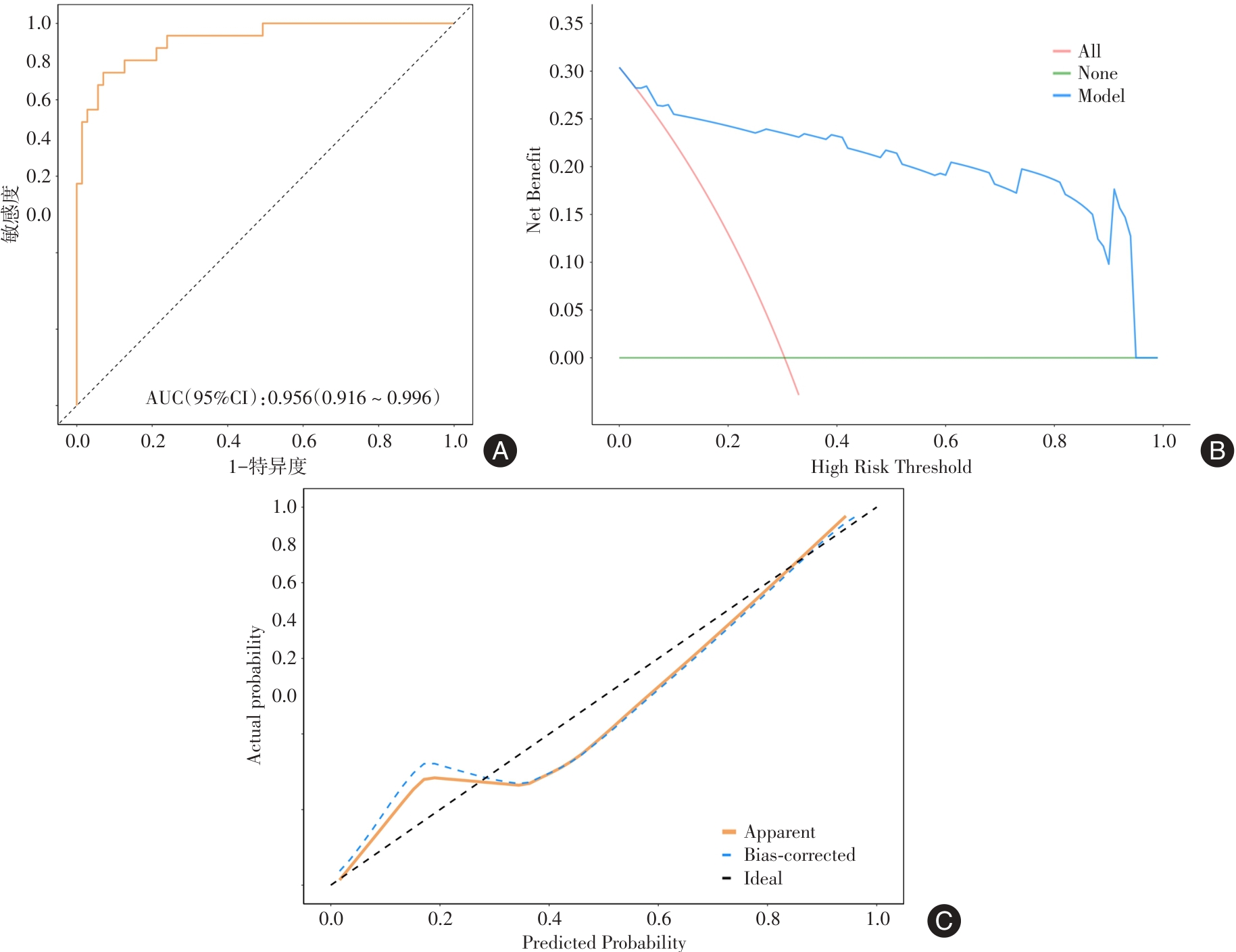
Fig.3
The value of the multi-factor logistic regression model in predicting poor ST segment recovery in STEMI patients after PCI surgery"
Tab.5
Logistic regression analysis of factors affecting ST segment regression in STEMI patients after PCI surgery"
| 自变量 | β | SE | Wald χ2 | P值 | OR值 | 95%CI |
|---|---|---|---|---|---|---|
| 常数 | -2.568 | 0.825 | 9.689 | 0.002 | - | - |
| 发病至入院时间 | 0.245 | 0.208 | 1.387 | 0.240 | 1.278 | 0.850 ~ 1.921 |
| 冠脉左前降支梗死 | 1.086 | 0.312 | 12.116 | < 0.001 | 2.962 | 1.607 ~ 5.460 |
| Killip分级 | 0.702 | 0.586 | 1.435 | 0.232 | 2.018 | 0.640 ~ 6.363 |
| TIMI血流Ⅲ级 | 0.935 | 0.598 | 2.445 | 0.119 | 2.547 | 0.789 ~ 8.224 |
| 术前IMA | 0.856 | 0.287 | 8.896 | 0.003 | 2.354 | 1.341 ~ 4.131 |
| 术前sST2 | 0.923 | 0.305 | 9.158 | 0.003 | 2.517 | 1.384 ~ 4.576 |
| 术前ApoB/ApoA1 | 1.052 | 0.318 | 10.944 | 0.001 | 2.863 | 1.535 ~ 5.340 |
Tab.6
Collinearity diagnostics for factors influencing poor ST segment regression in STEMI patients after PCI surgery"
| 自变量 | VIF值 | 容忍度 | 共线性判断 |
|---|---|---|---|
| 发病至入院时间 | 1.215 | 0.823 | 无明显共线性 |
| 冠脉左前降支梗死 | 1.326 | 0.754 | 无明显共线性 |
| Killip分级 | 1.432 | 0.698 | 无明显共线性 |
| TIMI血流Ⅲ级 | 1.298 | 0.771 | 无明显共线性 |
| 术前IMA | 1.495 | 0.669 | 无明显共线性 |
| 术前sST2 | 1.472 | 0.679 | 无明显共线性 |
| 术前ApoB/ApoA1 | 1.386 | 0.721 | 无明显共线性 |
| 平均值 | 1.375 | 0.727 | 整体无共线性 |
| [1] |
BISCAGLIA S, GUIDUCCI V, ESCANED J, et al. Complete or culprit-only PCI in older patients with myocardial infarction[J]. N Engl J Med, 2023, 389(10): 889-898. doi:10.1056/NEJMoa2300468 .
doi: 10.1056/NEJMoa2300468 |
| [2] |
WU C, GAO X, LI L, et al. Role of ST-segment resolution alone and in combination with TIMI flow after primary percutaneous coronary intervention for ST-segment-elevation myocardial infarction[J]. J Am Heart Assoc, 2023, 12(14): e029670. doi:10.1161/JAHA.123.029670 .
doi: 10.1161/JAHA.123.029670 |
| [3] |
GHAFFARI S, KOLAHDOUZAN K, RAHIMI M, et al. Predictors of ST depression resolution in STEMI patients undergoing primary PCI and its clinical significance[J]. Int J Gen Med, 2020, 13: 271-279. doi:10.2147/IJGM.S258573 .
doi: 10.2147/IJGM.S258573 |
| [4] |
KASSAM N, VARWANI M, NGUNGA M, et al. Ten-year review of ST-Segment Elevation Myocardial Infarction (STEMI) in Tanzania: A single center retrospective review[J]. Pan Afr Med J, 2024, 49: 82. doi:10.11604/pamj.2024.49.82.45351 .
doi: 10.11604/pamj.2024.49.82.45351 |
| [5] |
CHAUDHARY A J, IQBAL S, AHMAD KHAN N, et al. Comparative effects of rosuvastatin and atorvastatin loading doses on immediate post-percutaneous coronary intervention (PCI) thrombolysis in myocardial infarction (TIMI) flow in ST-segment elevation myocardial infarction (STEMI) patients[J]. Cureus, 2024, 16(11): e74076. doi:10.7759/cureus.74076 .
doi: 10.7759/cureus.74076 |
| [6] |
WANG Z, PENG J. The predictive value of the nomogram model of clinical risk factors for ischemia–reperfusion injury after primary percutaneous coronary intervention[J]. Sci Rep, 2023, 13: 5084. doi:10.1038/s41598-023-32222-2 .
doi: 10.1038/s41598-023-32222-2 |
| [7] |
XIANG L, ZHANG M, WU H, et al. The expression and prognostic value of ischemia modified albumin (IMA), red blood cell distribution width (RDW), and lipoprotein (LP) in patients with diabetes mellitus complicated with coronary heart disease[J]. Ann Palliat Med, 2021, 10(4): 4463-4471. doi:10.21037/apm-21-425 .
doi: 10.21037/apm-21-425 |
| [8] |
ZHANG Y, ZHANG L, CHEN Z. Effect of combining sST2/HDL-C ratio with risk factors of coronary heart disease on the detection of angina pectoris in Chinese: A retrospective observational study[J]. Cardiovasc Diagn Ther, 2023, 13(2): 345-354. doi:10.21037/cdt-22-520 .
doi: 10.21037/cdt-22-520 |
| [9] |
CHE W, JIN Y, CHANG S, et al. Prediction of myocardial ischemia-reperfusion injury post-PCI: Role of sST2 levels in STEMI patients[J]. BMC Cardiovasc Disord, 2025, 25(1): 280. doi:10.1186/s12872-025-04708-6 .
doi: 10.1186/s12872-025-04708-6 |
| [10] |
ZHOU Y, LIU H, YANG H, et al. The value of the apolipoprotein B/apolipoprotein A1 ratio in predicting the rapid progression of non-culprit coronary lesions in acute coronary syndrome in patients with diabetes mellitus after percutaneous coronary intervention[J]. Int Heart J, 2023, 64(4): 562-569. doi:10.1536/ihj.22-676 .
doi: 10.1536/ihj.22-676 |
| [11] |
中华医学会心血管病学分会,中华心血管病杂志编辑委员会.急性ST段抬高型心肌梗死诊断和治疗指南(2019)[J]. 中华心血管病杂志, 2019, 47(10): 766-783. doi:10.3760/cma.j.issn.0253-3758.2019.10.003
doi: 10.3760/cma.j.issn.0253-3758.2019.10.003 |
|
doi:10.3760/cma.j.issn.0253?3758.2019.10.003. doi:10.3760/cma.j.issn.0253-3758.2019.10.003
doi: 10.3760/cma.j.issn.0253-3758.2019.10.003 |
|
| [12] |
晋辉, 郑献召, 沈玲, 等. 三种冠状动脉内灌注用药方案对高血栓负荷急性ST段抬高型心肌梗死患者经皮冠状动脉介入术后心肌灌注及短期预后的影响[J]. 中国心血管杂志, 2024, 29(2): 143-151. doi:10.3969/j.issn.1007-5410. 2024. 02.009 .
doi: 10.3969/j.issn.1007-5410. 2024. 02.009 |
| [13] |
LYU W Y, QIN C Y, WANG X T, et al. The application of myocardial contrast echocardiography in assessing microcirculation perfusion in patients with acute myocardial infarction after PCI[J]. BMC Cardiovasc Disord, 2022, 22(1): 233. doi:10.1186/s12872-021-02404-9 .
doi: 10.1186/s12872-021-02404-9 |
| [14] |
LAHTI R, RANKINEN J, LYYTIKÄINEN L P, et al. High-risk ECG patterns in ST elevation myocardial infarction for mortality prediction[J]. J Electrocardiol, 2022, 74: 13-19. doi:10.1016/j.jelectrocard.2022.07.068 .
doi: 10.1016/j.jelectrocard.2022.07.068 |
| [15] |
SEDOVA K A, DEMIDOVA M M, AZAROV J E, et al. Terminal T-wave inversion predicts reperfusion tachyarrhythmias in STEMI[J]. J Electrocardiol, 2022, 71: 28-31. doi:10.1016/j.jelectrocard.2021.12.008 .
doi: 10.1016/j.jelectrocard.2021.12.008 |
| [16] |
RALAPANAWA U, SIVAKANESAN R, TENNAKOON S, et al. Ischemia-modified albumin: Is it a promising marker in acute coronary syndrome?[J]. BMC Cardiovasc Disord, 2024, 24(1): 436. doi:10.1186/s12872-024-04108-2 .
doi: 10.1186/s12872-024-04108-2 |
| [17] |
JAWADE P, KHILLARE K M, MANGUDKAR S, et al. A comparative study of ischemia-modified albumin: A promising biomarker for early detection of acute coronary syndrome (ACS)[J]. Cureus, 2023, 15(8): e44357. doi:10.7759/cureus.44357 .
doi: 10.7759/cureus.44357 |
| [18] |
ALADAĞ N, ASOĞLU R, OZDEMIR M, et al. Oxidants and antioxidants in myocardial infarction (MI): Investigation of ischemia modified albumin, malondialdehyde, superoxide dismutase and catalase in individuals diagnosed with ST elevated myocardial infarction (STEMI) and non-STEMI (NSTEMI)[J]. J Med Biochem, 2021, 40(3): 286-294. doi:10.5937/jomb0-28879 .
doi: 10.5937/jomb0-28879 |
| [19] |
OHNEWEIN B, SHOMANOVA Z, JIRAK P, et al. Dynamics of the novel cardiac biomarkers sST2, H-FABP, GDF-15 and suPAR in HFrEF patients undergoing heart failure therapy, a pilot study[J]. J Clin Med, 2025, 14(16): 5668. doi:10.3390/jcm14165668 .
doi: 10.3390/jcm14165668 |
| [20] |
HUANG S, YU L J, SUN G F, et al. Short-term predictive value of sST2 in patients with STEMI following primary PCI: A prospective observational study[J]. BMC Cardiovasc Disord, 2025, 25(1): 21. doi:10.1186/s12872-025-04488-z .
doi: 10.1186/s12872-025-04488-z |
| [21] |
PANTERIS E, DEDA O, PAPAZOGLOU A S, et al. Machine learning algorithm to predict obstructive coronary artery disease: Insights from the CorLipid trial[J]. Metabolites, 2022, 12(9): 816. doi:10.3390/metabo12090816 .
doi: 10.3390/metabo12090816 |
| [22] |
JIN Z L, HE T, PENG L, et al. Lipoprotein(a) and benefit of PCSK9 inhibition in emergency complex higher-risk and indicated patients[J]. Curr Med Sci, 2023, 43(6): 1206-1212. doi:10.1007/s11596-023-2791-9 .
doi: 10.1007/s11596-023-2791-9 |
| [23] |
HASSANPOUR M, RAHBARGHAZI R, REZABAKHSH A, et al. Relationship between angiogenesis biomarker endocan and apolipoproteins in patients with acute myocardial infarction[J]. Future Cardiol, 2024, 20(10): 555-561. doi:10.1080/14796678.2024.2365552 .
doi: 10.1080/14796678.2024.2365552 |
| [24] |
谢伟, 苏振琪. 血脂变异性对急性ST段抬高型心肌梗死急诊经皮冠脉介入术后不良心血管事件的预测价值[J]. 实用医学杂志, 2024, 40(15): 2121-2125. doi:10.3969/j.issn.1006-5725.2024.15.013 .
doi: 10.3969/j.issn.1006-5725.2024.15.013 |
| [25] |
贺威, 李馨, 王秋雨, 等. 老年急性ST段抬高型心肌梗死患者急诊介入术后慢血流或无复流危险因素及预后分析[J]. 中华老年心脑血管病杂志, 2024, 26(7): 742-745. doi:10.3969/j.issn.1009-0126.2024.07.004 .
doi: 10.3969/j.issn.1009-0126.2024.07.004 |
| [26] |
WU H L, HURILE B, LI Z P, et al. The predictive value of geriatric nutritional risk index combined with the GRACE score in predicting the risk of one year poor prognosis in elderly patients with non-ST segment elevation myocardial infarction after PCI[J]. Clin Interv Aging, 2024, 19: 705-714. doi:10.2147/CIA.S457971 .
doi: 10.2147/CIA.S457971 |
| Viewed | ||||||
|
Full text |
|
|||||
|
Abstract |
|
|||||
