

The Journal of Practical Medicine ›› 2026, Vol. 42 ›› Issue (12): 2230-2237.doi: 10.3969/j.issn.1006-5725.2026.12.019
• Chronic Disease Control • Previous Articles
Yingtao YU1,2,jinyan SU2,4,Xiulong ZHU1,3( )
)
Received:2026-02-26
Online:2026-06-25
Published:2026-06-30
Contact:
Xiulong ZHU
E-mail:13927586966@139.com
CLC Number:
Yingtao YU,jinyan SU,Xiulong ZHU. Integrating observational and Mendelian randomization analyses to investigate the association between the triglyceride-glucose index and coronary heart disease[J]. The Journal of Practical Medicine, 2026, 42(12): 2230-2237.
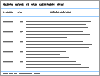
Tab.1
Baseline characteristics of participants"
| 参与者特征 | 非CHD组(n = 149) | CHD组(n = 144) | P值 |
|---|---|---|---|
| 年龄/岁 | 59.6 ± 10.3 | 66.0 ± 11.1 | < 0.001 |
| FPG/(mg/dL) | 113.7 ± 42.3 | 135.1 ± 67.2 | 0.001 |
| TG/(mg/dL) | 143.3 ± 88.3 | 174.0 ± 120.5 | 0.008 |
| TyG指数 | 8.8 ± 0.7 | 9.1 ± 0.8 | < 0.001 |
| 肌酐/(μmol/L) | 72.5 ± 19.6 | 82.2 ± 36.7 | 0.040 |
| 尿酸/(μmol/L) | 362.7 ± 91.7 | 381.6 ± 100.1 | 0.197 |
| 总胆固醇/(mmol/L) | 5.5 ± 1.1 | 5.5 ± 1.4 | 0.959 |
| 低密度脂蛋白/(mmol/L) | 3.5 ± 0.8 | 3.6 ± 1.0 | 0.913 |
| 高密度脂蛋白/(mmol/L) | 1.3 ± 0.3 | 1.2 ± 0.3 | < 0.001 |
| ALT/(U/L) | 26.8 ± 23.3 | 26.1 ± 16.4 | 0.293 |
| AST/(U/L) | 28.6 ± 13.1 | 35.9 ± 45.3 | < 0.001 |
| BMI/(kg/m2) | 23.7 ± 3.8 | 24.0 ± 3.7 | 0.782 |
| 性别/[例(%)] | 0.108 | ||
| 女 | 75(50.3) | 59(41.0) | |
| 男 | 74(49.7) | 85(59.0) | |
| 高血压病/[例(%)] | 0.337 | ||
| 否 | 110(73.8) | 99(68.8) | |
| 是 | 39(26.2) | 45(31.2) | |
| 糖尿病/[例(%)] | 0.007 | ||
| 否 | 134(89.9) | 113(78.5) | |
| 是 | 15(10.1) | 31(21.5) | |
| 吸烟/[例(%)] | 0.064 | ||
| 否 | 130(87.2) | 114(79.2) | |
| 是 | 19(12.8) | 30(20.8) | |
| 降脂药/[例(%)] | 0.002 | ||
| 否 | 119(79.9) | 91(63.2) | |
| 是 | 30(20.1) | 53(36.8) | |
| 降糖药/[例(%)] | 0.012 | ||
| 否 | 133(89.3) | 113(78.5) | |
| 是 | 16(10.7) | 31(21.5) |
Tab.2
Correlation between TyG index and CHD risk"
| 暴露因素 | 模型Ⅰ | 模型Ⅱ | 模型Ⅲ | |||||
|---|---|---|---|---|---|---|---|---|
| OR(95%CI) | P值 | OR(95%CI) | P值 | OR(95%CI) | P值 | |||
| TyG指数 | 1.92(1.36 ~ 2.70) | 0.000 2 | 2.47(1.64 ~ 3.73) | < 0.000 1 | 1.72(1.09 ~ 2.71) | 0.018 9 | ||
| TyG指数(四分位数) | ||||||||
| Q1 | 1.0 | 1.0 | 1.0 | |||||
| Q2 | 1.88(0.96 ~ 3.68) | 0.064 8 | 2.17(1.03 ~ 4.59) | 0.042 4 | 2.24(1.00 ~ 5.04) | 0.050 5 | ||
| Q3 | 1.99(1.02 ~ 3.88) | 0.044 7 | 2.84(1.35 ~ 6.01) | 0.006 1 | 2.10(0.92 ~ 4.78) | 0.079 2 | ||
| Q4 | 4.00(2.02 ~ 7.95) | < 0.000 1 | 6.08(2.75 ~ 13.43) | < 0.000 1 | 3.41(1.41 ~ 8.26) | 0.006 6 | ||
| P值(趋势性分析) | 1.52(1.23 ~ 1.88) | 0.000 1 | 1.77(1.37 ~ 2.27) | < 0.000 1 | 1.44(1.08 ~ 1.90) | 0.011 9 | ||
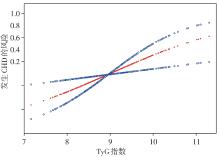
Fig.1
Estimate CHD risk using TyG index after adjusting for multiple covariates"
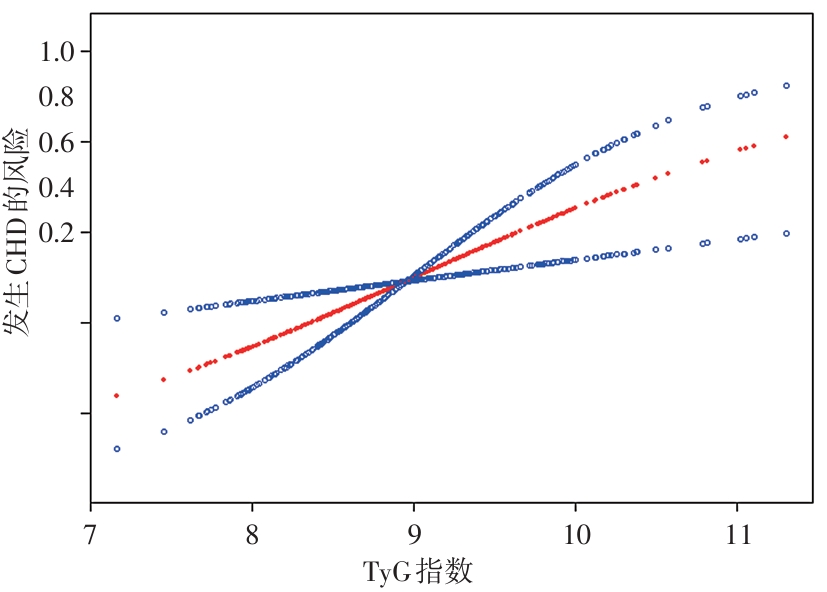
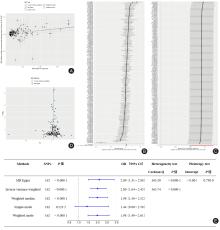
Fig.2
Causal relationship between TyG index and CHD in Mendelian randomization study"
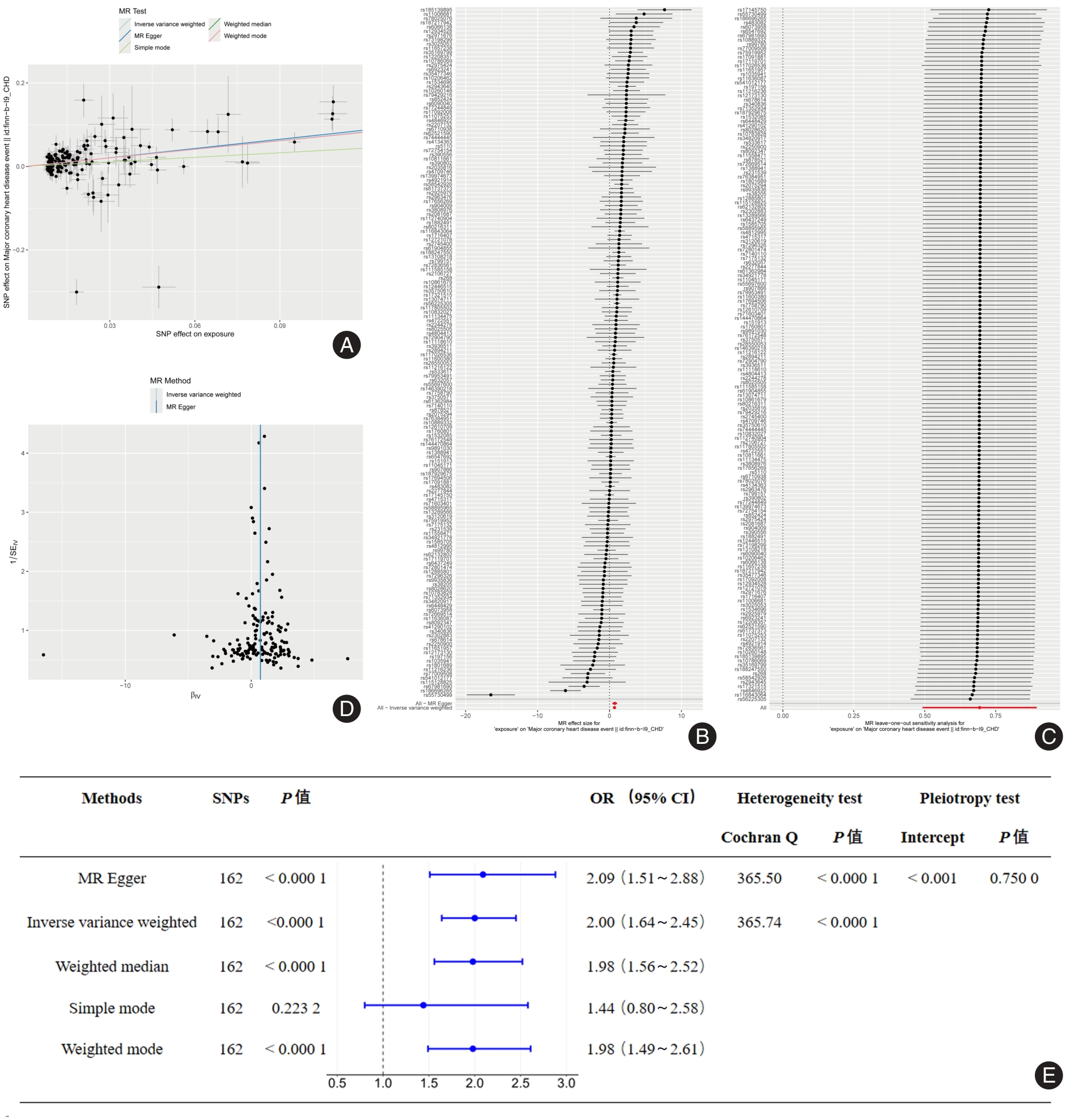
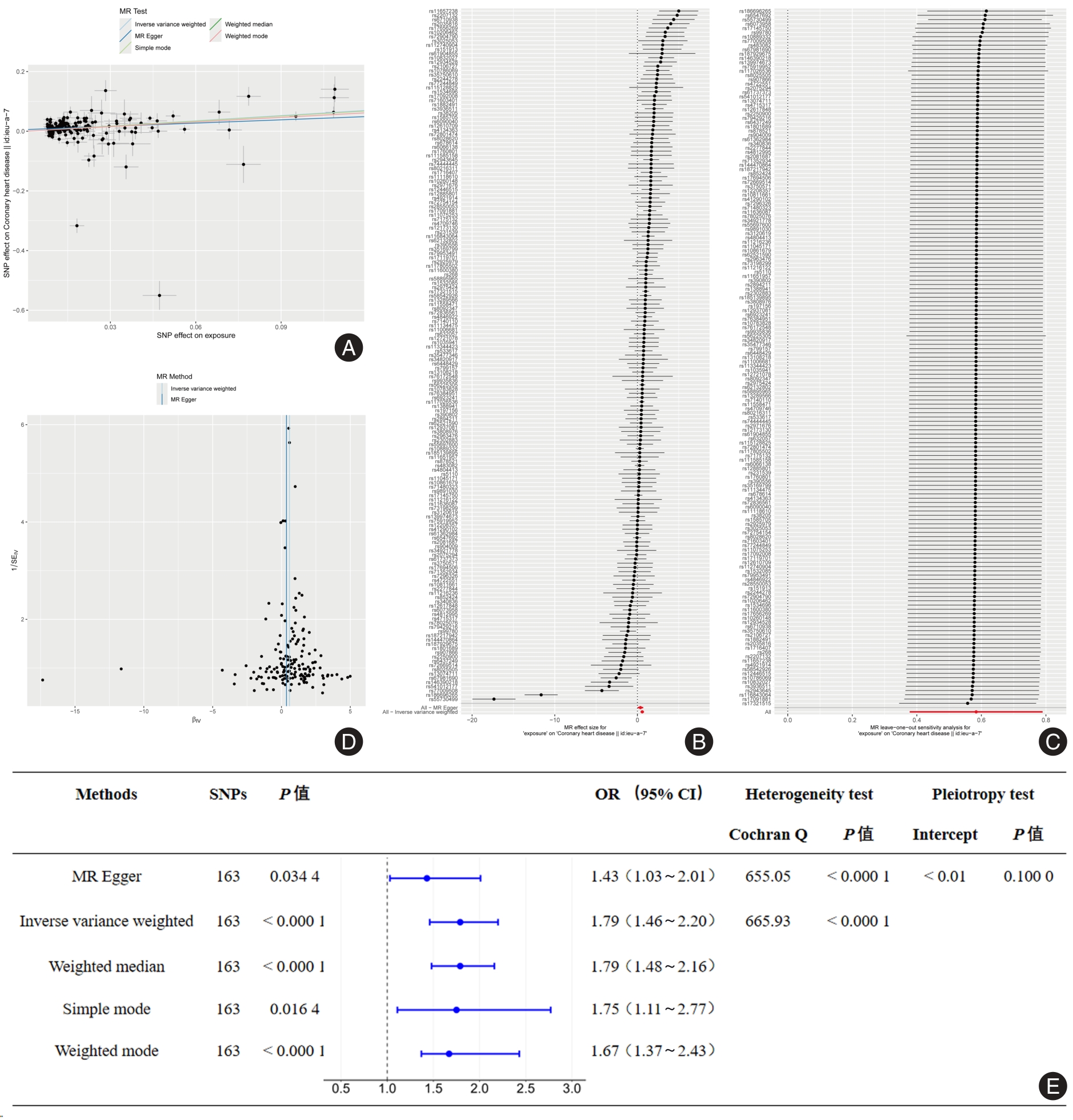
Fig.3
Conduct Mendelian randomization analysis on the causal relationship between TyG index and coronary heart disease using IEU-A-7 as the GWAS data sample for coronary heart disease"
| [1] |
刘伟, 李倩, 许士达. 基于NHANES公共数据库分析非酒精性脂肪肝病与冠心病风险及死亡率的相关性[J]. 实用预防医学,2025,32(11):1358-1363. doi: 10.3969/j.issn.1006-3110. 2025.11.015 .
doi: 10.3969/j.issn.1006-3110. 2025.11.015 |
| [2] |
VRINTS C, ANDREOTTI F, KOSKINAS K C, et al. 2024 ESC Guidelines for the management of chronic coronary syndromes[J]. Eur Heart J. 2024,45(36):3415-3537. doi: 10.1093/eurheartj/ehae177 .
doi: 10.1093/eurheartj/ehae177 |
| [3] |
俞晶芳, 谢琼娜. 围绝经期妇女并发冠状动脉粥样硬化性心脏病的危险因素和防控措施分析[J]. 中国妇幼保健,2021,36(22):5321-5324. doi: 10.19829/j. zgfybj. issn. 1001-4411.2021. 22.061 .
doi: 10.19829/j. zgfybj. issn. 1001-4411.2021. 22.061 |
| [4] |
刘贞杰, 张艳玲, 王灿灿, 等. 冠心病合并心房颤动患者的相关危险因素分析[J]. 中国循证心血管医学杂志,2023,15(8):979-981. doi: 10.3969/j.issn.1674-4055.2023.08.19 .
doi: 10.3969/j.issn.1674-4055.2023.08.19 |
| [5] |
王增武. 《中国心血管健康与疾病报告2024》:心血管疾病及其危险因素流行状况[J]. 中国心血管病研究,2025,23(9):771-793. doi:10.3969/j.issn.1672-5301.2025.09.001 .
doi: 10.3969/j.issn.1672-5301.2025.09.001 |
| [6] |
祁珊珊, 李博涵, 童睿, 等. 甘油三酯-葡萄糖指数对急性心肌梗死患者合并心律失常的预测价值[J]. 陕西医学杂志,2025,54(10):1337-1342. doi: 10.3969/j.issn.1000-7377.2025.10.007 .
doi: 10.3969/j.issn.1000-7377.2025.10.007 |
| [7] |
巴涛, 常向云, 朱余蓉, 等. 2型糖尿病大鼠rno⁃circRNA⁃0003340表达与胰岛素抵抗及胰岛β细胞功能的相关性研究[J]. 中国糖尿病杂志,2022,30(5):358-363. doi: 10.3969/i.issn.1006-6187.2022.05.007 .
doi: 10.3969/i.issn.1006-6187.2022.05.007 |
| [8] |
KOGAN A, RAM E, LEVIN S, et al. Impact of type 2 diabetes mellitus on short- and long-term mortality after coronary artery bypass surgery[J]. Cardiovasc Diabetol, 2018, 17(1): 151. doi: 10.1186/s12933-018-0796-7 .
doi: 10.1186/s12933-018-0796-7 |
| [9] |
LIU L, WU Z, ZHUANG Y, et al. Association of triglyceride-glucose index and traditional risk factors with cardiovascular disease among non-diabetic population: A 10-year prospective cohort study[J]. Cardiovasc Diabetol, 2022, 21(1): 256. doi: 10.1186/s12933-022-01694-3 .
doi: 10.1186/s12933-022-01694-3 |
| [10] |
KAPUR A, BARTOLINI D, FINLAY M C, et al. The Bypass Angioplasty Revascularization in Type 1 and Type 2 Diabetes Study: 5-year follow-up of revascularization with percutaneous coronary intervention versus coronary artery bypass grafting in diabetic patients with multivessel disease[J]. J Cardiovasc Med (Hagerstown), 2010, 11(1): 26-33. doi: 10.2459/JCM.0b013e328330ea32 .
doi: 10.2459/JCM.0b013e328330ea32 |
| [11] |
李成红, 王广川. 甘油三酯葡萄糖指数在不同心血管疾病中的研究进展[J]. 临床医学研究与实践,2025,10(30):181-184. doi: 10.19347/j.cnki.2096-1413.202530045 .
doi: 10.19347/j.cnki.2096-1413.202530045 |
| [12] |
TAM C S, XIE W, JOHNSON W D, et al. Defining Insulin Resistance from Hyperinsulinemic-Euglycemic Clamps[J]. Diabetes Care, 2012, 35(7): 1605-1610. doi: 10.2337/dc11-2339 .
doi: 10.2337/dc11-2339 |
| [13] |
SON D H, LEE H S, LEE Y J, et al. Comparison of triglyceride-glucose index and HOMA-IR for predicting prevalence and incidence of metabolic syndrome[J]. Nutr Metab Cardiovasc Dis, 2022, 32(3): 596-604. doi: 10.1016/j.numecd.2021.11.017 .
doi: 10.1016/j.numecd.2021.11.017 |
| [14] |
LI X, SUN M, YANG Y, et al. Predictive Effect of Triglyceride Glucose-Related Parameters, Obesity Indices, and Lipid Ratios for Diabetes in a Chinese Population: A Prospective Cohort Study[J]. Front Endocrinol (Lausanne), 2022, 13: 862919. doi: 10.3389/fendo.2022.862919 .
doi: 10.3389/fendo.2022.862919 |
| [15] |
EMDIN C A, KHERA A V, KATHIRESAN S. Mendelian Randomization[J]. JAMA, 2017, 318(19): 1925-1926. doi: 10.1001/ jama.2017.17219 .
doi: 10.1001/ jama.2017.17219 |
| [16] |
SEKULA P, DEL GRECO M F, PATTARO C, et al. Mendelian Randomization as an Approach to Assess Causality Using Observational Data[J]. J Am Soc Nephrol, 2016, 27(11): 3253-3265. doi: 10.1681/ASN.2016010098 .
doi: 10.1681/ASN.2016010098 |
| [17] |
SARASTE A, BARBATO E, CAPODANNO D, et al. Imaging in ESC clinical guidelines: Chronic coronary syndromes[J]. Eur Heart J Cardiovasc Imaging, 2019, 20(11): 1187-1197. doi: 10.1093/ehjci/jez219 .
doi: 10.1093/ehjci/jez219 |
| [18] |
GUERRERO-ROMERO F, SIMENTAL-MENDÍA L E, GONZÁLEZ-ORTIZ M, et al. The Product of Triglycerides and Glucose, a Simple Measure of Insulin Sensitivity. Comparison with the Euglycemic-Hyperinsulinemic Clamp[J]. J Clin Endocr Metab, 2010, 95(7): 3347-3351. doi: 10.1210/jc.2010-0288 .
doi: 10.1210/jc.2010-0288 |
| [19] |
SU J, LI Z, HUANG M, et al. Triglyceride glucose index for the detection of the severity of coronary artery disease in different glucose metabolic states in patients with coronary heart disease: A RCSCD-TCM study in China[J]. Cardiovasc Diabetol, 2022, 21(1): 96. doi: 10.1186/s12933-022-01523-7 .
doi: 10.1186/s12933-022-01523-7 |
| [20] |
SI S, LI J, LI Y, et al. Causal Effect of the Triglyceride-Glucose Index and the Joint Exposure of Higher Glucose and Triglyceride With Extensive Cardio-Cerebrovascular Metabolic Outcomes in the UK Biobank: A Mendelian Randomization Study[J]. Front Cardiovasc Med, 2020, 7: 583473. doi: 10.3389/fcvm.2020. 583473 .
doi: 10.3389/fcvm.2020. 583473 |
| [21] |
GREENLAND S. An introduction to instrumental variables for epidemiologists[J]. Int J Epidemiol, 2000, 29(4): 722-729. doi: 10.1093/ije/dyx275 .
doi: 10.1093/ije/dyx275 |
| [22] |
THOMAS D C, LAWLOR D A, THOMPSON J R. Re: Estimation of bias in nongenetic observational studies using "Mendelian triangulation" by Bautista et al[J]. Ann Epidemiol, 2007, 17(7): 511-513. doi: 10.1016/j.annepidem.2006.12.005 .
doi: 10.1016/j.annepidem.2006.12.005 |
| [23] |
DRWIŁA D, ROSTOFF P, GAJOS G, et al. Prognostic value of the triglyceride-glucose index among non-diabetic patients with acute myocardial infarction at one-year follow-up[J]. Kardiol Pol, 2021, 79(10): 1116-1123. doi: 10.33963/KP.a2021.0104 .
doi: 10.33963/KP.a2021.0104 |
| [24] |
DAVEY S G, HEMANI G. Mendelian randomization: Genetic anchors for causal inference in epidemiological studies[J]. Hum Mol Genet, 2014, 23(R1): R89-R98. doi: 10.1093/hmg/ddu328 .
doi: 10.1093/hmg/ddu328 |
| [25] |
AKBABA E, SEZGIN B, EDGÜNLÜ T. The role of adropin, salusin-α, netrin-1, and nesfatin-1 in endometriosis and their association with insulin resistance[J]. Turk J Obstet Gynecol, 2021, 18(3): 175-180. doi: 10.4274/tjod.galenos.2021.12080 .
doi: 10.4274/tjod.galenos.2021.12080 |
| [26] |
JANSSON P A. Endothelial dysfunction in insulin resistance and type 2 diabetes[J]. J Intern Med, 2007, 262(2): 173-183. doi: 10.1111/j.1365-2796.2007.01830.x .
doi: 10.1111/j.1365-2796.2007.01830.x |
| [27] |
MUNIYAPPA R, SOWERS J R. Role of insulin resistance in endothelial dysfunction[J]. Rev Endocr Metab Disord, 2013, 14(1): 5-12. doi: 10.1007/s11154-012-9229-1 .
doi: 10.1007/s11154-012-9229-1 |
| [28] |
HOTAMISLIGIL G S. Inflammation and metabolic disorders[J]. Nature, 2006, 444(7121): 860-867. doi: 10.1038/nature05485 .
doi: 10.1038/nature05485 |
| [29] |
RAZANI B, CHAKRAVARTHY M V, SEMENKOVICH C F. Insulin resistance and atherosclerosis[J]. Endocrinol Metab Clin North Am, 2008, 37(3): 603-621. doi: 10.1016/j.ecl.2008. 05.001 .
doi: 10.1016/j.ecl.2008. 05.001 |
| [30] |
ESSER N, LEGRAND-POELS S, PIETTE J, et al. Inflammation as a link between obesity, metabolic syndrome and type 2 diabetes[J]. Diabetes Res Clin Pract, 2014, 105(2): 141-150. doi: 10.1016/j.diabres.2014.04.006 .
doi: 10.1016/j.diabres.2014.04.006 |
| Viewed | ||||||
|
Full text |
|
|||||
|
Abstract |
|
|||||
