

The Journal of Practical Medicine ›› 2026, Vol. 42 ›› Issue (6): 991-998.doi: 10.3969/j.issn.1006-5725.2026.06.011
• Chronic Disease Control • Previous Articles Next Articles
Shengli WU1( ),Aixia XIE1,Xiaoyan LUO1,Yan ZHAO2,Fugang WANG3, YILIHAMU·TUNIYAZI1
Received:2025-10-10
Revised:2025-11-20
Accepted:2025-11-28
Online:2026-03-25
Published:2026-03-26
Contact:
Shengli WU
E-mail:wushengli413@163.com
CLC Number:
Shengli WU,Aixia XIE,Xiaoyan LUO,Yan ZHAO,Fugang WANG, YILIHAMU·TUNIYAZI. The predictive value of dynamic changes of TSHR antibody titer combined with thyroid ultrasound elastography for the recurrence risk of Graves′ disease[J]. The Journal of Practical Medicine, 2026, 42(6): 991-998.
Tab.1
Comparison of dynamic changes in TRAb titers between the two groups of patients (x ± s)/(IU/L)"
| 时间点 | 持续降低组(n = 197) | 动态升高组(n = 109) |
|---|---|---|
| 治疗前 | 12.48 ± 4.17 | 12.63 ± 4.21 |
| 治疗6个月 | 6.73 ± 2.24 | 7.26 ± 2.41 |
| 治疗12个月 | 3.24 ± 1.03 | 5.87 ± 1.94 |
| 治疗18个月 | 1.52 ± 0.47 | 4.35 ± 1.46 |
| 停药1个月 | 1.48 ± 0.48 | 4.67 ± 1.52 |
| 停药6个月 | 1.38 ± 0.44 | 5.28 ± 1.65 |
| 停药12个月 | 1.29 ± 0.41 | 8.73 ± 2.84 |
| 停药18个月 | 1.21 ± 0.35 | 11.85 ± 3.87 |
| 停药24个月 | 1.15 ± 0.36 | 13.46 ± 4.39 |
| F值 | F时间 = 3098.439,F组间 = 540.541,F交互 = 273.522 | |
| P值 | P时间 < 0.001,P组间 < 0.001,P交互 < 0.001 | |
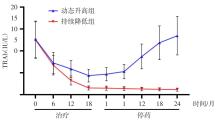
Fig.1
Trends in TRAb titers at different time points in the two groups of patients"
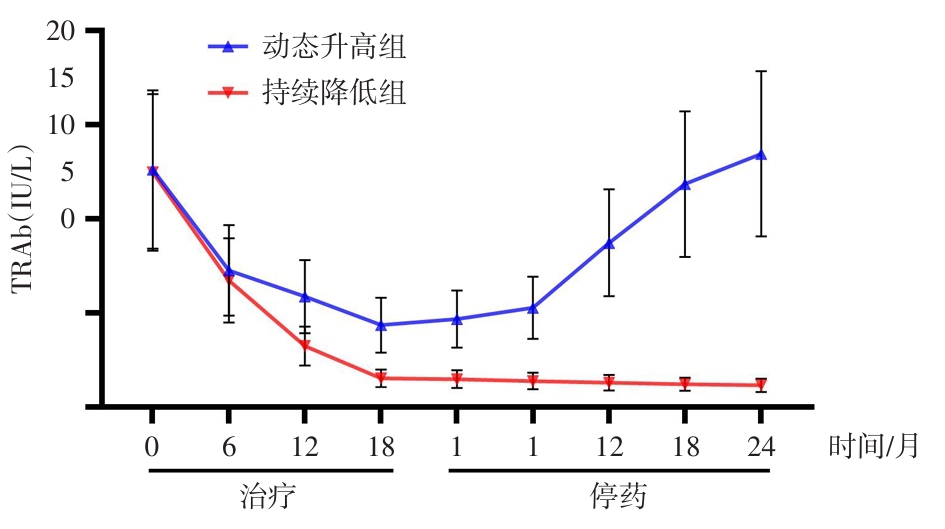
Tab.2
Comparison of clinical data between the relapse group and the non-relapse group"
| 项目 | 复发组(n = 87) | 未复发组(n = 205) | χ2/t值 | P值 |
|---|---|---|---|---|
| 年龄/岁 | 41.28 ± 8.64 | 42.73 ± 9.52 | 1.223 | 0.222 |
| 性别/[例(%)] | 0.022 | 0.883 | ||
| 男 | 34(39.08) | 82(40.00) | ||
| 女 | 53(60.92) | 123(60.00) | ||
| 吸烟史/[例(%)] | 0.481 | 0.488 | ||
| 有 | 21(24.14) | 42(20.49) | ||
| 无 | 66(75.86) | 163(79.51) | ||
| 家族史/[例(%)] | 0.338 | 0.561 | ||
| 有 | 10(11.49) | 19(9.27) | ||
| 无 | 77(88.51) | 186(90.73) | ||
| 病程/月 | 6.38 ± 2.17 | 6.24 ± 1.88 | 0.555 | 0.579 |
| GO CAS/[例(%)] | 1.111 | 0.292 | ||
| CAS ≥3分 | 18(20.69) | 32(15.61) | ||
| CAS <3分 | 69(79.31) | 173(84.39) | ||
| GO分级/[例(%)] | 0.971 | 0.331 | ||
| 轻度 | 38(43.68) | 96(46.83) | ||
| 中度 | 34(39.08) | 88(42.93) | ||
| 重度 | 15(17.24) | 21(10.24) | ||
| FT3/(pmol/L) | 18.92 ± 5.14 | 15.37 ± 4.28 | 6.095 | < 0.001 |
| FT4/(pmol/L) | 37.45 ± 8.63 | 29.26 ± 7.84 | 7.919 | < 0.001 |
| TSH/(mIU/L) | 0.10 ± 0.03 | 0.12 ± 0.05 | 1.737 | 0.084 |
| TPOAb/(IU/mL) | 71.36 ± 16.74 | 62.18 ± 14.23 | 4.777 | < 0.001 |
| TgAb/(IU/mL) | 48.72 ± 11.84 | 46.41 ± 10.67 | 1.637 | 0.103 |
| 甲状腺体积/cm3 | 32.47 ± 8.36 | 26.83 ± 7.14 | 5.860 | < 0.001 |
| 血流分级/[例(%)] | 2.022 | 0.155 | ||
| 0级 | 5(5.75) | 16(7.80) | ||
| 1级 | 18(20.69) | 52(25.37) | ||
| 2级 | 42(48.28) | 98(47.80) | ||
| 3级 | 22(25.29) | 39(19.02) | ||
| 弹性评分/[例(%)] | 9.542 | 0.002 | ||
| 0 | 6(6.90) | 34(16.59) | ||
| 1 | 18(20.69) | 49(23.90) | ||
| 2 | 11(12.64) | 45(21.95) | ||
| 3 | 30(34.48) | 42(20.49) | ||
| 4 | 22(25.29) | 35(17.07) | ||
| MEAN | 12.78 ± 4.23 | 11.84 ± 3.72 | 1.894 | 0.059 |
| %AREA/% | 39.26 ± 9.48 | 30.17 ± 8.86 | 7.851 | < 0.001 |
Tab.3
Multivariate logistic regression analysis of GD relapse"
| 变量 | β | SE | Wald χ2 | OR(95%CI) | P值 |
|---|---|---|---|---|---|
| TRAb滴度动态升高 | 1.251 | 0.432 | 8.386 | 3.494(1.498 ~8.148) | 0.004 |
| 弹性评分(3 ~ 4) | 1.031 | 0.424 | 5.913 | 2.804(1.221 ~ 6.437) | 0.015 |
| FT3 | 1.117 | 0.572 | 3.813 | 3.056(0.996 ~ 9.376) | 0.052 |
| FT4 | 0.640 | 0.352 | 3.306 | 1.896(0.951 ~ 3.781) | 0.070 |
| TPOAb | 0.724 | 0.541 | 1.791 | 2.063(0.714 ~ 5.956) | 0.182 |
| 甲状腺体积 | 0.879 | 0.364 | 5.831 | 2.408(1.180 ~ 4.916) | 0.016 |
| %AREA | 1.326 | 0.503 | 6.949 | 3.766(1.405~10.093) | 0.009 |
Tab.4
Predictive efficacy of different indicators for GD relapse"
| 预测指标 | AUC | 95%CI | 敏感度/% | 特异度/% | Youden指数 |
|---|---|---|---|---|---|
| TRAb滴度动态升高 | 0.823 | 0.781 ~ 0.865 | 76.32 | 78.44 | 0.547 |
| 弹性评分(3 ~ 4) | 0.652 | 0.598 ~ 0.706 | 64.22 | 62.84 | 0.370 |
| %AREA升高 | 0.801 | 0.756 ~ 0.846 | 73.56 | 72.92 | 0.565 |
| 甲状腺体积增大 | 0.724 | 0.675 ~ 0.773 | 68.74 | 69.23 | 0.479 |
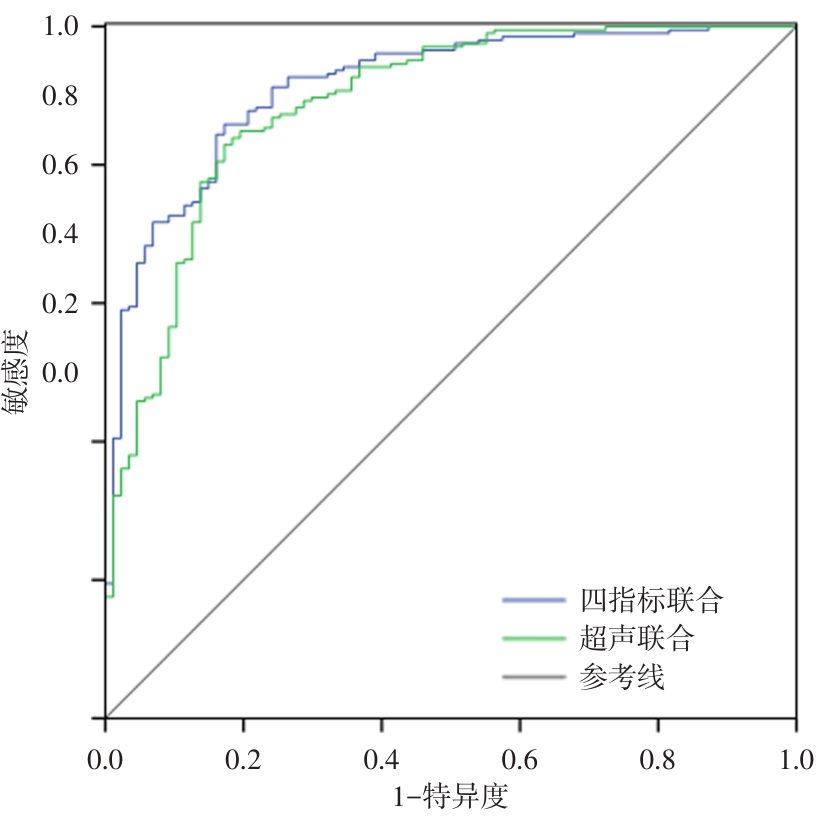
| 超声联合 | 0.888 | 0.852 ~ 0.924 | 84.20 | 83.72 | 0.679 |
| 四指标联合 | 0.913 | 0.874 ~ 0.938 | 86.32 | 87.46 | 0.738 |
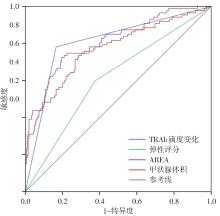
Fig.2
ROC curves of different indicators for early warning of GD recurrence"
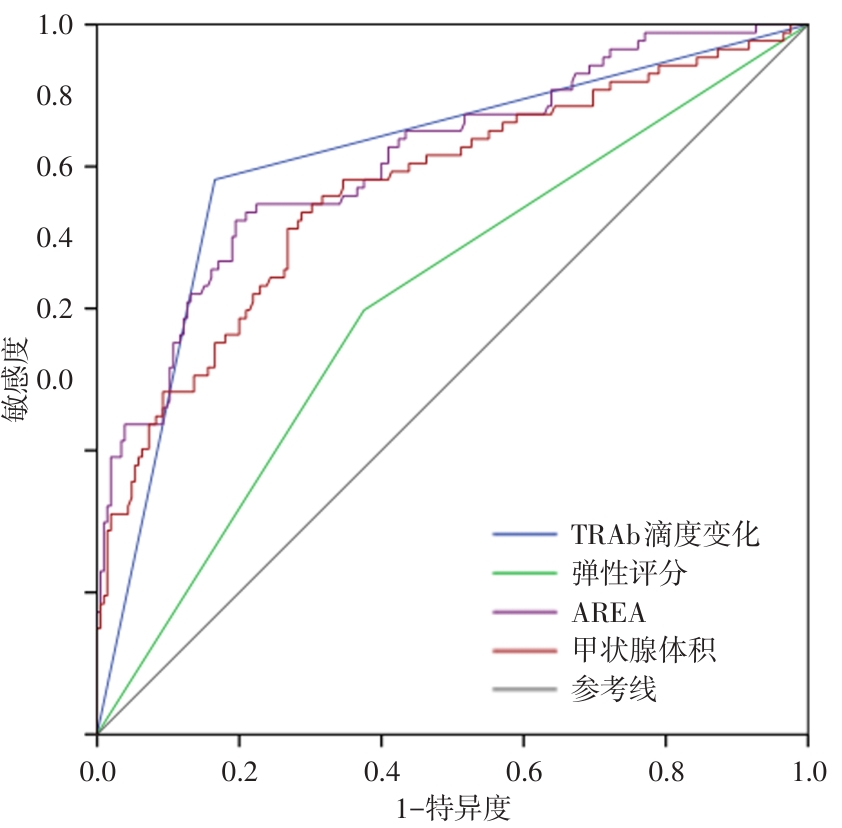
Fig.3
ROC curve of combined indicators for early warning of GD recurrence"
| [1] |
WIERSINGA W M, ECKSTEIN A K, ŽARKOVIĆ M. Thyroid eye disease (Graves' orbitopathy): Clinical presentation, epidemiology, pathogenesis, and management[J]. Lancet Diabetes Endocrinol, 2025,13(7):600-614.doi: 10.1016/S2213-8587(25)00066-X .
doi: 10.1016/S2213-8587(25)00066-X |
| [2] |
LANZOLLA G, MARINÒ M, MENCONI F. Graves disease: Latest understanding of pathogenesis and treatment optionst[J]. Nat Rev Endocrinol, 2024,20(11):647-660.doi: 10.1038/s41574-024-01016-5 .
doi: 10.1038/s41574-024-01016-5 |
| [3] |
WIERSINGA W M, POPPE K G, EFFRAIMIDIS G. Hyperthyroidism: Aetiology, pathogenesis, diagnosis, management, complications, and prognosist[J]. Lancet Diabetes Endocrinol, 2023,11(4): 282-298. doi: 10.1016/S2213-8587(23)00005-0 .
doi: 10.1016/S2213-8587(23)00005-0 |
| [4] |
AZIZI F, MEHRAN L, ABDI H, et al. Approach to the Patient Considering Long-term Antithyroid Drug Therapy for Graves' Diseaset[J]. J Clin Endocrinol Metab, 2024,109(10):e1881-e1888.doi: 10.1210/clinem/dgae456 .
doi: 10.1210/clinem/dgae456 |
| [5] |
VILLAGELIN D, COOPER D S, BURCH H B. A 2023 International Survey of Clinical Practice Patterns in the Management of Graves Disease: A Decade of Changet[J]. J Clin Endocrinol Metab, 2024,109(11):2956-2966.doi: 10.1210/clinem/dgae222 .
doi: 10.1210/clinem/dgae222 |
| [6] |
徐丹凤,王志利,刘洋,等.超声弹性成像对甲状腺良恶性结节的诊断价值[J].实用医学杂志,2019,35(6):977-981.doi:10.3969/j.issn.1006-5725.2019.06.030 .
doi: 10.3969/j.issn.1006-5725.2019.06.030 |
| [7] |
CAO Y, ZHAO X, YOU R, et al. CD11c+ B Cells Participate in the Pathogenesis of Graves' Disease by Secreting Thyroid Autoantibodies and Cytokinest[J]. Front Immunol, 2022,13:836347.doi: 10.3389/fimmu.2022.836347 .
doi: 10.3389/fimmu.2022.836347 |
| [8] |
TAKAHASHI H, KAJITA S, KATOH H, et al. Immunoglobulin G4-related thyroiditis associated with Graves' disease: A case report[J]. Heliyon, 2024,10(4):e25843.doi: 10.1016/j.heliyon.2024.e25843 .
doi: 10.1016/j.heliyon.2024.e25843 |
| [9] |
CEPEHA C M, PAUL C, BORLEA A, et al. Shear-Wave Elastography-Diagnostic Value in Children with Chronic Autoimmune Thyroiditist[J]. Diagnostics (Basel), 2021,11(2):248.doi: 10.3390/diagnostics11020248 .
doi: 10.3390/diagnostics11020248 |
| [10] |
中华医学会内分泌学分会《中国甲状腺疾病诊治指南》编写组. 中国甲状腺疾病诊治指南——甲状腺功能亢进症[J]. 中华内科杂志,2007,46(10):876-882.doi:10.3760/j.issn:0578-1426.2007.10.035 .
doi: 10.3760/j.issn:0578-1426.2007.10.035 |
| [11] |
ROSS D S, BURCH H B, COOPER D S, et al. 2016 American Thyroid Association Guidelines for Diagnosis and Management of Hyperthyroidism and Other Causes of Thyrotoxicosis[J]. Thyroid, 2016, 26(10):1343-1421.doi: 10.1089/thy.2016.0229 .
doi: 10.1089/thy.2016.0229 |
| [12] |
HESARGHATTA SHYAMASUNDER A, ABRAHAM P. Measuring TSH receptor antibody to influence treatment choices in Graves' diseaset[J]. Clin Endocrinol (Oxf), 2017,86(5):652-657.doi: 10.1111/cen.13327 .
doi: 10.1111/cen.13327 |
| [13] |
杨美琴,刘桂林,方明,等. 超声弹性成像鉴别Graves病与桥本氏甲状腺炎的临床价值[J]. 温州医科大学学报,2015,45(10):744-747,752.doi:10.3969/j.issn.2095-9400.2015.10.009 .
doi: 10.3969/j.issn.2095-9400.2015.10.009 |
| [14] |
HUTCHINGS K R, FRITZHAND S J, ESMAELI B, et al. Graves' Eye Disease: Clinical and Radiological Diagnosist[J]. Biomedicines, 2023,11(2):312.doi: 10.3390/biomedicines11020312 .
doi: 10.3390/biomedicines11020312 |
| [15] |
SUZUKI N, INOUE K, YOSHIMURA R, et al. The Mediation Role of Thyrotropin Receptor Antibody in the Relationship Between Age and Severity of Hyperthyroidism in Graves' Disease[J]. Thyroid, 2022, 32(10):1243-1248.doi: 10.1089/thy. 2022. 0252 .
doi: 10.1089/thy. 2022. 0252 |
| [16] |
JIN M, KIM C A, JEON M J, et al. Dynamic Risk Model for the Medical Treatment of Graves' Hyperthyroidism according to Treatment Duration[J]. Endocrinol Metab (Seoul), 2024, 39(4):579-589.doi: 10.3803/EnM.2024.1918 .
doi: 10.3803/EnM.2024.1918 |
| [17] |
OKAMURA K. Long-Term Antithyroid Drug Therapy in Smoldering or Fluctuating-Type Graves' Hyperthyroidism with Potassium Iodidet[J]. Endocrinol Metab (Seoul), 2024,39(6):827-838.doi: 10.3803/EnM.2024.2079 .
doi: 10.3803/EnM.2024.2079 |
| [18] |
黄靓,董晓秋,苗阔,等. 剪切波弹性成像与实时组织弹性成像对甲状腺高度可疑恶性结节的诊断价值[J]. 中华地方病学杂志,2020,39(1):58-63.doi:10.3760/cma.j.issn.2095-4255. 2020.01.013 .
doi: 10.3760/cma.j.issn.2095-4255. 2020.01.013 |
| [19] |
ZHA X Y, XU Z H, DONG J J, et al. Integrating shear wave elastography into clinical prediction of Graves' disease recurrence: A novel risk scoring systemt[J]. Front Endocrinol (Lausanne), 2025,16:1551983.doi: 10.3389/fendo.2025.1551983 .
doi: 10.3389/fendo.2025.1551983 |
| [20] |
STOIAN D, BORLEA A, MOISA-LUCA L, et al. Multiparametric ultrasound-based assessment of overt hyperthyroid diffuse thyroid diseaset[J]. Front Endocrinol (Lausanne), 2023,14:1300447.doi: 10.3389/fendo.2023.1300447 .
doi: 10.3389/fendo.2023.1300447 |
| [21] |
JIN M, JANG A, KIM C A, et al. Long-term follow-up result of antithyroid drug treatment of Graves' hyperthyroidism in a large cohort[J]. Eur Thyroid J, 2023, 12(2):e220226.doi: 10.1530/ETJ-22-0226 .
doi: 10.1530/ETJ-22-0226 |
| [22] |
PENG R, XIE P, JIN Z, et al. Significance of Thyroid-Stimulating Immunoglobulin and Thyrotropin Receptor Antibody in Graves Disease[J]. J Clin Endocrinol Metab, 2025, 110(9):e3002-e3010. doi: 10.1210/clinem/dgae892 .
doi: 10.1210/clinem/dgae892 |
| [23] |
ZĄBCZYŃSKA M, LINK-LENCZOWSKI P, POCHEĆ E. Glycosylation in Autoimmune Diseasest[J]. Adv Exp Med Biol, 2021,1325:205-218.doi: 10.1007/978-3-030-70115-4_10 .
doi: 10.1007/978-3-030-70115-4_10 |
| [24] |
郑忠菊,韦永琼,杨淑哲,等. 血清学与影像学联合检测在甲状腺功能亢进和妊娠合并Graves病鉴别诊断中的临床价值[J]. 川北医学院学报,2023,38(8):1110-1113.doi:10.3969/j.issn. 1005-3697.2023.08.024 .
doi: 10.3969/j.issn. 1005-3697.2023.08.024 |
| [25] |
崔雯锦,徐书杭,胡欣,等. 抗甲状腺药物治疗Graves病复发风险模型的构建与评估[J]. 中华内分泌代谢杂志,2022,38(5):382-390.doi:10.3760/cma.j.cn311282-20210812-00514 .
doi: 10.3760/cma.j.cn311282-20210812-00514 |
| Viewed | ||||||
|
Full text |
|
|||||
|
Abstract |
|
|||||
