

The Journal of Practical Medicine ›› 2026, Vol. 42 ›› Issue (6): 981-990.doi: 10.3969/j.issn.1006-5725.2026.06.010
• Oncology: Diagnosis, Treatment and Prevention • Previous Articles Next Articles
Chen NI1,Shaokai WANG1( ),Yu SONG1,Chenjie TAO2,Jian JIANG1,Zhipeng CHEN1,Huiping ZHU1
Received:2025-11-24
Revised:2026-01-14
Accepted:2026-01-15
Online:2026-03-25
Published:2026-03-26
Contact:
Shaokai WANG
E-mail:pandawsk@163.com
CLC Number:
Chen NI,Shaokai WANG,Yu SONG,Chenjie TAO,Jian JIANG,Zhipeng CHEN,Huiping ZHU. Sintilimab combined with chemotherapy for unresectable locally advanced ESCC: An analysis of efficacy and prognosis[J]. The Journal of Practical Medicine, 2026, 42(6): 981-990.
Tab.1
Comparison of general data between the two groups"
| 项目 | 联合组(n = 53) | 对照组(n = 29) | t/χ2值 | P值 |
|---|---|---|---|---|
| 年龄(x ± s)/岁 | 62.35 ± 5.80 | 63.12 ± 6.04 | 0.566 | 0.573 |
| BMI(x ± s)/(kg/m2) | 20.89 ± 0.75 | 21.03 ± 0.81 | 0.786 | 0.434 |
| 性别 | ||||
| 男 | 47(88.68) | 25(86.21) | 0.107 | 0.744 |
| 女 | 6(11.32) | 4(13.79) | ||
| 肿瘤原发部位 | ||||
| 胸上段 | 8(15.09) | 4(13.79) | 0.037 | 0.982 |
| 胸中段 | 24(45.28) | 13(44.83) | ||
| 胸下段 | 21(39.62) | 12(41.38) | ||
| TNM分期 | ||||
| ⅢB期 | 29(54.72) | 16(55.17) | 0.002 | 0.968 |
| ⅢC期 | 24(45.28) | 13(44.83) | ||
| 分化程度 | ||||
| 低分化 | 28(52.83) | 14(48.28) | 0.156 | 0.693 |
| 中高分化 | 25(47.17) | 15(51.72) | ||
| 手术后病理分期(ypTNM分期) | ||||
| Ⅰ期 | 3(5.66) | 0(0.00) | 5.850 | 0.119 |
| ⅡA期 | 9(16.98) | 1(3.45) | ||
| ⅡB期 | 7(13.21) | 3(10.34) | ||
| 无(未转化成功) | 34(64.15) | 25(86.21) |
Tab.2
Comparison of short-term curative effect between the two groups"
| 组别 | 例数 | CR | PR | SD | PD | ORR | DCR |
|---|---|---|---|---|---|---|---|
| 联合组 | 53 | 0(0.00) | 32(60.38) | 15(28.30) | 6(11.32) | 32(60.38) | 47(88.68) |
| 对照组 | 29 | 0(0.00) | 10(34.48) | 10(34.48) | 9(31.03) | 10(34.48) | 20(68.97) |
| χ2值 | 5.030 | 4.874 | |||||
| P值 | 0.025 | 0.027 |
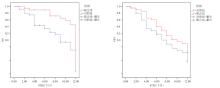
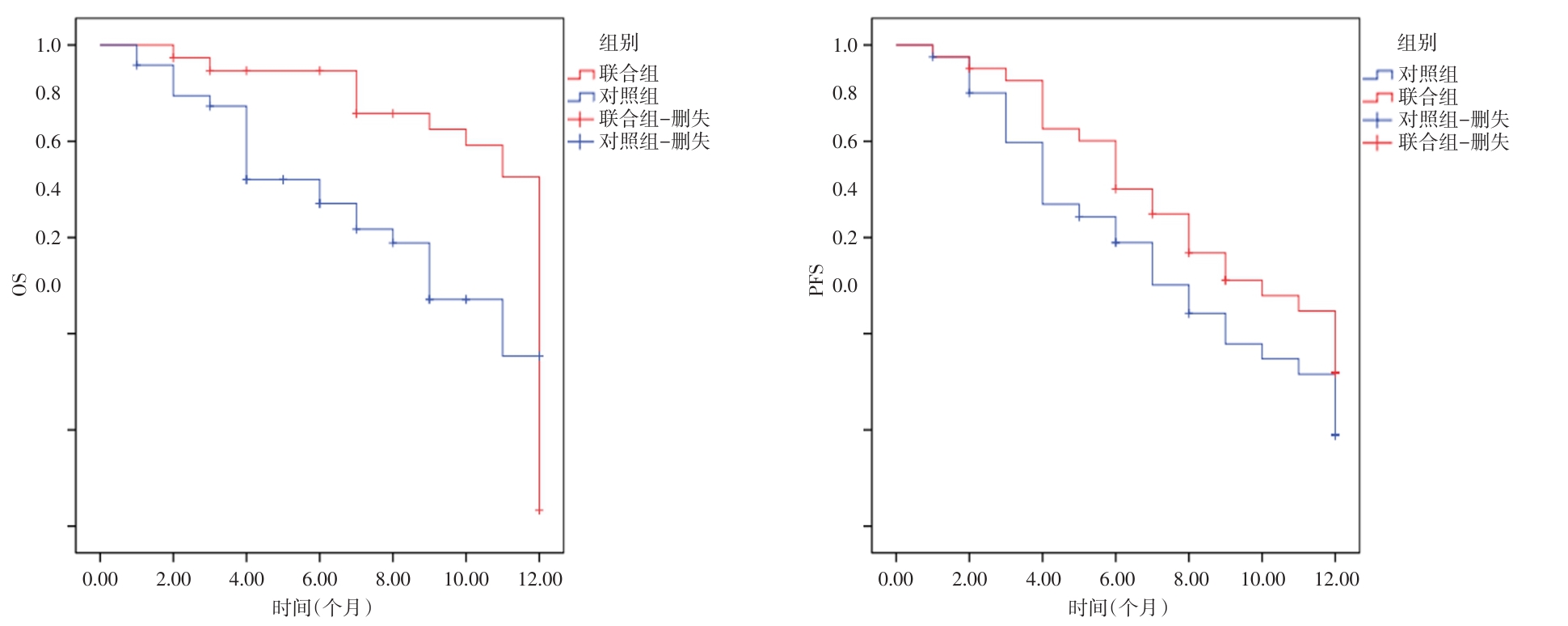
Fig.1
Analysis of survival curves in the two groups"
Tab.3
Comparison of tumor markers between the two groups"
| 组别 | 例数 | SCC-Ag | CEA | CYFRA 21-1 | |||
|---|---|---|---|---|---|---|---|
| 治疗前 | 治疗后 | 治疗前 | 治疗后 | 治疗前 | 治疗后 | ||
| 联合组 | 53 | 3.12 ± 0.34 | 1.01 ± 0.16* | 5.51 ± 0.20 | 1.62±0.18* | 3.59 ± 0.38 | 1.12 ± 0.14* |
| 对照组 | 29 | 3.20 ± 0.41 | 1.75 ± 0.23* | 5.58 ± 0.39 | 2.47±0.22* | 3.67 ± 0.41 | 1.79 ± 0.28* |
| t值 | 0.946 | 17.087 | 1.243 | 18.878 | 0.886 | 14.471 | |
| P值 | 0.347 | < 0.001 | 0.217 | < 0.001 | 0.378 | < 0.001 | |
Tab.4
Comparison of PD-1, PD-L1 between the two groups"
| 组别 | 例数 | PD-1 | PD-L1 | ||
|---|---|---|---|---|---|
| 治疗前 | 治疗后 | 治疗前 | 治疗后 | ||
| 联合组 | 53 | 29.15 ± 4.62 | 13.28 ± 3.25 | 12.68 ± 5.34 | 4.12 ± 0.75 |
| 对照组 | 29 | 28.76 ± 4.81 | 21.54 ± 3.79 | 13.12 ± 5.60 | 7.85 ± 1.92 |
| t值 | 0.360 | 10.370 | 0.351 | 12.549 | |
| P值 | 0.720 | < 0.001 | 0.727 | < 0.001 | |
Tab.5
Safety analysis in the two groups"
| 组别 | 例数 | 骨髓抑制 | 肝肾功能损害 | ||||
|---|---|---|---|---|---|---|---|
| Ⅲ级 | Ⅳ级 | 总发生率 | Ⅱ级 | Ⅲ—Ⅳ级 | 总发生率 | ||
| 联合组 | 53 | 12(22.64) | 2(3.77) | 14(26.42) | 2(3.77) | 0(0.00) | 2(3.77) |
| 对照组 | 29 | 6(20.69) | 1(3.45) | 7(24.14) | 1(3.45) | 1(3.45) | 2(6.90) |
| χ2值 | 0.051 | 0.394 | |||||
| P值 | 0.821 | 0.530 | |||||
| 组别 | 例数 | 胃肠道不适 | 皮疹 | ||||
| Ⅰ—Ⅱ级 | Ⅲ—Ⅳ级 | 总发生率 | Ⅰ—Ⅱ级 | Ⅲ—Ⅳ级 | 总发生率 | ||
| 联合组 | 53 | 17(32.08) | 3(5.66) | 20(37.74) | 4(7.55) | 1(1.89) | 5(9.43) |
| 对照组 | 29 | 8(27.59) | 2(6.90) | 10(34.48) | 0(0.00) | 2(6.90) | 2(6.90) |
| χ2值 | 0.085 | 0.316 | |||||
| P值 | 0.770 | 0.712 | |||||
| [1] |
MORGAN E, SOERJOMATARAM I, RUMGAY H, et al. The global landscape of esophageal squamous cell carcinoma and esophageal adenocarcinoma incidence and mortality in 2020 and projections to 2040: New estimates from GLOBOCAN 2020[J]. Gastroenterology, 2022, 163(3): 649-658.e2. doi:10.1053/j.gastro.2022.05.054 .
doi: 10.1053/j.gastro.2022.05.054 |
| [2] |
LANDER S, LANDER E, GIBSON M K. Esophageal cancer: Overview, risk factors, and reasons for the rise[J]. Curr Gastroenterol Rep, 2023, 25(11): 275-279. doi:10.1007/s11894-023-00899-0 .
doi: 10.1007/s11894-023-00899-0 |
| [3] |
刘良忠, 李小红, 彭科瑜, 等. 调强放疗同步多西他赛联合奥沙利铂化疗治疗Ⅲ/Ⅳ期食管癌的临床研究[J]. 实用医学杂志, 2019, 35(24): 3808-3812. doi:10.3969/j.issn.1006-5725.2019.24.017 .
doi: 10.3969/j.issn.1006-5725.2019.24.017 |
| [4] |
TESTA U, CASTELLI G, PELOSI E. The molecular characterization of genetic abnormalities in esophageal squamous cell carcinoma may foster the development of targeted therapies[J]. Curr Oncol, 2023, 30(1): 610-640. doi:10.3390/curroncol30010048 .
doi: 10.3390/curroncol30010048 |
| [5] |
TANCOŠ V, BLICHÁROVÁ A, PLANK L. Programmed death-ligand 1 expression in non-small cell lung carcinoma-Mechanism of regulation, association with other markers, and therapeutic implication[J]. Klin Onkol, 2022, 35(5): 372-376. doi:10.48095/ccko2022372 .
doi: 10.48095/ccko2022372 |
| [6] |
WOODARD G A, CHO C, CHEN L. Could programmed death-ligand 1 copy number alterations be a predictive biomarker for immunotherapy response?[J]. J Thorac Oncol, 2022, 17(5): 592-595. doi:10.1016/j.jtho.2022.03.009 .
doi: 10.1016/j.jtho.2022.03.009 |
| [7] |
LU S, WU L, JIAN H, et al. Sintilimab plus chemotherapy for patients with EGFR-mutated non-squamous non-small-cell lung cancer with disease progression after EGFR tyrosine-kinase inhibitor therapy (ORIENT-31): Second interim analysis from a double-blind, randomised, placebo-controlled, phase 3 trial[J]. Lancet Respir Med, 2023, 11(7): 624-636. doi:10.1016/s2213-2600(23)00135-2 .
doi: 10.1016/s2213-2600(23)00135-2 |
| [8] |
REN Z, XU J, BAI Y, et al. Sintilimab plus a bevacizumab biosimilar (IBI305) versus sorafenib in unresectable hepatocellular carcinoma (ORIENT-32): A randomised, open-label, phase 2–3 study[J]. Lancet Oncol, 2021, 22(7): 977-990. doi:10.1016/s1470-2045(21)00252-7 .
doi: 10.1016/s1470-2045(21)00252-7 |
| [9] |
LIU X, ZHANG Y, YANG K Y, et al. Induction-concurrent chemoradiotherapy with or without sintilimab in patients with locoregionally advanced nasopharyngeal carcinoma in China (CONTINUUM): A multicentre, open-label, parallel-group, randomised, controlled, phase 3 trial[J]. Lancet, 2024, 403(10445): 2720-2731. doi:10.1016/s0140-6736(24)00594-4 .
doi: 10.1016/s0140-6736(24)00594-4 |
| [10] |
ZHOU C, WU L, FAN Y, et al. Sintilimab plus platinum and gemcitabine as first-line treatment for advanced or metastatic squamous NSCLC: Results from a randomized, double-blind, phase 3 trial (ORIENT-12)[J]. J Thorac Oncol, 2021, 16(9): 1501-1511. doi:10.1016/j.jtho.2021.04.011 .
doi: 10.1016/j.jtho.2021.04.011 |
| [11] |
HANAOKA M, HINO H, SHIOMI A, et al. The Eastern Cooperative Oncology Group Performance Status as a prognostic factor of stage Ⅰ-Ⅲ colorectal cancer surgery for elderly patients: A multi-institutional retrospective analysis[J]. Surg Today, 2022, 52(7): 1081-1089. doi:10.1007/s00595-021-02412-4 .
doi: 10.1007/s00595-021-02412-4 |
| [12] |
中国食管癌筛查与早诊早治指南制定专家组.中国食管癌筛查与早诊早治指南(2022)[J]. 中华消化外科杂志, 2022, 21(6): 677-700. doi:10.3760/cma.j.cn112152-20220517-00348 .
doi: 10.3760/cma.j.cn112152-20220517-00348 |
| [13] |
SCHWARTZ L H, SEYMOUR L, LITIÈRE S, et al. RECIST 1.1-Standardisation and disease-specific adaptations: Perspectives from the RECIST Working Group[J]. Eur J Cancer, 2016, 62: 138-145. doi:10.1016/j.ejca.2016.03.082 .
doi: 10.1016/j.ejca.2016.03.082 |
| [14] |
WALIA A, TUIA J, PRASAD V. Progression-free survival, disease-free survival and other composite end points in oncology: Improved reporting is needed[J]. Nat Rev Clin Oncol, 2023, 20(12): 885-895. doi:10.1038/s41571-023-00823-5 .
doi: 10.1038/s41571-023-00823-5 |
| [15] |
江汝伟,黄思宇.食管鳞癌组织中IRF4,MDM2,C-myc表达与预后的关系研究[J].转化医学杂志, 2024, 13(7):1005-1009. doi:10.3969/j.issn.2095-3097.2024.07.005 .
doi: 10.3969/j.issn.2095-3097.2024.07.005 |
| [16] |
张婷婷,刘克,陈丹,等.帕博利珠单抗加小剂量阿帕替尼联合治疗老年食管癌的有效性及安全性[J].实用医学杂志, 2024, 40(24):3534-3538. doi:10.3969/j.issn.1006-5725.2024.24.016 .
doi: 10.3969/j.issn.1006-5725.2024.24.016 |
| [17] |
LIU Z, ZHAO Y, KONG P, et al. Integrated multi-omics profiling yields a clinically relevant molecular classification for esophageal squamous cell carcinoma[J]. Cancer Cell,2023,41(1):181-195. doi:10.1016/j.ccell.2022.12.004 .
doi: 10.1016/j.ccell.2022.12.004 |
| [18] |
CHENG N, WANG H, ZOU M, et al. Brain-derived programmed death-ligand 1 mediates immunosuppression post intracerebral hemorrhage[J]. J Cereb Blood Flow Metab, 2022, 42(11): 2048-2057. doi:10.1177/0271678x221116048 .
doi: 10.1177/0271678x221116048 |
| [19] |
MONSRUD A L, AVADHANI V, MOSUNJAC M B, et al. Programmed death ligand-1 expression is associated with poorer survival in anal squamous cell carcinoma[J]. Arch Pathol Lab Med, 2022, 146(9): 1094-1101. doi:10.5858/arpa.2021-0169-oa .
doi: 10.5858/arpa.2021-0169-oa |
| [20] |
岳瑞雪,胡崇珠,郝鑫,等.曲妥珠单抗和帕妥珠单抗联合不同化疗方案新辅助治疗HER-2阳性乳腺癌真实世界疗效及安全性观察[J].中国肿瘤临床, 2023, 50(5): 248-254. doi:10.12354/j.issn.1000-8179.2023.20221276 .
doi: 10.12354/j.issn.1000-8179.2023.20221276 |
| [21] |
耿嘉懿,慕腾,赵恒,等.食管鳞状细胞癌新辅助免疫治疗联合化疗后手术间隔时间对病理学结局和预后的影响[J].中华外科杂志, 2025, 63(7):597-604. doi:10.3760/cma.j.cn112139-20241121-00523 .
doi: 10.3760/cma.j.cn112139-20241121-00523 |
| [22] |
刘倩,王蕾,陆叶,等.拉帕替尼联合化疗治疗中晚期食管癌的效果及安全性[J].肿瘤研究与临床, 2025, 37(8): 618-622. doi:10.3760/cma.j.cn115355-20240621-00305 .
doi: 10.3760/cma.j.cn115355-20240621-00305 |
| [23] |
轩周莎莎,张学强,杨晨,等.食管癌患者卡瑞利珠单抗治疗前后血清KLF4,ANXA1水平变化及对疾病转归的交互作用分析[J].实用药物与临床, 2024, 27(9):655-660. doi:10.14053/j.cnki.ppcr.202409003 .
doi: 10.14053/j.cnki.ppcr.202409003 |
| [24] |
CHEN X, XU X, WANG D, et al. Neoadjuvant sintilimab and chemotherapy in patients with potentially resectable esophageal squamous cell carcinoma (KEEP-G 03): An open-label, single-arm, phase 2 trial[J]. J Immunother Cancer, 2023, 11(2): e005830. doi:10.1136/jitc-2022-005830 .
doi: 10.1136/jitc-2022-005830 |
| [25] |
XU J, LI Y, FAN Q, et al. Clinical and biomarker analyses of sintilimab versus chemotherapy as second-line therapy for advanced or metastatic esophageal squamous cell carcinoma: A randomized, open-label phase 2 study (ORIENT-2)[J]. Nat Commun, 2022, 13: 857. doi:10.1038/s41467-022-28408-3 .
doi: 10.1038/s41467-022-28408-3 |
| [26] |
宋芬芬,李胜棉.基于卡瑞利珠单抗的方案治疗局部晚期及转移性食管癌的真实世界研究[J].中国全科医学, 2025, 28(7):844-852. doi:10.12114/j.issn.1007-9572.2023.0448 .
doi: 10.12114/j.issn.1007-9572.2023.0448 |
| [27] |
WANG R, GUO T, WANG Q, et al. The efficacy and safety of induction chemotherapy combined with sintilimab followed by concurrent chemoradiotherapy plus sintilimab sequencing maintaining with sintilimab for patients with unresectable locally advanced esophageal squamous cell carcinoma[J]. BMC Cancer, 2025, 25(1): 97. doi:10.1186/s12885-025-13457-w .
doi: 10.1186/s12885-025-13457-w |
| [28] |
CUI S, FAN L, SUN X, et al. Recombinant human-endostatin combined with sintilimab and chemotherapy in first-line treatment of locally advanced or metastatic esophageal squamous cell carcinoma[J]. Oncol Lett, 2025, 29(5): 244. doi:10.3892/ol.2025.14990 .
doi: 10.3892/ol.2025.14990 |
| [29] |
王豪, 陆筱祎, 王文杰. 老年局部晚期食管癌同步放化疗序贯信迪利单抗免疫治疗的疗效[J]. 实用医学杂志, 2025, 41(3): 365-370. doi:10.3969/j.issn.1006-5725.2025.03.009 .
doi: 10.3969/j.issn.1006-5725.2025.03.009 |
| [30] |
王献, 尚自强, 杨冬, 等. 食管癌患者外周血中白细胞介素-1β和组织中程序性死亡分子1的表达对预后的影响及临床意义[J].中国医科大学学报, 2023, 52(12): 1082-1086. doi:10.12007/j.issn.0258-4646.2023.12.005 .
doi: 10.12007/j.issn.0258-4646.2023.12.005 |
| Viewed | ||||||
|
Full text |
|
|||||
|
Abstract |
|
|||||
