

The Journal of Practical Medicine ›› 2026, Vol. 42 ›› Issue (15): 2698-2705.doi: 10.3969/j.issn.1006-5725.2026.15.004
• Cardiovascular and Cerebrovascular Diseases Column • Previous Articles
Qing SHAN,Yi GAO,Chengcheng ZHANG,Meng HOU( )
)
Received:2026-03-17
Revised:2026-06-16
Accepted:2026-06-22
Online:2026-08-10
Published:2026-08-13
Contact:
Meng HOU
E-mail:444030496@qq.com
CLC Number:
Qing SHAN,Yi GAO,Chengcheng ZHANG,Meng HOU. The effect of goal-directed therapy guided by hypotension prediction index on intraoperative hypotension and postoperative AKI in elderly patients undergoing lung surgery[J]. The Journal of Practical Medicine, 2026, 42(15): 2698-2705.
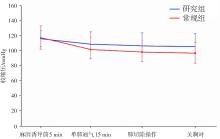
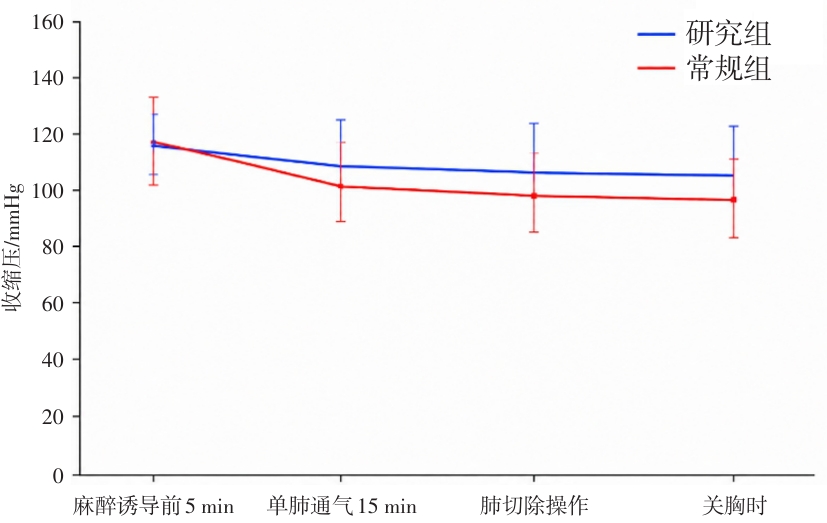
Fig.1
Systolic blood pressure trend chart of the two groups"
Tab.1
Comparison of general data between the two groups"
| 项目 | 研究组(n = 70) | 常规组(n = 71) | χ2/t/Z值 | P值 |
|---|---|---|---|---|
| 性别/例 | 0.184 | 0.668 | ||
| 男 | 31 | 34 | ||
| 女 | 39 | 37 | ||
| 年龄/岁 | 70.47 ± 2.94 | 71.13 ± 3.05 | 1.308 | 0.193 |
| 体质量指数/(kg/m2) | 22.53 ± 1.81 | 22.39 ± 1.77 | 0.464 | 0.643 |
| 合并疾病/[例(%)] | ||||
| 高血压 | 23(32.86) | 26(36.62) | 0.220 | 0.639 |
| 糖尿病 | 8(11.43) | 6(8.70) | 0.287 | 0.592 |
| 冠心病 | 12(17.14) | 16(22.54) | 0.644 | 0.422 |
| 有吸烟史/[例(%)] | 19(27.14) | 23(32.39) | 0.465 | 0.495 |
| 具体手术/例 | 0.486 | 0.784 | ||
| 肺叶切除术 | 41 | 39 | ||
| 楔形切除术 | 21 | 23 | ||
| 全肺切除术 | 8 | 9 | ||
| ASA分级/[例(%)] | 1.199 | 0.230 | ||
| Ⅰ级 | 18 | 25 | ||
| Ⅱ级 | 42 | 38 | ||
| Ⅲ级 | 10 | 8 | ||
| 手术时间[M(P25,P75)]/h | 2.50(1.70,3.30) | 2.40(1.80,3.10) | 0.390 | 0.697 |
| 麻醉时间[M(P25,P75)]/h | 2.80(1.90,3.60) | 2.60(2.10,3.40) | 0.596 | 0.552 |
| 术中失血量/mL | 173.31 ± 29.24 | 175.86 ± 31.07 | 0.502 | 0.617 |
| 术中BIS | 48.31 ± 2.17 | 47.79 ± 2.05 | 1.463 | 0.146 |
| 术前血清肌酐/(μmol/L) | 73.56 ± 7.41 | 72.49 ± 6.75 | 0.897 | 0.371 |
| 术前血清尿素氮/(mmol/L) | 4.81 ± 0.62 | 4.73 ± 0.58 | 0.791 | 0.430 |
Tab.2
Comparison of blood pressure indexes between the two groups"
| 项目 | 例数 | 麻醉诱导前5 min | 单肺通气后15 min | 肺切除操作时 | 关胸时 | F值 | P值 |
|---|---|---|---|---|---|---|---|
| 收缩压 | |||||||
| 研究组 | 70 | 118.35 ± 6.51 | 108.69 ± 5.04* | 106.85 ± 4.91* | 105.72 ± 4.02* | F组间=69.969,F时间=271.341, F交互=11.978 | 均P < 0.001 |
| 常规组 | 71 | 119.21 ± 6.83 | 103.47 ± 4.81* | 101.28 ± 4.67* | 100.95 ± 4.25* | ||
| t值 | 0.765 | 6.292 | 6.903 | 6.845 | |||
| P值 | 0.445 | < 0.001 | < 0.001 | < 0.001 | |||
| 舒张压 | |||||||
| 研究组 | 70 | 75.83 ± 3.23 | 70.41 ± 2.89* | 69.73 ± 2.46* | 68.21 ± 2.35* | F组间=0.938,F时间=236.568, F交互=1.488 | P组间=0.422,P时间< 0.001,F交互=0.962 |
| 常规组 | 71 | 76.49 ± 3.47 | 70.26 ± 2.83* | 69.54 ± 2.27* | 67.89 ± 2.06* | ||
| t值 | 1.169 | 0.311 | 0.477 | 0.860 | |||
| P值 | 0.245 | 0.756 | 0.634 | 0.391 | |||
| MAP | |||||||
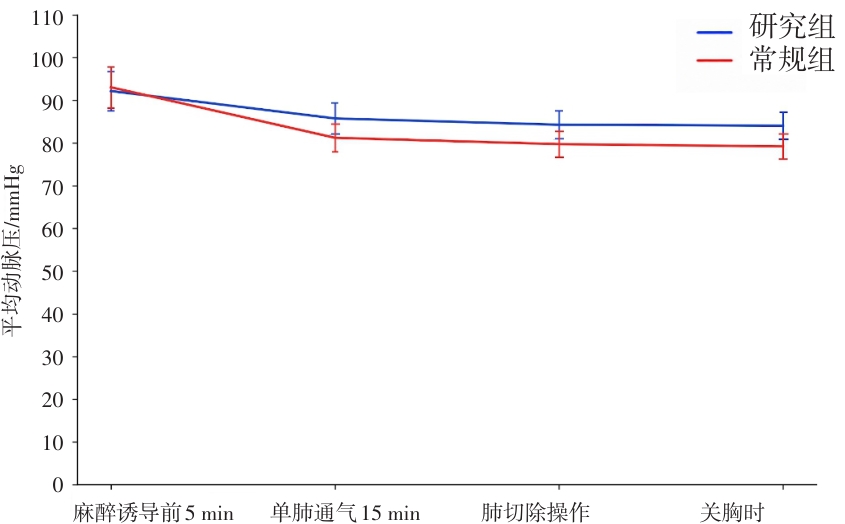
| 研究组 | 70 | 92.16 ± 4.59 | 85.75 ± 3.62* | 84.28 ± 3.27* | 84.06 ± 3.21* | F组间=112.289,F时间=282.481, F交互=20.171 | 均P < 0.001 |
| 常规组 | 71 | 93.04 ± 4.83 | 81.22 ± 3.25* | 79.73 ± 3.02* | 79.21 ± 2.96* | ||
| t值 | 1.109 | 7.821 | 8.585 | 9.329 | |||
| P值 | 0.269 | < 0.001 | < 0.001 | < 0.001 |
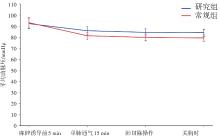
Fig.2
MAP trend chart of the two groups"
Tab.3
Comparison of the incidence of intraoperative hypotension and TWAH between the two groups"
| 组别 | 例数 | 术中低血压发生率 /[例(%)] | 低血压持续总 时间/min | TWAH /mmHg |
|---|---|---|---|---|
| 研究组 | 70 | 12(17.14) | 3.86 ± 1.07 | 0.25 ± 0.06 |
| 常规组 | 71 | 23(32.39) | 11.72 ± 2.15 | 0.37 ± 0.11 |
| χ2/t值 | 4.394 | 27.421 | 8.025 | |
| P值 | 0.036 | < 0.001 | < 0.001 |
Tab.4
Comparison of dobutamine and norepinephrine dosage between the two groups"
| 组别 | 例数 | 多巴酚丁胺 用量/mg | 去甲肾上腺素用量/μg | 总补液量/mL |
|---|---|---|---|---|
| 研究组 | 70 | 10.36 ± 2.07 | 216.14 ± 39.35 | 1 356.24 ± 213.14 |
| 常规组 | 71 | 2.21 ± 0.64 | 187.33 ± 43.14 | 1 329.81 ± 209.75 |
| t值 | 31.677 | 4.141 | 0.742 | |
| P值 | < 0.001 | < 0.001 | 0.459 |
Tab.5
Comparison of the incidence of postoperative AKI between the two groups"
| 组别 | 例数 | AKI诊断类型 | ||
|---|---|---|---|---|
| 基于肌酐 | 基于尿量 | 总发生率 | ||
| 研究组 | 70 | 0(0.00) | 1(1.43) | 1(1.43) |
| 常规组 | 71 | 3(4.23) | 5(7.04) | 8(11.27) |
| χ2校正值 | 4.183 | |||
| P值 | 0.041 | |||
Tab.6
Comparison of postoperative recovery between the two groups"
| 组别 | 例数 | ICU停留时间/h | 术后住院时间/d | 术后1个月内死亡/[例(%)] |
|---|---|---|---|---|
| 研究组 | 70 | 20.37 ± 3.85 | 7.22 ± 1.64 | 0(0.00) |
| 常规组 | 71 | 23.49 ± 4.32 | 8.36 ± 1.71 | 1(1.41) |
| t/χ2值 | 4.525 | 4.039 | - | |
| P值 | < 0.001 | < 0.001 | 1.000 |
| [1] |
WANG S, SHI Y, CHEN H, et al. Pulmonary function protection by single-port thoracoscopic segmental lung resection in elderly patients with IA non-small cell lung cancer: A differential matched analysis[J]. Medicine (Baltimore), 2023,102(17):336-348. doi:10.1097/md.0000000000033648 .
doi: 10.1097/md.0000000000033648 |
| [2] |
KUANG Q, ZHONG N, YE C, et al. Propofol versus remimazolam on cognitive function, hemodynamics, and oxygenation during one-lung ventilation in older patients undergoing pulmonary lobectomy: A randomized controlled trial[J]. J Cardiothorac Vasc Anesth, 2023, 37(10): 1996-2005. doi:10.1053/j.jvca. 2023.06.027 .
doi: 10.1053/j.jvca. 2023.06.027 |
| [3] |
SAASOUH W, CHRISTENSEN A L, XING F, et al. Incidence of intraoperative hypotension during non-cardiac surgery in community anesthesia practice: A retrospective observational analysis[J]. Perioper Med (Lond), 2023, 12(1): 29. doi:10.1186/s13741-023-00318-y .
doi: 10.1186/s13741-023-00318-y |
| [4] |
HABICHER M, DENN S M, SCHNECK E, et al. Perioperative goal-directed therapy with artificial intelligence to reduce the incidence of intraoperative hypotension and renal failure in patients undergoing lung surgery: A pilot study[J]. J Clin Anesth, 2025, 102: 111777. doi:10.1016/j.jclinane.2025.111777 .
doi: 10.1016/j.jclinane.2025.111777 |
| [5] |
BOHN E, SRINATHAN S, ADU-QUAYE J, et al. Predictors of acute kidney injury after lung resection surgery: A retrospective case-control study[J]. Can J Anaesth, 2023,70(12):1901-1908. doi:10.1007/s12630-023-02602-3 .
doi: 10.1007/s12630-023-02602-3 |
| [6] |
BOTROS M, JACKSON K, SINGH P, et al. Insights into early postoperative acute kidney injury following lung transplantation[J]. Clin Transplant, 2022, 36(4): e14568. doi:10.1111/ctr. 14568 .
doi: 10.1111/ctr. 14568 |
| [7] |
SHAW A D, KHANNA A K, SMISCHNEY N J, et al. Intraoperative hypotension is associated with persistent acute kidney disease after noncardiac surgery: A multicentre cohort study[J]. Br J Anaesth, 2022, 129(1): 13-21. doi:10.1016/j.bja.2022.03.027 .
doi: 10.1016/j.bja.2022.03.027 |
| [8] |
JIANG X, HU Y, GUO S, et al. Prediction of persistent acute kidney injury in postoperative intensive care unit patients using integrated machine learning: A retrospective cohort study[J]. Sci Rep, 2022, 12: 17134. doi:10.1038/s41598-022-21428-5 .
doi: 10.1038/s41598-022-21428-5 |
| [9] |
FRASSANITO L, GIURI P P, VASSALLI F, et al. Hypotension Prediction Index with non-invasive continuous arterial pressure waveforms (ClearSight): Clinical performance in Gynaecologic Oncologic Surgery[J]. J Clin Monit Comput, 2022, 36(5): 1325-1332. doi:10.1007/s10877-021-00763-4 .
doi: 10.1007/s10877-021-00763-4 |
| [10] |
刁胜翠, 饶祖华. 目标导向液体治疗对剖宫产术腰麻后低血压的疗效观察[J]. 生命科学仪器, 2024, 22(4): 55-57. doi:10.11967/2024220819 .
doi: 10.11967/2024220819 |
| [11] |
KHWAJA A. KDIGO clinical practice guidelines for acute kidney injury[J]. Nephron Clin Pract, 2012, 120(4): c179-c184. doi:10.1159/000339789 .
doi: 10.1159/000339789 |
| [12] |
MOHAMMADI I, FIROUZABADI S R, HOSSEINPOUR M, et al. Predictive ability of hypotension prediction index and machine learning methods in intraoperative hypotension: A systematic review and meta-analysis[J]. J Transl Med, 2024, 22(1): 725. doi:10.1186/s12967-024-05481-4 .
doi: 10.1186/s12967-024-05481-4 |
| [13] |
张晓雅, 孙明飞, 田苗苗. 前瞻性精准护理策略对主动脉夹层动脉瘤手术患者的血压、疼痛及长期预后的影响[J]. 成都医学院学报, 2025, 20(1): 110-113. doi:10.3969/j.issn.1674-2257.2025.01.025 .
doi: 10.3969/j.issn.1674-2257.2025.01.025 |
| [14] |
胡梦莹, 李娟, 康芳, 等. 不同液体治疗目标对老年食管癌根治患者术后恢复的影响[J]. 中国临床保健杂志, 2021, 24(6): 776-780. doi:10.3969/J.issn.1672-6790.2021.06.012 .
doi: 10.3969/J.issn.1672-6790.2021.06.012 |
| [15] |
范江花, 康霞艳, 张新萍, 等. 无创血流动力学监测对儿童脓毒性休克液体复苏容量反应性的预测价值[J]. 中国实用儿科杂志, 2021, 36(3): 205-210. doi:10.19538/j.ek2021030611 .
doi: 10.19538/j.ek2021030611 |
| [16] |
阳婷婷, 肖昌, 苏钰淇, 等. 低血压预测指数指导的血流动力学管理对老年患者术中低血压事件的影响[J]. 实用医学杂志, 2026, 42(2): 334-341. doi:10.3969/j.issn.1006-5725.2026. 02.020 .
doi: 10.3969/j.issn.1006-5725.2026. 02.020 |
| [17] |
胡玉蓉, 项美姣. 血必净注射液联合去甲肾上腺素对感染性休克患者血流动力学、血清炎症因子和免疫功能的影响[J]. 中国医药导报, 2024, 21(16): 56-58, 61. doi:10.20047/j.issn1673-7210.2024.16.15 .
doi: 10.20047/j.issn1673-7210.2024.16.15 |
| [18] |
FUJII T, TAKAKURA M, TANIGUCHI T, et al. Intraoperative hypotension affects postoperative acute kidney injury depending on the invasiveness of abdominal surgery: A retrospective cohort study[J]. Medicine (Baltimore), 2023,102(48):364-375. doi:10.1097/md.0000000000036465 .
doi: 10.1097/md.0000000000036465 |
| [19] |
ARIYARATHNA D, BHONSLE A, NIM J, et al. Intraoperative vasopressor use and early postoperative acute kidney injury in elderly patients undergoing elective noncardiac surgery[J]. Ren Fail, 2022, 44(1): 648-659. doi:10.1080/0886022X.2022.2061997 .
doi: 10.1080/0886022X.2022.2061997 |
| [20] |
PANG Z, LIANG S, ZHOU N, et al. Individualized blood pressure regulation and acute kidney injury in older patients having major abdominal surgery: A pilot randomized trial[J]. Int J Surg, 2025, 111(4): 2894-2902. doi:10.1097/js9.0000000000002289 .
doi: 10.1097/js9.0000000000002289 |
| [21] |
RIPOLLÉS-MELCHOR J, TOMÉ-ROCA J L, ZORRILLA-VACA A, et al. Hemodynamic management guided by the hypotension prediction index in abdominal surgery: A multicenter randomized clinical trial[J]. Anesthesiology, 2025, 142(4): 639-654. doi:10.1097/aln.0000000000005355 .
doi: 10.1097/aln.0000000000005355 |
| [22] |
黄睦容, 隋萌, 胡春兰, 等. 肺移植术后急性肾损伤诊疗新进展[J]. 器官移植, 2025, 16(2): 322-328. doi:10.12464/j.issn. 1674-7445.2024290 .
doi: 10.12464/j.issn. 1674-7445.2024290 |
| [23] |
ZARBOCK A, WEISS R, ALBERT F, et al. Epidemiology of surgery associated acute kidney injury (EPIS-AKI): A prospective international observational multi-center clinical study[J]. Intensive Care Med, 2023, 49(12): 1441-1455. doi:10.1007/s00134-023-07169-7 .
doi: 10.1007/s00134-023-07169-7 |
| [24] |
KWAN A C, WANG M, JI H, et al. Sex-divergent blood pressure associations with multiorgan system metabolic stress-Brief report[J]. Arterioscler Thromb Vasc Biol, 2025, 45(4): 557-561. doi:10.1161/atvbaha.124.322169 .
doi: 10.1161/atvbaha.124.322169 |
| [25] |
JIN L, SHAN L, YU K, et al. Postoperative acute kidney injury increases short- and long-term death risks in elderly patients (≥ 75 years old) undergoing coronary artery bypass graft surgery[J]. Int Urol Nephrol, 2024, 56(4): 1497-1508. doi:10.1007/s11255-023-03845-1 .
doi: 10.1007/s11255-023-03845-1 |
| Viewed | ||||||
|
Full text |
|
|||||
|
Abstract |
|
|||||
