

The Journal of Practical Medicine ›› 2025, Vol. 41 ›› Issue (24): 3897-3903.doi: 10.3969/j.issn.1006-5725.2025.24.014
• Clinical Research • Previous Articles
Dawei WANG1,Zheng ZHENG2,Yuxiang SHENG1,Zhiran LI3,Shaohua HUANGFU1,Bin. JIANG1( )
)
Received:2025-09-25
Online:2025-12-25
Published:2025-12-25
Contact:
Bin. JIANG
E-mail:jbfirsth@aliyun.com
CLC Number:
Dawei WANG,Zheng ZHENG,Yuxiang SHENG,Zhiran LI,Shaohua HUANGFU,Bin. JIANG. Risk factors for multidrug⁃resistant bacterial infections in perianal abscesses and the construction of a nomogram prediction model[J]. The Journal of Practical Medicine, 2025, 41(24): 3897-3903.

Tab.1
Distribution of pathogenic bacteria isolated fromperianal abscesses"
| 病原菌 | 株数 | 构成比/% | |
|---|---|---|---|
| 革兰阳性菌 | 中间链球菌 | 59 | 6.35 |
| 草绿色链球菌 | 16 | 1.72 | |
| 金黄色葡萄球菌 | 13 | 1.40 | |
| 粪球肠菌 | 11 | 1.18 | |
| 屎肠球菌 | 10 | 1.08 | |
| 其他 | 39 | 4.20 | |
| 革兰阴性菌 | 大肠埃希菌 | 446 | 48.01 |
| 肺炎克雷伯菌 | 183 | 19.70 | |
| 产超广谱β-内酰胺酶肠杆菌 | 68 | 7.32 | |
| 奇异变形杆菌 | 36 | 3.88 | |
| 其他 | 45 | 4.84 | |
| 真菌 | 白假丝酵母菌 | 1 | 0.11 |
Tab.2
Comparison of baseline characteristics in the non-MDRO and MDRO groups"
| 变量 | 非多重耐药组 (n = 620) | 多重耐药组 (n = 137) | t/Z/χ2值 | P值 |
|---|---|---|---|---|
| 年龄(x ± s)/岁 | 37.11 ± 11.19 | 36.85 ± 10.96 | 0.25 | 0.802 |
| BMI(x ± s)/(kg/m2) | 26.03 ± 4.31 | 26.63 ± 4.94 | -1.43 | 0.154 |
| CRP[M(P25,P75)] | 24.00(10.00, 54.00) | 28.00(9.00, 54.00) | -0.62 | 0.583 |
| 白细胞计数(x ± s)/× 109·L-1 | 10.82 ± 3.66 | 11.29 ± 4.32 | -1.33 | 0.185 |
| 中性粒细胞计数(x ± s)/× 109·L-1 | 8.24 ± 3.41 | 8.60 ± 4.05 | -1.06 | 0.291 |
| 性别 | 0.52 | 0.471 | ||
| 女 | 82(13.23) | 15(10.95) | ||
| 男 | 538(86.77) | 122(89.05) | ||
| 吸烟史 | 0.02 | 0.889 | ||
| 否 | 522(84.19) | 116(84.67) | ||
| 是 | 98(15.81) | 21(15.33) | ||
| 饮酒史 | 39.58 | < 0.001 | ||
| 否 | 570(91.94) | 100(72.99) | ||
| 是 | 50(8.06) | 37(27.01) | ||
| 高血压 | 62.49 | < 0.001 | ||
| 否 | 558(90.00) | 87(63.50) | ||
| 是 | 62(10.00) | 50(36.50) | ||
| 糖尿病 | 223.68 | < 0.001 | ||
| 否 | 572(92.26) | 53(38.69) | ||
| 是 | 48(7.74) | 84(61.31) |
Tab.3
Comparison of Baseline Characteristics in the training set and the test set"
| 变量 | 训练集(n = 530) | 验证集(n = 227) | t/Z/χ2值 | P值 |
|---|---|---|---|---|
| 年龄(x ± s)/岁 | 37.07 ± 11.05 | 37.04 ± 11.37 | 0.04 | 0.969 |
| BMI(x ± s)/(kg/m2) | 26.28 ± 4.56 | 25.81 ± 4.12 | 1.41 | 0.160 |
| CRP[M(P25,P75)] | 25.00(10.00,53.75) | 25.00(9.00,54.00) | -0.08 | 0.938 |
| 白细胞计数(x ± s)/×109·L-1 | 10.86 ± 3.81 | 11.01 ± 3.73 | -0.52 | 0.604 |
| 中性粒细胞计数(x ± s)/×109·L-1 | 8.27 ± 3.60 | 8.39 ± 3.37 | -0.43 | 0.666 |
| 性别 | 3.68 | 0.055 | ||
| 女 | 76(14.34) | 21(9.25) | ||
| 男 | 454(85.66) | 206(90.75) | ||
| 吸烟史 | 0.13 | 0.714 | ||
| 否 | 445(83.96) | 193(85.02) | ||
| 是 | 85(16.04) | 34(14.98) | ||
| 饮酒史 | 1.03 | 0.309 | ||
| 否 | 465(87.74) | 205(90.31) | ||
| 是 | 65(12.26) | 22(9.69) | ||
| 高血压 | 0.13 | 0.723 | ||
| 否 | 450(84.91) | 195(85.90) | ||
| 是 | 80(15.09) | 32(14.10) | ||
| 糖尿病 | 3.10 | 0.078 | ||
| 否 | 446(84.15) | 179(78.85) | ||
| 是 | 84(15.85) | 48(21.15) |
Tab.4
Logistic regression analysis for multidrug-resistant(the training set)"
| 变量 | 单因素logistic回归 | 多因素logistic回归 | ||||||||
|---|---|---|---|---|---|---|---|---|---|---|
| β | S.E | Z值 | P值 | OR(95%CI) | β | S.E | Z值 | P值 | OR(95%CI) | |
| CRP | 0.00 | 0.00 | 0.98 | 0.325 | 1.00(1.00~1.01) | |||||
| 白细胞计数 | 0.04 | 0.03 | 1.26 | 0.209 | 1.04(0.98~1.10) | |||||
| 中性粒细胞计数 | 0.03 | 0.03 | 0.94 | 0.347 | 1.03(0.97~1.09) | |||||
| 吸烟史 | ||||||||||
| 否 | 1.00(Reference) | |||||||||
| 是 | 0.06 | 0.30 | 0.19 | 0.853 | 1.06(0.58~1.92) | |||||
| 饮酒史 | ||||||||||
| 否 | 1.00(Reference) | 1.00 (Reference) | ||||||||
| 是 | 1.49 | 0.28 | 5.25 | < 0.001 | 4.42(2.54~7.69) | 1.80 | 0.35 | 5.20 | < 0.001 | 6.04(3.07~11.91) |
| 高血压 | ||||||||||
| 否 | 1.00(Reference) | 1.00 (Reference) | ||||||||
| 是 | 1.67 | 0.26 | 6.33 | < 0.001 | 5.32(3.17~8.92) | 1.46 | 0.33 | 4.49 | < 0.001 | 4.32(2.28~8.19) |
| 糖尿病 | ||||||||||
| 否 | 1.00(Reference) | 1.00 (Reference) | ||||||||
| 是 | 2.85 | 0.28 | 10.20 | < 0.001 | 17.31(10.01~29.95) | 2.72 | 0.30 | 8.94 | < 0.001 | 15.14(8.35~27.47) |
Fig.1
Nomogram for predicting MDRO infection risk in perianal abscess patients"
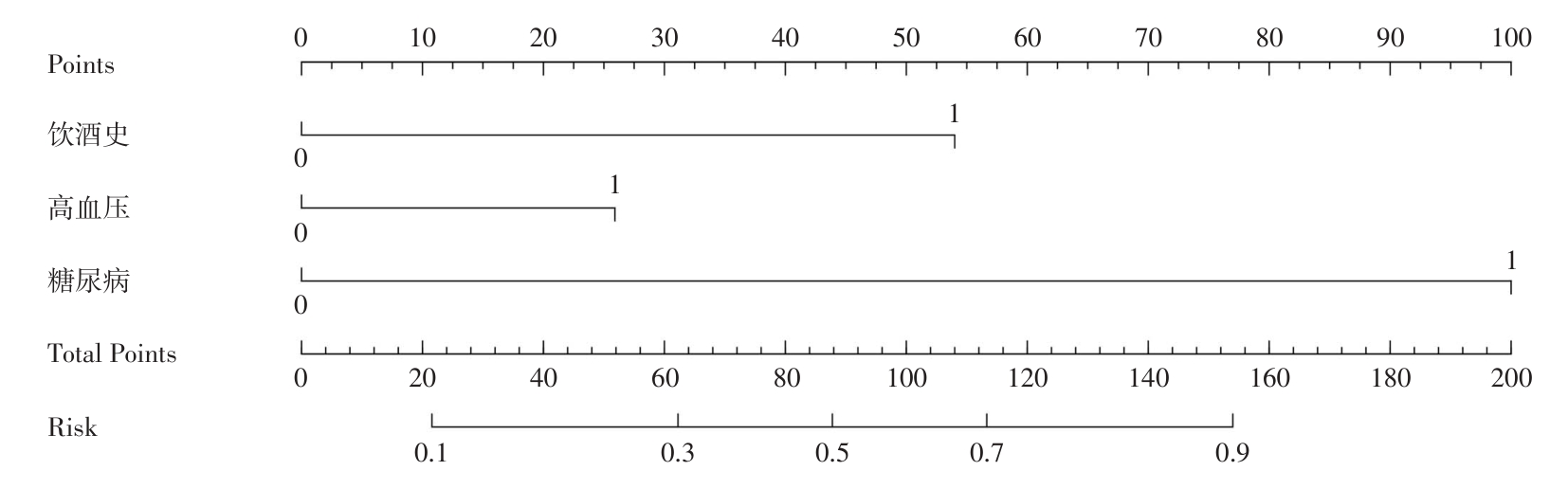
Fig.2
ROC curve of the nomogram for predicting MDRO infection in perianal abscesses"
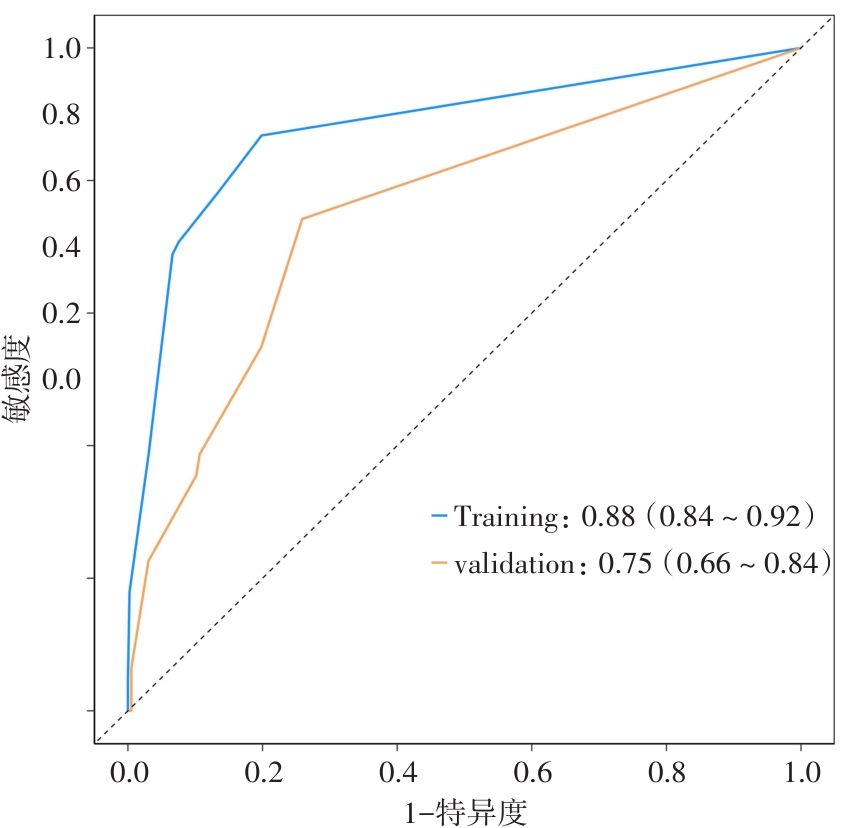
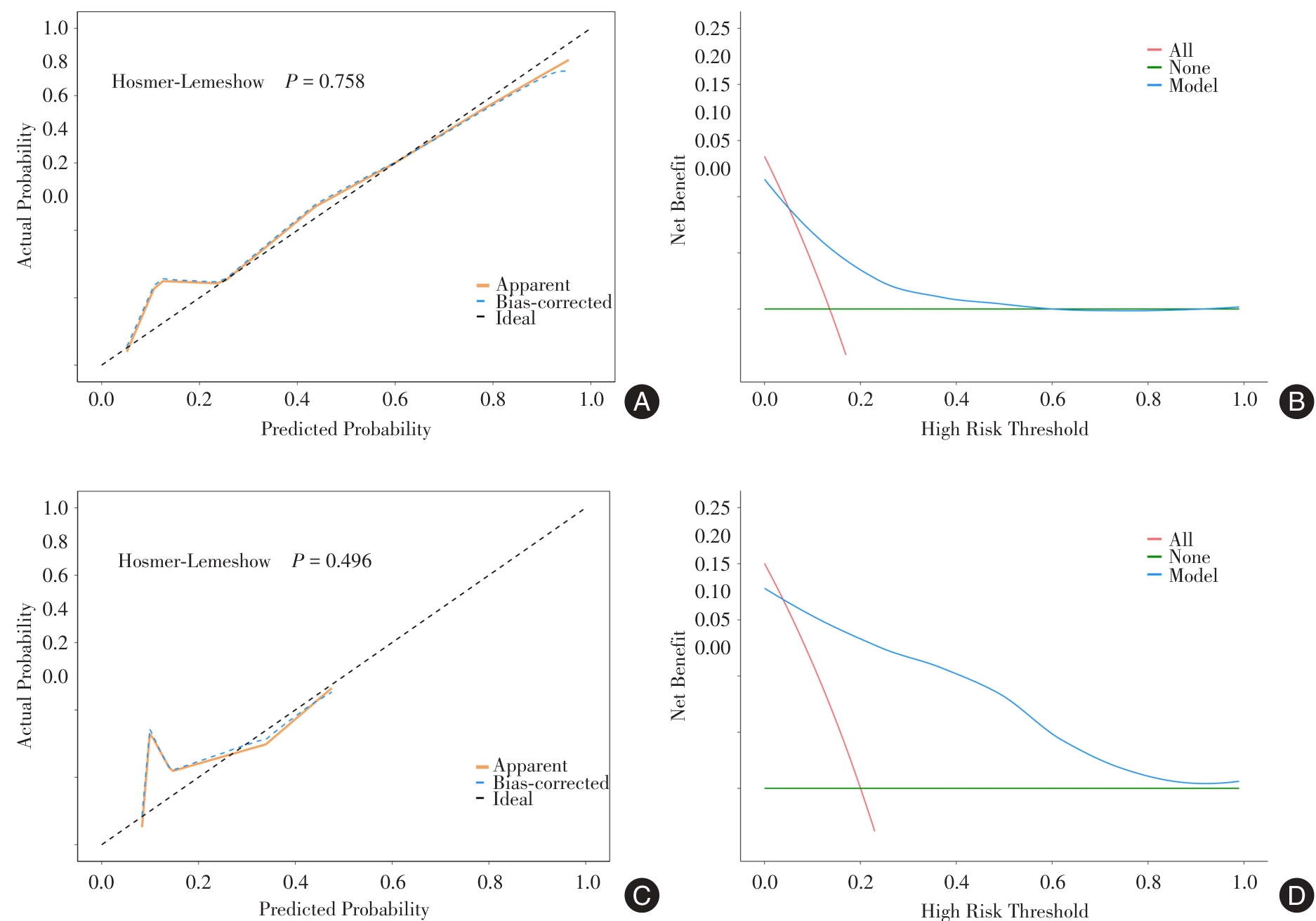
Fig.3
DCA and calibration curves of the nomogram for predicting MDRO infection in perianal abscesses"
| [1] |
HOSOKAWA T, TANAMI Y, SATO Y, et al. Incidence and diagnostic performance of ultrasound for perianal abscess or fistula‐in‐ano in pediatric patients with perianal inflammation[J]. J Clin Ultrasound, 2023, 51(5): 819-826. doi:10.1002/jcu.23446
doi: 10.1002/jcu.23446 |
| [2] |
DONG S, CHEN B, ZHANG J. Study on the factors influencing the prognosis after perianal abscess surgery[J]. BMC Gastroenterol, 2023, 23(1): 334. doi:10.1186/s12876-023-02959-1
doi: 10.1186/s12876-023-02959-1 |
| [3] | 周建平, 席雨婷, 毕苇, 等. 2022年版美国结直肠外科医师协会《肛周脓肿、肛瘘、直肠阴道瘘的临床实践指南》解读[J]. 中国实用外科杂志, 2024, 44(4): 438-440. |
| [4] |
MARINO A, MANIACI A, LENTINI M, et al. The Global Burden of Multidrug-Resistant Bacteria[J]. Epidemiologia, 2025, 6(2): 21. doi:10.3390/epidemiologia6020021
doi: 10.3390/epidemiologia6020021 |
| [5] |
QIAO L, GAO H, YOU Y, et al. Analysis of the distribution characteristics of infecting microorganisms in the wound tissue of patients with perianal abscess combined with infection and the influencing factors of wound healing[J]. BMC Gastroenterol, 2025, 25(1): 258. doi:10.1186/s12876-025-03853-8
doi: 10.1186/s12876-025-03853-8 |
| [6] |
BENDER F, ECKERTH L, FRITZENWANKER M, et al. Drug resistant bacteria in perianal abscesses are frequent and relevant[J]. Sci Rep, 2022, 12(1): 14866. doi:10.1038/s41598-022-19123-6
doi: 10.1038/s41598-022-19123-6 |
| [7] | 冯娜, 程燕洁, 李乐维. 肛周脓肿患者病原菌分布及多重耐药菌感染的危险因素分析[J]. 中国肛肠病杂志, 2024, 44(4): 52-56. |
| [8] | 吴军亮. 肛周脓肿患者脓液标本中病原菌的分布与耐药性分析[J]. 抗感染药学, 2022, 19(10): 1420-1423. |
| [9] |
RAMÍREZ PEDRAZA N, PÉREZ SEGOVIA A H, GARAY MORA J A, et al. Perianal fistula and abscess: An imaging guide for beginners[J]. Radiographics, 2022, 42(7): E208-E209. doi:10.1148/rg.210142
doi: 10.1148/rg.210142 |
| [10] |
HARRELL F E. Regression Modeling Strategies With Applications to Linear Models, Logistic and Ordinal Regression, and Survival Analysis[M]. 2nd ed. Cham: Springer International Publishing, 2015. doi:10.1007/978-3-319-19425-7_13
doi: 10.1007/978-3-319-19425-7_13 |
| [11] | 叶应妩,王毓三. 全国临床检验操作规程(第二版)[M].南京: 东南大学出版社, 1997. |
| [12] | 卫生部办公厅关于印发《多重耐药菌医院感染预防与控制技术指南(试行)》的通知[J].中华人民共和国卫生部公报,2011,(2):59-61. |
| [13] | 唐枭, 李欣奕, 何涛宏, 等. 肛周脓肿及肛瘘合并糖尿病的诊断及治疗进展[J]. 实用医学杂志, 2022, 38(16): 2100-2105. |
| [14] |
ADAMO K, GUNNARSSON U, EEG-OLOFSSON K, et al. Risk for developing perianal abscess in type 1 and type 2 diabetes and the impact of poor glycemic control[J]. Int J Colorectal Dis, 2021, 36: 999-1005. doi:10.1007/s00384-020-03818-1
doi: 10.1007/s00384-020-03818-1 |
| [15] | 赵曰景,陈泽霖,张武. 封闭负压引流联合Ilizarov胫骨横向骨搬移术对重度糖尿病足患者的氧化应激、炎症反应的影响[J].实用医学杂志,2025,41(13):2052-2057. |
| [16] |
DONG M, MAO Y, ZHAO Z, et al. Novel fabrication of antibiotic containing multifunctional silk fibroin injectable hydrogel dressing to enhance bactericidal action and wound healing efficiency on burn wound: In vitro and in vivo evaluations[J]. Int Wound J, 2022, 19(3): 679-691. doi:10.1111/iwj.13665
doi: 10.1111/iwj.13665 |
| [17] |
BRAR M S, REMZI F, WARUSAVITARNE J, et al. Does antibiotic therapy prevent fistula in-ano after incision and drainage of simple perianal abscess?[J]. Can J Surg, 2020, 63(4): E362-E363. doi:10.1503/cjs.017119
doi: 10.1503/cjs.017119 |
| [18] |
HOLT R I G, COCKRAM C S, MA R C W, et al. Diabetes and infection: Review of the epidemiology, mechanisms and principles of treatment[J]. Diabetologia, 2024, 67(7): 1168-1180. doi:10.1007/s00125-024-06102-x
doi: 10.1007/s00125-024-06102-x |
| [19] |
SALEH W, XUE W, KATZ J. Diabetes mellitus and periapical abscess: A cross-sectional study[J]. J Endod, 2020, 46(11): 1605-1609. doi:10.1016/j.joen.2020.08.015
doi: 10.1016/j.joen.2020.08.015 |
| [20] | 许珏,陈磊,吴亚亭. 颅内动脉瘤夹闭术后患者院内感染危险因素及其预测价值[J]. 新乡医学院学报,2025,42(11):897-900,908. |
| [21] | 杨意鹏,张扬,黄鑫怡,等. 276例严重颈脊髓创伤合并四肢瘫患者的术后生存分析[J]. 医学研究与战创伤救治,2024,37(6):610-615. |
| [22] | 黎学明, 曾晓东, 雷黎明, 等. 感染性心内膜炎术后肺部感染的危险因素[J]. 岭南心血管病杂志, 2023, 29(5): 534-539,545. |
| [23] | 林华杰, 金甬, 贾晋荣, 等. 骨折术后感染病原学及危险因素[J]. 中华医院感染学杂志, 2021, 31(18): 2806-2810. |
| [24] | 王媛媛, 刘志荣. 口腔癌术后感染病原菌分布特点及危险因素分析[J]. 中国病原生物学杂志, 2024, 19(5): 595-598,603. |
| [25] | 严健亮, 谢泽宇, 景蓉蓉, 等. 基于机器学习利用常规检验指标建立胃癌淋巴结转移预测模型[J]. 实用医学杂志, 2024, 40(6): 844-849. |
| [26] | 胡冰辉,王祥盛,马万里,等. 肛周脓肿多重耐药菌感染危险因素及其预测模型构建[J]. 中华医院感染学杂志,2024,34(9):1370-1373. |
| [1] | Kui DONG,jie WU,Jing YAN,Haitao LIU,Jun WANG,Guan′en. QIAO. Study on risk factors of colorectal adenomatous polyps and construction and validation of prediction model [J]. The Journal of Practical Medicine, 2025, 41(6): 838-845. |
| [2] | Runfang WANG,Ya DUAN,Liyan DU,Xiaodan LIU,Wenning LIAN,Yan HUO,Dandan. YANG. Epidemiological status and risk factors associated with placental abruption among pregnant women in Hebei Province [J]. The Journal of Practical Medicine, 2025, 41(6): 904-910. |
| [3] | Dongli LIU,Zilin QUAN,Lingxiu ZHONG,Qiqi CHEN,Wenqiao CAI,Senpei ZHUANG,Ying WEI,Huiyi PAN,Yawen. LIN. Construction and validation of a predictive model for antibiotic-associated diarrhea after surgery in children with congenital heart disease [J]. The Journal of Practical Medicine, 2025, 41(5): 683-690. |
| [4] | Qiaoying MO,Fangyi ZHU,Cunkui ZHU,Shenglong. MA. Nomogram model of malnutrition risk in patients suffering from chronic heart failure grounded on GNRI score [J]. The Journal of Practical Medicine, 2025, 41(5): 691-698. |
| [5] | Changhui WU,Zhiping HUANG,Huiping DAI,Huifang QIU,Chun HE,Fang. TANG. Energy efficiency of contrast⁃enhanced ultrasound combined with TERT promoter mutation to construct a nomogram model for the prediction of concomitant cervical lymph node metastasis in PTMC [J]. The Journal of Practical Medicine, 2025, 41(5): 756-765. |
| [6] | Wei LIU,Jun HOU,Longquan TANG,Peng ZHOU,Yan ZHONG,Qinyan LUO,Xiaoyu KUANG,Hua LIU,Ziqing XIONG,Wei XIONG,Chenggao WU,Aiping. LE. Analysis of influencing factors of blood transfusion in children with traumatic brain injury and construction of prediction model: A multi⁃center retrospective study [J]. The Journal of Practical Medicine, 2025, 41(4): 553-560. |
| [7] | Yi WEI,Chunhui RAO,Huize LIU,Wen. CHEN. Predictive value of multimodal nomogram on the risk of metastasis and recurrence in patients with stage Ⅱ colorectal cancer without adjuvant treatment [J]. The Journal of Practical Medicine, 2025, 41(23): 3723-3729. |
| [8] | Xinran ZHANG,Yan SHEN,Jiaojiao HU,Qingqing CHEN,Yangjie XIAO,Feng LU,Shasha YUAN,Xiaohong FU. Study on the applied value of combined clinical and ultrasound multiparameter constructed nomogram for predicting HER⁃2⁃positive breast cancer [J]. The Journal of Practical Medicine, 2025, 41(18): 2812-2819. |
| [9] | Yangchun DU,Hongyu ZHENG,Haining CHEN,Wenwen GUO,Jinxiu YAO,Tongliu LAN,Yanju XIAO. Ultrasound⁃based deep learning radiomics nomogram to differentiate type Ⅰ and type Ⅱ epithelial ovarian cancer [J]. The Journal of Practical Medicine, 2025, 41(18): 2920-2927. |
| [10] | Lingchun CAO,Fanliang MENG,Xiaoan SHENG. Risk factors and model construction of immune therapy⁃related thyroid dysfunction in non⁃small cell lung cancer [J]. The Journal of Practical Medicine, 2025, 41(17): 2705-2714. |
| [11] | Hong ZHANG,Rong ZHANG,Pengcheng YANG,Liyan LUO,Wenlong ZHANG,Yurong CHENG,Wenlin LIU,Wenbin. DONG. Construction of risk prediction model for preterm infant respiratory distress syndrome in Dali Prefecture [J]. The Journal of Practical Medicine, 2025, 41(15): 2342-2348. |
| [12] | Junzhi LIU,Lei QIU,Kun XU,Jianwei LIU,Dehua HU,Hua ZHU,Cheng SHEN,Ming LU,Jiangang. CHEN. Establishment of a nomogram model for predicting pelvic lymph node metastasis in prostate cancer based on systemic immune-infiltration inflammation index [J]. The Journal of Practical Medicine, 2025, 41(15): 2349-2354. |
| [13] | Hai QIU,Yifei GUI,Yuan. LIU. Predictors of sentinel lymph node metastasis in clinical T1⁃2 N0 breast cancer patients with preoperatively normal axillary ultrasound [J]. The Journal of Practical Medicine, 2025, 41(14): 2143-2151. |
| [14] | Zhiqiang LIU,Zhikun ZHAO,Wei MI,Gang WANG,Liang. LI. Predictive modeling of transient arrhythmia after PCI in patients with acute coronary syndromes [J]. The Journal of Practical Medicine, 2025, 41(13): 2025-2032. |
| [15] | Zhen ZHANG,Donghao WANG,Yang LYU. A prognostic model for patients was established based on negative fluid balance during septic shock treatment [J]. The Journal of Practical Medicine, 2025, 41(11): 1687-1693. |
| Viewed | ||||||
|
Full text |
|
|||||
|
Abstract |
|
|||||
