

The Journal of Practical Medicine ›› 2025, Vol. 41 ›› Issue (24): 3883-3890.doi: 10.3969/j.issn.1006-5725.2025.24.012
• Clinical Research • Previous Articles
Lu ZHANG1,Fen HE1,Xiaoyi LIANG1,Xiaoxia LIU1,Maoying LAN1,Wenwei XU1,Wei MO1,Jiancong SUN1,Juntao. ZOU2( )
)
Received:2025-10-17
Online:2025-12-25
Published:2025-12-25
Contact:
Juntao. ZOU
E-mail:zoujunt@mail.sysu.edu.cn
CLC Number:
Lu ZHANG,Fen HE,Xiaoyi LIANG,Xiaoxia LIU,Maoying LAN,Wenwei XU,Wei MO,Jiancong SUN,Juntao. ZOU. Impact of hypofractionated radiotherapy combined with immunotherapy on the prognosis of patients with lung metastases[J]. The Journal of Practical Medicine, 2025, 41(24): 3883-3890.
Tab.1
Clinical characteristics of 56 patients with pulmonary metastases and a total of 104 metastatic lesions"
| 项目 | 例数(%) | 项目 | 例数(%) |
|---|---|---|---|
| 性别 | 病灶部位 | ||
| 男 | 36(64.3) | 左上肺叶 | 19(18.3) |
| 女 | 20(35.7) | 左下肺叶 | 21(20.2) |
| 年龄 | 右上肺叶 | 29(27.9) | |
| ≤ 59岁 | 32(57.1) | 右中肺叶 | 2(1.9) |
| > 59岁 | 26(42.9) | 右下肺叶 | 33(31.7) |
| ECOG评分 | 处方剂量剂量模式 | ||
| ≤ 1分 | 45(80.4) | 50 Gy/4F | 28(27.7) |
| > 1分 | 11(19.6) | 50 Gy/5F | 23(22.1) |
| 原发肿瘤 | 50 Gy/10F | 15(14.4) | |
| 肺癌 | 35(62.5) | 48 Gy/4F | 14(13.5) |
| 消化系统 | 8(14.3) | 48 Gy/8F | 6(5.8) |
| 头颈部肿瘤 | 6(10.7) | 其他 | 18(16.5) |
| 其他 | 7(12.5) | 肿瘤体积 | |
| 呼吸门控技术 | 72(69.2) | < 2 cm3 | 51(49.0) |
| 有肺外远处转移 | 18(32.1) | ≥ 2 cm3 | 53(51.0) |
Tab.2
Comparison of baseline characteristics of patients by treatment group"
| 项目 | 联合免疫治疗组(n = 24) | 未联合免疫治疗组(n = 32) | χ2值 | P值 |
|---|---|---|---|---|
| 性别 | 4.051 | 0.040 | ||
| 男 | 19(79.2) | 17(53.1) | ||
| 女 | 5(20.8) | 15(46.9) | ||
| 年龄 | 5.469 | 0.019 | ||
| ≤ 59岁 | 18(75.0) | 14(43.8) | ||
| > 59岁 | 6(25.0) | 18(56.2%) | ||
| ECOG评分 | 1.358 | 0.206 | ||
| ≤ 1分 | 21(87.5) | 24(75.0) | ||
| > 1分 | 3(12.5) | 8(25.0) | ||
| 原发肿瘤分类 | 8.658 | 0.034 | ||
| 肺癌 | 13(54.2) | 22(68.8) | ||
| 消化系统 | 7(29.2) | 1(3.1) | ||
| 头颈部肿瘤 | 1(4.1) | 5(15.6) | ||
| 其他 | 3(12.5) | 4(12.5) | ||
| 是否合并肺外转移 | 0.027 | 0.547 | ||
| 是 | 8(33.3) | 10(31.2) | ||
| 否 | 16(66.7) | 22(68.8) |
Tab.3
Multivariate analysis of overall survival in 56 patients"
| 项目 | HR值 | 95%CI | P值 |
|---|---|---|---|
| 性别 | |||
| 男 | |||
| 女 | 0.893 | 0.362 ~ 2.207 | 0.807 |
| 年龄 | |||
| ≤ 59岁 | |||
| > 59岁 | 0.717 | 0.276 ~ 1.816 | 0.496 |
| ECOG评分 | |||
| ≤ 1分 | |||
| < 1分 | 1.941 | 0.653 ~ 5.768 | 0.233 |
| 原发肿瘤分类 | |||
| 肺癌 | |||
| 消化系统 | 0.723 | 0.216 ~ 2.416 | 0.716 |
| 头颈部肿瘤 | 0.720 | 0.123 ~ 4.226 | 0.472 |
| 其他 | 1.863 | 0.342 ~ 10.150 | 0.225 |
| 是否合并肺外转移 | |||
| 是 | |||
| 否 | 0.540 | 0.200 ~ 1.460 | 0.487 |
| 放疗后是否联合免疫治疗 | |||
| 是 | |||
| 否 | 1.451 | 0.508 ~ 4.148 | 0.277 |
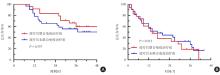
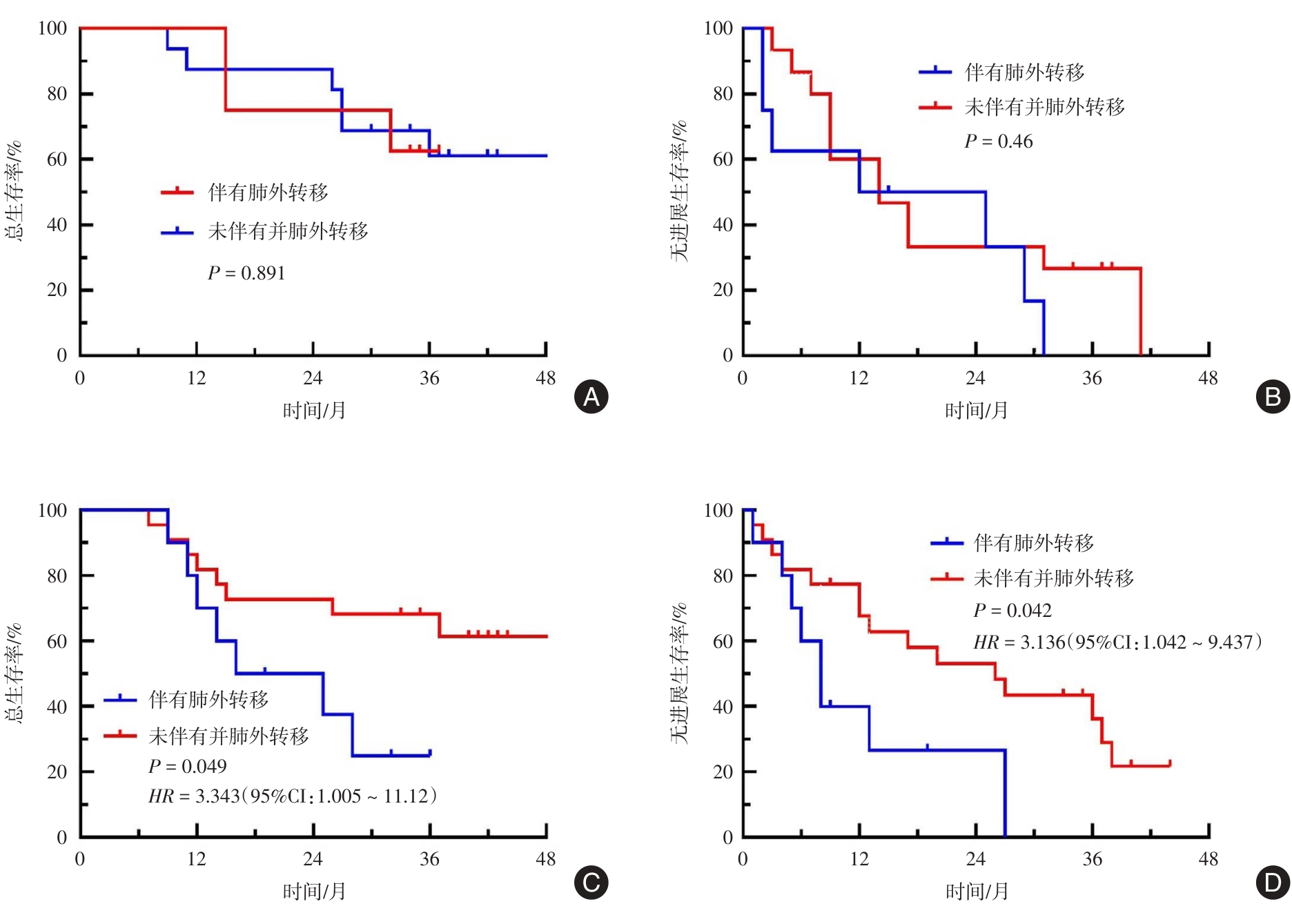
Fig.1
Comparison of overall survival based on receipt of post-radiotherapy immunotherapy in 56 patients"
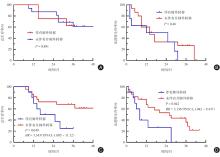
Fig.2
Survival outcomes by presence of extrapulmonary metastasis and post-radiotherapy immunotherapy in 56 patients"
Tab.4
Follow-up results of short-term efficacy evaluation for 104 pulmonary metastases"
| 结局事件 | 近期疗效评价 | χ2值 | P值 | |||
|---|---|---|---|---|---|---|
| CR | PR | SD | PD | |||
| 局部进展 | 0(0.0) | 6(54.5) | 2(18.2) | 3(27.3) | 30.887 | < 0.001 |
| 局部未进展 | 42(45.2) | 38(40.9) | 13(14.0) | 0(0.0) | ||
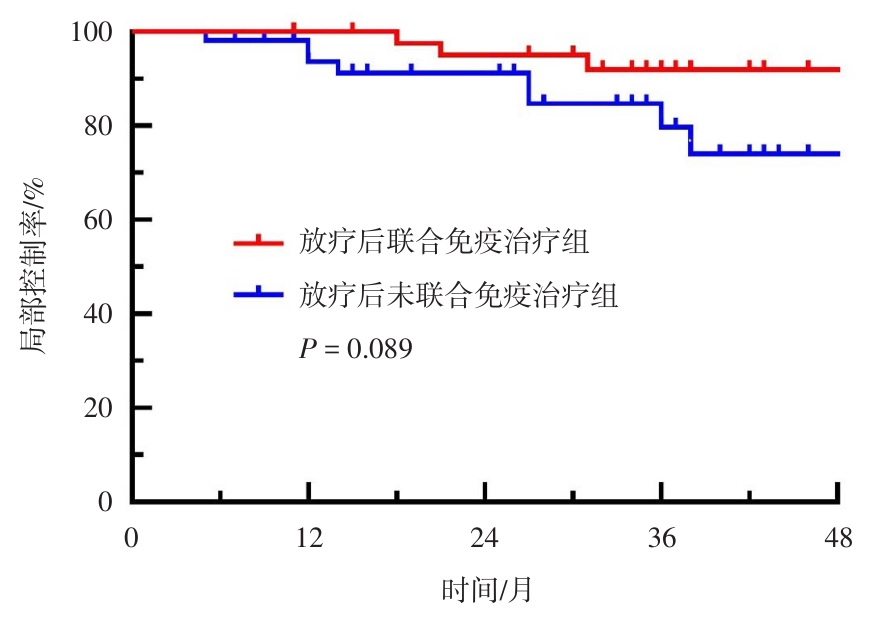
Fig.3
Comparison of local control rates based on receipt of post-radiotherapy immunotherapy for 104 lung metastases"
| [1] |
GELZINIS T A. The Society of Thoracic Surgeons Consensus Statements for the Surgical Treatment of Pulmonary Metastases[J]. J Cardiothorac Vasc Anesth, 2019, 33(9): 2448-2452. doi:10.1053/j.jvca.2019.02.035
doi: 10.1053/j.jvca.2019.02.035 |
| [2] |
CHEUNG F P, ALAM N Z, WRIGHT G M. The Past, Present and Future of Pulmonary Metastasectomy: A Review Article[J]. Ann Thorac Cardiovasc Surg, 2019, 25(3): 129-141. doi:10.5761/atcs.ra.18-00229
doi: 10.5761/atcs.ra.18-00229 |
| [3] |
DUDEK W, SCHREINER W, KHALAF M HAJ, et al. Surgery for Pulmonary Metastases: Long-Term Survival in 281 Patients[J]. Thorac Cardiovasc Surg, 2021, 69(7): 660-665. doi:10.1055/s-0041-1725203
doi: 10.1055/s-0041-1725203 |
| [4] |
ANTONOFF M B, SOFOCLEOUS C T, CALLSTROM M R, et al. The roles of surgery, stereotactic radiation, and ablation for treatment of pulmonary metastases[J]. J Thorac Cardiovasc Surg,2022, 163(2): 495-502. doi:10.1016/j.jtcvs.2021.01.143
doi: 10.1016/j.jtcvs.2021.01.143 |
| [5] | 朱旭,由金萍,夏晓萌,等. 肺部寡转移瘤立体定向放疗疗效及安全性[J]. 中华转移性肿瘤杂志,2023, 6(3): 234-238. |
| [6] |
LEE Y H, KANG K M, CHOI H S, et al. Comparison of stereotactic body radiotherapy versus metastasectomy outcomes in patients with pulmonary metastases[J]. Thorac Cancer,2018, 9(12): 1671-1679. doi:10.1111/1759-7714.12880
doi: 10.1111/1759-7714.12880 |
| [7] |
SPIGEL D R, FAIVRE-FINN C, GRAY J E, et al. Five-Year Survival Outcomes From the PACIFIC Trial: Durvalumab After Chemoradiotherapy in Stage III Non-Small-Cell Lung Cancer[J]. J Clin Oncol, 2022, 40(17): 1301-1311. doi:10.1200/jco.21.01308
doi: 10.1200/jco.21.01308 |
| [8] |
CHEN Y, GAO M, HUANG Z, et al. SBRT combined with PD-1/PD-L1 inhibitors in NSCLC treatment: A focus on the mechanisms, advances, and future challenges[J]. J Hematol Oncol, 2020, 13(1): 105. doi:10.1186/s13045-020-00940-z
doi: 10.1186/s13045-020-00940-z |
| [9] |
THEELEN W, CHEN D, VERMA V, et al. Pembrolizumab with or without radiotherapy for metastatic non-small-cell lung cancer: A pooled analysis of two randomised trials[J]. Lancet Respir Med, 2021, 9(5): 467-475. doi:10.1016/s2213-2600(20)30391-x
doi: 10.1016/s2213-2600(20)30391-x |
| [10] |
BECKERS P, BERZENJI L, YOGESWARAN S K, et al. Pulmonary metastasectomy in colorectal carcinoma[J]. J Thorac Dis, 2021, 13: 2628-2635. doi:10.21037/jtd-2019-pm-14
doi: 10.21037/jtd-2019-pm-14 |
| [11] |
RAMI-PORTA R, ASAMURA H, TRAVIS W D, et al. Lung cancer-major changes in the American Joint Committee on Cancer eighth edition cancer staging manual[J]. CA Cancer J Clin, 2017, 67(2): 138-155. doi:10.3322/caac.21390
doi: 10.3322/caac.21390 |
| [12] |
VORONOVA V, VISLOBOKOVA A, MUTIG K, et al. Combination of immune checkpoint inhibitors with radiation therapy in cancer: A hammer breaking the wall of resistance[J]. Front Oncol, 2022, 12: 1035884. doi:10.3389/fonc.2022.1035884
doi: 10.3389/fonc.2022.1035884 |
| [13] |
TULI H S, GARG V K, CHOUDHARY R, et al. Immunotherapeutics in lung cancers: From mechanistic insight to clinical implications and synergistic perspectives[J]. Mol Biol Rep, 2023, 50(3): 2685-2700. doi:10.1007/s11033-022-08180-9
doi: 10.1007/s11033-022-08180-9 |
| [14] |
SHAVERDIAN N, LISBERG A E, BORNAZYAN K, et al. Previous radiotherapy and the clinical activity and toxicity of pembrolizumab in the treatment of non-small-cell lung cancer: A secondary analysis of the KEYNOTE-001 phase 1 trial[J]. Lancet Oncol, 2017, 18(7): 895-903. doi:10.1016/s1470-2045(17)30380-7
doi: 10.1016/s1470-2045(17)30380-7 |
| [15] |
LUKE J J, LEMONS J M, KARRISON T G, et al. Safety and Clinical Activity of Pembrolizumab and Multisite Stereotactic Body Radiotherapy in Patients With Advanced Solid Tumors[J]. J Clin Oncol,2018, 36(16): 1611-1618. doi:10.1200/jco.2017.76.2229
doi: 10.1200/jco.2017.76.2229 |
| [16] | 张姝晶, 马廷耀, 杨国梁, 等. 以肺外为首次转移部位的头颈部腺样囊性癌患者的临床、预后特征及危险因素分析[J]. 中国耳鼻咽喉头颈外科, 2024, 31(5): 273-277. |
| [17] |
RICCO A, DAVIS J, RATE W, et al. Lung metastases treated with stereotactic body radiotherapy: The RSSearch® patient Registry's experience[J]. Radiat Oncol, 2017, 12(1): 35. doi:10.1186/s13014-017-0773-4
doi: 10.1186/s13014-017-0773-4 |
| [18] |
NUYTTENS J J, VAN DER VOORT VAN ZYP N C, VERHOEF C, et al. Stereotactic body radiation therapy for oligometastases to the lung: A phase 2 study[J]. Int J Radiat Oncol Biol Phys, 2015, 91(2): 337-343. doi:10.1016/j.ijrobp.2014.10.021
doi: 10.1016/j.ijrobp.2014.10.021 |
| [19] |
RIEBER J, STREBLOW J, UHLMANN L, et al. Stereotactic body radiotherapy (SBRT) for medically inoperable lung metastases-A pooled analysis of the German working group "stereotactic radiotherapy"[J]. Lung Cancer, 2016, 97: 51-58. doi:10.1016/j.lungcan.2016.04.012
doi: 10.1016/j.lungcan.2016.04.012 |
| [20] |
BAUML J M, MICK R, CIUNCI C, et al. Pembrolizumab After Completion of Locally Ablative Therapy for Oligometastatic Non-Small Cell Lung Cancer: A Phase 2 Trial[J]. JAMA Oncol, 2019, 5(9): 1283-1290. doi:10.1001/jamaoncol.2019.1449
doi: 10.1001/jamaoncol.2019.1449 |
| [1] | Xin LIU,Yutao HE,Fangming TIAN,Haocheng TANG,Zhitian SHI,Lin. WANG. Exploration and challenges of neoadjuvant therapy in the management of resectable hepatocellular carcinoma [J]. The Journal of Practical Medicine, 2025, 41(23): 3780-3785. |
| [2] | Zongjian HU,Shun WAN,Jianwei YANG,Li WANG,Siyu CHEN,Li YANG. Research progress of CAR⁃T cell therapy in bladder cancer [J]. The Journal of Practical Medicine, 2025, 41(22): 3496-3500. |
| [3] | Hang LI,Xiaomei YANG,Wen LYU,Huimin CHEN,Rui. XU. Three⁃year evaluation of the efficacy and safety of chronotherapy in dual⁃allergen subcutaneous immunotherapy [J]. The Journal of Practical Medicine, 2025, 41(21): 3405-3411. |
| [4] | Qiang FU,Zhongqi LU,Ying CHANG,Tiefeng JIN,Meihua. ZHANG. Research progress on the antitumor effects of immune checkpoint inhibitors [J]. The Journal of Practical Medicine, 2025, 41(2): 288-293. |
| [5] | Muying HUANG,Chu LIU,Jiaman LIU,Zhicong. WANG. Early identification of high⁃risk children who develop systemic adverse reactions related to dust mite allergy subcutaneous immunotherapy [J]. The Journal of Practical Medicine, 2025, 41(19): 3065-3071. |
| [6] | Lingchun CAO,Fanliang MENG,Xiaoan SHENG. Risk factors and model construction of immune therapy⁃related thyroid dysfunction in non⁃small cell lung cancer [J]. The Journal of Practical Medicine, 2025, 41(17): 2705-2714. |
| [7] | Caifang GUO,Hong FAN,Ting LUAN,Hui ZHAN,Haifeng WANG,Jiansong WANG. The role and research progress of cytoreductive nephrectomy in metastatic renal cell carcinoma [J]. The Journal of Practical Medicine, 2025, 41(13): 1952-1957. |
| [8] | Zegong HU,Yan BAI. Research advances in allergen-specific immunotherapy [J]. The Journal of Practical Medicine, 2025, 41(11): 1760-1766. |
| [9] | Jiang SHAO,Lin LI,Yansong GUO,Chengyuan SUN,Xichao WEN,Kebin ZHENG,Yanfang SHI. Research progress of CD73/NT5E in glioblastoma [J]. The Journal of Practical Medicine, 2024, 40(3): 428-431. |
| [10] | Zhaochen SUN,Junyan JIANG,Yitian. CHEN. Advancements in CAR⁃T cell research for the treatment of colorectal cancer [J]. The Journal of Practical Medicine, 2024, 40(18): 2640-2646. |
| [11] | Ziqi DING,Qian. ZHANG. Research progress in T cell exhaustion and its relationship with respiratory diseases [J]. The Journal of Practical Medicine, 2024, 40(13): 1895-1900. |
| [12] | Yawei ZHANG,Hongjin SHI,Shi FU,Jiansong WANG,Haifeng WANG. Research progress in biological role of TIGIT and its application in bladder cancer [J]. The Journal of Practical Medicine, 2024, 40(12): 1762-1766. |
| [13] | Xizhi WEN,Xiaoshi. ZHANG. Immunotherapy based on neoantigen: A personalized treatment strategy for melanoma [J]. The Journal of Practical Medicine, 2024, 40(10): 1331-1337. |
| [14] | WU Kaiyi, LÜ Xuedong, HE Haiyan, CHEN Jinliang. . Progress in the application of cryoablation combined with immunotherapy in the treatment of NSCLC [J]. The Journal of Practical Medicine, 2023, 39(8): 1058-1062. |
| [15] | ZHANG Xijie, LI Xin, ZHOU Wence.. Research progress of combined immunotherapy for metastatic pancreas cancer [J]. The Journal of Practical Medicine, 2023, 39(6): 655-659. |
| Viewed | ||||||
|
Full text |
|
|||||
|
Abstract |
|
|||||
