

The Journal of Practical Medicine ›› 2026, Vol. 42 ›› Issue (18): 3417-3424.doi: 10.3969/j.issn.1006-5725.2026.18.021
• Treatise:Mechanism and Practice • Previous Articles
Bin Zhao, Yuru Gao, Meng Liu, Wenqin Gou, Yiying Wang, Weiwei Zhu, Dong Zhang, Fangyu Ning, Tao Wang( ), Dong Hao, Xiaozhi Wang, Ting Sun
Received:2026-08-17
Revised:2026-08-31
Accepted:2026-09-01
Online:2026-09-25
Published:2026-10-19
Contact:
Tao Wang
About author:Zhao Bin collected and organized the clinical data and wrote the article. Gao Yuru, Liu Meng, Gou Wenqin and Wang Yiying collected and organized the clinical data. Zhu Weiwei, Zhang Dong and Ning Fangyu participated in the statistical analysis. Wang Tao designed the study and performed the final review of the article. Hao Dong, Wang Xiaozhi and Sun Ting revised and reviewed the article. All authors read and approved the final manuscript as submitted.
CLC Number:
Bin Zhao, Yuru Gao, Meng Liu, Wenqin Gou, Yiying Wang, Weiwei Zhu, Dong Zhang, Fangyu Ning, Tao Wang, Dong Hao, Xiaozhi Wang, Ting Sun. Association between early soluble thrombomodulin levels and day-5 sepsis-induced coagulopathy in patients with sepsis[J]. The Journal of Practical Medicine, 2026, 42(18): 3417-3424.
Tab.1
Comparison of D1 baseline characteristics between the D5 SIC and non-SIC groups"
| 指标 | D5非SIC组(n = 109) | D5 SIC组(n = 57) | Z/χ²值 | P值 |
|---|---|---|---|---|
| 年龄/岁 | 68.00(60.00,75.00) | 71.00(66.00,78.00) | -1.48 | 0.138 |
| 性别/[例(%)] | 0.43 | 0.511 | ||
| 男 | 69(63.3) | 39(68.4) | ||
| 女 | 40(36.7) | 18(31.6) | ||
| 基础疾病/[例(%)] | ||||
| 糖尿病 | 27(25.0) | 17(29.8) | 0.44 | 0.505 |
| 高血压 | 49(45.4) | 27(47.4) | 0.06 | 0.807 |
| 慢性心脏疾病 | 35(32.1) | 25(43.9) | 2.24 | 0.135 |
| 慢性肺疾病 | 23(21.1) | 7(12.3) | 1.97 | 0.161 |
| 感染来源/[例(%)] | 0.92 | 0.338 | ||
| 肺部感染 | 75(68.8) | 35(61.4) | ||
| 肺外感染 | 34(31.2) | 22(38.6) | ||
| 疾病严重程度 | ||||
| APACHE Ⅱ评分/分 | 16.00(13.00,22.00) | 20.00(14.00,26.00) | -2.61 | 0.009 |
| SOFA凝血亚评分/分 | 0.00(0.00,0.00) | 1.00(0.00,1.00) | -3.75 | < 0.001 |
| 乳酸/(mmol/L) | 1.30(1.00,2.40) | 1.70(1.20,2.90) | -1.98 | 0.047 |
| 凝血相关指标 | ||||
| 血小板/(×10⁹·L-1) | 208.00(170.00,278.00) | 139.00(105.00,219.00) | 3.78 | < 0.001 |
| PT/s | 13.50(12.50,14.80) | 14.60(13.50,16.40) | -3.99 | < 0.001 |
| APTT/s | 32.90(28.20,37.60) | 39.00(33.62,45.55) | -4.11 | < 0.001 |
| INR | 1.13(1.05,1.24) | 1.23(1.12,1.40) | -4.05 | < 0.001 |
| 纤维蛋白原/(g/L) | 4.80(3.50,5.70) | 4.10(3.20,5.50) | 1.39 | 0.165 |
| D-二聚体/(μg/mL) | 2.54(0.97,5.06) | 4.16(1.79,7.97) | -2.69 | 0.007 |
Tab.2
Comparison of D1 coagulation, endothelial and fibrinolysis-related biomarkers between the D5 SIC and non-SIC groups"
| 指标 | D5非SIC组 | D5 SIC组 | Z值 | P值 |
|---|---|---|---|---|
| TAT/(ng/mL) | 6.35(3.67,10.91) | 11.93(7.19,26.62) | -4.79 | < 0.001 |
| sTM/(TU/mL) | 9.01(6.67,11.96) | 14.15(11.88,18.18) | -7.14 | < 0.001 |
| PIC/(μg/mL) | 0.90(0.65,1.27) | 1.04(0.76,1.71) | -2.16 | 0.031 |
| t-PAIC/(ng/mL) | 6.65(3.63,10.26) | 8.93(4.74,15.08) | -2.39 | 0.017 |
Tab.3
Logistic regression and sensitivity analyses of the association between sTM and D5 SIC"
| 模型 | 变量 | β | SE | Waldχ² | OR | 95%CI | P值 |
|---|---|---|---|---|---|---|---|
| 模型0 | sTM(每增加1 SD) | 2.228 | 0.398 | 31.40 | 9.28 | 4.26 ~ 20.22 | < 0.001 |
| 模型1 | sTM(每增加1 SD) | 2.122 | 0.401 | 28.04 | 8.35 | 3.81 ~ 18.32 | < 0.001 |
| 模型1 | SOFA凝血亚评分(每增加1分) | 0.491 | 0.244 | 4.03 | 1.63 | 1.01 ~ 2.64 | 0.045 |
| 模型2 | sTM(每增加1 SD) | 2.190 | 0.421 | 27.00 | 8.93 | 3.91 ~ 20.41 | < 0.001 |
| 模型2 | SOFA凝血亚评分(每增加1分) | 0.584 | 0.272 | 4.60 | 1.79 | 1.05 ~ 3.06 | 0.032 |
| 模型2 | APACHE Ⅱ评分(每增加5分) | 0.134 | 0.151 | 0.79 | 1.14 | 0.85 ~ 1.54 | 0.374 |
| 模型3 | sTM(每增加1 SD) | 2.299 | 0.454 | 25.68 | 9.96 | 4.09 ~ 24.23 | < 0.001 |
| 模型3 | PLT(每增加10 × 10⁹/L) | -0.074 | 0.024 | 9.16 | 0.93 | 0.89 ~ 0.97 | 0.002 |
| 模型3 | INR(每增加0.1) | 0.348 | 0.132 | 7.00 | 1.42 | 1.09 ~ 1.83 | 0.008 |
| 模型3 | APACHE Ⅱ评分(每增加5分) | 0.099 | 0.162 | 0.38 | 1.10 | 0.80 ~ 1.52 | 0.540 |
Tab.4
AUCs of sTM, SOFA coagulation subscore, and their combination for discriminating D5 SIC"
| 指标 | AUC | 95%CI |
|---|---|---|
| SOFA凝血亚评分 | 0.679 | 0.602 ~ 0.756 |
| sTM | 0.839 | 0.780 ~ 0.899 |
| sTM联合SOFA凝血亚评分 | 0.854 | 0.796 ~ 0.911 |
Tab.5
Discriminative performance of sTM and routine coagulation models for D5 SIC"
| 模型 | AUC(95%CI) | 最佳截断值 | 敏感度/% | 特异度/% | 准确率/% |
|---|---|---|---|---|---|
| sTM | 0.839(0.780 ~ 0.899) | 12.11 TU/mL | 73.7 | 79.2 | 77.3 |
| PLT+INR | 0.785(0.706 ~ 0.864) | 77.2 | 76.4 | 76.7 | |
| PLT+INR+sTM | 0.888(0.837 ~ 0.939) | 93.0 | 76.4 | 82.2 |
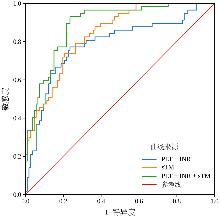
Fig.1
ROC curves of sTM and routine coagulation models for discriminating D5 SIC"
| [1] |
|
| [2] |
宋景春, 丁仁彧, 吕奔, 等. 脓毒症性凝血病诊疗中国专家共识(2024版)[J]. 解放军医学杂志, 2024, 49(11): 1221-1236. doi:10.11855/j.issn.0577-7402.1189.2024.0918 .
|
| [3] |
|
| [4] |
|
| [5] |
|
| [6] |
|
| [7] |
|
| [8] |
|
| [9] |
|
| [10] |
|
| [11] |
|
| [12] |
|
| [13] |
|
| [14] |
|
| [15] |
|
| [16] |
|
| [17] |
耿方敏, 贺元旦, 李文娟, 等. 不同DIC评分系统对脓毒症患者凝血功能障碍早期诊断和预后预测的价值[J]. 实用医学杂志, 2024, 40(2): 248-252. doi:10.3969/j.issn.1006-5725.2024.02.021 .
|
| [18] |
王仙琦, 张斌, 张琪, 等. 基于单细胞测序分析脓毒症早期血小板数量和功能变化[J]. 实用医学杂志, 2024, 40(9): 1218-1224. doi:10.3969/j.issn.1006-5725.2024.09.007 .
|
| [19] |
|
| [20] |
|
| [1] | Lili LI,Na′na PAN,Jing XU. Risk assessment of intracranial hemorrhage in preterm infants younger than 32 weeks based on early postnatal coagulation parameters and platelet counts [J]. The Journal of Practical Medicine, 2026, 42(6): 1057-1062. |
| [2] | Liang CAO,Fang ZOU,Changhong ZHANG,Kailun XU,Jianqing ZHAO,Jingqi LI,Jianhua LIU,Zhanhong TANG. Mechanism of CREG regulating PINK1/Parkin to promote mitophagy in sepsis-induced acute lung injury [J]. The Journal of Practical Medicine, 2026, 42(5): 861-868. |
| [3] | Ronghai Lin, Junfei Liu, Luxia Ye, Qi Chen, Sheng Zhang, Ke Cui, Yongpo Jiang, Yinghe Xu. The effect of lipoxin A4 on vascular endothelial damage in sepsis through regulating the balance of Ang-2/Ang-1 via FPR2 [J]. The Journal of Practical Medicine, 2026, 42(16): 3001-3008. |
| [4] | Huiling LAN,Junpeng TANG,Pengfei WANG,Yihan DING,Meng HU,Tao YU,Fengqing SONG. The value of dynamic monitoring of procalcitonin in guiding anti-infective treatment for patients with sepsis [J]. The Journal of Practical Medicine, 2026, 42(14): 2632-2639. |
| [5] | Wenqing ZHAO,Liuyuan LI,Chongjian ZHANG,Hailong QIU,Xiaofeng LI. Prognostic value of the Model for End-Stage Liver Disease Excluding International Normalized Ratio(MELD-XI) score for long-term all-cause mortality in elderly patients following cardiac valve surgery [J]. The Journal of Practical Medicine, 2026, 42(12): 2091-2097. |
| [6] | Tao HUANG,Xiaojuan LUO,Fengpiao HUANG,Xiaoying FU,Yunsheng CHEN,Ke CAO. Development and validation of a multi-dimensional pediatric sepsis early warning score based on routine laboratory indicators [J]. The Journal of Practical Medicine, 2026, 42(11): 2077-2082. |
| [7] | Zhen ZHANG,Donghao WANG,Yang LV. Diagnostic value of skeletal muscle ultrasonography combined with bioelectrical impedance analysis in acquired weakness in the intensive care unit of patients with tumor sepsis [J]. The Journal of Practical Medicine, 2026, 42(1): 21-28. |
| [8] | Songbai WU,Yao. DAI. Predictive value of multiligand proteoglycan⁃1, vascular endothelial⁃calmodulin and neuron⁃specific enolase in sepsis⁃associated encephalopathy in elderly patients [J]. The Journal of Practical Medicine, 2025, 41(8): 1111-1116. |
| [9] | Tong DUAN,Qi WU,Hui. LIU. Correlation between iron death⁃related gene expression level and myocardial dysfunction and prognosis in sepsis [J]. The Journal of Practical Medicine, 2025, 41(6): 846-851. |
| [10] | Luoyi HE,Pinjing LIU,Jingming HUANG,Lixin GU,Zhanhong. TANG. To explore the distribution,risk factors and prognosis of capillary leakage syndrome in VA⁃ECMO patients [J]. The Journal of Practical Medicine, 2025, 41(4): 542-547. |
| [11] | Jinyan GUO,Yuqing YOU,Ke CHEN,Fen PAN,Jiahui LAI,Sufang CHEN,Weifeng. YAO. Protective mechanism of sevoflurane on acute lung injury in sepsis by regulating the Wnt/β-catenin signaling pathway [J]. The Journal of Practical Medicine, 2025, 41(19): 2991-2999. |
| [12] | Tianzhen HUA,Haitao WANG,Shuting WEI,Sen TONG,Ning DONG,Xiaomei ZHU,Yongming YAO,Wei LIU. The programmed death of megakaryocytes and its impact on platelet-production copacity and coagulation function in mice with sepsis [J]. The Journal of Practical Medicine, 2025, 41(15): 2325-2335. |
| [13] | Yunfen TIAN,Bin WANG,Fangxiang ZHANG. Multi-target regulation of short-chain fatty acids in sepsis [J]. The Journal of Practical Medicine, 2025, 41(13): 2105-2110. |
| [14] | Yuexian LYU,Xiu BI,Ying LIU,Shujing CUI,Lixin ZHAO,Ge GAO,Jianxia WANG,Juan LI,Jun LI. The efficacy of plasma gasdermin D C⁃terminal fragment in the early diagnosis of sepsis [J]. The Journal of Practical Medicine, 2025, 41(12): 1899-1906. |
| [15] | Xianqi WANG,Bin ZHANG,Qi ZHANG,Zheng DAI,Jinxin ZHANG,Xiaoli LIANG,Lin LI,Lin WU,Shanshou LIU. Analysis of the changes in the count and function of platelet at the early sepsis based on single cell sequencing [J]. The Journal of Practical Medicine, 2024, 40(9): 1218-1224. |
| Viewed | ||||||
|
Full text |
|
|||||
|
Abstract |
|
|||||
