

The Journal of Practical Medicine ›› 2026, Vol. 42 ›› Issue (14): 2632-2639.doi: 10.3969/j.issn.1006-5725.2026.14.016
• Treatise:Mechanism and Practice • Previous Articles
Huiling LAN1,Junpeng TANG2,Pengfei WANG2,Yihan DING2,Meng HU2,Tao YU2,Fengqing SONG2( )
)
Received:2026-05-12
Online:2026-07-25
Published:2026-08-05
Contact:
Fengqing SONG
E-mail:310449019@qq.com
CLC Number:
Huiling LAN,Junpeng TANG,Pengfei WANG,Yihan DING,Meng HU,Tao YU,Fengqing SONG. The value of dynamic monitoring of procalcitonin in guiding anti-infective treatment for patients with sepsis[J]. The Journal of Practical Medicine, 2026, 42(14): 2632-2639.
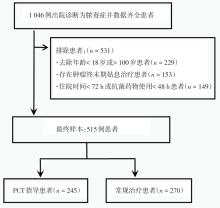
Fig.1
Flowchart of patient selection"
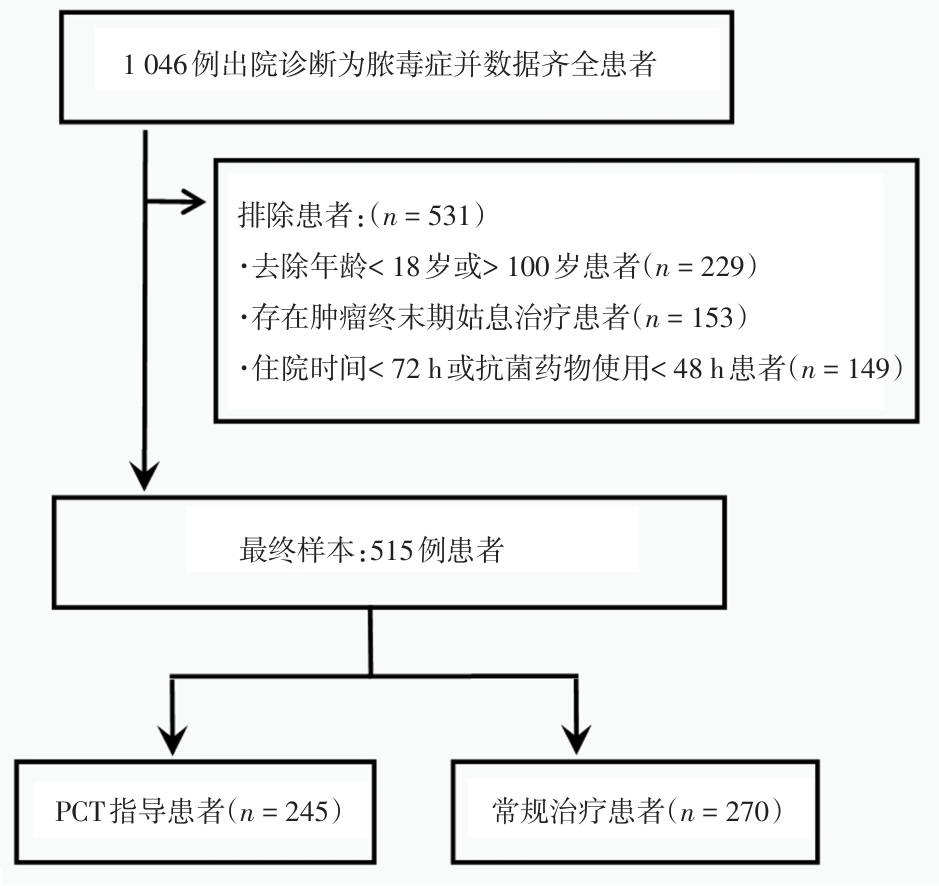

Tab.1
Comparison of baseline general data between two groups of sepsis patients"
| 指标 | 常规治疗组(n = 270) | PCT指导组(n = 245) | χ2/Z值 | P值 |
|---|---|---|---|---|
| 年龄[M(P75,P25)/岁] | 60(48,70) | 62(50,74) | -1.745 | 0.081 |
| 男性/[例(%)] | 180(66.7) | 161(65.7) | 0.018 | 0.893 |
| 既往病史/[例(%)] | ||||
| 高血压 | 79(29.3) | 87(35.5) | 2.022 | 0.155 |
| 糖尿病 | 66(24.4) | 68(27.8) | 0.571 | 0.450 |
| 慢性阻塞性肺病 | 4(1.5) | 6(2.4) | 0.420 | 0.635 |
| 肝硬化 | 10(3.7) | 5(2.0) | 1.157 | 0.391 |
| 慢性肾功能不全 | 13(4.8) | 11(4.5) | 0.000 | 1.000 |
Tab.2
Comparison of overall efficacy between the two groups of sepsis patients"
| 指标 | 常规治疗组(n = 270) | PCT指导组(n = 245) | χ2/Z/t值 | P值 |
|---|---|---|---|---|
| 抗菌药物使用时长/h | 579.01(288.99,1 290.77) | 408.01(228.06,887.00) | -3.291 | 0.001 |
| 停药时PCT/(ng/mL) | 0.97(0.22,6.04) | 0.31(0.09,1.41) | -4.892 | < 0.001 |
| 28 d死亡率/[例(%)] | 76(28.1) | 41(16.7) | 8.273 | 0.003 |
| 院内死亡率/[例(%)] | 100(37.0) | 71(29.0) | 3.407 | 0.065 |
| 日均抗菌药物费用(x ± s)/元 | 1 871.39 ± 2 606.92 | 2 071.15 ± 6 785.75 | 0.449 | 0.654 |
| 抗菌药物费用/元 | 12 231.96(3 396.04,2 7211.60) | 6 790.44(2 393.00,21 712.71) | -2.878 | 0.004 |
Tab.3
Comparison of safety indicators between the two groups of sepsis patients"
| 指标 | 常规治疗组(n = 270) | PCT指导组(n = 245) | χ2值 | P值 |
|---|---|---|---|---|
| 抗感染相关肾损伤 | 49(18.1) | 40(16.3) | 0.185 | 0.668 |
| AST异常 | 123(45.6) | 107(43.7) | 0.115 | 0.734 |
| ALT异常 | 129(47.8) | 94(38.4) | 4.263 | 0.039 |
| 胆红素异常 | 126(46.7) | 105(42.9) | 0.607 | 0.436 |
Tab.4
Efficacy Analysis by Different Clinical Feature Subgroups"
| 亚组分类 | 指标 | 常规治疗组 (n = 270) | PCT指导组 (n = 245) | Z值 | P值 | P for interaction |
|---|---|---|---|---|---|---|
| 年龄亚组 | ||||||
≥ 65岁 (常规组 n = 112,PCT 组 n = 108) | 抗菌药物使用时长/h | 454.25(254.25,738.08) | 395.01(212.51,814.52) | -0.468 | 0.640 | 0.039 |
| 住院时间/d | 18.00(10.75,27.00) | 15.00(10.00,25.00) | -1.167 | 0.244 | 0.605 | |
< 65岁 (常规组 n = 158,PCT 组 n = 137) | 抗菌药物使用时长/h | 716.52(386.99,1 583.27) | 408.06(247.00,935.00) | -3.891 | < 0.001 | - |
| 住院时间/d | 23.00(12.25,33.50) | 17.00(11.00,26.00) | -2.492 | 0.013 | - | |
| SOFA亚组 | ||||||
≥ 4分 (常规组 n = 80,PCT 组 n = 61) | 抗菌药物使用时长/h | 584.01(277.26,1 632.26) | 641.99(277.01,1 066.04) | -0.052 | 0.959 | 0.074 |
| 住院时间/d | 15.50(10.00,31.00) | 17.00(12.00,27.00) | -0.306 | 0.760 | 0.114 | |
< 4分 (常规组 n = 190,PCT 组 n = 184) | 抗菌药物使用时长/h | 577.04(297.74,1 192.14) | 374.92(213.74,773.03) | -3.682 | < 0.001 | - |
| 住院时间/d | 21.00(13.00,31.00) | 16.00(10.00,25.00) | -3.291 | 0.001 | - | |
| 糖尿病亚组 | ||||||
合并糖尿病 (常规组 n = 66,PCT 组 n = 68) | 抗菌药物使用时长/h | 567.98(270.76,1 400.53) | 421.00(257.51,830.51) | -1.081 | 0.280 | 0.332 |
| 住院时间/d | 19.00(10.00,25.75) | 19.00(11.75,25.50) | -0.954 | 0.340 | 0.003 | |
无糖尿病 (常规组 n = 204,PCT 组 n = 177) | 抗菌药物使用时长/h | 583.51(290.51,1 241.77) | 374.02(215.02,908.01) | -3.107 | 0.002 | - |
| 住院时间/d | 22.00(12.00,34.00) | 14.00(10.00,26.00) | -4.082 | < 0.001 | - |
| [1] |
SINGER M, DEUTSCHMAN C S, SEYMOUR C W, et al. The third international consensus definitions for sepsis and septic shock (Sepsis-3)[J]. JAMA, 2016, 315 (8): 801-810. doi: 10.1001/jama.2016.0287 .
doi: 10.1001/jama.2016.0287 |
| [2] |
RUDD K E, JOHNSON S C, AGESA K M, et al. Global, regional, and national sepsis incidence and mortality, 1990-2017: Analysis for the Global Burden of Disease Study [J]. Lancet, 2020, 395 (10219): 200-211. doi: 10.1016/S0140-6736 (19) 32989-7 .
doi: 10.1016/S0140-6736 (19) 32989-7 |
| [3] |
吴中,罗丽丽,胡豫. 重症感染相关凝血异常的诊疗进展[J]. 临床血液学杂志,2025,38(7):505-511. doi:10.13201/j.issn. 1004-2806.2025.07.003 .
doi: 10.13201/j.issn. 1004-2806.2025.07.003 |
| [4] |
DESPOSITO L, BASCARA C. Review: Sepsis guidelines and core measure bundles [J]. Postgrad Med, 2024, 136 (7): 702-711. doi: 10.1080/00325481.2024.2388021 .
doi: 10.1080/00325481.2024.2388021 |
| [5] |
PAK T R, RHEE C, KLOMPAS M. Timing and spectrum of antibiotic treatment for suspected sepsis and septic shock: Why so controversial [J]. Infect Dis Clin North Am, 2022, 36 (4): 719-733. doi: 10.1016/j.idc.2022.08.001 .
doi: 10.1016/j.idc.2022.08.001 |
| [6] |
WEHRENBERG K, MITCHELL M, ZEMBLES T, et al. Antibiotic treatment duration for culture-negative sepsis in the pediatric intensive care unit [J]. Antimicrob Steward Healthc Epidemiol, 2023, 3 (1): e249. doi: 10.1017/ash.2023.502 .
doi: 10.1017/ash.2023.502 |
| [7] |
KYRIAZOPOULOU E, GIAMARELLOS-BOURBOULIS E J. Antimicrobial Stewardship Using Biomarkers: Accumulating Evidence for the Critically Ill[J]. Antibiotics,2022,11(3):367. doi:10.3390/antibiotics11030367 .
doi: 10.3390/antibiotics11030367 |
| [8] |
PARK D W, CHOI J Y, KIM C J, et al. Implementation of procalcitonin in antibiotic stewardship: Derivation of a consensus algorithm for procalcitonin use in clinical practice [J]. Infect Chemother, 2022, 54 (4): 621-636. doi: 10.3947/ic.2022.0170 .
doi: 10.3947/ic.2022.0170 |
| [9] |
JORDAN A, SIVAPALAN P, RØMER V, et al. Time-updated phenotypic guidance of corticosteroids and antibiotics in COPD: Rationale, perspective and a proposed method[J]. Biomedicines,2023,11(5):1395. doi:10.3390/biomedicines11051395 .
doi: 10.3390/biomedicines11051395 |
| [10] |
苏丽,张瑞英,李缺缺. 动态监测脓毒症患者血浆降钙素原水平指导抗生素治疗对疗程及耐药性和预后的影响[J]. 中国临床研究,2025,38(11):1670-1674. doi:10.13429/j.cnki.cjcr. 2025.11.009 .
doi: 10.13429/j.cnki.cjcr. 2025.11.009 |
| [11] |
张玉,李军,杨卫立. 降钙素原在脓毒症精准诊疗中的多维作用及未来发展[J]. 临床医学进展,2025,15(6):2021-2030. doi:10.12677/acm.2025.1561943 .
doi: 10.12677/acm.2025.1561943 |
| [12] |
KHILNANI G C, TIWARI P, ZIRPE K G, et al. Guidelines for the use of procalcitonin for rational use of antibiotics [J]. Indian J Crit Care Med, 2022, 26 (): S77-S94. doi: 10.5005/jp-journals-10071-24326 .
doi: 10.5005/jp-journals-10071-24326 |
| [13] |
谢国栋,武能舜,陈超,等. 血清降钙素原水平监测指导儿童轻度社区获得性肺炎临床用药的价值研究[J]. 当代医学,2024(6):5-9. doi:10.3969/j.issn.1009-4393.2024.06.02 .
doi: 10.3969/j.issn.1009-4393.2024.06.02 |
| [14] |
闫圣涛,张国强. 降钙素原在血流感染脓毒症病原体鉴别诊断中的价值 [J]. 中国急救复苏与灾害医学杂志,2022,17 (11):1533-1536. doi:10.3969/j.issn.1673-6966.2022.11.032 .
doi: 10.3969/j.issn.1673-6966.2022.11.032 |
| [15] |
陈耀武,陈一峰,白成剑,等. 动态监测血清降钙素原水平在老年重症肺炎患者抗生素降阶梯治疗中的应用效果[J]. 广西医学,2023,45 (3):355-357,361. doi:10.11675/j.issn.0253-4304. 2023.03.20 .
doi: 10.11675/j.issn.0253-4304. 2023.03.20 |
| [16] |
程业童,胡爱玲,王娜. 降钙素原监测在肝脓肿继发脓毒血症停药指导中的价值[J]. 中西医结合肝病杂志,2025,35(6):704-707. doi:10.3969/j.issn.1005-0264.2025.006.010 .
doi: 10.3969/j.issn.1005-0264.2025.006.010 |
| [17] |
PAPP M, KISS N, BAKA M, et al. Procalcitonin-guided antibiotic therapy may shorten length of treatment and may improve survival-a systematic review and meta-analysis [J]. Crit Care, 2023, 27 (1): 394. doi: 10.1186/s13054-023-04677-2 .
doi: 10.1186/s13054-023-04677-2 |
| [18] |
KIM J H. Clinical utility of procalcitonin on antibiotic stewardship: A narrative review [J]. Infect Chemother, 2022, 54 (4): 610-620. doi: 10.3947/ic.2022.0162 .
doi: 10.3947/ic.2022.0162 |
| [19] |
SCHUETZ P. How to best use procalcitonin to diagnose infections and manage antibiotic treatment [J]. Clin Chem Lab Med, 2022, 61 (5): 822-828. doi: 10.1515/cclm-2022-1072 .
doi: 10.1515/cclm-2022-1072 |
| [20] |
MAZAHERI T, RANASINGHE R, AL-HASANI W, et al. A cytokine panel and procalcitonin in COVID-19, a comparison between intensive care and non-intensive care patients[J]. PLoS One, 2022,17(5):e0266652. doi:10.1371/journal.pone.0266652 .
doi: 10.1371/journal.pone.0266652 |
| [21] |
SCHUETZ P, WIRZ Y, SAGER R, et al. Effect of procalcitonin-guided antibiotic treatment on mortality in acute respiratory infections: A patient level meta-analysis[J]. Lancet Infect Dis, 2018, 18(1): 95-107. doi: 10.1016/S1473-3099(17)30592-3 .
doi: 10.1016/S1473-3099(17)30592-3 |
| [22] |
HESSELS L, VOSSEN D, LEEUW M, et al. Procalcitonin-guided antibiotic prescription in patients with respiratory syncytial virus and influenza virus [J]. BMJ Open Respir Res, 2025, 12 (1): e003483. doi: 10.1136/bmjresp-2025-003483 .
doi: 10.1136/bmjresp-2025-003483 |
| [23] |
蒋艳红,许一吟,廖若彤,等. 单次与多次抗生素方案对关节置换术护理负荷及医疗成本的影响 [J]. 实用医学杂志,2026, 42 (2): 311-319. doi: 10.3969/j.issn.1006-5725.2026.02.017 .
doi: 10.3969/j.issn.1006-5725.2026.02.017 |
| [24] |
BERTOLINO G, MARRAS L, MUREDDU V, et al. Trends of antimicrobial consumption in hospital: Tackling the hidden part of the iceberg with an electronic personalised prescription software for antimicrobial stewardship [J]. Adv Exp Med Biol, 2023, 1370: 113-123. doi: 10.1007/5584_2022_752 .
doi: 10.1007/5584_2022_752 |
| [25] |
许仙仙,蒋永泼. 脓毒症患者早期抗生素治疗的研究进展[J]. 实用医学杂志,2023,39(10):1311-1315. doi:10.3969/j.issn.1006-5725.2023.10.021 .
doi: 10.3969/j.issn.1006-5725.2023.10.021 |
| [26] |
YOON C, PARK S Y, KIM B, et al. Relationship between the appropriateness of antibiotic treatment and clinical outcomes/medical costs of patients with community‑acquired acute pyelonephritis: A multicenter prospective cohort study [J]. BMC Infect Dis, 2022, 22 (1): 112. doi: 10.1186/s12879-022-07097-9 .
doi: 10.1186/s12879-022-07097-9 |
| [27] |
SHIRAISHI C, KATO H, OGURA T, et al. An investigation of broad-spectrum antibiotic-induced liver injury based on the FDA Adverse Event Reporting System and retrospective observational study[J]. Sci Rep,2024,14(1):18221. doi:10.1038/s41598-024-69279-6 .
doi: 10.1038/s41598-024-69279-6 |
| [28] |
CAGIR Y, DURAK M B, SIMSEK C, et al. Comparison of ERCP outcomes and complication risk between elderly and younger patients: A large single-center study[J]. J Clin Med,2024,13(20):6112. doi:10.3390/jcm13206112 .
doi: 10.3390/jcm13206112 |
| [29] |
李子琦. 脓毒血症护理学管理:从急症救治到居家康复[J]. 医学研究与实践,2025,3(12):94-97. doi: 10.61369/MRP. 2025120021 .
doi: 10.61369/MRP. 2025120021 |
| [30] |
JIANG L, CHENG M. Impact of diabetes mellitus on outcomes of patients with sepsis: An updated systematic review and meta-analysis[J]. Diabetol Metab Syndr,2022,14(1):39. doi:10.1186/s13098-022-00803-2 .
doi: 10.1186/s13098-022-00803-2 |
| [31] |
GÖBÜT H, ŞIMŞEK B H, INAN N, et al. The effect of ozone on kidney and liver tissues in the treatment of sepsis caused by cecal perforation in diabetic mice[J]. Drug Des Devel Ther,2025,19:11355-11369. doi:10.2147/DDDT.S536553 .
doi: 10.2147/DDDT.S536553 |
| [32] |
PARK A K, NAKASONE T S, KAUSHAL A, et al. Quantifying the relationship between renal function and procalcitonin: A study of 14 431 blood cultures [J]. Open Forum Infect Dis, 2025, 12 (11): ofaf654. doi: 10.1093/ofid/ofaf654 .
doi: 10.1093/ofid/ofaf654 |
| [33] |
SUNDARA S V, LU X, BUSMAIL H, et al. C-reactive protein versus procalcitonin in the early diagnosis of neonatal sepsis: A systematic review [J]. Cureus, 2025, 17 (8): e90353. doi: 10.7759/cureus.90353 .
doi: 10.7759/cureus.90353 |
| Viewed | ||||||
|
Full text |
|
|||||
|
Abstract |
|
|||||
