

The Journal of Practical Medicine ›› 2026, Vol. 42 ›› Issue (18): 3323-3329.doi: 10.3969/j.issn.1006-5725.2026.18.010
• Chronic Disease Control • Previous Articles
Honghong Shi, Yuhe Yan, Yue Li, Lihua Wang( )
Received:2026-06-09
Revised:2026-08-11
Accepted:2026-08-19
Online:2026-09-25
Published:2026-10-19
Contact:
Lihua Wang
About author:Shi Honghong was responsible for writing the review. Yan Yuhe, Li Yue participated in the collection of literature. Wang Lihua supervised the writing. All authors read and approved the final manuscript as submitted.
CLC Number:
Honghong Shi, Yuhe Yan, Yue Li, Lihua Wang. Research progress on the role of succinate metabolism in kidney diseases and related targeted therapeutic strategies[J]. The Journal of Practical Medicine, 2026, 42(18): 3323-3329.
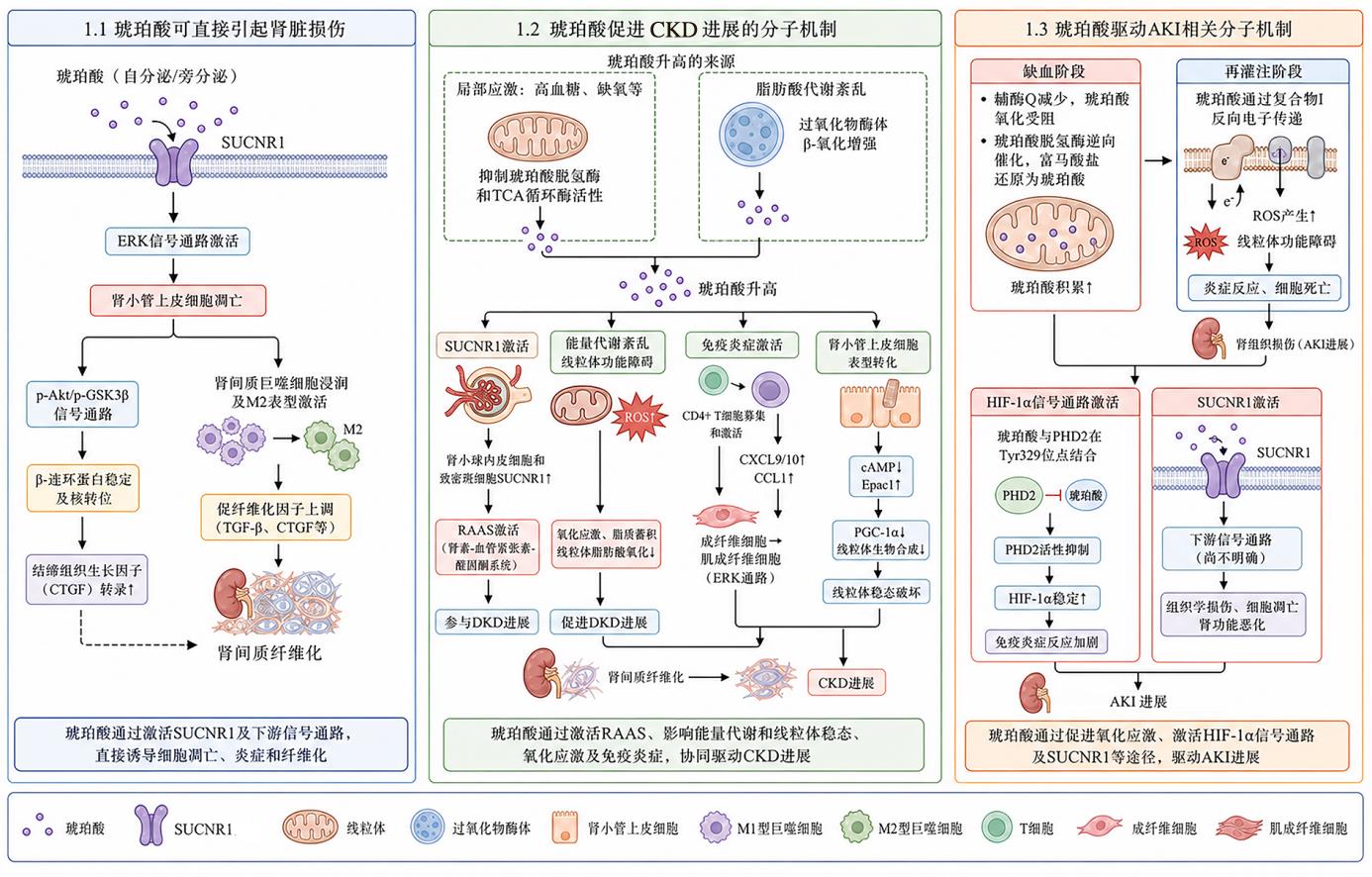
Fig.1
Mechanisms of succinate in driving the onset and progression of kidney disease"
| [1] |
|
| [2] |
|
| [3] |
|
| [4] |
|
| [5] |
|
| [6] |
|
| [7] |
|
| [8] |
朱道仙, 陆江, 郝福星, 等. 基于尿液代谢组学研究青蒿琥酯对庆大霉素诱导犬急性肾功能衰竭的保护机制[J]. 江苏农业科学, 2022, 50(2): 137-142. doi:10.15889/j.issn.1002-1302. 2022.02.023 .
|
| [9] |
彭瑞, 杨瑞文, 魏澹宁, 等. 琥珀酸受体1加重肾脏缺血再灌注损伤的作用研究[J/OL]. 中华移植杂志(电子版), 2024, 18(3): 159-164. doi:10.3877/cma.j.issn.1674-3903.2024.03.003 .
|
| [10] |
|
| [11] |
|
| [12] |
|
| [13] |
|
| [14] |
|
| [15] |
|
| [16] |
|
| [17] |
张妍, 顾昕妍, 李洁, 等. 琥珀酸通过GPR91负调控cAMP-Epac1信号通路而加重肾间质纤维化[J]. 中国病理生理杂志, 2026, 42(2): 299-307. doi:10.3969/j.issn.1000-4718.2026. 02.011 .
|
| [18] |
|
| [19] |
|
| [20] |
王佳慧, 郑可, 李雪梅. 脂质组学在肾脏疾病中的应用与进展[J]. 实用医学杂志, 2025, 41(1): 1-6. doi:10.3969/j.issn. 1006-5725.2025.01.001 .
|
| [21] |
|
| [22] |
|
| [23] |
|
| [24] |
杨琳琳, 刘刚, 易锐, 等. 急性肾损伤风险预测方法的研究进展[J]. 实用医学杂志, 2022, 38(18): 2367-2372. doi:10. 3969/j.issn.1006-5725.2022.18.021 .
|
| [25] |
|
| [26] |
范菽卫, 王华斌. 基于非靶向尿液代谢组学建立糖尿病肾脏疾病诊断模型的研究[J]. 浙江医学, 2025, 47(13): 1365-1369. doi:10.12056/j.issn.1006-2785.2025.47.13.2024-2673 .
|
| [27] |
|
| [28] |
|
| [29] |
|
| [30] |
|
| [31] |
|
| [32] |
|
| [33] |
袁延蕾,周莹,吕旺,等. 苹果多酚通过调节DNA 5hmC减缓糖尿病小鼠的肾功能损伤[C]//第七届海峡两岸暨港澳营养科学大会摘要集.2022:92-93. doi:10.26914/c.cnkihy.2022.064868 .
|
| [34] |
芮丽, 康建英, 何清伟, 等. 赵怡蕊教授应用芪术胶囊干预糖尿病肾病的三羧酸循环机制初探[J]. 中国中西医结合肾病杂志, 2020, 21(4): 351-353, 381. doi:10.3969/j.issn.1009-587X. 2020.04.021 .
|
| [35] |
|
| [36] |
|
| [37] |
|
| [38] |
|
| [39] |
|
| [40] |
|
| [1] | Jianmei YU,Weichun HE. Progress in mechanism and targeted therapy of immune kidney disease mediated by complement [J]. The Journal of Practical Medicine, 2026, 42(5): 899-908. |
| [2] | Yongsi LIU,Yingmin DENG,Marsu VANAKHUN,Ruijing LI,Wen SHI,Chuyun CHEN. Construction of a risk prediction model for type 2 diabetic kidney disease based on the inflammatory indices SII and SIRI [J]. The Journal of Practical Medicine, 2026, 42(2): 266-275. |
| [3] | Ziqing WANG,Ning DING,Lianpeng YANG,Linyun WANG,Jingrui LI,Yibin WANG,Guizhong LI,Yideng JIANG,Guanjun LU. The role of circ_0001126 in Hcy-induced ferroptosis of MPC-5 cells [J]. The Journal of Practical Medicine, 2026, 42(2): 201-211. |
| [4] | Sijia Chen, Hui Li, Xiaoyu Li. The pathogenic bacteria distribution of pulmonary infection in elderly patients with chronic kidney disease during maintenance hemodialysis and the appraised value of serum NGAL, sP-selectin and MCP-1 [J]. The Journal of Practical Medicine, 2026, 42(16): 2972-2980. |
| [5] | Lianpeng YANG,Ning DING,Ziqing WANG,Yining TIAN,Yichen WANG,Yideng JIANG,Guanjun LU. piR-13663072 inhibits homocysteine-induced podocyte apoptosis via regulating the Bcl-2/Bax-Caspase-3 signaling pathway [J]. The Journal of Practical Medicine, 2026, 42(14): 2577-2587. |
| [6] | Qiuyu ZHOU,Xinyu SUN. Research progress on the treatment of diabetic kidney disease with traditional chinese medicine based on gut microbiota [J]. The Journal of Practical Medicine, 2026, 42(11): 1996-2006. |
| [7] | Dan ZHU,Wanjun LU,Ying ZHU,Jinlu CAO,Yingzi CHEN. Developing an unsupervised deep learning model for diabetic nephropathy prediction using panoramic fundus retinal images [J]. The Journal of Practical Medicine, 2025, 41(22): 3598-3608. |
| [8] | Xinyu CHEN,Xiaolei LUO,Yimeng HUANG,Li MA. Predictive value of non⁃invasive assessment for adverse events in acute coronary syndrome patients with chronic kidney disease [J]. The Journal of Practical Medicine, 2025, 41(13): 1971-1978. |
| [9] | Jiahui WANG,Ke ZHENG,Xuemei LI. Applications and advances of lipidomics in kidney disease [J]. The Journal of Practical Medicine, 2025, 41(1): 1-6. |
| [10] | Ning WANG,Yan HAO,Dawei CHEN,Zhiguo ZHANG,Dan KUANG,Qing ZHANG,Yiqi YING,Zhaolian WEI,Ping ZHOU,Yunxia CAO. Application research of PGT in blocking the inheritance of novel mutations in the PKHD1 gene in autosomal recessive polycystic kidney disease pedigrees [J]. The Journal of Practical Medicine, 2024, 40(7): 1006-1010. |
| [11] | Kunyuan HUANG,Kehua JIANG,Qing WANG. Research progress of S100A9 in renal diseases [J]. The Journal of Practical Medicine, 2024, 40(22): 3251-3255. |
| [12] | Kaidi JING,Cheng LI,Xiao MA,Shubin JIANG,Lan. LI. Effects of metoprolol succinate on acute stage pacing threshold and amplitude of intracardiac electrical signal in a leadless pacemaker [J]. The Journal of Practical Medicine, 2024, 40(21): 3036-3039. |
| [13] | Xiaoqin LI,Lexin WANG,Xiaojun MA,Na LI,Guanjun LU,Zhihan ZHANG,Pengcheng. ZHANG. Mechanism of iron death induced by high homocysteine via TRPC6/NF⁃κb in glomerular podiatocytes [J]. The Journal of Practical Medicine, 2024, 40(2): 174-181. |
| [14] | ZHANG Zhe, LIU Xiaoyi, YE Peiyi, XIE Chao, KONG Yaozhong. . Clinical and pathological characteristics of patients with type 2 diabetes mellitus complicated with non⁃dia⁃ betic renal disease [J]. The Journal of Practical Medicine, 2023, 39(10): 1253-1257. |
| [15] |
SONG Caixia, YAN Ting, YAN Zhenyuan, YU Yulan..
Clinical observation on the improvement of residual renal function in hemodialysis patients with bp⁃nacombined with Niaoduqing [J]. The Journal of Practical Medicine, 2022, 38(4): 494-497. |
| Viewed | ||||||
|
Full text |
|
|||||
|
Abstract |
|
|||||
