

The Journal of Practical Medicine ›› 2026, Vol. 42 ›› Issue (9): 1552-1560.doi: 10.3969/j.issn.1006-5725.2026.09.009
• Oncology: Diagnosis, Treatment and Prevention • Previous Articles
Chengyu SHI1,Feifei MENG2,Bing XU1,Cheng GUO3( )
)
Received:2026-01-08
Online:2026-05-10
Published:2026-04-29
Contact:
Cheng GUO
E-mail:guocheng440605@163.com
CLC Number:
Chengyu SHI,Feifei MENG,Bing XU,Cheng GUO. The influence of different hepatic blood flow occlusion methods during laparoscopic left hemihepatectomy on serum HMGB1, TK1, H2AFX levels and immune function in patients with primary liver cancer[J]. The Journal of Practical Medicine, 2026, 42(9): 1552-1560.
Tab.1
Comparison of general data among the three groups"
| 项目 | A组(n = 57) | B组(n = 45) | C组(n = 39) | F/χ2值 | P值 |
|---|---|---|---|---|---|
| 年龄/岁 | 59.28 ± 4.42 | 60.01 ± 4.27 | 59.77 ± 3.95 | 0.394 | 0.675 |
| 肿瘤最大径/cm | 5.78 ± 1.02 | 5.82 ± 0.96 | 5.89 ± 1.13 | 0.132 | 0.877 |
| 肿瘤个数/个 | 2.34 ± 0.35 | 2.27 ± 0.31 | 2.31 ± 0.29 | 0.595 | 0.553 |
| 性别/[例(%)] | 0.069 | 0.966 | |||
| 男 | 38(66.67) | 31(68.89) | 26(66.67) | ||
| 女 | 19(33.33) | 14(31.11) | 13(33.33) | ||
| 肝功能分级(Child-Pugh法)/[例(%)] | 0.088 | 0.957 | |||
| A级 | 39(68.42) | 32(71.11) | 27(69.23) | ||
| B级 | 18(31.58) | 13(28.89) | 12(30.77) |
Tab.2
Comparison of three groups of perioperative-related indicators"
| 组别 | 例数 | 手术时间/h | 术中出血量/mL | 术后首次排气时间/d | 下床活动时间/d | 术后首次进食流质时间/d | 住院时间/d |
|---|---|---|---|---|---|---|---|
| A组 | 57 | 4.06 ± 1.03 | 272.12 ± 42.22 | 2.77 ± 0.68 | 4.79 ± 1.02 | 8.23 ± 1.72 | 12.73 ± 3.13 |
| B组 | 45 | 3.94 ± 0.83 | 249.54 ± 34.46* | 2.16 ± 0.61* | 3.81 ± 0.78* | 7.54 ± 1.53* | 10.61 ± 2.23* |
| C组 | 39 | 3.89 ± 0.77 | 228.67 ± 35.31*# | 1.75 ± 0.47*# | 3.08 ± 0.67*# | 6.06 ± 1.44*# | 8.19 ± 1.77*# |
| F值 | 0.460 | 15.381 | 34.410 | 47.450 | 21.877 | 37.331 | |
| P值 | 0.632 | < 0.001 | < 0.001 | < 0.001 | < 0.001 | < 0.001 |
Tab.3
Comparison of three groups of liver function indicators"
| 时间 | 组别 | 例数 | ALT/(U/L) | AST/(U/L) | TBIL/(μmol/L) | PA/(g/L) | ALP/(U/L) |
|---|---|---|---|---|---|---|---|
| 术前 | A组 | 57 | 42.98 ± 5.59 | 37.68 ± 5.41 | 17.23 ± 3.89 | 2.76 ± 0.36 | 133.57 ± 13.37 |
| B组 | 45 | 42.61 ± 4.53 | 37.77 ± 4.43 | 17.45 ± 3.62 | 2.62 ± 0.48 | 132.66 ± 10.72 | |
| C组 | 39 | 42.50 ± 6.49 | 37.54 ± 5.37 | 17.86 ± 3.81 | 2.81 ± 0.55 | 129.65 ± 11.26 | |
| F值 | 0.102 | 0.021 | 0.322 | 2.019 | 1.284 | ||
| P值 | 0.903 | 0.979 | 0.725 | 0.137 | 0.280 | ||
| 术后3 d | A组 | 57 | 81.34 ± 9.32△ | 67.20 ± 7.35△ | 37.95 ± 4.91△ | 1.54 ± 0.45△ | 297.54 ± 16.33△ |
| B组 | 45 | 65.15 ± 7.38*△ | 54.18 ± 5.27*△ | 28.25 ± 4.24*△ | 1.95 ± 0.49*△ | 258.27 ± 13.93*△ | |
| C组 | 39 | 51.24 ± 6.29*#△ | 48.06 ± 6.23*#△ | 23.32 ± 3.15*#△ | 2.24 ± 0.61*#△ | 213.08 ± 14.21*#△ | |
| F值 | 168.960 | 112.453 | 147.656 | 22.647 | 367.632 | ||
| P值 | < 0.001 | < 0.001 | < 0.001 | < 0.001 | < 0.001 |
Tab.4
Comparison of three groups of immune function indicators"
| 时间 | 组别 | 例数 | CD3+ | CD4+ | CD8+ | CD4+/CD8+ |
|---|---|---|---|---|---|---|
| 术前 | A组 | 57 | 67.45 ± 7.30 | 45.89 ± 6.48 | 20.73 ± 4.78 | 2.11 ± 0.43 |
| B组 | 45 | 66.38 ± 7.32 | 46.40 ± 7.42 | 20.82 ± 4.51 | 2.08 ± 0.45 | |
| C组 | 39 | 67.47 ± 8.26 | 46.22 ± 6.38 | 20.97 ± 4.60 | 2.09 ± 0.46 | |
| F值 | 0.310 | 0.075 | 0.031 | 0.060 | ||
| P值 | 0.734 | 0.928 | 0.970 | 0.941 | ||
| 术后3 d | A组 | 57 | 55.12 ± 6.24△ | 29.18 ± 4.21△ | 27.78 ± 5.21△ | 1.07 ± 0.27△ |
| B组 | 45 | 58.28 ± 7.16*△ | 33.74 ± 4.27*△ | 25.52 ± 5.35*△ | 1.33 ± 0.26*△ | |
| C组 | 39 | 61.66 ± 8.12*#△ | 38.15 ± 5.18*#△ | 23.23 ± 4.04*#△ | 1.65 ± 0.33*#△ | |
| F值 | 9.922 | 46.309 | 9.835 | 48.124 | ||
| P值 | < 0.001 | < 0.001 | < 0.001 | < 0.001 |
Tab.5
Comparison of the levels of HMGB1, TK1 and H2AFX in the three groups of serum"
| 时间 | 组别 | 例数 | HMGB1/(ng/mL) | TK1/(pmol/L) | H2AFX |
|---|---|---|---|---|---|
| 术前 | A组 | 57 | 13.67 ± 2.73 | 1.23 ± 0.31 | 1.42 ± 0.31 |
| B组 | 45 | 13.52 ± 2.66 | 1.25 ± 0.34 | 1.45 ± 0.33 | |
| C组 | 39 | 13.39 ± 2.60 | 1.27 ± 0.30 | 1.44 ± 0.30 | |
| F值 | 0.130 | 0.186 | 0.121 | ||
| P值 | 0.878 | 0.830 | 0.886 | ||
| 术后3 d | A组 | 57 | 31.73 ± 5.61△ | 3.29 ± 0.68△ | 4.37 ± 0.76△ |
| B组 | 45 | 25.69 ± 4.58*△ | 2.75 ± 0.54*△ | 3.41 ± 0.65*△ | |
| C组 | 39 | 19.37 ± 3.54*#△ | 2.13 ± 0.48*#△ | 2.52 ± 0.49*#△ | |
| F值 | 77.899 | 45.492 | 92.579 | ||
| P值 | < 0.001 | < 0.001 | < 0.001 |
Tab.6
Comparison of three groups of complications"
| 组别 | 例数 | 胸腔积液 | 腹腔出血 | 肝衰竭 | 胆漏 | 合计 |
|---|---|---|---|---|---|---|
| A组 | 57 | 4(7.02) | 2(3.51) | 2(3.51) | 4(7.02) | 12(21.05) |
| B组 | 45 | 3(6.67) | 1(2.22) | 1(2.22) | 2(4.44) | 7(15.56) |
| C组 | 39 | 1(2.56) | 0(0.00) | 0(0.00) | 0(0.00) | 1(2.56)*# |
| χ2值 | 6.605 | |||||
| P值 | 0.037 |
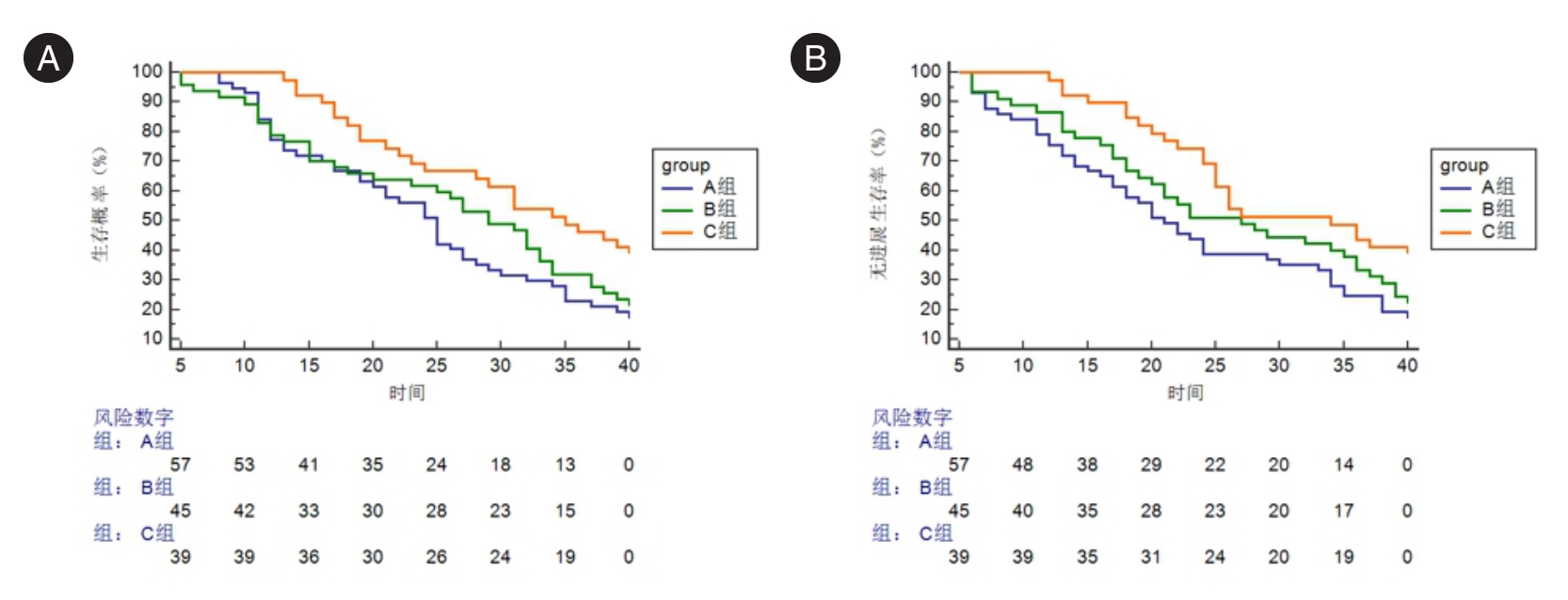
Fig.1
The Kaplan-Meier survival curve was used to compare the OS and PFS of the three groups"
| [1] |
TAN E Y, DANPANICHKUL P, YONG J N, et al. Liver cancer in 2021: Global Burden of Disease study[J]. J Hepatol, 2025, 82(5): 851-860. doi: 10.1016/j.jhep.2024.10.031 .
doi: 10.1016/j.jhep.2024.10.031 |
| [2] |
RUMGAY H, ARNOLD M, FERLAY J, et al. Global burden of primary liver cancer in 2020 and predictions to 2040[J]. J Hepatol, 2022, 77(6): 1598-1606. doi: 10.1016/j.jhep.2022.08.021 .
doi: 10.1016/j.jhep.2022.08.021 |
| [3] |
LIU D, FANG J M, CHEN X Q. Clinical significance of half-hepatic blood flow occlusion technology in patients with hepatocellular carcinoma with cirrhosis[J]. World J Clin Cases, 2022, 10(24): 8547-8555. doi: 10.12998/wjcc.v10.i24.8547 .
doi: 10.12998/wjcc.v10.i24.8547 |
| [4] |
CHEN S, HUANG C, LIAO G, et al. Distinct single-cell immune ecosystems distinguish true and de novo HBV-related hepatocellular carcinoma recurrences[J]. Gut, 2023, 72(6): 1196-1210. doi: 10.1136/gutjnl-2022-328428 .
doi: 10.1136/gutjnl-2022-328428 |
| [5] |
古丽斯坦, 康书红, 谷申森. 区域性入肝血流阻断对腹腔镜肝切除术治疗原发性肝癌的近期疗效及安全性评价[J]. 临床和实验医学杂志, 2025, 24(1): 14-18. doi: 10.3969/j.issn.1671-4695.2025.01.004 .
doi: 10.3969/j.issn.1671-4695.2025.01.004 |
| [6] |
ZHANG Y, REN H, LI J, et al. Elevated HMGB1 expression induced by hepatitis B virus X protein promotes epithelial-mesenchymal transition and angiogenesis through STAT3/miR-34a/NF-κB in primary liver cancer[J]. Am J Cancer Res, 2021, 11(2): 479-494. PMID: .
pmid: 33575082 |
| [7] |
TAO J, WANG Z, SHI R, et al. ERK-USP9X-coupled regulation of thymidine kinase 1 promotes both its enzyme activity-dependent and its enzyme activity-independent functions for tumor growth[J]. Nat Struct Mol Biol, 2025, 32(5): 853-863. doi: 10.1038/s41594-024-01473-6 .
doi: 10.1038/s41594-024-01473-6 |
| [8] |
HU H, ZHONG T, JIANG S. H2AFX might be a prognostic biomarker for hepatocellular carcinoma[J]. Cancer Rep (Hoboken), 2023, 6(1): e1684. doi: 10.1002/cnr2.1684 .
doi: 10.1002/cnr2.1684 |
| [9] |
HEIMBACH J K, KULIK L M, FINN R S, et al. AASLD guidelines for the treatment of hepatocellular carcinoma[J]. Hepatology, 2018, 67(1): 358-380. doi: 10.1002/hep.29086 .
doi: 10.1002/hep.29086 |
| [10] |
CHEN Z, ZHANG G, REN X, et al. Cross-talk between Myeloid and B Cells Shapes the Distinct Microenvironments of Primary and Secondary Liver Cancer[J]. Cancer Res, 2023, 83(21): 3544-3561. doi: 10.1158/0008-5472.CAN-23-0193 .
doi: 10.1158/0008-5472.CAN-23-0193 |
| [11] |
国家卫生健康委员会医政医管局. 原发性肝癌诊疗规范(2019年版)[J]. 中华肝脏病杂志, 2020, 28(2): 112-128. doi: 10.3760/cma.j.issn.1007-3418.2020.02.004 .
doi: 10.3760/cma.j.issn.1007-3418.2020.02.004 |
| [12] |
孙彦浩, 周毅, 胡亿龙. 腹直肌面积及内脏脂肪分布对肝癌开腹根治术后手术切口感染风险的预测价值[J]. 实用医学杂志, 2025, 41(10): 1445-1452. doi: 10.3969/j.issn.1006-5725.2025.10.003 .
doi: 10.3969/j.issn.1006-5725.2025.10.003 |
| [13] |
LIAO W, JEPSEN P, COUPLAND C, et al. Development and validation of personalised risk prediction models for early detection and diagnosis of primary liver cancer among the English primary care population using the QResearch® database: Research protocol and statistical analysis plan[J]. Diagn Progn Res, 2022, 6(1): 21. doi: 10.1186/s41512-022-00133-x .
doi: 10.1186/s41512-022-00133-x |
| [14] |
LI H Y, JING Y M, SHEN X, et al. Protein tyrosine phosphatase non-receptor II: A possible biomarker of poor prognosis and mediator of immune evasion in hepatocellular carcinoma[J]. World J Gastrointest Oncol, 2024, 16(9): 3913-3931. doi: 10.4251/wjgo.v16.i9.3913 .
doi: 10.4251/wjgo.v16.i9.3913 |
| [15] |
LAPITZ A, AZKARGORTA M, MILKIEWICZ P, et al. Liquid biopsy-based protein biomarkers for risk prediction, early diagnosis, and prognostication of cholangiocarcinoma[J]. J Hepatol, 2023, 79(1): 93-108. doi: 10.1016/j.jhep.2023.02.027 .
doi: 10.1016/j.jhep.2023.02.027 |
| [16] |
KIKUCHI M, IWAI T, NISHIDA M, et al. Assessment of hepatic veno-occlusive disease/sinusoidal obstruction syndrome using different scanning approaches for the ultrasonographic evaluation of portal vein blood flow and hepatic artery resistive index in hematopoietic stem cell transplant recipients[J]. J Med Ultrason (2001), 2023, 50(4): 465-471. doi: 10.1007/s10396-023-01335-6 .
doi: 10.1007/s10396-023-01335-6 |
| [17] |
JINGHAN W, JIANYANG A, WENCONG M, et al. Totally laparoscopic associating simultaneous bile duct and portal vein ligation for planned hepatectomy for primary liver cancer: A case report[J]. J Med Case Rep, 2023, 17(1): 200. doi: 10.1186/s13256-023-03859-4 .
doi: 10.1186/s13256-023-03859-4 |
| [18] |
FICHTINGER R S, ALDRIGHETTI L A, HILAL M ABU, et al. Laparoscopic Versus Open Hemihepatectomy: The ORANGE II PLUS Multicenter Randomized Controlled Trial[J]. J Clin Oncol, 2024, 42(15): 1799-1809. doi: 10.1200/JCO.23.01019 .
doi: 10.1200/JCO.23.01019 |
| [19] |
FENG W, CHEN J, HUANG W, et al. HMGB1-mediated elevation of KLF7 facilitates hepatocellular carcinoma progression and metastasis through upregulating TLR4 and PTK2[J]. Theranostics, 2023, 13(12): 4042-4058. doi: 10.7150/thno.84388 .
doi: 10.7150/thno.84388 |
| [20] |
LI Z, WU Z, YOU X, et al. Pan-cancer analysis reveals that TK1 promotes tumor progression by mediating cell proliferation and Th2 cell polarization[J]. Cancer Cell Int, 2024, 24(1): 329. doi: 10.1186/s12935-024-03515-x .
doi: 10.1186/s12935-024-03515-x |
| [21] |
PRABHU K S, KUTTIKRISHNAN S, AHMAD N, et al. H2AX: A key player in DNA damage response and a promising target for cancer therapy[J]. Biomed Pharmacother, 2024, 175(1): 116663. doi: 10.1016/j.biopha.2024.116663 .
doi: 10.1016/j.biopha.2024.116663 |
| [22] |
CHEN Y Z, XU D, JIA Y X, et al. HMGB1 orchestrates tumor-osteoclast crosstalk to drive bone metastasis in hepatocellular carcinoma[J]. Cell Death Dis, 2025, 16(1): 712. doi: 10.1038/s41419-025-08037-6 .
doi: 10.1038/s41419-025-08037-6 |
| [23] |
邓金涛,许文斌,任建华,等.重组人HMGB1调控内皮细胞成血管作用的机制初探[J].器官移植,2023,14(3):397-403.doi: 10.3969/j.issn.1674-7445.2023.03.011 .
doi: 10.3969/j.issn.1674-7445.2023.03.011 |
| [24] |
LI Q, ZHANG L, YANG Q, et al. Thymidine kinase 1 drives hepatocellular carcinoma in enzyme-dependent and -independent manners[J]. Cell Metab, 2023, 35(6): 912-927.e7. doi: 10.1016/j.cmet.2023.03.017 .
doi: 10.1016/j.cmet.2023.03.017 |
| [25] |
HU H, ZHONG T, JIANG S. H2AFX might be a prognostic biomarker for hepatocellular carcinoma[J]. Cancer Rep (Hoboken), 2023, 6(1): e1684. doi: 10.1002/cnr2.1684 .
doi: 10.1002/cnr2.1684 |
| [26] |
张浩楠, 张林枝, 高炜, 等. 免疫评分在肝癌患者中的预后研究[J]. 中国临床解剖学杂志, 2021, 39(1): 82-89. doi: 10.13418/j.issn.1001-165x.2021.01.016 .
doi: 10.13418/j.issn.1001-165x.2021.01.016 |
| [27] |
池育菁, 杨心怡, 朱月永, 等. 乙型肝炎和酒精对肝硬化肝癌的预后特征和影响因素分析[J]. 中国热带医学, 2025, 25(3): 289-296. doi: 10.13604/j.cnki.46-1064/r.2025.03.06 .
doi: 10.13604/j.cnki.46-1064/r.2025.03.06 |
| [28] |
TAO J, WANG Z, SHI R, et al. ERK-USP9X-coupled regulation of thymidine kinase 1 promotes both its enzyme activity-dependent and its enzyme activity-independent functions for tumor growth[J]. Nat Struct Mol Biol, 2025, 32(5): 853-863. doi: 10.1038/s41594-024-01473-6 .
doi: 10.1038/s41594-024-01473-6 |
| Viewed | ||||||
|
Full text |
|
|||||
|
Abstract |
|
|||||
