

实用医学杂志 ›› 2026, Vol. 42 ›› Issue (18): 3298-3314.doi: 10.3969/j.issn.1006-5725.2026.18.008
• 慢性病防治专栏 • 上一篇
牟欢1, 王依澜2, 魏晓航3, 张泉2( )
收稿日期:2026-05-07
修回日期:2026-08-12
接受日期:2026-08-24
出版日期:2026-09-25
发布日期:2026-10-19
通讯作者:
张泉
基金资助:
Huan Mou1, Yilan Wang2, Xiaohang Wei3, Quan Zhang2()
Received:2026-05-07
Revised:2026-08-12
Accepted:2026-08-24
Online:2026-09-25
Published:2026-10-19
Contact:
Quan Zhang
About author:Mou Huan was responsible for developing the article′s structure, compiling the data, and drafting the manuscript. Wang Yilan was responsible for reviewing and revising the manuscript. Wei Xiaohang was responsible for literature search and screening. Zhang Quan was responsible for finalizing the manuscript and overseeing the entire process. All authors read and approved the final manuscript as submitted.
摘要:
心房颤动(atrial fibrillation, AF)是临床上常见的心律失常之一,其负担日益加重,而传统的管理方式存在着诸多不足。人工智能(artificial intelligence, AI)为AF的全程管理开辟了新的技术路径。该文对AI在AF全程管理中的应用情况、研究进展及转化面临的挑战进行了梳理。AI增强心电图(electrocardiogram, ECG)结合可穿戴设备实现多场景筛查;AI辅助心电图全自动化分析在准确率与效率达到甚至超越传统方法;AI模型在新发AF风险、血栓栓塞风险及消融术后复发的预测效果优于传统评分,但出血风险预测提升有限;AI辅助个性化抗凝、消融术中导航、节律控制与心率控制决策选择展现出了临床应用潜力。然而,其临床转化仍面临技术、应用与政策层面的多重挑战。技术上,模型可解释性不足、数据孤岛、多模态融合欠缺、性能与效用脱节及噪声干扰等问题突出;应用上,系统割裂、AI融合不深、医保支付滞后、基层能力薄弱、闭环管理缺位及数字鸿沟制约落地;政策上,监管审批、责任归属与数据治理尚待完善。未来应推进可解释性AI与国产设备融合,构建跨机构数据共享及多模态融合框架,建立以硬终点为导向的验证体系,发展信号质量感知技术;打通跨平台数据互通,深化临床工作流嵌入,完善医保支付、基层赋能及闭环管理配套机制;建立全周期监管体系,明确权责边界,构建数据治理规范,才能推动AI从技术可用走向医疗普惠,切实降低AF疾病负担。
中图分类号:
牟欢, 王依澜, 魏晓航, 张泉. 人工智能赋能心房颤动全程管理:应用进展、转化障碍与健康公平性思考[J]. 实用医学杂志, 2026, 42(18): 3298-3314.
Huan Mou, Yilan Wang, Xiaohang Wei, Quan Zhang. Artificial intelligence-enabled comprehensive management of atrial fibrillation: Advances in application, barriers to translation and considerations on health equity[J]. The Journal of Practical Medicine, 2026, 42(18): 3298-3314.
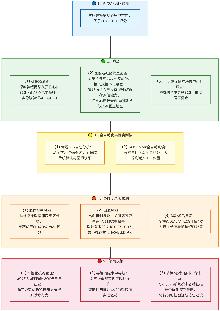
图1
AI应用于AF全程管理的框架图"
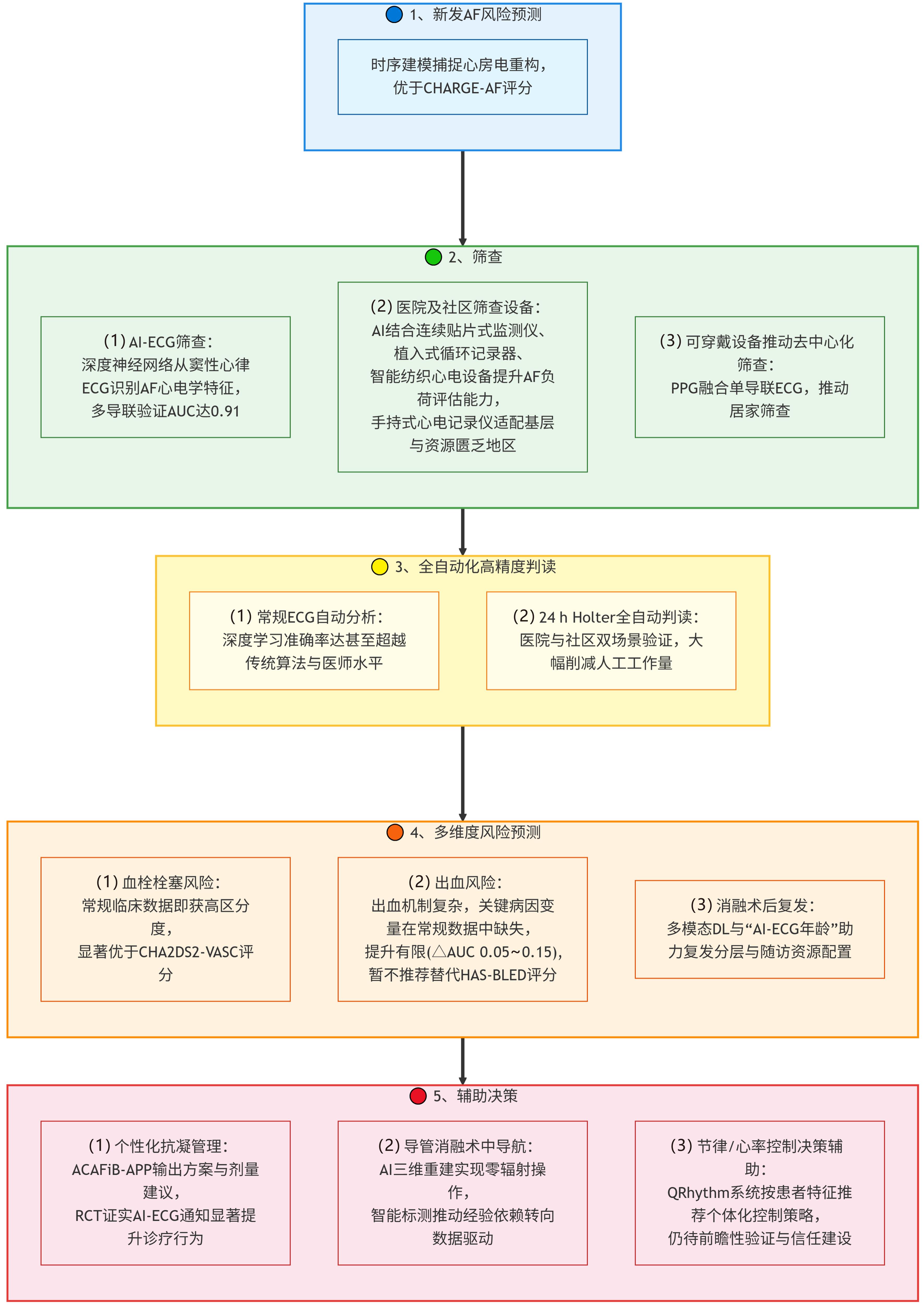
表1
各类设备性能对比表"
| 对比维度 | 贴片式监测仪 | 植入式循环记录器 | 智能纺织心电设备 | 手持式心电记录仪 | 可穿戴设备 |
|---|---|---|---|---|---|
| 技术原理 | 体表粘贴式电极,连续记录单导联或多导联心电信号 | 皮下植入,长期连续记录皮下单导联ECG | 将电极与织物纤维融合,以无感穿戴形式采集心电信号 | 手持电极接触体表,按需采集单导联ECG | PPG通过光电传感器监测外周血流搏动信号 |
| 性能优势 | 无创、舒适度较好、可长时间连续佩戴,能评估AF负荷 | 可超长程监测(数月到数年),对偶发/无症状AF检出能力强 | 无感化、舒适度好及依从性极高 | 操作简便、成本低廉,适合快速按需采集,不依赖长期佩戴 | 去中心化、居家场景适用,无需专业操作,可大规模普适性部署 |
| 局限性 | 信号伪影、电极稳定性挑战,长期佩戴可能引发皮肤不适 | 有创植入、高昂成本,目前难以作为社区大规模筛查常规手段 | 处于发展初期,信号稳定性不足、算法成熟度待验证、研发成本高 | 属于片段式按需采集,可能遗漏阵发性AF,依赖患者主动触发 | 信号质量易受运动伪影、肤色、外周灌注状态干扰;在老年/血管疾病人群中性能明显下降;假阳性率偏高;研究多由厂商资助,存在选择性报告偏倚 |
| 最佳适用场景 | 医院内长程监测、卒中高危人群二级预防、AF负荷精确评估 | 不明原因晕厥/隐源性卒中、高度怀疑偶发AF但反复常规检查阴性者 | 长期居家舒适化监测 | 基层医疗机构、医疗资源匮乏地区、大规模流行病学现场快速筛查 | 社区大规模人群初筛、居家健康管理(尤其适合中青年、低风险人群的初步风险提示) |
表2
AI在AF管理各环节应用研究的基本特征(研究类型、样本量、数据来源与算法)"
| 应用环节 | 代表性研究 | 研究类型 | 样本量 | 数据来源 | 算法 |
|---|---|---|---|---|---|
| 筛查 | Attia等[ | 回顾性研究 | 约65万份ECG | 美国梅奥诊所的数字ECG数据库 | CNN |
| 筛查 | Perez等[ | 前瞻性研究 | 419 297名参与者 | Apple可穿戴设备用户 | Apple Watch内置的不规则脉搏通知算法 |
| 筛查 | Lubitz等[ | 前瞻性研究 | 455 699名参与者 | Fitbit可穿戴设备用户 | Fitbi设备内置的新型PPG软件算法 |
| 筛查 | Guo等[ | 前瞻性研究 | 644 124名参与者,完成心血管风险因素问卷者209 274人 | 华为可穿戴设备用户 | 华为设备内置的PPG算法/C2HEST临床风险评分 |
| 诊断 (常规ECG) | Smith等[ | 回顾性研究 | 24 123份12导联ECG | 美国德克萨斯州休斯顿贝勒医学院及其附属医院的ECG数据库 | Cardiologs® |
| 诊断 (24 h Holter) | Zhang等[ | 回顾性研究(医 院+社区双场景) | 23 621份Holter记录 | 中国大型三甲医院的Holter数据库+社区流行病学筛查队列 | 以RR间期为输入的DL模型 |
| 诊断 (24 h Holter) | Fiorina等[ | 回顾性、多中心研究 | 1 000份Holter记录 | 法国三家独立医疗中心的Holter数据库 | 残差注意力DL模型 |
| 风险预测 (新发AF) | Hill等[ | 回顾性队列研究 | 2 994 837名参与者 | 英国临床实践研究数据链 | 时间变化神经网络模型 |
| 风险预测 (新发AF) | Choi等[ | 回顾性队列研究 | 176 090名参与者 | 韩国首尔三星医疗中心的单中心电子病历与ECG数据库 | LightGBM |
| 风险预测 (新发AF) | Jin等[ | 回顾性开发 | 552 372份ECG记录 | 韩国全南国立大学医院数据库 | 可解释性DL模型 |
| 风险预测 (血栓栓塞) | Lin等[ | 回顾性开发+ 外部验证 | 9 511例新诊断AF患者 | 台湾大学医院数据库 | logistic回归/ XGBoost |
| 风险预测 (血栓栓塞) | Joddrell等[ | 前瞻性、多中心注册研究 | 26 183例新诊断AF患者 | GLORIA-AF注册登记研究数据库 | ML(23个变量) |
| 风险预测 (出血) | Chaudhary等[ | 回顾性队列研究 | 24 468 例AF接受DOAC治疗的患者 | 美国匹兹堡大学医学中心电子健康记录 | RF |
| 风险预测 (消融复发) | Tang等[ | 回顾性分析 | 156例接受导管消融术的连续患者 | 美国斯坦福大学的一家三级转诊中心 | CNN多模态融合架构 |
| 风险预测 (消融复发) | Qiu等[ | 回顾性队列研究 | 920例接受首次AF射频消融术的患者 | 南京医科大学第一附属医院 | DL/Transformer多模态融合架构 |
| 治疗决策 (抗凝) | Liu等[ | 前瞻性RCT | 17 817例患者 | 中国台湾2家医院 | DL |
| 治疗决策 (消融导航) | Dello等[ | 回顾性、多中心观察性研究 | 157例接受脉冲场消融的AF患者 | 意大利5个心血管中心 | DL(左心房三维重建) |
| 治疗决策 (消融导航) | Seitz等[ | 前瞻性、多中心、观察性研究 | 85例持续性AF患者 | 法国的8个医疗中心 | VX1 |
| 治疗决策 (消融导航) | Fox等[ | 回顾性研究 | 10例复杂AF患者 | 美国加州大学圣地亚哥分校医疗机构和退伍军人事务部圣地亚哥医疗系统 | 正向求解AI-ECG心律失常标测算法 |
| 治疗决策 (节律/心率控制) | Stacy等[ | 基于调查的横断面研究 | 33名临床医生 | 美国科罗拉多大学医疗机构 | 临床决策支持系统- QRhythm系统 |
表3
AI在AF管理各环节应用研究的主要结果及验证、前瞻性、临床硬终点情况"
| 应用环节 | 代表性研究 | 主要结果 | 是否 外部验证 | 是否有前 瞻性研究 | 是否涉及临床 硬终点 |
|---|---|---|---|---|---|
| 筛查 | Attia等[ | AF检测AUC 0.87,准确率83.3% | 否 | 否 | 否 |
| 筛查 | Perez等[ | 收到不规则脉搏通知的概率很低(0.52%),在收到通知的参与者中,34%在后续ECG贴片读数中显示房颤,84% 的通知与房颤一致 | 不适用 | 是 | 否 |
| 筛查 | Lubitz等[ | IHRD发生率为 1%,在1 057名佩戴可分析ECG贴片的IHRD参与者中,32.2%(340例)确诊AF | 不适用 | 是 | 否 |
| 筛查 | Guo等[ | 心悸症状+C2HEST评分联合预测AF检出的C-index为0.76,优于单用C2HEST评分的0.72 | 不适用 | 是 | 否 |
| 诊断 (常规ECG) | Smith等[ | 准确率91.2%,显著优于传统算法(80.2%),与医生+传统算法(90.0%)无统计学差异 | 否 | 否 | 否 |
| 诊断 (24 h Holter) | Zhang等[ | 社区测试集灵敏度1.000,特异度0.997 | 是 | 否 | 否 |
| 诊断 (24 h Holter) | Fiorina等[ | 灵敏度0.98,特异度0.98,分析时间缩短> 25%(4.4 min vs. 6.0 min) | 是 | 否 | 否 |
| 风险预测 (新发AF) | Hill等[ | AUC 0.82,优于CHARGE-AF评分(0.73) | 否 | 否 | 否 |
| 风险预测 (新发AF) | Choi等[ | AUC提高至0.88 | 否 | 否 | 否 |
| 风险预测 (新发AF) | Jin等[ | 预测1个月内阵发性AF风险AUC 0.90 | 否 | 否 | 否 |
| 风险预测 (血栓栓塞) | Lin等[ | 内部AUC 0.915/0.914,外部0.877 ~ 0.886,显著优于 CHA₂DS₂-VASc(0.614 ~ 0.621) | 是 | 否 | 是(1年卒中) |
| 风险预测 (血栓栓塞) | Joddrell等[ | 预测1年卒中AUC 0.653,优于CHA₂DS₂-VASc(0.535) 但提升有限 | 否 | 是 | 是(1年卒中) |
| 风险预测 (出血) | Chaudhary等[ | 预测1年大出血AUC 0.76,高于HAS-BLED(0.57) | 否 | 否 | 是(1年出血) |
| 风险预测 (消融复发) | Tang等[ | 预测消融术后复发AUC 0.86 | 否 | 否 | 否 |
| 风险预测 (消融复发) | Qiu等[ | 消融复发AUC 0.899,有助于识别低复发风险患者 | 否 | 否 | 否 |
| 治疗决策 (抗凝) | Liu等[ | AI组AF诊断率提高40%,NOAC处方率增加85%;但缺血性卒中、心血管死亡和全因死亡率在两组间均无显著差异 | 不适用 | 是 | 是(缺血性卒中、 心血管死亡 和全因死亡率) |
| 治疗决策 (消融导航) | Dello等[ | 平均节约建模时间3 min,透视时间7.5 min,实现零辐射 | 不适用 | 否 | 否 |
| 治疗决策 (消融导航) | Seitz等[ | 急性AF终止率88%,术后无房性心律失常比例73% | 不适用 | 是 | 否 |
| 治疗决策 (消融导航) | Fox等[ | 核心消融时间缩短35.9%;透视时间缩短58.7% | 不适用 | 否 | 否 |
| 治疗决策(节律/心率控制) | Stacy等[ | 安全性评分4.7/5,仅50%医生“基本同意”建议,信任度不足 | 不适用 | 否 | 否 |
| [1] |
|
| [2] |
|
| [3] |
|
| [4] |
|
| [5] |
|
| [6] |
|
| [7] |
何斌, 储慧民. 人工智能在房颤诊疗中的应用进展[J]. 实用心电学杂志, 2022, 31(4): 262-266, 279. doi:10.13308/j.issn.2095-9354.2022.04.007 .
|
| [8] |
|
| [9] |
|
| [10] |
|
| [11] |
|
| [12] |
|
| [13] |
|
| [14] |
|
| [15] |
|
| [16] |
|
| [17] |
|
| [18] |
|
| [19] |
|
| [20] |
|
| [21] |
|
| [22] |
|
| [23] |
|
| [24] |
|
| [25] |
|
| [26] |
|
| [27] |
|
| [28] |
|
| [29] |
|
| [30] |
|
| [31] |
|
| [32] |
|
| [33] |
|
| [34] |
|
| [35] |
|
| [36] |
|
| [37] |
|
| [38] |
念思琦, 赵璐露, 华宝桐. 心房颤动导管消融术后房性心律失常复发的研究进展[J]. 实用医学杂志, 2024, 40(10): 1338-1343. doi:10.3969/j.issn.1006-5725.2024.10.002 .
|
| [39] |
李艳茹, 金卫东, 郭皓, 等. 房颤伴心力衰竭患者射频消融治疗后复发的预测模型[J]. 实用医学杂志, 2025, 41(17): 2637-2645. doi:10.3969/j.issn.1006-5725.2025.17.005 .
|
| [40] |
|
| [41] |
|
| [42] |
|
| [43] |
|
| [44] |
|
| [45] |
|
| [46] |
|
| [47] |
|
| [48] |
|
| [49] |
|
| [50] |
|
| [51] |
|
| [52] |
|
| [53] |
|
| [54] |
|
| [55] |
|
| [56] |
|
| [57] |
李土权, 戴奇山, 刘震, 等. 城市医疗集团心房颤动的机会性筛查成本效益分析[J]. 广州医药, 2026, 57(5): 639-650. doi:10.20223/j.cnki.1000-8535.2026.05.015 .
|
| [58] |
汤志杰, 孙国珍, 王洁, 等. 早期心房颤动筛查的成本效果分析研究进展[J]. 中国全科医学, 2023, 26(1): 104-112, 117. doi:10.12114/j.issn.1007-9572.2022.0653 .
|
| [59] |
AI辅助诊断首次列入国家医保局立项指南[N]. 医师报, 2024-11-28(A02). doi:10.44211/n.cnki.nysbz.2024.000524 .
|
| [60] |
|
| [61] |
魏金玲, 赵洪光, 牛少林, 等. 基层医疗区域 “心电一张网” 运行效果分析[J]. 心血管病防治知识, 2025, 15(22): 50-57. doi:10.3969/j.issn.1672-3015.2025.22.013 .
|
| [62] |
余新艳, 顾志乐, 张晓娟, 等. 人工智能在远程心电云平台辅助决策基层危急值心电图中的应用价值研究[J]. 中国全科医学, 2022, 25(11): 1363-1367, 1372. doi:10.12114/j.issn. 1007-9572.2021.01.411 .
|
| [63] |
|
| [64] |
|
| [65] |
高晨曦, 陈德芳, 陈清勇, 等. 可穿戴/移动设备在隐匿性心房颤动管理中的应用进展和挑战[J]. 中国全科医学, 2024, 27(30): 3835-3840. doi:10.12114/j.issn.1007-9572.2023.0755 .
|
| [66] |
|
| [67] |
丁岚, 涂惠, 丁美舟, 等. 基于互联网技术的心房颤动病人抗凝管理平台的建立及应用研究[J]. 全科护理, 2023, 21(4): 522-526. doi:10.12104/j.issn.1674-4748.2023.04.022 .
|
| [68] |
|
| [69] |
国家药监局.人工智能医用软件产品分类界定指导原则[EB/OL]. (2021-07-08)[2026-07-15].
|
| [70] |
|
| [71] |
赖锦坝, 曾祥卫, 孙志刚, 等. 人工智能心电分析软件审评关注点研究[J]. 中国医疗器械信息, 2022, 28(7): 12-14. doi:10.3969/j.issn.1006-6586.2022.07.004 .
|
| [72] | |
| [73] |
|
| [1] | 钟佳倩,谢晓燕,郑艳玲. 多模态超声与人工智能在乳腺癌早期诊断与预后预测中的应用进展[J]. 实用医学杂志, 2026, 42(9): 1491-1500. |
| [2] | 仇晓蕊,张译丹,杨国锋. 多模态人工智能在阿尔茨海默病早期诊断中的应用:现状、挑战与临床转化路径[J]. 实用医学杂志, 2026, 42(9): 1579-1585. |
| [3] | 蔡淑娴,朱东宁,徐皓玮,黄嘉淇,李逍宇,李卓豪,刘秀峰,闫玉红. 深度学习构建舌象分类系统在银屑病中医证型识别中的应用[J]. 实用医学杂志, 2026, 42(3): 395-405. |
| [4] | 朱欣,梁杨标,肖雄,谢佳霖,朱俊燕,陈彦. 基于超声影像组学与深度学习的类风湿关节炎疾病活动度评估模型构建[J]. 实用医学杂志, 2026, 42(15): 2786-2797. |
| [5] | 黎舒欣,张荣丽,邱雄峰,胡桢云,吴伟铭,江慧琳,李敏,陈淮. 基于人工智能与胸腹部平扫CT影像特征的主动脉夹层诊断模型构建与验证[J]. 实用医学杂志, 2026, 42(11): 1906-1914. |
| [6] | 韩英妹,李一杰,张衡,李伟庆,冯泽,王丰. 深度学习在阿尔茨海默病疾病转化预测影像学研究中的应用价值[J]. 实用医学杂志, 2025, 41(9): 1413-1424. |
| [7] | 郭蕊,刘涛,苏玺. 基于心电图参数、犬尿氨酸代谢物建立精神分裂症共患心血管疾病的列线图模型[J]. 实用医学杂志, 2025, 41(8): 1205-1211. |
| [8] | 凤伟祥,王娟,宋艳斌,薛社亮,李文华. 沙库巴曲缬沙坦在行导管消融的非阵发性心房颤动患者中的远期疗效[J]. 实用医学杂志, 2025, 41(7): 1036-1043. |
| [9] | 王立坤,郝琦,金炜涵,董时正,武雪亮,胡晓峰,武亮,荀敬,马洪庆. 多组学与人工智能在预测和诊断结直肠癌肝转移中的应用[J]. 实用医学杂志, 2025, 41(7): 1070-1078. |
| [10] | 邹颖,刘继华,李静宜,毕海,石岩,陆秀娣,张启波. 基于超声的迁移学习人工智能模型对甲状腺囊实性结节恶性概率的评估效能[J]. 实用医学杂志, 2025, 41(6): 889-895. |
| [11] | 胡高凯,牛亚楠,龚玉康,胡阳,徐瑞轩,高文山. 深度学习在腰椎疾病诊断、手术规划及术后预测中的应用研究进展[J]. 实用医学杂志, 2025, 41(6): 921-928. |
| [12] | 张华,梁秀雅,郑梓儀,尹通,李声,黄键澎. 非侵入性脑刺激技术在广泛性焦虑障碍治疗中的应用研究进展[J]. 实用医学杂志, 2025, 41(24): 3808-3815. |
| [13] | 朱丹,卢万俊,朱颖,曹金璐,陈英姿. 构建基于“无标注”眼底全景视网膜图像深度学习模型预测糖尿病肾病[J]. 实用医学杂志, 2025, 41(22): 3598-3608. |
| [14] | 芦苇,张盼,覃玉术. CT灌注成像联合人工智能评估脑梗死后再灌注损伤的临床意义[J]. 实用医学杂志, 2025, 41(2): 264-270. |
| [15] | 王春,王晓娣,张海涛,刘丹. 人工智能量化参数联合256层螺旋CT扫描对肺磨玻璃结节浸润程度的预测[J]. 实用医学杂志, 2025, 41(19): 3106-3111. |
| 阅读次数 | ||||||
|
全文 |
|
|||||
|
摘要 |
|
|||||
