

The Journal of Practical Medicine ›› 2026, Vol. 42 ›› Issue (14): 2550-2557.doi: 10.3969/j.issn.1006-5725.2026.14.008
• Oncology: Diagnosis, Treatment and Prevention • Previous Articles
Huaifeng LIANG,Sijin LI,Daocheng LI( )
)
Received:2026-03-23
Online:2026-07-25
Published:2026-08-05
Contact:
Daocheng LI
E-mail:daochenli@126.com
CLC Number:
Huaifeng LIANG,Sijin LI,Daocheng LI. Correlation analysis of methylation levels of plasma CCNE1, IRX2, and XPR1 genes with clinicopathological features and prognosis in patients with endometrial cancer[J]. The Journal of Practical Medicine, 2026, 42(14): 2550-2557.

Tab.1
Primer sequences"
| 基因 | 上游引物5′-3′ | 下游引物5′-3′ |
|---|---|---|
| CCNE1甲基化 | TCGGCGATTTCGTTATTTC | ACGACCCGAAAACGAAC |
| IRX2甲基化 | GCGGTTTTAGGGTTTCG | CGACTAACGACGACGAC |
| XPR1甲基化 | CGTTTCGCGGTTTTTC | GACGACGACGACGACGA |
Tab.2
Comparison of plasma CCNE1, IRX2 and XPR1 methylation levels between the control group and the study group"
| 组别 | 例数 | CCNE1甲基化 | IRX2甲基化 | XPR1甲基化 |
|---|---|---|---|---|
| 对照组 | 100 | 1.09 ± 0.11 | 1.01 ± 0.14 | 1.04 ± 0.13 |
| 观察组 | 120 | 0.84 ± 0.13 | 5.18 ± 0.75 | 0.77 ± 0.12 |
| t值 | 15.218 | 54.790 | 15.999 | |
| P值 | < 0.001 | < 0.001 | < 0.001 |
Tab.3
Relationship between plasma CCNE1, IRX2 and XPR1 methylation and clinical and pathological characteristics in the study group"
| 项目 | 例数 | CCNE1甲基化 | χ2 值 | P值 | IRX2甲基化 | χ2 值 | P值 | XPR1甲基化 | χ2 值 | P值 | |||
|---|---|---|---|---|---|---|---|---|---|---|---|---|---|
| 高表达(n = 61) | 低表达(n = 59) | 高表达(n = 63) | 低表达(n = 57) | 高表达(n = 60) | 低表达(n = 60) | ||||||||
| 年龄 | 0.031 | 0.860 | 0.870 | 0.351 | 0.534 | 0.465 | |||||||
| < 55岁 | 58 | 29(47.54) | 29(49.15) | 33(52.38) | 25(43.86) | 27(45.00) | 31(51.67) | ||||||
| ≥ 55岁 | 62 | 32(52.46) | 30(50.85) | 30(47.62) | 32(56.14) | 33(55.00) | 29(48.33) | ||||||
| 绝经状态 | 0.131 | 0.717 | 1.183 | 0.277 | 1.634 | 0.201 | |||||||
| 是 | 59 | 29(47.54) | 30(50.85) | 28(44.44) | 31(54.39) | 26(43.33) | 33(55.00) | ||||||
| 否 | 61 | 32(52.46) | 29(49.15) | 35(55.56) | 26(45.61) | 34(56.67) | 27(45.00) | ||||||
| FIGO分期 | 12.419 | < 0.001 | 13.715 | < 0.001 | 11.422 | 0.001 | |||||||
| Ⅰ+Ⅱ期 | 74 | 47(77.05) | 27(45.76) | 29(46.03) | 45(78.95) | 46(76.67) | 28(46.67) | ||||||
| Ⅲ+Ⅳ期 | 46 | 14(22.95) | 32(54.24) | 34(53.97) | (21.05) | 14(23.33) | 32(53.33) | ||||||
| 肿瘤最大径 | 0.315 | 0.575 | 0.344 | 0.558 | 0.536 | 0.464 | |||||||
| < 2 cm | 64 | 31(50.82) | 33(55.93) | 32(50.79) | 32(56.14) | 34(56.67) | 30(50.00) | ||||||
| ≥ 2 cm | 56 | 30(49.18) | 26(44.07) | 31(49.21) | 25(43.86) | 26(43.33) | 30(50.00) | ||||||
| 组织学分级 | 12.164 | < 0.001 | 13.070 | < 0.001 | 16.594 | < 0.001 | |||||||
| 中/高分化 | 70 | 45(73.77) | 25(42.37) | 27(42.86) | 43(75.44) | 46(76.67) | 24(40.00) | ||||||
| 低分化 | 50 | 16(26.33) | 34(57.63) | 36(57.14) | 14(24.56) | 14(23.33) | 36(60.00) | ||||||
| 微卫星不稳定 | 3.346 | 0.067 | 2.166 | 0.141 | 0.300 | 0.584 | |||||||
| 是 | 61 | 26(42.62) | 35(59.32) | 28(44.44) | 33(57.89) | 29(48.33) | 32(53.33) | ||||||
| 否 | 59 | 35(57.38) | 24(40.68) | 35(55.56) | 24(42.11) | 31(51.67) | 28(46.67) | ||||||
| 浸润肌壁深度 | 12.008 | 0.001 | 14.894 | < 0.001 | 19.221 | < 0.001 | |||||||
| < 1/2肌层 | 62 | 41(67.21) | 21(35.59) | 22(34.92) | 40(70.18) | 43(71.67) | 19(31.67) | ||||||
| ≥ 1/2肌层 | 58 | 20(32.79) | 38(64.41) | 41(65.08) | 17(29.82) | 17(28.33) | 41(68.33) | ||||||
| 淋巴结转移 | 11.267 | 0.001 | 10.931 | 0.001 | 8.044 | 0.005 | |||||||
| 无 | 86 | 52(85.25) | 34(57.63) | 37(58.73) | 49(85.96) | 50(83.33) | 36(60.00) | ||||||
| 有 | 34 | 9(14.75) | 25(42.37) | 26(41.27) | 8(14.04) | 10(16.67) | 24(40.00) | ||||||
| 病理类型 | 0.279 | 0.597 | 0.393 | 0.531 | 0.136 | 0.713 | |||||||
| 子宫内膜样癌 | 68 | 36(59.02) | 32(54.24) | 34(53.97) | 34(59.65) | 33(55.00) | 35(58.33) | ||||||
| 非子宫内膜样癌 | 52 | 25(40.98) | 27(45.76) | 29(46.03) | 23(40.35) | 27(45.00) | 25(41.67) | ||||||
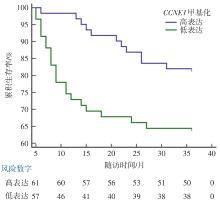
Fig.1
Relationship between different levels of plasma CCNE1 methylation and 3-year survival rate"
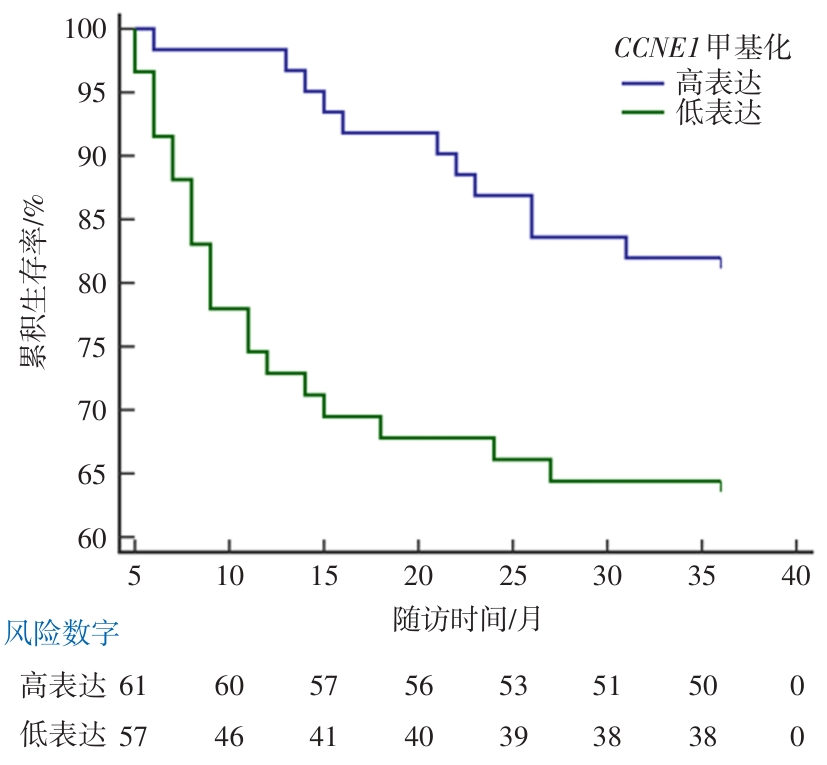
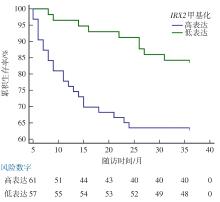
Fig.2
Relationship between different levels of plasma IRX2 methylation and 3-year survival rate"
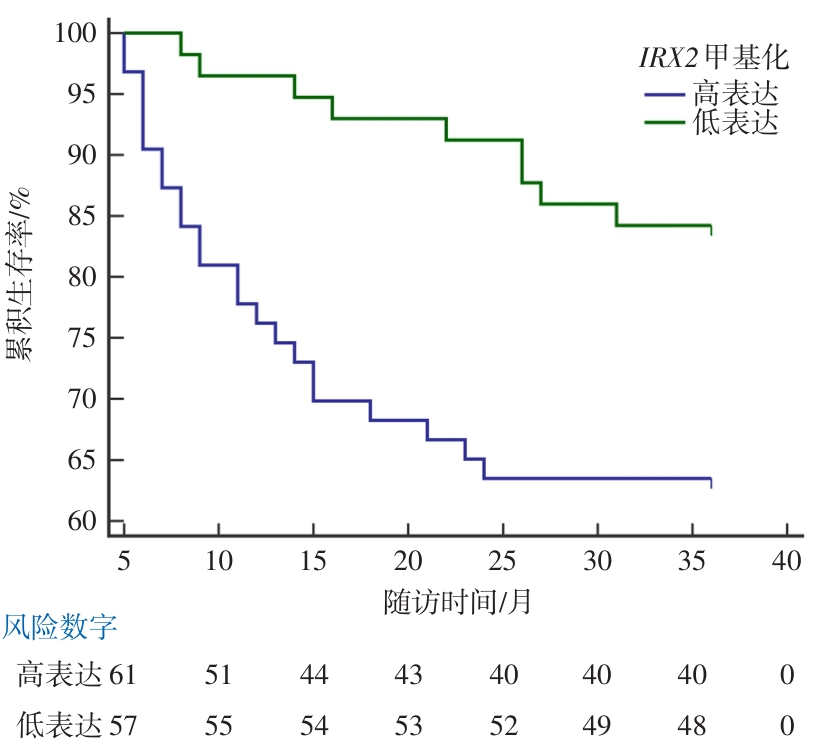
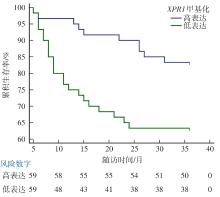
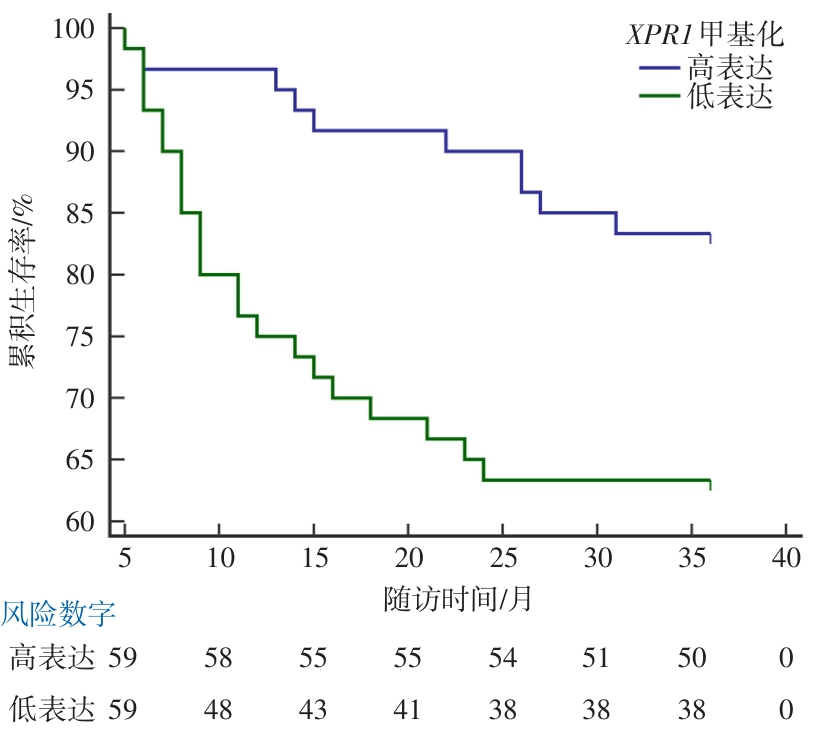
Fig.3
Relationship between different levels of XPR1 methylation in plasma and 3-year survival rate"
Tab.4
Comparison of plasma CCNE1, IRX2 and XPR1methylation levels in EC patients with different prognoses x ± s"
| 组别 | 例数 | CCNE1甲基化 | IRX2甲基化 | XPR1甲基化 |
|---|---|---|---|---|
| 生存组 | 88 | 0.90 ± 0.14 | 4.86 ± 0.71 | 0.82 ± 0.13 |
| 死亡组 | 32 | 0.68 ± 0.09 | 6.05 ± 0.85 | 0.63 ± 0.08 |
| t值 | 8.277 | 7.693 | 7.740 | |
| P值 | < 0.001 | < 0.001 | < 0.001 |
Tab.5
Analysis of prognostic factors for EC patients using the Cox proportional hazards regression model"
| 因素 | β | SE | Waldχ2 | HR值 | 95%CI | P值 |
|---|---|---|---|---|---|---|
| CCNE1甲基化 | -0.976 | 0.201 | 23.554 | 0.377 | 0.254 ~ 0.559 | < 0.001 |
| IRX2甲基化 | 1.077 | 0.174 | 38.315 | 2.936 | 2.088 ~ 4.129 | < 0.001 |
| XPR1甲基化 | -0.870 | 0.186 | 21.872 | 0.419 | 0.291 ~ 0.603 | < 0.001 |
| 常量 | -7.601 | 1.126 | 45.567 | < 0.001 |
Tab.6
Predictive value of plasma CCNE1, IRX2 and XPR1 methylation for poor prognosis in EC patients"
| 指标 | AUC | 95%CI | Cut-off值 | 敏感度/% | 特异度/% | 约登指数 |
|---|---|---|---|---|---|---|
| CCNE1甲基化 | 0.827 | 0.747 ~ 0.890 | 0.81 | 87.50 | 67.05 | 0.546 |
| IRX2甲基化 | 0.820 | 0.739 ~ 0.884 | 5.28 | 84.37 | 71.59 | 0.560 |
| XPR1甲基化 | 0.816 | 0.735 ~ 0.881 | 0.70 | 65.62 | 86.36 | 0.512 |
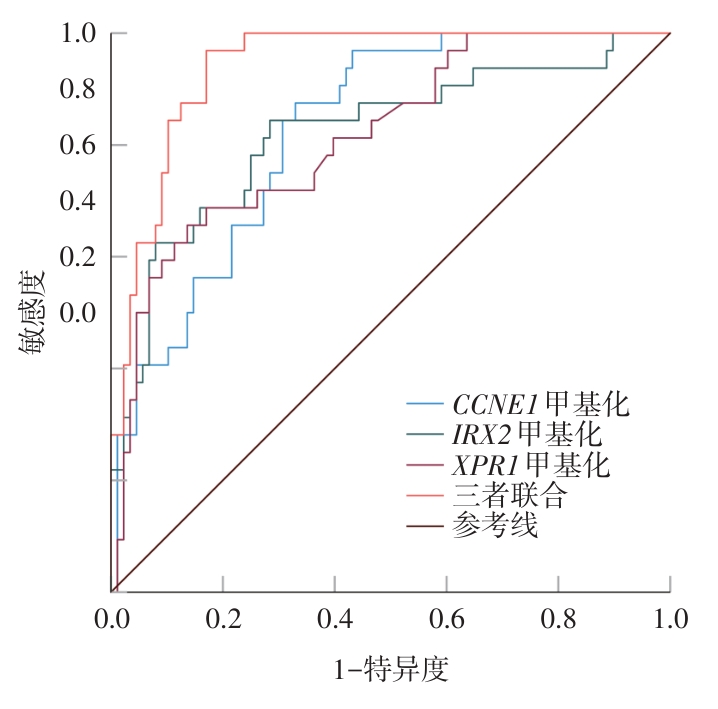
| 三者联合 | 0.941 | 0.882 ~ 0.976 | - | 96.87 | 82.95 | 0.798 |
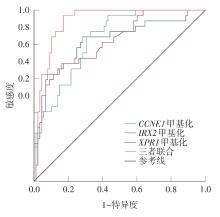
Fig.4
ROC curves showing that plasma CCNE1, IRX2 and XPR1 methylation levels predict poor prognosis in EC patients"
| [1] |
HABESHIAN T S, PARK S Y, CONTI D, et al. Inflammatory and insulinemic dietary and lifestyle patterns and incidence of endometrial cancer: The multiethnic cohort[J]. Am J Clin Nutr, 2025, 121(6):1236-1245. doi: 10.1016/j.ajcnut. 2025.04. 020 .
doi: 10.1016/j.ajcnut. 2025.04. 020 |
| [2] |
CONCIN N, MATIAS-GUIU X, CIBULA D, et al. ESGO-ESTRO-ESP guidelines for the management of patients with endometrial carcinoma: Update 2025[J]. Lancet Oncol, 2025, 26(8):423-435. doi: 10.1016/S1470-2045(25)00167-6 .
doi: 10.1016/S1470-2045(25)00167-6 |
| [3] |
刘露, 丁慧静, 张坤. 子宫内膜癌早期筛查和诊断技术的研究进展[J]. 中国性科学, 2026, 35(3):35-38. doi: 10.3969/j.issn.1672-1993.2026.03.008 .
doi: 10.3969/j.issn.1672-1993.2026.03.008 |
| [4] |
NISHIKUBO H, KAWABATA K, SANO T, et al. CCNE1 gene amplification might be associated with lymph node metastasis of gastric cancer[J]. Genes (Basel), 2025, 16(6):617. doi: 10.3390/genes16060617 .
doi: 10.3390/genes16060617 |
| [5] |
ZHENG X, CHEN L, LIU W, et al. CCNE1 is a predictive and immunotherapeutic indicator in various cancers including UCEC: A pan-cancer analysis[J]. Hereditas, 2023, 160(1):13. doi: 10.1186/s41065-023-00273-0 .
doi: 10.1186/s41065-023-00273-0 |
| [6] |
MA Z G, YUAN Y P, FAN D, et al. IRX2 regulates angiotensin II-induced cardiac fibrosis by transcriptionally activating EGR1 in male mice[J]. Nat Commun, 2023, 14(1):4967. doi: 10.1038/s41467-023-40639-6 .
doi: 10.1038/s41467-023-40639-6 |
| [7] |
XU Q, ZHOU W, ZHOU Y, et al. IRX2 regulates endometrial carcinoma oncogenesis by transcriptional repressing RUVBL1[J]. Exp Cell Res, 2024, 434(1):113866. doi: 10.1016/j.yexcr. 2023.113866 .
doi: 10.1016/j.yexcr. 2023.113866 |
| [8] |
HAN X, YANG L, NUERMANGULI R, et al. In-depth evaluation of XPR1 as a new prognostic indicator for endometrial cancer[J]. BMC Cancer, 2025, 25(1):1411. doi: 10.1186/s12885-025-14818-1 .
doi: 10.1186/s12885-025-14818-1 |
| [9] |
COLOMBO N, CREUTZBERG C, AMANT F, et al. ESMO-ESGO-ESTRO Consensus Conference on Endometrial Cancer: Diagnosis, treatment and follow-up[J]. Ann Oncol, 2016, 27(1):16-41. doi: 10.1097/IGC.0000000000000609 .
doi: 10.1097/IGC.0000000000000609 |
| [10] |
翟一阳, 马韵翼, 翟俊英, 等. 子宫内膜癌组织肿瘤坏死因子α诱导蛋白8家族成员2、细胞增殖核抗原表达水平及与临床病理参数和预后的关系[J]. 实用医学杂志, 2025, 41(3):379-384. doi: 10.3969/j.issn.1006-5725.2025.03.011 .
doi: 10.3969/j.issn.1006-5725.2025.03.011 |
| [11] |
GAO S, WANG J, LI Z, et al. Global Trends in incidence and mortality rates of endometrial cancer among individuals aged 55 years and above from 1990 to 2021: An Analysis of the Global Burden of Disease[J]. Int J Womens Health, 2025, 17(1):651-662. doi: 10.2147/IJWH.S499435 .
doi: 10.2147/IJWH.S499435 |
| [12] |
GODDARD E, PACE D, TWELLS L, et al. Laparoscopic bariatric surgery with hysterectomy for endometrial cancer to improve long-term outcomes: A review article[J]. Int J Gynecol Cancer, 2025, 35(2):100033. doi: 10.1016/j.ijgc.2024.100033 .
doi: 10.1016/j.ijgc.2024.100033 |
| [13] |
中国医师协会微无创医学专业委员会妇科肿瘤学组, 中国医院协会妇产医院分会妇科肿瘤专业学组, 中国优生科学协会肿瘤生殖学分会, 等. 子宫内膜未分化/去分化癌诊治的中国专家共识(2022年版)[J]. 癌症进展, 2023, 21(1):1-9, 14. doi: 10.11877/j.issn.1672-1535.2023.21.01.01 .
doi: 10.11877/j.issn.1672-1535.2023.21.01.01 |
| [14] |
XU T, DING H, CHEN J, et al. Research progress of DNA Methylation in Endometrial cancer[J]. Biomolecules, 2022, 12(7):938. doi: 10.3390/biom12070938 .
doi: 10.3390/biom12070938 |
| [15] |
TAKAMATSU S, HILLMAN R T, YOSHIHARA K, et al. Molecular classification of ovarian high-grade serous/endometrioid carcinomas through multi-omics analysis: JGOG3025-TR2 study[J]. Br J Cancer, 2024, 131(8): 1340-1349. doi: 10.1038/s41416-024-02837-x .
doi: 10.1038/s41416-024-02837-x |
| [16] |
ULLAH M A, FARZANA M, ISLAM M S, et al. Identification of the prognostic and therapeutic values of cyclin E1 (CCNE1) gene expression in Lung Adenocarcinoma and Lung Squamous Cell Carcinoma: A database mining approach[J]. Heliyon, 2022, 8(9):10367. doi: 10.1016/j.heliyon.2022.e10367 .
doi: 10.1016/j.heliyon.2022.e10367 |
| [17] |
LABEAU T, LOGER J S, JEAN-LAURENT M, et al. Molecular profiling of endometrial cancer in martinique reveals frequent CCNE1 amplification in poor prognosis tumors[J]. Sci Rep, 2025, 15(1):40830. doi: 10.1038/s41598-025-24580-w .
doi: 10.1038/s41598-025-24580-w |
| [18] |
MARLIN R, LOGER J S, JOACHIM C, et al. Copy number signatures and CCNE1 amplification reveal the involvement of replication stress in high-grade endometrial tumors oncogenesis[J]. Cell Oncol (Dordr), 2024, 47(4):1441-1457. doi: 10.1007/s13402-024-00942-w .
doi: 10.1007/s13402-024-00942-w |
| [19] |
CATELA C, ASSIMACOPOULOS S, CHEN Y, et al. The Iroquois (Iro/Irx) homeobox genes are conserved Hox targets involved in motor neuron development[J]. iScience, 2025, 28(4):112210. doi: 10.1016/j.isci.2025.112210 .
doi: 10.1016/j.isci.2025.112210 |
| [20] |
ZHANG J, ZHOU Y, LI X, et al. Expression profile and prognostic values of irx family members in lung adenocarcinoma[J]. Curr Med Chem, 2025, 32(35): 7906-7924. doi: 10.2174/0109298673320965240829065919 .
doi: 10.2174/0109298673320965240829065919 |
| [21] |
HUANG J, YUAN L, HUANG W, et al. LATPS, a novel prognostic signature based on tumor microenvironment of lung adenocarcinoma to better predict survival and immunotherapy response[J]. Front Immunol, 2022, 13(1):1064874. doi: 10.3389/fimmu.2022.1064874 .
doi: 10.3389/fimmu.2022.1064874 |
| [22] |
ZHANG X Y, LIU Y, RONG Q, et al. RUVBL1 accelerates tongue squamous cell carcinoma by mediating CRaf/MEK/ERK pathway[J]. iScience, 2024, 27(4):109434. doi: 10.1016/j.isci.2024.109434 .
doi: 10.1016/j.isci.2024.109434 |
| [23] |
SU Y, MEI L, WU Y, et al. Xenotropic and polytropic retrovirus receptor 1 (XPR1) promotes progression of papillary thyroid carcinoma via the BRAF-ERK1/2-P53 signaling pathway[J]. J Endocrinol Invest, 2025, 48(3):633-652. doi: 10.1007/s40618-024-02481-5 .
doi: 10.1007/s40618-024-02481-5 |
| [24] |
SUN C, GUAN H, LI J, et al. RBM15-mediated m6A modification of XPR1 promotes the malignant progression of lung adenocarcinoma[J]. Naunyn Schmiedebergs Arch Pharmacol, 2025, 398(7):9279-9290. doi: 10.1007/s00210-025- 03849-x .
doi: 10.1007/s00210-025- 03849-x |
| [25] |
WANG L. Bioinformatics analyses proposed xenotropic and polytropic retrovirus receptor 1 as a potential diagnostic and prognostic biomarker and immunotherapeutic target in head and neck squamous cell carcinoma[J]. Auris Nasus Larynx, 2023, 50(1):134-150. doi: 10.1016/j.anl.2022.05.018 .
doi: 10.1016/j.anl.2022.05.018 |
| [26] |
AKASU-NAGAYOSHI Y, HAYASHI T, KAWABATA A, et al. PHOSPHATE exporter XPR1/SLC53A1 is required for the tumorigenicity of epithelial ovarian cancer[J]. Cancer Sci, 2022, 113(6):2034-2043. doi: 10.1111/cas.15358 .
doi: 10.1111/cas.15358 |
| Viewed | ||||||
|
Full text |
|
|||||
|
Abstract |
|
|||||
