

The Journal of Practical Medicine ›› 2026, Vol. 42 ›› Issue (3): 531-540.doi: 10.3969/j.issn.1006-5725.2026.03.023
• Treatise: Clinical Practice • Previous Articles
Lin BU1( ),Shuqun HU2,Yali CHAO1,Shengnan ZHANG1,Min ZHOU1,Huilin XU1
Received:2025-11-12
Online:2026-02-10
Published:2026-02-09
Contact:
Lin BU
E-mail:bym68839@163.com
CLC Number:
Lin BU,Shuqun HU,Yali CHAO,Shengnan ZHANG,Min ZHOU,Huilin XU. The influence of pressure regulated volume controlled ventilation mode on respiratory mechanics, myocardial injury and postoperative pulmonary complications in patients undergoing cardiac valve surgery[J]. The Journal of Practical Medicine, 2026, 42(3): 531-540.
Tab.1
Comparison of baseline conditions between the two groups"
| 项目 | PRVC组(n = 50) | 对照组(n = 50) | χ2 /t值 | P值 |
|---|---|---|---|---|
| 性别 | 0.167 | 0.683 | ||
| 男 | 31(62.00) | 29(58.00) | ||
| 女 | 19(38.00) | 21(42.00) | ||
| 年龄(x ± s)/岁 | 52.15 ± 10.14 | 51.61 ± 12.71 | 0.235 | 0.815 |
| BMI(x ± s)/(kg/m2) | 23.35 ± 3.17 | 24.01 ± 3.78 | 0.946 | 0.347 |
| 手术类型 | 0.044 | 0.834 | ||
| 单瓣膜手术 | 32(64.00) | 33(66.00) | ||
| 联合瓣膜手术 | 18(36.00) | 17(34.00) | ||
| NYHA分级 | 0.219 | 0.640 | ||
| Ⅱ级 | 11(22.00) | 13(26.00) | ||
| Ⅲ级 | 39(78.00) | 37(74.00) | ||
| CPB时间(x ± s)/min | 107.01 ± 22.19 | 110.97 ± 21.83 | 0.900 | 0.371 |
| 主动脉阻断时间(x ± s)/min | 70.62 ± 15.31 | 72.14 ± 15.42 | 0.495 | 0.622 |
| 病程(x ± s)/年 | 10.14 ± 3.16 | 10.26 ± 3.34 | 0.185 | 0.854 |
| 瓣膜病分型 | 0.451 | 0.930 | ||
| 退行性瓣膜病 | 31(62.00) | 30(60.00) | ||
| 风湿性瓣膜病 | 15(30.00) | 14(28.00) | ||
| 先天性心脏瓣膜病 | 2(4.00) | 3(6.00) | ||
| 其他 | 2(4.00) | 3(6.00) | ||
| 术式 | 0.053 | 0.817 | ||
| 瓣膜置换 | 37(74.00) | 38(76.00) | ||
| 瓣膜修复 | 13(26.00) | 12(24.00) | ||
| 瓣膜病类型 | 0.472 | 0.925 | ||
| 主动脉瓣 | 12(24.00) | 11(22.00) | ||
| 二尖瓣 | 16(32.00) | 19(38.00) | ||
| 三尖瓣 | 4(8.00) | 3(6.00) | ||
| 联合 | 18(36.00) | 17(34.00) |
Tab.2
Comparison of respiratory mechanics parameters of the two groups at different times of surgery"
| 组别 | 时间 | Ppeak/cmH2O | Pplat/cmH2O | Cdyn/(mL/cmH2O) | △P/cmH2O |
|---|---|---|---|---|---|
| PRVC组(n = 50) | T1 | 19.51 ± 2.14 | 16.56 ± 1.98 | 44.51 ± 3.67 | 13.22 ± 1.76 |
| T2 | 18.91 ± 1.96 | 16.16 ± 1.79 | 45.02 ± 2.79 | 12.63 ± 1.57 | |
| T3 | 19.63 ± 1.79 | 17.01 ± 2.13 | 44.83 ± 3.15 | 13.31 ± 1.71 | |
| T4 | 20.06 ± 2.01 | 17.56 ± 2.23 | 42.51 ± 2.69 | 13.75 ± 1.23 | |
| 对照组(n = 50) | T1 | 21.93 ± 2.01* | 20.21 ± 2.53* | 42.68 ± 3.85* | 15.32 ± 1.34* |
| T2 | 21.75 ± 1.87* | 19.71 ± 1.75* | 42.01 ± 2.86* | 14.78 ± 1.63* | |
| T3 | 22.76 ± 3.14* | 20.34 ± 2.16* | 41.98 ± 2.26* | 15.37 ± 1.54* | |
| T4 | 24.26 ± 2.75* | 21.65 ± 1.78* | 39.14 ± 1.78* | 16.66 ± 1.78* | |
| F组间、时间、交互 | 195.100、12.270、2.842 | 315.000、11.741、0.601 | 87.761、20.682、1.251 | 212.600、15.341、1.641 | |
| P组间、时间、交互 | < 0.001、< 0.001、0.038 | < 0.001、< 0.001、0.615 | < 0.001、< 0.001、0.291 | < 0.001、< 0.001、0.179 |
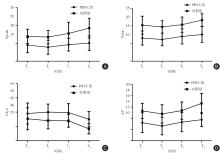
Fig.1
Line graphs of changes in respiratory mechanical parameters at different times in the two groups of surgeries"
Tab.3
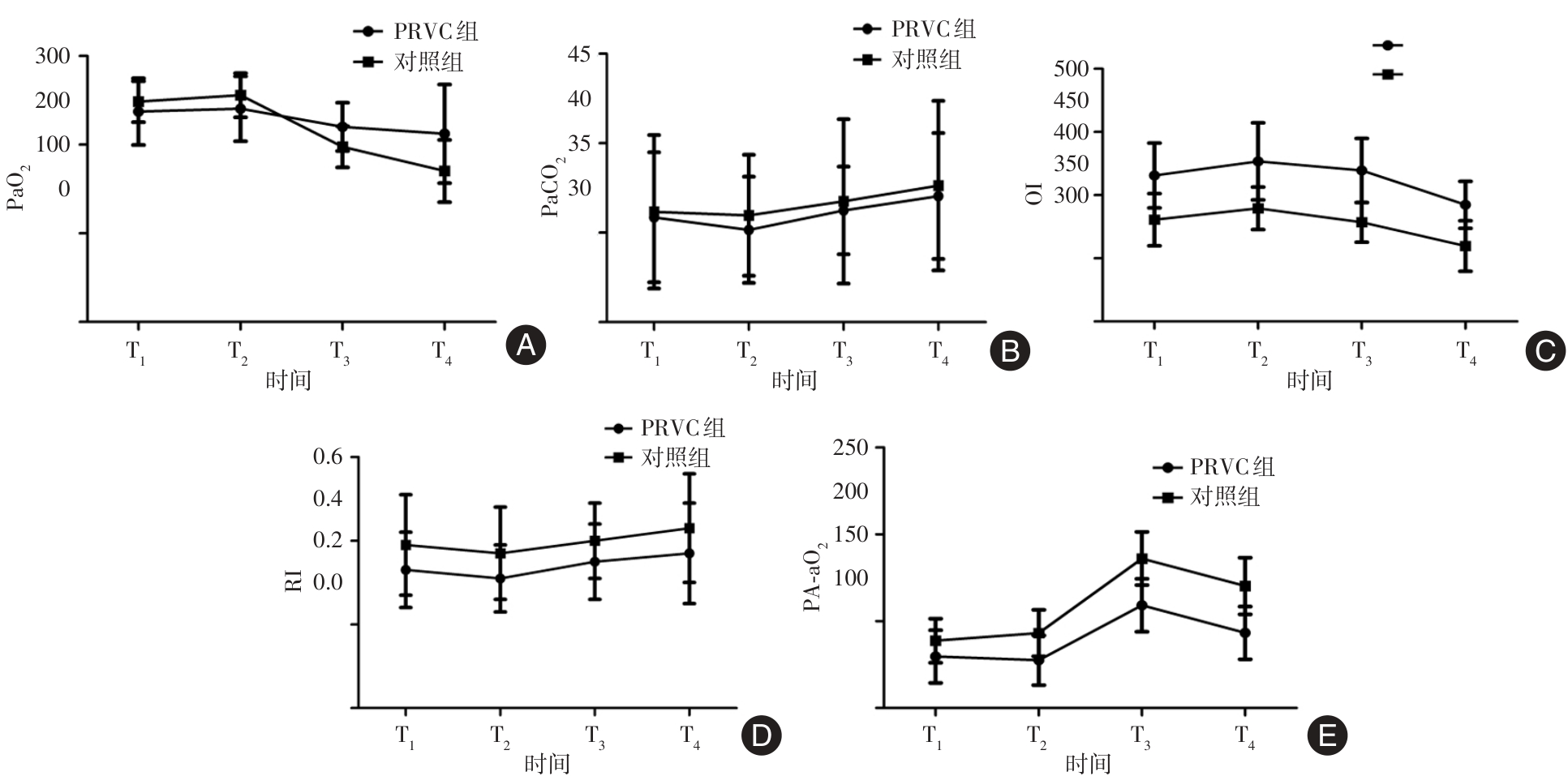
Comparison of oxygenation parameters at different operation times between the two groups"
| 组别 | 时间 | PaO2/mmHg | PaCO2/mmHg | OI/mmHg | RI | PA-aO2/mmHg |
|---|---|---|---|---|---|---|
| PRVC组(n = 50) | T1 | 237.26 ± 37.63 | 35.86 ± 3.63 | 415.56 ± 25.63 | 0.33 ± 0.09 | 129.63 ± 15.21 |
| T2 | 240.52 ± 36.54 | 35.16 ± 2.97 | 426.75 ± 30.52 | 0.31 ± 0.08 | 127.53 ± 14.33 | |
| T3 | 220.14 ± 27.23 | 36.24 ± 3.45 | 419.54 ± 25.41 | 0.35 ± 0.09 | 159.17 ± 13.79 | |
| T4 | 212.25 ± 55.71 | 37.05 ± 3.52 | 392.36 ± 18.56 | 0.37 ± 0.11 | 143.26 ± 15.22 | |
| 对照组(n = 50) | T1 | 248.51 ± 23.14* | 36.17 ± 4.29 | 380.57 ± 20.63* | 0.39 ± 0.12* | 138.75 ± 12.69* |
| T2 | 255.77 ± 24.79* | 35.97 ± 3.38 | 389.63 ± 16.85* | 0.37 ± 0.11* | 143.21 ± 13.36* | |
| T3 | 197.63 ± 23.35* | 36.75 ± 4.59 | 378.52 ± 15.73* | 0.40 ± 0.09* | 186.11 ± 15.32* | |
| T4 | 170.27 ± 35.16* | 37.63 ± 4.74 | 359.75 ± 20.07* | 0.43 ± 0.13* | 170.25 ± 16.37* | |
| F组间、时间、交互 | 7.575、62.543、 15.870 | 2.147、4.054、 0.075 | 269.700、37.793、0.647 | 29.891、5.782、 0.057 | 177.900、156.401、 8.941 | |
| P组间、时间、交互 | 均< 0.001 | 0.144、0.007、 0.974 | < 0.001、< 0.001、0.585 | < 0.001、< 0.001、0.982 | 均< 0.001 |
Fig.2
Line graphs of oxygenation parameter changes at different times of the two groups of surgeries"
Tab.4
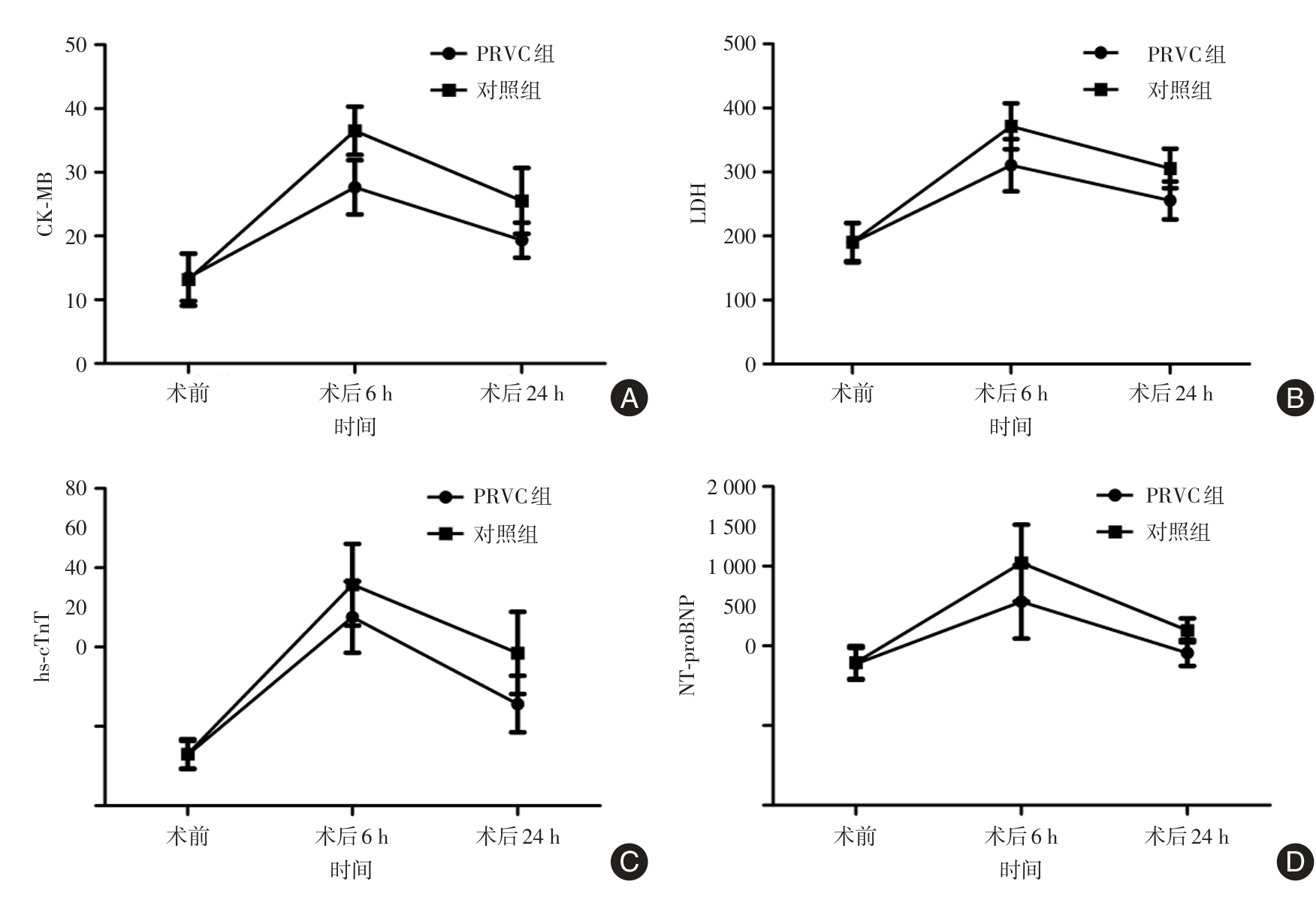
Comparison of myocardial injury markers before and after surgery between the two groups"
| 组别 | 时间 | CK-MB/(ng/mL) | LDH/(U/L) | hs-cTnT/(ng/L) | NT-proBNP/(pg/mL) |
|---|---|---|---|---|---|
| PRVC组(n = 50) | 术前 | 13.52 ± 3.69 | 189.63 ± 30.57 | 12.86 ± 3.52 | 887.63 ± 100.52 |
| 术后6 h | 27.63 ± 4.25? | 310.56 ± 40.75? | 47.57 ± 9.01? | 1 276.71 ± 230.51? | |
| 术后24 h | 19.35 ± 2.76? | 255.63 ± 29.78? | 25.63 ± 7.11? | 955.63 ± 81.78? | |
| 对照组(n = 50) | 术前 | 13.17 ± 4.12 | 190.75 ± 29.83 | 13.01 ± 3.76 | 895.98 ± 102.65 |
| 术后6 h | 36.52 ± 3.79?# | 371.52 ± 35.97?# | 55.75 ± 10.29?# | 1 520.52 ± 240.89?# | |
| 术后24 h | 25.52 ± 5.17?# | 305.63 ± 30.71?# | 38.52 ± 10.37?# | 1 097.37 ± 75.63?# | |
| F组间、时间、交互 | 111.100、540.63、34.741 | 95.041、523.300、23.042 | 60.571、605.200、16.753 | 53.791、286.700、14.501 | |
| P组间、时间、交互 | < 0.001 | < 0.001 | < 0.001 | < 0.001 |
Fig.3
Line graphs of changes in myocardial injury markers before and after surgery in the two groups"
Tab.5
Comparison of postoperative recovery between the two groups"
| 组别 | 手术时间/min | 拔管时间/h | ICU停留时间/h | 总住院时间/d |
|---|---|---|---|---|
| PRVC组(n = 50) | 261.25 ± 30.57 | 10.12 ± 1.75 | 29.86 ± 5.14 | 11.23 ± 2.16 |
| 对照组(n = 50) | 259.21 ± 29.75 | 13.57 ± 2.96 | 33.56 ± 7.53 | 13.01 ± 3.25 |
| t值 | 0.338 | 7.094 | 2.870 | 3.225 |
| P值 | 0.736 | < 0.001 | 0.005 | 0.002 |
Tab.6
Comparison of postoperative pulmonary complications between the two groups"
| 组别 | 例数 | 肺不张 | 肺部感染 | 气胸 | 呼吸衰竭 | 胸腔积液 | 支气管痉挛 | 合计 |
|---|---|---|---|---|---|---|---|---|
| PRVC组 | 50 | 2(4.00) | 2(4.00) | 0(0.00) | 1(2.00) | 1(2.00) | 1(2.00) | 7(14.00) |
| 对照组 | 50 | 4(8.00) | 7(14.00) | 1(2.00) | 3(6.00) | 3(6.00) | 3(6.00) | 21(42.00) |
| χ2值 | 0.177* | 1.954 | - | 0.260* | 0.260* | 0.260* | 9.722 | |
| P值 | 0.674 | 0.162 | 1.000# | 0.610 | 0.610 | 0.610 | 0.002 |
| [1] |
VAHANIAN A, BEYERSDORF F, PRAZ F, et al. 2021 ESC/EACTS Guidelines for the management of valvular heart disease[J]. Eur Heart J, 2022, 43(7): 561-632. doi:10.1093/eurheartj/ehab395 .
doi: 10.1093/eurheartj/ehab395 |
| [2] |
RANA M. Aortic valve stenosis: Diagnostic approaches and recommendations of the 2021 ESC/EACTS guidelines for the management of valvular heart disease-a review of the literature[J]. Cardiol Cardiovasc Med, 2022, 6(3): 315-324. doi:10.26502/fccm.92920267 .
doi: 10.26502/fccm.92920267 |
| [3] |
DOKOLLARI A, MARGARYAN R, TORREGROSSA G, et al. Risk predictors that impact long-term prognosis in patients undergoing aortic valve replacement with the Perceval sutureless bioprosthesis[J]. Cardiovasc Revasc Med, 2023, 55: 10-19. doi:10.1016/j.carrev.2023.04.006 .
doi: 10.1016/j.carrev.2023.04.006 |
| [4] |
范婧婧, 韩晶晶, 陈宇, 等. 吸入氧浓度对非体外循环下冠状动脉搭桥患者心肌损伤的影响[J]. 南京医科大学学报(自然科学版), 2023, 43(12): 1719-1723. doi:10.7655/NYDXBNS20231216 .
doi: 10.7655/NYDXBNS20231216 |
| [5] |
BECKER S, SCHNITZLER R, REMBECKI M, et al. Individualized flow-controlled versus conventional pressure-controlled ventilation in on-pump heart surgery (FLOWVENTIN HEARTSURG): Study protocol for a randomized controlled trial[J]. Trials, 2023, 24(1): 195. doi:10.1186/s13063-023-07201-7 .
doi: 10.1186/s13063-023-07201-7 |
| [6] |
GONG X, ZHU L, ZHANG M, et al. Utilizing spontaneous ventilation modes in patients underwent corrective surgery for right ventricular outflow tract obstructive congenital heart disease: A crossover study[J]. Rev Cardiovasc Med, 2023, 24(5): 143. doi:10.31083/j.rcm2405143 .
doi: 10.31083/j.rcm2405143 |
| [7] |
张建友, 郭宁, 杨大威, 等. 压力控制容量保证通气对胸腔镜肺叶切除术患者围术期肺功能的影响[J]. 临床麻醉学杂志, 2024, 40(8): 820-824. doi:10.12089/jca.2024.08.007 .
doi: 10.12089/jca.2024.08.007 |
| [8] |
SCHRANC Á, DIAPER J, SÜDY R, et al. Benefit of flow-controlled over pressure-regulated volume control mode during one-lung ventilation: A randomized experimental crossover study[J]. Anesth Analg, 2023, 136(3): 605-612. doi:10.1213/ANE.0000000000006322 .
doi: 10.1213/ANE.0000000000006322 |
| [9] |
QASEEM A, SNOW V, FITTERMAN N, et al. Risk assessment for and strategies to reduce perioperative pulmonary complications for patients undergoing noncardiothoracic surgery: A guideline from the American College of Physicians[J]. Ann Intern Med, 2006, 144(8): 575-580. doi:10.7326/0003-4819-144-8-200604180-00008 .
doi: 10.7326/0003-4819-144-8-200604180-00008 |
| [10] |
ZHANG L L, JIA B W, ZHUO Z P, et al. Ac2-26 reduced lung injury after cardiopulmonary bypass via the AKT1/GSK3β/ENOS pathway[J]. J Surg Res, 2024, 301: 324-335. doi:10.1016/j.jss. 2024.06.009 .
doi: 10.1016/j.jss. 2024.06.009 |
| [11] |
REKHTMAN D, BERMUDEZ F, VERVOORT D, et al. A global systematic review of open heart valvular surgery in resource-limited settings[J]. Ann Thorac Surg, 2024, 117(3): 652-660. doi:10.1016/j.athoracsur.2023.10.016 .
doi: 10.1016/j.athoracsur.2023.10.016 |
| [12] |
AKINTOYE O, MUSA A, GYAU-AMPONG C, et al. A systematic review and meta-analysis on outcomes of valvular heart surgery in Africa[J]. World J Surg, 2024, 48(1): 228-239. doi:10.1002/wjs.12019 .
doi: 10.1002/wjs.12019 |
| [13] | 范光磊, 扶书扬, 郑明珠, 等. 术前肌肉减少症与老年患者心脏手术后严重肺部并发症的关系[J]. 中华麻醉学杂志, 2023(7): 787-792. |
| [14] |
龚孝珏, 张小蝶, 王江梅, 等. 新生儿心脏手术术后肺部并发症的危险因素和死亡预测模型构建[J]. 实用医学杂志, 2023, 39(15): 1932-1938. doi:10.3969/j.issn.1006-5725. 2023. 15.013 .
doi: 10.3969/j.issn.1006-5725. 2023. 15.013 |
| [15] |
ROGERS C A, MAZZA G, MAISHMAN R, et al. Low frequency ventilation during cardiopulmonary bypass to protect postoperative lung function in cardiac valvular surgery: The PROTECTION phase II randomized trial[J]. J Am Heart Assoc, 2024, 13(19): e035011. doi:10.1161/JAHA.124.035011 .
doi: 10.1161/JAHA.124.035011 |
| [16] |
ZHENG X M, YANG Z, YANG G L, et al. Lung injury after cardiopulmonary bypass: Alternative treatment prospects[J]. World J Clin Cases, 2022, 10(3): 753-761. doi:10.12998/wjcc.v10.i3.753 .
doi: 10.12998/wjcc.v10.i3.753 |
| [17] |
FU Z, WU X, ZHENG F, et al. Sevoflurane anesthesia ameliorates LPS-induced acute lung injury (ALI) by modulating a novel LncRNA LINC00839/miR-223/NLRP3 axis[J]. BMC Pulm Med, 2022, 22(1): 159. doi:10.1186/s12890-022-01957-5 .
doi: 10.1186/s12890-022-01957-5 |
| [18] |
WANG Y, CHEN L, YAO C, et al. Early plasma proteomic biomarkers and prediction model of acute respiratory distress syndrome after cardiopulmonary bypass: A prospective nested cohort study[J]. Int J Surg, 2023, 109(9): 2561-2573. doi:10.1097/JS9.0000000000000434 .
doi: 10.1097/JS9.0000000000000434 |
| [19] |
许俊平, 陈霖, 余天兴, 等. 血管紧张素转换酶2和卡托普利对机械通气相关性肺损伤小鼠的影响及作用机制[J]. 中华急诊医学杂志, 2025, 34(9): 1222-1228. doi:10.3760/cma.j.cn114656-20240919-00652 .
doi: 10.3760/cma.j.cn114656-20240919-00652 |
| [20] | 沈美丽, 陈志旭, 陈伟虹, 等. 鱼油脂肪乳联合肠外营养支持对先天性心脏病术后机械通气患儿血气指标及呼吸力学的影响[J]. 临床小儿外科杂志, 2024, 23(7): 627-632. |
| [21] |
ROSHDY A. Respiratory monitoring during mechanical ventilation: The present and the future[J]. J Intensive Care Med, 2023, 38(5): 407-417. doi:10.1177/08850666231153371 .
doi: 10.1177/08850666231153371 |
| [22] |
罗超, 李威威, 郭松青, 等. 肺复张通气策略对心肺转流下二尖瓣置换术后心室功能的影响[J]. 临床麻醉学杂志, 2024, 40(9): 990-992. doi:10.12089/jca.2024.09.019 .
doi: 10.12089/jca.2024.09.019 |
| [23] |
BILLSTEIN C, SCHENK A, VERGNAT M, et al. Effects of intraoperative ventilation strategies on ventilation inhomogeneity and inflammatory response in pediatric cardiac surgery—a randomized pilot study[J]. Pediatr Anesth, 2026, 36(1): 88-99. doi:10.1111/pan.70066 .
doi: 10.1111/pan.70066 |
| [24] |
YAO W, YANG M, CHENG Q, et al. Effect of pressure-controlled ventilation-volume guaranteed on one-lung ventilation in elderly patients undergoing thoracotomy[J]. Med Sci Monit, 2020, 26: e921417. doi:10.12659/MSM.921417 .
doi: 10.12659/MSM.921417 |
| [25] | LIU X, WANG L. Comparison of the effects of different mechanical ventilation modes on the incidence of ventilation-associated pneumonia: A case study of patients undergoing thoracic surgery[J]. Am J Transl Res, 2022, 14(12): 8668-8675. |
| [26] |
TOMII D, HEG D, LANZ J, et al. Renin-angiotensin system inhibition in patients with myocardial injury complicating transcatheter aortic valve replacement[J]. JACC Adv, 2024, 3(9): 101212. doi:10.1016/j.jacadv.2024.101212 .
doi: 10.1016/j.jacadv.2024.101212 |
| Viewed | ||||||
|
Full text |
|
|||||
|
Abstract |
|
|||||
