

The Journal of Practical Medicine ›› 2026, Vol. 42 ›› Issue (11): 2019-2025.doi: 10.3969/j.issn.1006-5725.2026.11.017
• Chronic Disease Control • Previous Articles
Chenyu CAI,Jing LI,Yingjie XIA,Yuanyuan LI( )
)
Received:2026-01-26
Online:2026-06-10
Published:2026-06-15
Contact:
Yuanyuan LI
E-mail:547504077@qq.com
CLC Number:
Chenyu CAI,Jing LI,Yingjie XIA,Yuanyuan LI. The relationship between the levels of PLAP-1 and AIM-2 in gingival crevicular fluid and the clinical stage, periodontal indicators and prognosis of elderly patients with periodontitis[J]. The Journal of Practical Medicine, 2026, 42(11): 2019-2025.
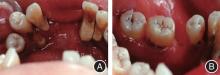
Fig.1
Oral example of an elderly patient with periodontitis before treatment"
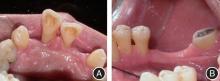
Fig.2
Oral examples of elderly patients with periodontitis after treatment"
Tab.1
Comparison of PLAP-1 and AIM-2 levels in periodontitis patients at different clinical stages"
| 指标 | Ⅲ—Ⅳ期组(n = 51) | Ⅰ—Ⅱ期组(n = 53) | t值 | P值 |
|---|---|---|---|---|
| PLAP-1/(pg/mL) | 173.95 ± 19.71 | 190.20 ± 22.54 | 3.908 | < 0.001 |
| AIM-2/(μg/L) | 4.82 ± 0.84 | 3.58 ± 0.73 | 8.044 | < 0.001 |
Tab.2
Data of patients with different prognoses and levels of PLAP-1 and AIM-2 in gingival crevicular fluid"
| 指标 | 预后不良组(n = 41) | 预后良好组(n = 63) | t/χ2值 | P值 |
|---|---|---|---|---|
| 年龄/岁 | 69.20 ± 7.74 | 68.86 ± 7.26 | 0.227 | 0.821 |
| 性别/[例(%)] | 0.090 | 0.764 | ||
| 男 | 24(58.54) | 35(55.56) | ||
| 女 | 17(41.46) | 28(44.44) | ||
| 吸烟史/[例(%)] | 0.116 | 0.733 | ||
| 有 | 15(36.59) | 21(33.33) | ||
| 无 | 26(63.41) | 42(66.67) | ||
| 牙周炎临床分期/[例(%)] | 0.129 | 0.720 | ||
| Ⅰ—Ⅱ期 | 20(48.78) | 33(52.38) | ||
| Ⅲ—Ⅳ期 | 21(51.22) | 30(47.62) | ||
| 最深PD值/mm | 5.87 ± 1.63 | 5.14 ± 1.35 | 2.481 | 0.015 |
| AL/mm | 4.52 ± 0.67 | 4.48 ± 0.81 | 0.263 | 0.793 |
| 牙槽骨高度/mm | 7.06 ± 0.85 | 7.21 ± 0.93 | 0.831 | 0.408 |
| 菌斑指数 | 1.24 ± 0.29 | 1.25 ± 0.22 | 0.200 | 0.842 |
| PLAP-1/(pg/mL) | 166.39 ± 20.18 | 192.54 ± 22.42 | 6.042 | < 0.001 |
| AIM-2/(μg/L) | 4.71 ± 0.76 | 3.85 ± 0.69 | 5.967 | < 0.001 |
Tab.3
Correlation between periodontal parameters and gingival crevicular fluid levels of PLAP-1 and AIM-2 in elderly patients with periodontitis"
| 指标 | PD | AL |
|---|---|---|
| PLAP-1 | r = -0.501,P < 0.001 | r = -0.496,P < 0.001 |
| AIM-2 | r = 0.517,P < 0.001 | r = 0.522,P < 0.001 |
Tab.4
Factors associated with poor prognosis in elderly patients with periodontitis"
| 影响因素 | β | SE | Wald χ2 | OR | 95%CI | P值 |
|---|---|---|---|---|---|---|
| 最深PD值 | 1.058 | 0.385 | 7.554 | 2.881 | 1.355 ~ 6.127 | 0.006 |
| PLAP-1 | -0.232 | 0.104 | 4.973 | 0.793 | 0.647 ~ 0.972 | 0.026 |
| AIM-2 | 0.984 | 0.392 | 6.296 | 2.674 | 1.240 ~ 5.766 | 0.012 |
Tab.5
Predictive value of gingival crevicular fluid PLAP-1 and AIM-2 levels for prognosis in elderly periodontitis patients"
| 指标 | 敏感度/% | 特异度/% | 截断值 | AUC | 95%CI | 约登指数 |
|---|---|---|---|---|---|---|
| PLAP-1 | 75.61 | 82.54 | 179.35 pg/mL | 0.820 | 0.734 ~ 0.905 | 0.582 |
| AIM-2 | 75.61 | 71.42 | 4.20 μg/L | 0.832 | 0.751 ~ 0.914 | 0.470 |
| 联合预测 | 87.80 | 73.02 | - | 0.895 | 0.834 ~ 0.957 | 0.608 |
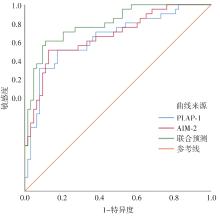
Fig.3
ROC curves of gingival crevicular fluid PLAP-1 and AIM-2 levels for predicting the prognosis of elderly patients with periodontitis"
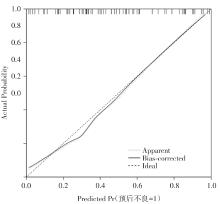
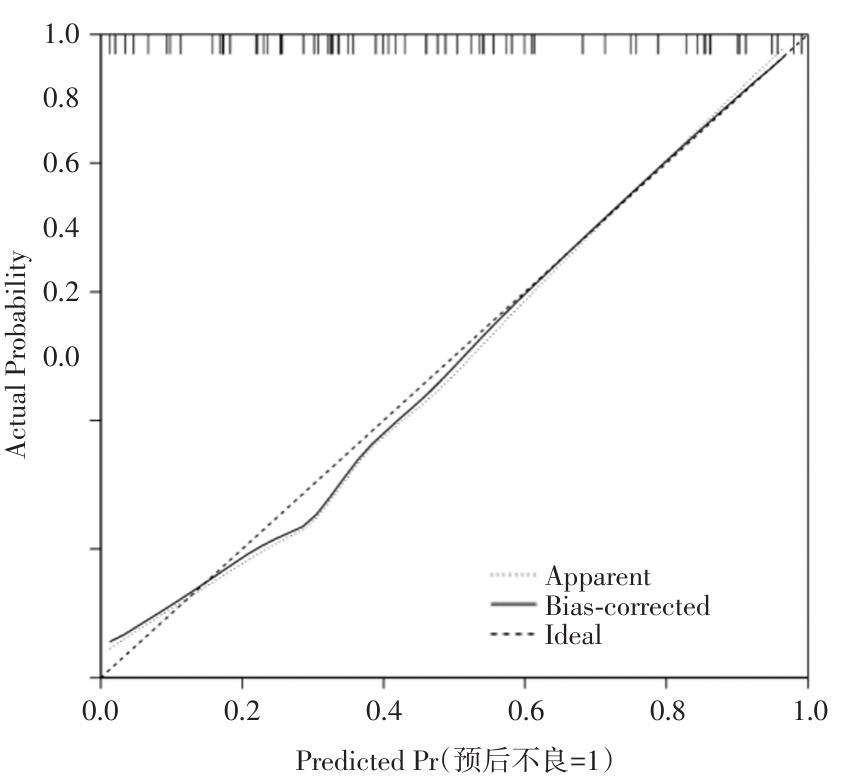
Fig.4
Fitted curve of the combined prediction model using gingival crevicular fluid PLAP-1 and AIM-2 levels"
| [1] |
杨婷婷, 黄一丹, 杨蓉蓉, 等. 2型糖尿病合并慢性牙周炎患者血清LRG1、LDH与牙周指标和牙周病变程度的关系[J]. 实用医学杂志, 2024, 40(16): 2250-2255. doi: 10.3969/j.issn.1006-5725.2024.16.009 .
doi: 10.3969/j.issn.1006-5725.2024.16.009 |
| [2] |
BOTELHO J, LEIRA Y, VIANA J, et al. The Role of Inflammatory Diet and Vitamin D on the Link between Periodontitis and Cognitive Function: A Mediation Analysis in Older Adults[J]. Nutrients, 2021, 13(3): 924-937. doi: 10.3390/nu13030924 .
doi: 10.3390/nu13030924 |
| [3] |
LI X, LI C, ZHANG W, et al. Inflammation and aging: Signaling pathways and intervention therapies[J]. Signal Transduct Target Ther, 2023, 8(1): 239-252. doi: 10.1038/S41392-023-01502-8 .
doi: 10.1038/S41392-023-01502-8 |
| [4] |
YANG T, CHENG B, NOBLE J M, et al. Replication of gene polymorphisms associated with periodontitis-related traits in an elderly cohort: The Washington Heights/Inwood Community Aging Project Ancillary Study of Oral Health[J]. J Clin Periodontol, 2022, 49(5): 414-427. doi: 10.1111/jcpe.13605 .
doi: 10.1111/jcpe.13605 |
| [5] |
马艳茹, 宋恒国, 宋双, 等. 益生菌辅助米诺环素对老年慢性牙周炎患者牙周指数、唾液菌群浓度及口腔健康状态的影响[J]. 实用口腔医学杂志, 2025, 41(4): 490-494. doi: 10.3969/j.issn.1001-3733.2025.04.009 .
doi: 10.3969/j.issn.1001-3733.2025.04.009 |
| [6] |
YU C, TAO D, CAI M, et al. Analysis of Factors Influencing the Prognosis of Periodontal Disease Treated with Host Modulation and the Development of a Predictive Model[J]. Altern Ther Health Med, 2024, 30(5): 202-208. PMID: .
pmid: 37917900 |
| [7] |
MANOHAR M P, KUMAR R S, BALU P. Comparative Evaluation of Periodontal Ligament-associated Protein-1/Asporin Levels in Periodontal Tissue in Health and Disease[J]. Contemp Clin Dent, 2024, 15(2): 143-146. doi: 10.4103/ccd.ccd_114_23 .
doi: 10.4103/ccd.ccd_114_23 |
| [8] |
WANG X, WANG Y. LncRNA DCST1-AS1 inhibits PDLCs' proliferation in periodontitis and may bind with miR-21 precursor to upregulate PLAP-1[J]. J Periodontal Res, 2021, 56(2): 256-264. doi: 10.1111/jre.12809 .
doi: 10.1111/jre.12809 |
| [9] |
KINOSHITA M, YAMADA S, SASAKI J, et al. Mice Lacking PLAP-1/Asporin Show Alteration of Periodontal Ligament Structures and Acceleration of Bone Loss in Periodontitis[J]. Int J Mol Sci, 2023, 24(21): 15989-15998. doi: 10.3390/ijms242115989 .
doi: 10.3390/ijms242115989 |
| [10] |
DIARIMALALA R O, WEI Y, HU D, et al. Inflammasomes during SARS-CoV-2 infection and development of their corresponding inhibitors[J]. Front Cell Infect Microbiol, 2023, 9(13): 1218039-1218048. doi: 10.3389/fcimb.2023.1218039 .
doi: 10.3389/fcimb.2023.1218039 |
| [11] |
YıLMAZ B, EMINGIL G, ÖZTÜRK V Ö, et al. Gingival crevicular fluid levels of TLR-9, AIM-2, and ZBP-1 in periodontal diseases[J]. Oral Dis, 2025, 31(3): 941-948. doi: 10.1111/odi. 15108 .
doi: 10.1111/odi. 15108 |
| [12] |
MARCHESAN J T, GIRNARY M S, MOSS K, et al. Role of inflammasomes in the pathogenesis of periodontal disease and therapeutics[J]. Periodontol, 2000, 82(1): 93-114. doi: 10.1111/prd. 12269 .
doi: 10.1111/prd. 12269 |
| [13] |
SANZ M, HERRERA D, KEBSCHULL M, et al. Treatment of stage Ⅰ-Ⅲ periodontitis-The EFP S3 level clinical practice guideline[J]. J Clin Periodontol, 2020, 22(22): 4-60. doi: 10.1111/jcpe.13290 .
doi: 10.1111/jcpe.13290 |
| [14] |
TONETTI M S, GREENWELL H, KORNMAN K S. Staging and grading of periodontitis: Framework and proposal of a new classification and case definition[J]. J Periodontol, 2018, 1(1): S159-S172. doi: 10.1002/JPER.18-0006 .
doi: 10.1002/JPER.18-0006 |
| [15] |
王蕊蕊, 李淑肖, 李芳芳. 牙周炎患者血清HDAC3、sPD-1、Omentin-1水平与牙周指标及牙周-正畸联合治疗后预后的关系[J]. 国际检验医学杂志, 2025, 46(4): 448-452. doi: 10.3969/j.issn.1673-4130.2025.04.012 .
doi: 10.3969/j.issn.1673-4130.2025.04.012 |
| [16] |
CAI G, REN L, YU J, et al. A Microenvironment-Responsive, Controlled Release Hydrogel Delivering Embelin to Promote Bone Repair of Periodontitis via Anti-Infection and Osteo-Immune Modulation[J]. Adv Sci (Weinh), 2024, 11(34): e2403786. doi: 10.1002/advs.202403786 .
doi: 10.1002/advs.202403786 |
| [17] |
ZHAO J, ZHOU Y H, ZHAO Y Q, et al. Gender Variations in the Oral Microbiomes of Elderly Patients with Initial Periodontitis[J]. J Immunol Res, 2021, 2021: 7403042. doi: 10.1155/2021/7403042 .
doi: 10.1155/2021/7403042 |
| [18] |
余一鸣, 吴玉莹, 吴雨煊, 等. 我国1990—2019年成人牙周病疾病负担现状分析及牙周病发病趋势预测[J]. 中华口腔医学杂志, 2023, 58(12): 1265-1272. doi: 10.3760/cma.j.issn.1000-8039.2024.01.121 .
doi: 10.3760/cma.j.issn.1000-8039.2024.01.121 |
| [19] |
马腾宇, 赵溪达, 刘璐. 老年群体牙周病流行现状及影响因素的研究进展[J]. 口腔疾病防治, 2025, 33(6): 474-481. doi: 10.12016/j.issn.2096-1456.202440488 .
doi: 10.12016/j.issn.2096-1456.202440488 |
| [20] |
TELES F, MARTIN L, PATEL M, et al. Gingival Crevicular Fluid Biomarkers During Periodontitis Progression and After Periodontal Treatment[J]. J Clin Periodontol, 2025, 52(1): 40-55. doi: 10.1111/jcpe.14061 .
doi: 10.1111/jcpe.14061 |
| [21] |
SØDAL A T T, SKUDUTYTE-RYSSTAD R, DIEP M T, et al. Periodontitis in a 65-year-old population: Risk indicators and impact on oral health-related quality of life[J]. BMC Oral Health, 2022, 22(1): 640-652. doi: 10.1186/s12903-022-02662-9 .
doi: 10.1186/s12903-022-02662-9 |
| [22] | 刘双. PLAP-1通过TGF—β1/Smad信号通路调控牙周炎中牙槽骨失衡的作用研究[D]. 济南: 山东大学, 2023. |
| [23] |
KUMARI M, SHARMA A, TIRPUDE N V. Herbacetin ameliorates lipopolysaccharide-elicited inflammatory response by suppressing NLRP-3/AIM-2 inflammasome activation, PI3K/Akt/MAPKs/NF-κB redox inflammatory signalling, modulating autophagy and macrophage polarization imbalance[J]. Mol Biol Rep, 2024, 51(1): 1159-1176. doi: 10.1007/s11033-024-10068-9 .
doi: 10.1007/s11033-024-10068-9 |
| [24] |
YADALAM P K, ARUMUGANAINAR D, NATARAJAN P M, et al. Artificial intelligence-powered prediction of AIM-2 inflammasome sequences using transformers and graph attention networks in periodontal inflammation[J]. Sci Rep, 2025, 15(1): 8733-8745. doi: 10.1038/s41598-025-93409-3 .
doi: 10.1038/s41598-025-93409-3 |
| [25] |
CARRILLO-GÁLVEZ A B, ZURITA F, GUERRA-VALVERDE J A, et al. NLRP3 and AIM2 inflammasomes expression is modified by LPS and titanium ions increasing the release of active IL-1β in alveolar bone-derived MSCs[J]. Stem Cells Transl Med, 2024, 13(8): 826-841. doi: 10.1093/stcltm/szae042 .
doi: 10.1093/stcltm/szae042 |
| [26] |
MÜLLER F, SRINIVASAN M, KRAUSE K H, et al. Periodontitis and peri-implantitis in elderly people experiencing institutional and hospital confinement[J]. Periodontol 2000, 2022, 90(1): 138-145. doi: 10.1111/prd.12454 .
doi: 10.1111/prd.12454 |
| Viewed | ||||||
|
Full text |
|
|||||
|
Abstract |
|
|||||
