

The Journal of Practical Medicine ›› 2026, Vol. 42 ›› Issue (10): 1779-1786.doi: 10.3969/j.issn.1006-5725.2026.10.012
• Modernization of Traditional Chinese Medicine • Previous Articles
Chonghe WANG1,Chenrui LI1,Yuntao YANG2,3( ),Jianan CHEN2
Received:2025-12-25
Online:2026-05-25
Published:2026-05-27
Contact:
Yuntao YANG
E-mail:yyt02@163.com
CLC Number:
Chonghe WANG,Chenrui LI,Yuntao YANG,Jianan CHEN. Research progress on the pathogenesis of post-stroke depression and acupuncture treatment based on the reward circuit[J]. The Journal of Practical Medicine, 2026, 42(10): 1779-1786.
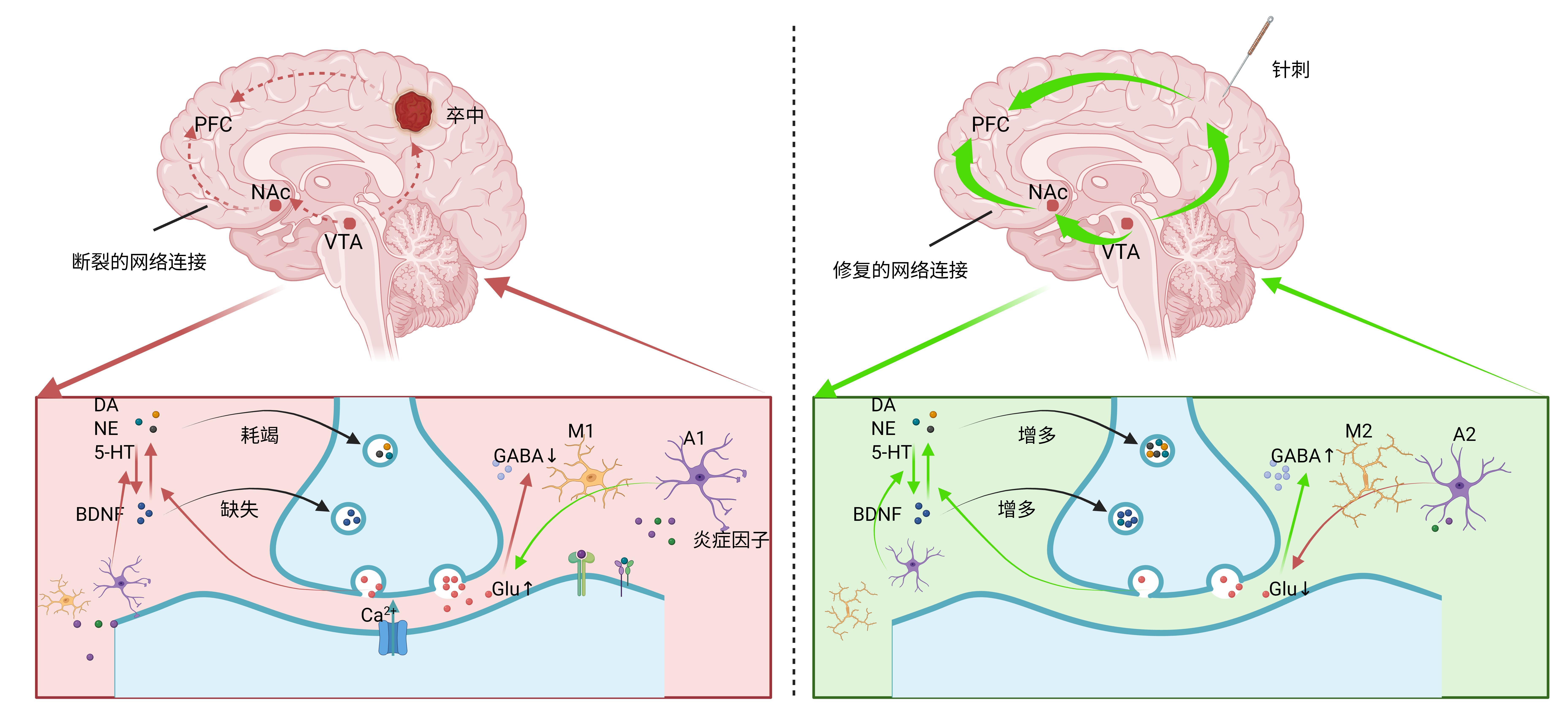
Fig.1
The mechanism diagram of reward circuit dysfunction after stroke and the therapeutic effect of acupuncture on the reward circuit in PSD"
| [1] |
王少石, 周新雨, 朱春燕. 卒中后抑郁临床实践的中国专家共识[J]. 中国卒中杂志, 2016, 11(8): 685-693. doi:10.3969/j.issn.1673-5765.2016.08.015 .
doi: 10.3969/j.issn.1673-5765.2016.08.015 |
| [2] |
李世明, 冯为, 崔凤伟, 等. 中国脑卒中后抑郁患病率meta分析[J]. 实用医学杂志, 2021, 37(16): 2058-2064. doi:10.3969/j.issn.1006-5725.2021.16.005 .
doi: 10.3969/j.issn.1006-5725.2021.16.005 |
| [3] |
符家武, 吴昊, 廖志敏, 等. miRNA-146a基因多态性与缺血性卒中后抑郁的相关性[J]. 实用医学杂志, 2024, 40(19): 2708-2712. doi:10.3969/j.issn.1006-5725.2024.19.008 .
doi: 10.3969/j.issn.1006-5725.2024.19.008 |
| [4] |
ZHOU H, WEI Y J, XIE G Y. Research progress on post-stroke depression[J]. Exp Neurol, 2024, 373: 114660. doi:10.1016/j.expneurol.2023.114660 .
doi: 10.1016/j.expneurol.2023.114660 |
| [5] |
杨云涛, 邵素菊, 吴毅明, 等. 邵氏努针运气针法治疗卒中后抑郁临床经验[J]. 中国针灸, 2024, 44(5): 565-568. doi:10.13703/j.0255-2930.20230831-0003 .
doi: 10.13703/j.0255-2930.20230831-0003 |
| [6] | 周章帆. 针刺与抗抑郁药治疗卒中后抑郁疗效比较的Meta分析[D]. 武汉: 湖北中医药大学, 2024. |
| [7] |
WIJERATNE T, SALES C. Understanding why post-stroke depression may be the norm rather than the exception: The anatomical and neuroinflammatory correlates of post-stroke depression[J]. J Clin Med, 2021, 10(8): 1674. doi:10.3390/jcm10081674 .
doi: 10.3390/jcm10081674 |
| [8] |
COOPER S, ROBISON A J, MAZEI-ROBISON M S. Reward circuitry in addiction[J]. Neurotherapeutics, 2017, 14(3): 687-697. doi:10.1007/s13311-017-0525-z .
doi: 10.1007/s13311-017-0525-z |
| [9] |
IKEMOTO S. Brain reward circuitry beyond the mesolimbic dopamine system: A neurobiological theory[J]. Neurosci Biobehav Rev, 2010, 35(2): 129-150. doi:10.1016/j.neubiorev.2010.02.001 .
doi: 10.1016/j.neubiorev.2010.02.001 |
| [10] |
PAN S, WANG S, XUE X, et al. Multidimensional pain modulation by acupuncture analgesia: The reward effect of acupuncture on pain relief[J]. Evid Based Complement Alternat Med, 2022, 2022: 3759181. doi:10.1155/2022/3759181 .
doi: 10.1155/2022/3759181 |
| [11] |
DUTCHER J M. Brain reward circuits promote stress resilience and health: Implications for reward-based interventions[J]. Curr Dir Psychol Sci, 2023, 32(1): 65-72. doi:10.1177/09637214221121770 .
doi: 10.1177/09637214221121770 |
| [12] |
SHI Y, ZENG Y, WU L, et al. A study of the brain abnormalities of post-stroke depression in frontal lobe lesion[J]. Sci Rep, 2017, 7(1): 13203. doi:10.1038/s41598-017-13681-w .
doi: 10.1038/s41598-017-13681-w |
| [13] |
OESTREICH L K L, WRIGHT P, O’SULLIVAN M J. Microstructural changes in the reward system are associated with post-stroke depression[J]. Neuroimage Clin, 2020, 28: 102360. doi:10.1016/j.nicl.2020.102360 .
doi: 10.1016/j.nicl.2020.102360 |
| [14] |
OESTREICH L K L, WRIGHT P, O’SULLIVAN M J. Hyperconnectivity and altered interactions of a nucleus accumbens network in post-stroke depression[J]. Brain Commun, 2022, 4(6): fcac281. doi:10.1093/braincomms/fcac281 .
doi: 10.1093/braincomms/fcac281 |
| [15] |
SÁNCHEZ-KUHN A, FERNÁNDEZ-MARTÍN P, RODRÍGUEZ-HERRERA R, et al. Lower reward sensitivity in frontostriatal stroke: Influence of depression and resting-state functional connectivity[J]. Cogn Affect Behav Neurosci, 2025, 25(6): 1779-1794. doi:10.3758/s13415-025-01318-9 .
doi: 10.3758/s13415-025-01318-9 |
| [16] |
张璟婷, 张弛, 薄化君, 等. 醒脑开窍针刺通过Nrf2/HO-1通路对卒中后抑郁大鼠行为学和单胺类神经递质释放的影响[J]. 现代中西医结合杂志, 2024, 33(18): 2483-2488, 2495. doi:10.3969/j.issn.1008-8849.2024.18.001 .
doi: 10.3969/j.issn.1008-8849.2024.18.001 |
| [171] | 李鑫,范康程,赵书阳,等.运动与多巴胺的交叉对话:作用与相关机制[J/OL].生命科学,1-23[2026-02-24].. |
| [18] |
李仲贤, 焦梓桐, 任涵月, 等. 静息态功能性MRI评价蓝斑-去甲肾上腺素系统介导伴有失眠抑郁症的发生机制[J]. 中国组织工程研究, 2026,30(12): 3083-3090. doi:10.12307/2026.708 .
doi: 10.12307/2026.708 |
| [19] |
王帅, 曹祖懋, 李志刚. 痛情绪相关神经递质及神经环路研究进展[J]. 世界科学技术-中医药现代化, 2022, 24(1): 252-257. doi:10.11842/wst.20210401006 .
doi: 10.11842/wst.20210401006 |
| [20] |
HAMA S, MURAKAMI T, YAMASHITA H, et al. Neuroanatomic pathways associated with monoaminergic dysregulation after stroke[J]. Int J Geriatr Psychiatry, 2017, 32(6): 633-642. doi:10.1002/gps.4503 .
doi: 10.1002/gps.4503 |
| [21] |
李臻, 殷伟东, 熊金才, 等. 运动干预改善抑郁症神经功能的研究进展[J]. 生理科学进展, 2025, 56(4): 365-370. doi:10.20059/j.cnki.pps.2025.05.1107 .
doi: 10.20059/j.cnki.pps.2025.05.1107 |
| [22] |
宋雪晴, 孙雅伦, 周丽芳, 等. BDNF对中枢神经系统疾病作用的研究进展[J]. 生物学杂志, 2024, 41(6): 96-103. doi:10.3969/j.issn.2095-1736.2024.06.096 .
doi: 10.3969/j.issn.2095-1736.2024.06.096 |
| [23] |
李宗辉, 曹通, 陆永利, 等. 药物成瘾与抑郁症共病机制的研究进展[J]. 中国细胞生物学学报, 2023, 45(3): 412-419. doi:10.11844/cjcb.2023.03.0008 .
doi: 10.11844/cjcb.2023.03.0008 |
| [24] |
DUMAN R S, MONTEGGIA L M. A neurotrophic model for stress-related mood disorders[J]. Biol Psychiatry, 2006, 59(12): 1116-1127. doi:10.1016/j.biopsych.2006.02.013 .
doi: 10.1016/j.biopsych.2006.02.013 |
| [25] |
ZHANG Z H, WU L N, SONG J G, et al. Correlations between cognitive impairment and brain-derived neurotrophic factor expression in the hippocampus of post-stroke depression rats[J]. Mol Med Rep, 2012, 6(4): 889-893. doi:10.3892/mmr.2012.1009 .
doi: 10.3892/mmr.2012.1009 |
| [26] |
MU Y, WANG Z, ZHOU J, et al. Correlations of post-stroke depression with inflammatory response factors[J]. Iran J Public Health, 2018, 47(7): 988-993. PMID: .
pmid: 30181997 |
| [27] |
MILLER A H, RAISON C L. The role of inflammation in depression: From evolutionary imperative to modern treatment target[J]. Nat Rev Immunol, 2016, 16(1): 22-34. doi:10.1038/nri.2015.5 .
doi: 10.1038/nri.2015.5 |
| [28] |
吴则南, 张晨. 快感缺失的炎症机制研究进展[J]. 上海交通大学学报(医学版), 2021, 41(2): 241-245. doi:10.3969/j.issn.1674-8115.2021.02.018 .
doi: 10.3969/j.issn.1674-8115.2021.02.018 |
| [29] |
FELGER J C, TREADWAY M T. Inflammation effects on motivation and motor activity: Role of dopamine[J]. Neuropsychopharmacology, 2017, 42(1): 216-241. doi:10.1038/npp.2016.143 .
doi: 10.1038/npp.2016.143 |
| [30] |
PAJARILLO E, RIZOR A, LEE J, et al. The role of astrocytic glutamate transporters GLT-1 and GLAST in neurological disorders: Potential targets for neurotherapeutics[J]. Neuropharmacology, 2019, 161: 107559. doi:10.1016/j.neuropharm.2019.03.002 .
doi: 10.1016/j.neuropharm.2019.03.002 |
| [31] |
QI J, ZHANG S, WANG H L, et al. A glutamatergic reward input from the dorsal raphe to ventral tegmental area dopamine neurons[J]. Nat Commun, 2014, 5: 5390. doi:10.1038/ncomms6390 .
doi: 10.1038/ncomms6390 |
| [32] |
MORALES M, ROOT D H. Glutamate neurons within the midbrain dopamine regions[J]. Neuroscience, 2014, 282: 60-68. doi:10.1016/j.neuroscience.2014.05.032 .
doi: 10.1016/j.neuroscience.2014.05.032 |
| [33] |
李心蔚, 王君敏, 王建, 等. 卒中后癫痫的疾病修饰治疗[J]. 中风与神经疾病杂志, 2025, 42(8): 685-692. doi:10.19845/j.cnki.zfysjjbzz.2025.0132
doi: 10.19845/j.cnki.zfysjjbzz.2025.0132 |
| [34] | 李秋文. mPFC脑区QPRT酶对小鼠色氨酸-犬尿氨酸代谢及产后抑郁的影响[D]. 长沙: 中南大学, 2024. |
| [35] |
薛晓丹, 王美丽, 邵雨竹, 等. 基于抑制性突触可塑性的神经元放电率自稳态机制[J]. 物理学报, 2019, 68(7): 270-280. doi:10.7498/aps.68.20182234 .
doi: 10.7498/aps.68.20182234 |
| [36] |
ZHANG P, WANG J, XU Q, et al. Altered functional connectivity in post-ischemic stroke depression: A resting-state functional magnetic resonance imaging study[J]. Eur J Radiol, 2018, 100: 156-165. doi:10.1016/j.ejrad.2018.01.003 .
doi: 10.1016/j.ejrad.2018.01.003 |
| [37] |
ZHANG Y, WANG C, SUN C, et al. Neural complexity in patients with poststroke depression: A resting EEG study[J]. J Affect Disord, 2015, 188: 310-318. doi:10.1016/j.jad.2015.09.017 .
doi: 10.1016/j.jad.2015.09.017 |
| [38] |
YANG R, CHEN J, YUE S, et al. Disturbed hierarchy and mediation in reward-related circuits in depression[J]. Neuroimage Clin, 2025, 45: 103739. doi:10.1016/j.nicl.2025.103739 .
doi: 10.1016/j.nicl.2025.103739 |
| [39] |
WU P, ZHOU Y M, LIAO C X, et al. Structural changes induced by acupuncture in the recovering brain after ischemic stroke[J]. Evid Based Complement Alternat Med, 2018, 2018: 5179689. doi:10.1155/2018/5179689 .
doi: 10.1155/2018/5179689 |
| [40] | 赵彬. 针康法对脑卒中后抑郁患者静息态功能核磁及血清标志物的影响[D]. 哈尔滨: 黑龙江中医药大学, 2022. |
| [41] |
WEI C, CHEN J, YANG Q, et al. Effects of manual acupuncture versus sham acupuncture in patients with post-stroke depression: A randomized clinical trial[J]. Neurol Ther, 2024, 13(6): 1717-1735. doi:10.1007/s40120-024-00672-z .
doi: 10.1007/s40120-024-00672-z |
| [42] |
胡晓丽, 李佳慧. 针刺联合重复经颅磁刺激治疗轻中度卒中后抑郁: 随机对照试验[J]. 中国针灸, 2024, 44(7): 765-769. doi:10.13703/j.0255-2930.20230908-0007 .
doi: 10.13703/j.0255-2930.20230908-0007 |
| [43] |
JIANG Y, ZOU D, LI Y, et al. Monoamine neurotransmitters control basic emotions and affect major depressive disorders[J]. Pharmaceuticals, 2022, 15(10): 1203. doi:10.3390/ph15101203 .
doi: 10.3390/ph15101203 |
| [44] | 沈富伟, 周弋人, 缪礁丹. 帕罗西汀与阿米替林联用对卒中后抑郁大鼠额前皮质区与海马区的单胺类递质、脑源性神经营养因子水平的改变[J]. 脑与神经疾病杂志, 2021, 29(3): 160-165. |
| [45] |
孙国林, 张咏梅. 中脑边缘奖赏系统参与阿片类药物成瘾的环路机制[J]. 中国药理学通报, 2019, 35(5): 611-614. doi:10.3969/j.issn.1001-1978.2019.05.005 .
doi: 10.3969/j.issn.1001-1978.2019.05.005 |
| [46] |
HAHN A, REED M B, MURGAŠ M, et al. Dynamics of human serotonin synthesis differentially link to reward anticipation and feedback[J]. Mol Psychiatry, 2025, 30(2): 600-607. doi:10.1038/s41380-024-02696-1 .
doi: 10.1038/s41380-024-02696-1 |
| [47] |
ZHANG Y, CHEN Y, XIN Y, et al. Norepinephrine system at the interface of attention and reward[J]. Prog Neuropsychopharmacol Biol Psychiatry, 2023, 125: 110751. doi:10.1016/j.pnpbp.2023.110751 .
doi: 10.1016/j.pnpbp.2023.110751 |
| [48] |
郭锐,秦卫帅,张双勇,等. 甘麦大枣汤对抑郁模型大鼠海马神经元突触结构及结构蛋白表达的影响[J]. 中国应用生理学杂志, 2020, 36(5): 444-448. doi:10.12047/j.cjap.5939.2020.094 .
doi: 10.12047/j.cjap.5939.2020.094 |
| [49] |
孙培养, 蔡荣林, 李佩芳, 等. “通督调神”针刺对脑卒中后抑郁大鼠海马神经元保护作用及单胺类神经递质的影响[J]. 中国针灸, 2019, 39(7): 741-747.doi:10.13703/j.0255-2930.2019.07.017 .
doi: 10.13703/j.0255-2930.2019.07.017 |
| [50] |
DENG B, DI W, LONG H, et al. The involvement of 5-HT was necessary for EA-mediated improvement of post-stroke depression[J]. Transl Psychiatry, 2025, 15(1): 382. doi:10.1038/s41398-025-03621-y .
doi: 10.1038/s41398-025-03621-y |
| [51] |
章显宝, 汪燕, 王震, 等. 针刺对卒中后抑郁大鼠5-HTT、5-HT1AR、NEα2 R蛋白表达的影响[J]. 北京中医药大学学报, 2016, 39(9): 783-788. doi:10.3969/j.issn.1006-2157.2016.09.017 .
doi: 10.3969/j.issn.1006-2157.2016.09.017 |
| [52] |
郭振凤,侯美屹,李京轩,等.五味子木脂素基于大麻素Ⅰ型受体调控脑源性神经营养因子抗抑郁作用机制研究[J].药学学报,2026,61(3):802-812.doi:10.16438/j.0513-4870.2025-0783 .
doi: 10.16438/j.0513-4870.2025-0783 |
| [53] |
CHANG X, HE Y, LIU Y, et al. Serum brain derived neurotrophic factor levels and post-stroke depression in ischemic stroke patients[J]. J Affect Disord, 2024, 361: 341-347. doi:10.1016/j.jad.2024.06.050 .
doi: 10.1016/j.jad.2024.06.050 |
| [54] |
LI P, CHENG J, GU Q, et al. Intermediation of perceived stress between early trauma and plasma M/P ratio levels in obsessive-compulsive disorder patients[J]. J Affect Disord, 2021, 285: 105-111. doi:10.1016/j.jad.2021.02.046 .
doi: 10.1016/j.jad.2021.02.046 |
| [55] |
孙培养, 储浩然, 李难, 等. “通督调神” 针刺对脑卒中后抑郁大鼠海马CREB/BDNF/TrkB信号通路的影响[J]. 中国针灸, 2022, 42(8): 907-913. doi:10.13703/j.0255-2930.20220206-k0003 .
doi: 10.13703/j.0255-2930.20220206-k0003 |
| [56] |
DONG H, QIN Y Q, SUN Y C, et al. Electroacupuncture ameliorates depressive-like behaviors in poststroke rats via activating the tPA/BDNF/TrkB pathway[J]. Neuropsychiatr Dis Treat, 2021, 17: 1057-1067. doi:10.2147/NDT.S298540 .
doi: 10.2147/NDT.S298540 |
| [57] |
王保国, 肖伟, 王震, 等. “通督治郁” 针法治疗脑卒中后抑郁对临床症状及血清5-HT、NE、DA的影响[J]. 中华中医药学刊, 2023, 41(3): 190-193. doi:10.13193/j.issn.1673-7717.2023.03.041 .
doi: 10.13193/j.issn.1673-7717.2023.03.041 |
| [58] |
KWON H S, KOH S H. Neuroinflammation in neurodegenerative disorders: The roles of microglia and astrocytes[J]. Transl Neurodegener, 2020, 9(1): 42. doi:10.1186/s40035-020-00221-2 .
doi: 10.1186/s40035-020-00221-2 |
| [59] |
FELGER J C, LI Z, HAROON E, et al. Inflammation is associated with decreased functional connectivity within corticostriatal reward circuitry in depression[J]. Mol Psychiatry, 2016, 21(10): 1358-1365. doi:10.1038/mp.2015.168 .
doi: 10.1038/mp.2015.168 |
| [60] |
LU W, WEN J. Neuroinflammation and post-stroke depression: Focus on the microglia and astrocytes[J]. Aging Dis, 2024, 16(1): 394-407. doi:10.14336/AD.2024.0214-1 .
doi: 10.14336/AD.2024.0214-1 |
| [61] |
LAI C, HE W, YANG H, et al. Electroacupuncture improved depressive behaviors and synaptic plasticity of post-stroke depressed mice via inhibiting the JNK signaling pathway[J]. Neurol Res, 2026, 48(1): 12-27. doi:10.1080/01616412.2025.2520017 .
doi: 10.1080/01616412.2025.2520017 |
| [62] | 王静文. 电针治疗调控Lipocalin2与星形胶质细胞在卒中后抑郁与认知障碍中的保护作用与机制研究[D]. 重庆: 重庆医科大学, 2023. |
| [63] |
金玉, 王翠, 王非, 等. 醒脑开窍针刺调控P2X7R/NLRP3/IL-1β通路对卒中后抑郁大鼠抑郁行为的影响[J]. 中国比较医学杂志, 2026, 36(1): 51-61. doi:10.3969/j.issn.1671-7856.2026.01.006 .
doi: 10.3969/j.issn.1671-7856.2026.01.006 |
| [64] |
ZHANG N, HAN K, SHENG L, et al. Neuropharmacological insights into glutamate homeostasis in post-stroke depression regulated by astrocytes[J]. Curr Neuropharmacol, 2025.doi:10.2174/011570159X379476250611052236 . Online ahead of print.
doi: 10.2174/011570159X379476250611052236 |
| [65] |
高倩, 张明宽, 陈志彬, 等. 星形胶质细胞的免疫炎性反应和谷氨酸代谢异常在卒中后抑郁发病中的作用[J]. 药学研究, 2023, 42(11): 915-920. doi:10.13506/j.cnki.jpr.2023.11.012 .
doi: 10.13506/j.cnki.jpr.2023.11.012 |
| [66] |
肖娟, 王佳, 鲁镇坤, 等. 电针调控前额叶皮层GLU/NMDAR2B通路改善APP/PS1小鼠突触可塑性损伤的作用机制[J]. 湖北中医药大学学报, 2025, 27(1): 8-12. doi:10.3969/j.issn.1008-987x.2025.01.02 .
doi: 10.3969/j.issn.1008-987x.2025.01.02 |
| [67] |
严嘉宁, 赵立峰, 余涛, 等. 电针对脑卒中后抑郁大鼠谷氨酸类神经递质及其受体的表达影响[J]. 宁波大学学报(理工版), 2018, 31(3): 72-75. doi:10.3969/j.issn.1001-5132.2018.03.013 .
doi: 10.3969/j.issn.1001-5132.2018.03.013 |
| [68] |
肖伟, 章显宝, 王震, 等. 针刺对卒中后抑郁大鼠脑组织神经递质及5-羟色胺转运体、5-羟色胺1A受体、去甲肾上腺素α2受体的影响[J]. 针刺研究, 2016, 41(6): 528-534. doi:10.13702/j.1000-0607.2016.06.009 .
doi: 10.13702/j.1000-0607.2016.06.009 |
| [69] |
吕美玲, 楚鑫, 王洁, 等. 不同针刺方法对脑卒中后抑郁患者抑郁状态改善的网状Meta分析[J]. 中国民族民间医药, 2025, 34(4): 111-118. doi:10.3969/j.issn.1007-8517.2025.04.zgmzmjyyzz202504022 .
doi: 10.3969/j.issn.1007-8517.2025.04.zgmzmjyyzz202504022 |
| [70] |
ZHANG Y, TANG Y W, PENG Y T, et al. Acupuncture, an effective treatment for post-stroke neurologic dysfunction[J]. Brain Res Bull, 2024, 215: 111035. doi:10.1016/j.brainresbull.2024.111035 .
doi: 10.1016/j.brainresbull.2024.111035 |
| [71] |
颜靖岚, 樊郑翠, 王博凯, 等. 针灸抗抑郁机制的新视角: 奖赏与反奖赏神经环路的协同调控作用[J]. 上海中医药杂志, 2024, 58(4): 1-8. doi:10.16305/j.1007-1334.2024.2312150 .
doi: 10.16305/j.1007-1334.2024.2312150 |
| [72] |
ARAGONA B, DE LUCA R, PICCOLO A, et al. Is bupropion useful in the treatment of post-stroke thalamic apathy? A case report and considerations[J]. Funct Neurol, 2018, 33(4): 213-216. PMID: .
pmid: 30663968 |
| [73] |
SU X, ZHU L, SHI X, et al. Pilot randomized trial of high- and low-frequency repetitive transcranial magnetic stimulation in post-stroke depression with EEG monitoring[J]. Front Neurol, 2025, 16: 1671487. doi:10.3389/fneur.2025.1671487 .
doi: 10.3389/fneur.2025.1671487 |
| [74] |
TANG J, LU L, YUAN J, et al. Exercise-induced activation of SIRT1/BDNF/mTORC1 signaling pathway: A novel mechanism to reduce neuroinflammation and improve post-stroke depression[J]. Actas Esp Psiquiatr, 2025, 53(2): 366-378. doi:10.62641/aep.v53i2.1838 .
doi: 10.62641/aep.v53i2.1838 |
| Viewed | ||||||
|
Full text |
|
|||||
|
Abstract |
|
|||||
