

The Journal of Practical Medicine ›› 2026, Vol. 42 ›› Issue (10): 1770-1778.doi: 10.3969/j.issn.1006-5725.2026.10.011
• Chronic Disease Control • Previous Articles
Hongzhi BIAN( ),Junlei HAN,Lu YANG,Jianping HU
Received:2025-12-10
Online:2026-05-25
Published:2026-05-27
Contact:
Hongzhi BIAN
E-mail:bian20251210@163.com
CLC Number:
Hongzhi BIAN,Junlei HAN,Lu YANG,Jianping HU. The early diagnosis and prognostic value of suPAR combined with CD8+T lymphocyte detection for chronic pulmonary aspergillosis[J]. The Journal of Practical Medicine, 2026, 42(10): 1770-1778.

Tab.1
Comparison of suPAR and CD8+ between CPA group and non CPA group"
| 项目 | CPA组(n = 212) | 非CPA组(n = 46) | χ2/t值 | P值 |
|---|---|---|---|---|
| 性别(男/女)/例 | 119/93 | 29/17 | 0.738 | 0.390 |
| 年龄( | 58.15 ± 7.86 | 58.34 ± 7.93 | 0.148 | 0.882 |
| 体质量指数( | 21.55 ± 1.96 | 21.36 ± 1.75 | 0.607 | 0.544 |
| 文化程度 | 0.225 | 0.635 | ||
| 高中及以下 | 168(79.25) | 35(76.09) | ||
| 大专及以上 | 44(20.75) | 11(23.91) | ||
| 居住地 | 0.523 | 0.469 | ||
| 城镇 | 112(52.83) | 27(58.70) | ||
| 农村 | 100(47.14) | 19(41.30) | ||
| 婚姻情况 | 0.006 | 0.940 | ||
| 未婚 | 5(2.36) | 1(2.17) | ||
| 已婚 | 207(97.64) | 45(97.83) | ||
| 高血压 | 122(57.55) | 26(56.52) | 0.016 | 0.899 |
| 糖尿病 | 96(45.28) | 18(39.13) | 0.580 | 0.446 |
| 高血脂 | 77(36.32) | 15(32.61) | 0.227 | 0.634 |
| 慢性阻塞肺疾病 | 76(35.85) | 14(30.43) | 0.488 | 0.485 |
| 支气管扩张 | 48(22.64) | 9(19.57) | 0.208 | 0.648 |
| 吸烟史 | 89(41.98) | 17(36.96) | 0.394 | 0.530 |
| 饮酒史 | 83(39.15) | 15(32.61) | 0.687 | 0.407 |
| 收缩压( | 124.30 ± 8.35 | 124.15 ± 8.11 | 0.111 | 0.913 |
| 舒张压( | 80.28 ± 8.84 | 80.13 ± 8.17 | 0.106 | 0.916 |
| 心率( | 75.67 ± 8.84 | 75.17 ± 8.66 | 0.349 | 0.727 |
| 住院时间( | 15.62 ± 1.71 | 15.43 ± 1.72 | 0.682 | 0.495 |
| 低蛋白血症 | 67(31.60) | 13(28.26) | 0.197 | 0.657 |
| 实性结节 | 170(80.19) | 28(60.87) | 7.904 | 0.005 |
| 空洞 | 138(65.09) | 11(23.91) | 26.272 | < 0.001 |
| 血红蛋白( | 121.34 ± 10.40 | 121.28 ± 10.42 | 0.035 | 0.972 |
| 总胆固醇( | 4.11 ± 0.77 | 4.03 ± 0.65 | 0.656 | 0.513 |
| 甘油三酯( | 1.15 ± 0.37 | 1.12 ± 0.35 | 0.503 | 0.615 |
| 血钾( | 4.56 ± 0.61 | 4.49 ± 0.63 | 0.701 | 0.484 |
| 血钠( | 135.48 ± 2.69 | 135.14 ± 2.71 | 0.776 | 0.438 |
| 血钙( | 2.41 ± 0.66 | 2.37 ± 0.59 | 0.379 | 0.705 |
| 血磷( | 1.27 ± 0.20 | 1.24 ± 0.19 | 0.930 | 0.353 |
| 乳酸脱氢酶( | 205.08 ± 10.20 | 203.98 ± 10.12 | 0.664 | 0.507 |
| suPAR( | 5.36 ± 1.73 | 3.72 ± 1.08 | 6.168 | < 0.001 |
| CD8+( | 23.84 ± 4.61 | 20.27 ± 3.05 | 5.015 | < 0.001 |
Tab.2
Diagnostic value of suPAR and CD8+ in CPA"
| 指标 | AUC | 标准误差 | 95%CI | P值 | 截断值 | 约登指数 | 敏感度/% | 特异度/% |
|---|---|---|---|---|---|---|---|---|
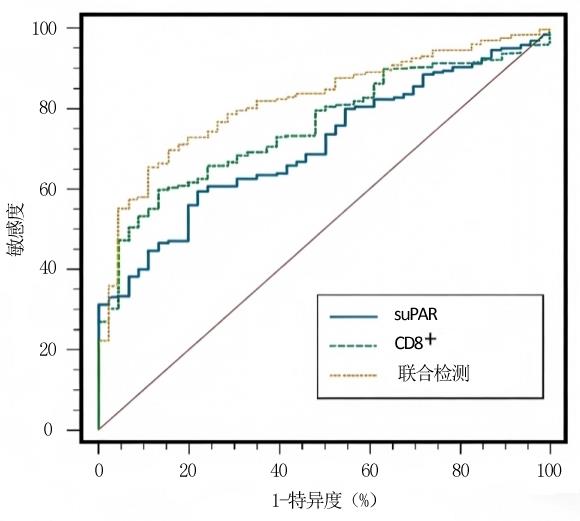
| suPAR | 0.710* | 0.036 | 0.651 ~ 0.765 | < 0.001 | > 4.351 ng/mL | 0.377 | 59.43 | 78.26 |
| CD8+ | 0.757* | 0.033 | 0.700 ~ 0.808 | < 0.001 | > 23.020% | 0.469 | 59.91 | 86.96 |
| 联合检测 | 0.819 | 0.029 | 0.767 ~ 0.864 | < 0.001 | 0.855 | 0.547 | 65.57 | 89.13 |
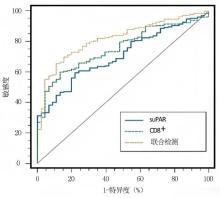
Fig.1
ROC curve of diagnostic value of suPAR and CD8+ in CPA"
Tab.3
Comparison of general information between survival group and death group"
| 项目 | 病死组(n = 34) | 生存组(n = 178) | χ2/t值 | P值 |
|---|---|---|---|---|
| 性别(男/女)/例 | 20/14 | 99/79 | 0.119 | 0.730 |
| 年龄/岁 | 60.98 ± 8.06 | 58.04 ± 7.23 | 2.132 | 0.034 |
| 体质量指数( | 21.73 ± 2.07 | 21.52 ± 1.93 | 0.575 | 0.566 |
| 文化程度 | 0.804 | 0.370 | ||
| 高中及以下 | 25(73.53) | 143(80.34) | ||
| 大专及以上 | 9(26.47) | 35(19.66) | ||
| 居住地 | 0.151 | 0.697 | ||
| 城镇 | 19(55.88) | 93(52.25) | ||
| 农村 | 15(44.12) | 85(47.75) | ||
| 婚姻情况 | 0.060 | 0.807 | ||
| 未婚 | 1(2.94) | 4(2.25) | ||
| 已婚 | 33(97.06) | 174(97.75) | ||
| 高血压 | 18(52.94) | 104(58.43) | 0.352 | 0.553 |
| 糖尿病 | 21(61.76) | 75(42.13) | 4.440 | 0.035 |
| 高血脂 | 10(29.42) | 67(37.64) | 0.836 | 0.361 |
| 慢性阻塞性肺疾病 | 14(41.18) | 62(34.83) | 0.499 | 0.480 |
| 支气管扩张 | 7(20.56) | 41(23.03) | 0.097 | 0.755 |
| 吸烟史 | 17(50.00) | 72(40.45) | 1.069 | 0.301 |
| 饮酒史 | 15(44.12) | 68(38.20) | 0.419 | 0.517 |
| 收缩压( | 124.36 ± 8.66 | 124.29 ± 8.27 | 0.045 | 0.964 |
| 舒张压( | 80.17 ± 7.63 | 80.29 ± 7.83 | 0.082 | 0.934 |
| 心率(次/min) | 75.29 ± 8.27 | 75.76 ± 8.93 | 0.284 | 0.776 |
| 霉菌球类型 | 0.599 | 0.439 | ||
| 单纯性 | 15(44.12) | 66(37.08) | ||
| 复杂性 | 19(55.88) | 112(62.92) | ||
| 住院时间( | 15.76 ± 1.86 | 15.59 ± 1.67 | 0.534 | 0.594 |
| 低蛋白血症 | 19(55.88) | 48(26.97) | 11.043 | < 0.001 |
| 实性结节 | 26(76.47) | 144(80.90) | 0.374 | 0.541 |
| 空洞 | 21(61.76) | 117(65.73) | 0.198 | 0.657 |
| 单纯药物治疗 | 26(76.47) | 156(87.64) | 2.932 | 0.087 |
| 药物联合手术 | 8(23.53) | 22(12.36) | ||
| 血红蛋白( | 121.27 ± 10.27 | 121.36 ± 10.46 | 0.046 | 0.963 |
| 总胆固醇( | 4.17 ± 0.82 | 4.10 ± 0.76 | 0.486 | 0.627 |
| 甘油三酯( | 1.13 ± 0.33 | 1.15 ± 0.38 | 0.287 | 0.775 |
| 血钾( | 4.47 ± 0.56 | 4.58 ± 0.62 | 0.962 | 0.337 |
| 血钠( | 135.27 ± 2.55 | 135.54 ± 2.73 | 0.534 | 0.594 |
| 血钙( | 2.38 ± 0.62 | 2.42 ± 0.67 | 0.323 | 0.747 |
| 血磷( | 1.25 ± 0.18 | 1.28 ± 0.21 | 0.780 | 0.436 |
| 乳酸脱氢酶( | 205.27 ± 10.35 | 205.04 ± 10.16 | 0.121 | 0.904 |
| suPAR( | 6.27 ± 1.95 | 4.88 ± 1.42 | 4.900 | < 0.001 |
| CD8+( | 26.52 ± 4.99 | 22.73 ± 4.05 | 4.808 | < 0.001 |
Tab.4
Analysis of factors influencing poor prognosis in CPA patients"
| 因素 | B | SE | Wald | P值 | HR | 95%CI |
|---|---|---|---|---|---|---|
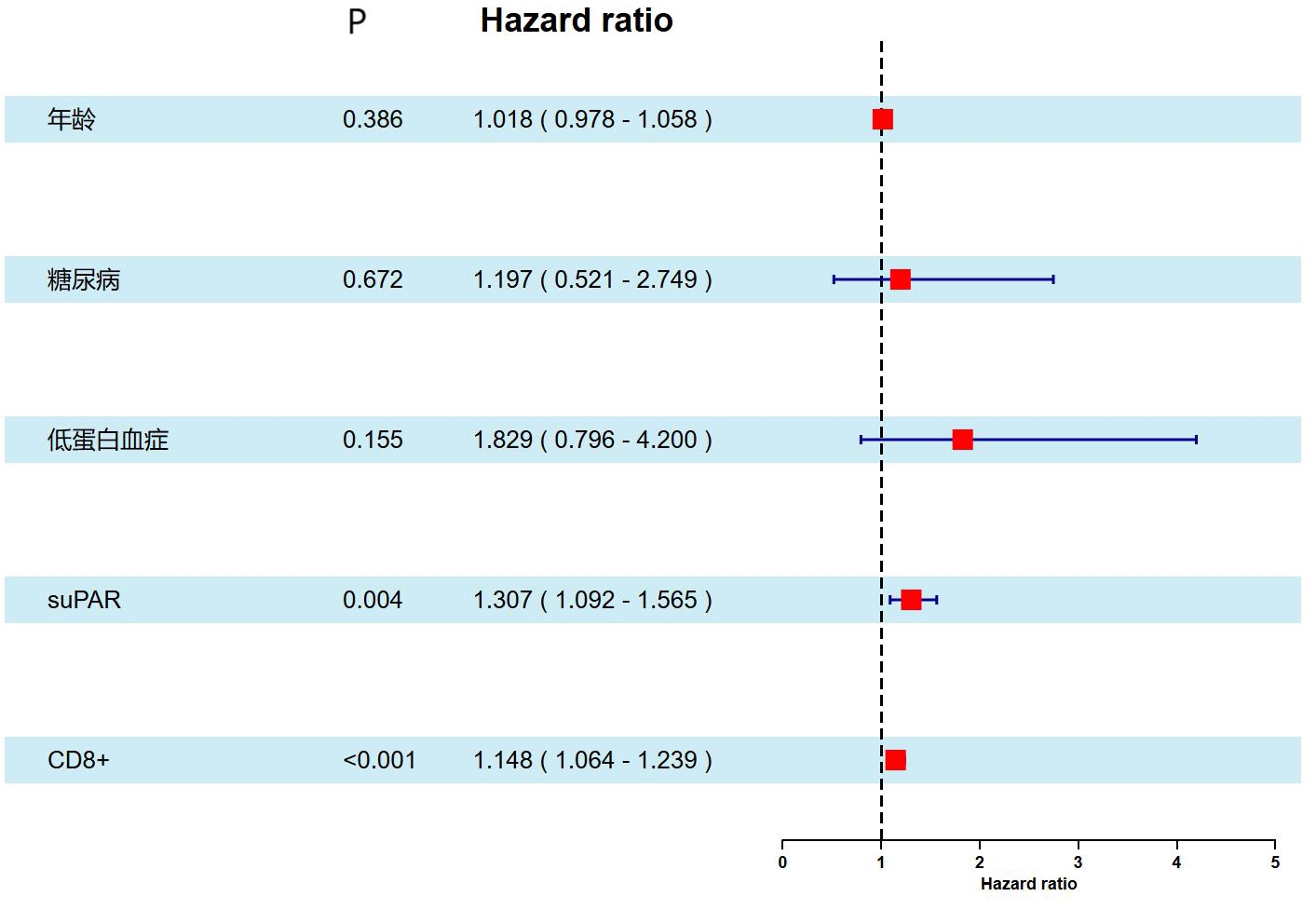
| 年龄 | 0.017 | 0.020 | 0.750 | 0.386 | 1.018 | 0.978 ~ 1.058 |
| 糖尿病 | 0.180 | 0.424 | 0.179 | 0.672 | 1.197 | 0.521 ~ 2.749 |
| 低蛋白血症 | 0.604 | 0.424 | 2.024 | 0.155 | 1.829 | 0.796 ~ 4.200 |
| suPAR | 0.268 | 0.092 | 8.525 | 0.004 | 1.307 | 1.092 ~ 1.565 |
| CD8+ | 0.138 | 0.039 | 12.648 | < 0.001 | 1.148 | 1.064 ~ 1.239 |
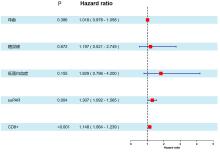
Fig.2
Cox regression forest plot of significant variables"
Tab.5
Value of suPAR, CD8+ in prognostic evaluation of CPA"
| 指标 | AUC | 标准误差 | 95%CI | P值 | 截断值 | 约登指数 | 敏感度/% | 特异度/% |
|---|---|---|---|---|---|---|---|---|
| suPAR | 0.646* | 0.059 | 0.577 ~ 0.710 | < 0.001 | > 8.090 ng/mL | 0.294 | 35.29 | 79.21 |
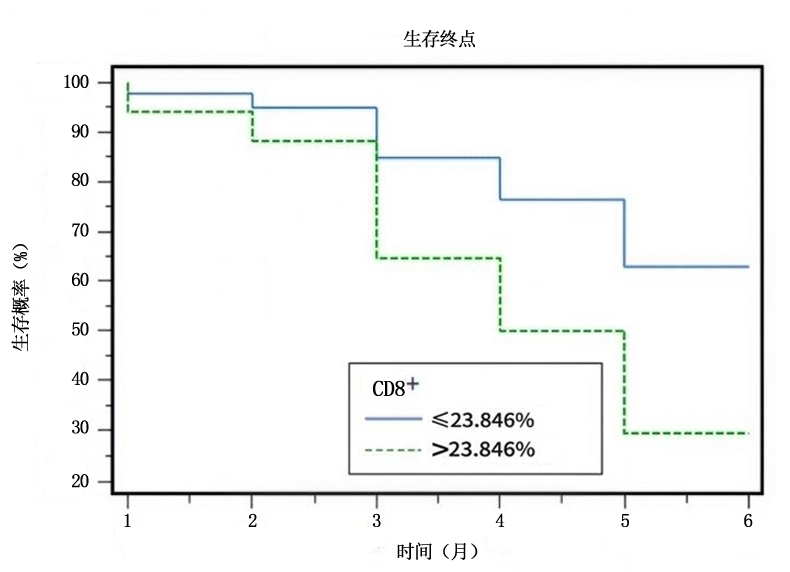
| CD8+ | 0.723* | 0.049 | 0.658 ~ 0.782 | < 0.001 | > 23.846% | 0.335 | 70.59 | 62.92 |
| 联合检测 | 0.846 | 0.039 | 0.790 ~ 0.892 | < 0.001 | 0.279 | 0.545 | 64.71 | 89.89 |
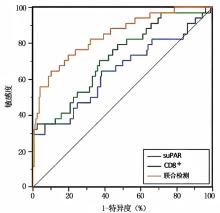
Fig.3
ROC curve of the value of suPAR, and CD8+in the prognostic evaluation of CPA"
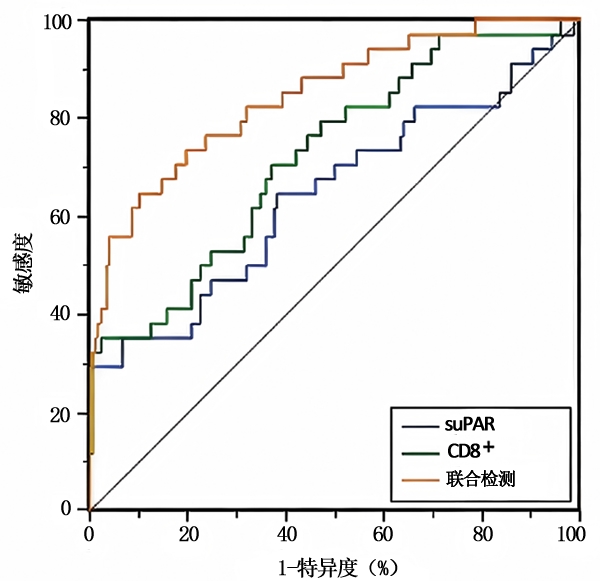
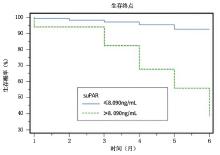
Fig.4
Kaplan Meier survival curve of suPAR"
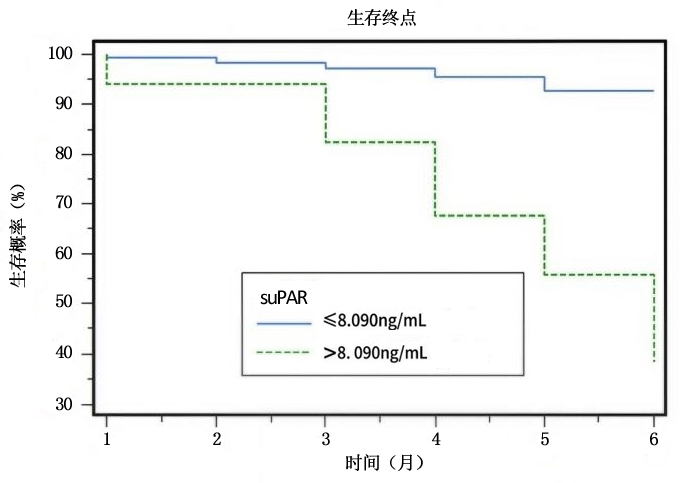
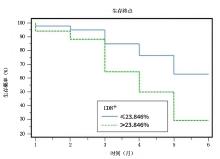
Fig.5
CD8+ Kaplan Meier survival curve"
| [1] |
SEJGAL I S, DHOORIA S, MUTHU V, et al. An overview of the available treatments for chronic cavitary pulmonary aspergillosis[J]. Expert Rev Respir Med, 2020, 14(7): 715-727.doi: 10.1080/17476348.2020.1750956 .
doi: 10.1080/17476348.2020.1750956 |
| [2] |
BALUKU J B, NUWAGIRA E, BONGOMIN F, et al. Pulmonary TB and chronic pulmonary aspergillosis: Clinical differences and similarities[J]. Int J Tuberc Lung Dis, 2021, 25(7): 537-546.doi: 10.5588/ijtld.21.0034 .
doi: 10.5588/ijtld.21.0034 |
| [3] |
BARATELLA E, DI LUCA V, OLIVA A, et al. CT Imaging Features of Pulmonary Sarcoidosis: Typical and Atypical Radiological Features and Their Differential Diagnosis[J]. Medicina, 2025, 61(12): 2094..doi: 10.3390/medicina61122094 .
doi: 10.3390/medicina61122094 |
| [4] |
BARAC A, VUJOVIC A, DRAZIC A, et al. Diagnosis of chronic pulmonary aspergillosis: Clinical, radiological or laboratory?[J]. J Fungi (Basel), 2023, 9(11): 1084..doi: 10.3390/jof9111084 .
doi: 10.3390/jof9111084 |
| [5] |
ISMAIL A, HAYEK S S. Role of soluble urokinase-type plasminogen activator receptor in cardiovascular disease[J]. Curr Cardiol Rep, 2023, 25(12): 1797-1810.doi: 10.1007/s11886-023-01991-7 .
doi: 10.1007/s11886-023-01991-7 |
| [6] |
DOWSETT J, FERKINGSTAD E, RASMUSSEN L J H, et al. Eleven genomic loci affect plasma levels of chronic inflammation marker soluble urokinase-type plasminogen activator receptor[J]. Commun Biol, 2021, 4(1): 655.doi:10.1038/s42003-021-02144-8 .
doi: 10.1038/s42003-021-02144-8 |
| [7] |
KUMAR V. Cytotoxic T cells: Kill, memorize, and mask to maintain immune homeostasis[J]. Int J Mol Sci, 2025, 26(18): 8788.doi:10.3390/ijms26188788 .
doi: 10.3390/ijms26188788 |
| [8] |
PATTERSON T F, THOMPSON G R 3rd, DENNING D W, et al. Practice guidelines for the diagnosis and management of aspergillosis: 2016 update by the Infectious Diseases Society of America[J].Clin Infect Dis, 2016, 63(4): e1-e60.doi:10.1093/cid/ciw326
doi: 10.1093/cid/ciw326 |
| [9] |
MEI Z X, HAN J F, YU H W, et al. Detection of serum Aspergillus-specific IgM and IgG antibody levels for the diagnosis of chronic pulmonary aspergillosis developed in patients with tuberculosis[J].Eur J Clin Microbiol Infect Dis, 2023, 42(9): 1081-1089. doi: 10.1007/s10096-023-04637-2 .
doi: 10.1007/s10096-023-04637-2 |
| [10] |
顾永丽, 程聪, 孙莹, 等. 伏立康唑与伊曲康唑治疗慢性阻塞性肺疾病合并肺曲霉菌感染的循证药物经济学评价[J].中国医院药学杂志, 2020, 40(21): 2255-2259. doi:10.13286/j.1001-5213.2020.21.10 .
doi: 10.13286/j.1001-5213.2020.21.10 |
| [11] |
汤健丽,李征途,叶枫.流感相关肺曲霉病的流行病学和诊治进展[J].华西医学,2020,35(1):1-4.doi:10.7507/1002-0179.202001079 .
doi: 10.7507/1002-0179.202001079 |
| [12] |
朱龙银,王海霞,程伟,等.血浆suPAR及尿NGAL,KIM-1对成人心脏手术相关性急性肾损伤的早期诊断价值[J].解放军医学杂志, 2021, 46(12):1205-1212.doi:10.11855/j.issn.0577-7402.2021.12.06 .
doi: 10.11855/j.issn.0577-7402.2021.12.06 |
| [13] |
ULAJ A, IBSEN A, AZURMENDI L, et al. Improving prognostication of pneumonia among elderly patients: Usefulness of suPAR[J]. BMC Geriatr, 2024, 24(1): 709.doi: 10.1186/s12877-024-05270-0 .
doi: 10.1186/s12877-024-05270-0 |
| [14] |
ZÖPHEL D, ANGENENDT A, KASCHEK L, et al. Faster cytotoxicity with age: Increased perforin and granzyme levels in cytotoxic CD8+ T cells boost cancer cell elimination[J]. Aging Cell, 2022, 21(8): e13668.doi:10.1111/acel.13668 .
doi: 10.1111/acel.13668 |
| [15] |
REISINGER A C, HATZL S, PRATTES J, et al. Soluble urokinase plasminogen activator receptor (suPAR) in bronchoalveolar fluid and blood in critically ill patients—A prospective cohort study[J]. Infection, 2024, 52(1): 249-252.doi:10.1007/s15010-023-02127-3 .
doi: 10.1007/s15010-023-02127-3 |
| [16] |
SHEPHERD F R, MCLAREN J E. T cell immunity to bacterial pathogens: Mechanisms of immune control and bacterial evasion[J]. Int J Mol Sc, 2020, 21(17): 6144..doi:10.3390/ijms21176144 .
doi: 10.3390/ijms21176144 |
| [17] |
MINATO N, HATTORI M, HAMAZAKI Y. Physiology and pathology of T-cell aging[J]. Int Immunol, 2020, 32(4): 223-231.doi:10.1093/intimm/dxaa006 .
doi: 10.1093/intimm/dxaa006 |
| [18] |
彭妙官, 邓雪峰. 静脉注射激素对合并2型糖尿病的重度慢性阻塞性肺疾病急性加重期患者疗效及安全性[J].实用医学杂志, 2022, 38(20): 2590-2596. doi:10.3969/j.issn.1006-5725.2022.20.015 .
doi: 10.3969/j.issn.1006-5725.2022.20.015 |
| [19] |
脱鸣富, 习静, 魏育芳, 等. 我国AECOPD患者继发肺部真菌感染危险因素的Meta分析[J]. 中国医院药学杂志, 2020, 40(4): 412-418. doi:10.13286/j.1001-5213.2020.04.11 .
doi: 10.13286/j.1001-5213.2020.04.11 |
| [20] |
HAMADA M, VARKOLY K S, RIYADH O, et al. Urokinase-type plasminogen activator receptor (uPAR) in inflammation and disease: A unique inflammatory pathway activator[J]. Biomedicines, 2024, 12(6): 1167.doi:10.3390/biomedicines12061167 .
doi: 10.3390/biomedicines12061167 |
| [21] |
VERDON D J, MULAZZANI M, JENKINS M R. Cellular and molecular mechanisms of CD8+ T cell differentiation, dysfunction and exhaustion[J]. Int J Mol Sci, 2020, 21(19): 7357. doi:10.3390/ijms21197357 .
doi: 10.3390/ijms21197357 |
| [22] |
马芳,孙傲,许亚朋,等.非粒细胞缺乏的慢阻肺合并侵袭性肺曲霉菌病诊断及预后分析[J].临床肺科杂志, 2024, 29(5): 649-653. doi:10.3969/j.issn.1009-6663.2024.05.001 .
doi: 10.3969/j.issn.1009-6663.2024.05.001 |
| Viewed | ||||||
|
Full text |
|
|||||
|
Abstract |
|
|||||
