

The Journal of Practical Medicine ›› 2026, Vol. 42 ›› Issue (3): 477-485.doi: 10.3969/j.issn.1006-5725.2026.03.016
• Treatise: Clinical Practice • Previous Articles
Mengyuan WANG,Fanliang MENG( )
)
Received:2025-10-14
Online:2026-02-10
Published:2026-02-09
Contact:
Fanliang MENG
E-mail:13966337677@163.com
CLC Number:
Mengyuan WANG,Fanliang MENG. Analysis of risk factors for carbapenem-resistant Klebsiella pneumoniae infection and construction of a nomogram prediction model[J]. The Journal of Practical Medicine, 2026, 42(3): 477-485.

Tab.1
Comparison of clinical characteristics between the training set and validation set for the CRKP infection riskprediction model"
| 临床资料 | 训练集(n = 295) | 验证集(n = 127) | t/Z/χ2值 | P值 |
|---|---|---|---|---|
| 年龄(x ± s)/岁 | 71.00 ± 13.43 | 69.88 ± 11.36 | 0.818 | 0.414 |
| 性别 | 0.284 | 0.594 | ||
| 男 | 221(74.92) | 92(72.44) | ||
| 女 | 74(25.08) | 35(27.56) | ||
| 住院时间[M(P25,P75)]/d | 13.00(10.00,19.00) | 13.00(9.00,18.00) | -0.485 | 0.628 |
| 入住ICU | 102(34.58) | 41(32.28) | 0.208 | 0.648 |
| 合并基础疾病 | ||||
| 高血压 | 121(41.02) | 55(43.31) | 0.192 | 0.662 |
| 糖尿病 | 94(31.86) | 36(28.35) | 0.515 | 0.473 |
| 心血管疾病 | 86(29.15) | 41(32.28) | 0.414 | 0.520 |
| 脑血管疾病 | 100(33.90) | 48(37.80) | 0.592 | 0.442 |
| 慢性肺病 | 61(20.68) | 25(19.69) | 0.054 | 0.816 |
| 恶性实体肿瘤 | 57(19.32) | 29(22.83) | 0.675 | 0.411 |
| 手术史 | 162(54.92) | 73(57.48) | 0.237 | 0.627 |
| 抗菌药物使用情况 | ||||
| 加酶抑制剂 | 178(60.34) | 81(63.78) | 0.443 | 0.506 |
| 头孢菌素类 | 140(47.46) | 58(45.67) | 0.114 | 0.736 |
| 碳青霉烯类 | 70(23.73) | 32(25.20) | 0.104 | 0.747 |
| 喹诺酮类 | 98(33.22) | 46(36.22) | 0.355 | 0.551 |
| 氨基糖苷类 | 15(5.08) | 5(3.94) | 0.259 | 0.611 |
| 四环素类 | 25(8.47) | 7(5.51) | 1.112 | 0.292 |
| 万古霉素 | 16(5.42) | 7(5.51) | 0.001 | 0.971 |
| 联合使用抗生素 | 119(40.34) | 53(41.73) | 0.071 | 0.789 |
| 侵入性操作 | ||||
| 吸痰 | 110(37.29) | 49(38.58) | 0.063 | 0.801 |
| 气管切开或插管 | 69(23.39) | 27(21.26) | 0.229 | 0.632 |
| 机械通气 | 79(26.78) | 30(23.62) | 0.462 | 0.497 |
| 留置导尿管 | 151(51.19) | 62(48.82) | 0.199 | 0.655 |
| 留置胃管 | 108(36.61) | 48(37.80) | 0.054 | 0.817 |
| 深静脉置管 | 61(20.68) | 23(18.11) | 0.367 | 0.545 |
| 血液透析 | 9(3.05) | 6(4.72) | 0.725 | 0.394 |
| WBC[M(P25,P75)]/(× 109/L) | 9.44(6.71,13.67) | 8.83(6.24,12.03) | -1.432 | 0.152 |
| N% [M(P25,P75)]/% | 81.90(74.20,88.10) | 81.40(71.50,87.50) | -0.842 | 0.400 |
| NEU[M(P25,P75)]/(× 109/L) | 7.70(4.82,12.11) | 7.01(4.42,10.39) | -1.351 | 0.177 |
| LYM[M(P25,P75)]/(× 109/L) | 0.98(0.65,1.39) | 0.98(0.63,1.35) | -0.524 | 0.600 |
| RBC(x ± s)/(× 1012/L) | 3.56 ± 0.86 | 3.66 ± 0.84 | -1.130 | 0.259 |
| ALB[M(P25,P75)]/(g/L) | 35.20(31.00,37.60) | 34.60(31.60,37.40) | -0.264 | 0.792 |
| NLR[M(P25,P75)] | 7.75(4.46,14.19) | 7.70(3.92,13.86) | -0.123 | 0.902 |
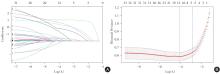
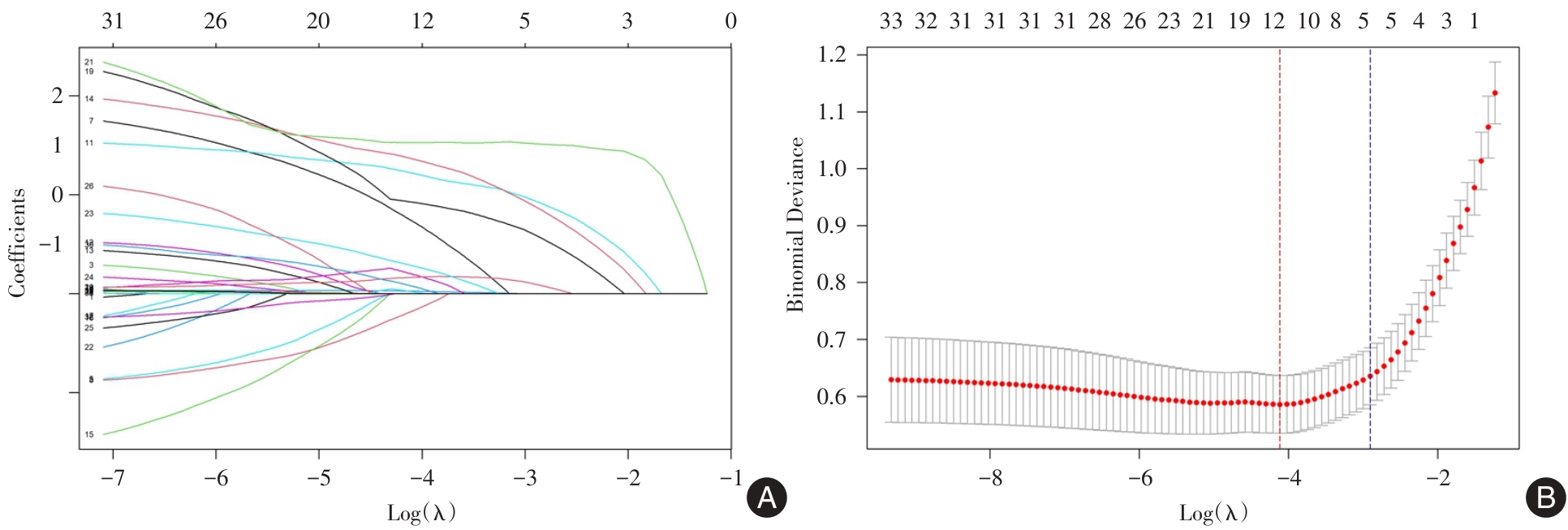
Fig.1
LASSO regression of training set"
Tab.2
Multivariate logistic regression analysis results of CRKP infection risk in the training set"
| 自变量 | β | S.E | Wald | P值 | OR | 95%CI |
|---|---|---|---|---|---|---|
| 入住ICU | 1.586 | 0.497 | 3.188 | 0.001 | 4.883 | 1.842 ~ 12.946 |
| 碳青霉烯类药物 | 1.575 | 0.465 | 3.392 | < 0.001 | 4.832 | 1.944 ~ 12.009 |
| 联合使用抗生素 | 0.806 | 0.444 | 1.817 | 0.069 | 2.239 | 0.938 ~ 5.341 |
| 吸痰 | 0.837 | 0.562 | 1.488 | 0.137 | 2.309 | 0.767 ~ 6.954 |
| 气管切开或插管 | 1.565 | 0.509 | 3.074 | 0.002 | 4.784 | 1.763 ~ 12.981 |
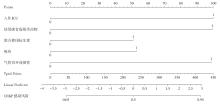
Fig.2
Nomogram prediction model for CRKP infection risk"
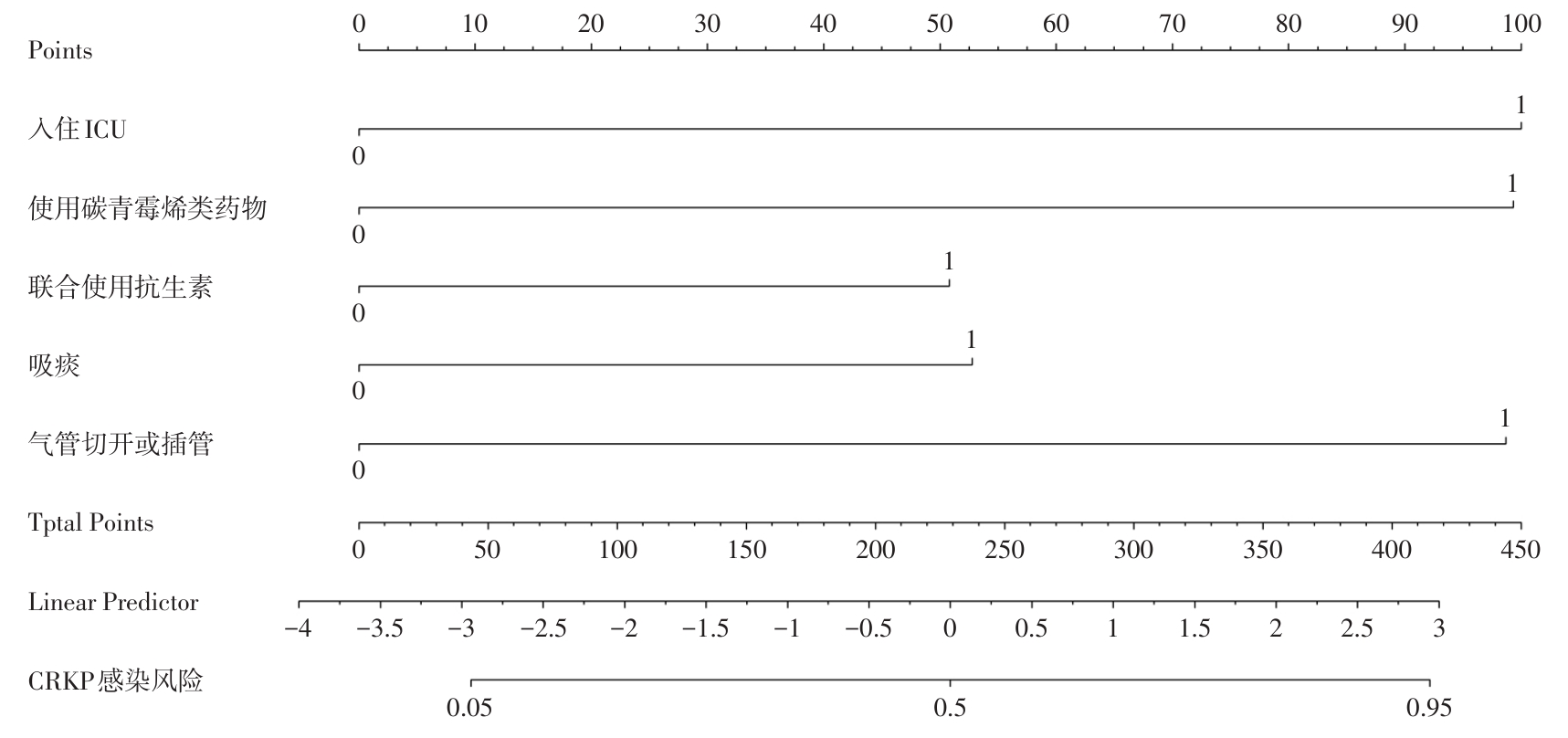
Fig.3
ROC curve of CRKP infection risk prediction model"
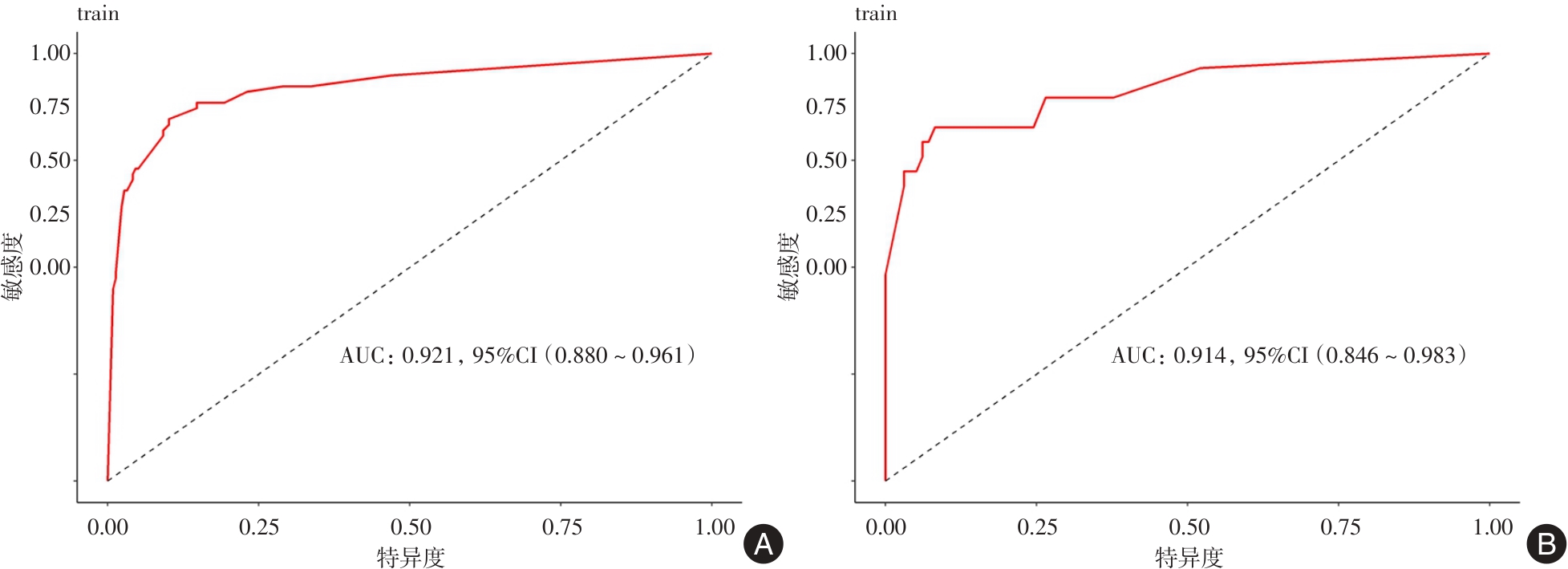
Fig.4
Calibration curve of the CRKP infection risk prediction model"
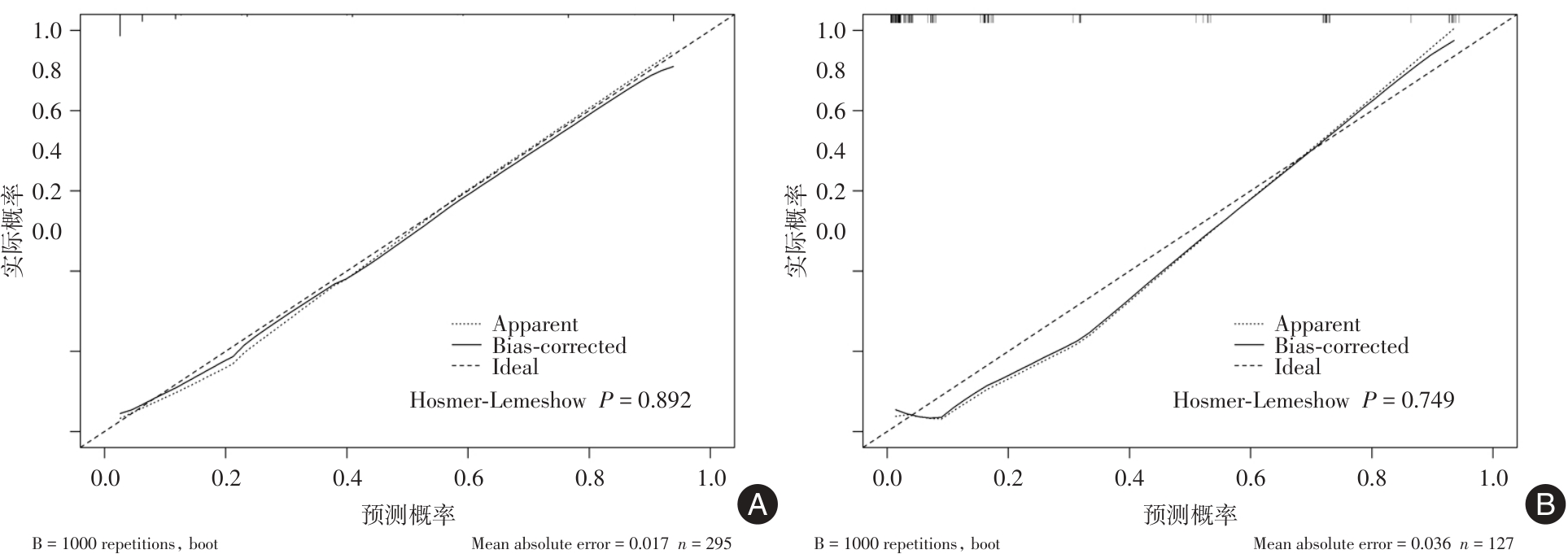
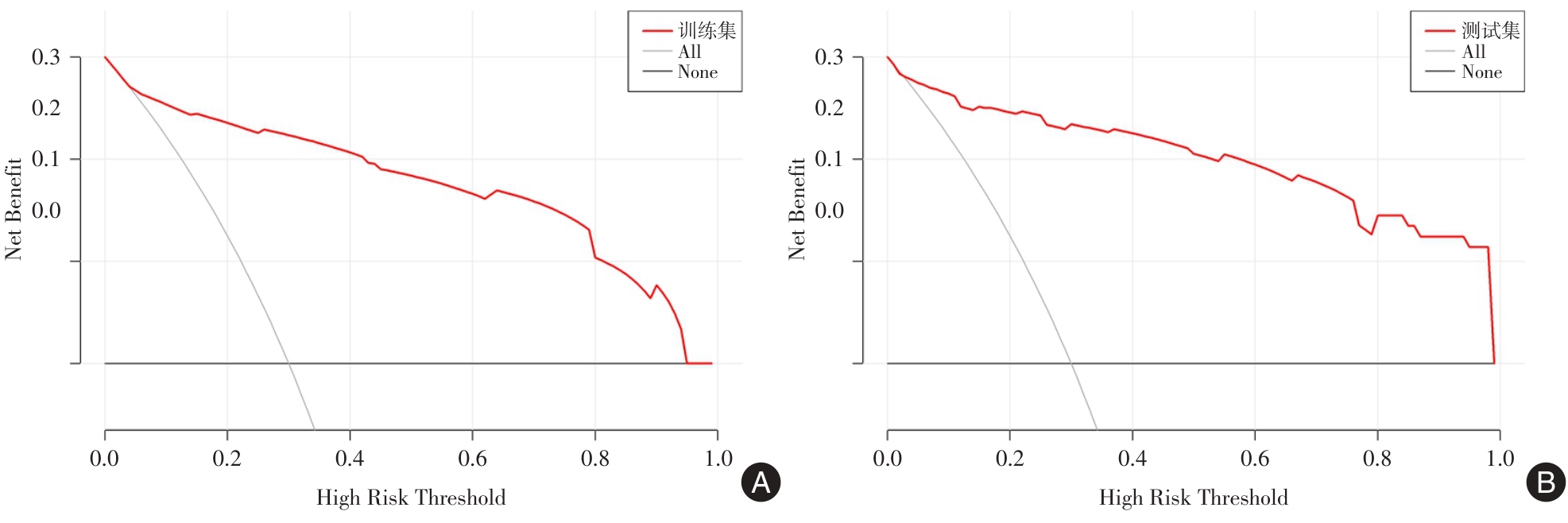
Fig.5
Decision curve of the CRKP infection risk prediction model"
| [1] |
MA J, SONG X, LI M, et al. Global spread of carbapenem-resistant Enterobacteriaceae: Epidemiological features, resistance mechanisms, detection and therapy[J]. Microbiol Res, 2023, 266: 127249. doi: 10.1016/j.micres.2022.127249 .
doi: 10.1016/j.micres.2022.127249 |
| [2] | CHINET 数据云. CHINET中国细菌耐药监测网 [EB/OL]. [2025-06-08]. . |
| [3] |
YAO H, YANG Y, YAO H, et al. Development of prediction models for carbapenem-resistant Klebsiella pneumoniae acquisition and prognosis in adult patients[J]. Front Pharmacol, 2024, 15: 1439116. doi: 10.3389/fphar.2024.1439116 .
doi: 10.3389/fphar.2024.1439116 |
| [4] |
ARATO V, RASO M M, GASPERINI G, et al. Prophylaxis and Treatment against Klebsiella pneumoniae: Current Insights on This Emerging Anti-Microbial Resistant Global Threat[J]. Int J Mol Sci, 2021, 22(8): 4042. doi: 10.3390/ijms22084042 .
doi: 10.3390/ijms22084042 |
| [5] |
SNELL K I E, LEVIS B, DAMEN J A A, et al. Transparent reporting of multivariable prediction models for individual prognosis or diagnosis: checklist for systematic reviews and meta-analyses (TRIPOD-SRMA)[J]. BMJ, 2023, 381:e073538. doi: 10.1136/bmj-2022-073538 .
doi: 10.1136/bmj-2022-073538 |
| [6] | Clinical and Laboratory Standards Institute. Performance standards for antimicrobial susceptibility testing:M100-S34 [S/OL]. [2025-05-10]. . |
| [7] |
LOU T, DU X, ZHANG P, et al. Risk factors for infection and mortality caused by carbapenem-resistant Klebsiella pneumoniae: A large multicentre case–control and cohort study[J]. J Infect, 2022, 84(5): 637-647. doi: 10.1016/j.jinf.2022.03.010 .
doi: 10.1016/j.jinf.2022.03.010 |
| [8] |
SADER H S, MENDES R E, STREIT J M, et al. Antimicrobial susceptibility of Gram-negative bacteria from intensive care unit and non-intensive care unit patients from United States hospitals (2018-2020)[J]. Diagn Microbiol Infect Dis, 2022, 102(1): 115557. doi: 10.1016/j.diagmicrobio.2021.115557 .
doi: 10.1016/j.diagmicrobio.2021.115557 |
| [9] |
王颖,邬巧玲,应娇茜.内科重症监护病房耐碳青霉烯肠杆菌定植情况及耐药性[J]. 实用医学杂志, 2022, 38(8):970-973. doi: 10.3969/j.issn.1006-5725.2022.08.011 .
doi: 10.3969/j.issn.1006-5725.2022.08.011 |
| [10] |
WANG Z, QIN R R, HUANG L, et al. Risk factors for carbapenem-resistant Klebsiella pneumoniae infection and mortality of Klebsiella pneumoniae infection[J]. Chin Med J (Engl), 2018, 131(1): 56-62. doi: 10.4103/0366-6999.221267 .
doi: 10.4103/0366-6999.221267 |
| [11] |
ALEIDAN F A S, ALKHELAIFI H, ALSENAID A, et al. Incidence and risk factors of carbapenem-resistant Enterobacteriaceae infection in intensive care units: A matched case-control study[J]. Expert Rev Anti Infect Ther, 2021, 19(3): 393-398. doi: 10.1080/14787210.2020.1822736 .
doi: 10.1080/14787210.2020.1822736 |
| [12] |
ZHU W, YUAN Z, ZHOU H. Risk factors for carbapenem-resistant Klebsiella pneumoniae infection relative to two types of control patients: A systematic review and meta-analysis[J]. Antimicrob Resist Infect Control, 2020, 9(1): 23. doi: 10.1186/s13756-020-0686-0 .
doi: 10.1186/s13756-020-0686-0 |
| [13] |
CHU W, HANG X, LI X, et al. Bloodstream infections in patients with rectal colonization by carbapenem-resistant Enterobacteriaceae: A prospective cohort study[J]. Infect Drug Resist, 2022, 15: 6051-6063. doi: 10.2147/IDR.S383688 .
doi: 10.2147/IDR.S383688 |
| [14] |
COLANERI M, GIORDANI P, MILANESI S, et al. From Colonisation to Infection: Assessing the BSI Potential in Patients with KPC, NDM, VRE and CRAB Rectal Colonisation[J]. Infect Dis Ther, 2025, 14(10): 2359-2372. doi: 10.1007/s40121-025-01222-2 .
doi: 10.1007/s40121-025-01222-2 |
| [15] |
GAO S, YAN R, ZHANG S, et al. Rectal culture could predict carbapenem-resistant organism bloodstream infection and reduce the mortality in haematological patients: A retrospective cohort study[J]. J Glob Antimicrob Resist, 2024, 36: 96-104. doi: 10.1016/j.jgar.2023.12.007 .
doi: 10.1016/j.jgar.2023.12.007 |
| [16] |
QIN X, WU S, HAO M, et al. The Colonization of Carbapenem-Resistant Klebsiella pneumoniae: Epidemiology, Resistance Mechanisms, and Risk Factors in Patients Admitted to Intensive Care Units in China[J]. J Infect Dis, 2020, 221(): S206-S214. doi: 10.1093/infdis/jiz622 .
doi: 10.1093/infdis/jiz622 |
| [17] |
LIU P, LI X, LUO M, et al. Risk factors for carbapenem-resistant Klebsiella pneumoniae infection: A meta-analysis[J]. Microb Drug Resist, 2018, 24(2): 190-198. doi: 10.1089/mdr. 2017.0061 .
doi: 10.1089/mdr. 2017.0061 |
| [18] |
LIANG X, CHEN P, DENG B, et al. Outcomes and risk factors of bloodstream infections caused by carbapenem-resistant and non-carbapenem-resistant Klebsiella pneumoniae in China[J]. Infect Drug Resist, 2022, 15: 3161-3171. doi: 10.2147/IDR.S367588 .
doi: 10.2147/IDR.S367588 |
| [19] |
XIAO T, ZHU Y, ZHANG S, et al. A retrospective analysis of risk factors and outcomes of carbapenem-resistant Klebsiella pneumoniae bacteremia in nontransplant patients[J]. J Infect Dis, 2020, 221(): S174-S183. doi: 10.1093/infdis/jiz559 .
doi: 10.1093/infdis/jiz559 |
| [20] |
YUAN Y, WANG J, YAO Z, et al. Risk factors for carbapenem-resistant Klebsiella pneumoniae bloodstream infections and outcomes[J]. Infect Drug Resist, 2020, 13: 207-215. doi: 10.2147/IDR.S223243 .
doi: 10.2147/IDR.S223243 |
| [21] |
LOU T, DU X, ZHANG P, et al. Risk factors for infection and mortality caused by carbapenem-resistant Klebsiella pneumoniae: A large multicentre case–control and cohort study[J]. J Infect, 2022, 84(5): 637-647. doi: 10.1016/j.jinf. 2022. 03.010 .
doi: 10.1016/j.jinf. 2022. 03.010 |
| [22] |
程玉谦,王悦.碳青霉烯耐药高毒力肺炎克雷伯菌的研究进展[J]. 实用医学杂志, 2022, 38(22):2874-2879. doi: 10.3969/j.issn.1006-5725.2022.22.020 .
doi: 10.3969/j.issn.1006-5725.2022.22.020 |
| [23] |
LEI T, LIAO B, YANG L R, et al. Hypervirulent and carbapenem-resistant Klebsiella pneumoniae: A global public health threat[J]. Microbiol Res, 2024, 288: 127839. doi: 10.1016/j.micres.2024.127839 .
doi: 10.1016/j.micres.2024.127839 |
| [24] |
WANG Q, WANG R, Wang S, et al. Expansion and transmission dynamics of high risk carbapenem-resistant Klebsiella pneumoniae subclones in China: An epidemiological, spatial, genomic analysis[J]. Drug Resist Updat, 2024, 74: 101083. doi: 10.1016/j.drup.2024.101083 .
doi: 10.1016/j.drup.2024.101083 |
| [25] |
LIU E, JIA P, LI X, et al. In vitro and in vivo effect of antimicrobial agent combinations against carbapenem-resistant Klebsiella pneumoniae with different resistance mechanisms in China[J]. Infect Drug Resist, 2021, 14: 917-928. doi: 10.2147/IDR.S292431 .
doi: 10.2147/IDR.S292431 |
| [26] |
KARAMPATAKIS T, TSERGOULI K, BEHZADI P. Carbapenem-resistant Klebsiella pneumoniae: Virulence factors, molecular epidemiology and latest updates in treatment options[J]. Antibiotics (Basel), 2023, 12(2): 234. doi: 10.3390/antibiotics12020234 .
doi: 10.3390/antibiotics12020234 |
| [27] |
PU D, ZHAO J, CHANG K, et al. “Superbugs” with hypervirulence and carbapenem resistance in Klebsiella pneumoniae: The rise of such emerging nosocomial pathogens in China[J]. Sci Bull (Beijing), 2023, 68(21): 2658-2670. doi: 10.1016/j.scib. 2023.09.040 .
doi: 10.1016/j.scib. 2023.09.040 |
| [28] |
LIAO Q, FENG Z, LIN H, et al. Carbapenem-resistant gram-negative bacterial infection in intensive care unit patients: Antibiotic resistance analysis and predictive model development[J]. Front Cell Infect Microbiol, 2023, 13: 1109418. doi: 10.3389/fcimb.2023.1109418 .
doi: 10.3389/fcimb.2023.1109418 |
| [1] | Yunting ZHUANG,Yao SONG,Qian CHEN,Yanxuan XIAO,Tian TAN,Wenhui LI,Ruiyan BAI,Zeshan LIN,Zhijian. WANG. Risk factor analysis and predictive indicators of postpartum haemorrhage in singleton pregnant women with severe preeclampsia [J]. The Journal of Practical Medicine, 2025, 41(8): 1155-1160. |
| [2] | Kui DONG,jie WU,Jing YAN,Haitao LIU,Jun WANG,Guan′en. QIAO. Study on risk factors of colorectal adenomatous polyps and construction and validation of prediction model [J]. The Journal of Practical Medicine, 2025, 41(6): 838-845. |
| [3] | Runfang WANG,Ya DUAN,Liyan DU,Xiaodan LIU,Wenning LIAN,Yan HUO,Dandan. YANG. Epidemiological status and risk factors associated with placental abruption among pregnant women in Hebei Province [J]. The Journal of Practical Medicine, 2025, 41(6): 904-910. |
| [4] | Dongli LIU,Zilin QUAN,Lingxiu ZHONG,Qiqi CHEN,Wenqiao CAI,Senpei ZHUANG,Ying WEI,Huiyi PAN,Yawen. LIN. Construction and validation of a predictive model for antibiotic-associated diarrhea after surgery in children with congenital heart disease [J]. The Journal of Practical Medicine, 2025, 41(5): 683-690. |
| [5] | Qiaoying MO,Fangyi ZHU,Cunkui ZHU,Shenglong. MA. Nomogram model of malnutrition risk in patients suffering from chronic heart failure grounded on GNRI score [J]. The Journal of Practical Medicine, 2025, 41(5): 691-698. |
| [6] | Changhui WU,Zhiping HUANG,Huiping DAI,Huifang QIU,Chun HE,Fang. TANG. Energy efficiency of contrast⁃enhanced ultrasound combined with TERT promoter mutation to construct a nomogram model for the prediction of concomitant cervical lymph node metastasis in PTMC [J]. The Journal of Practical Medicine, 2025, 41(5): 756-765. |
| [7] | Wei LIU,Jun HOU,Longquan TANG,Peng ZHOU,Yan ZHONG,Qinyan LUO,Xiaoyu KUANG,Hua LIU,Ziqing XIONG,Wei XIONG,Chenggao WU,Aiping. LE. Analysis of influencing factors of blood transfusion in children with traumatic brain injury and construction of prediction model: A multi⁃center retrospective study [J]. The Journal of Practical Medicine, 2025, 41(4): 553-560. |
| [8] | Dawei WANG,Zheng ZHENG,Yuxiang SHENG,Zhiran LI,Shaohua HUANGFU,Bin. JIANG. Risk factors for multidrug⁃resistant bacterial infections in perianal abscesses and the construction of a nomogram prediction model [J]. The Journal of Practical Medicine, 2025, 41(24): 3897-3903. |
| [9] | Yi WEI,Chunhui RAO,Huize LIU,Wen. CHEN. Predictive value of multimodal nomogram on the risk of metastasis and recurrence in patients with stage Ⅱ colorectal cancer without adjuvant treatment [J]. The Journal of Practical Medicine, 2025, 41(23): 3723-3729. |
| [10] | Xinran ZHANG,Yan SHEN,Jiaojiao HU,Qingqing CHEN,Yangjie XIAO,Feng LU,Shasha YUAN,Xiaohong FU. Study on the applied value of combined clinical and ultrasound multiparameter constructed nomogram for predicting HER⁃2⁃positive breast cancer [J]. The Journal of Practical Medicine, 2025, 41(18): 2812-2819. |
| [11] | Yangchun DU,Hongyu ZHENG,Haining CHEN,Wenwen GUO,Jinxiu YAO,Tongliu LAN,Yanju XIAO. Ultrasound⁃based deep learning radiomics nomogram to differentiate type Ⅰ and type Ⅱ epithelial ovarian cancer [J]. The Journal of Practical Medicine, 2025, 41(18): 2920-2927. |
| [12] | Lingchun CAO,Fanliang MENG,Xiaoan SHENG. Risk factors and model construction of immune therapy⁃related thyroid dysfunction in non⁃small cell lung cancer [J]. The Journal of Practical Medicine, 2025, 41(17): 2705-2714. |
| [13] | Zhaoyang WANG,Nan. ZHANG. Constructing a Nomogram prediction model for early recurrence of hepatocellular carcinoma radical hepatectomy based on CT imaging omics and traditional Chinese medicine tongue image features [J]. The Journal of Practical Medicine, 2025, 41(16): 2590-2596. |
| [14] | Hong ZHANG,Rong ZHANG,Pengcheng YANG,Liyan LUO,Wenlong ZHANG,Yurong CHENG,Wenlin LIU,Wenbin. DONG. Construction of risk prediction model for preterm infant respiratory distress syndrome in Dali Prefecture [J]. The Journal of Practical Medicine, 2025, 41(15): 2342-2348. |
| [15] | Junzhi LIU,Lei QIU,Kun XU,Jianwei LIU,Dehua HU,Hua ZHU,Cheng SHEN,Ming LU,Jiangang. CHEN. Establishment of a nomogram model for predicting pelvic lymph node metastasis in prostate cancer based on systemic immune-infiltration inflammation index [J]. The Journal of Practical Medicine, 2025, 41(15): 2349-2354. |
| Viewed | ||||||
|
Full text |
|
|||||
|
Abstract |
|
|||||
