

The Journal of Practical Medicine ›› 2026, Vol. 42 ›› Issue (2): 255-265.doi: 10.3969/j.issn.1006-5725.2026.02.011
• Chronic Disease Control • Previous Articles
Wei TAO1,Shifeng LIANG2,Zhinong SHI1,Zhen LI2,Lunshan WANG1( )
)
Received:2025-08-21
Revised:2025-11-03
Accepted:2025-11-06
Online:2026-01-25
Published:2026-01-22
Contact:
Lunshan WANG
E-mail:wanglunshan@163.com
CLC Number:
Wei TAO,Shifeng LIANG,Zhinong SHI,Zhen LI,Lunshan WANG. Effects of acupuncture on immune homeostasis and functional recovery in ischemic stroke rehabilitation patients[J]. The Journal of Practical Medicine, 2026, 42(2): 255-265.
Tab.1
Baseline clinical characteristics of enrolled patients"
| 变量 | 健康对照组(n = 50) | 康复对照组(n = 50) | 针灸试验组(n = 50) | χ2/F值 | P值 |
|---|---|---|---|---|---|
| 性别 | 0.16 | 0.922 | |||
| 男 | 27(54.00) | 28(56.00) | 29(58.00) | ||
| 女 | 23(46.00) | 22(44.00) | 21(42.00) | ||
| 年龄[M(P25,P75)]/岁 | 68.50(62.00,77.75) | 69.00(59.50,78.75) | 71.50(65.25,79.00) | 0.53 | 0.766 |
| 高血压 | 3.26 | 0.196 | |||
| 否 | 20(40.00) | 29(58.00) | 24(48.00) | ||
| 是 | 30(60.00) | 21(42.00) | 26(52.00) | ||
| 糖尿病 | 0.68 | 0.712 | |||
| 否 | 33(66.00) | 31(62.00) | 29(58.00) | ||
| 是 | 17(34.00) | 19(38.00) | 21(42.00) | ||
| 吸烟 | 1.36 | 0.506 | |||
| 否 | 35(70.00) | 38(76.00) | 40(80.00) | ||
| 是 | 15(30.00) | 12(24.00) | 10(20.00) | ||
| 饮酒 | 1.88 | 0.391 | |||
| 否 | 30(60.00) | 36(72.00) | 35(70.00) | ||
| 是 | 20(40.00) | 14(28.00) | 15(30.00) |
Tab.2
Comparison of baseline immune and inflammatory-related indicators in enrolled patients"
| 变量 | 健康对照组(n = 50) | 康复对照组(n = 50) | 针灸试验组(n = 50) | χ2/F值 | P值 |
|---|---|---|---|---|---|
| 总T/% | 74.50(68.25,80.00) | 50.00(37.00,66.75) | 52.00(46.00,56.00) | 73.98 | < 0.001 |
| CD4+/% | 43.00(39.25,45.00) | 24.50(17.25,37.75) | 28.00(25.25,31.00) | 54.99 | < 0.001 |
| CD8+/% | 30.50(22.00,37.75) | 22.50(17.00,27.75) | 20.50(17.25,24.00) | 20.66 | < 0.001 |
| CD4+/CD8+ | 1.42(1.13,2.19) | 1.17(0.79,1.75) | 1.35(1.13,1.73) | 6.37 | 0.041 |
| NK/% | 14.00(10.00,18.00) | 25.00(16.50,30.75) | 26.00(22.00,29.00) | 45.12 | < 0.001 |
| B/% | 8.50(5.00,12.00) | 21.00(18.00,23.75) | 21.00(18.00,23.75) | 88.98 | < 0.001 |
| WBC/(×10?·L -1) | 9.55(8.39,10.93) | 19.43(17.34,21.62) | 18.17(14.18,20.87) | 89.82 | < 0.001 |
| CRP/(mg/L) | 50.01(47.63,52.92) | 129.40(91.00,141.30) | 114.15(100.57,138.65) | 89.78 | < 0.001 |
| TNF-α/(pg/L) | 3.77(3.51,4.05) | 6.34(4.49,8.10) | 6.27(4.73,8.10) | 45.92 | < 0.001 |
| IL-6/(pg/L) | 36.56(34.12,38.32) | 69.60(62.73,85.60) | 67.94(55.08,79.86) | 96.11 | < 0.001 |
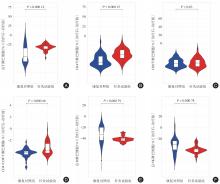
Fig.1
Comparison of changes in peripheral blood lymphocyte subset levels before and after treatmentbetween acupuncture experimental group and rehabilitation control group"
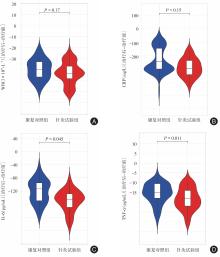
Fig.2
Comparison of inflammatory marker levels before and after treatmentbetween acupuncture experimental group and rehabilitation control group"
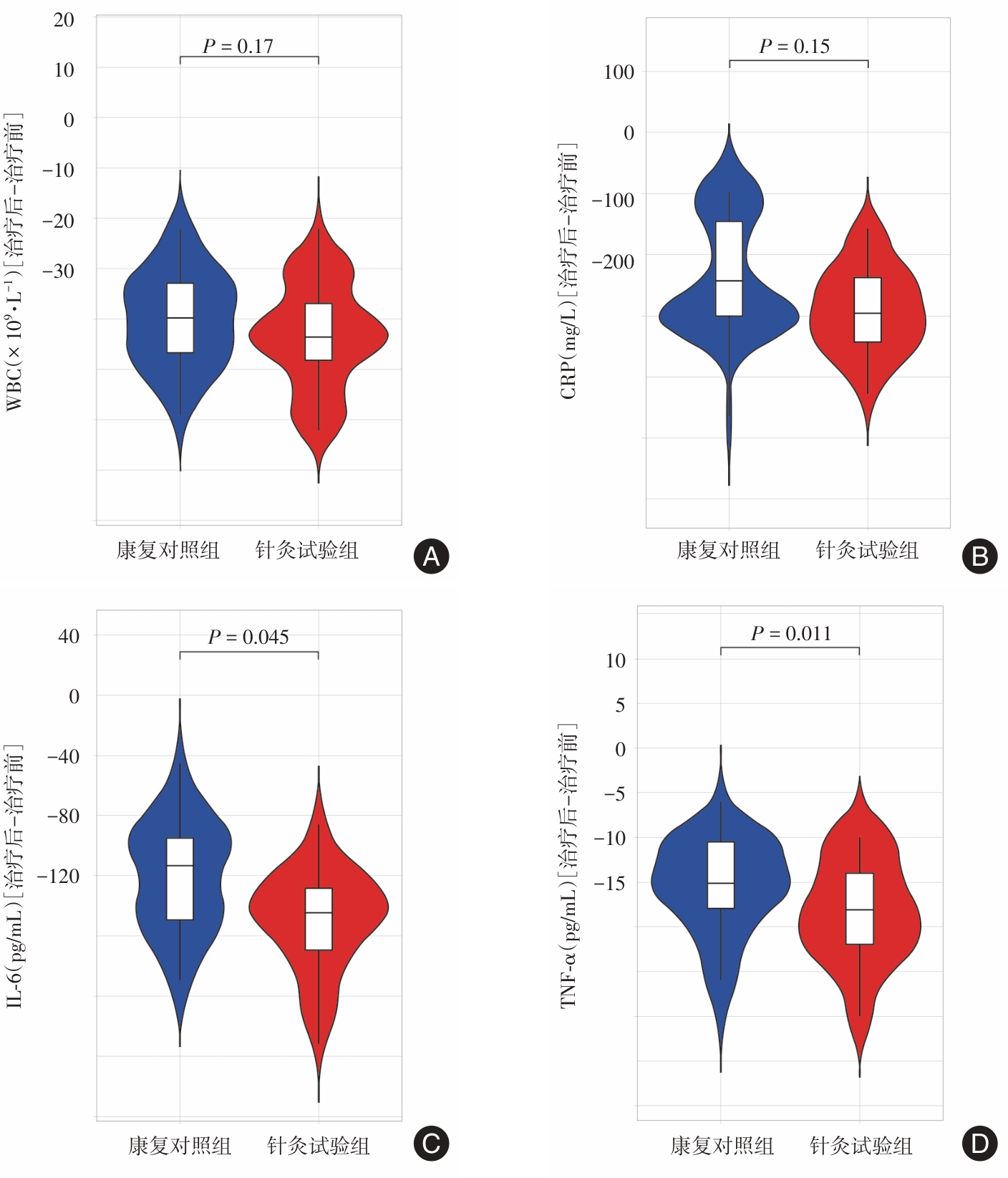
Fig.3
Comparison of daily life ability scale scores before and after treatment in acupuncture experimental group and rehabilitation control group"
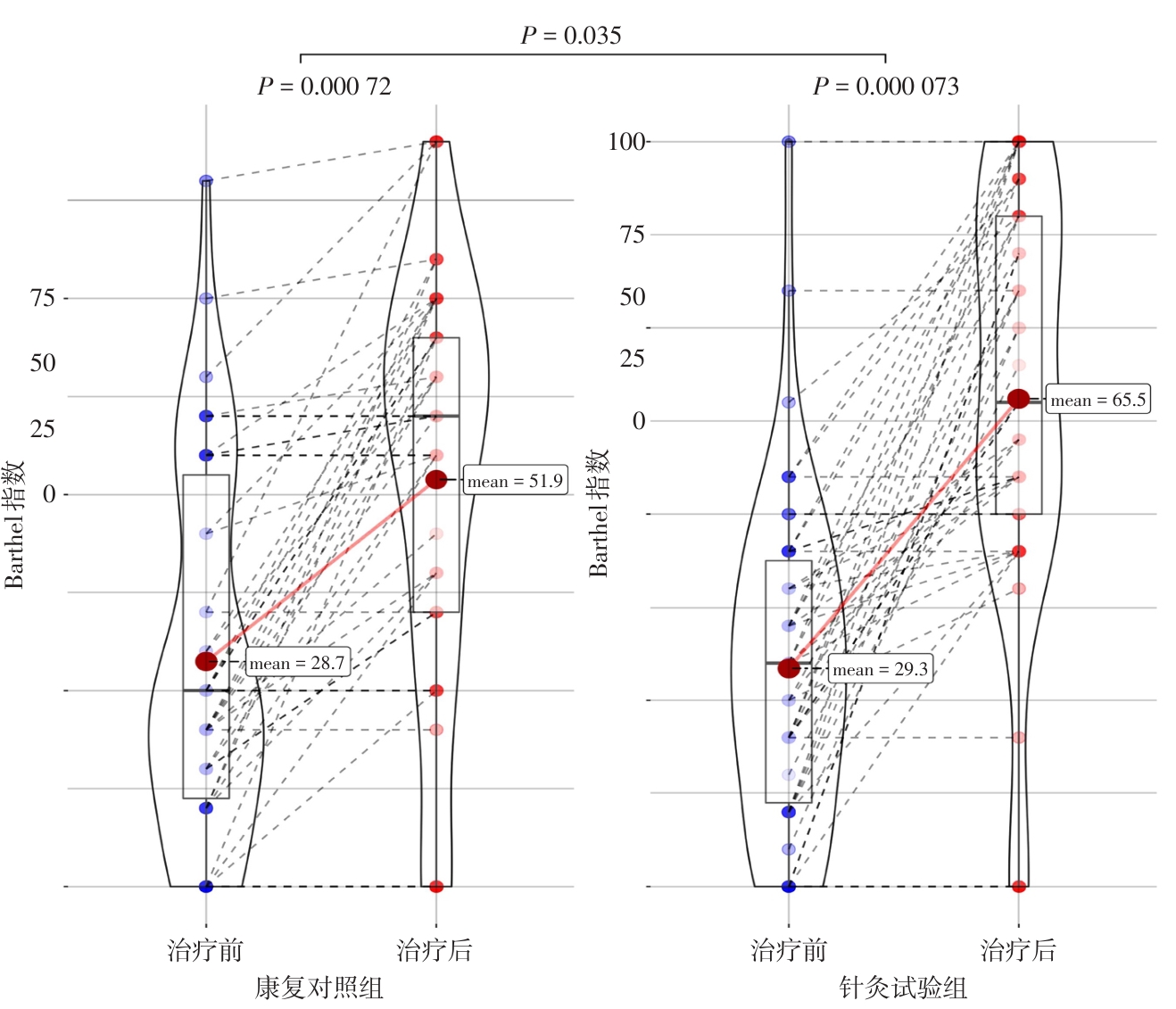
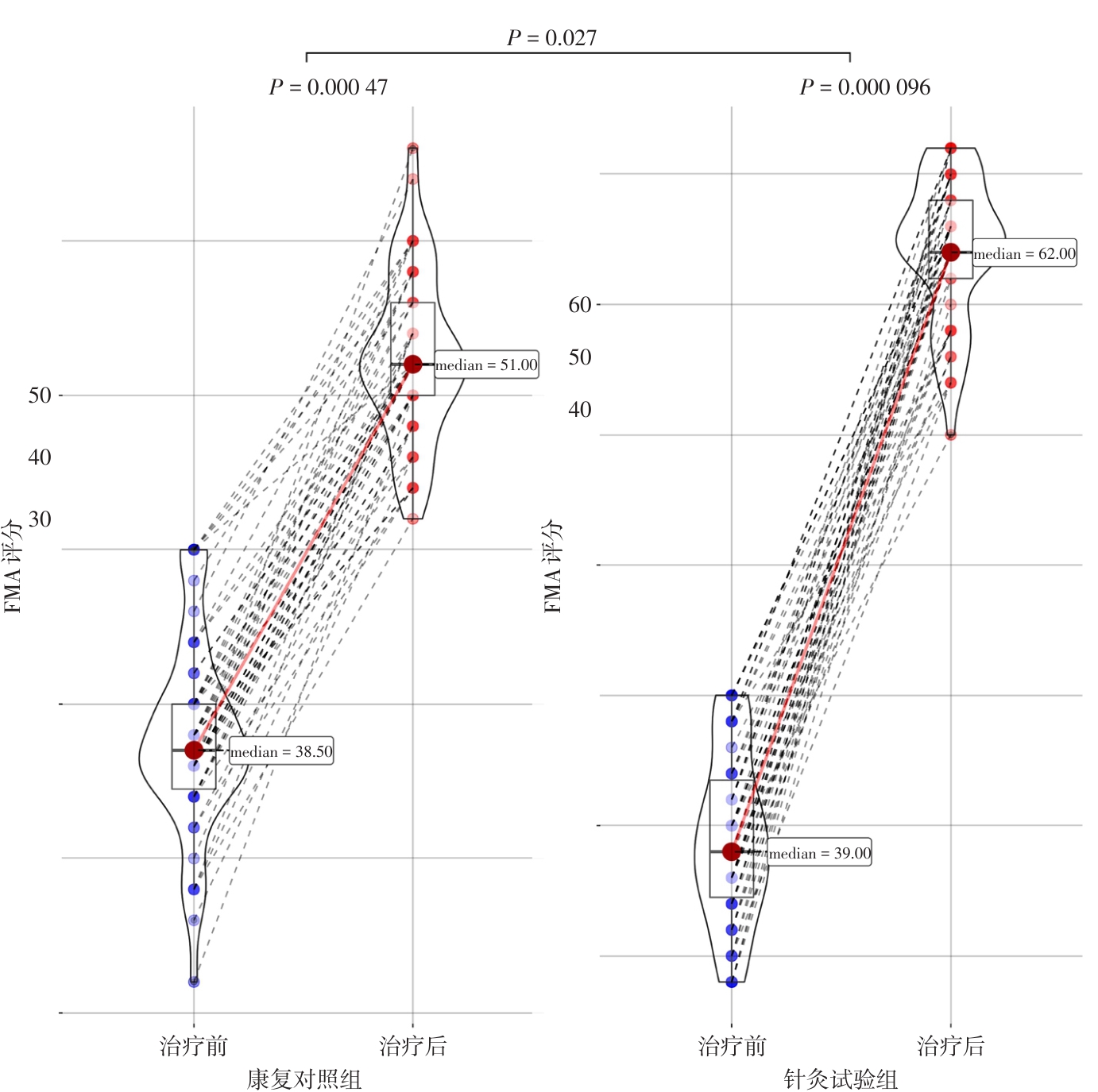
Fig.4
Comparison of Fugl-Meyer Assessment (FMA) scores before and after treatmentbetween patients in acupuncture experimental group and rehabilitation control group"
Tab.3
Analysis of overall therapeutic effects in patients of the acupuncture experimental group and"
| 组别 | 基本恢复 | 明显进步 | 进步 | 稍进步 | 无变化 | 总有效率/% | χ2值 | P值 |
|---|---|---|---|---|---|---|---|---|
| 康复对照组(n = 50) | 6(12.00) | 10(20.00) | 10(20.00) | 10(20.00) | 14(28.00) | 72.00 | 11.32 | 0.001 |
| 针灸试验组(n = 50) | 15(30.00) | 14(28.00) | 10(20.00) | 8(16.00) | 3(6.00) | 96.00 |
Tab.4
Comparison of the incidence of adverse reactions between the acupuncture experimental group and"
| 组别 | 针刺部位轻微疼痛 | 皮下出血(瘀斑) | 胃肠道不适 | 肝功能异常(ALT 轻度升高) | 总不良反应 |
|---|---|---|---|---|---|
| 康复对照组(n = 50) | 0(0.00) | 0(0.00) | 5(10.00) | 2(4.00) | 7(14.00) |
| 针灸试验组(n = 50) | 4(8.00) | 1(2.00) | 3(6.00) | 1(2.00) | 9(18.00) |
| χ2值 | 4.21 | 1.01 | 0.53 | 0.34 | 0.37 |
| P值 | 0.040 | 0.315 | 0.467 | 0.560 | 0.543 |
| [1] |
FESKE S K. Ischemic Stroke[J]. Am J Med, 2021, 134(12): 1457-1464. doi:10.1016/j.amjmed.2021.07.027 .
doi: 10.1016/j.amjmed.2021.07.027 |
| [2] |
WANG Y J, LI Z X, GU H Q, et al. China Stroke Statistics: an update on the 2019 report from the National Center for Healthcare Quality Management in Neurological Diseases, China National Clinical Research Center for Neurological Diseases, the Chinese Stroke Association, National Center for Chronic and Non-communicable Disease Control and Prevention, Chinese Center for Disease Control and Prevention and Institute for Global Neuroscience and Stroke Collaborations[J]. Stroke Vasc Neurol, 2022, 7(5):415-450.doi:10.1136/svn-2021-001374 .
doi: 10.1136/svn-2021-001374 |
| [3] |
PENG Y, LI N, DU X, et al. Acupuncture combined with mirror therapy for post-stroke dyskinesia: A meta-analysis and systematic review[J]. Medicine (Baltimore), 2024, 103(26):e38733.doi: 10.1097/MD.0000000000038733 .
doi: 10.1097/MD.0000000000038733 |
| [4] |
PAUL S, CANDELARIO-JALIL E. Emerging neuroprotective strategies for the treatment of ischemic stroke: An overview of clinical and preclinical studies[J]. Exp Neurol, 2021, 335:113518. doi:10.1016/j.expneurol.2020.113518 .
doi: 10.1016/j.expneurol.2020.113518 |
| [5] |
唐文娟, 贾欢欢, 杜峣楠, 等. 以手三阳经为主针刺与督脉灸、透药艾灸疗法对风寒阻络型颈椎病的功能改善效果分析[J]. 实用医学杂志, 2024, 40(12): 1744-1748. doi: 10.3969/j.issn.1006-5725.2024.12.022 .
doi: 10.3969/j.issn.1006-5725.2024.12.022 |
| [6] |
原双兴, 丁友鹤, 范楗彪. 益气复脉注射液联合针灸辅治冠心病心绞痛气阴两虚型疗效观察[J]. 实用中医药杂志, 2024, 40(12):2487-2489.doi : 10.3969/j.issn.1004-2814.2024.12 .
doi: 10.3969/j.issn.1004-2814.2024.12 |
| [7] |
邰萱, 韦雪兰, 张婷, 等. 针药结合治疗心肌梗死研究进展[J]. 亚太传统医药, 2024, 20(7):229-233.doi:10.11954/ytctyy.202407045 .
doi: 10.11954/ytctyy.202407045 |
| [8] |
朱拓, 赵怡灯, 詹海兰, 等. “通督调神”针刺联合手功能训练治疗脑梗死后手功能障碍[J]. 实用医学杂志, 2025, 41(15): 2418-2425.doi : 10.3969/j.issn.1006-5725.2025.15.019 .
doi: 10.3969/j.issn.1006-5725.2025.15.019 |
| [9] |
LIU S, WANG Z, SU Y, et al. A neuroanatomical basis for electroacupuncture to drive the vagal-adrenal axis[J]. Nature, 2021, 598(7882):641-645. doi:10.1038/s41586-021-04001-4 .
doi: 10.1038/s41586-021-04001-4 |
| [10] |
中国卒中学会, 中国卒中学会神经介入分会, 中华预防医学会卒中预防与控制专业委员会介入学组, 等.急性缺血性卒中血管内治疗中国指南2023[J].中国卒中杂志, 2023, 18(6):684-711.doi:10.3969/j.issn.1673-5765.2023.06.010 .
doi: 10.3969/j.issn.1673-5765.2023.06.010 |
| [11] |
倪小佳, 林浩, 罗旭飞, 等. 脑卒中中西医结合防治指南(2023版)[J]. 中国全科医学, 2025, 28(5):521-533.doi:10.12114/j.issn.1007-9572.2024.0485 .
doi: 10.12114/j.issn.1007-9572.2024.0485 |
| [12] |
MCGILL K, SACKLEY C, GODWIN J, et al. Using the Barthel Index and modified Rankin Scale as Outcome Measures for Stroke Rehabilitation Trials; A Comparison of Minimum Sample Size Requirements[J]. J Stroke Cerebrovasc Dis, 2022, 31(2):106229. doi: 10.1016/j.jstrokecerebrovasdis.2021.106229 .
doi: 10.1016/j.jstrokecerebrovasdis.2021.106229 |
| [13] |
JIANG T, LIU Q, LIU H, et al. Acupuncture alleviates hemorrhagic transformation after delayed rt-PA treatment for acute ischemic stroke by regulating the mitophagy-NLRP3 inflammasome pathway[J]. Front Neurol, 2025, 16:1533092.doi: 10.3389/fneur.2025.1533092 .
doi: 10.3389/fneur.2025.1533092 |
| [14] |
WU Y, ZHANG Z, LI Q, et al. Clinical study on the efficacy of postural control combined with electroacupuncture in treating dysphagia after stroke[J]. Front Neurol, 2024, 15:1296758.doi: 10.3389/fneur.2024.1296758 .
doi: 10.3389/fneur.2024.1296758 |
| [15] |
LIU F, TSANG R C, ZHOU J, et al. Relationship of Barthel Index and its Short Form with the Modified Rankin Scale in acute stroke patients[J]. J Stroke Cerebrovasc Dis, 2020, 29(9): 105033.doi: 10.1016/j.jstrokecerebrovasdis.2020.105033 .
doi: 10.1016/j.jstrokecerebrovasdis.2020.105033 |
| [16] |
HARA K, TAUCHI Y, HANADA K, et al. Estimating the Number of Latent Ranks of the Fugl-Meyer Assessment Score for the Affected Upper Extremity After Stroke[J]. Cureus, 2025, 17(5):e84210.doi: 10.7759/cureus.84210 .
doi: 10.7759/cureus.84210 |
| [17] |
HERNÁNDEZ E D, FORERO S M, GALEANO C P, et al. Intra- and inter-rater reliability of Fugl-Meyer Assessment of Lower Extremity early after stroke[J]. Braz J Phys Ther, 2021, 25(6): 709-718.doi: 10.1016/j.bjpt.2020.12.002 .
doi: 10.1016/j.bjpt.2020.12.002 |
| [18] |
李平,吴钟璇,张云如,等. 中风病诊断与疗效评定标准(试行)[J]. 北京中医药大学学报,1996,19(1):55-56. doi: 10.3321/j.issn:1006-2157. 1996. 01.022 .
doi: 10.3321/j.issn:1006-2157. 1996. 01.022 |
| [19] |
章薇, 娄必丹, 李金香, 等.中医康复临床实践指南·缺血性脑卒中(脑梗死)[J]. 康复学报, 2021, 31(6): 437-447. doi: 10.3724/SP.J.1329.2021.06001 .
doi: 10.3724/SP.J.1329.2021.06001 |
| [20] |
DAVID C, RUCK T, ROLFES L, et al. Impact of NKG2D Signaling on Natural Killer and T-Cell Function in Cerebral Ischemia[J]. J Am Heart Assoc, 2023, 12(12):e029529. doi: 10.1161/JAHA.122.029529 .
doi: 10.1161/JAHA.122.029529 |
| [21] |
ZHANG Y, JIANG Y, ZOU Y, et al. Peripheral blood CD19 positive B lymphocytes increase after ischemic stroke and correlate with carotid atherosclerosis[J]. Front Neurol, 2023, 14:1308041.doi: 10.3389/fneur.2023.1308041 .
doi: 10.3389/fneur.2023.1308041 |
| [22] |
思宇涛, 尹琳, 马春野, 等. 前后循环大血管闭塞型缺血性脑卒中血管成功再通后临床预后的比较[J]. 中华神经医学杂志,2023, 22(10): 1016-1022. doi:10.3760/cma.j.cn115354-20230824-00082 .
doi: 10.3760/cma.j.cn115354-20230824-00082 |
| [23] |
SEETLANI N K, KUMARI G, YASMIN F, et al. The frequency and pattern of deranged lipid profile in patients with ischemic stroke: A retrospective study[J]. Acta Biomed, 2022, 93(3):e2022178.doi: 10.23750/abm.v93i3.11576 .
doi: 10.23750/abm.v93i3.11576 |
| [24] |
VOGELGESANG A, GRUNWALD U, LANGNER S, et al. Analysis of lymphocyte subsets in patients with stroke and their influence on infection after stroke[J]. Stroke, 2008, 39(1):237-241.doi: 10.1161/STROKEAHA.107.493635 .
doi: 10.1161/STROKEAHA.107.493635 |
| [25] |
ZHANG Y, WEI L, DU Y, et al. Association Between Programed Cell Death-1 and CD4+ T Cell Alterations in Different Phases of Ischemic Stroke Patients[J]. Front Cell Neurosci, 2018, 12:170.doi: 10.3389/fncel.2018.00170 .
doi: 10.3389/fncel.2018.00170 |
| [26] |
JIANG C, KONG W, WANG Y, et al. Changes in the cellular immune system and circulating inflammatory markers of stroke patients[J]. Oncotarget, 2017, 8(2): 3553-3567. doi: 10.18632/oncotarget.12201 .
doi: 10.18632/oncotarget.12201 |
| [27] |
ZHOU X, XUE S, SI X K, et al. Impact of peripheral lymphocyte subsets on prognosis for patients after acute ischemic stroke: A potential disease prediction model approach[J]. CNS Neurosci Ther, 2024, 30(8):e70023. doi: 10.1111/cns.70023 .
doi: 10.1111/cns.70023 |
| [28] |
XU Y, PENG J, YAN Y, et al. CD19+B cell depletion: A novel strategy to alleviate ischemic stroke damage[J]. Front Immunol, 2025, 16:1528471. doi: 10.3389/fimmu.2025.1528471 .
doi: 10.3389/fimmu.2025.1528471 |
| [29] |
FITZPATRICK Z, FRAZER G, FERRO A, et al. Gut-educated IgA plasma cells defend the meningeal venous sinuses[J]. Nature, 2020, 587(7834): 472-476. doi: 10.1038/s41586-020-2886-4 .
doi: 10.1038/s41586-020-2886-4 |
| [30] |
王颖, 茅伟, 吴海洋, 等. 针刺结合清肺祛痰汤治疗痰热壅肺型卒中相关性肺炎及对细胞免疫功能的影响[J]. 中国针灸, 2022, 42 (11): 1240-1244, 1262. doi:10.13703/j.0255-2930. 20220208-k0003 .
doi: 10.13703/j.0255-2930. 20220208-k0003 |
| [31] |
LI M, YANG F, ZHANG X, et al. Electroacupuncture attenuates depressive-like behaviors in poststroke depression mice through promoting hippocampal neurogenesis and inhibiting TLR4/NF-κB/NLRP3 signaling pathway[J]. Neuroreport, 2024, 35(14):947-960.doi: 10.1097/WNR.0000000000002088 .
doi: 10.1097/WNR.0000000000002088 |
| [32] |
黄卫, 吴海波, 冯伦冬, 等. 针刺联合康复治疗对老年脑卒中患者免疫功能和神经功能的影响[J]. 针刺研究, 2018, 43(9):567-572. doi:10.13702/j.1000-0607.170611 .
doi: 10.13702/j.1000-0607.170611 |
| [33] |
刘继业, 孟红, 王佳贺. 龙血通络胶囊联合针刺对气虚血瘀型缺血性脑卒中恢复期患者细胞免疫,血液相关指标及运动功能的影响[J]. 河南中医, 2022, 42(12):1904-1907.doi:10.16367/j.issn.1003-5028.2022.12.0401 .
doi: 10.16367/j.issn.1003-5028.2022.12.0401 |
| [34] |
张柏扬, 王利东, 刘佳. 急性脑梗死经复方脑肽节苷脂注射液联合奥扎格雷治疗对TNF-α,Ang-1,VEGF水平,颈动脉狭窄程度的影响[J]. 吉林医学, 2023, 44(10): 2902-2904.doi: 10.3969/j.issn.1004-0412.2023.10.068 .
doi: 10.3969/j.issn.1004-0412.2023.10.068 |
| [35] |
WANG Y, ZHANG J H, SHENG J, et al. Immunoreactive Cells After Cerebral Ischemia[J]. Front Immunol, 2019, 10:2781.doi: 10.3389/fimmu.2019.02781 .
doi: 10.3389/fimmu.2019.02781 |
| [36] |
崔佳佳, 张成洲, 朱蓓, 等. 脑梗死患者血清miR-21-5p,IL-6,IL-8表达水平及其预测模型构建[J]. 中国老年学杂志, 2023, 43(17):4103-4106.doi : 10.3969/j.issn.1005-9202.2023.17.003 .
doi: 10.3969/j.issn.1005-9202.2023.17.003 |
| [37] |
崔亚, 邓海鹏. 针刺联合重复经颅磁刺激治疗脑卒中后抑郁对血清BDNF,IL-1β,IL-6,TNF-α水平的影响[J]. 实用中医药杂志, 2023, 39(1):1-3.doi : 10.3969/j.issn.1004-2814. 2023. 01.001 .
doi: 10.3969/j.issn.1004-2814. 2023. 01.001 |
| [38] |
TSAI C Y, LIAO W L, WU H M, et al. Acupuncture improves neurological function and anti-inflammatory effect in patients with acute ischemic stroke: A double-blinded randomized controlled trial[J]. Complement Ther Med, 2024, 82:103049.doi: 10.1016/j.ctim.2024.103049 .
doi: 10.1016/j.ctim.2024.103049 |
| Viewed | ||||||
|
Full text |
|
|||||
|
Abstract |
|
|||||
