

The Journal of Practical Medicine ›› 2026, Vol. 42 ›› Issue (13): 2345-2354.doi: 10.3969/j.issn.1006-5725.2026.13.010
• Chronic Disease Control • Previous Articles
Yating YIN1,2,3,Xiaoman LIU1,3,Mei YANG1,Mengqi XIAO1,Xiaoqiang HOU3,Zhitao FENG1,2( )
)
Received:2026-03-21
Online:2026-07-10
Published:2026-07-14
Contact:
Zhitao FENG
E-mail:fengzhitao2008@126.com
CLC Number:
Yating YIN,Xiaoman LIU,Mei YANG,Mengqi XIAO,Xiaoqiang HOU,Zhitao FENG. Exploring the mechanism of ferroptosis in rheumatoid arthritis from the perspective of blood stasis[J]. The Journal of Practical Medicine, 2026, 42(13): 2345-2354.
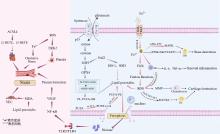
Fig.1
The mechanism of ferroptosis in rheumatoid arthritis and ferroptosis participates in the process of blood stasis"
Tab.1
Molecular mechanism by which active components from traditional Chinese medicinals promoting blood circulation and eliminate blood stasis enhance antioxidant capacity through ferroptosis"
| 作用机制 | 中药成分 | 药物来源 | 模型 | 作用机制 |
|---|---|---|---|---|
| 调控Nrf2/GPX4通路 | 槲皮素[64-65] | 葫芦巴、黄芪 | CFA大鼠、前交叉韧带横断(ACLT)小鼠 | TNF-α、IL-6、IL-1β、MDA↓、SOX9、SOD、GPX4、Nrf2、HO-1↑ |
| 大黄素[ | 大黄 | CIA小鼠模型 | IL-1β↓、Nrf2、SOD、AMPK↑ | |
| 白藜芦醇[ | 虎杖 | H2O2诱导RA-FLSs | ROS、MDA、NF-κB、FLSs增殖↓、Nrf2、HO-1↑ | |
| 丹酚酸B[ | 丹参 | UUO大鼠模型 | Fe2+、MDA、↓、SOD、Nrf2、GPX4↑ | |
| 黄芪甲苷[ | 黄芪 | 内皮细胞氧化损伤模型 | ROS↓、SOD、Nrf2、HO-1mRNA↑ | |
| 原阿片碱[ | 延胡索 | ACLT小鼠 | ROS↓、Nrf2、GPX4、NQO1、HO-1↑ | |
| 抑制铁蓄积与脂质过氧化 | 姜黄素[ | 姜黄 | ATDC5小鼠软骨细胞 | Fe2+、ROS、MMP-13、ACSL4↓、Prdx6、ColⅡ↑ |
| 丹参酮ⅡA[ | 丹参 | ATDC5小鼠软骨细胞 | ROS、MDA、MMP-13、铁浓度↓、ColⅡ、GSH、GPX4↑ | |
| 白花丹素[ | 白花丹 | H2O2诱导的软骨细胞 | ROS、Fe2+、COX-2、ACSL4、MDA↓、GPX4、SLC7A11↑ | |
| 三七皂苷R1[ | 三七 | H2O2诱导小鼠成骨细胞 | ROS、MAPK↓、ALP、OCN、ColⅠ、Runx2↑ | |
抗炎与保护软骨等多靶点 协同作用 | 牡荆素[ | 山楂 | IL-1β诱导的软骨细胞 | HIF-1α、IL-1β、IL-6、TNF-α、MMP-1、MMP-3、MMP-13↓ |
| 银杏内酯[ | 银杏 | 小鼠骨髓间充质干细胞 | RANKL、ROS、超氧化物↓、过氧化氢酶、SOD2↑ |
| [1] |
FINCKH A, GILBERT B T, HODKINSON B, et al. Global epidemiology of rheumatoid arthritis[J]. Nat Rev Rheumatol, 2022,18(10): 591-602.doi: 10.1038/s41584-022-00827-y .
doi: 10.1038/s41584-022-00827-y |
| [2] |
北京协和医院国家皮肤与免疫疾病临床医学研究中心, 中国医师协会风湿免疫专科医师分会, 中国康复医学会风湿免疫病康复专业委员会, 等. 2024中国类风湿关节炎诊疗指南[J]. 中华内科杂志, 2024,63(11): 1059-1077.doi:10.3760/cma.j.cn112138-20240531-00360 .
doi: 10.3760/cma.j.cn112138-20240531-00360 |
| [3] |
武占成, 赵晶, 朱秀惠, 等. 类风湿关节炎的骨病变从络病论治[J]. 中国组织工程研究, 2020,24(5): 760-765.doi:10.3969/j.issn.2095-4344.2475 .
doi: 10.3969/j.issn.2095-4344.2475 |
| [4] |
D'ORAZIO A, CIRILLO A L, GRECO G, et al. Pathogenesis of rheumatoid arthritis: One year in review 2024[J]. Clin Exp Rheumatol, 2024,42(9): 1707-1713.doi: 10.55563/clinexprheumatol/0307ed .
doi: 10.55563/clinexprheumatol/0307ed |
| [5] | 曹云祥, 刘健, 黄传兵, 等. 类风湿关节炎从瘀论治研究进展[J]. 中华中医药杂志, 2021,36(2): 983-985. |
| [6] |
曾嘉旭, 何琪, 陈柏豪, 等. 以“血瘀”理论指导治疗:解读膝骨关节炎“铁超载”的相关机制[J]. 中国组织工程研究, 2024,28(11): 1743-1748.doi:10.12307/2024.237 .
doi: 10.12307/2024.237 |
| [7] |
ZHAO H, TANG C, WANG M, et al. Ferroptosis as an emerging target in rheumatoid arthritis[J]. Front Immunol, 2023,14: 1260839.doi:10.3389/fimmu.2023.1260839 .
doi: 10.3389/fimmu.2023.1260839 |
| [8] |
刘承鑫, 王子焱, 魏佳明, 等. 郭志华基于“虚、瘀、痰”辨治痹证经验[J]. 中医药导报, 2023,29(12): 163-166.doi:10.13862/j.cn43-1446/r.2023.12.033 .
doi: 10.13862/j.cn43-1446/r.2023.12.033 |
| [9] | 曹玉举. 娄多峰“虚、邪、瘀”理论论治类风湿关节炎[J]. 中华中医药杂志, 2018,33(2): 569-571. |
| [10] |
徐润, 姜泉, 韩曼, 等. 基于“心痹”理论论治类风湿关节炎的心血管损伤[J]. 上海中医药杂志, 2022,56(11): 48-52.doi:10.16305/j.1007-1334.2022.2112002 .
doi: 10.16305/j.1007-1334.2022.2112002 |
| [11] |
GODBOLE S, SOLOMON J L, JOHNSON M, et al. Treating Cardiovascular Disease in the Inflammatory Setting of Rheumatoid Arthritis: An Ongoing Challenge[J]. Biomedicines, 2024,12(7):1608. doi:10.3390/biomedicines12071608 .
doi: 10.3390/biomedicines12071608 |
| [12] |
郭迎春, 孟令茜, 高志云, 等. 血管回声跟踪技术评价类风湿关节炎患者的颈动脉粥样硬化发生的相关性[J]. 实用医学杂志, 2018,34(15): 2600-2603.doi:10.3969/j.issn.1006-5725. 2018.15.036 .
doi: 10.3969/j.issn.1006-5725. 2018.15.036 |
| [13] |
HANNAWI S, HANNAWI H, ALOKAILY F, et al. Variables associated with subclinical atherosclerosis among rheumatoid arthritis patients of Gulf Cooperative Council countries[J]. Saudi Med J, 2020,41(2): 128-137.doi:10.15537/smj.2020.2.24900 .
doi: 10.15537/smj.2020.2.24900 |
| [14] | 李志宇, 温成平. 类风湿关节炎血小板增多症的中医治疗思路探讨[J]. 中华中医药杂志, 2020,35(11): 5629-5632. |
| [15] |
范俊, 路臻豪, 乔鑫. 类风湿关节炎患者血清miR-140-5p、VEGF水平与动脉粥样硬化的相关性分析[J]. 国际检验医学杂志, 2024,45(22): 2705-2709.doi:10.3969/j.issn.1673-4130. 2024.22.004 .
doi: 10.3969/j.issn.1673-4130. 2024.22.004 |
| [16] |
姚茹冰, 蔡辉, 郭郡浩. 论血瘀与类风湿关节炎发病及治疗的相关性[J]. 河北中医, 2009,31(5): 771-773.doi: 10.3969/j.issn.1002-2619.2009.05.085 .
doi: 10.3969/j.issn.1002-2619.2009.05.085 |
| [17] |
GUAN M, YU Q, ZHOU G, et al. Mechanisms of chondrocyte cell death in osteoarthritis: Implications for disease progression and treatment[J]. J Orthop Surg Res, 2024,19(1): 550.doi:10.1186/s13018-024-05055-6 .
doi: 10.1186/s13018-024-05055-6 |
| [18] |
CHEN X, KANG R, KROEMER G, et al. Ferroptosis in infection, inflammation, and immunity[J]. J Exp Med, 2021,218(6):e20210518. doi:10.1084/jem.20210518 .
doi: 10.1084/jem.20210518 |
| [19] |
JIANG X, STOCKWELL B R, CONRAD M. Ferroptosis: mechanisms, biology and role in disease[J]. Nat Rev Mol Cell Biol, 2021,22(4): 266-282. doi:10.1038/s41580-020-00324-8 .
doi: 10.1038/s41580-020-00324-8 |
| [20] |
RU Q, LI Y, CHEN L, et al. Iron homeostasis and ferroptosis in human diseases: Mechanisms and therapeutic prospects[J]. Signal Transduct Target Ther, 2024,9(1): 271.doi:10.1038/s41392-024-01969-z .
doi: 10.1038/s41392-024-01969-z |
| [21] |
SENATOR G B, MUIRDEN K D. Concentration of iron in synovial membrane, synovial fluid, and serum in rheumatoid arthritis and other joint diseases[J]. Ann Rheum Dis, 1968,27(1): 49-54.doi:10.1136/ard.27.1.49 .
doi: 10.1136/ard.27.1.49 |
| [22] |
LUO H, ZHANG R. Icariin enhances cell survival in lipopolysaccharide-induced synoviocytes by suppressing ferroptosis via the Xc-/GPX4 axis[J]. Exp Ther Med, 2021,21(1): 72.doi:10.3892/etm.2020.9504 .
doi: 10.3892/etm.2020.9504 |
| [23] |
XIE Z, HOU H, LUO D, et al. ROS-Dependent Lipid Peroxidation and Reliant Antioxidant Ferroptosis-Suppressor-Protein 1 in Rheumatoid Arthritis: A Covert Clue for Potential Therapy[J]. Inflammation, 2021,44(1): 35-47.doi:10.1007/s10753-020-01338-2 .
doi: 10.1007/s10753-020-01338-2 |
| [24] |
WU J, FENG Z, CHEN L, et al. TNF antagonist sensitizes synovial fibroblasts to ferroptotic cell death in collagen-induced arthritis mouse models[J]. Nat Commun, 2022,13(1): 676.doi:10.1038/s41467-021-27948-4 .
doi: 10.1038/s41467-021-27948-4 |
| [25] |
刘小曼, 沈小兰, 郭响, 等. 氧感知信号通路在类风湿关节炎中的研究进展[J]. 中国免疫学杂志, 2025, 41(3): 1-14.doi: 10.3969/j.issn.1000-484X.2025.03.036 .
doi: 10.3969/j.issn.1000-484X.2025.03.036 |
| [26] |
ZHAO H, DONG Q, HUA H, et al. Contemporary insights and prospects on ferroptosis in rheumatoid arthritis management[J]. Front Immunol, 2024,15: 1455607.doi:10.3389/fimmu.2024. 1455607 .
doi: 10.3389/fimmu.2024. 1455607 |
| [27] |
VAN VULPEN L F, ROOSENDAAL G, van ASBECK B S, et al. The detrimental effects of iron on the joint: A comparison between haemochromatosis and haemophilia[J]. J Clin Pathol, 2015,68(8): 592-600.doi:10.1136/jclinpath-2015-202967 .
doi: 10.1136/jclinpath-2015-202967 |
| [28] |
DAS B K, WANG L, FUJIWARA T, et al. Transferrin receptor 1-mediated iron uptake regulates bone mass in mice via osteoclast mitochondria and cytoskeleton[J]. eLife, 2022,11: e73539.doi:10.7554/eLife.73539 .
doi: 10.7554/eLife.73539 |
| [29] |
VALANEZHAD A, ODATSU T, ABE S, et al. Bone Formation Ability and Cell Viability Enhancement of MC3T3-E1 Cells by Ferrostatin-1 a Ferroptosis Inhibitor of Cancer Cells[J]. Int J Mol Sci, 2021,22(22):12259.doi:10.3390/ijms222212259 .
doi: 10.3390/ijms222212259 |
| [30] |
赵恒伍, 王文娟, 陈胜武. 铁超载通过ASK1-p38通路介导的铁死亡途径抑制成骨细胞功能[J]. 中国医科大学学报, 2021,50(6): 530-534.doi:10.12007/j.issn.0258-4646.2021.06.011 .
doi: 10.12007/j.issn.0258-4646.2021.06.011 |
| [31] |
CEN W J, FENG Y, LI S S, et al. Iron overload induces G1 phase arrest and autophagy in murine preosteoblast cells[J]. J Cell Physiol, 2018,233(9): 6779-6789.doi:10.1002/jcp.26405 .
doi: 10.1002/jcp.26405 |
| [32] |
AO Q, HU H, HUANG Y. Ferroptosis and endoplasmic reticulum stress in rheumatoid arthritis[J]. Front Immunol, 2024,15: 1438803.doi:10.3389/fimmu.2024.1438803 .
doi: 10.3389/fimmu.2024.1438803 |
| [33] |
KULAKOVA K, LAWAL T R, MCCARTHY E, et al. The Contribution of Macrophage Plasticity to Inflammatory Arthritis and Their Potential as Therapeutic Targets[J]. Cells, 2024,13(18):1586.doi:10.3390/cells13181586 .
doi: 10.3390/cells13181586 |
| [34] |
XUE J D, GAO J, TANG A F, et al. Shaping the immune landscape: Multidimensional environmental stimuli refine macrophage polarization and foster revolutionary approaches in tissue regeneration[J]. Heliyon, 2024,10(17): e37192.doi:10.1016/j.heliyon.2024.e37192 .
doi: 10.1016/j.heliyon.2024.e37192 |
| [35] |
ZHAO T, YANG Q, XI Y, et al. Ferroptosis in Rheumatoid Arthritis: A Potential Therapeutic Strategy[J]. Front Immunol, 2022,13: 779585.doi:10.3389/fimmu.2022.779585 .
doi: 10.3389/fimmu.2022.779585 |
| [36] |
WANG L, HUANG B, ZENG Y, et al. N-Acetylcysteine overcomes epalrestat-mediated increase of toxic 4-hydroxy-2-nonenal and potentiates the anti-arthritic effect of epalrestat in AIA model[J]. Int J Biol Sci, 2023,19(13): 4082-4102.doi:10.7150/ijbs.85028 .
doi: 10.7150/ijbs.85028 |
| [37] |
DUVVURI B, BADDOUR A A, DEANE K D, et al. Mitochondrial N-formyl methionine peptides associate with disease activity as well as contribute to neutrophil activation in patients with rheumatoid arthritis[J]. J Autoimmun, 2021,119: 102630.doi:10.1016/j.jaut.2021.102630 .
doi: 10.1016/j.jaut.2021.102630 |
| [38] |
ZAMUDIO-CUEVAS Y, MARTINEZ-FLORES K, MARTINEZ-NAVA G A, et al. Rheumatoid Arthritis and Oxidative Stress[J]. Cell Mol Biol, 2022,68(6): 174-184.doi:10.14715/cmb/2022. 68.6.28 .
doi: 10.14715/cmb/2022. 68.6.28 |
| [39] |
DANKS L, KOMATSU N, GUERRINI M M, et al. RANKL expressed on synovial fibroblasts is primarily responsible for bone erosions during joint inflammation[J]. Ann Rheum Dis, 2016,75(6): 1187-1195.doi:10.1136/annrheumdis-2014-207137 .
doi: 10.1136/annrheumdis-2014-207137 |
| [40] |
VAILLANCOURT F, MORQUETTE B, SHI Q, et al. Differential regulation of cyclooxygenase-2 and inducible nitric oxide synthase by 4-hydroxynonenal in human osteoarthritic chondrocytes through ATF-2/CREB-1 transactivation and concomitant inhibition of NF-kappaB signaling cascade[J]. J Cell Biochem, 2007,100(5): 1217-1231.doi:10.1002/jcb.21110 .
doi: 10.1002/jcb.21110 |
| [41] |
李朝霞, 高鲁, 张晓峰, 等. 铁死亡在类风湿性关节炎中的研究进展[J]. 中国骨质疏松杂志, 2024,30(6): 889-894.doi:10.3969/j.issn.1006-7108.2024.06.020 .
doi: 10.3969/j.issn.1006-7108.2024.06.020 |
| [42] |
BERGSTROM B, SELLDEN T, BOLLMANN M, et al. Methotrexate promotes the release of granulocyte-macrophage colony-stimulating factor from rheumatoid arthritis fibroblast-like synoviocytes via autocrine interleukin-1 signaling[J]. Arthritis Res Ther, 2024,26(1): 178.doi:10.1186/s13075-024-03406-6 .
doi: 10.1186/s13075-024-03406-6 |
| [43] |
CHANG S, TANG M, ZHANG B, et al. Ferroptosis in inflammatory arthritis: A promising future[J]. Front Immunol, 2022,13: 955069.doi:10.3389/fimmu.2022.955069 .
doi: 10.3389/fimmu.2022.955069 |
| [44] |
FERREIRA H B, MELO T, PAIVA A, et al. Insights in the Role of Lipids, Oxidative Stress and Inflammation in Rheumatoid Arthritis Unveiled by New Trends in Lipidomic Investigations[J]. Antioxidants (Basel), 2021,10(1):45.doi:10.3390/antiox10010045 .
doi: 10.3390/antiox10010045 |
| [45] |
MIAO Y, CHEN Y, XUE F, et al. Contribution of ferroptosis and GPX4's dual functions to osteoarthritis progression[J]. EBioMedicine, 2022,76: 103847.doi:10.1016/j.ebiom.2022.103847 .
doi: 10.1016/j.ebiom.2022.103847 |
| [46] |
LING H, LI M, YANG C, et al. Glycine increased ferroptosis via SAM-mediated GPX4 promoter methylation in rheumatoid arthritis[J]. Rheumatology (Oxford), 2022, 61(11): 4521-4534.doi:10.1093/rheumatology/keac069 .
doi: 10.1093/rheumatology/keac069 |
| [47] |
ZENG C, LIN J, ZHANG K, et al. SHARPIN promotes cell proliferation of cholangiocarcinoma and inhibits ferroptosis via p53/SLC7A11/GPX4 signaling[J]. Cancer Sci, 2022,113(11): 3766-3775.doi:10.1111/cas.15531 .
doi: 10.1111/cas.15531 |
| [48] |
CHADHA S, BEHL T, KUMAR A, et al. Role of Nrf2 in rheumatoid arthritis[J]. Curr Res Transl Med, 2020,68(4): 171-181.doi:10.1016/j.retram.2020.05.002 .
doi: 10.1016/j.retram.2020.05.002 |
| [49] |
ZHANG Y, WANG G, WANG T, et al. Nrf2-Keap1 pathway-mediated effects of resveratrol on oxidative stress and apoptosis in hydrogen peroxide-treated rheumatoid arthritis fibroblast-like synoviocytes[J]. Ann N Y Acad Sci, 2019,1457(1): 166-178.doi:10.1111/nyas.14196 .
doi: 10.1111/nyas.14196 |
| [50] |
HE F, ANTONUCCI L, KARIN M. NRF2 as a regulator of cell metabolism and inflammation in cancer[J]. Carcinogenesis, 2020,41(4): 405-416.doi:10.1093/carcin/bgaa039 .
doi: 10.1093/carcin/bgaa039 |
| [51] |
WANG H, LIU C, ZHAO Y, et al. Mitochondria regulation in ferroptosis[J]. Eur J Cell Biol, 2020,99(1): 151058.doi:10.1016/j.ejcb.2019.151058 .
doi: 10.1016/j.ejcb.2019.151058 |
| [52] |
GATTERMANN N, MUCKENTHALER M U, KULOZIK A E, et al. The Evaluation of Iron Deficiency and Iron Overload[J]. Dtsch Arztebl Int, 2021,118(49): 847-856.doi:10.3238/arztebl.m2021.0290 .
doi: 10.3238/arztebl.m2021.0290 |
| [53] |
TATMATSU-ROCHA J C, MENDES-COSTA L S. Inflammatory markers, oxidative stress, and mitochondrial dynamics: Repercussions on coronary artery disease in diabetes[J]. World J Diabetes, 2024,15(9): 1853-1857.doi:10.4239/wjd.v15.i9.1853 .
doi: 10.4239/wjd.v15.i9.1853 |
| [54] |
TSUKIJI N, YOKOMORI R, TAKUSAGAWA K, et al. C-type lectin-like receptor-2 in platelets mediates ferric chloride-induced platelet activation and attenuates ferroptosis of endothelial cells[J]. J Thromb Haemost., 2024,22(6): 1749-1757.doi:10.1016/j.jtha.2024.03.003 .
doi: 10.1016/j.jtha.2024.03.003 |
| [55] |
YANG M, COOLEY B C, LI W, et al. Platelet CD36 promotes thrombosis by activating redox sensor ERK5 in hyperlipidemic conditions[J]. Blood, 2017,129(21): 2917-2927.doi:10.1182/blood-2016-11-750133 .
doi: 10.1182/blood-2016-11-750133 |
| [56] |
SHARIFI-RAD M, ANIL K N, ZUCCA P, et al. Lifestyle, Oxidative Stress, and Antioxidants: Back and Forth in the Pathophysiology of Chronic Diseases[J]. Front Physiol, 2020,11: 694.doi:10.3389/fphys.2020.00694 .
doi: 10.3389/fphys.2020.00694 |
| [57] |
刘祎, 杨漾, 苏畅, 等. 基于ACSL4信号通路探讨血府逐瘀汤干预冠心病血瘀证大鼠铁死亡的作用机制[J]. 中国实验方剂学杂志, 2025,31(6): 27-38.doi:10.13422/j.cnki.syfjx. 20241906 .
doi: 10.13422/j.cnki.syfjx. 20241906 |
| [58] |
NAVEENKUMAR S K, SHARATHBABU B N, HEMSHEKHAR M, et al. The Role of Reactive Oxygen Species and Ferroptosis in Heme-Mediated Activation of Human Platelets[J]. ACS Chem Biol, 2018,13(8): 1996-2002.doi:10.1021/acschembio. 8b00458 .
doi: 10.1021/acschembio. 8b00458 |
| [59] |
VINCHI F, PORTO G, SIMMELBAUER A, et al. Atherosclerosis is aggravated by iron overload and ameliorated by dietary and pharmacological iron restriction[J]. Eur Heart J, 2020,41(28): 2681-2695.doi:10.1093/eurheartj/ehz112 .
doi: 10.1093/eurheartj/ehz112 |
| [60] |
王晓燕, 邹小义, 祝翔, 等. 铁超载调控氧化性低密度脂蛋白诱导泡沫细胞促动脉粥样硬化活化的作用[J]. 实用医学杂志, 2024,40(3): 295-301.doi:10.3969/j.issn.1006-5725.2024. 03.003 .
doi: 10.3969/j.issn.1006-5725.2024. 03.003 |
| [61] |
FEARON U, CANAVAN M, BINIECKA M, et al. Hypoxia, mitochondrial dysfunction and synovial invasiveness in rheumatoid arthritis[J]. Nat Rev Rheumatol, 2016,12(7): 385-397.doi:10.1038/nrrheum.2016.69 .
doi: 10.1038/nrrheum.2016.69 |
| [62] |
BIERI S, MOLLER B, AMSLER J. Ferroptosis in Arthritis: Driver of the Disease or Therapeutic Option?[J]. Int J Mol Sci, 2024,25(15): 8212.doi:10.3390/ijms25158212 .
doi: 10.3390/ijms25158212 |
| [63] |
程园园, 黄传兵, 朱雅文, 等. 从“肝肾-线粒体”关联探讨铁死亡与骨关节炎相关性[J]. 中国骨质疏松杂志, 2024,30(12): 1826-1831.doi: 10.3969/j.issn.1006-7108.2024.12.019 .
doi: 10.3969/j.issn.1006-7108.2024.12.019 |
| [64] |
CHEN K, YU Y, WANG Y, et al. Systematic Pharmacology and Experimental Validation to Reveal the Alleviation of Astragalus membranaceus Regulating Ferroptosis in Osteoarthritis[J]. Drug Des Devel Ther, 2024,18: 259-275.doi:10.2147/DDDT.S441350 .
doi: 10.2147/DDDT.S441350 |
| [65] |
EL-SAID K S, ATTA A, MOBASHER M A, et al. Quercetin mitigates rheumatoid arthritis by inhibiting adenosine deaminase in rats[J]. Mol Med, 2022,28(1): 24.doi:10.1186/s10020-022-00432-5 .
doi: 10.1186/s10020-022-00432-5 |
| [66] |
TANG M, ZENG Y, PENG W, et al. Pharmacological Aspects of Natural Quercetin in Rheumatoid Arthritis[J]. Drug Des Devel Ther, 2022,16: 2043-2053.doi:10.2147/DDDT.S364759 .
doi: 10.2147/DDDT.S364759 |
| [67] |
CHENG D W, YUE Y F, CHEN C X, et al. Emodin alleviates arthritis pain through reducing spinal inflammation and oxidative stress[J]. Mol Pain, 2022,18: 804347678.doi:10.1177/17448069221146398 .
doi: 10.1177/17448069221146398 |
| [68] |
JI J, TAO P, WANG Q, et al. Emodin attenuates diabetic kidney disease by inhibiting ferroptosis via upregulating Nrf2 expression[J]. Aging (Albany NY), 2023,15(15): 7673-7688.DOI:10.18632/aging.204933 .
doi: 10.18632/aging.204933 |
| [69] |
孙源博, 宋嫣然, 王诗琪, 等. 丹酚酸B基于Nrf2-Gpx4通路介导的铁死亡途径改善单侧输尿管梗阻大鼠肾脏间质纤维化[J]. 陆军军医大学学报, 2022,44(10): 1018-1024.doi:10.16016/j.2097-0927.202110189 .
doi: 10.16016/j.2097-0927.202110189 |
| [70] |
SONG Q, ZHAO Y, YANG Y, et al. Astragaloside IV protects against retinal iron overload toxicity through iron regulation and the inhibition of MAPKs and NF-kappaB activation[J]. Toxicol Appl Pharmacol, 2021,410: 115361.doi:10.1016/j.taap.2020. 115361 .
doi: 10.1016/j.taap.2020. 115361 |
| [71] |
谭维, 傅馨莹, 杨仁义, 等. 黄芪甲苷调控Nrf2/HO-1信号通路对血管内皮细胞氧化损伤的影响[J]. 湖南中医药大学学报, 2024,44(9): 1592-1600.doi:10.3969/j.issn.1674-070X. 2024.09.006 .
doi: 10.3969/j.issn.1674-070X. 2024.09.006 |
| [72] |
CHEN H, ZHONG Y, SANG W, et al. Protopine protects chondrocytes from undergoing ferroptosis by activating Nrf2 pathway[J]. Biochem Biophys Res Commun, 2024,710: 149599.doi:10.1016/j.bbrc.2024.149599 .
doi: 10.1016/j.bbrc.2024.149599 |
| [73] |
XU J, ZHI X, ZHANG Y, et al. Tanshinone IIA alleviates chondrocyte apoptosis and extracellular matrix degeneration by inhibiting ferroptosis[J]. Open Life Sci, 2023,18(1): 20220666.doi:10.1515/biol-2022-0666 .
doi: 10.1515/biol-2022-0666 |
| [74] |
CUI T, LAN Y, YU F, et al. Plumbagin alleviates temporomandibular joint osteoarthritis progression by inhibiting chondrocyte ferroptosis via the MAPK signaling pathways[J]. Aging (Albany NY), 2023,15(22): 13452-13470.doi:10.18632/aging.205253 .
doi: 10.18632/aging.205253 |
| [75] |
SHENG W, LI A, YUE Y, et al. A Novel Curcumin-Loaded Nanoplatform Alleviates Osteoarthritis by Inhibiting Chondrocyte Ferroptosis[J]. Macromol Rapid Commun, 2024, 46(7):e2400495: e2400495.doi:10.1002/marc.202400495 .
doi: 10.1002/marc.202400495 |
| [76] |
LI X, LIN H, ZHANG X, et al. Notoginsenoside R1 attenuates oxidative stress-induced osteoblast dysfunction through JNK signalling pathway[J]. J Cell Mol Med, 2021,25(24): 11278-11289. doi:10.1111/jcmm.17054 .
doi: 10.1111/jcmm.17054 |
| [77] |
YANG H, HUANG J, MAO Y, et al. Vitexin alleviates interleukin-1beta-induced inflammatory responses in chondrocytes from osteoarthritis patients: Involvement of HIF-1alpha pathway[J]. Scand J Immunol, 2019,90(2): e12773.doi:10.1111/sji.12773 .
doi: 10.1111/sji.12773 |
| [78] |
LEE C W, LIN H C, WANG B Y, et al. Ginkgolide B monotherapy reverses osteoporosis by regulating oxidative stress-mediated bone homeostasis[J]. Free Radic Biol Med, 2021,168: 234-246.doi:10.1016/j.freeradbiomed.2021.03.008 .
doi: 10.1016/j.freeradbiomed.2021.03.008 |
| [79] |
胡皖华,胥义周,白正林,等.巨噬细胞靶向的纳米载药平台治疗RA滑膜炎研究新进展[J].新医学,2024,55(2):101-105.doi: 10.3969/j.issn.0253-9802.2024.02.005 .
doi: 10.3969/j.issn.0253-9802.2024.02.005 |
| Viewed | ||||||
|
Full text |
|
|||||
|
Abstract |
|
|||||
