

The Journal of Practical Medicine ›› 2026, Vol. 42 ›› Issue (18): 3356-3363.doi: 10.3969/j.issn.1006-5725.2026.18.014
• Treatise:Mechanism and Practice • Previous Articles
Tao Liu1, Qinglin Xu2,4, Yao Tang2, Zhao Chen2, Xiaoyun Xi2, Wei Pan2, Zhikuan Yang2,3, Weizhong Lan1,3( )
Received:2026-06-23
Revised:2026-07-26
Accepted:2026-07-27
Online:2026-09-25
Published:2026-10-19
Contact:
Weizhong Lan
About author:Liu Tao performed the research, collected data, analyzed and interpreted the data, wrote the manuscript, and revised it according to the editorial comments. Pan Wei analyzed and interpreted the data. Xu Qinglin and Yang Zhikuan participated in topic selection and designed the study. Chen Zhao, Tang Yao, and Xi Xiaoyun performed the research and collected data. Lan Weizhong participated in topic selection, designed the study, revised the results and conclusions, and verified the revisions according to the editorial comments. All authors read and approved the final manuscript as submitted.
CLC Number:
Tao Liu, Qinglin Xu, Yao Tang, Zhao Chen, Xiaoyun Xi, Wei Pan, Zhikuan Yang, Weizhong Lan. Vision therapy recommendation intention and recommendation behavior based on the COM-B model[J]. The Journal of Practical Medicine, 2026, 42(18): 3356-3363.
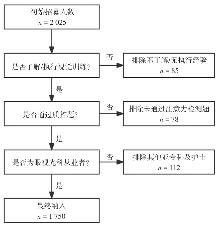
Fig.1
Flowchart of participant screening and inclusion"
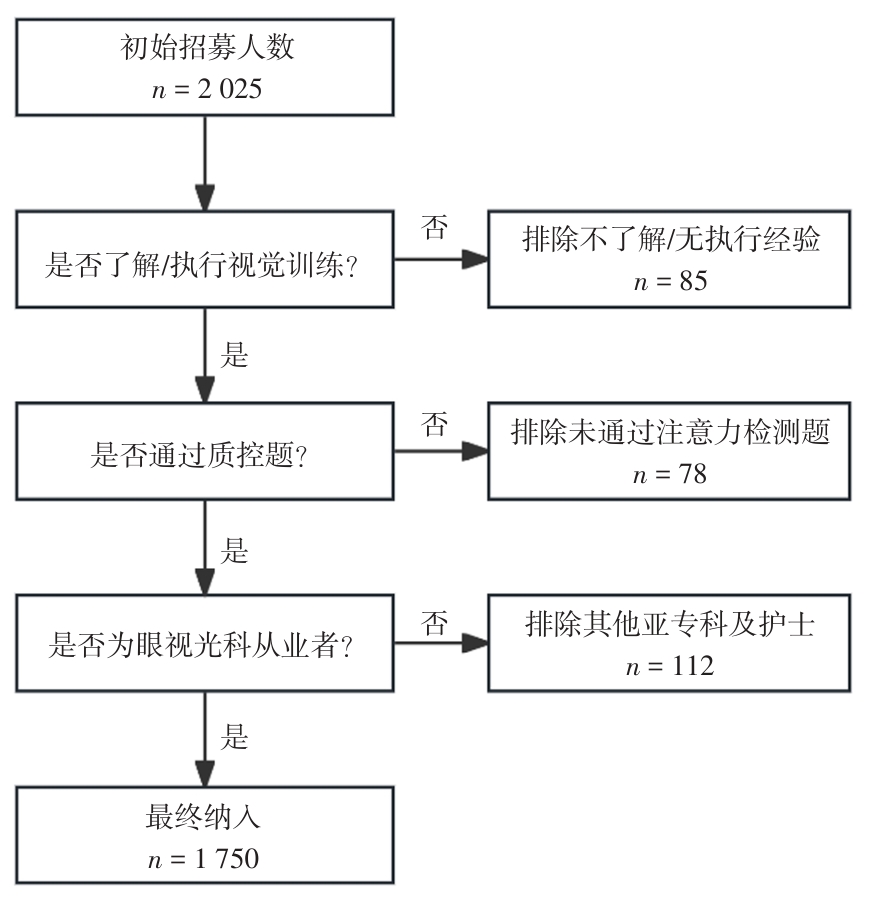
Tab.1
Demographic and professional characteristics of optometric practitioners"
| 特征 | 例数(n = 1 750) |
|---|---|
| 年龄 | |
| < 30岁 | 846(48.3) |
| 30 ~ 39岁 | 586(33.5) |
| 40 ~ 49岁 | 255(14.6) |
| 50 ~ 59岁 | 52(3.0) |
| ≥ 60岁 | 11(0.6) |
| 职业角色 | |
| 医生 | 395(22.6) |
| 视光师 | 1 355(77.4) |
| 眼视光科工作年限 | |
| < 1年 | 63(3.6) |
| 1 ~ 5年 | 932(53.3) |
| 6 ~ 10年 | 417(23.8) |
| > 10年 | 338(19.3) |
| 机构类型 | |
| 私立眼科医院 | 1 382(79.0) |
| 私立眼科诊所 | 248(14.2) |
| 公立眼科医院 | 64(3.7) |
| 公立眼科诊所 | 56(3.2) |
Tab.2
Quantile regression analysis of factors associated with recommendation intention"
| 变量 | 全样本(n = 1 750) | 眼科医生亚组 | |||
|---|---|---|---|---|---|
| β | P值 | β | P值 | ||
| 反思性动机 | 0.857 | < 0.001 | 0.769 | < 0.001 | |
| 专业知识得分 | < 0.001 | 1.000 | -0.062 | 0.334 | |
| 眼视光科工作年限 | -0.143 | 0.115 | -0.308 | 0.115 | |
| 职业角色(眼科医生vs. 验光师) | 0.143 | 0.096 | - | - | |
| 职称 | - | - | 0.154 | 0.135 | |
| 手术权限 | - | - | 0.154 | 0.368 | |
| 机构类型 | 0.429 | 0.002 | 0.487 | 0.221 | |
Tab.3
Ordinal logistic regression analysis of recommendation behavior in the overall sample"
| | | | | |
|---|---|---|---|---|
| | | | | |
| | - | - | | |
| | - | - | | |
| | | | | |
| | - | | | |
| | ||||
| | | | - | - |
| | | | - | - |
| | | | - | - |
Tab.4
Ordinal logistic regression analysis of recommendation behavior among ophthalmologists"
| | | | | |
|---|---|---|---|---|
| | | | | |
| | | | | |
| | ||||
| | | | | |
| | | | | |
| | | | | |
| | | | | |
| | | | | |
| | | | | |
| | ||||
| | | | - | - |
| | | | - | - |
| | | | - | - |
| [1] |
American Optometric Association. Vision therapy: American Optometric Association Vision Therapy Task Force [EB/OL]. St. Louis: American Optometric Association.[2026-07-23]
|
| [2] |
|
| [3] |
|
| [4] |
|
| [5] |
|
| [6] |
|
| [7] |
|
| [8] |
中华医学会儿科学分会康复学组,中华医学会儿科学分会眼科学组. 儿童脑源性视觉障碍诊断与治疗专家共识[J]. 中华儿科杂志, 2024, 62(5):402-411. doi: 10.3760/cma.j.cn112140-20240112-00043.
|
| [9] |
|
| [10] |
|
| [11] |
|
| [12] |
|
| [13] |
|
| [14] |
|
| [15] |
|
| [16] |
|
| [17] |
|
| [18] |
|
| [19] |
|
| [20] |
|
| [21] |
|
| [22] |
|
| [23] |
|
| [24] |
|
| [25] |
|
| [26] |
|
| [27] |
|
| [28] |
|
| [29] |
|
| [30] |
|
| [31] |
|
| [32] |
|
| [33] |
|
| [34] |
|
| [35] |
|
| [36] |
|
| [37] |
杨媛,胡鹏,黄艳. 社区医护人员高尿酸血症健康管理知信行现状分析[J]. 实用医学杂志, 2024, 40(14):2015-2020. doi: 10.3969/j.issn.1006-5725.2024.14.019.
|
| [38] |
|
| [39] |
韩超,祝学梅,王莹,等. 日间医疗的规范化发展思考[J]. 实用医学杂志, 2024, 40(8):1038-1041. doi: 10.3969/j.issn.1006-5725.2024.08.002.
|
| [40] |
|
| [41] |
|
| [42] |
|
| [1] | Zhenggang WANG,Hui XIONG,Ting HE,Xiaojing LIU,Yanhua YE. Serum melatonin and IGFBP3 levels in the diagnosis and prognostic evaluation of age⁃related cataract [J]. The Journal of Practical Medicine, 2026, 42(5): 831-837. |
| [2] | Wenjun GENG,Bei ZHAO,Huili YAN,Hongjiao KONG,Yu TAN,Li ZHANG. Different endometrial preparation protocols for frozen-thawed embryo transfer in elderly patientscomparison of pregnancy outcomes [J]. The Journal of Practical Medicine, 2026, 42(5): 878-883. |
| [3] | Xuefan YANG,Feng YE,Dandan RUAN,Xiaohui MO,Qiang JU. Effect of minocycline on acne inflammation via PPARγ/STAT3 pathway [J]. The Journal of Practical Medicine, 2026, 42(2): 212-219. |
| [4] | Bin SUN,Ni LI,Lin YAN,Qizhao WANG,Min ZHANG,Yuehan YANG,Huan. QIN. Microglia mediate neuroinflammation and immune cell recruitment in blue light‑damaged retina [J]. The Journal of Practical Medicine, 2025, 41(23): 3666-3675. |
| [5] | Dan ZHU,Wanjun LU,Ying ZHU,Jinlu CAO,Yingzi CHEN. Developing an unsupervised deep learning model for diabetic nephropathy prediction using panoramic fundus retinal images [J]. The Journal of Practical Medicine, 2025, 41(22): 3598-3608. |
| [6] | Wujing QIU,Huayao RUAN,Ziwei YANG,Yihua CHEN,Yuhan LV,Pei TANG,Qianqian. ZHANG. Research Progress on the Treatment of Corneal Neovascularization with Small Molecule Extracts of Traditional Chinese Medicine [J]. The Journal of Practical Medicine, 2025, 41(19): 3119-3128. |
| [7] | Shangyan JIANG,Jiangying HAN,Yunyun WANG,Junfei ZHANG,Liu TIAN. Comparison of two methods of tube closure in patients with hepatic failure treated with a dual plasma molecular adsorbent system combined with plasma exchange [J]. The Journal of Practical Medicine, 2025, 41(15): 2320-2324. |
| [8] | Mei CHEN,Zongzhi LI,Xuewei QIN,Limin WANG,LI ZHENG. Protective effect of LncRNA MEG3 on diabetic retinopathy in rats by regulating COX⁃2/PGE2/VEGF signaling pathway [J]. The Journal of Practical Medicine, 2025, 41(9): 1319-1326. |
| [9] | Shujin WEI,Jinrong ZHAO,Yuanlong ZHANG,Wenjuan CHU,Dan SHEN,Weiyi HUANG,Lu TIAN. Analysis of influence of demodex infection on clinical symptoms, signs and content of MMP⁃9 in tears of patients with meibomian gland dysfunction [J]. The Journal of Practical Medicine, 2025, 41(7): 997-1003. |
| [10] | Xue HE,Huan MA,Cong LI,Yan WANG,Yu KUANG,Lei LIU,Honghua YU,Xiaohong. YANG. Retinal neurovascular characteristics and their correlation with depression severity in patients with coronary artery disease and depression [J]. The Journal of Practical Medicine, 2025, 41(4): 515-521. |
| [11] | Jianwen PENG,Wei CHEN,Lan HUANG,Zhiqi CHEN,Sifei XIANG,Xianlin ZHANG,Junming. WANG. Efficacy and safety of clear lens extraction with extended depth of focus intraocular lens implantation in the treatment of primary angle⁃closure suspect with presbyopia [J]. The Journal of Practical Medicine, 2025, 41(4): 536-542. |
| [12] | Yu FENG,Xin LI,Zhenjia ZHANG,Xinping JIA,Qingxin. ZHAO. Analysis of the effects of different personalized cutting modes of SPT⁃Trans PRK on visual quality and corneal higher order aberrations after myopic astigmatism surgery [J]. The Journal of Practical Medicine, 2024, 40(23): 3337-3342. |
| [13] | Juan TANG,Fen LAN,Linxia MENG,Qinqin ZHANG,Chuanqiang DAI,Zheng LEI,Qilin FANG,Ying LI,Xiaoli WU,Tao. LI. The clinical effect of the whole process blood glucose management on improving postoperative vision in T2DM cataract patients with non-diabetic retinopathy based on visual electrophysiology and OCTA study [J]. The Journal of Practical Medicine, 2024, 40(20): 2888-2899. |
| [14] | Xiongzi LIANG,Qingsong ZHANG,Wanju YANG,Si LENG,Haixia WU,Minghui. ZHANG. Comparison of the early postoperative visual quality of oval versus round valve in FS⁃LASIK [J]. The Journal of Practical Medicine, 2024, 40(17): 2430-2434. |
| [15] | Rui ZHANG,Ying ZHOU,Wenji NI,Ya HUANG,Dandan LI,Tao JIN,Yong. ZHONG. Application value of artificial intelligence⁃basedretinal microvascular analysis in diagnosis of diabetes complications [J]. The Journal of Practical Medicine, 2024, 40(8): 1142-1147. |
| Viewed | ||||||
|
Full text |
|
|||||
|
Abstract |
|
|||||
